
 Security+
 CySA+
 PenTest+
 SecAI+
 Network+
 A+
 Cloud+
 Linux+
How Long Does It Take to Learn Cyber Security? (2026)

How long does it take to learn cyber security? This question is important if you are beginning your journey.
Security+ SY0-701 or SY0-801? (updated November 2026)
CompTIA launched Security+ SY0-801 on 17 November 2026. We recommend SY0-701 for now: it's valid until 11 June 2027, 801 is brand new with very little training available yet, and employers only ask whether you have Security+, not which version. Our free Security+ cheat sheet covers both.
The time it takes to grasp cyber security is unique for each individual, and understanding the time commitment and learning involved is the first step toward achieving success.
This article will outline the three essential steps required to learn cyber security: basic IT, networking, and diving into the foundation aspects of cyber security itself.
We will review key concepts you will learn, certifications you can use as a blueprint, and how long it usually takes to prepare for each stage. Additionally, we will suggest resources that can help you learn the material. Let's review your cyber security education and how long it will take.
What Do We Mean “Learn Cyber Security”?
What do we mean by learn cyber security? Are we talking about the time it takes to become a hacker, CISO, or SOC analyst?
Let’s answer these questions by defining our terms, goals, and whether certifications are important.
Defining Our Terms
Cyber security is vast, and expecting to learn everything is unrealistic and unnecessary, as no career in cyber security requires you to know everything. So, what's the end goal?
It’s about acquiring foundational cyber security knowledge and concepts. Starting with IT knowledge, moving into networking, and finally into cyber security itself.
Think of it like building a house. You can build a house without a foundation, but it won’t be very sturdy and will likely come crashing down. But if you build a solid foundation for the house, you’ve set the stage for a strong structure.
This is the same for learning cyber security. A strong IT and networking foundation is essential as it gives you the skills to understand and effectively manage security challenges.
Cyber security knowledge serves two main purposes: firstly, it prepares you for entry-level positions in the field. Secondly, it gives you sufficient understanding to identify specific areas of interest within cyber security, allowing you to plan your next career steps.
For instance, you might find penetration testing or threat hunting interesting and decide to specialize in it.
Defining Our Goals
For a good grasp of cyber security, you must begin with a solid IT foundation before adding on some advanced networking ideas to learn how different systems communicate, and finally, build upon that with cyber security.
There are different ways to learn about the three areas, but popular certifications already exist for each one (IT, networking, and cyber security) and provide the topics that should be covered.
These certifications provide well-organized information and define clear objectives. By providing you with a syllabus as your guide, you can ensure that you are learning the necessary information needed before moving on.
We will help you pick out three certifications, one for each area, to use as your guide. We will explain what you must learn and when to move on to the next step.
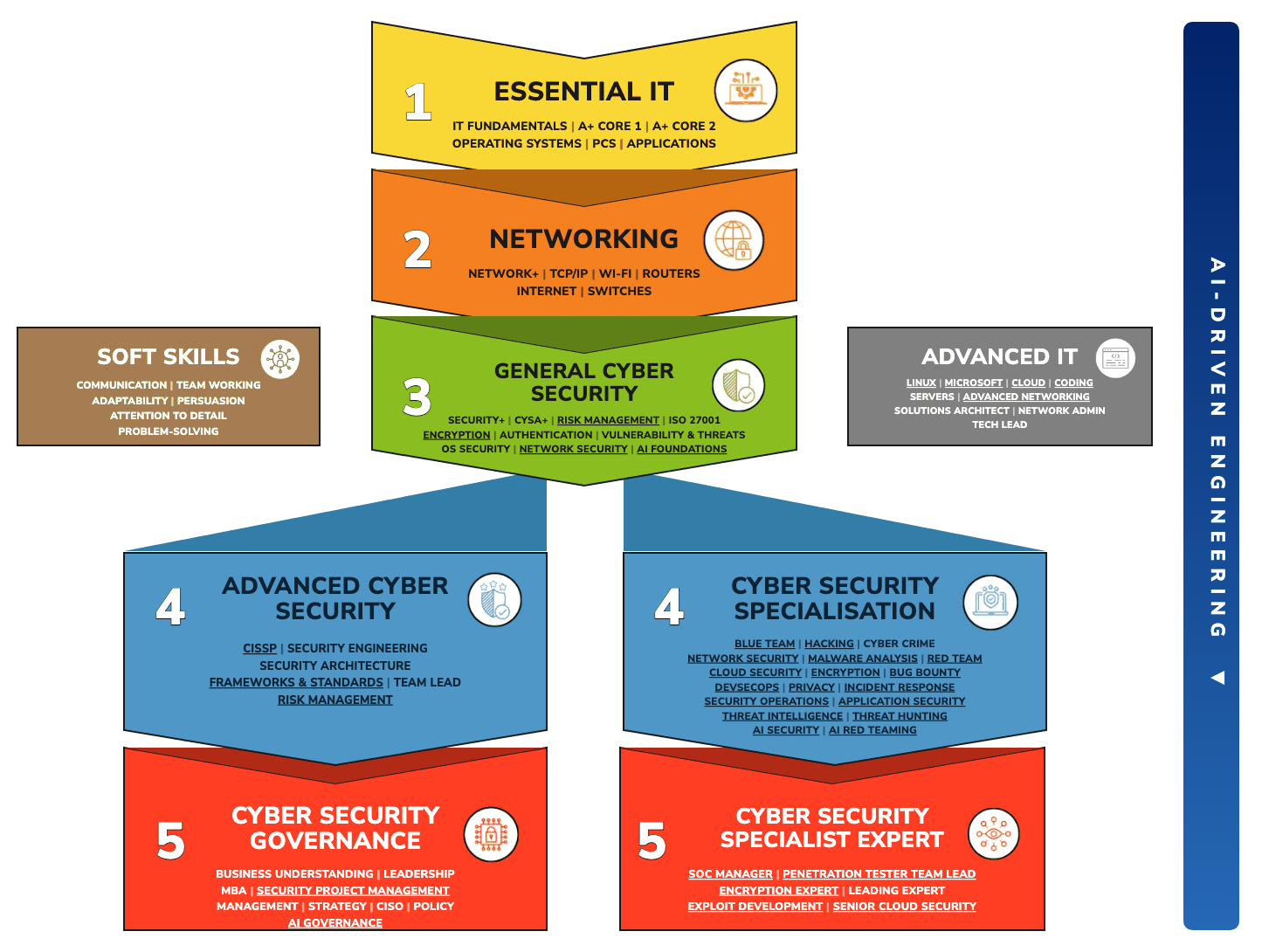
On the StationX roadmap, A+ sits in step 1 (Essential IT), Network+ in step 2 (Networking) and Security+ in step 3 (General Cyber Security).
Do I Need the Certifications?
Learning cyber security doesn't require earning certifications, but using the domains they provide as a roadmap is highly beneficial.
While you can learn the material without taking the exams, obtaining the certifications is valuable to your resume.
Since you're already covering the material needed for these certifications, taking the extra step to get certified, which involves paying for and passing the exam, can be a wise investment.
Ultimately, the choice is yours, but considering the resume boost and the structured learning path they offer, it might be worthwhile to go for the certification.

Learning Basic IT
The first step in your journey is learning basic IT. Basic IT, or Information Technology, is the fundamental knowledge and skills related to computing technology. This is an essential starting point in your cyber security journey. It typically includes understanding:
- Computer Hardware: Knowledge of internal components like motherboards, CPUs, GPUs, and RAM.
- Operating Systems: Proficiency in installing, configuring, and maintaining various operating systems like Windows, Linux, and macOS.
- Software Applications: Skills in installing, updating, and troubleshooting various software applications.
- Networking Basics: Understanding of networking concepts such as IP addressing, DNS, DHCP, and basic routing.
- Basic Security Principles: Awareness of cyber security fundamentals, such as virus and malware protection, firewall configuration, and secure password practices.
- Troubleshooting and Support: Experience providing clear and effective guidance to end-users, often translating complex technical terms into simple language.
Knowledge Through Certifications
We have explained why choosing certifications is a great guide to what you need to know along the way. But which certifications are available for you when you want to prove your IT knowledge?
Though the Cisco Certified Technician (CCT) program is built around those who are interested in concentrating more on onsite support and maintaining Cisco systems and devices, it might not be useful for IT beginners.
There is also the Google IT Support Professional Certificate. It is tailored for beginners, focusing more on immediate job readiness for IT support roles, particularly in the context of Google's tools and services. But it doesn’t provide a comprehensive overview of IT.
Our recommendation is to use the CompTIA A+ certification. Unlike the other two, CompTIA A+ offers the most comprehensive overview of IT, helping you understand the terminologies and how different technologies all come together.
The A+ syllabus covers essential hardware, networking, operating systems, and security topics, emphasizing real-world skills and troubleshooting. As a vendor-neutral certification, A+ opens doors to various entry-level IT roles and provides a solid base for further certifications and a stepping stone to learning networking.
Here are the domains for each exam.
CompTIA A+ 220-1201 (Core 1) Exam Domains
- Mobile Devices: Focuses on the essentials of mobile devices, including setup, configuration, and common troubleshooting.
- Networking: Teaches the basics of networks, including understanding various network types and configurations.
- Hardware: This dives into the key components of computer hardware and how they interact, from CPUs to storage devices.
- Virtualization and Cloud Computing: Introduces the concepts of running virtual machines and utilizing cloud-based resources.
- Hardware and Network Troubleshooting: Develops skills in diagnosing and resolving common issues with computer hardware and networks.
CompTIA A+ 220-1202 (Core 2) Exam Domains
- Operating Systems: Covers the installation and management of major operating systems, including their maintenance and optimization.
- Security: Focuses on the fundamentals of IT security, including threat mitigation and protective measures.
- Software Troubleshooting: Involves solving typical software-related issues across different operating systems.
- Operational Procedures: Emphasizes the best practices in IT operations, including safety protocols and professional communication.
How Long to Study?
Students typically report that they can pass both examinations in approximately one month if they had prior knowledge and between six and eight weeks if they were just beginning by devoting two hours per day to exam preparation.
This translates for both exams to be approximately 120-160 hours for someone new and 20-40 hours for someone already proficient in A+ material.
To be ready to move on to networking, this is how long it takes to build basic IT knowledge. If you want to take the exam and open yourself up to career opportunities passing the A+ provides, then check out this article CompTIA A+ Jobs: What Careers Does This Certification Offer?
CompTIA A+ Question Types and Top Book Recommendations
Courses
To learn the fundamentals of basic IT, follow our CompTIA A+ roadmap on StationX Labs: video lessons, guides, cheat sheets and hands-on browser labs for both A+ exams. Free to register, with a free lab to try.
Learning Networking
After grasping and understanding basic IT, the next step in your journey to learning cyber security is understanding networking. This is different from simply understanding how a home network operates and functions (though that will definitely help). This is more about learning enterprise networking.
The key differences between managing a home network and an enterprise network are in their scale, complexity, cost, monitoring, and security. In networking, you'll encounter and learn about various aspects, such as:
- Network Fundamentals: Understanding IP addressing, including IPv4/IPv6, subnetting, and address allocation.
- Network Design: Ability to choose appropriate networking hardware (switches, routers, hubs) and lay out an efficient network topology.
- Wireless Networking: Understanding of wireless communication standards (like IEEE 802.11) and the configuration and deployment of wireless access points.
- Network Security: Proficiency in securing network infrastructure, including implementing firewalls, intrusion detection/prevention systems, and VPNs.
- Network Monitoring: Ability to analyze network traffic and bandwidth utilization to ensure optimal network performance.
Knowledge Through Certifications
Which networking certifications can you use as a blueprint to learn the skills and knowledge needed to work with enterprise networking and bring you one step closer to learning cyber security?
You might consider the CCNA (Cisco Certified Network Associate) certification, which often comes to mind for many due to its coverage of networking concepts. However, its main focus is working with Cisco enterprise network hardware.

Another networking certification is JNCIA-Junos. While teaching some of the fundamental networking concepts, this certification focuses on the Juniper OS.
The certification we recommend if your end goal is cyber security, is the CompTIA Network+. It's vendor-neutral, which covers a broader range of networking concepts applicable to various networking technologies rather than focusing on a specific vendor's hardware or software.
Network+ is a great stepping stone to learning cyber security as it provides a foundational understanding of networking concepts that are crucial for understanding and mitigating security threats.
What will you learn by studying and sitting for the Network+ exam? Here are the domains covered by Network+.
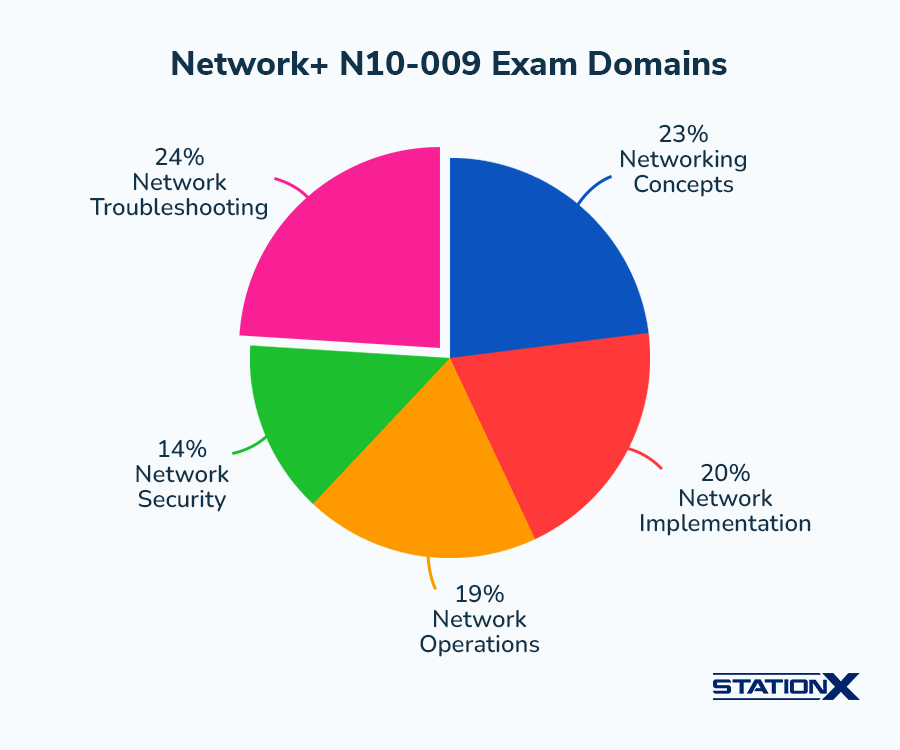
- Networking Troubleshooting: Centers on systematic approaches to diagnosing and fixing network issues, resolving connectivity and performance disruptions, using diagnostic tools, and interpreting diagrams to troubleshoot effectively.
- Networking Concepts: Examines essential topics like the OSI and TCP/IP models, the roles of ports and protocols, IP addressing methods, data center and cloud networking, and virtualization foundations.
- Network Implementation: Focuses on setting up networking devices, implementing wireless standards and configurations, routing and switching technologies, and ensuring proper cabling practices.
- Network Operations: Covers keeping a network running day to day, including monitoring and performance data, documentation, network policies and procedures, high availability and disaster recovery, and remote access methods.
- Network Security: Highlights core security principles, detecting and mitigating threats, employing network hardening strategies, and protecting physical and remote network environments.
How Long to Study?
The study times needed to learn Network+ will vary greatly depending on many factors. For someone with no prior networking knowledge or experience, the time needed may be between four and six months if you study for two hours a day, which is around 280 hours total.
The study time can be much shorter for someone with some knowledge and or experience. This could work out to be between six and eight weeks if you study daily for two hours, which is approximately 100 hours of total study time.
This gives you a good guideline of how much time is needed to prepare and learn the material. Once completed, you are ready to move on to cyber security. Should you take the exam, it opens many more doors for potential careers and an increase in salary. See CompTIA Network+ Certification Salary: How Much Will You Make?
Essential Network+ Articles to Help You Succeed!
Courses
To learn networking, follow our CompTIA Network+ roadmap on StationX Labs: video lessons, guides, cheat sheets and hands-on browser labs. Free to register, with a free lab to try. Also, check out "Best Networking Courses for Beginners: Top 15 Picks."
Learning Security
Once you know IT and networking, you are ready to learn cyber security. Let’s quickly define “cyber security”.
Cyber security refers to the strategies and techniques used to safeguard networks, computers, servers, mobile devices, other endpoints, and data from attacks, theft, and damage.
This can be accomplished from an offensive as well as a defensive strategy. From the offensive side, you could employ penetration testing and red teaming to simulate real attacks. On the defensive side, you will likely use threat detection, continuous monitoring, and implementing policies and procedures.
What will you learn when you begin to study cyber security? Cyber security requires understanding the following fundamental topics and technical knowledge.
- Security Concepts and Threats: Recognizing the core principles of cyber security, which are confidentiality, integrity, and availability (CIA triad). Familiarity with different cyber threats and attacks: malware, phishing, social engineering, and network-based attacks.
- Cryptography and Encryption: This includes the basics of cryptography, such as symmetric and asymmetric encryption, hashing algorithms, digital signatures, and cryptographic protocols. How encryption is used to secure data in transit and at rest.
- Identity and Access Management (IAM): Principles governing access to resources and data. It encompasses understanding authentication, authorization, accounting, single sign-on (SSO) & multi-factor authentication (MFA).
- Security Policies and Frameworks: Security policies, standards, and best practices. Details on regulatory compliance issues, ISO 27001, NIST, and GDPR frameworks.
- Vulnerability Management and Penetration Testing: Identifying vulnerabilities in systems and networks and how to fix them. Basics of penetration testing as a method to test the security of systems.
Knowledge Through Certifications
There is no shortage of options for cyber security certifications when it comes to learning the fundamentals. These can include some of the following.
SSCP (Systems Security Certified Practitioner) is a respected certification from ISC2. It is often best suited for individuals with some existing experience, and its focus is more on day-to-day security operations. To become fully certified, you need one year of full-time experience in the exam domains (a related degree can cover that year), although you can pass the exam first and become an Associate of ISC2, which gives you two years to gain the experience.
GSEC (GIAC Security Essentials Certification) is widespread and respected in the industry but can be very detailed and technical. It may be more appropriate for those who have already entered cyber security.
Part of Google’s Career Certificates, Google Cybersecurity Professional offers a good mix of theory and practice. However, it is aimed at complete beginners and does not go as deep as Security+.
To balance a comprehensive understanding of cyber security and beginner's skills in the industry, we recommend the CompTIA Security+ certification as a guide.
It is a certification that contains all the important aspects of network security, threat management, identity, and access management, among others, that are necessary for successful entry into the world of cyber security.
As a vendor-neutral certification, it offers knowledge and competency that apply across multiple platforms and technologies.
Let’s look at what you will learn within the Security+ domains and objectives.
Two versions of the exam are live right now: SY0-701 and the new SY0-801, which CompTIA launched on 17 November 2026. SY0-701 retires in English on 11 June 2027. Our advice is to take SY0-701 for now, because its training is mature and SY0-801 training is still thin everywhere. Take SY0-801 only if you can't sit the exam before 11 June 2027. Both lead to the same Security+ certification, and employers don't ask which version you passed. We'll switch our recommendation to SY0-801 once its training is established. See our SY0-701 vs SY0-801 comparison for the full breakdown.
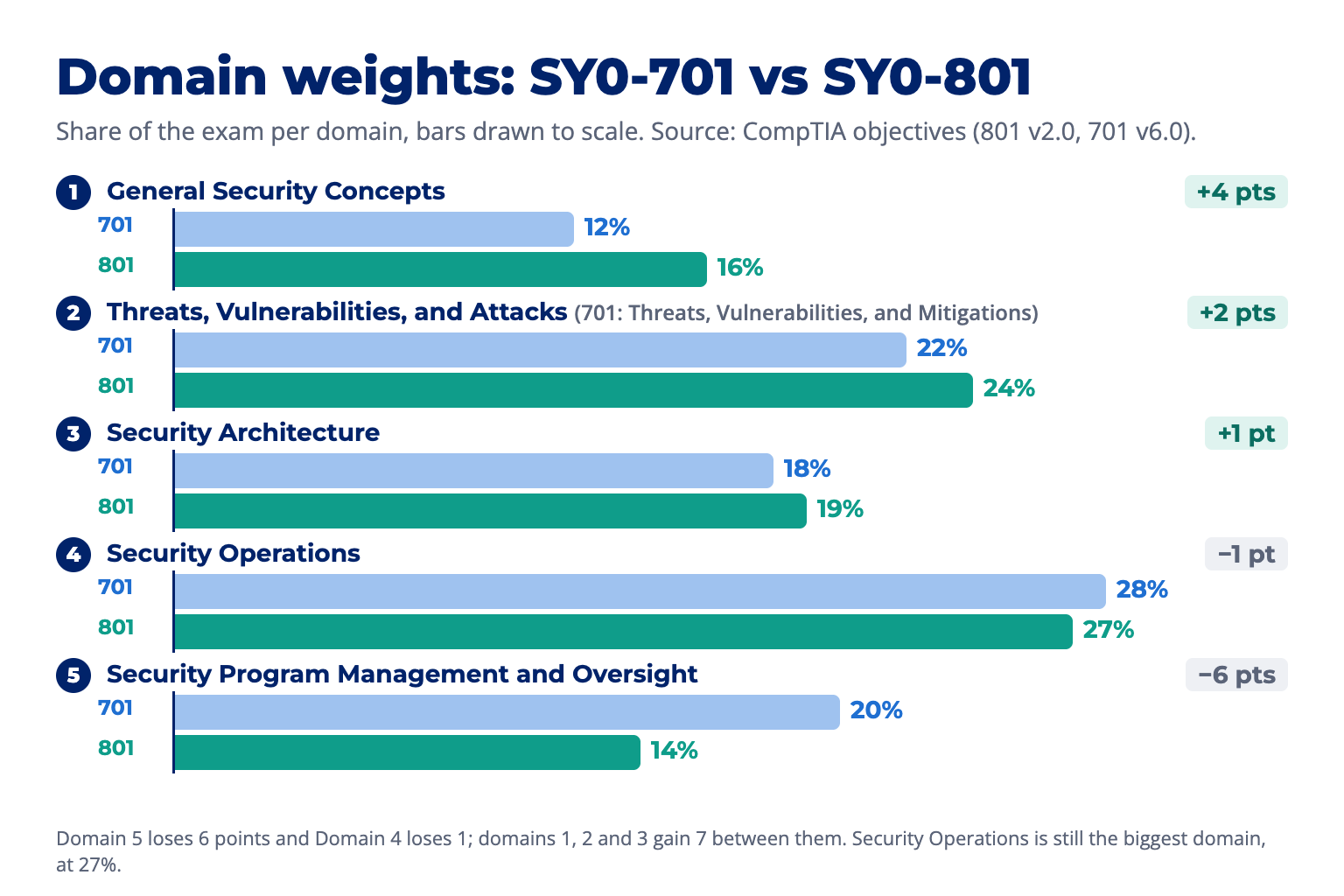
| Domain | SY0-701 | SY0-801 |
|---|---|---|
| General Security Concepts | 12% | 16% |
| Threats, Vulnerabilities, and Mitigations (SY0-801: Threats, Vulnerabilities, and Attacks) | 22% | 24% |
| Security Architecture | 18% | 19% |
| Security Operations | 28% | 27% |
| Security Program Management and Oversight | 20% | 14% |
The domain descriptions below follow SY0-701. SY0-801 keeps the same five areas, renames Domain 2 to Threats, Vulnerabilities, and Attacks, and adds a new objective (2.6) on the security risks of using AI.
- General Security Concepts: This covers the foundational principles of cyber security, including different security controls, the CIA triad, and its importance in relation to confidentiality, integrity, and availability.
- Threats, Vulnerabilities, and Mitigations: The section focuses on threat actors and their motivations, threat vectors and attack surfaces, common vulnerabilities, indicators of malicious activity such as malware and network attacks, and mitigation techniques like segmentation, hardening, and patching.
- Security Architecture: Discusses secure design in the cloud, on-premises environments hybrid environments with reference to architectural models. This domain emphasizes the importance of securing infrastructure and data, along with data protection and resilience and recovery (high availability, backups, and continuity of operations).
- Security Operations: This covers the operational side of managing security within an organization. These include ways of securing computer resources, asset management techniques, vulnerability management, identity and access management, incident response, and security monitoring and alerting.
- Security Program Management and Oversight: This examines the oversight and management of security programs where effective security governance elements are discussed, plus roles and responsibilities, risk management (including qualitative and quantitative risk analysis such as single loss expectancy (SLE) and annualized loss expectancy (ALE)), third-party risk, security compliance, penetration testing and audits, and security awareness.
How Long to Study?
The study time needed to grasp the material from the Security+ will vary from person to person, but here are some average study times.
For an absolute beginner with no networking knowledge, it will likely take you between three to six months if you study for two hours a day. This is an average of 252 hours.
If you have experience in networking and IT, which you would gain from taking the A+ and Network+, or have been exposed to cyber security concepts and terminologies, it might take you between four to six weeks. This works out to be an average of 70 hours.
If you choose to take the Security+ exam, you have given yourself a significant credential in cyber security which will open you up to many job opportunities. See which jobs you are prepared for with our article, What CompTIA Security+ Jobs Can You Get
Security+ Study Guides, Questions, and Cheat Sheets Are All Here!
Courses
Once you are ready to take on the challenge of learning security, start with our free Security+ roadmap on StationX Labs.
- ✓A step-by-step Security+ roadmap: every exam domain in order, so you always know what to study next
- ✓Free video lessons, guides and cheat sheets from our Security+ courses
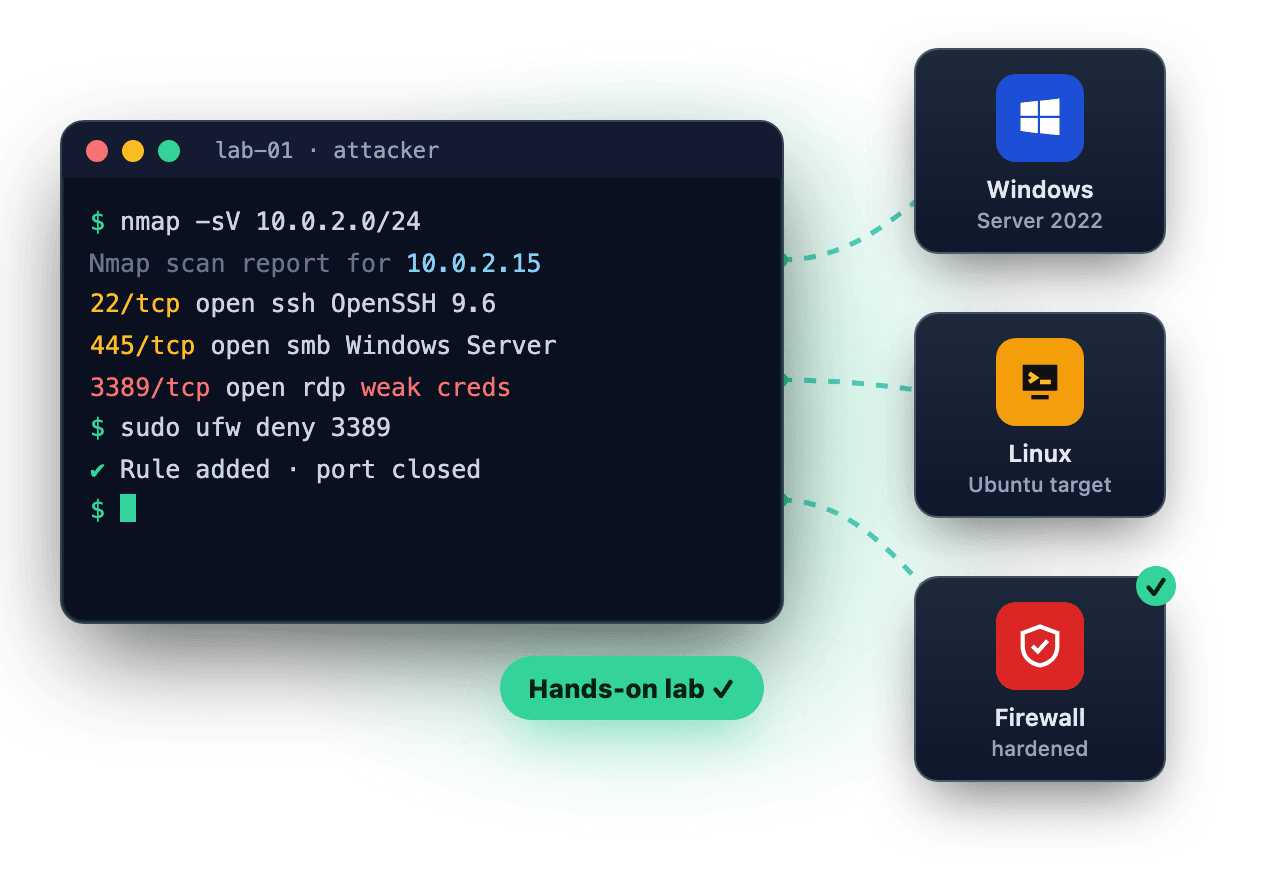
- ✓Hands-on labs in your browser: nothing to install, try one free
- ✓All your progress in one place, ready for exam day
Built for SY0-701; our SY0-801 roadmap is coming soon.
The Next Step: AI-Driven Engineering
The three stages above are the regular cyber security foundation: IT, networking and security, the way the field has always been learned. The next step is AI-driven engineering, the new way of doing cyber security.
On the official StationX roadmap, AI-Driven Engineering isn't a box at the end. It runs alongside every step, from Essential IT through to the expert roles, because security work is becoming AI-driven in every role.
So what is it? You learn to build AI agents that solve the real problems in your own security work, and to run them with confidence. You architect the solution, direct the AI, decide what to ship and verify it's right; the AI does the building. No coding background is required. Anyone can prompt an AI to write code. The skill that matters is directing it to ship something secure enough to trust in production.
StationX teaches it in the AI Master's Program, which is built for three starting points: people new to cyber security, people already working in it who want to lead the AI shift, and people working in tech, such as developers, IT, DevOps and cloud professionals. The intensive year is twelve months of mentorship, mastermind groups and project work. During it you ship a real, working cyber security solution and build your own personal AI infrastructure, and the StationX Certified AI-Driven Security Engineer (SX-AIE) is earned when you can build credible commercial solutions with it, not awarded for attendance.
To understand more, read our guide to AI-driven engineering and see the AI Master's Program.
Conclusion
How long does it take to learn cyber security?
Experienced individuals will need around 200 study hours over three to four months to cover the A+, Network+, and Security+ materials, while beginners should anticipate 673 hours spread across 11 to 12 months. These estimates are based on a study plan of 2 hours per day.
Once you’ve completed these three steps, it means you now have the skills and foundation needed to pursue a career in cyber security, potentially leading you to become a cyber security expert given time. Your next steps are wide open, and you could go in many different directions.
That is the regular cyber security foundation. The next step, which runs alongside all three on the StationX roadmap, is AI-driven engineering, the new way of doing cyber security.
There are many entry level cyber security jobs you can begin with. Afterwards, you could pivot towards offensive security and become a penetration tester, or you could possibly look at the defensive side of security and become a cyber security analyst. Your options are plentiful.
Frequently Asked Questions
How hard is it to learn cyber security?
The difficulty in learning cyber security depends on the career path you intend to pursue and the abilities you already possess. See Is Cyber Security Hard To Learn?
Is cyber security a lot of math?
Cyber security does not involve much math at all, although having a grasp on basic math is helpful.
Does cyber security pay well?
Cyber security professionals are paid well, depending on their careers. To see a breakdown of different cyber security careers and their respective salaries, see Top 10 Careers in Cyber Security (and Which Is Right for You?)
Is 30 too late for cyber security?
No, not at all. It is never too late for someone to enter cyber security at any age. The demand for professionals in this field keeps growing, and diversity of backgrounds can be an advantage. People who begin a career in cyber security at 30 or later have a wealth of life experiences and skills from previous jobs that are very valuable in this field.
What qualifications do I need for cyber security?
Firstly you’ll need some type of experience, whether on the job or self-taught. You will also require certifications to prove your knowledge to employers. In this article, we’ve outlined the three that will help you get started in cyber security. You can also check out Cybersecurity Certifications for Beginners.
About the Author

Nathan House, Founder & CEO of StationX
Nathan House has 30 years of hands-on cybersecurity experience and is Cambridge-educated, holding CISSP, CISA, CISM, OSCP, CEH, and SABSA. He founded StationX in 1999 — one of the UK’s first cybersecurity companies — and has secured £71 billion in UK mobile banking transactions and the London 2012 Olympics, advising clients including Microsoft, Cisco, BP, Vodafone, and VISA. He authored the world’s most popular cybersecurity course — a #1 Udemy bestseller taken by over 500,000 students — and was named Cyber Security Educator of the Year 2020, AI Security Educator of the Year, and a UK Top 25 Security Influencer 2025. A DEF CON speaker and featured expert on CNN, Fox News, NBC, and the BBC, Nathan leads StationX’s training of more than half a million students worldwide.