
 Security+
 CySA+
 PenTest+
 SecAI+
 Network+
 A+
 Cloud+
 Linux+
GSEC vs CompTIA Security+: Which Should You Take in 2026?
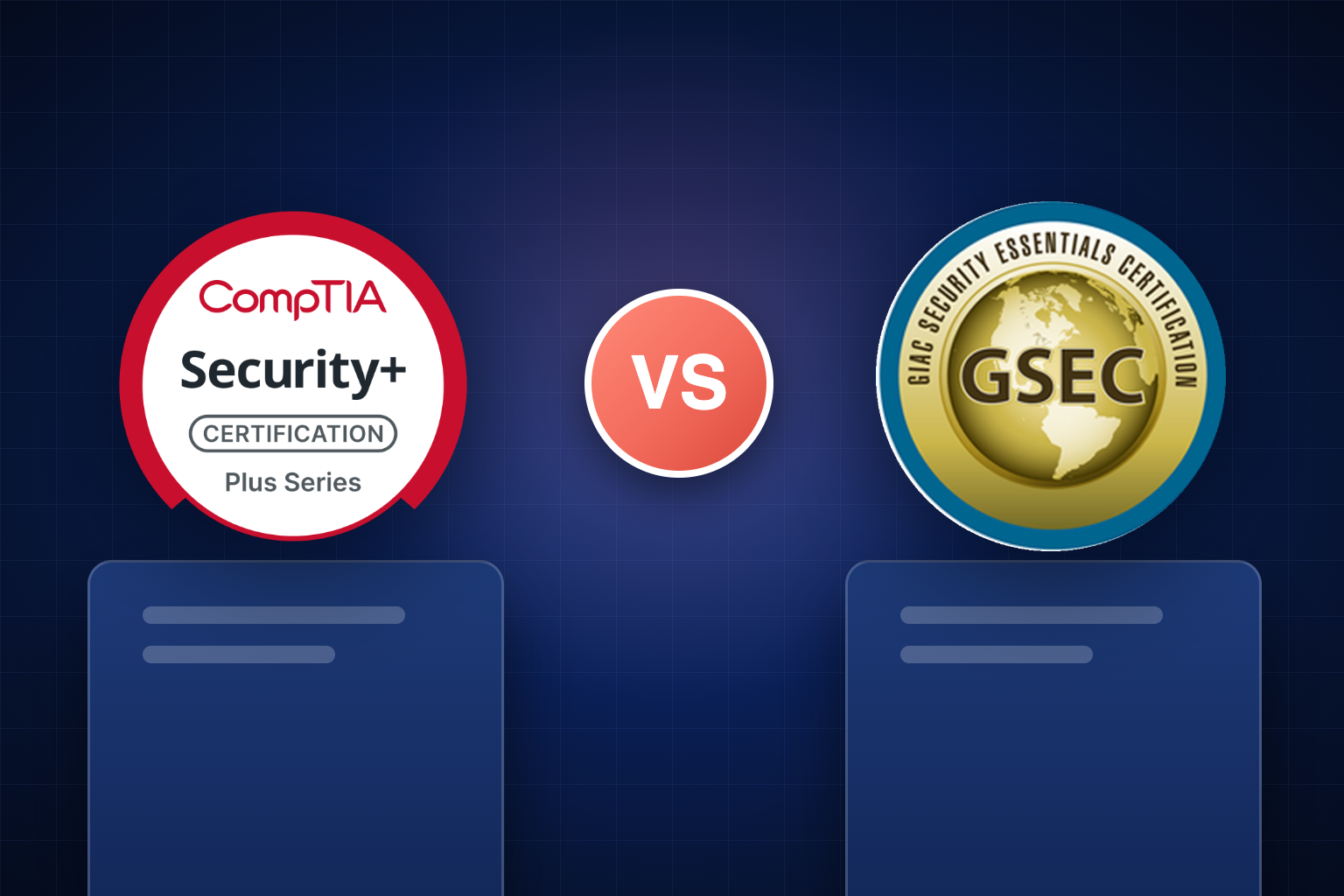
Both GSEC and Security+ cyber security certifications are valued by prospective employers, but there are some nuances you need to be aware of before pursuing these certifications.
Security+ SY0-701 or SY0-801? (updated November 2026)
CompTIA launched Security+ SY0-801 on 17 November 2026. We recommend SY0-701 for now: it’s valid until 11 June 2027, 801 is brand new with very little training available yet, and employers only ask whether you have Security+, not which version. Our free Security+ cheat sheet covers both.
Both certifications are designed to demonstrate a baseline understanding of cyber security fundamentals. Despite being must-have certifications for aspiring cyber security professionals, these certifications do differ with respect to material covered, price, complexity, passing score, and various other characteristics.
Before investing time and money into these certifications it’s important that you know the specifics of the GSEC vs Security+ certifications and what differentiates them.
What Are GSEC and Security+ Certifications?
GSEC and Security+ are cyber security certificates that test your understanding of a range of cyber security topics. GSEC, short for GIAC Security Essentials (GSEC) is designed by Global Information Assurance Certification (GIAC). Security+, however, is CompTIA’s most popular cyber security certification.
Both organizations are vendor neutral and administer a wide range of certifications. We should add, however, that the GSEC may ask test takers about cloud environments such as Azure and AWS while CompTIA will not dive into vendor-related specifics.
Outside of this one vendor-specific area, the majority of the material covered will overlap between the two certifications.
While both certifications will ensure you have a baseline understanding of cyber security, both organizations recommend you have a solid understanding of IT and networking before taking these exams.
At a glance, these two certifications may look nearly identical. Yet, while they both cover crucial aspects of cyber security that you’ll need to know for professional purposes there are key differences between them.
About GSEC
GSEC is a highly sought-after cyber security certification that professionals obtain in order to convey their prowess to employers.
This can be considered an entry-level cyber security certification, as it requires test takers to have fundamental and more advanced knowledge of a range of cyber-related topics. Test takers should already have a solid understanding of IT and networking.
GSEC is recognized internationally and respected widely within the cyber security and IT industries.
GSEC derives its respect from the organization that created the certification, the Global Information Assurance Certification (GIAC). The GIAC is a globally respected organization that specializes in the creation and issuing of information security certifications. In addition to GSEC, the Global Information Assurance Certification issues more than 60 other certifications.
If you’re new to the field of cyber security or have limited experience and want to both refine and demonstrate your knowledge, obtaining the GSEC certificate can help you do so.
The certification covers a range of areas including but not limited to:
- Access control, password management, and defense in depth
- Cryptography
- Cloud computing, including AWS fundamentals and Azure
- Linux fundamentals, including hardening and securing
- Incident handling and response, DLP, vulnerability scanning, and penetration testing
This may sound like the perfect certification for you, but it’s not the only certification in question.
About Security+
Like GSEC, the Security+ certification is also pursued in order to demonstrate baseline cyber security skills.
If you already have CompTIA’s A+ and Network+ certifications under your belt and want to showcase your cyber security skills to employers, this certification is for you.
Its issuing body, CompTIA, provides training, testing, and holds events for those in the field of information technology. CompTIA (along with ISC2) is considered one the most respected vendor-neutral professional certification organizations.
CompTIA’s global reach provides a degree of respectability to its certifications that few other organizations can match.
Security+ was designed to validate that test takers have a baseline knowledge of cyber security subjects and prepare you for an entry-level position in cyber security. Security+ is now in its eighth version (SY0-801, launched 17 November 2026), and the seventh (SY0-701) stays live until 11 June 2027. Every three years, CompTIA redesigns the exam to reflect the field. Each new version is built from subject matter expert workshops and an industry-wide survey of security professionals.
The test will cover areas such as but not limited to:
- Assessing a company’s security posture
- Recommending and implementing security solutions
- Securing and monitoring of hybrid environments such as the cloud, mobile, and IoT
- Awareness of law and policies as they pertain to cyber security
- Analysis of security events and incidents
While there appear to be considerable overlaps when it comes to the GIAC security essentials vs CompTIA Security+, there are still various crucial differences.

Career Progression and Certification Pathways
GSEC and Security+ both serve as stepping stones into the cybersecurity field, but they fit into career pathways in slightly different ways depending on your background and future plans.
Where These Certifications Fit in Your Timeline
Both certifications are typically earned early in a cyber security career, after gaining a solid foundation in IT and networking through experience or certifications like CompTIA A+ and Network+.
- Security+ is often the first formal cyber security credential many pursue, especially for those transitioning from help desk, systems, or general IT roles. It establishes broad baseline knowledge across multiple domains and aligns well with entry-level security positions.
- GSEC is frequently chosen by candidates who already have some IT experience and want to validate more technical, hands-on security skills. While still considered an entry-level credential, it assumes a slightly higher level of familiarity with cyber security concepts.
In many ways, Security+ is about the language and big picture, while GSEC is about real-world implementation.
Stackability and Strategic Positioning
Security+ establishes a broad cyber security foundation, introducing key principles like risk management, security architecture, operations, and threat mitigation in a vendor-neutral way. It’s designed to give newcomers a structured overview of the field and prepare them for entry-level security roles.
GSEC delves deeper into technical implementations, covering topics such as applying access control, command-line cryptography tools, and Linux security, including configuration-level controls.
It places more emphasis on hands-on performance and real-world scenarios, making it a natural next step for those who want to strengthen their technical skills.
Earning Security+ first can make the GSEC exam feel more approachable, but it’s not a strict prerequisite. Experienced IT professionals with a strong security background can start directly with GSEC if they prefer.
That said, as we go further into the content and career comparison, we’ll address whether pursuing both is redundant or valuable.
Exam Details
Both exams are more similar than they are different, however there are some crucial differences that could impact which exam you decide to take.
| Exam details | GSEC | Security+ (SY0-701 and SY0-801) |
|---|---|---|
| Test length | 4 hours | 90 minutes |
| Questions | 106 | Maximum of 90 |
| Passing score | 72% | 750 on a scale of 100 to 900 |
GSEC Exam Details
For the GSEC certificate, you’ll be given 4 hours to complete 106 questions.
Similar to Security+, the majority of GSEC questions are multiple choice, while a few will be performance-based that test practical hands-on skills. For these performance-based questions you may use real programs, code, and VMs to solve real-world problems.
The minimum score needed to pass the GSEC is 72%.
GSEC is also proctored by Pearson VUE should you decide to take the test in person. Through ProctorU they provide a remote-testing option.
GSEC covers much of the same material but is a bit wider in scope. These are the exam objectives that differentiate GSEC from Security+:
- Virtualization, Cloud Security, and AI Essentials (including AWS and Azure)
- Container and MacOS Security
- DLP (data loss prevention)
- Windows Security Policies
- Windows Access Controls
- Windows Services and Microsoft Cloud
Security+ Exam Details
Two versions of the Security+ exam are live right now: SY0-701 and the new SY0-801, which launched on 17 November 2026. Both earn the same Security+ certification and share the format below. Our advice right now is to take SY0-701, because its training is mature and SY0-801 training is still thin everywhere. Take SY0-801 only if you can’t sit the exam before SY0-701 retires on 11 June 2027. Employers don’t ask which version you passed, and we’ll switch our recommendation to SY0-801 once its training is established. See our SY0-701 vs SY0-801 comparison for the full breakdown.
For the Security+ exam, you’ll have 90 minutes to complete a maximum of 90 questions. If you’ve adequately studied for the exam you can expect to finish before the 90-minute mark.
Of these approximately 90 questions the vast majority will be multiple choice. However, to begin the test you’ll usually be asked to complete a few weighted performance-based questions (PBQs). CompTIA doesn’t publish how many PBQs you’ll get, but test takers typically report only a handful. PBQs are designed to test your critical thinking and technical cyber security skills. The number of PBQs you are given will impact the number of multiple choice questions you have to answer.
Via a simulator you’ll be required to solve a complex problem that cyber security professionals might encounter on the job. You may be asked to fix an issue with the firewall or use basic bash commands like ifconfig or ping. These questions are more time consuming than multiple choice questions and as such you may wish to skip them and come back to them after you’ve completed the multiple choice questions.
To pass you’ll need a score of 750 on a scale of 100 to 900. This is a scaled score, so it doesn’t convert to a simple percentage of questions answered correctly.
As far as the material you’ll be tested on, Security+ covers the following areas. The percentages indicate the extent to which each area of expertise is represented in each version.
| Domain | SY0-701 | SY0-801 |
|---|---|---|
| General Security Concepts | 12% | 16% |
| Threats, Vulnerabilities, and Mitigations (SY0-701) / Attacks (SY0-801) | 22% | 24% |
| Security Architecture | 18% | 19% |
| Security Operations | 28% | 27% |
| Security Program Management and Oversight | 20% | 14% |
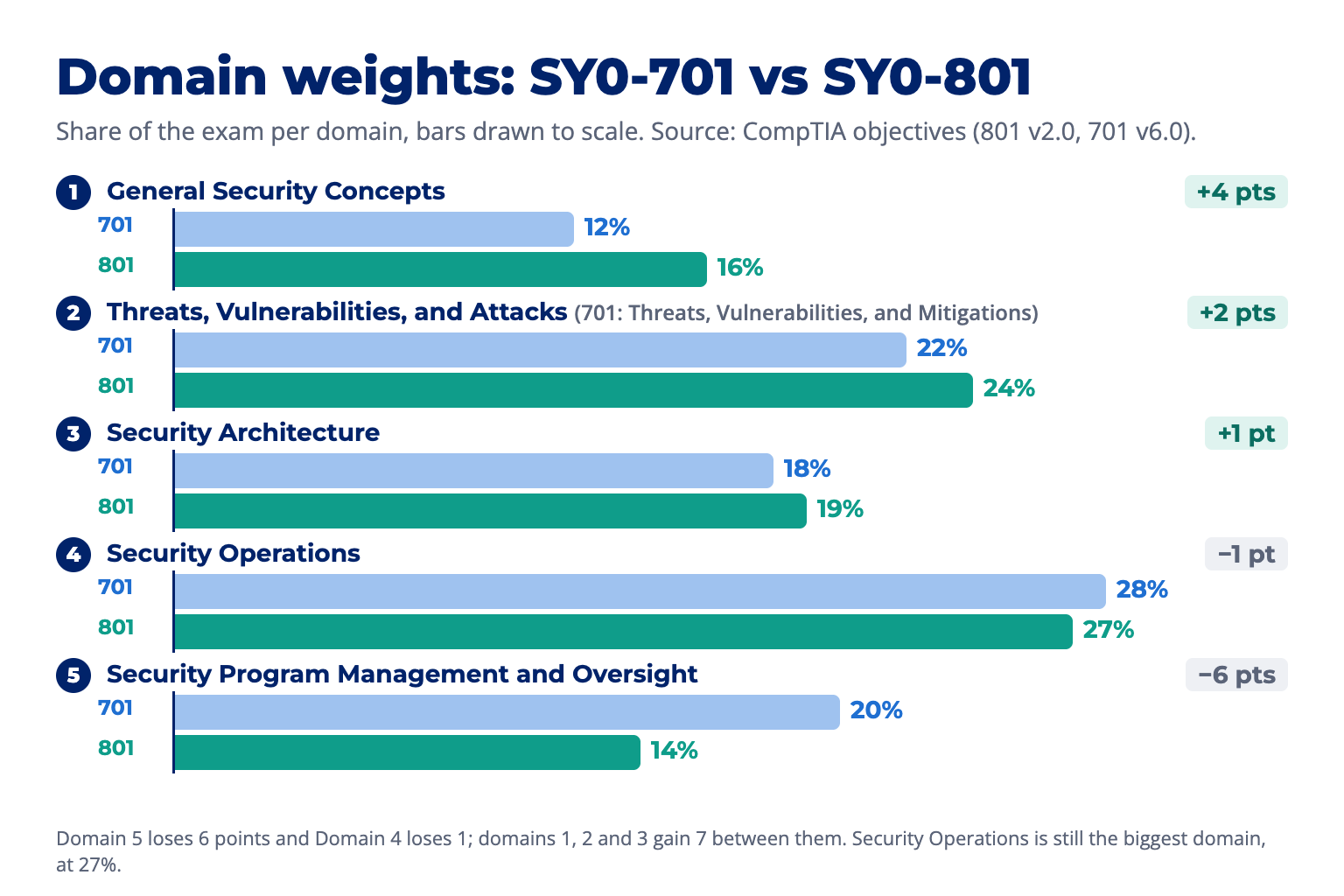
SY0-701 has 28 objectives and SY0-801 has 27. The biggest addition in SY0-801 is objective 2.6, which covers the security risks of using AI.
On CompTIA’s website, you can download a detailed list of all the exam objectives.
The Security+ exam can be taken either in your home or in person. If taken online it will be proctored by Pearson OnVUE, a remote exam proctoring company. To take the exam online you’ll have to abide by strict measures such as:
- Turning your microphone/camera on for the entirety of the test
- Making sure your desk is clear of all items and that no object is within arm’s reach
- Staying within view of the video camera for the entirety of the test
- No food is permitted, and the only drink allowed is a beverage in an unmarked container
Plenty of times are available to schedule a test online with various timeslots open every day.
If taking the exam in person you’ll be required to go to a Pearson VUE test center near you. You won’t be allowed to bring any personal items in the testing room. Bags, smartphones, smartwatches, notes, and food will have to wait outside.
Verdict: Tie
CompTIA Security+ vs GIAC Security Essentials have quite a bit of overlap when it comes to the areas of expertise covered. Both cover the fundamentals of cyber security while testing your knowledge using both multiple choice and in-depth performance based questions.
Security+ may cover more areas of knowledge but does so at more of a surface level than GSEC. GSEC dives deeper into topics, however it doesn’t cover the same scope of knowledge as Security+.
Eligibility Requirements
There are no hard eligibility requirements for Security+ or GSEC. That means neither CompTIA or GIAC will ask you for proof of professional experience or of prior certifications.
While anyone is able to sign up for these exams, you should have a firm understanding of fundamental cyber security topics prior to taking the exams. Both organizations provide guidance on the knowledge base that is recommended that you have before taking these exams.
GSEC Requirements
There are no eligibility requirements to take the GSEC exam.
GIAC does recommend that test takers have practical work experience before taking the exam, although they don’t specify the number of years of experience. GIAC also mentions that college level courses or self-paced study may allow you to master the test.
Security+ Requirements
There are no eligibility requirements for Security+ test takers, however a baseline understanding of IT security is recommended.
CompTIA recommends that you have two years of hands-on experience working in a security/systems admin job role. It would also make sense to already have CompTIA’s A+ and Network+ under your belt before attempting Security+. That being said, we have found that a combination of diligent studying and practice test taking along with a fundamental understanding of networking and IT should be enough to pass the exam.
Verdict: GSEC
You don’t need to be a cyber security expert to take either of these exams. Diligent studying alone should help you pass either test. That being said, CompTIA’s recommendation of two years of hands-on experience versus GIAC’s more general note that practical work experience can help suggests that the Security+ exam has stronger suggested requirements than GSEC.
Exam Difficulty
Neither exam should be taken lightly. Diligent studying and hands-on experience should be had before considering taking either one of these tests. Even if you have professional experience, it’s never a bad idea to look at each exam’s objectives and study accordingly.
GSEC Difficulty
GSEC is a whopping 4 hour exam made up of 106 questions. Like Security+, most are multiple-choice, however there are hands-on performance-based questions as well.
Although they mostly cover the same foundational cyber security information, GSEC also asks vendor-specific questions regarding Azure and AWS.
To pass the GSEC you need a minimum score of 72%.
Security+ Difficulty
Security+ covers a wide range of concepts as you can view here via their exam objectives. Despite the range of topics covered, most multiple choice questions require having a surface level understanding of cyber security concepts.
If you have taken the A+ or Network+ you will notice considerable overlap between these two certifications and Security+.
To pass the exam you’ll need a score of at least 750 on the 100 to 900 scale. Remember that there is a maximum of 90 questions (the majority are multiple choice) and you’ll have 90 minutes to answer them. To help prepare for the exam, take a look at this Security+ Cheat Sheet.
Verdict: Security+
Both exams require lengthy preparation and will test you on a wide range of cyber security knowledge. The passing scores aren’t directly comparable (Security+ uses a scaled score), but Security+ is not as in-depth, technical, or long a test as the GSEC. This makes Security+ just narrowly the easier of the two exams.
Job Opportunities
If you’re looking to break into cyber security, GSEC or Security+ can help your resume stand out to potential employers. Both organizations have brand recognition and thus are respected within the field. However when it comes to entry-level cyber security certifications, one certification is the clear winner.
GSEC Jobs
When we searched Indeed for jobs that require GSEC, 2,447 jobs throughout the entire US were found. Job counts change daily, so treat this as a snapshot.
Jobs hiring those that have GSEC are entry-level, mid-level, and senior positions ranging from a Cyber Defensive Operations Specialist to a Cyber Security Analyst.
- Information Security Analyst - $80K–$105K
- Cyber Defense Analyst / SOC Analyst - $75K–$100K
- Incident Responder - $85K–$115K
- Systems Administrator - $70K–$95K
- Security Engineer - $95K–$125K
- Vulnerability Management Analyst - $80K–$110K
- Penetration Tester (Junior–Mid) - $85K–$115K
- Cloud Security Analyst - $90K–$120K
- Compliance Specialist / Security Auditor - $75K–$100K
- IT Security Specialist (Generalist) - $70K–$95K
Similar to Security+, employers asking for GSEC require applicants to have more than a single certification to their name. They want applicants to have hands-on skills. These skills will depend on the type of job you apply to.
Security+ Jobs
First off, what kind of jobs does Security+ prepare you for?
Considering it’s an entry-level cyber security certification, it would prepare you for a similar line of work as GSEC.
After you obtain your Security+ certification you may consider applying for the following jobs accompanied by approximate US salary ranges (these vary by location and experience):
- Cyber Security Manager - $110K–$145K
- Business Analyst - $75K–$95K
- Software Developer - $85K–$115K
- Security Consultant - $95K–$125K
- Cloud Security Engineer - $80K–$110K
- Penetration Tester - $75K–$100K
- Compliance Analyst - $70K–$90K
- Network Security Engineer - $85K–$115K
- Security Analyst II - $60K–$85K
When we searched LinkedIn, we found nearly 8,000 job openings that ask for CompTIA’s Security+ certificate.
Just because hiring teams require certifications for certain roles, it’s rarely the only requirement. Remember that Security+ is an entry level cyber certification. It proves that you have baseline knowledge within the realm of cyber security, but that you are far from an expert.
Career Pivots: Broad Foundations vs Technical Depth
Security+ is often the launchpad for a wide range of cybersecurity careers. Its broad, vendor-neutral coverage makes it ideal for professionals building foundational knowledge and exploring different paths — from SOC analysis or governance to preparing for intermediate certifications like CySA+ or SSCP. It’s about breadth and awareness rather than deep technical execution.
GSEC, on the other hand, focuses on practical, hands-on security operations. It’s well suited for professionals with existing technical backgrounds who want to strengthen their ability to implement, monitor, and defend systems in real environments. This makes it an excellent choice for those pursuing roles such as security engineer, SOC analyst, or defensive operations specialist — where applied skill matters more than theory.
Verdict: Security+
Quite often you’ll see job postings asking for either Security+ or GSEC. Despite testing the same material more employers are asking that applicants have Security+. This is indicative of CompTIA’s brand reputation. As a more respected and widely known organization, more employers prefer to see Security+ on your resume rather than GSEC.
Cost and Recertification
Certifications, regardless of who issues them, are costly. Let’s find out how these two entry-level cyber security certifications compare.
GSEC Cost
GSEC is more than twice as expensive as the Security+ exam.
Your first attempt at GSEC costs $999.
Should you fail and wish to retake the exam you will pay $899. GSEC is valid for four years. If you want to renew the certification, you’ll pay $499 and either earn 36 CPE credits or retake the exam.
Security+ Cost
Security+ costs $439 per attempt in the US, or $878 with Retake Assurance, for either SY0-701 or SY0-801. A standard Security+ voucher works for either version, but a Retake Assurance retake must be on the same version you first sat. Should you fail there is no discount for a second attempt.
For Less.
StationX is a CompTIA Authorized Partner. The same official exam vouchers you'd buy from CompTIA, for less.
CompTIA price USD 878.00
Your exam voucher plus a free second attempt if you don't pass first time.
Today's US prices against CompTIA's US list price. Prices change and vary by country; the voucher page shows yours.
The certification is valid for three years, after which you can renew by passing the latest version of the exam or by earning 50 Continuing Education Units (CEUs). You can also automatically renew the certification by obtaining a more advanced certification such as the CySA+ or the PenTest+.
If you renew with CEUs, the continuing education fee is $150 for the three-year cycle. You don’t have to pay it annually, but it must be paid before your certification expires.
To earn continuing education credits you may:
- Earn a non-CompTIA certification
- Complete training or higher education
- Participate in IT events
- Publish relevant articles
- Gain professional experience
| Cost and recertification | GSEC | Security+ |
|---|---|---|
| First attempt | $999 | $439 |
| Retake | $899 | $439 (no retake discount) |
| Renewal | $499, plus 36 CPE credits or a retake | 50 CEUs plus the $150 CE fee, or pass the latest version of the exam |
| Validity | Four years | Three years |
Verdict: Security+
Security+ is considerably cheaper than GSEC in both exam price and renewal fees.
To offset the cost you may ask your employer if they can sponsor the exam. Should an employer do so, it’s likely that they will only pay for the cost of the exam should you pass. You may also be able to find vouchers online or through online courses that can provide access to a discounted exam.
Final Verdict: GSEC vs Security+
Despite the knowledge being tested on the Security+ vs GSEC being comparable, there are other factors at play that set the two apart.
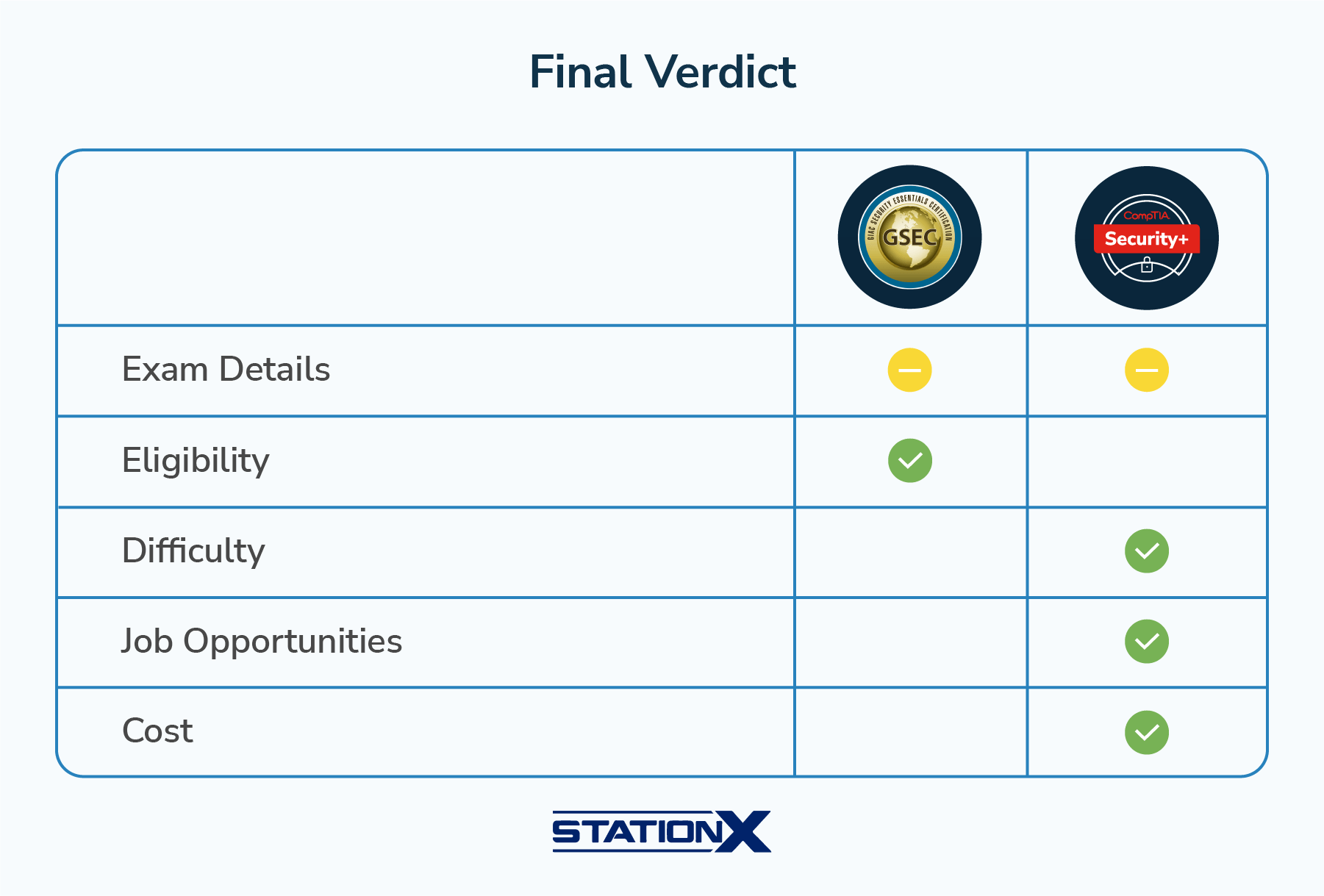
CompTIA’s Security+ is more cost-effective, more recognized by employers, easier to obtain, and is an overall higher-value certification than GIAC’s GSEC.
If you’re just starting out, begin by building a strong foundation with our CompTIA Security+ Course & SY0-701 Practice Test Bundle and save up to 50% when purchasing your CompTIA Security+ Voucher through StationX, making your certification journey more affordable.
If you’re not fully confident in the knowledge required to pass Security+, follow our Security+ roadmap on StationX Labs: video courses for each exam domain plus hands-on labs for SY0-701, with an SY0-801 roadmap coming soon, and it is free to start.
- ✓A step-by-step Security+ roadmap: every exam domain in order, so you always know what to study next
- ✓Free video lessons, guides and cheat sheets from our Security+ courses
- ✓Hands-on labs in your browser: nothing to install, try one free
- ✓All your progress in one place, ready for exam day
Built for SY0-701; our SY0-801 roadmap is coming soon.
Start your journey with StationX today and prepare with confidence!
For Less.
StationX is a CompTIA Authorized Partner. The same official exam vouchers you'd buy from CompTIA, for less.
CompTIA price USD 878.00
Your exam voucher plus a free second attempt if you don't pass first time.
Today's US prices against CompTIA's US list price. Prices change and vary by country; the voucher page shows yours.
The CompTIA Security+ Course & SY0-701 Practice Test Bundle includes:
- CompTIA Security+ Study Guide: SY0-701 Total Course
- CompTIA Security+ Training: Self-Paced Course
- CompTIA Security+ SY0-701 Exam Questions and Answers
- CompTIA Security+ Practice Test Series: Ace the SY0-701
- CompTIA Security+ Exam Objectives Flash Cards: SY0-701 Prep
About the Author

Nathan House, Founder & CEO of StationX
Nathan House has 30 years of hands-on cybersecurity experience and is Cambridge-educated, holding CISSP, CISA, CISM, OSCP, CEH, and SABSA. He founded StationX in 1999 — one of the UK’s first cybersecurity companies — and has secured £71 billion in UK mobile banking transactions and the London 2012 Olympics, advising clients including Microsoft, Cisco, BP, Vodafone, and VISA. He authored the world’s most popular cybersecurity course — a #1 Udemy bestseller taken by over 500,000 students — and was named Cyber Security Educator of the Year 2020, AI Security Educator of the Year, and a UK Top 25 Security Influencer 2025. A DEF CON speaker and featured expert on CNN, Fox News, NBC, and the BBC, Nathan leads StationX’s training of more than half a million students worldwide.