Will AI Replace Cybersecurity Jobs? 5 Roles It Can't (2026)
Will AI replace cybersecurity jobs? If you're trying to get into this field, it's probably the first question on your mind, and I don't blame you. The two roles that used to be the classic way in, SOC analyst and junior penetration tester, are the ones most exposed to AI.
But that's only half the story. I've spent 30 years in cybersecurity and taught more than 500,000 students, and I built JobZone Risk to score thousands of jobs on how exposed they are to AI. When we ran every cybersecurity role through it, five came back with none of their tasks scored as displaced. Not low. None. And each one is protected by a different kind of wall.
In this guide, we'll go through all five: what the job is, the wall that protects it, and what it pays. Then we'll work out which one fits you.
TL;DR if you've only got 30 seconds
AI is replacing checklist work, so entry roles like first-line alert checking are shrinking fast.
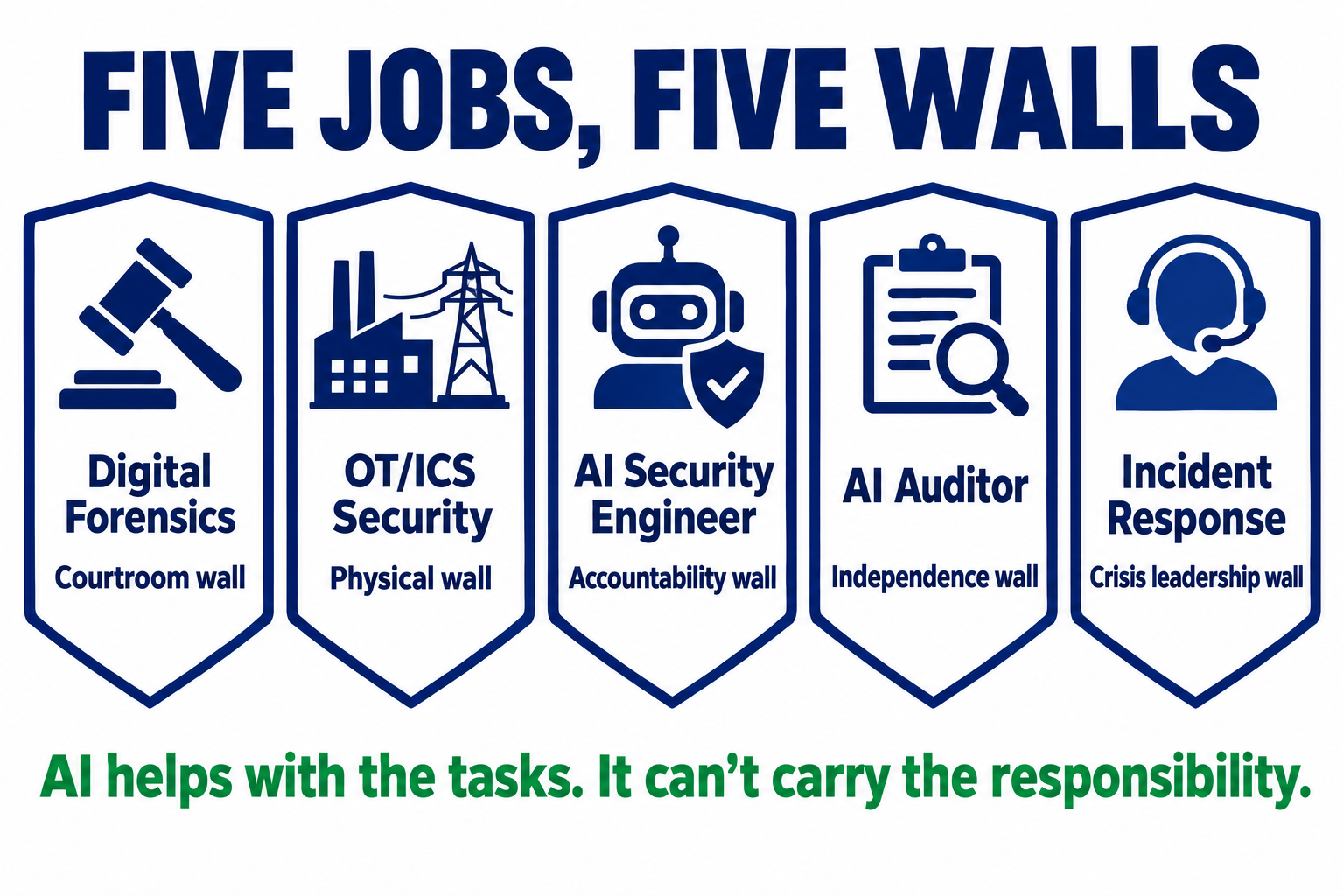
Five roles have a wall AI can't get past: a courtroom, a physical site, legal accountability, independence, or leadership in a crisis.
Digital forensics, OT/ICS security, AI security engineering, AI auditing and incident response all score in JobZone's green zone, with 0% of tasks displaced.
Pick the one that fits how you think, not just the one that pays most.
Will AI Replace Cybersecurity Jobs? The Short Answer
Some, yes. On JobZone Risk, a tier 1 SOC analyst (the person who checks each security alert against a written procedure) scores 5.4 out of 100. A junior penetration tester (someone paid to break into a company's systems, with permission, to find the holes first) scores 6.4. Those jobs are mostly repeatable tasks, and repeatable tasks are what AI does best. I go into why in Future of Cybersecurity: 3 Things AI Just Broke.
Here's how JobZone Risk works, in plain terms. It breaks each job into its tasks and asks, for every task: will AI do this instead of a person (displaced), help a person do it faster (augmented), or not touch it at all? Then it adds the evidence: hiring data, pay trends, new laws, and what AI can actually do today. The result is a score from 0 (very exposed) to 100 (safe).
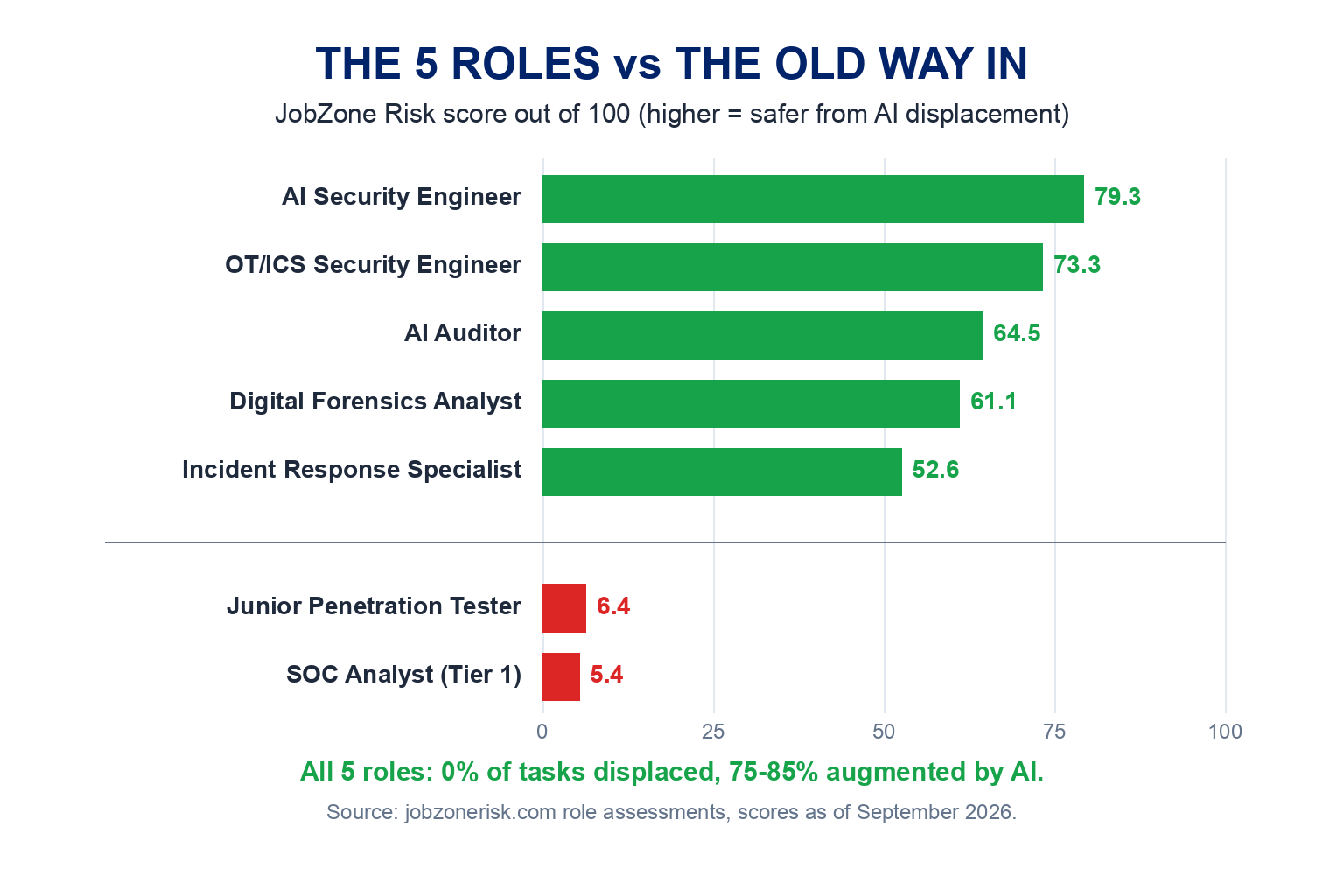
The five roles in this guide all have 0 percent of their tasks scored as displaced. That doesn't mean AI isn't involved. It's heavily involved in all of them. It means AI makes these people faster instead of making them unnecessary. And the reason is always the same shape: somewhere in the job, a person has to stand behind the result.
Let me be clear about what "can't kill" means here. It isn't a guarantee. JobZone scores what AI can do to each task today, using today's evidence. Teams may still get smaller as AI makes each person faster, and the scores will change as the technology and the law change. What it does mean is that each of these roles keeps a person at its centre, for a reason that isn't going away soon. The score and the zone also weigh different things: a role can have a middling score, like incident response at 52.6, and still be green because none of its tasks are being handed over to AI.
1. Digital Forensics Analyst: The Courtroom Wall
Digital forensics analysts investigate what happened after an attack. They recover deleted files, rebuild the timeline of what the attacker did and when, and work out exactly what was taken.
AI is all over this job. It can sift through huge amounts of data in hours, spot patterns and piece a timeline together. So why is it on the list? Because of the courtroom.
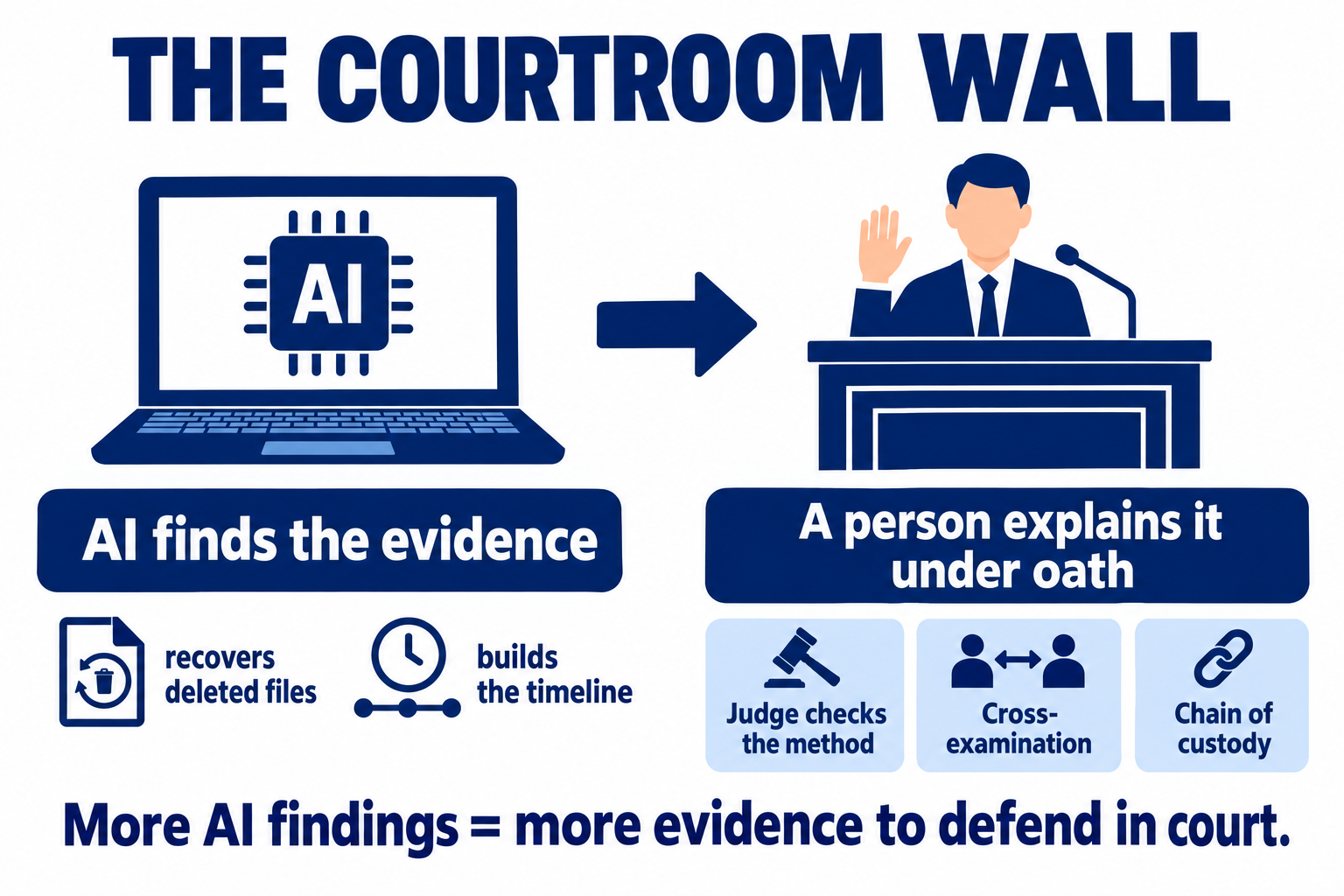
In a US court, "the AI said so" isn't an answer. Under the Daubert standard and Rule 702, the judge has to be satisfied that the method behind the evidence is reliable. In practice, that means a qualified expert explains how the evidence was found, and the other side's lawyer cross-examines them on every step.
The courts are already dealing with AI here. In September 2025 a California court threw out a whole case after finding that the plaintiffs' video evidence was a deepfake. And in May 2026, the committee that writes the US federal rules of evidence redrafted a proposed Rule 707, which says AI-produced evidence should ordinarily need an expert to vouch for it. It isn't law yet, but you can see where it's heading.
Here's the part most people miss. In my experience, the more AI finds, the more there is for forensic analysts to check, explain and defend. Think of a metal detector on a beach. A better detector finds more things, but someone still has to dig each one up and say what it is.
The wall is strongest where evidence has to stand up to scrutiny: in court, in front of a regulator, or in an insurance claim. Routine internal investigations that never leave the company are more exposed to automation.
JobZone Risk score
61.1
Zone
Green
Tasks displaced / augmented
0% / 75%
2. OT/ICS Security Specialist: The Physical Wall
OT stands for operational technology and ICS for industrial control systems. Put simply, these are the people who secure the machines that run the physical world: power grids, water treatment plants, oil refineries and factories.
In the video I called this the air gap wall, and that's part of it. Many of these systems are deliberately kept off the internet, so cloud AI tools can't reach them. But it goes deeper than that.
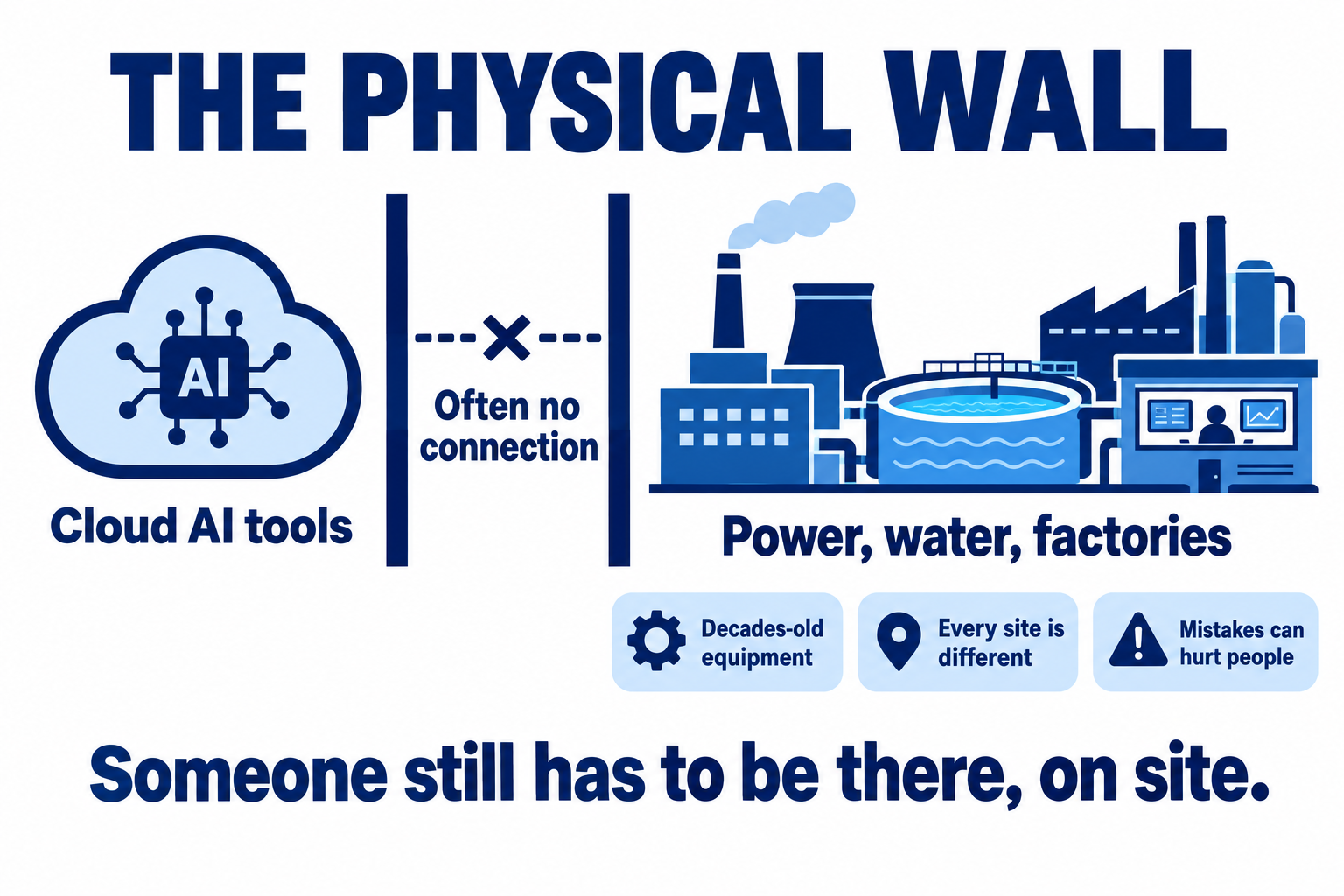
The equipment is old. Some of it is decades old, because it only needs to keep working, not be cutting edge. San Francisco's Muni Metro train control system, installed in 1998, still runs on floppy disks, and its replacement isn't expected to finish until the early 2030s. There's no AI connection to plug into a floppy disk.
Every site is different. Two water plants can be wired in completely different ways, so the knowledge is local and hands-on.
Mistakes can hurt people. A bad decision here can mean an explosion, a chemical leak or a blackout. No organisation is handing those calls to an AI on its own.
The rules name people. In North America the grid's cyber rules, NERC CIP, set by the body that oversees the power grid, are mandatory and audited. They require background checks, training and regularly reviewed access for everyone who touches critical systems. The global standard, IEC 62443, is voluntary, but it's increasingly written into contracts.
This played out for real in July 2026. A coordinated attack targeted the control systems at more than 30 Minnesota water systems. In Plymouth, crews had to physically go out to the lift stations and water towers and run things by hand. The water stayed safe because people who understood the equipment were there to operate it.
That's what makes the security job hard to automate. Securing a plant means walking the site, knowing which device controls what, and agreeing every change with the engineers who run it, because a security update that restarts the wrong controller can stop production. That knowledge lives with people on site.
JobZone Risk score
73.3
Zone
Green
Tasks displaced / augmented
0% / 85%
If you're interested in these AI-resistant careers, each one has a different way in, with different certifications and skills. Picking the wrong starting point can waste months. Our free Cybersecurity Career Path Finder helps you map it out.
3. AI Security Engineer: The Accountability Wall
An AI security engineer breaks AI systems before attackers do. They test chatbots and AI agents for tricks like prompt injection (hiding instructions in text so the AI does something it shouldn't), find weaknesses in how AI is connected to company data, and design the security around it. It's really a family of roles, and three years ago most of them didn't exist.
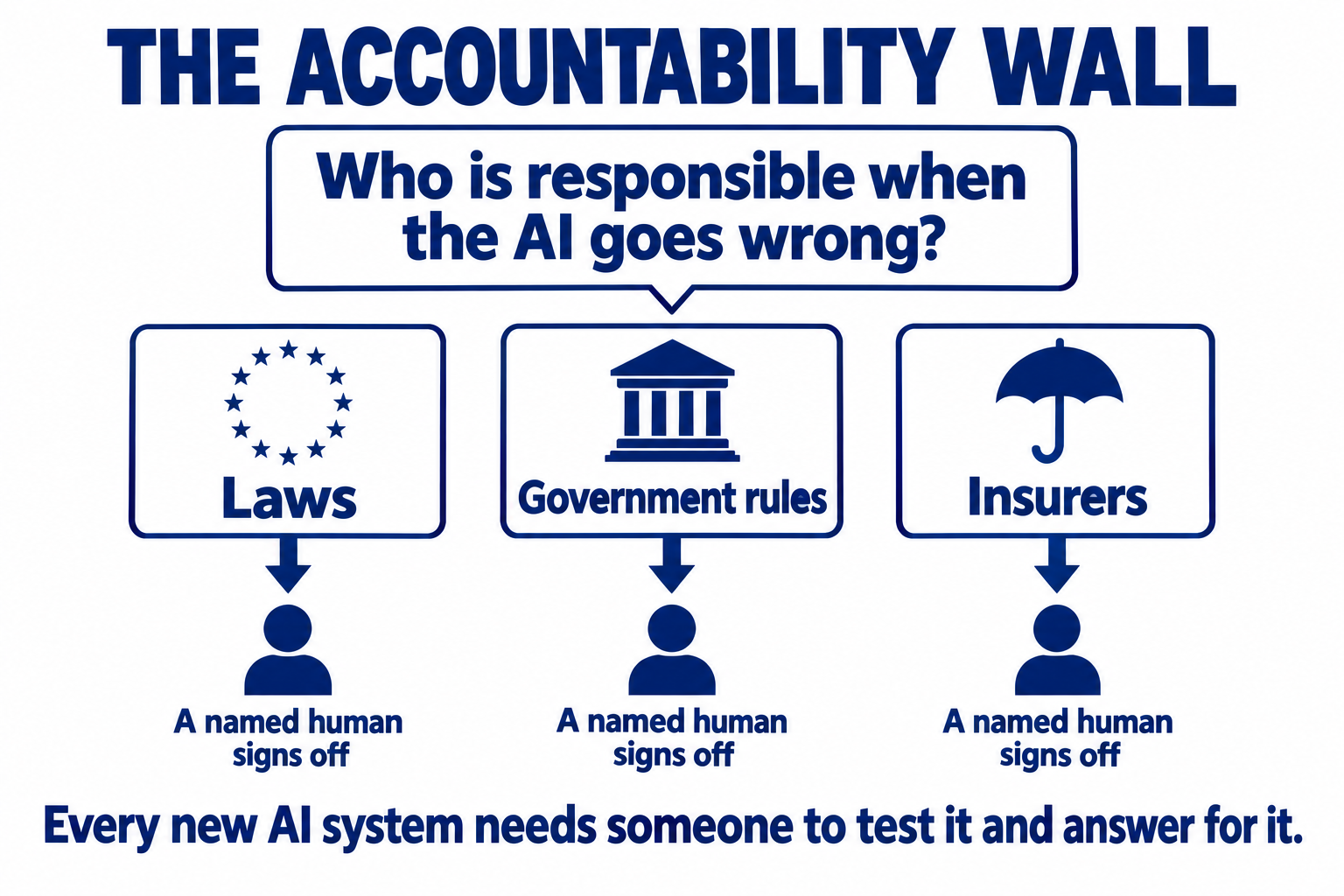
The wall here is accountability. Every company using AI has to answer one question: who's responsible when it goes wrong? And the rules keep pointing at a person who can show the system was tested and is safe to use. Producing that evidence is the AI security engineer's job:
The EU AI Act. It requires high-risk AI to be designed so people can effectively oversee it (Article 14). In July 2026 the EU pushed those high-risk rules back to December 2027, so companies are preparing now. Fines go up to €15 million or 3% of global turnover.
US federal agencies. NIST, the US standards agency, publishes an AI Risk Management Framework, but it is voluntary guidance. The binding rule is OMB memo M-25-21, from the White House budget office, which requires human oversight, intervention and accountability for high-impact AI, and says agencies must stop using systems that can't meet it.
Insurers. My view is that no insurer is going to cover a company on the basis that the AI checked itself and said it was fine. Someone qualified has to test it and sign it off.
Every new AI system is something new to attack. In April 2026, Vercel disclosed a breach that started with a compromised third-party AI tool used by one of its employees. That's exactly the kind of risk an AI security engineer is paid to find first. The wider AI jobs market is growing fast too, which pulls security roles along with it. Postings for AI engineers in design, engineering and manufacturing rose 143% in a year, according to Autodesk, and LinkedIn ranks AI engineer as the fastest-growing job in the US for 2026.
JobZone Risk score
79.3
Zone
Green
Tasks displaced / augmented
0% / 75%
That's the highest score of the five. If you want to see real listings for this kind of work, I track them in AI-Driven Cyber Security Jobs, and Best AI Security Certifications covers how to get qualified.
4. AI Auditor: The Independence Wall
An AI auditor checks AI systems for bias, safety and whether they follow the law. Think of them as the brake pedal on AI. Before a bank uses AI to approve loans, someone has to check it isn't quietly rejecting people from one postcode, and that the bank could explain its decisions to a regulator.
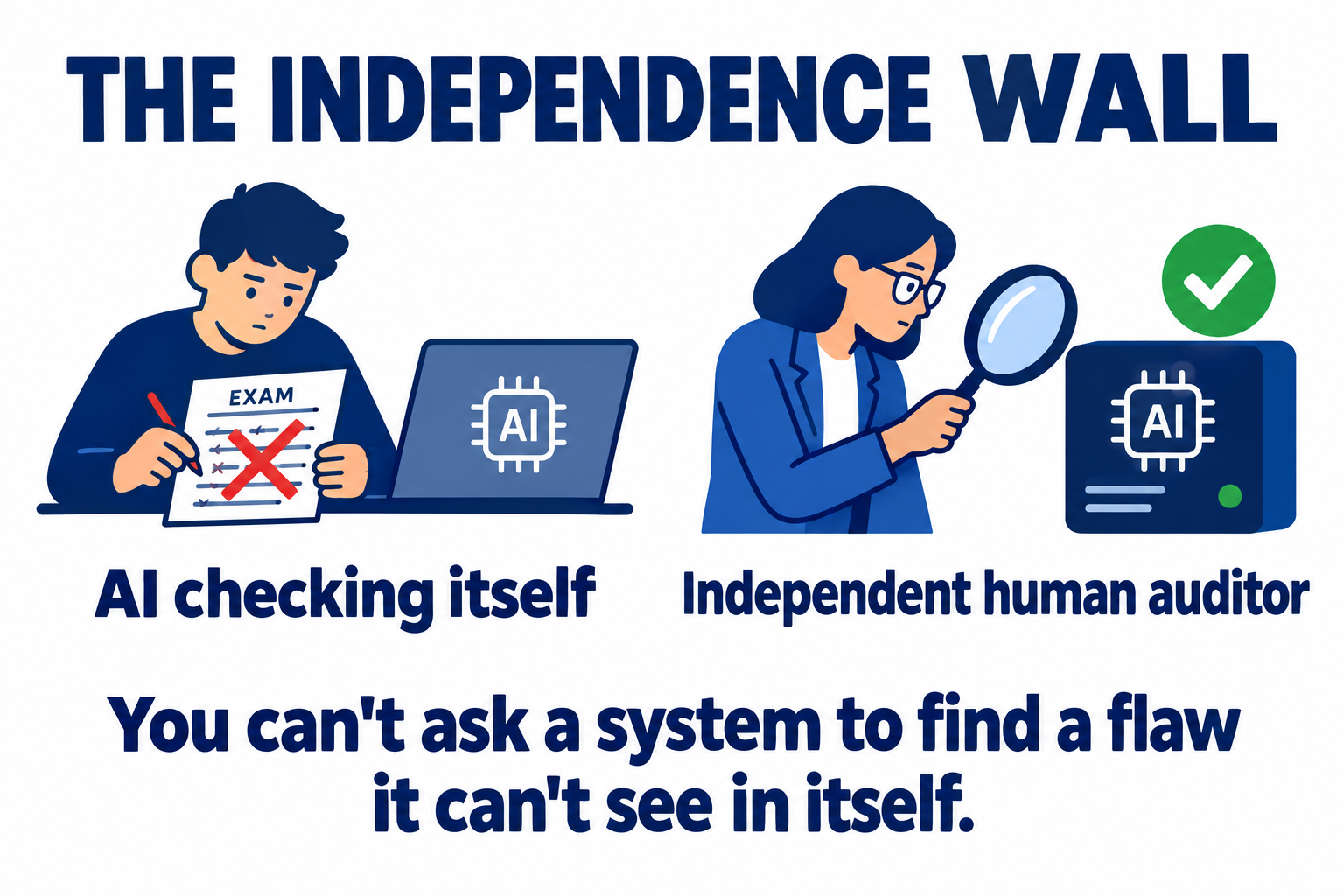
In the video I called this the recursive dependency wall. In plain English: you can't rely on AI alone to audit AI. It's like asking a student to mark their own exam. If a model has a blind spot, such as a bias baked into its training data, asking the same kind of model to find that blind spot runs into the same problem. Auditors do use AI tools to help, but the sign-off has to come from someone independent, and today that means a person.
The demand is only just getting started. When the consulting firm BCG was certified to ISO/IEC 42001, the international standard for managing AI, in January 2026, it said it was among the first 100 organisations worldwide. Colorado has replaced its AI Act with a new law, in force from January 2027, that gives people the right to ask for a human review of automated decisions. And in a survey of 671 organisations by IAPP, the main professional body for privacy and AI governance, only 1.5% said they wouldn't need more AI governance staff in the next year.
The best part: you don't need to code. If you come from governance, risk and compliance, this is your way into AI without writing Python.
JobZone Risk score
64.5
Zone
Green
Tasks displaced / augmented
0% / 80%
One correction to the video: I quoted 72.3 for this role, but that's JobZone's score for the more senior AI Governance Lead. The AI Auditor role itself scores 64.5. Both are firmly green, and governance lead is the natural next step up.
5. Incident Response Specialist: The Crisis Leadership Wall
An incident response specialist leads when a breach hits. They investigate, contain the damage, and coordinate with executives, lawyers and sometimes the police. Often at 3am, with the business on fire. I can vouch for that, having taken those calls and rushed into the office more than once.
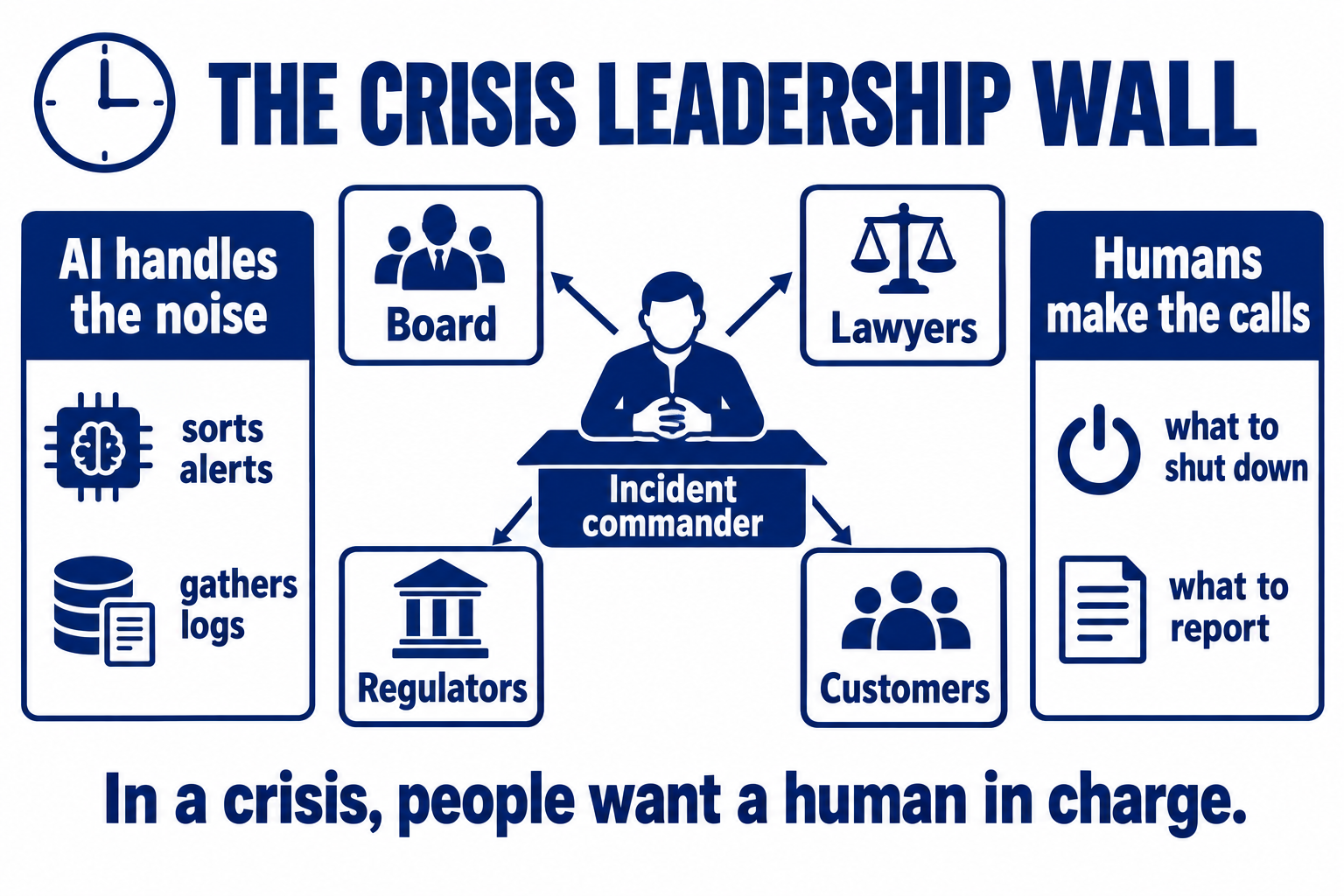
The wall here is leadership under pressure. When a company is breached, the board doesn't want an AI running the crisis. They want a person they trust making the calls. And the calls are big. Shut down the wrong system and you can tip off the attacker, destroy evidence, or cost the company millions.
The law builds in judgement too. Under GDPR, you have to notify the regulator unless the breach is unlikely to put people at risk. Under HIPAA, a breach is presumed unless a documented risk assessment shows otherwise. The payment card standard, PCI DSS, requires named, trained people on call around the clock. AI tools can gather the evidence. An accountable person has to make, and sign off, the decision.
You can see it in real incidents. When medical technology company Stryker was hit in March 2026, its filing to US regulators described teams working around the clock with outside experts and law enforcement, and a decision still pending on whether the incident was "material", meaning serious enough that investors must be told. AI handles the noise. People handle the decisions.
JobZone Risk score
52.6
Zone
Green
Tasks displaced / augmented
0% / 85%
What These AI-Proof Cybersecurity Jobs Pay
Salary data for newer roles varies a lot between sources, so here are ranges with the source named. For comparison, the US median pay for information security analysts is $129,180 (Bureau of Labor Statistics, May 2025).
| Role | Typical US pay | Source |
|---|---|---|
| Digital Forensics Analyst | about $123,000 average; senior roles higher | Glassdoor |
| OT/ICS Security | $130,000 to $180,000 mid-level; listings up to $231,000 | JobZone Risk, ZipRecruiter listings |
| AI Security Engineer | about $183,000 average; specialist roles $200,000 to $280,000+ | ZipRecruiter, via JobZone Risk |
| AI Auditor / AI Governance | median $151,800; $221,000 for technical AI governance roles | IAPP salary survey |
| Incident Response | about $108,000 for analysts; about $135,000 for IR engineers | Hack The Box, via JobZone Risk |
Pay depends heavily on location, seniority and employer. Treat these as a guide to which roles pay well, not a promise.
Which AI-Proof Cybersecurity Job Fits You?
So which one is for you? Here's how I'd think about it.
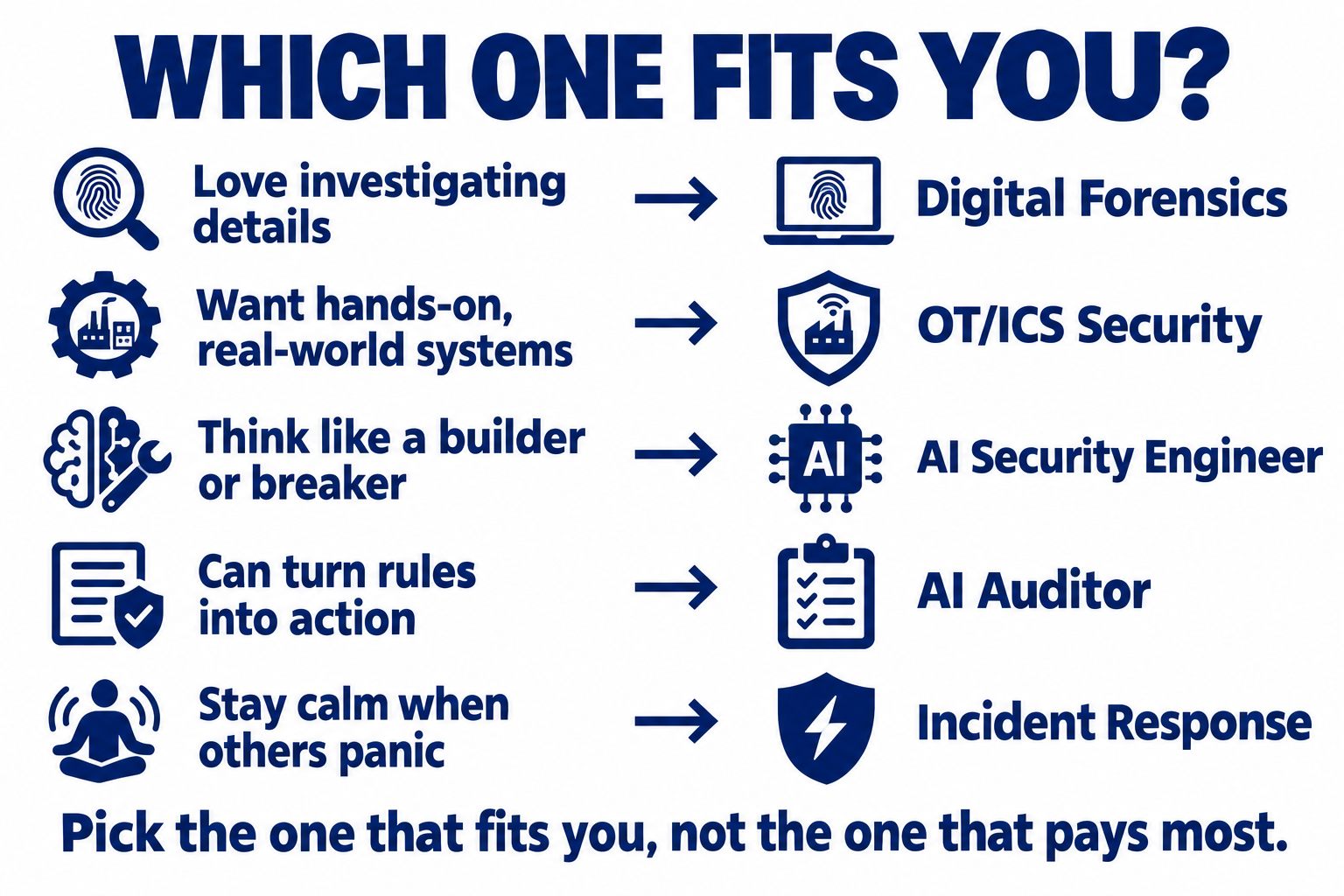
You love investigating details. Digital forensics. You'd enjoy piecing together exactly what happened.
You want hands-on, real-world systems. OT/ICS security. Your work keeps the lights on and the water running.
You like building things, or breaking them. AI security engineering. It's the most technical of the five, and the highest paid.
You can turn rules into action. AI auditing. Ideal if you come from compliance, audit or risk.
You stay calm when everyone else panics. Incident response. You'd be the person everyone looks to at 3am.
Pick the one that fits you, not the one that pays the most.
And be honest with yourself about the trade-offs, because each wall has a weak spot. If courts start accepting AI evidence with less human checking, the forensics wall gets lower. As more plants connect their equipment to modern networks, OT security becomes more like regular IT security. AI tools will take over more of the routine checks in auditing. And incident response will keep shrinking at the junior end as AI handles more of the triage. The people these walls protect best are the ones who do the judgement part of the job well, not just the routine part.
The Skill Behind All Five: AI-Driven Engineering
Here's the thing nobody's saying. Every one of these five jobs is going to be done with AI underneath it. The forensics analyst uses AI to sift the data. The incident responder uses it to sort the alerts. The AI security engineer tests it for a living. The wall protects the role, but the people who do best in it will be the ones who can build and direct AI to do the heavy lifting.
I call that skill AI-driven engineering: building AI systems that do real work and get better every time they run, instead of just using an AI tool now and then. That's the skill I'd add to whichever of these five you choose. You don't need to be a programmer to start. Directing AI tools well, and knowing when to trust their output, is a skill in itself, and it matters just as much to an auditor as to an engineer.
If you want to start, our free web-book Become the Cyber Security Expert the AI Era Demands is a good first step. And if you want real labs, real projects and mentorship to land one of these roles, that's what the AI Master's Program is for. You can get a full refund up until the programme begins, and if you haven't proven you can build your own working solutions by the end of the year, the programme stays open until you do, at no extra cost.
Frequently Asked Questions
Will AI replace cybersecurity jobs?
Some of them. Entry-level roles built on repeatable tasks, such as tier 1 SOC analyst and junior penetration tester, score around 5 to 6 out of 100 on JobZone Risk. But roles where a person has to testify, be on site, sign off or lead a crisis score far higher, and none of the five in this guide has any of its tasks scored as displaced by AI.
Will AI take over cybersecurity jobs completely?
Not on current evidence. AI is taking over tasks, such as sorting alerts and running scans, much faster than whole jobs. The work that stays human is the work someone has to answer for: evidence in court, safety-critical systems, sign-off on AI systems and decisions in a breach.
Is cybersecurity safe from AI?
Cybersecurity as a field is growing, because AI creates new systems to protect and helps attackers too. Individual roles vary a lot. Check the specific role you're aiming for on JobZone Risk, which scores thousands of jobs on how exposed they are to AI.
Which cybersecurity job is the most AI-proof?
Of the five in this guide, AI Security Engineer scores highest on JobZone Risk at 79.3 out of 100, followed by OT/ICS Security Engineer at 73.3. Both have 0 percent of their tasks scored as displaced by AI.
Do I need to code for an AI-proof cybersecurity job?
Not for all of them. AI auditing suits people from governance, risk and compliance backgrounds, and incident response depends more on calm judgement than on programming. AI security engineering is the most technical of the five.
About the Author

Nathan House, Founder & CEO of StationX
Nathan House has 30 years of hands-on cybersecurity experience and is Cambridge-educated, holding CISSP, CISA, CISM, OSCP, CEH, and SABSA. He founded StationX in 1999 — one of the UK’s first cybersecurity companies — and has secured £71 billion in UK mobile banking transactions and the London 2012 Olympics, advising clients including Microsoft, Cisco, BP, Vodafone, and VISA. He authored the world’s most popular cybersecurity course — a #1 Udemy bestseller taken by over 500,000 students — and was named Cyber Security Educator of the Year 2020, AI Security Educator of the Year, and a UK Top 25 Security Influencer 2025. A DEF CON speaker and featured expert on CNN, Fox News, NBC, and the BBC, Nathan leads StationX’s training of more than half a million students worldwide.