These Tech Jobs Are Evolving Into $900K Monsters!
If you work in cybersecurity, or you're trying to get in, the job you're preparing for is changing under your feet. Not disappearing. Changing. Pen testers still break in. SOC teams, the analysts in a company's security operations centre who watch its systems and respond to alerts, still stop attacks. Managers still lead. But the job ads now want all of them to do that work in a different way: by directing AI.
I know because I read them. For our free AI-driven cyber security jobs tracker I've gone through more than 500 real job ads from hundreds of employers, and the same shift turns up again and again, from Capital One and Microsoft to Okta and Google. In this article, we'll look at the actual wording in those ads, what they pay, and the two steps I'd take if I wanted one of these jobs.
Let's start with what's actually different.
TL;DR if you've only got 30 seconds
AI isn't replacing these security jobs. The same jobs are being done a different way, with the person directing AI instead of doing every step by hand.
Real ads now ask for it in plain words: pen testers who direct AI agents, managers who run teams of people and agents, engineers who build the agents everyone else uses.
The pay in these ads runs from $119,800 at Microsoft up to $450,000 to $600,000 (including bonus) at Bridgewater, the best-paid role where AI is central. The highest range I've found, $499,000 to $900,000 at Netflix, is for a senior security job where AI is only a small part.
Where to start: learn the security fundamentals, then build one small thing that uses AI to do real security work.
Same Job, Done a Different Way
Take a penetration tester, the person a company pays to break into its systems so the holes get found before a criminal finds them. The old way, they run the scanning tools by hand, read the output, write the attack code, and write up the report. The new way, they tell a set of AI agents what to attack and what to look for. The agents do the scanning and write the attack code, and the tester checks the results and decides what's real.
An AI agent, by the way, is an AI you give a goal rather than a single question. It works out the steps and carries them out itself: run a scan, read the results, pick the next tool, run that, and so on until the job is done.
Same job. Same deliverable. Done a different way. That's what I call an AI-driven security engineer: someone who uses AI to do the security work and directs it properly, so what comes out is something they'd put their name on. It's not the same as an "AI security engineer", whose job is protecting AI systems. This is about using AI to do the security job itself.
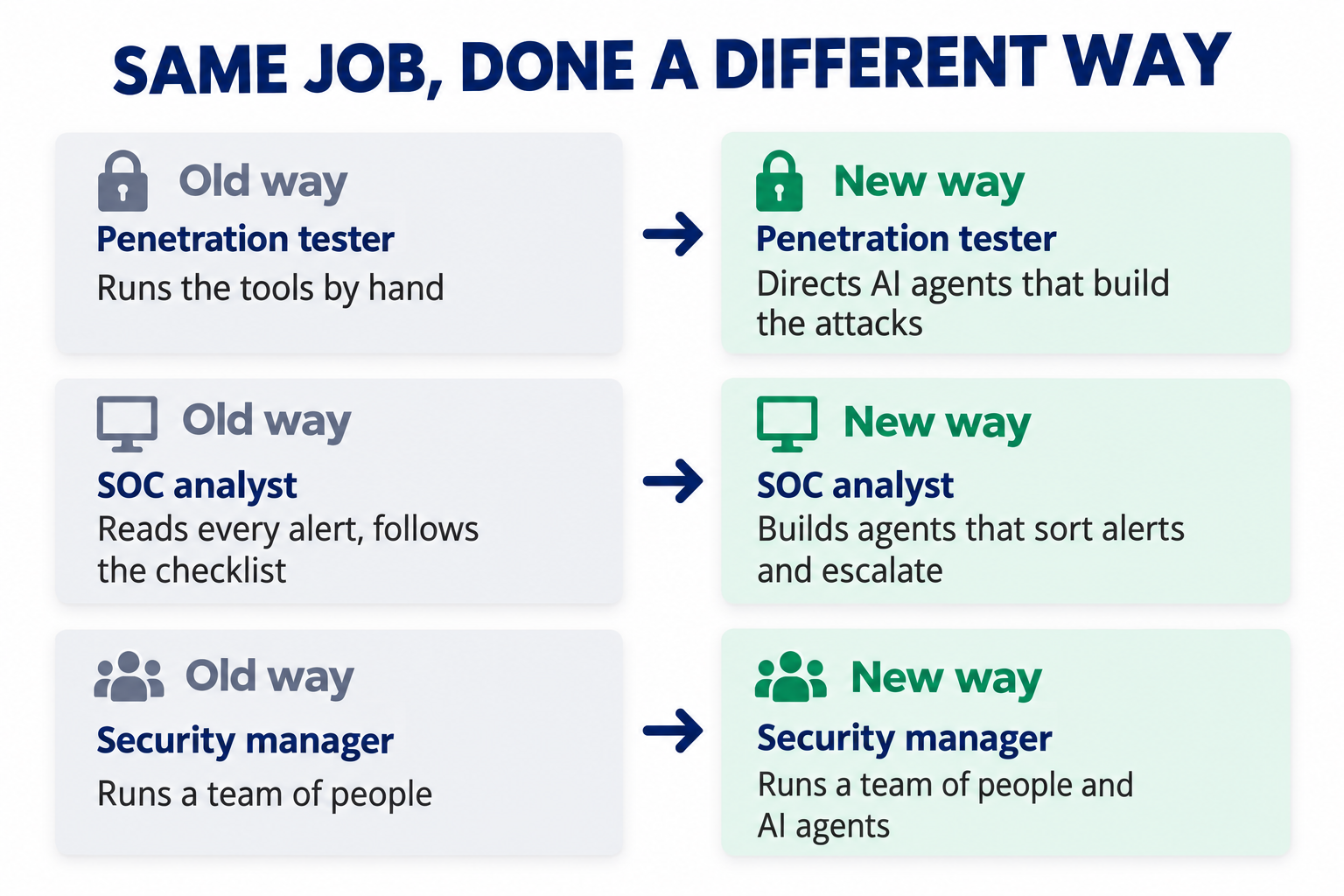
Across the ads, the shift shows up in three moves. First, people doing the work with AI. Second, leaders running teams that mix people and agents. Third, engineers building the agent systems everyone else runs on. Let's take them in order, with the actual wording from the ads.
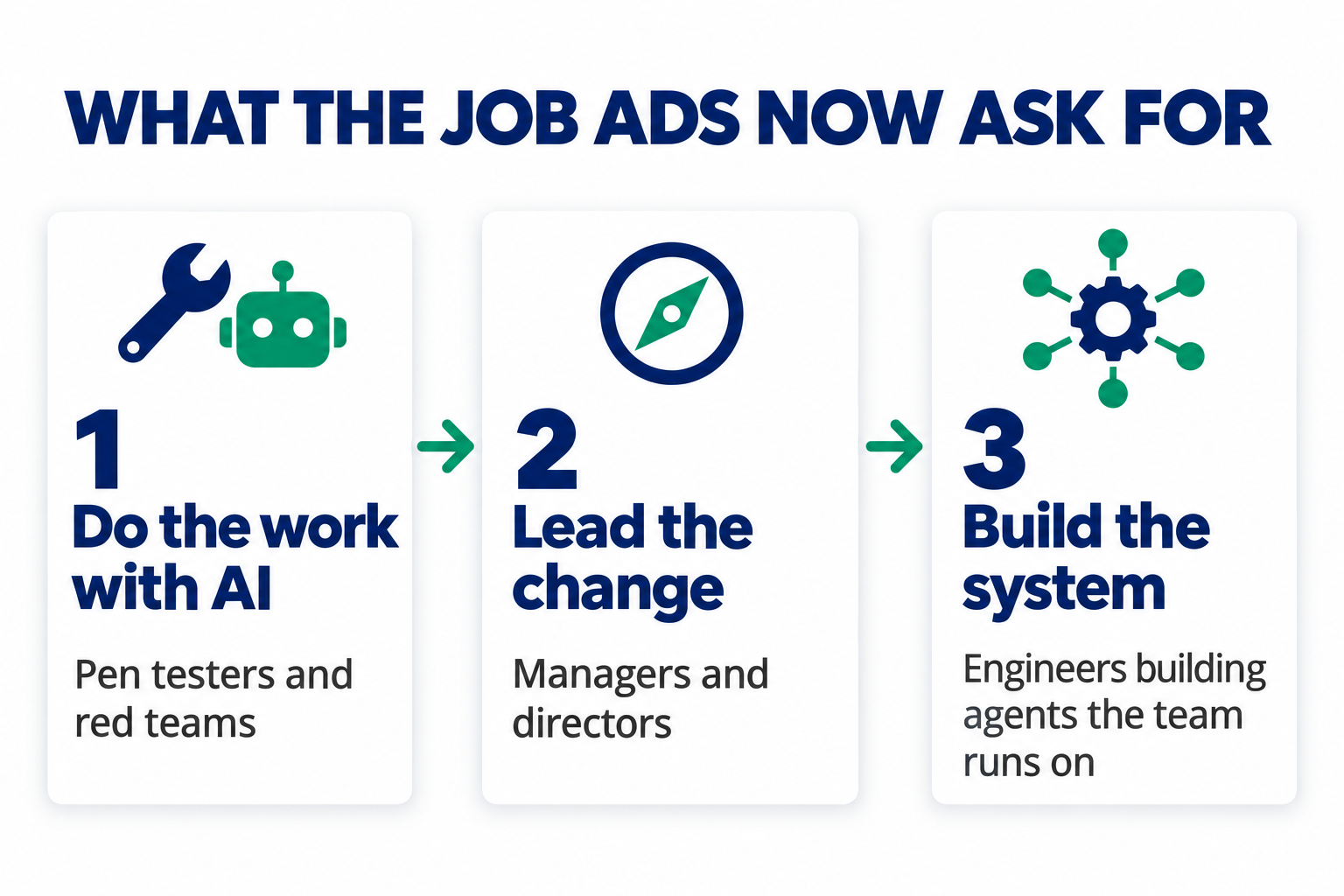
Move One: Do the Work With AI
Start with the people paid to break in and find the weak spots: penetration testers and red teams. A red team is a group that plays the attacker against its own company, so it can find out how a real attack would get through.
Capital One advertised a Senior AI Engineer for a new red team, paying $176,500 to $201,400 in New York, San Francisco and San Jose. The ad has since closed, but the archived copy is clear about the idea:
"Our AI Foundations team is forming a brand new AI Red Team to focus on adversarial attacks against AI systems, essentially building AI to attack AI"
The targets here are AI systems, but look at the method: the team builds AI to do the attacking. The red team's own work is being done by AI that the engineers build and direct.
Microsoft's Windows Security team is hiring senior and principal security engineers (principal, like staff, is a level above senior, for very experienced engineers) at two levels, with US pay from $119,800 to $274,800 across them. Look at how the ad describes the work:
"Review features and code for security defects and architectural risk using agents and automated tools built by you and others."
Notice "built by you". They don't just want someone who can use a tool they've bought. They want someone who builds the agents that do the review.
Las Vegas Sands went further. Its ad for a Senior Application Security Engineer (AI-First Development) has now closed, and I couldn't find an archived copy, but we captured it for the tracker at the time. It said:
"AI agents serve as primary producers of offensive tooling, exploit proof-of-concept code, attack automation, and adversary-emulation artifacts, while the engineer provides operational direction"
"Exploit proof-of-concept code" means a small program that proves a security hole can really be used. "Adversary-emulation artifacts" are the scripts and tools a red team uses to copy the known methods of a real attacker group. That used to be the tester's own work. In this ad, the AI writes it and the engineer directs.
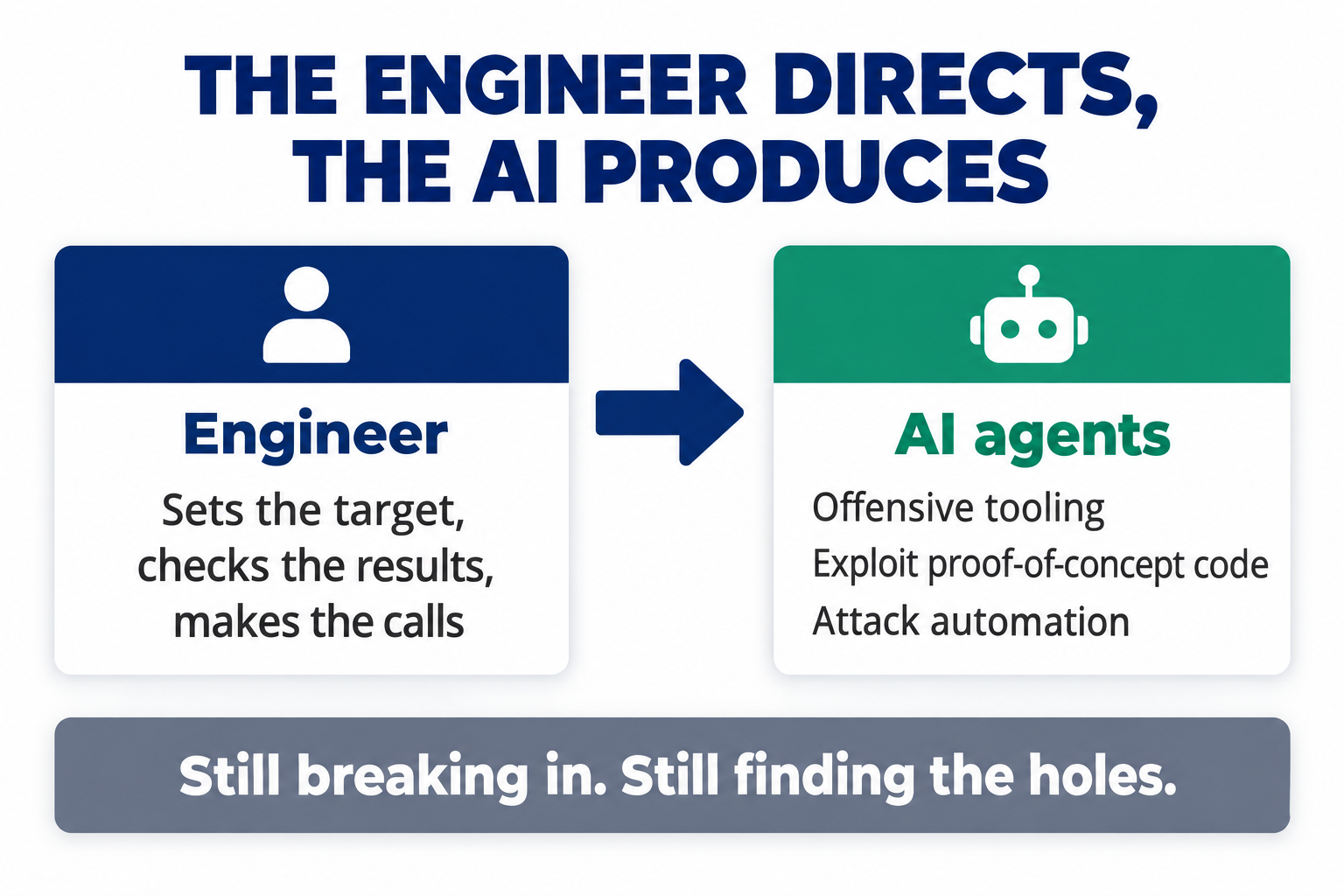
So you're still breaking in. You're still finding the holes. But the AI does the producing, and you do the directing. That changes who companies want to hire, including the people who lead them.
Move Two: Lead the Change
Now for the people who manage that work. Among the leadership roles in our jobs data that list US pay, the typical figure is about $228,000 (the median of each role's salary range midpoint, across 14 leadership roles in early September).
Okta is hiring a Senior Director of GRC. GRC stands for governance, risk and compliance: setting a company's security rules, weighing its risks, and making sure it meets the laws and standards it has to follow. The base pay is $264,000 to $363,000 in the San Francisco Bay Area. The ad asks the person to:
"Drive AI-first Transformation"
and to "integrate AI and agentic tools into daily GRC operations". In other words, the director's job now includes changing how the whole function works, not just running it.
Microsoft again, this time a Principal Security Engineering Manager in the Office of the CISO (the chief information security officer, the person in charge of a company's security), paying $142,800 to $274,800. The ad wants someone to:
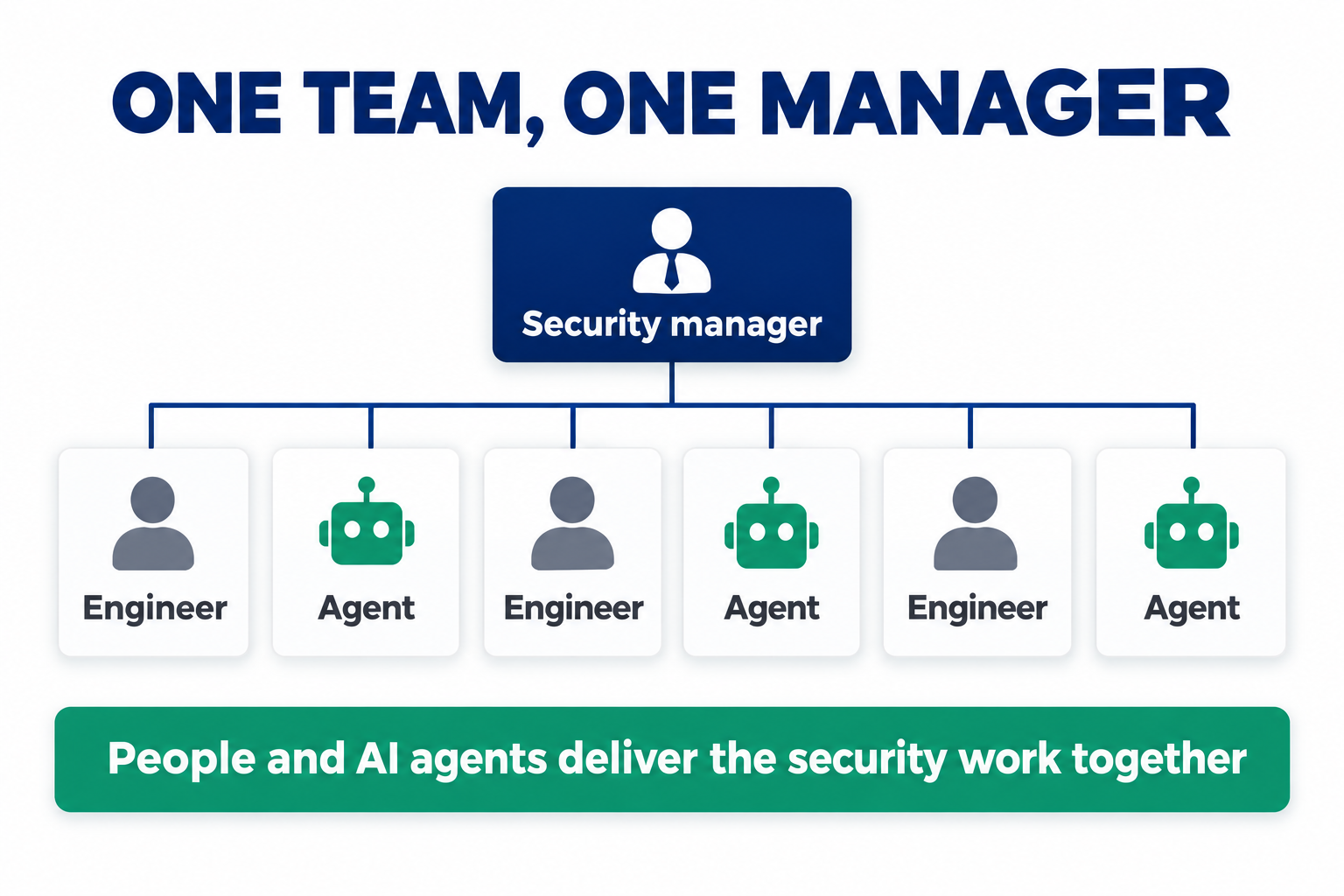
"Build and operationalize a hybrid human + agentic Security Operations Engineering model."
Picture the team that describes. One manager. A few engineers. And alongside them, AI agents doing part of the work. People and agents, one team, one manager.
Zeta Global's Director of Application Security goes the same way. The ad asks the person to build "an AI-native, agent-driven Application Security function". When we captured it at the end of August, it listed total pay of $275,000 to $315,000; by late September the range had risen to $300,000 to $350,000.
The leader's job isn't to run a security team any more. It's to run a team of people and AI that delivers the security work together. The doing changed, so the managing changed with it. Which raises the question: who builds the agents those teams run on?
Move Three: Build the System
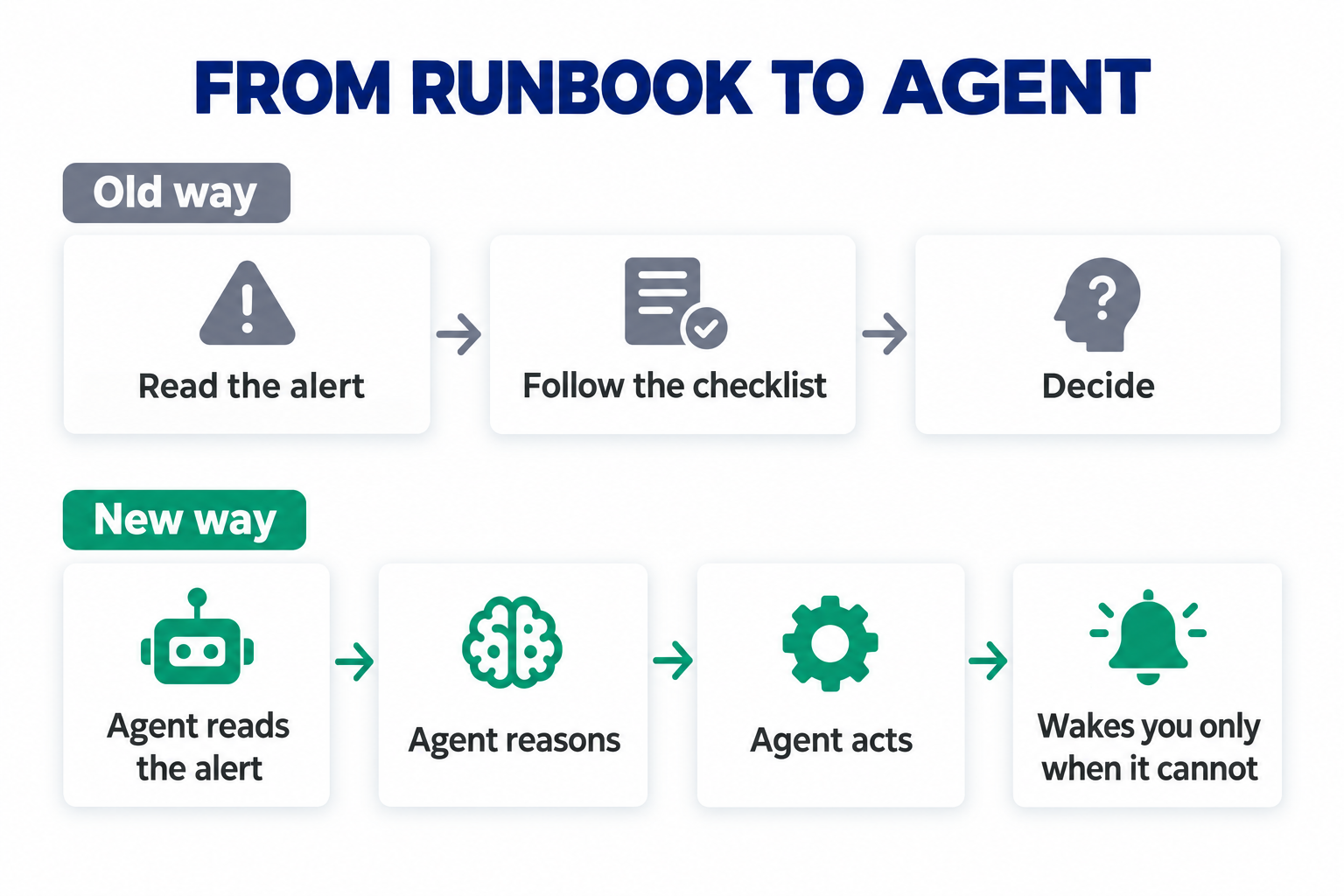
Among the roles in our tracker where directing AI is the heart of the job, the best paid is Bridgewater Associates' Staff AI Agentic Security Engineer. The ad listed $450,000 to $600,000, and it's worth reading the small print: that range includes a target bonus, and the ad put the expected base salary at 65 to 75 percent of it. The ad has since closed, but Bridgewater's own posting is archived. In the ad's words, the role would:
"Replace manual runbooks with intelligent agents that reason, act, and escalate"
A runbook is the checklist a security analyst follows when an alert fires: check this, look up that, then decide what to do. Picture a shift in a security operations centre (SOC). A login from a new country. A file that looks odd. A sudden spike in traffic. Most of these turn out to be harmless, and the analyst works through each one by the book. Bridgewater wants someone to build agents that do that work, and only wake a person when they can't.
AbbVie, the pharmaceutical company, puts the whole idea in one line. Its Principal Agentic AI Security Engineer role, paying $141,500 to $268,500, says the person will:
"build with agents, not just build agents"
So there are the three moves: do the work with AI, lead the change, build the system. You might be thinking this only matters for senior people. It doesn't.
Even Early-Career Roles Now Want AI
Google is hiring a Security Engineer, Detection. Detection engineering means writing the rules and systems that spot an attack as it happens. Google labels the role early career and asks for about a year of relevant experience. US pay is $123,000 to $175,000, plus bonus and equity. And even here, the duties include this:
"Deploy agentic detection engineering workflows"
That's an early-career role, and AI is already part of how the work gets done. Every ad in this article, plus hundreds more, is in the free jobs tracker with the full ad and a screenshot, so you can read them yourself. So what do these jobs actually pay?
What These Jobs Pay
This chart puts every salary range from the ads above side by side, drawn to scale. All figures are US dollars, as listed in each ad.
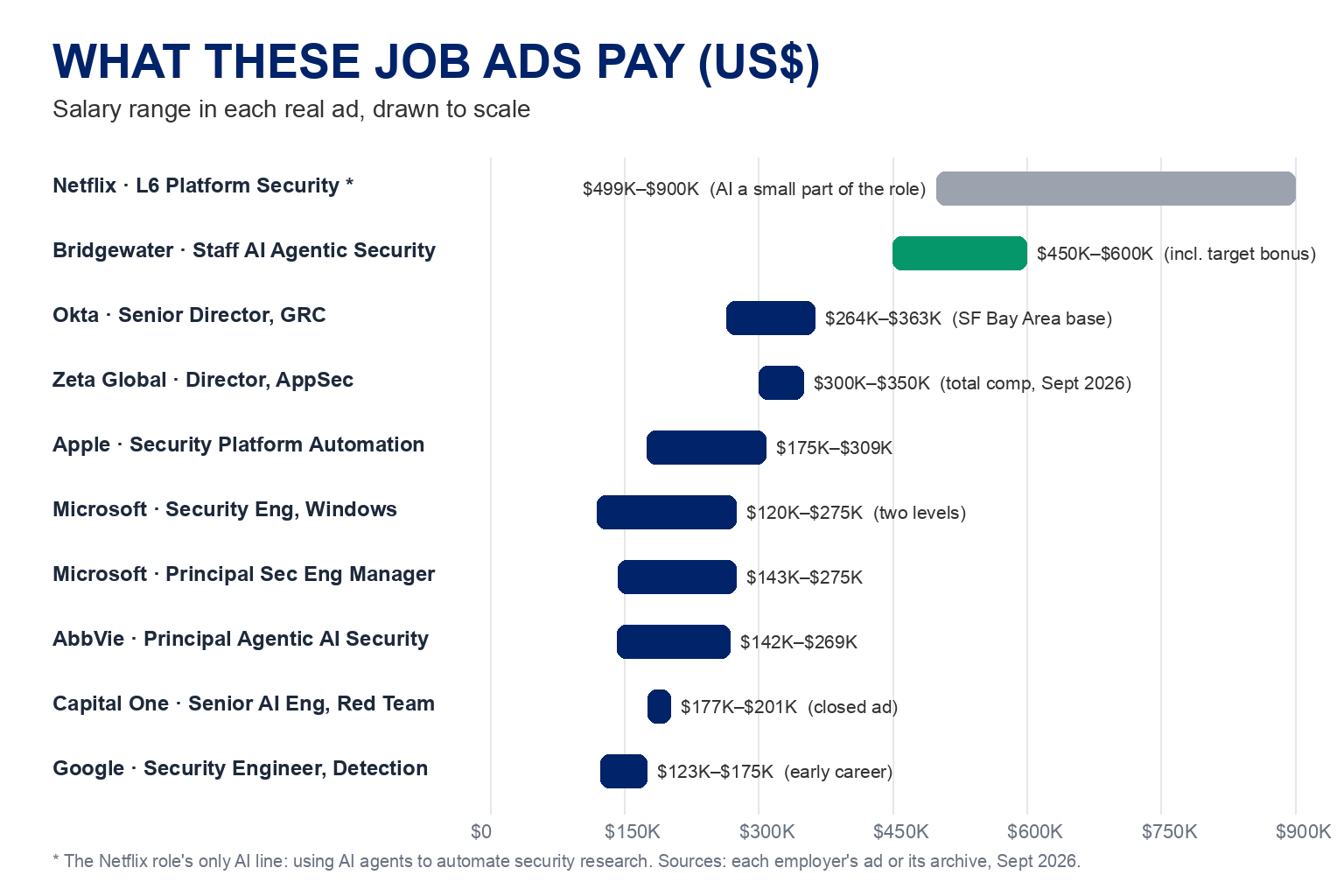
You'll notice one bar at the top that I haven't mentioned yet. Netflix is hiring a Software Engineer (L6) in Platform Security with a range of $499,000 to $900,000. It's the highest range in the tracker. But I want to be straight with you about it: its only AI line is "Experience using AI agents to automate security research". AI is a small part of that job, so it isn't a typical example of this shift. It does show where senior security engineering pay can go.
In plain English
Why is the pay so high? The ads don't say, but I think two things are a big part of it: very few people can do this yet, and the ones who can make a whole team more productive. Think of a company that needs its code reviewed for security holes. One engineer checking it by hand might get through a few features a week. An engineer who has built agents to do the first pass, and who checks what they find, can cover far more. Companies pay for that difference.
So the money is there. The question is how you get from where you are now to one of these roles.
How to Start: Two Steps
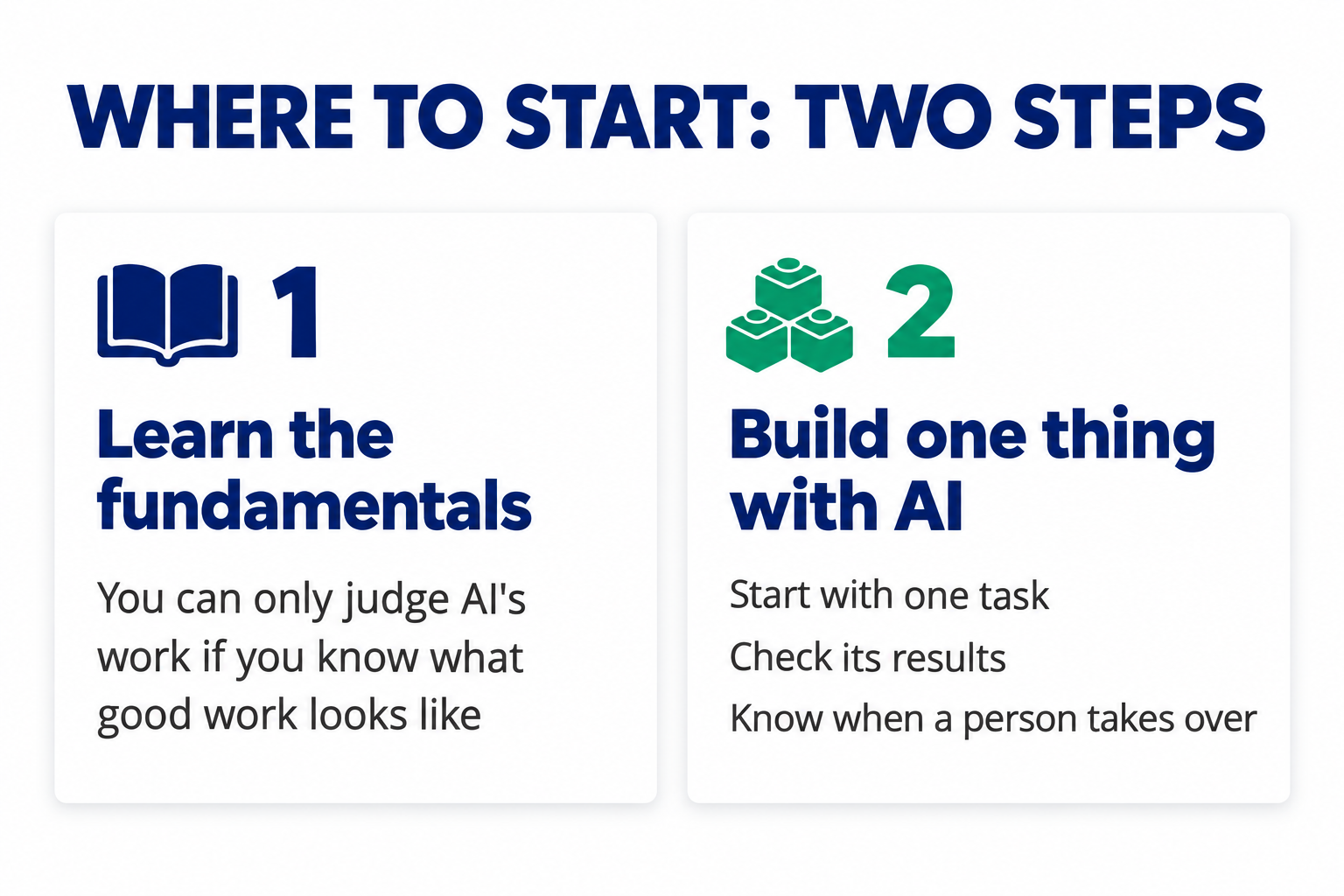
You don't need to be senior to start, and you don't need to do everything at once. Two steps.
Learn the security fundamentals for the role you want. You can only judge AI's work if you know what good work looks like. If you want to be a pen tester, learn how attacks actually work. If you want to run a SOC, learn how networks and alerts work. AI makes the typing faster; it doesn't give you the judgement.
Build one thing that uses AI to do real security work. Start with a single task. For example, an agent that reads a suspicious email and explains whether it looks like phishing, and why. Check its results against your own judgement, and learn where it gets things wrong and a person needs to take over.
Step two is where most people stop, and it's the first step towards what the ads ask for. Apple's Security Platform Automation Engineer role, which pays $175,000 to $308,500, asks for:
"1 year of building LLM- or agent-based systems that ran in production, with a measured quality bar"
An LLM, or large language model, is the kind of AI behind chatbots like ChatGPT: it reads and writes text, and it's usually what powers an AI agent. That's a senior role (it also asks for eight years or more of experience), and a weekend project won't meet that bar on its own. Look at what it's measuring: a system that real people used in production, with its results checked against a set quality standard. Your phishing checker is the first version. To get from there to what Apple wants, get it (or something like it) used for real work, keep it running, and keep a record of how often it's right and where it goes wrong. The sooner you start, the sooner you have that year to show.
If you want the full route, including certifications, projects and support, our new cybersecurity roadmap lays it out step by step. And if you want to learn the method itself, start with our guide to agentic engineering and the free AI-Driven Engineering course.

The Crisis and the Opportunity
First, the crisis. If you prepare for the job as it used to be, typing every command, following every checklist by hand, you're training for the part of the job that's going to AI. Every week I see more of these ads, and the wording keeps moving the same way.
Then there's the opportunity. Very few people have these skills yet, and I think that's a big part of why the pay is where it is. If you already work in security, your experience is the hard part, and you have it. What's left is learning to direct AI with it.
If you're earlier in the journey, our free web-book Become the Cyber Security Expert the AI Era Demands explains the change and what these new roles mean. And if you want to build these skills properly, with mentorship and real projects you ship, that's what the AI Master's Program is for. It's application only.
Frequently Asked Questions
What is an AI-driven security engineer?
A security professional who directs AI to do the hands-on security work, then checks the result and makes the calls. The security job stays the same (testing, defending, leading, building), but AI agents do much of the execution and the person directs them. It is not the same as an AI security engineer, whose job is to protect AI systems.
Is AI replacing cybersecurity jobs?
The job ads we analysed show something different: the same roles, done a different way. Pen testers still break in, SOC teams still stop attacks and managers still lead, but employers now want them to do that work by directing AI agents.
How much do AI-driven security jobs pay?
In the ads covered here, US salary ranges run from 123,000 to 175,000 dollars for an early-career Google detection role up to 450,000 to 600,000 dollars (including target bonus) for Bridgewater's Staff AI Agentic Security Engineer. The highest range we found, 499,000 to 900,000 dollars at Netflix, is a platform security role where AI is only a small part of the job.
Do entry-level security jobs now require AI skills?
Some already mention it. Google's Security Engineer, Detection role, which Google labels early career and which asks for about a year of experience, lists deploying agentic detection engineering workflows among its duties.
How do I become an AI-driven security engineer?
Two steps. First, learn the security fundamentals for the role you want, because you can only judge AI's work if you know what good work looks like. Second, build something small that uses AI to do real security work, check its results, and learn when a person needs to take over.
About the Author

Nathan House, Founder & CEO of StationX
Nathan House has 30 years of hands-on cybersecurity experience and is Cambridge-educated, holding CISSP, CISA, CISM, OSCP, CEH, and SABSA. He founded StationX in 1999 — one of the UK’s first cybersecurity companies — and has secured £71 billion in UK mobile banking transactions and the London 2012 Olympics, advising clients including Microsoft, Cisco, BP, Vodafone, and VISA. He authored the world’s most popular cybersecurity course — a #1 Udemy bestseller taken by over 500,000 students — and was named Cyber Security Educator of the Year 2020, AI Security Educator of the Year, and a UK Top 25 Security Influencer 2025. A DEF CON speaker and featured expert on CNN, Fox News, NBC, and the BBC, Nathan leads StationX’s training of more than half a million students worldwide.