StationXThe Masters Program
Apply now →
Your resources

Everything you need to decide with confidence.

What you'll be able to build, what it leads to, the proof, and the people to talk to, all in one place.

Listen · read by HALThis page in 2 minutes
1:55
stationx@hal: ~/intro
$8,500or 3 × $3,000
3+ hours a weekdesigned around a full-time job
About 12 monthswith no clock: support continues until you've got there
$1,000 depositsecures your seat while a cohort fills, and gives you time to choose a payment plan
Full refundany time before you start, apart from the deposit
No coding neededyou direct the AI; it does the building
Your take-away documents

Keep these, and share them.

Everything you, your partner or your employer needs to decide, to read now or later.

What it leads to

One capability. Three futures.

The outcome is AI-driven engineering skills: directing AI across every discipline needed to deliver a complete security solution, the skills companies are hiring for right now. Where you take them is your choice. We can't promise the job, but you'll leave with the skills employers are asking for.

Listen · read by HALOne capability, three futures
0:46
EMPLOYEDA senior role at the top of your pay grade
INDEPENDENTYour own security consultancy
FOUNDERA business of your own
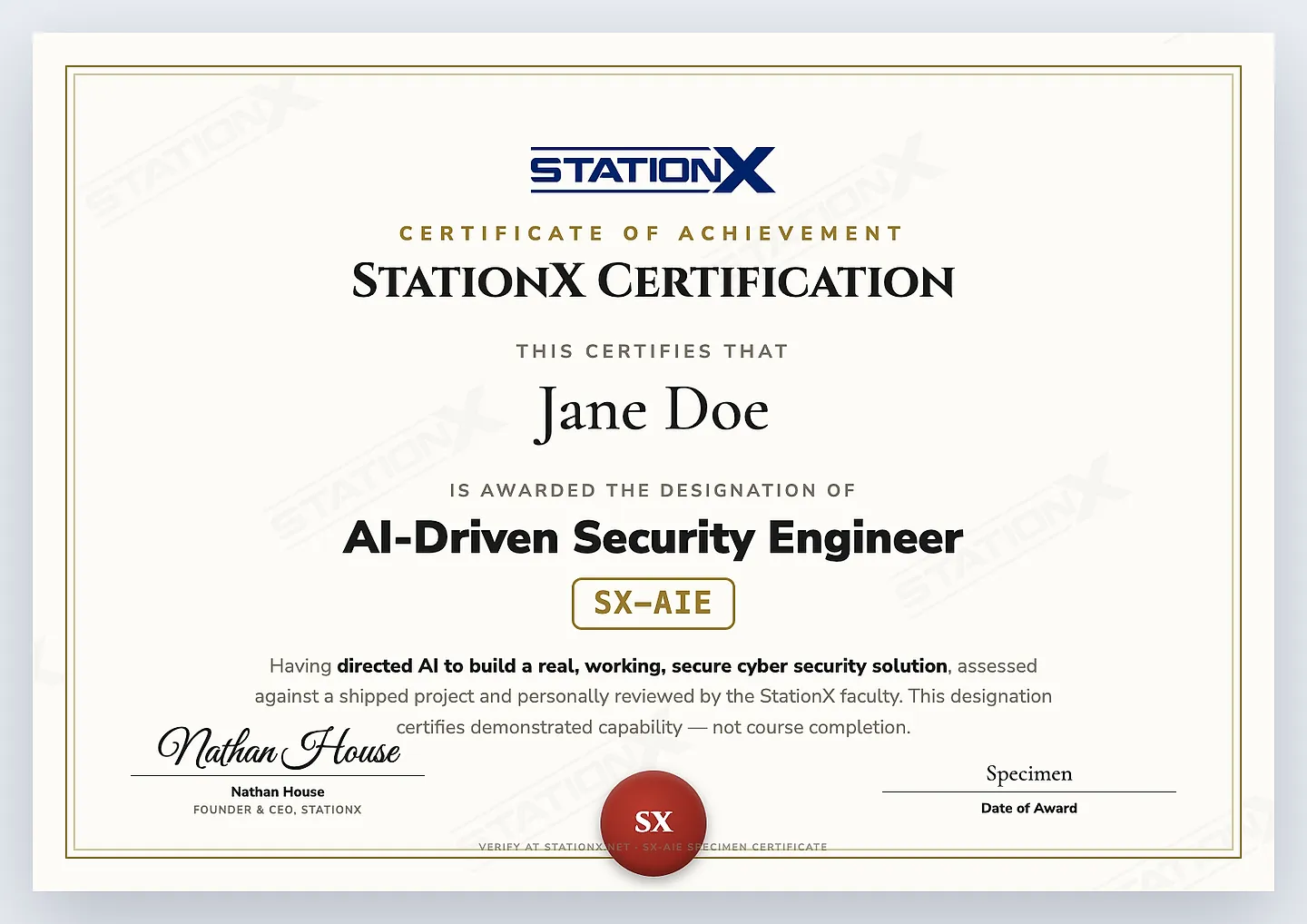
The SX-AIE certificate
The certification

StationX Certified AI-Driven Security Engineer (SX-AIE)

Awarded when you can build credible commercial security solutions and have built your own AI infrastructure to do it. Earned by building, not by attending.

If you want your own business

The Incubator: start and grow your own business.

For members who want to run a cyber security or tech business, or already do. It sits inside the Inner Circle and it's yours for life.
Business consultancyHelp with how to start and grow a cyber security or tech business: market research, choosing what to offer, winning engagements and finding your first customers.
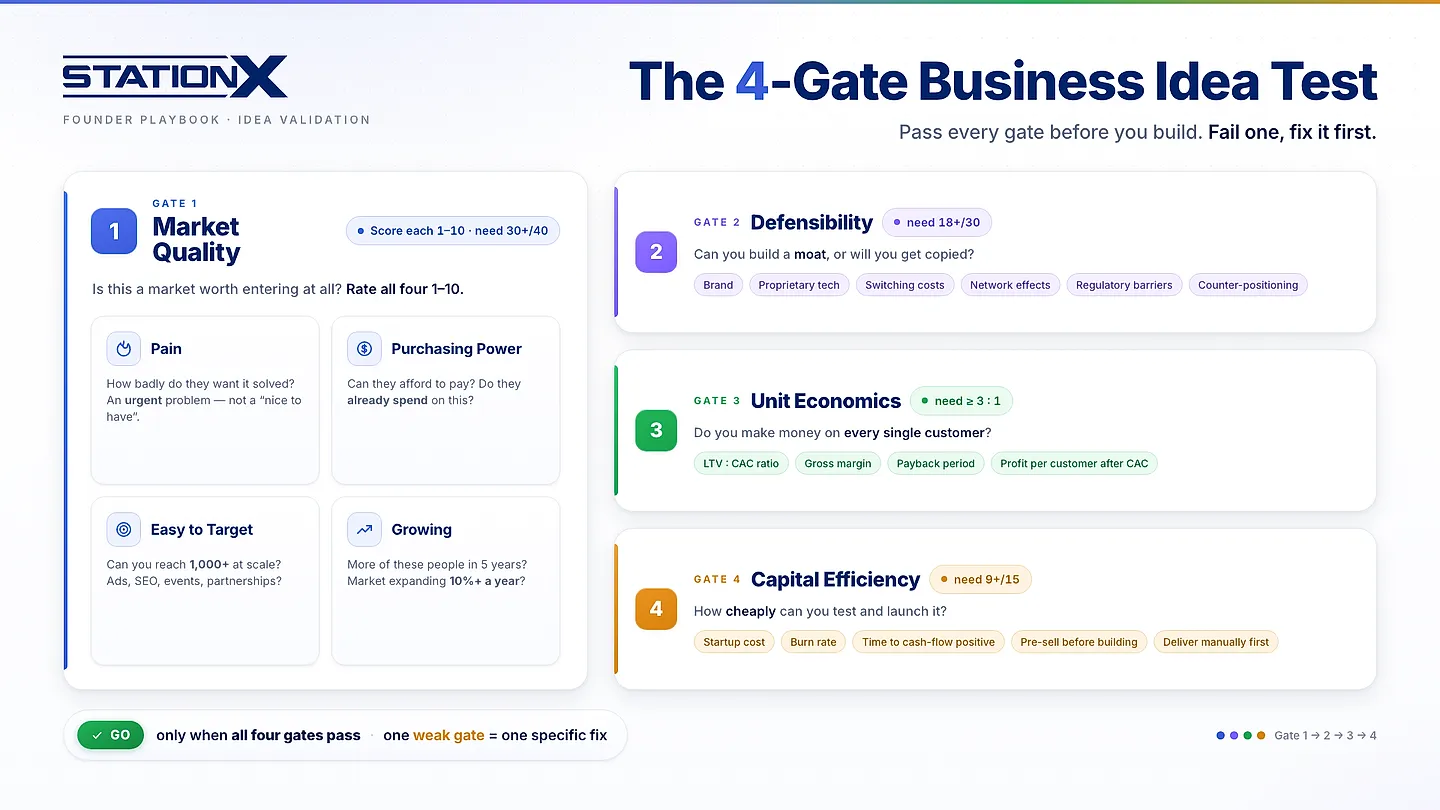
Founder resourcesThe StationX Founder Playbook, starting with the 4-Gate Business Idea Test, so you know an idea will work before you build it.
PartnersFind co-founders and partners among members on the same path.
Founders helping foundersShare your site, your pricing and your marketing, and get honest feedback from people doing the same thing.
The 4-Gate Business Idea Test, from the StationX Founder Playbook
From the Founder Playbook: the 4-Gate Business Idea Test.
Built in the programme

Members are already shipping.

Real, working security tools, each built by one member directing AI.
Listen · read by HALWhat members are building
0:41
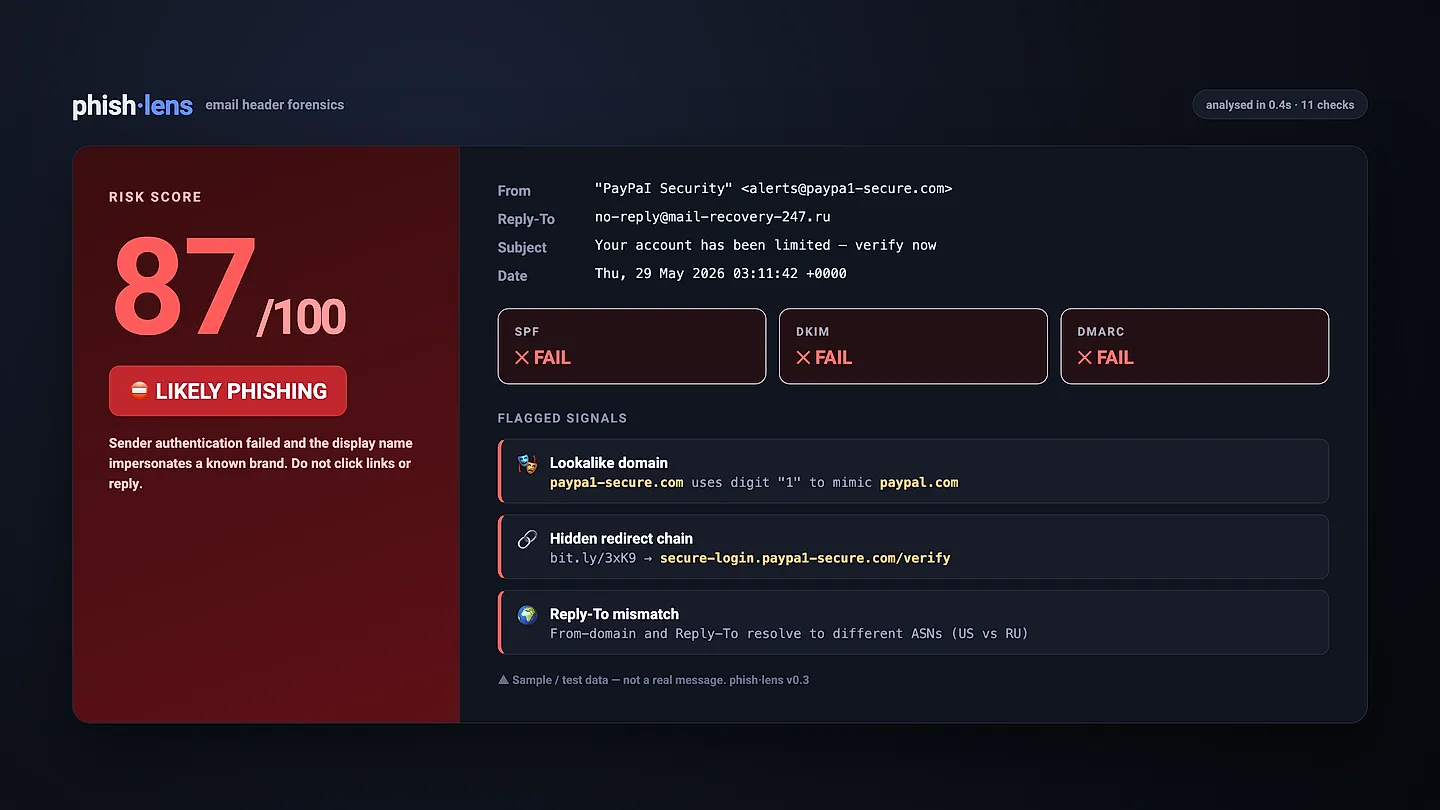
Phishing Analyser sample output
phish-lens

Phishing Analyser

Takes a raw email and scores it 0–100 for phishing risk, with the evidence laid out.

Built by Craig · current cohort
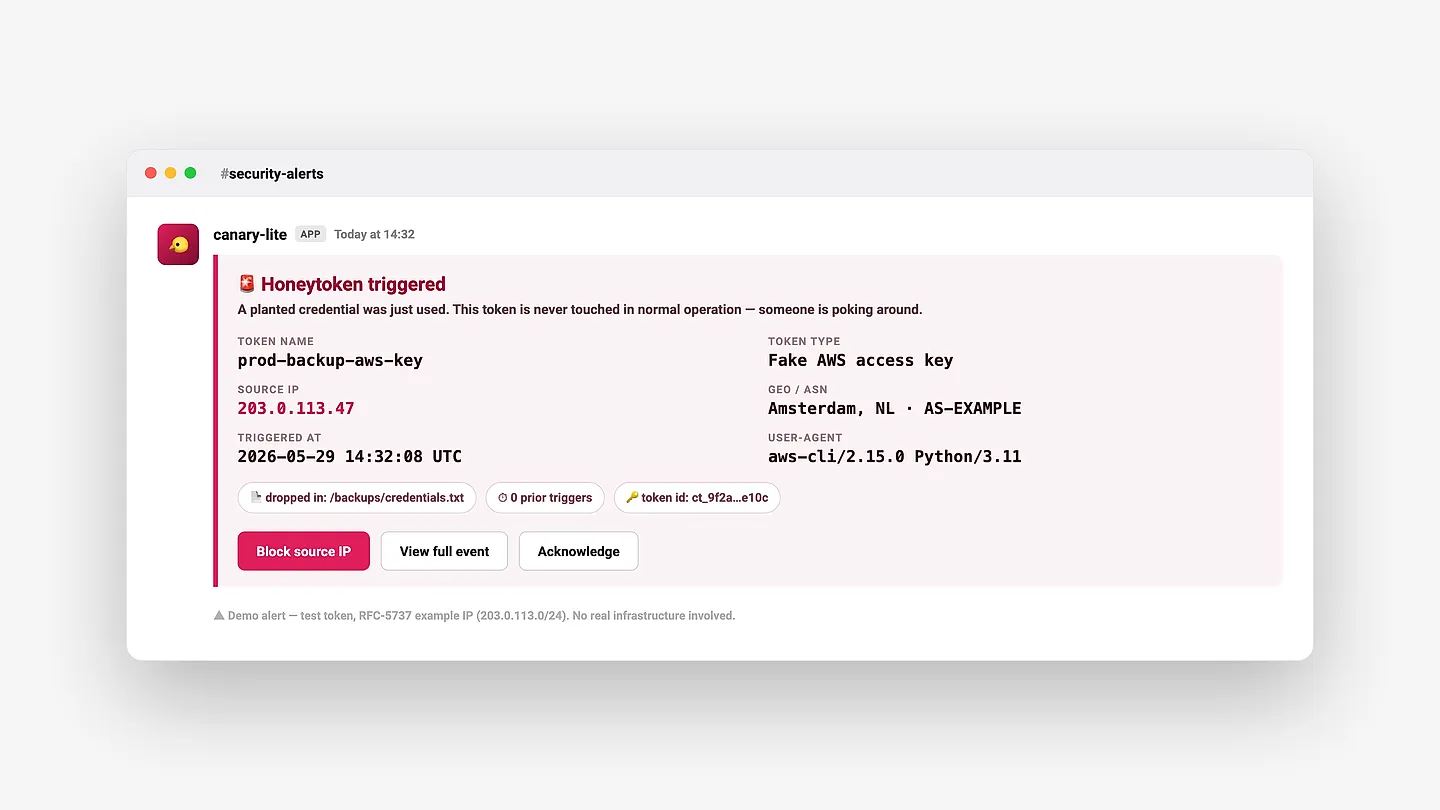
Honeytoken Tripwire sample output
canary-lite

Honeytoken Tripwire

Plants fake credentials and alerts the instant an intruder touches one.

Built by Stuart · current cohort
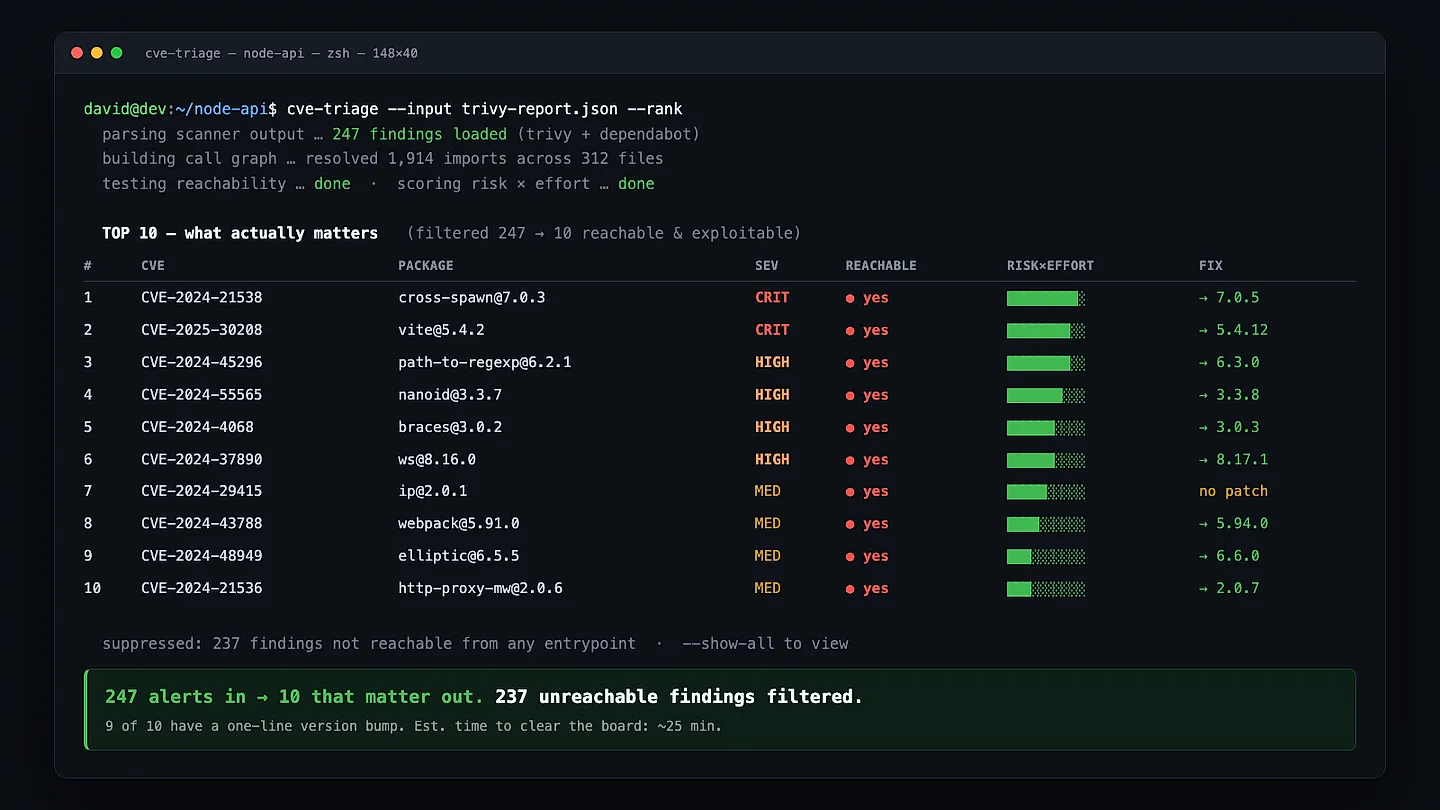
Vulnerability Triage sample output
cve-triage

Vulnerability Triage

Turns hundreds of vulnerability alerts into the top ten that actually matter.

Built by David · current cohort
Prompt-Injection Firewall sample output
llmwarden

Prompt-Injection Firewall

A Python library that catches prompt injection and jailbreak attempts before they reach an AI app.

Built by Steven · current cohort · public benchmarks on GitHub →
AI-driven engineering in action

See it done in your career.

Pick a role and watch Nathan direct his AI through a real piece of work in it. This is what you learn to do.

Listen · read by HALSee it done in your career
0:12
What you'll learn

The AI-Driven Engineering curriculum.

This is the AI-Driven Engineering part of the programme, and it keeps growing: new sessions are added every week as the field changes. Hover over (or tap) any session to see what's in it.

Listen · read by HALWhat you'll learn
1:32
Live workshopsTaught live, recorded, and added to every week
WorkbooksA written companion for every session, to work through at your own pace
AudioEvery workbook read aloud by HAL, so you can listen on the move
GitHub reposThe HAL Vault: ready-made code to build your own AI agents
1 · The HarnessDriving Claude Code
1 Foundations
  • What AI-driven engineering is and why code was never the hard part
  • The proof
  • From three shipped products to over 500 job adverts paying for it
  • The four tiers of building around an AI
  • The six-step method and the one rule underneath
  • The danger and the
2 The Basics
  • Install Claude Code
  • Learn permissions
  • The tool cycle
  • CLAUDE.md
  • Git
  • Context memory
  • Models
  • Sessions
3 Beyond the Basics
  • MCPs
  • Plan mode
  • The development protocol
  • Models
  • Permissions
  • Output style
  • Thinking mode
  • Auto-compact
  • Rewind
4 Commands & Skills
  • What commands and skills are
  • How they differ
  • Where they live
  • When to reach for which
  • An open brainstorm of what to automate first
5 MCP
  • What MCP is
  • Where servers live
  • The three transports
  • Built-in connectors
  • Installing from the CLI
  • Secrets
  • Security
  • Lazy loading
  • The integration ladder from MCP to script to API
6 Five Builds
  • The five hands-on builds you need from Sessions 2 to 5
  • Worked through together on a live call. Use this page as your reference at your own pace: install Claude Code
  • Connect an MCP
  • Write your first command and skill
7 Tiers & Hooks
  • The four tiers of AI-driven engineering
  • From raw harness to shared infrastructure
  • Hooks: the deterministic guardrail that turns a stochastic agent into something you can trust
8 Agents
  • Agent definitions
  • Sub-agents
  • Team agents
  • The collision problem and worktrees
  • Agent View
  • Dynamic workflows and ultracode
  • Plugins and the marketplace
  • The security discussion
  • Can the model itself be broken
2 · Build ItYour AI assistant & infrastructure
9 Assistant Prep
  • The Fable models' security gating and what it means for security people
  • AI-driven engineering vs the AI security career roles
  • The move to Tier 2
  • The assistant prerequisites checklist
  • Which MCPs are worth it
  • A live HAL demo
10 Assistant Anatomy
  • What an AI assistant actually is
  • The seven parts it's made of (structure
  • Identity
  • Memory
  • Skills
  • Work
  • Interface
  • Governance)
  • The order to build them in
11 Installing Your Assistant
  • Getting the HAL skeleton installed and running
  • Every real install gotcha from the live session
  • Why the struggle is the point
  • Structure: the first of the seven parts
12 Identity, Memory, Skills
  • The four parts that make an assistant yours
  • How to choose your models and keep your data private
13 Pentest & Bug Bounty
  • What becoming AI-driven actually does to a real job
  • Encoding your expertise into agents that hunt bugs and drive pen-testing tools
  • Shown live
14 Work & Interface
  • How the job actually gets done
  • Agents
  • Loops and headless runs
  • How you reach the thing you've built. Plus a bug bounty update and what changed in the job market
15 Governance
  • The three questions to ask about any agent you run
  • The four jobs of a control
  • Five fixes you can put in place tonight
  • Starting with a deny list that takes five minutes
3 · One tool, end to endArchitect, build, prove, ship
16 Architect It First
  • One small problem
  • Is this domain
  • URL or file malicious?
  • Architected out loud: research the providers
  • Choose by criteria
  • Screen the risk
  • Pick the stack
  • Meet the five documents that make building repeatable
17 API Client
  • The VirusTotal client gets built live
  • One plain-English prompt
  • The standards do the steering. What the agent did unprompted
  • What the watchlist caught
  • The review that ran
  • The review that didn't
  • The layers of checking above it all
18 Proving Your Code
  • Six layers of checking on the VirusTotal client
  • Cheapest first: linters and types
  • Tests and mutation
  • The three scans
  • Specialist reviewers
  • End-to-end against the real API
  • Exploratory personas
  • The one document that runs most of them
19 Delivery Pipeline
  • The pipeline for code an agent wrote: the six empty seats
  • CD and DevSecOps in plain words
  • The delivery protocol from the vault
  • Gates and where they stand
  • Staging and rollback
  • Git and GitHub properly: commit
  • Push
  • Pull
  • Pull request
20 Branches, Hooks, CI
  • Main
  • Branch
  • Origin and worktree built up one picture at a time
  • The pull request
  • The live repo map
  • Seven rules for every day
  • Two agents on the same code
  • Lefthook on your machine
  • CI on a clean one
21 Safe Deploys
  • Dependabot and Trivy watching what you depend on
  • Why an update is only as safe as your tests
  • Dev
  • Staging and production
  • The deploy and the way back
  • The commit-count check
  • What to test at each station
  • The words you say
22 Assistants & Mods
  • The new personal assistants from the big labs
  • The HAL dashboard in demo mode
  • What a mod is
  • Where it shows up
  • What a settings hook can really do
  • Choosing the lightest tool
  • Building a force-push guard without writing code
  • Four questions to ask Hal
4 · The AI-Driven Engineering Lifecycle (AIDEL)A step-by-step way to build with AI you can trust
1 Screen
  • What am I responsible for
  • How risky is this?
2 Frame
  • Is this the right problem
  • Is it worth solving?
3 Spike
  • Is there one real unknown worth testing cheaply first?
4 Build
  • Build it
  • With the right amount of rigour for the risk
5 Verify
  • Does it give the right answers? Where's the evidence?
6 Gate
  • Is it allowed to be released?
5 · Technical & security architecture domainsEvery area you direct AI across to design and secure a complete system
Architecture Practice
  • Thinking Like an Architect
  • Recording & Communicating Decisions
  • Frameworks & Reference Models
  • Technology Selection
  • Directing the AI Executor
Languages & Code
  • What Code Actually Is
  • Languages for Web Pages
  • Languages for Servers & Scripts
  • Languages for Operating Systems & Infrastructure
  • Languages for Mobile Apps
  • Languages for Enterprise Backends
  • Languages for Data & Databases
  • Choosing a Language & Stack
  • Frameworks & Libraries
Application Architecture
  • Client & Server
  • Internal Structure
  • System Topology
  • Frontend Delivery
  • Platform Targets
Data & Databases
  • Database Kinds
  • Modelling & Querying
  • Analytics & Movement
  • Custodianship
APIs & Integration
  • What an API Is
  • API Specs
  • The Contract in Writing
  • API Styles
  • Events
  • Webhooks & Queues
  • Third-Party Services
  • Living With APIs
Infrastructure & Cloud
  • Where Software Runs
  • The Cloud & Its Providers
  • Managed & AI-Builder Platforms
  • Containers & Serverless
  • The OS Underneath
  • Infrastructure as Code
Networking & the Web
  • Internet Fundamentals
  • Names & Addresses
  • HTTP & HTTPS
  • Traffic Management
  • Private Networks
Delivery & Deployment
  • Version Control
  • Build & Test
  • Environments & Config
  • CI/CD & Releases
  • Why Deploys Break
Reliability, Performance & Operations
  • Scaling
  • Performance & Caching
  • Resilience
  • Observability
  • Operations Forever
Cost & Economics
  • What You're Actually Paying For
  • Free Tiers & Their Cliffs
  • Costs That Scale With Success
  • Cost Controls
AI Architecture
  • Models & Providers
  • Talking to Models
  • Retrieval & Knowledge
  • Agents & Orchestration
  • AI in Production
Security Principles & Threat Modelling
  • Core Principles
  • Know Your Attacker
  • Threat Modelling
  • Risk & Compliance for Builders
Identity & Access
  • Authentication
  • Sessions & Tokens
  • Federation & SSO
  • Authorization
  • Machine Identity & Secrets
Application & Supply Chain Security
  • Named Attacks
  • The Untrusted Client
  • Defensive Coding
  • Security Testing
  • Supply Chain
Data Security & Privacy
  • Cryptography Essentials
  • Protecting Data in Each State
  • Secrets Hygiene
  • Privacy Duties
  • Breaches & Custodianship
Security Operations & Resilience
  • Defending the Perimeter
  • Hardening & Cloud Posture
  • Vulnerability Management
  • Detection & Monitoring
  • Incident Response & Recovery
AI Security & Governance
  • Attacks on AI Features
  • Agent Guardrails
  • AI Data Risks
  • AI-Built Code & Supply Chain
  • AI Governance & Rules
View the interactive domains map Members
Around the curriculum

It's one part of the programme.

Your personal roadmapBuilt around your goal when you join, so you know what to do next
Thousands of courses1,000+ StationX courses for life, plus 30,000+ in the Nexus library, labs and cyber range during your intensive year
Your Success ManagerKeeps you on track from day one
Weekly mastermind groupA small group of peers who meet every week
The Inner CircleExperts and people on the same journey all over the world, for life
24/7 expert supportA support room whenever you're stuck
Real work experienceSupervised project work you can point to
Career supportCV, LinkedIn and resume help, done for you
The end game

An AI system that runs a department, or a whole business.

This is what you build towards. Nathan runs 80% of StationX on HAL, an AI operating system he directs on his own: it handles operations, security, development, content, finance and research. Members are building their own versions now, starting with an AI assistant and growing it into infrastructure that can run a team's work, or a company's.

Listen · read by HALYour own AI operating system
0:30
See where AI operating systems are heading →
A founder planning a business
Why now

Every business is shifting to AI.

One person directing AI can now deliver what used to need a whole company. Whether you want a senior role or a business of your own, AI-driven engineering is the skill the shift demands.

Listen · read by HALWhy every business is shifting to AI
0:25
Read: AI-Driven Businesses →
Common questions

Your questions, answered.

The questions people ask most before they join. Read them, or press play and HAL will answer.

Listen · read by HALPlay all the answers, one after another
4:45
It's new. Does it actually work?
Listen · read by HALIt's new. Does it actually work?
0:25

Members are already shipping real security tools (see what they've built above). StationX has been teaching cyber security since 1999, to more than half a million students. And there's no clock: if you haven't proven you can design and build your own working solutions by the end of the year, the programme stays open until you do, at no extra cost.

Is there a guarantee or a refund?
Listen · read by HALIs there a guarantee or a refund?
0:34

You can get a full refund at any point before you start. Starting means signing your programme agreement, getting your account, or having your onboarding call. The deposit is the exception: it secures your seat, so it isn't refundable. Once you've started there's no money-back guarantee; instead the programme stays open at no extra cost until you can design and build your own working solutions. There's no job guarantee: the salaries we show are advertised salaries, not promises.

How much time does it take?
Listen · read by HALHow much time does it take?
0:14

A minimum of three focused hours a week, designed to work alongside a full-time job. The intensive year runs about twelve months, and support continues after that until you get there.

Do I need to be a developer?
Listen · read by HALDo I need to be a developer?
0:16

No. The AI does the building. You direct it, architect the solution, decide what to ship and check it works. Many of the most successful members have no development background, and the foundations are taught from the ground up.

Do I need a cyber security or IT background?
Listen · read by HALDo I need a cyber security or IT background?
0:17

No. A cyber security or IT background is a big advantage and we recommend it, but it isn't required. People have started from zero, and there's a full curriculum for bringing you up to speed from the ground up.

Is this a university Master's degree?
Listen · read by HALIs this a university Master's degree?
0:18

No. It's called the AI Master's Program, but it isn't an accredited university degree. It's a one-year programme that builds AI-driven engineering skills, with the StationX SX-AIE certification earned by building.

Who owns what I build?
Listen · read by HALWho owns what I build?
0:24

You do. If your work uses StationX material, such as the HAL Vault packages, that part stays under its licence: it's licensed to you personally, you can modify it and build on top of it, but you can't republish it or sell services that run it for others. For a team or company licence, email contact@stationx.net.

Do you help with the job search?
Listen · read by HALDo you help with the job search?
0:19

Yes. The Career Toolkit has resources on applying for jobs and sorting out your CV and resume, and you get CV, LinkedIn and resume support during the intensive year, plus Career Matchmaker PRO. We can't promise a job, but you won't be doing the search alone.

Why can't I just use ChatGPT or Claude myself?
Listen · read by HALWhy can't I just use ChatGPT or Claude myself?
0:23

You can, and you'll get working software out. But a chat window raises the floor, not the ceiling: what it produces is a prototype with flaws you can't see, and in security a flaw you can't see is a breach. AI-Driven Engineering is the discipline that turns it into something you can trust.

Can I pay in instalments?
Listen · read by HALCan I pay in instalments?
0:23

Yes. It's $8,500 as a single payment, or three payments of $3,000. A $1,000 deposit secures your seat, so you don't lose your place while a cohort is filling up, and it gives you time to choose your payment plan. You start once $3,000 has been paid; the rest follows the plan you agreed.

See your payment options →
My partner or employer needs to agree.
Listen · read by HALMy partner or employer needs to agree.
0:19

That's normal for a decision this size. Partners are welcome, and encouraged, to join the call with Robert. You can also share the two-page summary with your partner, or send the business case to your manager or finance team. Both are linked at the top of this page.

What if the job market changes?
Listen · read by HALWhat if the job market changes?
0:19

The programme is built around capability, not job-market forecasts. Whatever happens to hiring, you walk out with a working security solution you've built, a capability the market pays for, the Inner Circle around you, and the choice of how to use all three.

Could I learn this for free?
Listen · read by HALCould I learn this for free?
0:19

Some of it. The cyber security fundamentals are freely available, and you can teach yourself the basics. What you can't get for free is AI-Driven Engineering itself, the structure around it, and the people: your Success Manager, your mastermind group and the Inner Circle.

Nathan House
Who leads it

Nathan House: CEO and founder of StationX, 30+ years in cyber security

Listen · read by HALWho leads it
0:37
  • Founded StationX in 1999, one of the UK's first cyber security companies
  • Secured £71 billion in UK mobile banking transactions, and the London 2012 Olympics
  • Advised Microsoft, Cisco, BP, Vodafone, VISA, GSK, NatWest and BT
  • Author of the world's most popular cyber security course for decades: more than half a million students worldwide
  • UK Top 25 Cyber Security Influencer 2025 · AI Security Educator of the Year · DEF CON speaker
  • Featured on CNN, Fox News, NBC, BBC and NDTV · Cambridge-educated · CISSP, CISA, CISM, OSCP, CEH, SABSA
  • Builds what he teaches: HAL, the AI infrastructure now running 80% of StationX, and JobZone Risk, built solo in two weeks
Nathan on LinkedIn →
Your call with Robert

Bring your questions.

It's a fit call, not a hard sell. Robert will look at where you're starting from and where you want to get to, answer your questions, and walk you through the payment options. You decide afterwards.

Haven't spoken to Robert yet?

Apply for your call → See your payment options →
Why trust StationX

Nathan House has advised

Microsoft
Cisco
VISA
Vodafone
BT
GSK
BP

As featured on

CNNFOX NEWSNBCBBCNDTV
London 2012 Olympics security£71bn of UK mobile banking securedDEF CON speakerUK Top 25 Cyber Security Influencer 2025AI Security Educator of the YearHalf a million students