
 Security+
 CySA+
 PenTest+
 SecAI+
 Network+
 A+
 Cloud+
 Linux+
CompTIA Security+ Domains: SY0-801 & SY0-701 (2026)
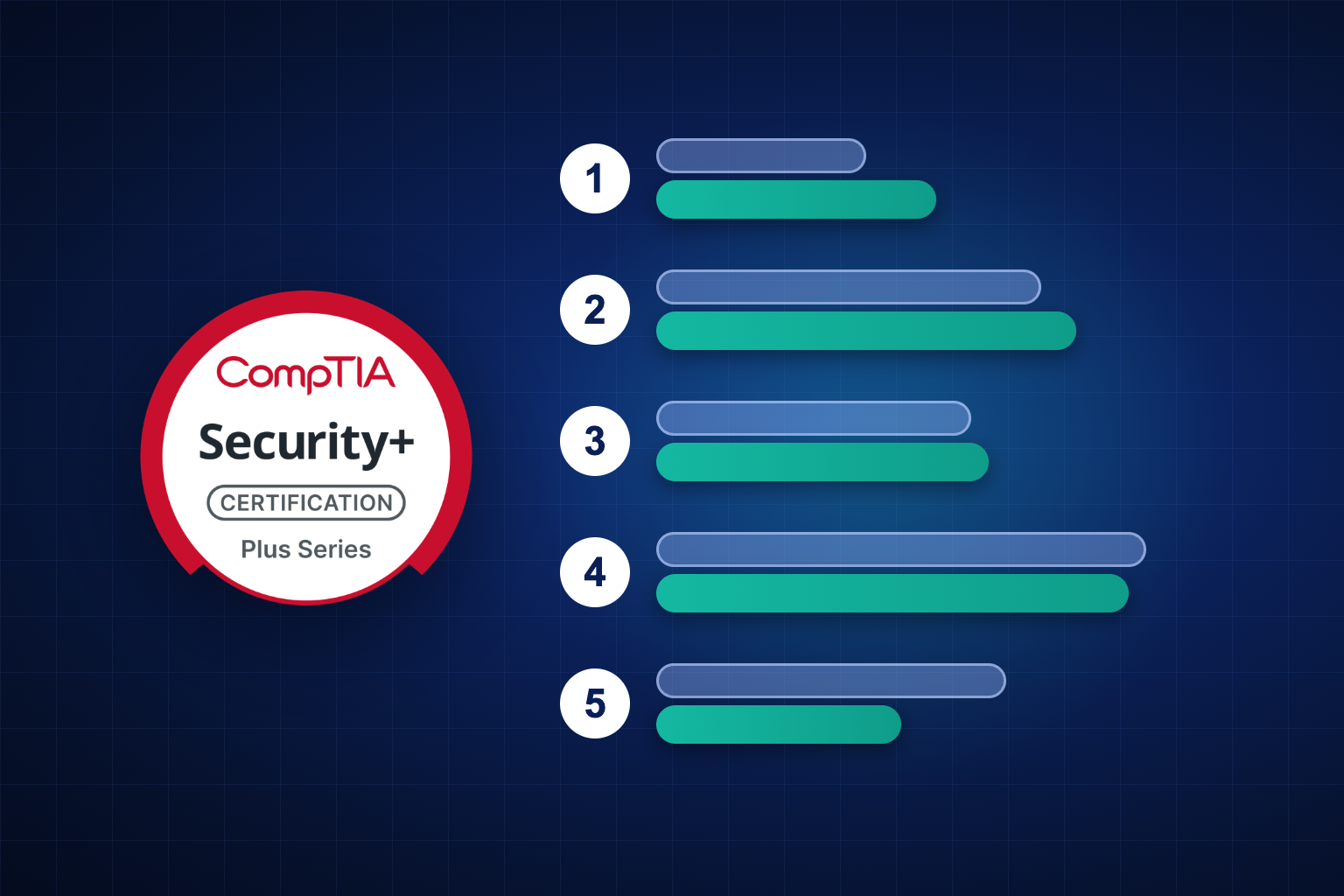
If you're preparing to start a career in cyber security, the CompTIA Security+ exam (SY0-801, or SY0-701 until it retires) covers a broad range of essential topics, making it crucial to understand its knowledge domains.
Security+ SY0-701 or SY0-801? (updated November 2026)
CompTIA launched Security+ SY0-801 on 17 November 2026. We recommend SY0-701 for now: it’s valid until 11 June 2027, 801 is brand new with very little training available yet, and employers only ask whether you have Security+, not which version. Our free Security+ cheat sheet covers both.
Mastering these domains will help you structure your study plan and ensure you're ready for the exam. But what does each of these Security+ domains mean, and what cyber security concepts do they include?
Look no further: we’ve got you covered. We’ll demystify the exam objectives to help you plan your studies. For each domain, we’ll explain key ideas, terms, and acronyms you must remember. Moreover, we’ll show you examples of questions that assess your knowledge of every exam domain.
When you’re ready, let’s dive in.
For Less.
StationX is a CompTIA Authorized Partner. The same official exam vouchers you'd buy from CompTIA, for less.
CompTIA price USD 878.00
Your exam voucher plus a free second attempt if you don't pass first time.
Today's US prices against CompTIA's US list price. Prices change and vary by country; the voucher page shows yours.
About the CompTIA Security+ Exam
CompTIA Security+ is a globally recognized entry-level cyber security certification focusing primarily on up-to-date best practices for risk management and risk mitigation. It emphasizes the practical aspects of identifying and addressing security threats, attacks, and vulnerabilities.
According to CompTIA, the target audience for the Security+ certification is IT professionals with about two years of experience in IT administration with a security focus. For SY0-801, CompTIA recommends two years of hands-on experience as a security administrator; for SY0-701, it recommends Network+ and two years in a security or systems administrator job role.
They should have experience in IT administration with a focus on security, hands-on experience with technical information security, and a broad knowledge of security concepts.
The latest CompTIA Security+ exam code is SY0-801, which launched on 17 November 2026. Its five exam domains are:
- General Security Concepts (16%)
- Threats, Vulnerabilities, and Attacks (24%)
- Security Architecture (19%)
- Security Operations (27%)
- Security Program Management and Oversight (14%)
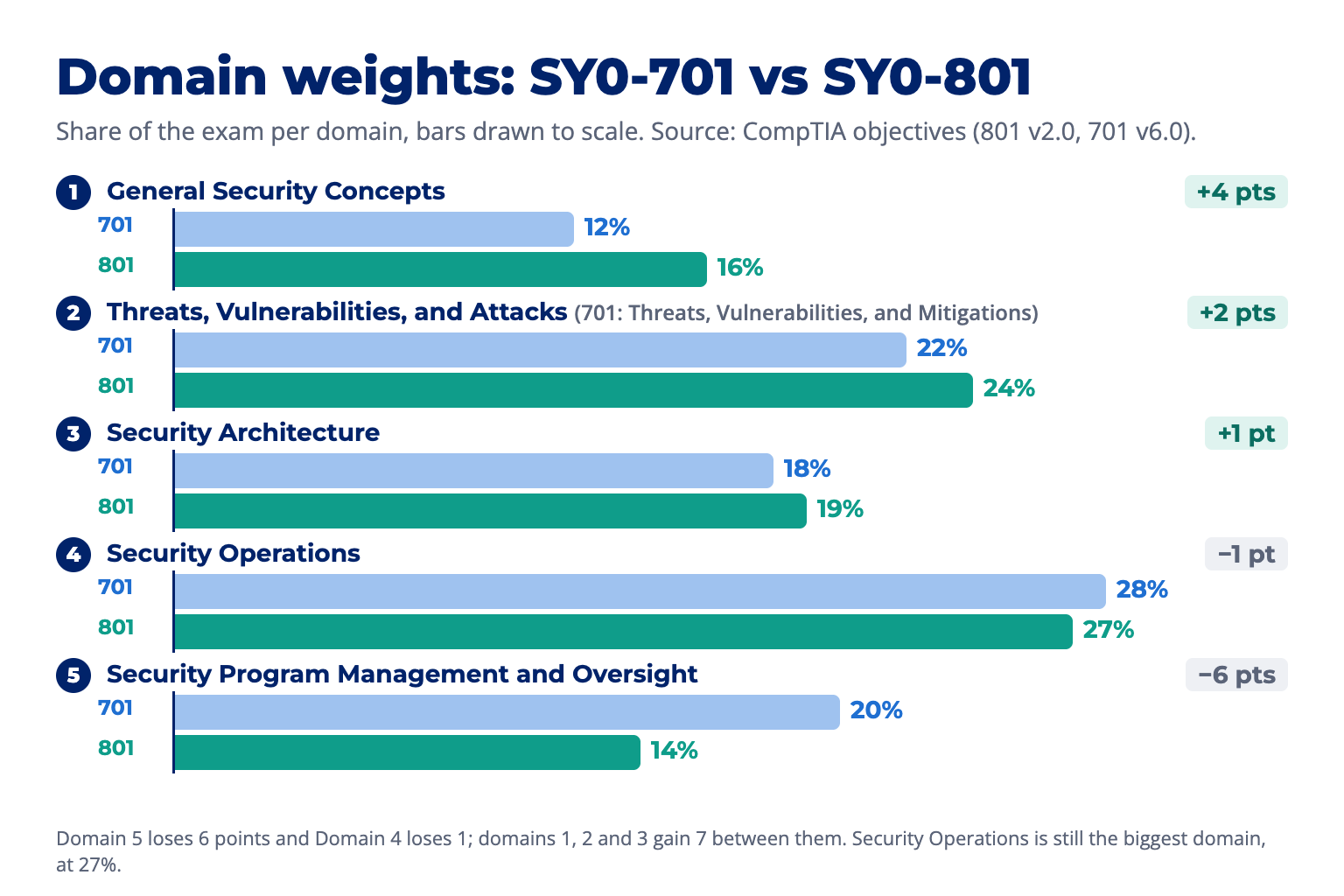
SY0-701 is still available until its English exam retires on 11 June 2027, and it’s the version we recommend for now. Both versions lead to the same Security+ certification. Here’s how their domains compare:
| Domain | SY0-701 | SY0-801 |
|---|---|---|
| 1.0 General Security Concepts | 12% | 16% |
| 2.0 Threats, Vulnerabilities, and Mitigations (701) / Threats, Vulnerabilities, and Attacks (801) | 22% | 24% |
| 3.0 Security Architecture | 18% | 19% |
| 4.0 Security Operations | 28% | 27% |
| 5.0 Security Program Management and Oversight | 20% | 14% |
What Changed in SY0-801?
CompTIA hasn’t published an official list of changes, so this comes from our side-by-side reading of the two exam objectives documents (SY0-701 v6.0 and SY0-801 v2.0):
- The weights shift. Domain 1 gains 4 points, Domain 2 gains 2 and Domain 3 gains 1. Domain 4 loses 1 and Domain 5 loses 6. Security Operations is still the biggest domain.
- Domain 2 is renamed “Threats, Vulnerabilities, and Attacks”. Mitigation techniques, objective 2.5 in SY0-701, become part of Domain 4 (objective 4.1).
- AI is new. Objective 2.6 covers threats and vulnerabilities associated with artificial intelligence, such as prompt injection, poisoning, jailbreaking, and hallucinations. Objective 4.6 adds AI to automation, including agentic AI and chatbots.
- Incident response steps change (see Domain 4 below), and recovery metrics such as RTO and RPO move from Domain 5 to Domain 3.
- The format stays the same: up to 90 questions in 90 minutes, with a passing score of 750. SY0-801 has 27 objectives (SY0-701 has 28) and, for now, is offered in English only.
The Security+ exam is essential for aspiring cybersecurity professionals, IT administrators, and related roles because it validates the skills needed for baseline security readiness and incident response. It equips candidates to handle current threats and take a proactive approach to preventing future attacks.
Topics in these core knowledge domains include the latest trends in threats, attacks, vulnerabilities, automation, zero trust, risk, IoT, and operational technology (OT). SY0-801 also adds AI-related risks.
There’s also a strong focus on the latest techniques for cyber security professionals working in hybrid cloud and on-premises environments. So, pay attention to cloud environments, communication, reporting, and teamwork.
The CompTIA Security+ exam includes two types of questions:
- Multiple-choice questions, which may admit single or multiple answers;
- Performance-based questions (PBQs), which test your ability to solve problems in a simulated environment.
These make CompTIA Security+ an incredibly valuable certification, demonstrating the holder’s excellence in practical cyber security skills. According to CompTIA, most PBQs appear at the beginning of the exam. It doesn’t publish how many you’ll get.
Both versions are 90-minute examinations, during which you’ll answer up to 90 questions and complete an optional survey afterwards. The passing score is 750 on a scale of 100 to 900.
For more information, refer to our guide to Security+.
Below, each domain shows its SY0-801 weight first. The example questions apply to both SY0-701 and SY0-801: each one tests a topic listed in both versions’ exam objectives.
Without further ado, let’s move on to the first domain.

Domain 1: General Security Concepts (SY0-801: 16%, SY0-701: 12%)
“Better safe than sorry.”
Cyber security is an umbrella industry of multiple and diverse roles, including technical and administrative. Different areas of cyber security represent how we can categorize many topics based on their connections and relationships.
This domain concerns key security principles: fundamental cyber security concepts, appropriate security controls, change management processes, security solutions, and cryptographic solutions. Such concepts form the basis for the dynamic field of cyber security knowledge. SY0-801 merges SY0-701’s first two objectives (security controls and fundamental concepts) into one and adds defense in depth and least privilege to it.
Arguably, the most important security principle is the CIA Triad:
- Confidentiality means you need authorization to access certain data.
- Integrity focuses on maintaining the accuracy, consistency, and trustworthiness of data.
- Availability ensures that resources are accessible and usable when needed.
News, such as the infamous CrowdStrike outage, caused by a faulty software update rather than a cyberattack, shows that no organization is immune to disruption.
Therefore, a major topic in this domain is change management, the navigation of the impacts of changes to an organization. Risk management, an ongoing process of identifying, analyzing, evaluating, and addressing cyber threats, belongs to Domain 5.
Cyber threats often originate from threat actors, which include individuals, groups, or organizations such as hackers, cybercriminals, and nation-state actors.
However, threats can also arise from system vulnerabilities, misconfigurations, and human error. Security controls help organizations avoid, prevent, detect, mitigate, respond to, and remediate risks posed by both intentional and unintentional cyber threats.
Cryptography is an important part of technical security controls in this domain. It protects data such as credit card transactions, emails, and websites from theft or tampering.
It’s based on the use of algorithms and mathematical functions to transform readable plaintext into unintelligible ciphertext, which is difficult to recover computationally.
Some key terms/acronyms to remember:
- AAA: Authentication, Authorization, and Accounting
- Blockchain: a tamper-resistant shared data structure often associated with cryptocurrency. (SY0-701 only; SY0-801’s cryptography objective no longer lists it.)
- Non-repudiation: the inability of a subject to deny having performed an action.
- PKI: Public key infrastructure
- Zero Trust: The zero trust model enforces strict verification for all users and devices inside and outside an organization’s network. It requires continuous authentication and access validation, reducing the risk of breaches caused by compromised credentials or insider threats.
Example questions from this domain: (answer key follows)
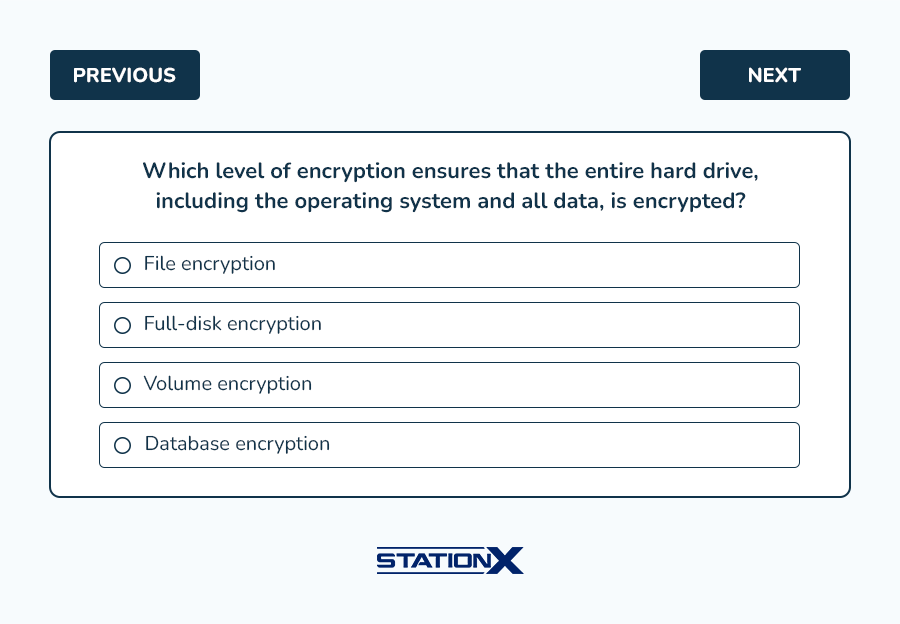
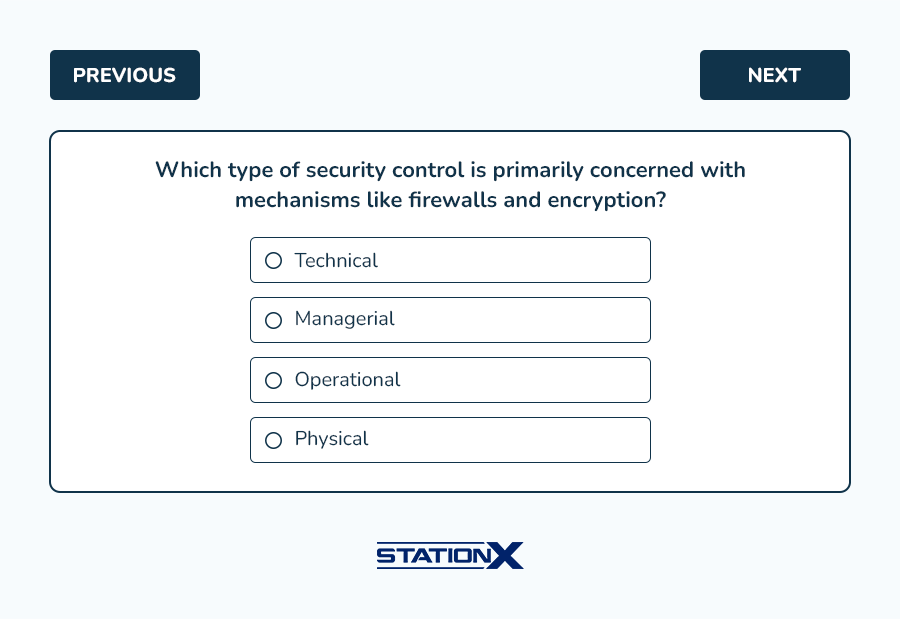
Expand for answer key
Answers:
- B. Full-disk encryption ensures that the entire hard drive, including the operating system and all data, is encrypted. This protects against unauthorized access, especially if the device is lost or stolen.
- A. Technical controls, often referred to as logical controls, are implemented using technology. They are designed to protect data's confidentiality, integrity, and availability as it is processed, transmitted, and stored. Examples include firewalls, which block unauthorized access to a network; encryption, which scrambles data so it can’t be understood without the correct key; and intrusion detection systems, which monitor networks for signs of malicious activity.
Domain 2: Threats, Vulnerabilities, and Attacks (SY0-801: 24%, SY0-701: 22%)
“Status quo—that’s Latin for the mess we’re in…”
This domain focuses on identifying and mitigating security threats and vulnerabilities.
You must understand common threat actors and their motivations, threat vectors and attack surfaces, vulnerabilities, indicators of malicious activity, and cyber threat mitigation techniques. In SY0-801, mitigation moves to Domain 4, and a new objective covers threats and vulnerabilities associated with artificial intelligence (AI), such as model manipulation, data poisoning, prompt injection, and jailbreaking.
In cyber security, assets are devices containing something to protect, such as data. You must become familiar with different types of threats:
- Malware refers to applications that steal data from or ruin assets, such as ransomware, Trojans, worms, spyware, bloatware, viruses, keyloggers, logic bombs, and rootkits.
- Social engineering exploits human weakness to gain unauthorized access and perform unauthorized functions on assets.
- Insider threats are accidental or deliberate organizational risks that can cause damage.
- Advanced persistent threats (APTs) are covert operations aimed at long-term intelligence-mining hacking.
Every system has exploitable weak points called vulnerabilities. Those with low cyber security awareness may not know about them until something happens. Here are some common vulnerabilities:
- Outdated software poses cyber security risks because threat actors may have found ways to exploit the old code. Hence, it’s important to patch your systems regularly.
- Misconfigurations and faulty updates may cause systems to crash—the CrowdStrike outage in July 2024, caused by a defective content update, is a case in point.
- Weak authentication mechanisms, such as wireless security settings, permit unauthorized resource access.
But not all hope is lost. Mitigation strategies (part of Domain 4 in SY0-801) include:
- Patch management: Always keep systems up-to-date with a rollback in case of a crash.
- Access controls: Limiting permissions to data and systems reduces the likelihood of data breaches and insider threats.
- Security awareness training: A common implementation is having staff respond to simulated phishing emails.
Some key terms/acronyms to remember:
- ACL: Access Control List
- DDoS: Distributed denial-of-service attack
- SQLi: Structured Query Language injection
- Zero-day attack: An attack that exploits a previously unknown vulnerability
- Prompt injection (SY0-801): Crafting input that makes an AI model ignore its instructions or reveal data it shouldn’t
Example question from this domain: (answer key follows)
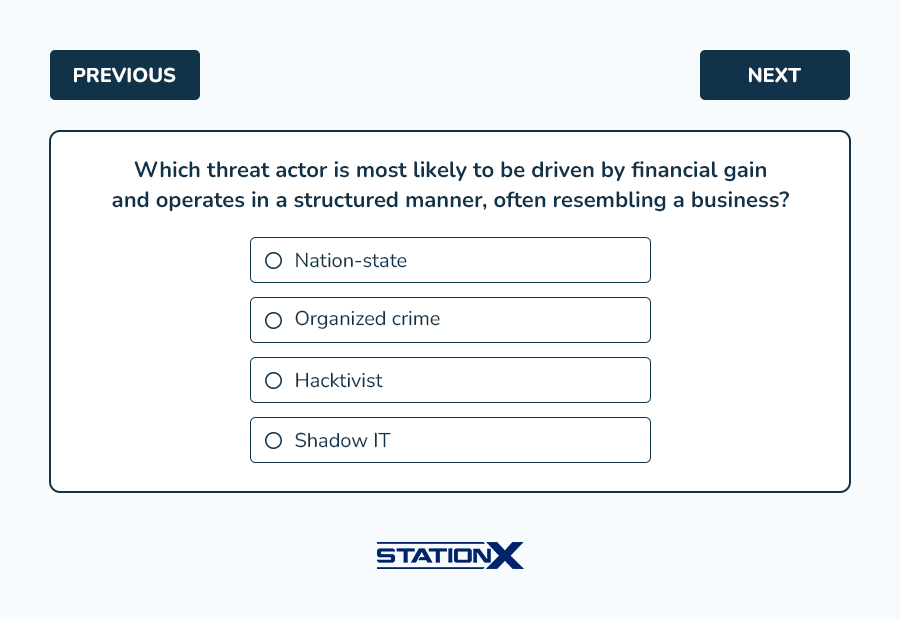
Expand for answer key
Answers:
- B. Organized crime groups are primarily motivated by financial gain. They operate in a structured manner, often resembling businesses, and engage in illegal activities to generate profit. Their operations can range from fraud schemes to ransomware attacks, and they often have resources and capabilities that can pose significant threats.
Domain 3: Security Architecture (SY0-801: 19%, SY0-701: 18%)
“He wins his battles by making no mistakes. [...] the skillful fighter puts himself into a position which makes defeat impossible and does not miss the moment for defeating the enemy.”
This domain highlights the process of designing secure IT infrastructures, including the security implications of different architecture models, concepts, and strategies to protect data and the importance of resilience and recovery. SY0-801 adds topics such as Security Service Edge (SSE), Group Managed Service Accounts (gMSAs), and privilege creep.
Questions will ask you about scenarios in which you apply security principles to secure enterprise infrastructure.
Security models offer a blueprint for organizational security. They often follow security frameworks such as NIST and ISO, which are well-documented standards, policies, procedures, and best practices to strengthen an organization’s security posture and reduce risk.
The most important principles of secure design are defense-in-depth and least privilege (SY0-801 lists both under Domain 1). Layering security measures delays threat actors’ intrusion and speeds up their eventual detection. Least privilege limits threat actors’ impact on assets.
Secure network architecture concepts, such as the following, comprise a major part of this domain:
- Segmentation refers to dividing a network into smaller sections or subnets using devices such as switches, routers, and firewalls, or logical groupings such as virtual local area networks (VLANs).
- Firewalls filter incoming and outgoing network traffic based on predefined security rules.
- Demilitarized zones (DMZs) are physical or logical sub-networks that separate an organization’s internal network from external untrusted networks. They typically contain external-facing resources such as DNS, email, proxy, and web servers.
Some key terms/acronyms to remember:
- Defense-in-depth: Using multiple layers of security measures
- ICS: Industrial control systems (SY0-701; SY0-801 groups these under operational technology, OT)
- Least privilege: Only grant users/entities the minimum access or permissions needed to perform their job.
- SASE: Secure access service edge (SY0-701; SY0-801 lists Security Service Edge, SSE)
- SCADA: Supervisory control and data acquisition (SY0-701)
Example questions from this domain: (answer key follows)

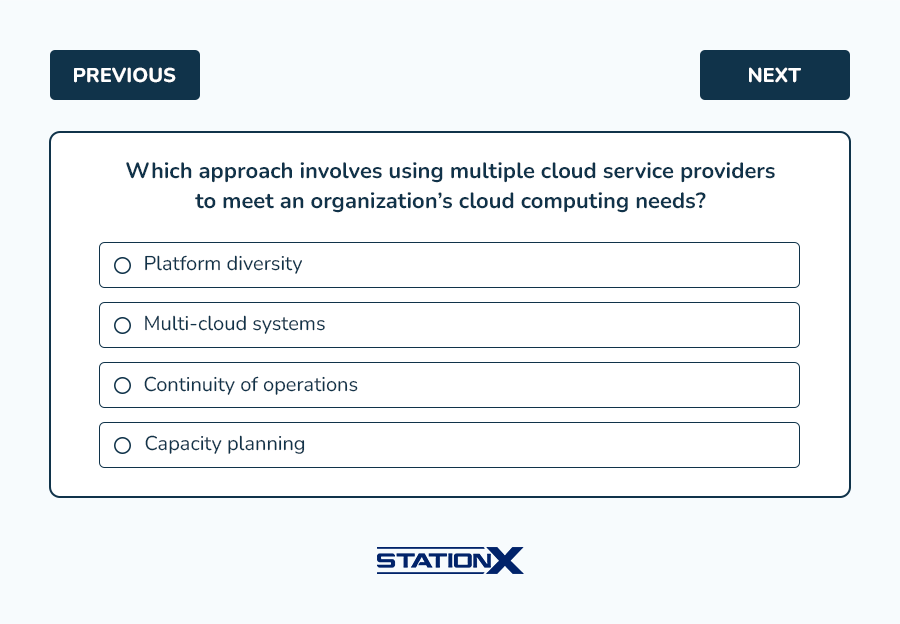
Expand for answer key
Answers:
- B. In a serverless architecture, developers write code that is executed in response to events. The cloud provider automatically manages the infrastructure, including server provisioning and scaling, allowing developers to focus on code.
- B. Multi-cloud systems involve leveraging multiple cloud service providers to distribute cloud computing resources and reduce dependence on a single provider.
Domain 4: Security Operations (SY0-801: 27%, SY0-701: 28%)
“Keep your head on a swivel.”
The highest-weighted domain in both versions focuses on daily security tasks and incident response.
You must understand the security implications of proper hardware, software, and data asset management, vulnerability management, security alerting and monitoring, automation and orchestration in secure operations, and incident response. SY0-801 adds AI to automation (agentic AI, chatbots, and AI-augmented baselines) and takes in the mitigating controls that used to sit in Domain 2.
Scenario-based questions will test your knowledge of common security techniques for computing resources, ways to modify enterprise capabilities to enhance security, identity and access management, and the use of data sources to support an investigation. For example, questions on secure application development belong here.
Monitoring, logging, and continuous security assessment are important because organizations can thus respond promptly to emerging threats, ensuring the security of their systems and data.
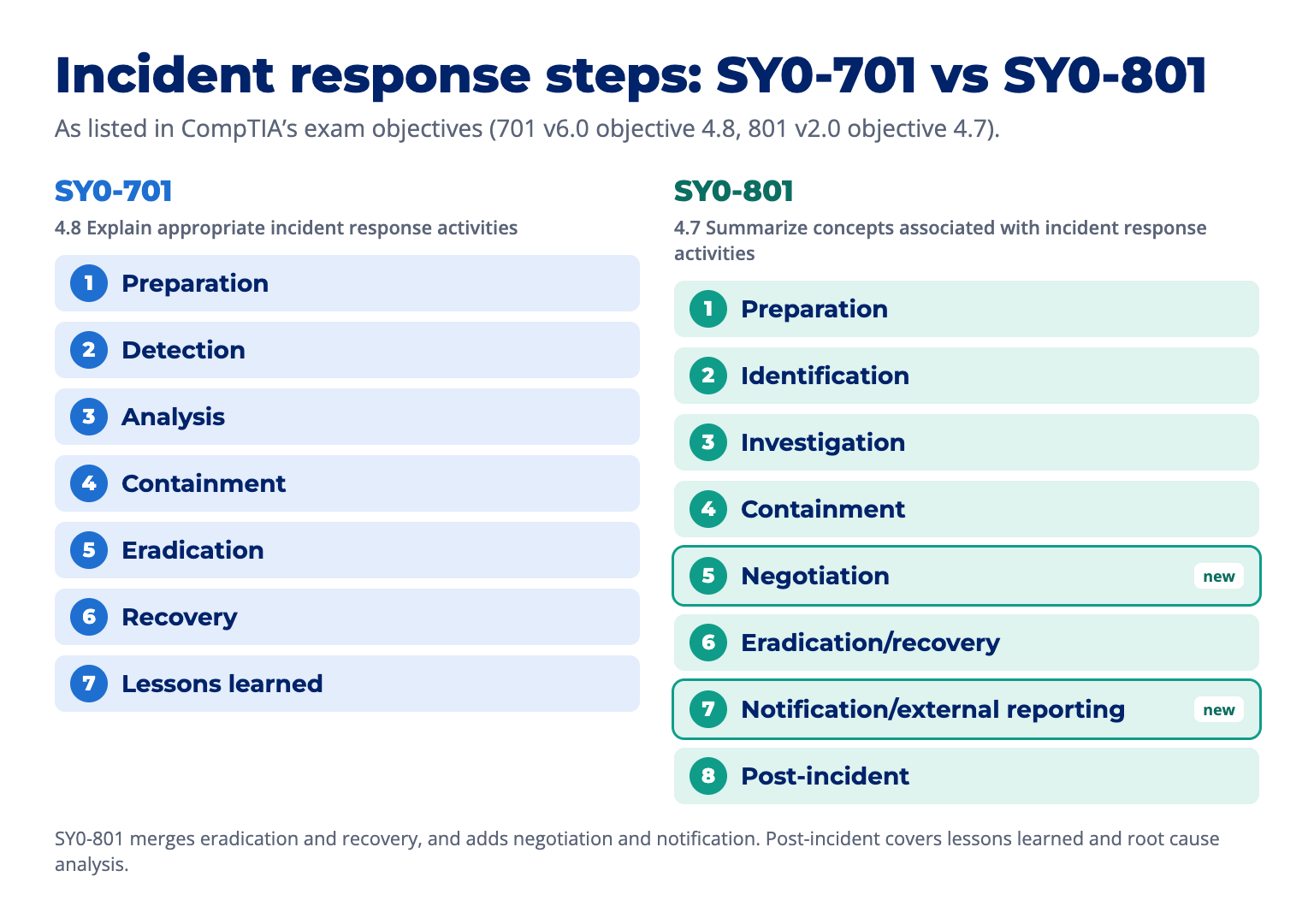
The incident response steps differ between the two versions. SY0-801 merges eradication and recovery, and adds negotiation and notification/external reporting:
Familiarize yourself with operational security practices such as:
- Vulnerability management: the ongoing, regular process of identifying, assessing, reporting on, managing, and remediating vulnerabilities across a network.
- Threat hunting: a proactive approach to identifying previously unknown or ongoing cyber threats.
- Security automation: the use of tools with minimal human intervention for preventing, detecting, identifying, and eliminating cyber threats.
Some key terms/acronyms to remember:
- CVE: Common Vulnerabilities and Exposures (SY0-701’s objectives call it Common Vulnerability Enumeration)
- NAC: Network access control
- MDM: Mobile device management
- OSINT: Open-source intelligence (SY0-701)
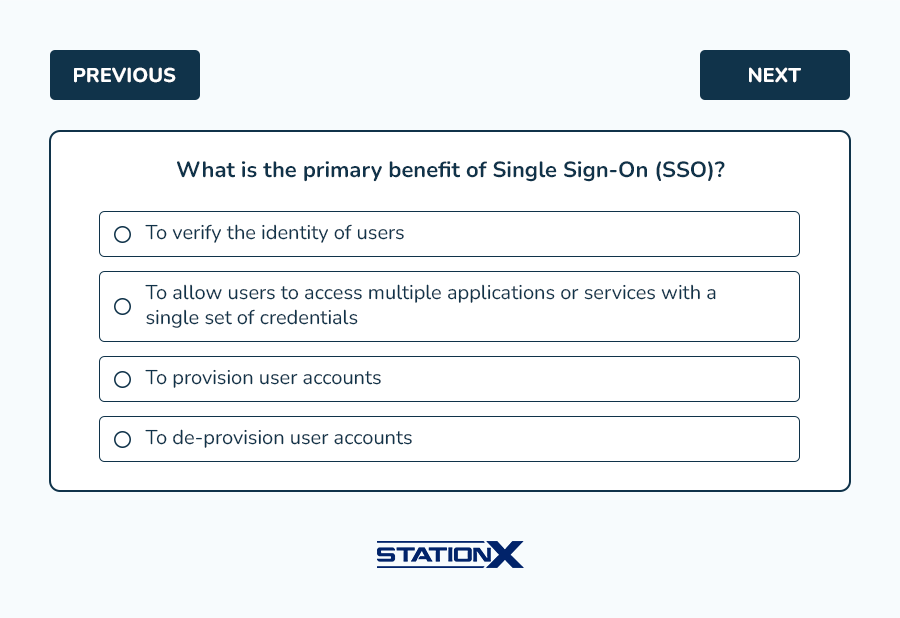
Example question from this domain: (answer key follows)
Expand for answer key
Answers:
- B. SSO simplifies the user experience by allowing users to log in once and gain access to multiple applications or services without needing to authenticate multiple times
Free Security+ cheat sheet
Revising for the exam? Our CompTIA Security+ cheat sheet covers SY0-801 and SY0-701 side by side: ports, cryptography, attacks, risk maths and mnemonics, plus a free PDF.
Domain 5: Security Program Management and Oversight (SY0-801: 14%, SY0-701: 20%)
“Learn to obey before you command.”
Real-life cyber security professionals must comply with relevant laws, regulations, and industry standards because cyber threats have consequences. Governance, risk management, and compliance (GRC) characterize this domain. It shrinks the most in SY0-801, from 20% to 14%.
You must know about effective security GRC, third-party risk assessment and management, audits, and assessments. Scenario-based questions will ask you how to implement security awareness practices.
Cyber security and risk management go hand in hand. We rely on security frameworks such as NIST or ISO 27001 to communicate security policies to other members of their respective teams at work and amongst other cyber security professionals in the industry.
From these policies, we derive procedures to deal with cyber threats.
Business continuity planning (BCP) is a system of prevention and recovery from potential threats to a company. The goal is to protect personnel and assets and quickly resume their functions in a disaster.
Disaster recovery planning (DRP) ensures businesses are prepared to face different cyber threats, including malware attacks, power outages, and natural disasters. A good DRP swiftly and effectively restores operations in an enterprise environment.
Laws and standards like GDPR, HIPAA, and PCI DSS impose standardized procedures on data handling. Regulatory compliance with them respects the data privacy rights of individuals and groups involved, defiance of which may have severe legal and reputational consequences.
Some key terms/acronyms to remember:
- AUP: Acceptable Use Policy
- ALE: Annualized Loss Expectancy
- RPO: Recovery Point Objective (in Domain 3 for SY0-801)
- SDLC: Software development lifecycle (SY0-701)
- SLA: Service Level Agreement
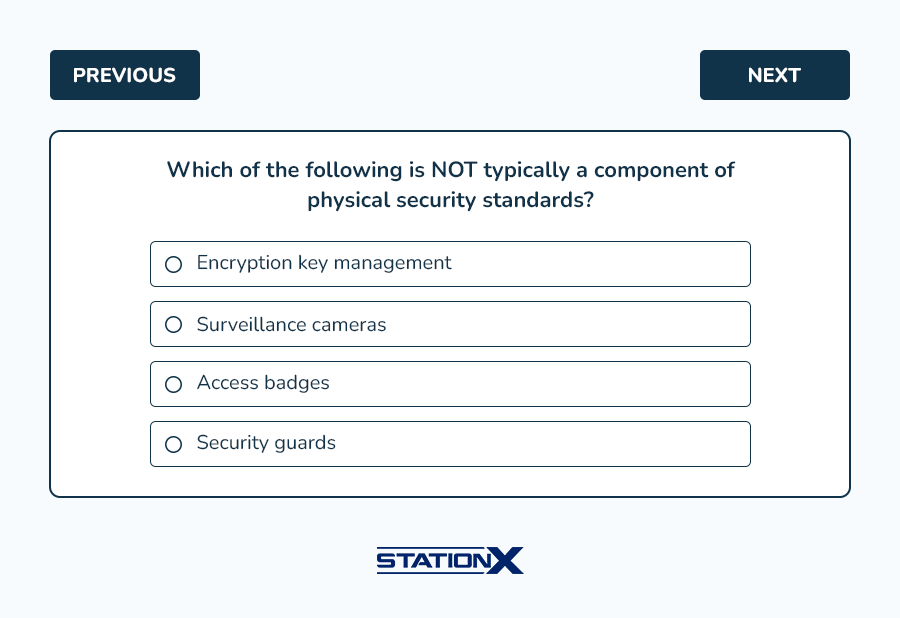
Example question from this domain: (answer key follows)
Expand for answer key
Answers:
- A. While surveillance cameras, access badges, and security guards are components of physical security standards, encryption key management pertains to encryption standards.
- ✓A step-by-step Security+ roadmap: every exam domain in order, so you always know what to study next
- ✓Free video lessons, guides and cheat sheets from our Security+ courses
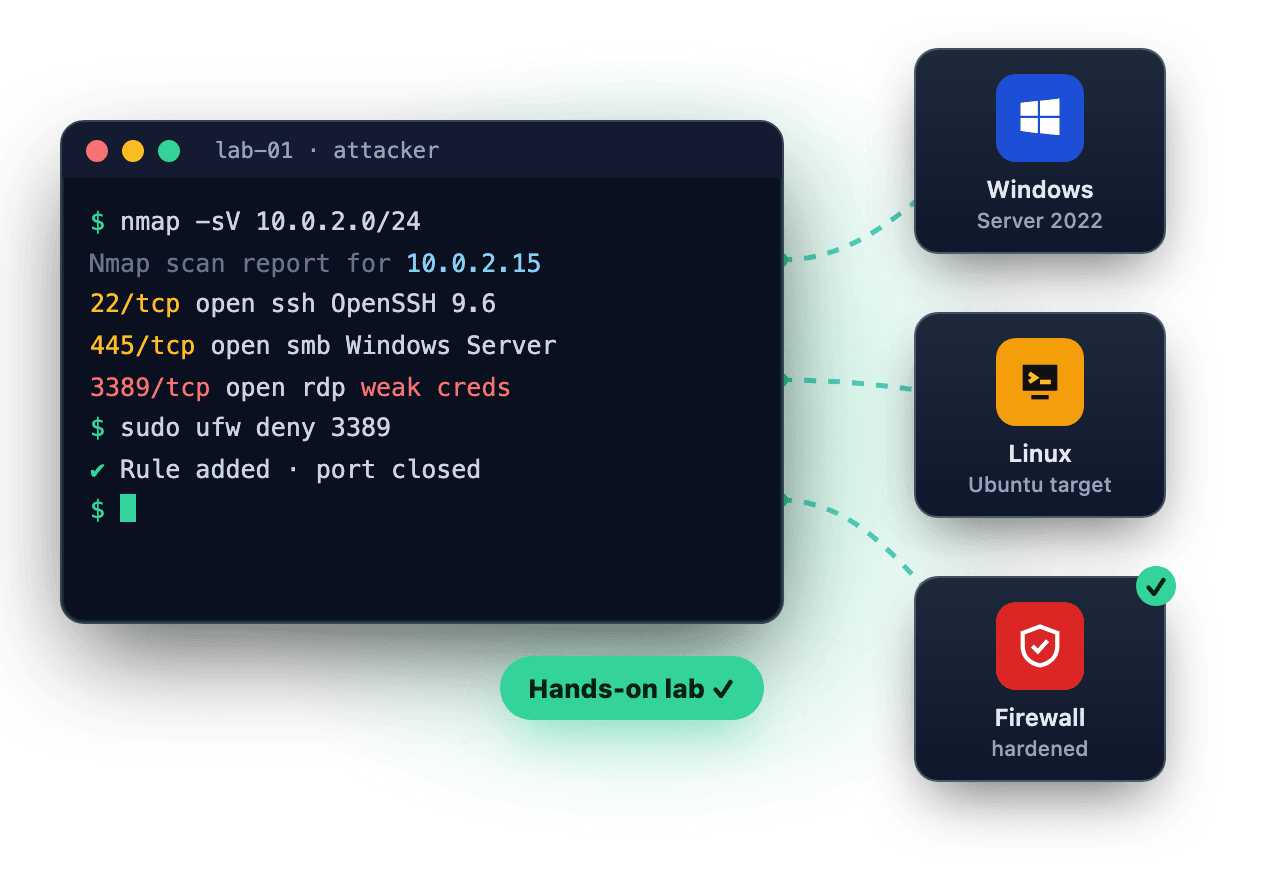
- ✓Hands-on labs in your browser: nothing to install, try one free
- ✓All your progress in one place, ready for exam day
Built for SY0-701; our SY0-801 roadmap is coming soon.
Conclusion
We hope this brief article on Security+ domains helps you plan your studies for this in-demand entry-level cyber security certification.
SY0-801 is now live, but we recommend taking SY0-701 for now: it stays available until 11 June 2027 and leads to the same Security+ certification. Security+ isn’t an easy exam, but with proper planning, practice, and perseverance, you can enter the field of cyber security and gain valuable work experience there for further career opportunities.
If you’re preparing for your Security+ certification, we have two great options to help your success. You can buy our CompTIA Security+ Course & SY0-701 Practice Test Bundle as a one-time purchase and get lifetime access to over 50 hours of on-demand training, 15 practice exams, and flashcards for SY0-701.
To learn Security+ step by step, follow the StationX Security+ roadmap on StationX Labs: video courses for each exam domain plus hands-on labs for SY0-701 (our SY0-801 roadmap is coming soon), and it’s free to start.
Lastly, you can save big by purchasing your Security+ exam voucher directly from StationX! We offer vouchers for all CompTIA certification exams, at a discount off CompTIA’s price.
For Less.
StationX is a CompTIA Authorized Partner. The same official exam vouchers you'd buy from CompTIA, for less.
CompTIA price USD 878.00
Your exam voucher plus a free second attempt if you don't pass first time.
Today's US prices against CompTIA's US list price. Prices change and vary by country; the voucher page shows yours.
The CompTIA Security+ Course & SY0-701 Practice Test Bundle includes:
- CompTIA Security+ Study Guide: SY0-701 Total Course
- CompTIA Security+ Training: Self-Paced Course
- CompTIA Security+ SY0-701 Exam Questions and Answers
- CompTIA Security+ Practice Test Series: Ace the SY0-701
- CompTIA Security+ Exam Objectives Flash Cards: SY0-701 Prep
About the Author

Nathan House, Founder & CEO of StationX
Nathan House has 30 years of hands-on cybersecurity experience and is Cambridge-educated, holding CISSP, CISA, CISM, OSCP, CEH, and SABSA. He founded StationX in 1999 — one of the UK’s first cybersecurity companies — and has secured £71 billion in UK mobile banking transactions and the London 2012 Olympics, advising clients including Microsoft, Cisco, BP, Vodafone, and VISA. He authored the world’s most popular cybersecurity course — a #1 Udemy bestseller taken by over 500,000 students — and was named Cyber Security Educator of the Year 2020, AI Security Educator of the Year, and a UK Top 25 Security Influencer 2025. A DEF CON speaker and featured expert on CNN, Fox News, NBC, and the BBC, Nathan leads StationX’s training of more than half a million students worldwide.