Is Cybersecurity Hard? What the Data Actually Shows (2026)
Is cybersecurity hard? If you're thinking about getting into it, you've probably asked yourself that more than once. And the honest answer is yes, but probably not for the reason you think.
I've spent 30 years in cybersecurity and taught more than 500,000 students. What I've seen again and again is that the material isn't what stops most people. Something else decides whether you make it. In this guide, we'll look at what's genuinely easier than you think, what's actually hard, and what the research says helps. Then I'll give you five practical ways to make it easier on yourself.
TL;DR if you've only got 30 seconds
The technical fundamentals are learnable. You don't need to be a genius, a coder, a graduate or young.
The hard part is finishing. Most people who start free online courses never complete them.
Commitment and structure change who finishes: paying learners, cohorts and people with a firm plan all do much better.
So the real question isn't "am I smart enough?" It's "what will keep me going?"
Is Cybersecurity Hard? The Short Answer
Cybersecurity is hard in the way learning a language is hard. Any one lesson is manageable. What's hard is turning up for enough lessons, over enough months, to actually become fluent. Most people who struggle with cybersecurity don't hit a wall of difficulty. They drift away.
That's good news, because drifting away is a problem you can fix. You can't make yourself smarter overnight, but you can change the structure around you. Let's start with why it feels so hard in the first place.
Why Cybersecurity Feels So Hard
It does feel intimidating, and I think we should be honest about that.
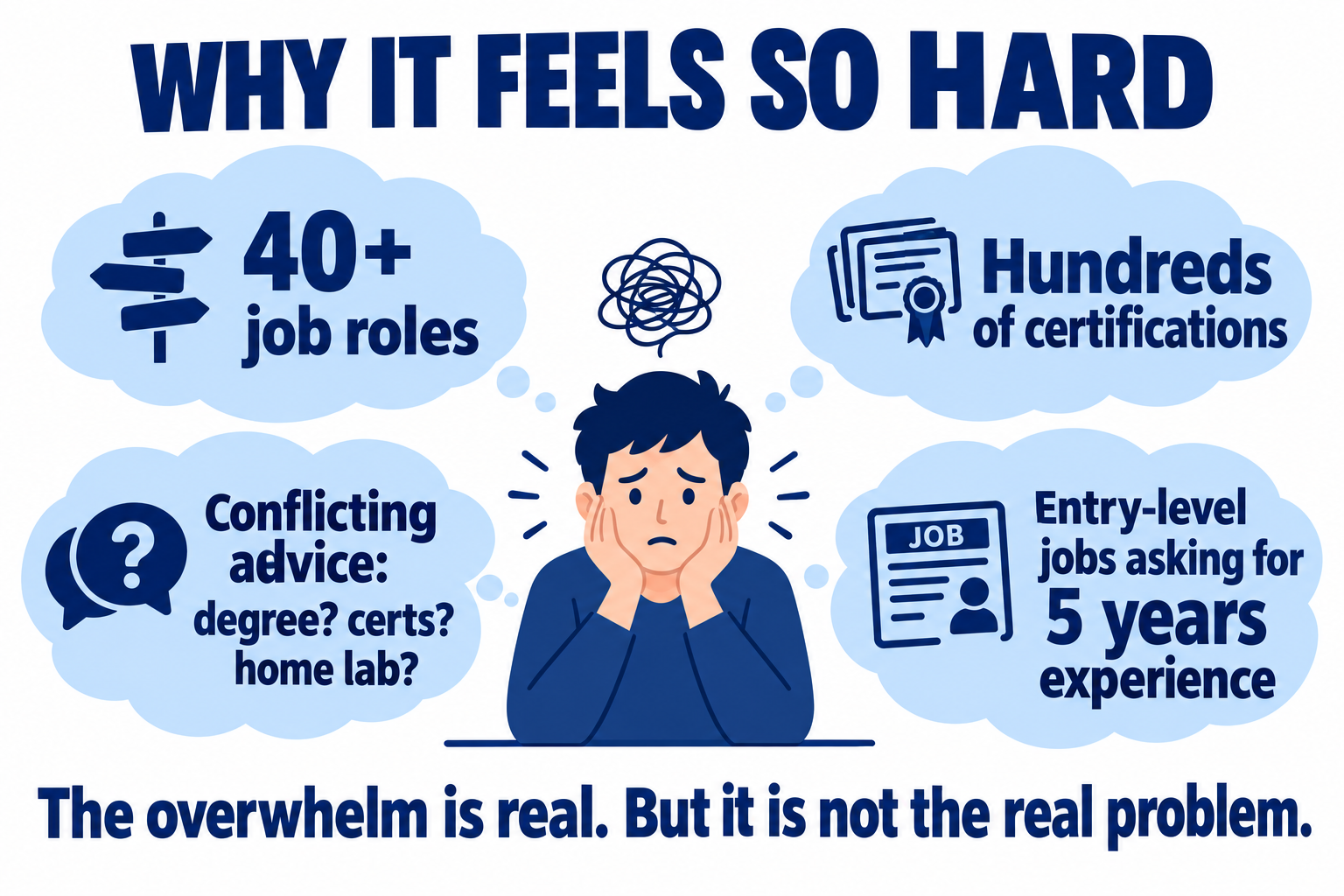
There are dozens of roles. Penetration tester, SOC analyst, cloud security engineer, governance and risk, incident response. Somewhere between 40 and 50 of them, depending on how you count.
There are hundreds of certifications. CompTIA Security+, CISSP, Certified Ethical Hacker, OSCP. Every one of them feels like it could be the right answer or the wrong one.
The advice contradicts itself. One person says get a degree. Another says a degree is useless. Someone else says forget both and build a home lab (your own practice setup at home).
Entry-level job ads can be unrealistic. In ISC2's 2025 survey of 929 hiring managers, 38% said they require CISA for entry-level roles, and 34% expect CISSP. Both need around five years' experience. ISC2 itself called requirements like that "often difficult or impossible" for newcomers to meet.
So if you've felt overwhelmed, it isn't just you. But after three decades, I've noticed that overwhelm does something worse than make it feel hard. It makes people quit. That's the real problem, and we'll come back to it.
What's Easier Than You Think
Some parts of cybersecurity are genuinely easier than most people expect.
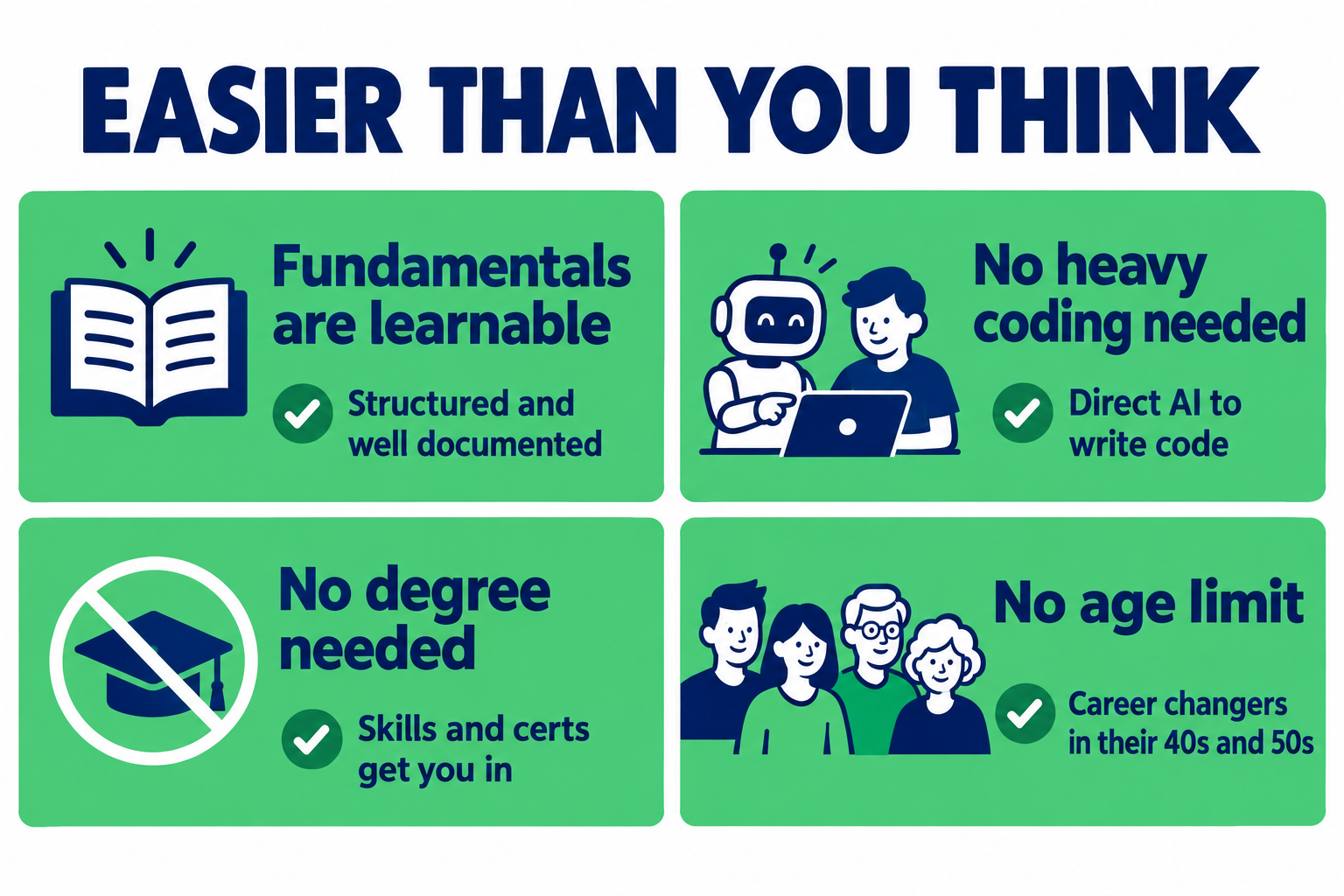
The fundamentals are learnable. Networking, security concepts and how systems work are structured and well documented. You don't need to be a genius. You need a decent study plan and some consistency. Take a certification like CompTIA Security+. It's a common first certification, and people pass it every day by working through a structured course and practice exams. One tip: CompTIA doesn't publish pass rates, so ignore any "official" pass rate you see online.
You don't need to be a coder. You do need to understand how code and systems work. But more and more of the actual code writing can be done by AI tools. What matters is knowing what to build and how to direct those tools well.
You don't need a degree for many roles. Some of the most successful people I've worked with don't have one. Many job ads still list a degree, but plenty of hiring managers will look past it if you can prove what you can do. I go into the numbers in Is a Cybersecurity Degree Worth It?
Your age doesn't matter. I've mentored many career changers in their 40s and 50s who now work in the field. And employers are used to hiring people who started somewhere else: in ISACA's 2026 survey, 54% of security professionals said half or more of their cybersecurity team started out in a different field.
So for most people, the technical side is the easier part. Which raises the obvious question.
The Hard Part: Finishing
What gets most people isn't the material. It's finishing.
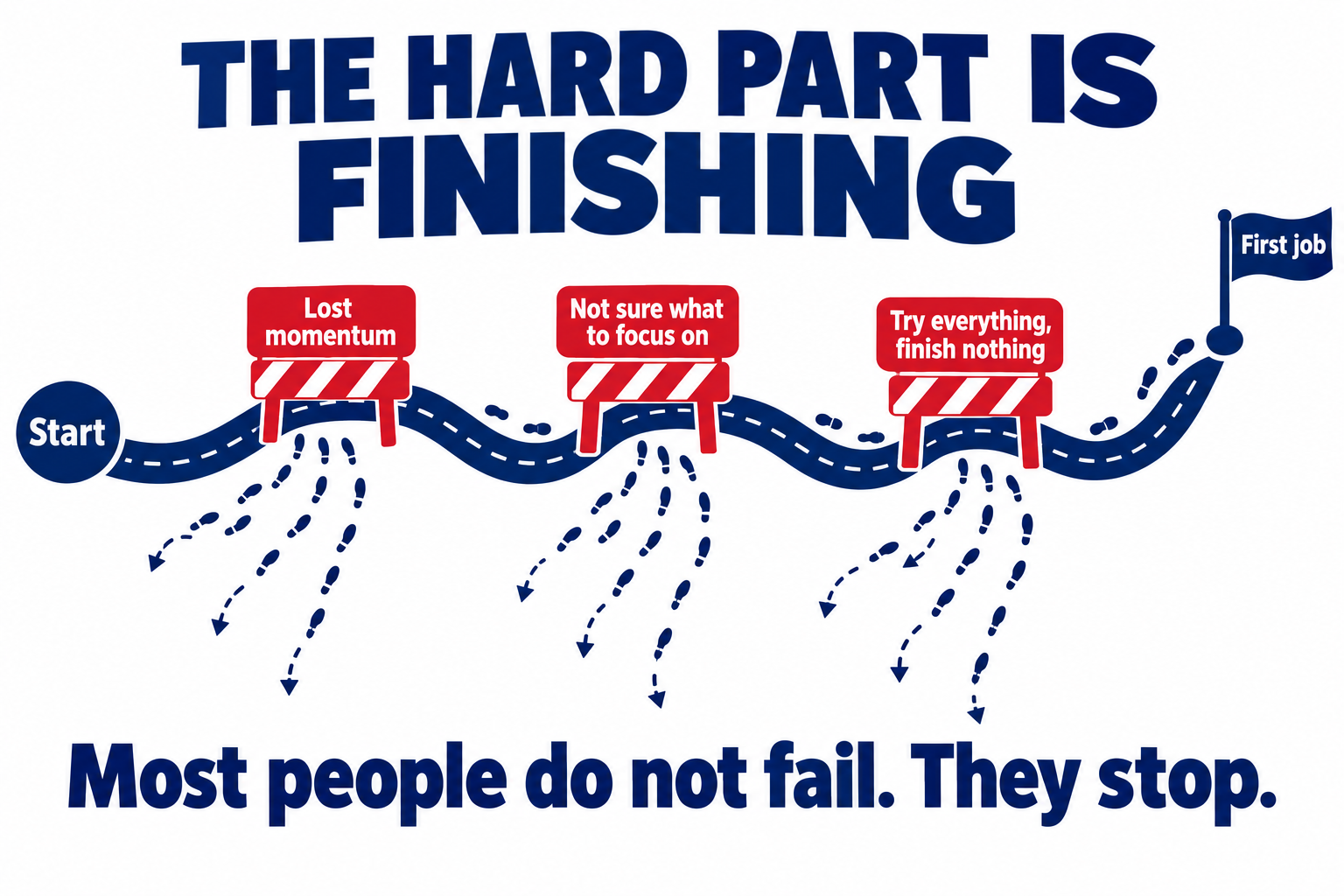
Look at online courses. A study of 221 free online courses found a median completion rate of 12.6%. In Harvard and MIT's free online courses, just over 3% of learners finished in 2017 to 2018. So most people who start, stop.
Those numbers don't tell us why people stop. But in my experience, it's rarely the material. It's a human problem, not a cybersecurity one. People lose momentum. They don't know what to focus on, so they try everything and finish nothing. I sometimes think of a cat chasing a laser pointer: lots of energy, always moving, never catching anything.
And yes, soft skills matter too. In the 2025 ISC2 Cybersecurity Workforce Study, hiring managers named problem solving (29%), collaboration (24%) and communication (22%) more often than any technical skill.
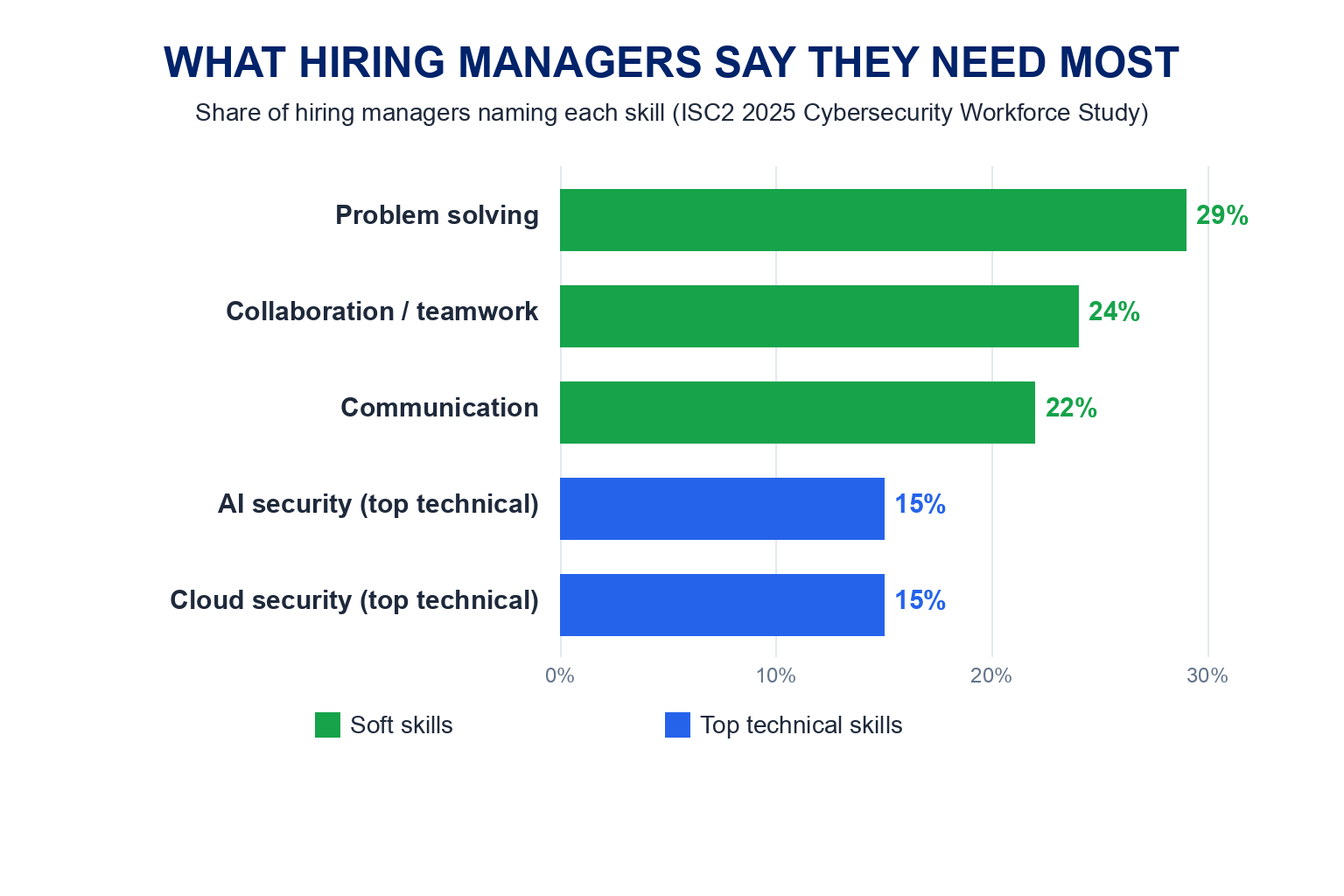
But soft skills only matter if you stay long enough to develop them. The genuinely hard part of cybersecurity is keeping going, and not letting life get in the way.
What the Research Says Helps You Finish
If the hard part is sticking with it, what does the evidence say about that? Three studies point the same way.
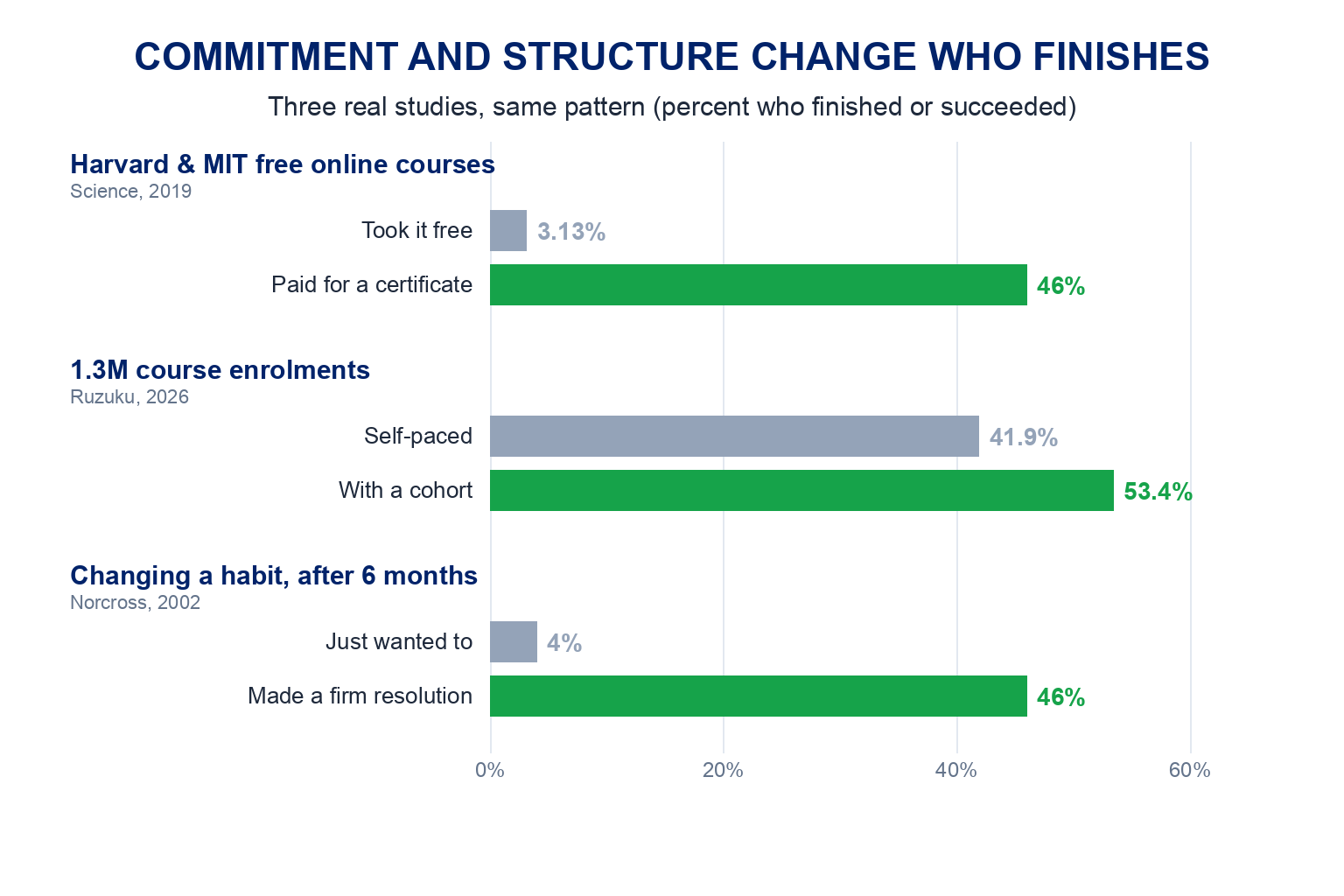
Committing changes the odds. In Harvard and MIT's online courses, about 3% of learners finished overall, but 46% of the ones who paid for a verified certificate did. Same courses. Paying learners may also have been keener to begin with, so this shows a strong link rather than proof, but the gap is hard to ignore.
Learning with a group helps. Ruzuku, a platform that hosts online courses, looked at 1.3 million enrolments on its platform. It found that 53.4% of people finished courses they took with a cohort (a group going through it together), against 41.9% for self-paced courses.
A firm plan beats a vague wish. In a 2002 study by John Norcross, 46% of people who made a firm resolution to change were still succeeding six months later, against 4% of people who only wanted to change.
I'll be straight with you: you'll see much bigger numbers quoted online, such as "95% success with an accountability partner" or "90% completion for cohorts". I couldn't find a real study behind them, so I'm not going to use them. The real numbers are smaller, and they show links rather than proof, but they all point in the same direction.
Structure isn't magic, either. A study group or a programme takes time, sometimes money, and it won't do the work for you. You still have to put the hours in. What it does is make it much harder to quietly drift away when motivation dips.
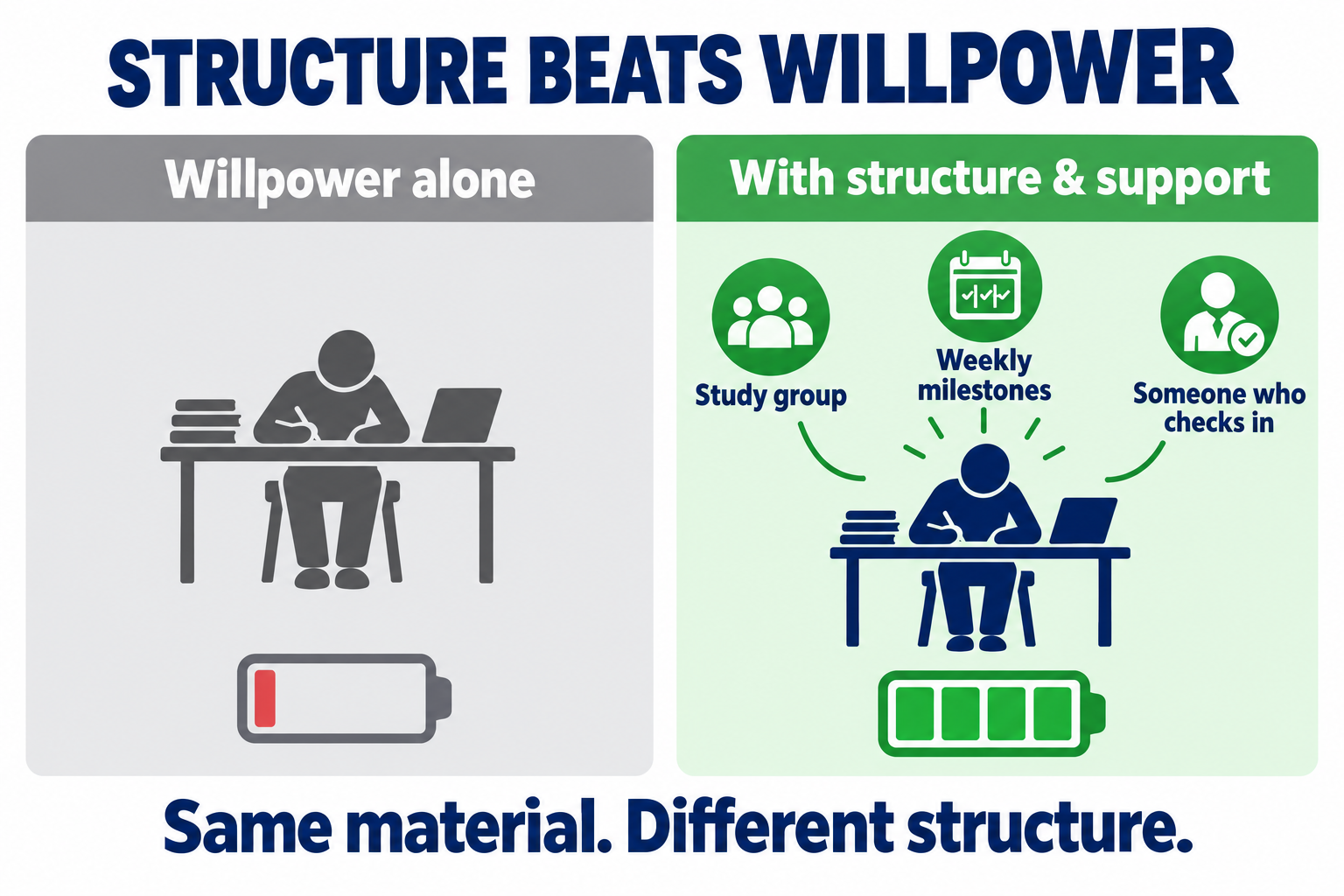
And it matches what I see. The students in our programmes who make it aren't necessarily the smartest or the most technical. They sometimes really surprise me. It's the ones who turn up to their study group (we call them mastermind groups), who have clear milestones every week, and who have someone who notices when they fall behind and helps them back up. In my experience, the structure around you matters more than the talent inside you.
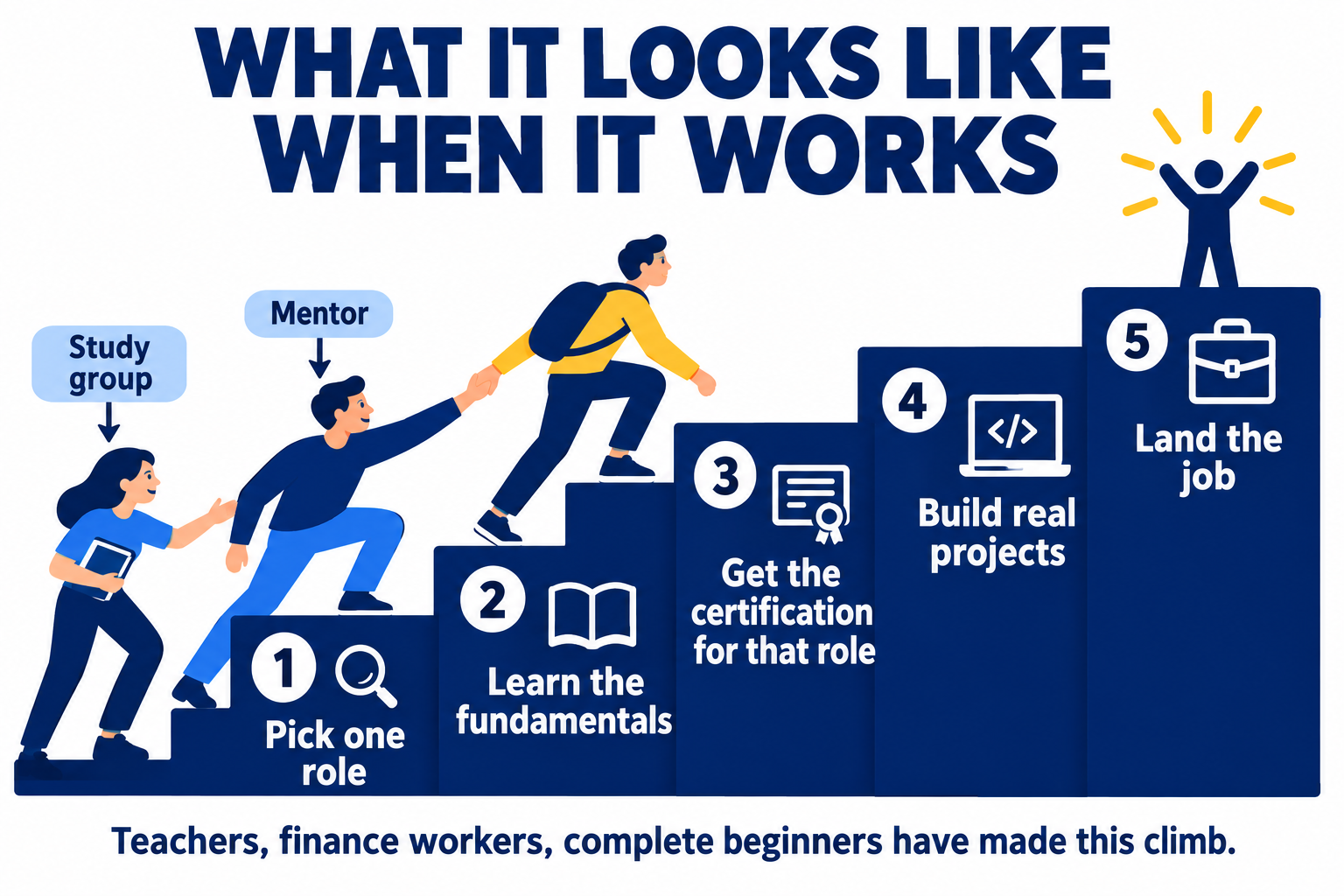
I've seen students fail certification exams more than once and bomb interviews. They didn't quit, because they had a group around them, a mentor checking in and a clear path. And they went on to land roles at Fortune 500 companies. Career changers from teaching, from finance, complete beginners who'd never touched a command line. The ones with the right structure made it.
Is Cybersecurity Hard to Get Into?
Learning is one thing. Getting hired is another, so let's be honest about that too.
The demand is real. US employers posted more than 514,000 cybersecurity job listings in the 12 months to April 2025, according to CyberSeek. The US Bureau of Labor Statistics projects information security analyst jobs will grow 21% from 2025 to 2035, much faster than average. And in ISC2's hiring study, 61% of hiring managers said entry-level roles are typically filled within three months.
But employers are picky. In ISACA's 2026 survey, only 31% said most applicants for cyber jobs are well qualified. The survey doesn't say exactly what applicants are missing. But in my experience, the fastest way to stand out is proof that you can do the work. Projects you've built, certifications for the role you want, and the soft skills we just covered.
AI is changing which roles are easiest to start in, too. Some classic entry-level jobs are shrinking, while others are growing. I cover which ones in Will AI Replace Cybersecurity Jobs?
5 Ways to Make Cybersecurity Easier to Learn
So how do you become one of the people who finishes? Here's what I'd recommend.
Pick one role first. Don't try to learn all of cybersecurity. Choose one role, such as SOC analyst (the person who watches and investigates security alerts) or cloud security, and learn what that job needs. Our free Career Path Finder helps you choose.
Commit, in writing. Set a specific goal with a date, like "pass Security+ by March", not "learn cybersecurity". In the Norcross study, people who made a firm commitment did far better than people who only wished to change. Writing it down with a date is a simple way to make yours concrete.
Find your people. Join a study group or a cohort, in person or online. Five or six people on the same path, holding each other to it, keeps you going when motivation dips.
Get someone to check in. A mentor, a friend, or a study partner you report your progress to every week. Knowing someone will ask makes it much harder to quietly give up.
Build things, not just notes. Set small weekly milestones that produce something: a lab you've set up, a report you've written, a tool you've built with AI. Progress you can see keeps you moving.
If you want the full route laid out, our cybersecurity roadmap goes through it step by step, and the free web-book Become the Cyber Security Expert the AI Era Demands is a good place to start. And if you want the structure built in, with mentors, a mastermind group and real projects, that's what the AI Master's Program is for (a mentored StationX programme, not a university degree). You can get a full refund up until the programme begins, and if you haven't proven you can build your own working solutions by the end of the year, the programme stays open until you do, at no extra cost.
So is cybersecurity hard? Yes, but not because you're not smart enough. The question was always whether you'll keep going long enough. And that comes down less to willpower than to the structure around you. Get the structure in place and you can absolutely do this.

Frequently Asked Questions
Is cybersecurity hard to learn?
The technical fundamentals are learnable for most people with a clear plan and steady study. The hard part is keeping going long enough, because most people who start online courses don't finish. Having a study group, weekly goals and someone who checks on your progress makes a real difference.
Is cybersecurity hard to get into?
It can feel that way, because many entry-level job ads ask for experience or certifications a beginner can't have. But employers do hire newcomers: in ISACA's 2026 survey, 54% of security professionals said half or more of their team came from other fields.
Do you need to be good at coding for cybersecurity?
Not for most roles. You need to understand how systems and code work, and increasingly how to direct AI tools that write code for you. Some specialist roles, such as application security, do involve more programming.
Is cybersecurity a hard major?
A cybersecurity degree covers a wide range of topics, and many students find the breadth demanding. But you don't need a degree for many cybersecurity roles, and a focused path of certifications and projects is often faster and far cheaper.
How long does it take to learn cybersecurity?
It depends on where you start and how much time you can give it. In my experience, many people with a structured plan are ready to apply for entry-level roles in six to twelve months.
About the Author

Nathan House, Founder & CEO of StationX
Nathan House has 30 years of hands-on cybersecurity experience and is Cambridge-educated, holding CISSP, CISA, CISM, OSCP, CEH, and SABSA. He founded StationX in 1999 — one of the UK’s first cybersecurity companies — and has secured £71 billion in UK mobile banking transactions and the London 2012 Olympics, advising clients including Microsoft, Cisco, BP, Vodafone, and VISA. He authored the world’s most popular cybersecurity course — a #1 Udemy bestseller taken by over 500,000 students — and was named Cyber Security Educator of the Year 2020, AI Security Educator of the Year, and a UK Top 25 Security Influencer 2025. A DEF CON speaker and featured expert on CNN, Fox News, NBC, and the BBC, Nathan leads StationX’s training of more than half a million students worldwide.