Is a Cybersecurity Degree Worth It? The $50K Trap and Fix
Is a cybersecurity degree worth it? If you're about to spend $50,000 and four years finding out, you deserve a straight answer first. For most people starting out, I don't think it is, and the reason isn't that education is bad. I have a degree myself, from Cambridge. It's that a typical cybersecurity degree fails you in three specific ways, and the biggest one is a cost almost nobody works out properly.
I've spent 30 years in cybersecurity and taught more than 500,000 students, and I watch closely what actually gets people hired. In this guide, we'll go through the three failures, work out what a degree really costs, compare it with certifications, and cover the one situation where a degree still makes sense.
Let's start with the short answer.
TL;DR if you've only got 30 seconds
Degrees teach a little of everything. Employers hire for one role, in depth.
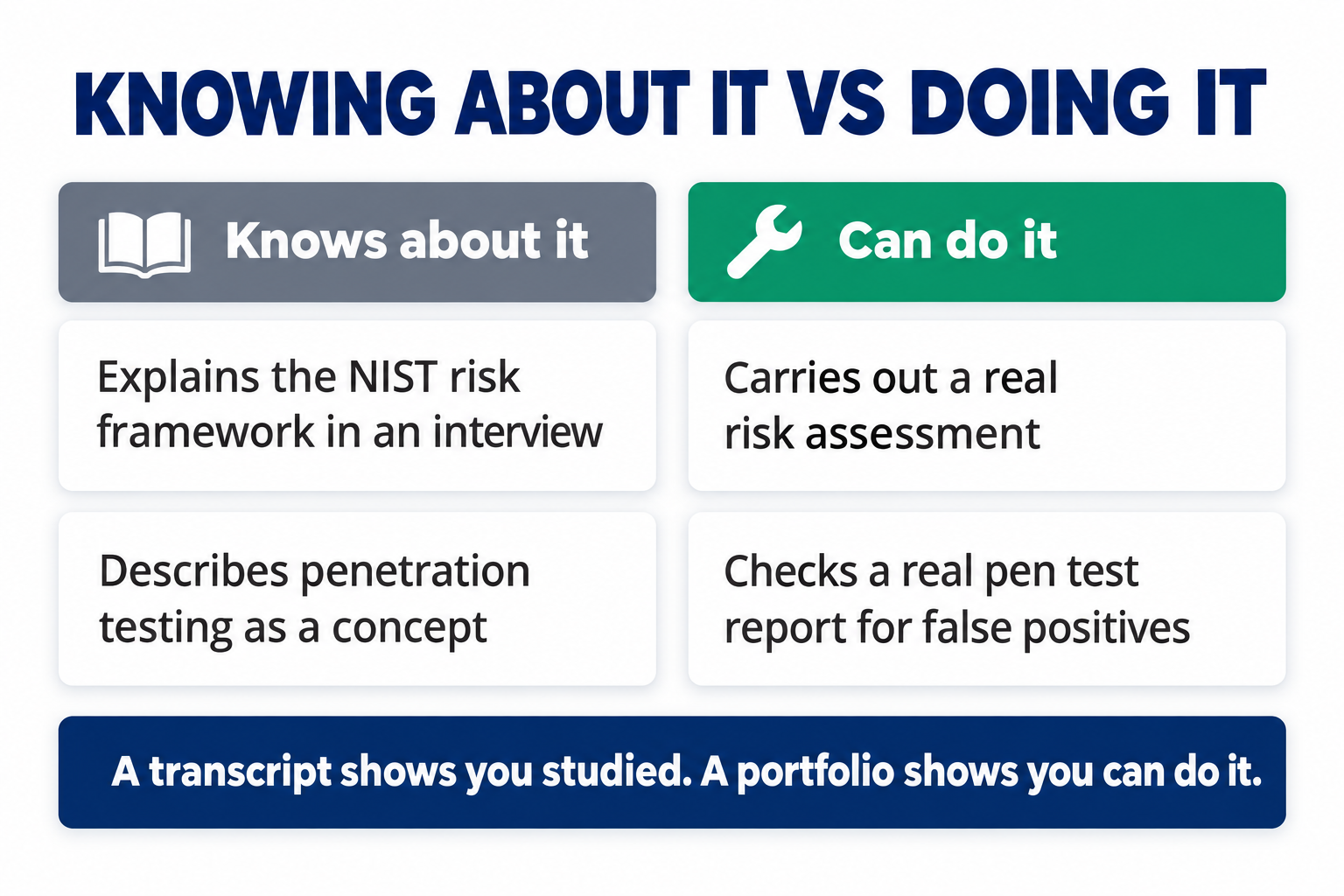
Degrees teach you about security. Employers want proof you can do it.
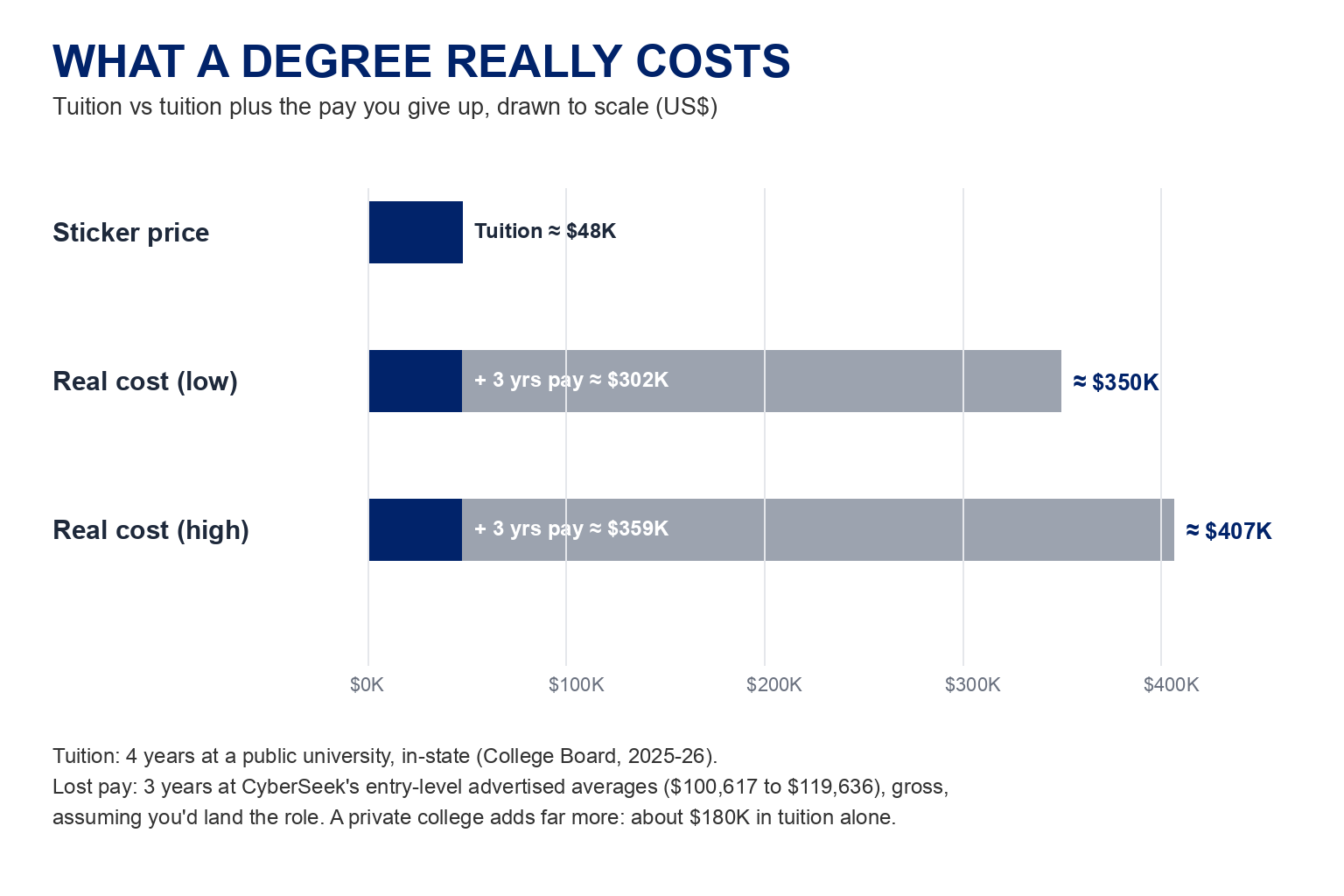
About $48,000 of public tuition plus roughly three years of pay you don't earn puts the real cost at around $350,000 to $400,000.
The faster path: pick one role, get the certifications for it, build projects, and find a mentor. Save the degree for the executive track, if you ever need it.
Is a Cybersecurity Degree Worth It? The Short Answer
Even governments are starting to question the degree requirement. In February 2026, the House Oversight Committee voted 44 to 0 to advance the Cybersecurity Hiring Modernization Act (H.R. 5000). It would stop most federal cybersecurity jobs from requiring a degree, unless a separate, existing law already requires a degree for that particular job. It hasn't had a full vote in the House yet, so it isn't law. But when a committee votes unanimously to drop a requirement, that tells you where things are heading.
Let me be fair about where things are today, though. Most job postings still list a degree. In CyberSeek's data on entry-level cybersecurity roles, almost every posting that states an education level asks for a bachelor's or higher. So a degree can still help you get past some filters.
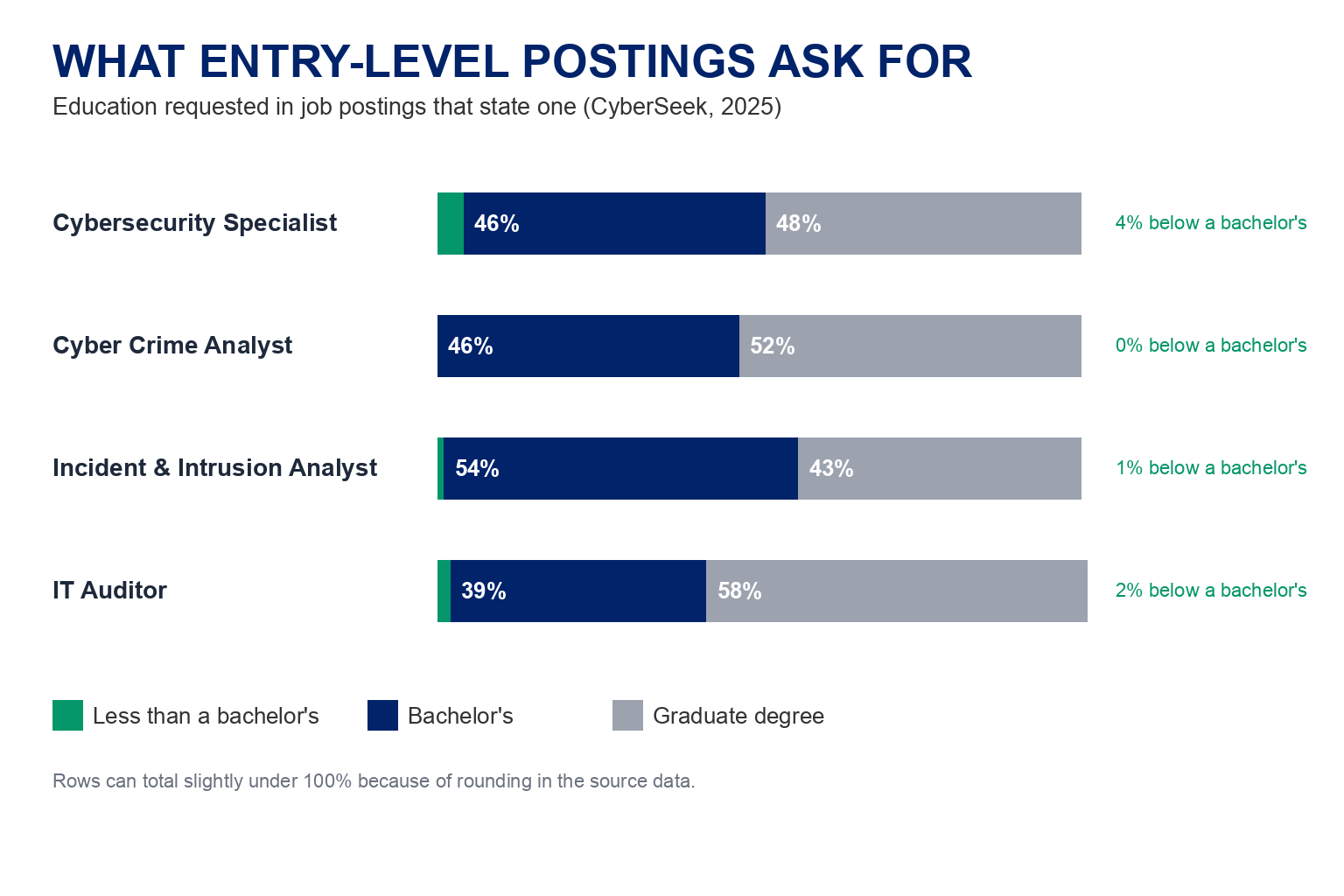
But the people doing the hiring are more flexible than the postings. In ISC2's 2025 study of 929 hiring managers, most said they would consider entry-level or junior candidates who only had IT work experience (90 percent) or only an entry-level cybersecurity certification (89 percent) over candidates who only had an education in IT, cybersecurity or computer science. In ISC2's words, relevant experience and certifications "can often outweigh a degree alone". The listing asks for a degree. The person reading your application often cares more about what you can show them.
So the degree isn't worthless. My view is that at $50,000 and four years, it's the wrong investment for most people who want to get into cybersecurity. The reasons start with how people end up on that path.
How Students Get Trapped on the Degree Path
It usually starts at school. A careers adviser tells you that you need a degree to work in cybersecurity. They're not lying to you. They just don't know this industry well. These are often the same people who tell you that you need to be brilliant at maths to be a programmer.
So you enrol. You commit to four years and around $50,000. You graduate. And you find yourself competing with people who skipped the degree, got certified, built projects, and have already been working in the field for three years.
Now, most people hear that and think: fine, I'll skip the degree and get certifications instead. That's just the other side of the same broken argument. The real question isn't degree versus certifications. It's why the degree fails. Once you see that, the right path is much clearer. There are three failures.
Failure 1: Degrees Teach Breadth, Not Depth
Degree programmes are designed to be broad. You get a little networking, a little coding, a little governance, some forensics, some incident response, some cryptography. The idea is that you graduate as a well-rounded cybersecurity professional.
The trouble is that employers don't hire well-rounded cybersecurity professionals. They hire for specific roles, for example:
AI security specialist. Protects AI systems, such as testing a company's chatbot so it can't be tricked into leaking customer data.
Cloud security engineer. Secures systems that run on cloud platforms like AWS or Azure, such as making sure a file store isn't open to the whole internet.
Security auditor. Checks whether a company's security controls actually work and meet the standards it has to follow.
Application security engineer. Finds and fixes security flaws in the software a company builds, such as a weakness in a website's login page.
Security governance professional. Sets the security rules and policies, such as a company's password policy, and manages its security risk.
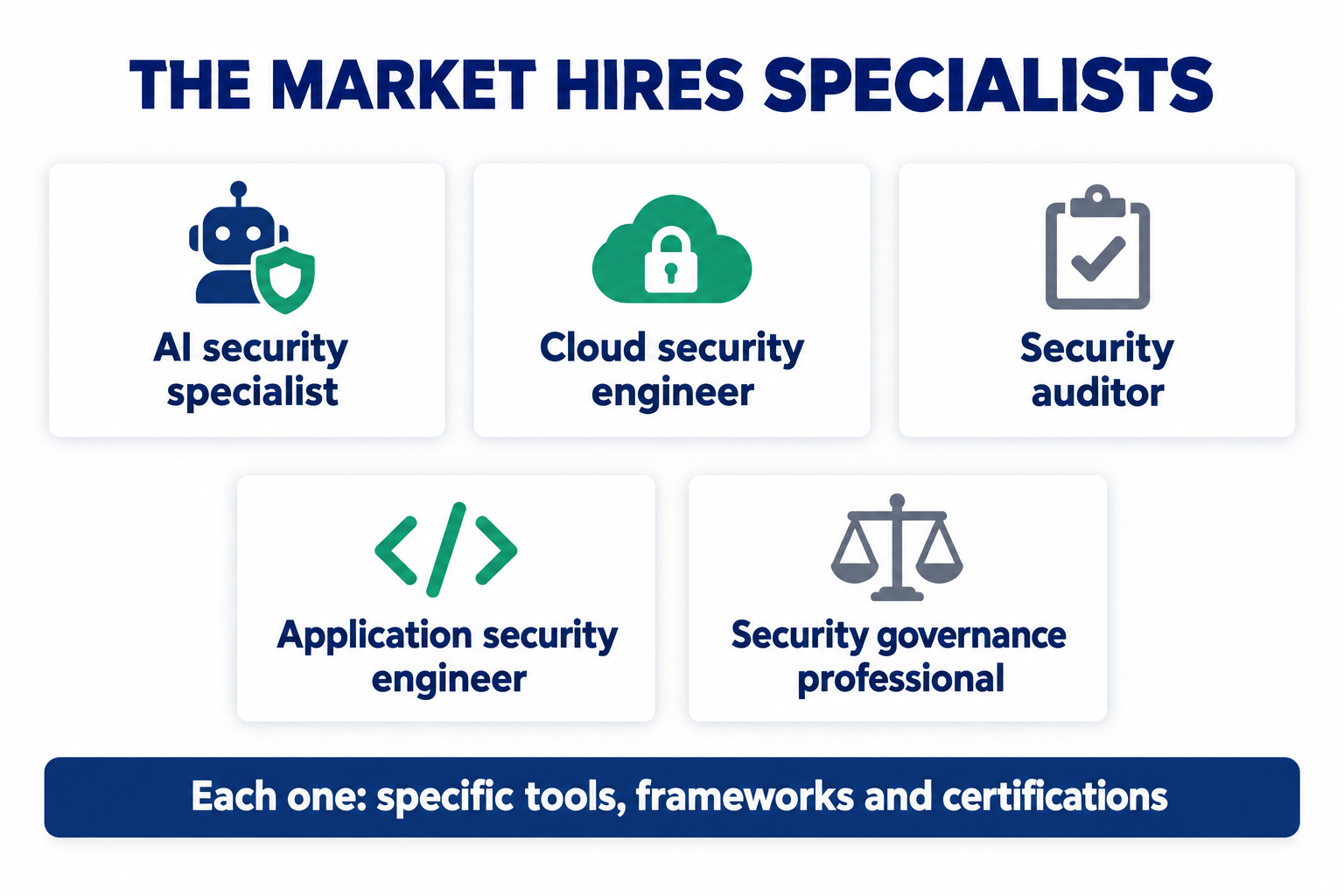
Each of those roles has its own tools, frameworks and certifications. Look at real job postings and you'll see what I mean. Next to the education line, they ask for things like experience with Splunk (a tool for searching and analysing security logs), familiarity with NIST 800-53 (a US catalogue of security controls), or CompTIA CySA+ (a certification for security analysts) preferred. Specific tools. Specific knowledge. Proof you can do this job, not every job.
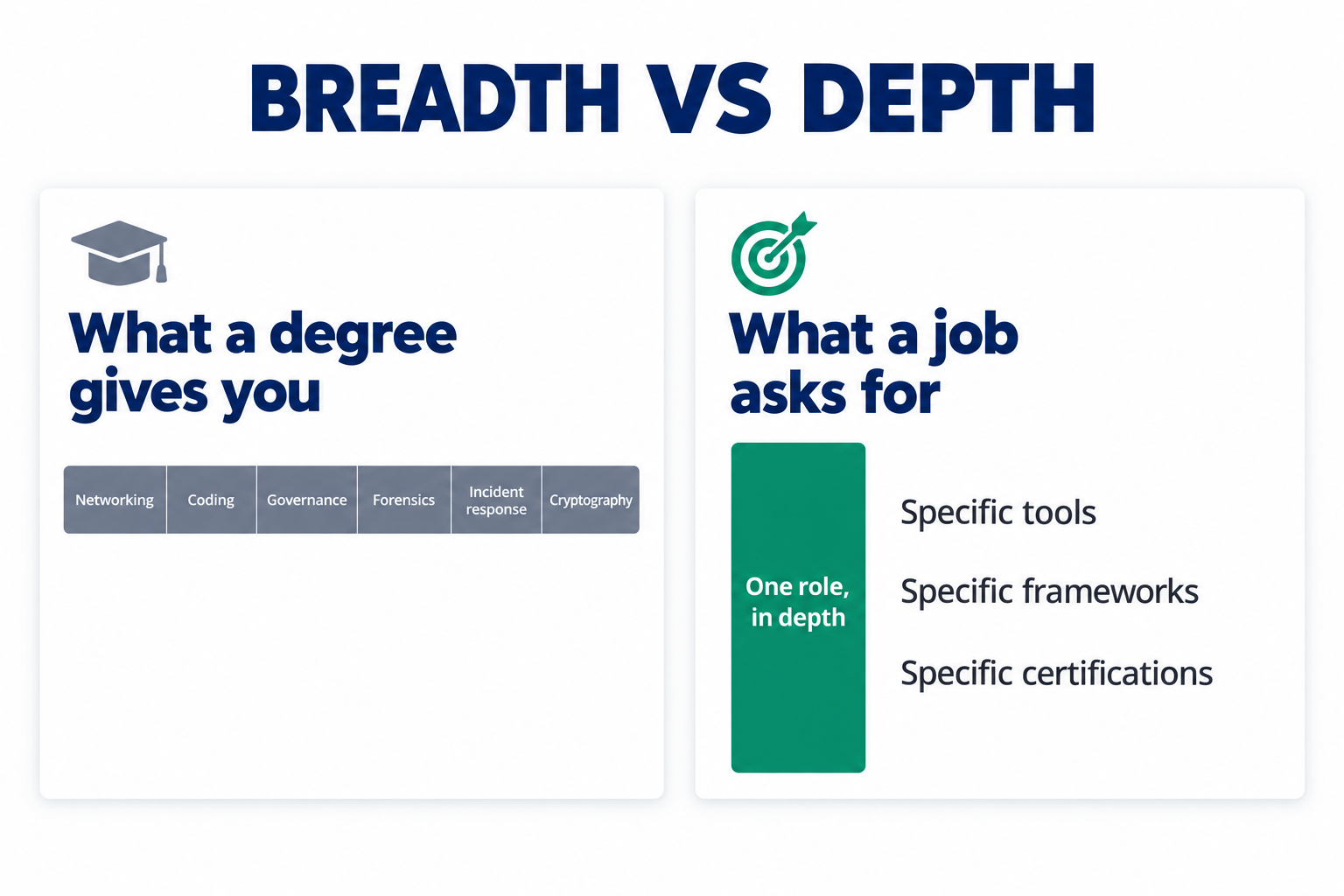
Think of it like hiring a plumber. You don't want someone who's done a short module on plumbing, electrics, carpentry and roofing. You want someone who can fix your boiler today. A degree trains you for every security role and none of them. Employers reward depth. The degree gives you breadth. And even if the teaching, the curriculum and the price were perfect, that mismatch alone would make it the wrong investment for most people. But the rest isn't perfect either.
Failure 2: Theory, Not Doing the Work
The second failure is how degrees teach. They teach you about cybersecurity. Employers hire people who can do cybersecurity. Those aren't the same thing.
I've been hiring security people for decades, and I've made this mistake myself. I've hired people with impressive degrees who could explain the NIST risk framework perfectly in an interview, but couldn't actually carry out a risk assessment. They could describe penetration testing (being paid to break into an organisation's systems, with its permission, to find the weak spots before a real attacker does) as a concept. But hand them a real pen test report, the list of weaknesses a tester found, and they couldn't spot the false positives: findings that look like problems but aren't.
To be fair, some degrees include capstone projects, final labs and group exercises, and those are good. But a supervised end-of-semester project isn't the same as building a detection rule, an alert that goes off when it sees real attacker behaviour in a company's logs. It isn't the same as building your own AI security agent, a small AI-powered program that does a security job by itself, such as reading hundreds of alerts and flagging the few that matter. And it isn't the same as finding a real weakness in open-source software, meaning software whose code anyone can read.
Take the AI security agent. To build one, you have to decide which alerts matter, connect it to real data, test it, and fix it when it gets things wrong. When it works, you can show it to an interviewer and walk them through it. A degree lets you say you understand security. A working project lets you show it.
Employers can tell the difference. A degree shows you studied security, and that you can stick at something for a few years, which does count for something. A portfolio shows you can do the work. And in an interview, that's the proof they're looking for.
So the degree teaches the wrong scope and the wrong way. But neither of those is the most expensive mistake.
Failure 3: What a Cybersecurity Degree Really Costs
Everyone focuses on the tuition. According to the College Board, four years of in-state tuition and fees at a US public university average about $48,000 (2025-26 prices). "In-state" is the lower price a public university charges students who live in that state; students from elsewhere usually pay more. At a private nonprofit college it's closer to $180,000. That's a lot of money. But it isn't the real cost.
The real cost includes the pay you don't earn while you're studying. A simple way to think about it: compare two people who start at the same time. One spends four years on a degree. The other spends about a year on a focused path and starts working. That's roughly three years where one of them is earning and the other isn't.
How much is three years of entry-level pay? CyberSeek's data shows advertised average salaries for entry-level cybersecurity roles of about $100,000 to $120,000 in the US. Three years of that, plus $48,000 of tuition, comes to roughly $350,000 to $400,000.
What this number assumes
It's a rough guide, not a promise. It uses gross pay (before tax), and it assumes you would land an entry-level role on the faster path, which takes real work. A private college, or living costs, would push the figure higher.
Take a moment with that. What else could you do with that sort of money and time? The degree doesn't just cost more money. It costs years of your life, and the last thing you want is to spend those years training for the wrong role, or for no particular role at all.
Cybersecurity Degree vs Certifications
The alternative is a focused path: a small number of certifications for one specific role, plus projects where you build and deliver things yourself. In my experience it costs a few thousand dollars, not tens of thousands. And with structure, many people are ready to apply for jobs in six to twelve months, depending on where they start.
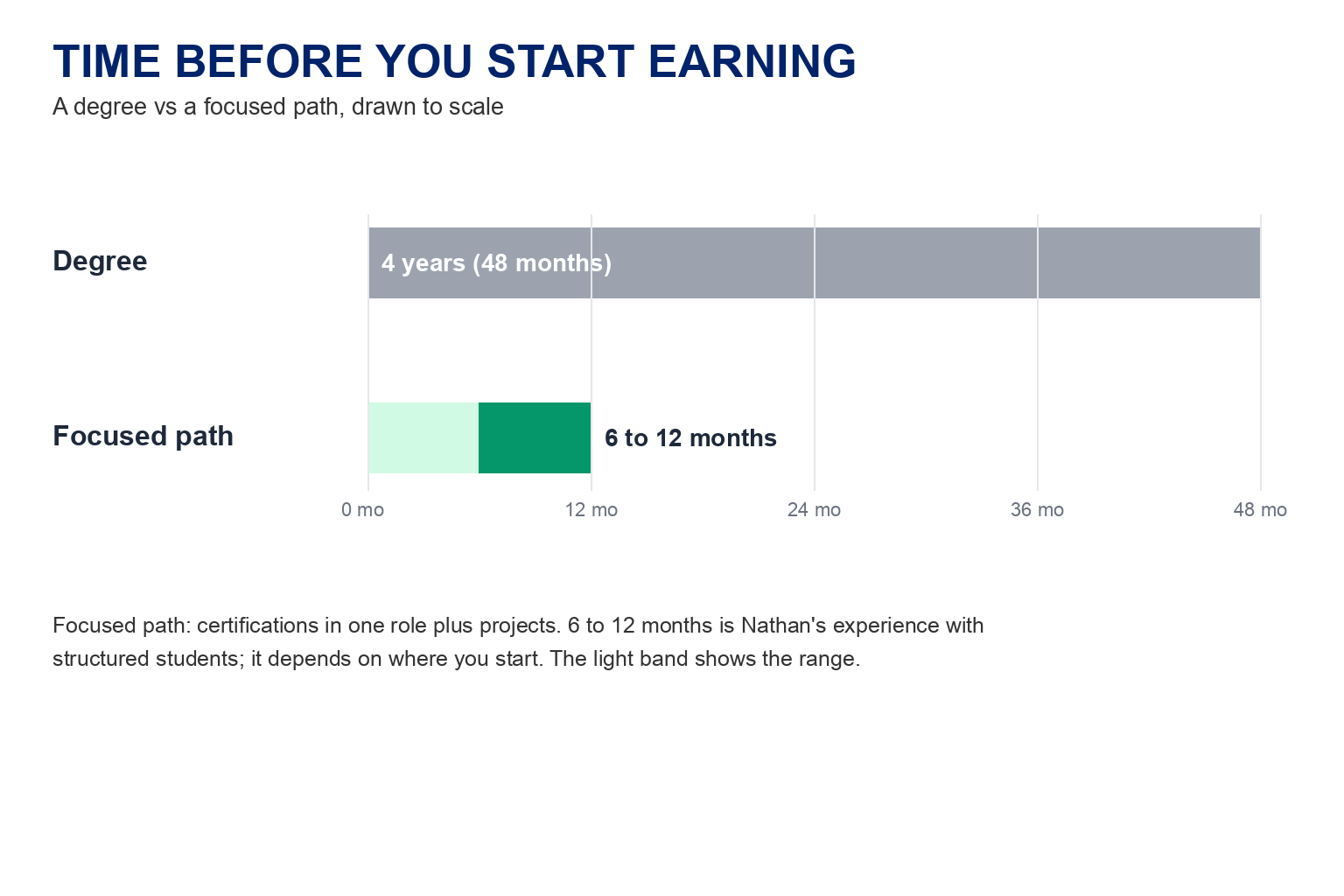
So you could be earning a full salary around three years before someone on a degree even graduates. And as the ISC2 study showed, most hiring managers will consider a candidate whose only cyber credential is an entry-level certification over one with only an education.
One warning before you pick a lane. Some security roles are changing fast because of AI. I built JobZone Risk to score thousands of roles on how exposed they are to AI and automation, so you can compare cybersecurity roles side by side and check that the one you're training for will still be there. You can also use our free Cybersecurity Career Path Finder to see which roles fit your background.
So what does the better path actually look like, step by step?
The Fix: Focus, Prove It, Find Your People
Each of the three failures has a direct answer.
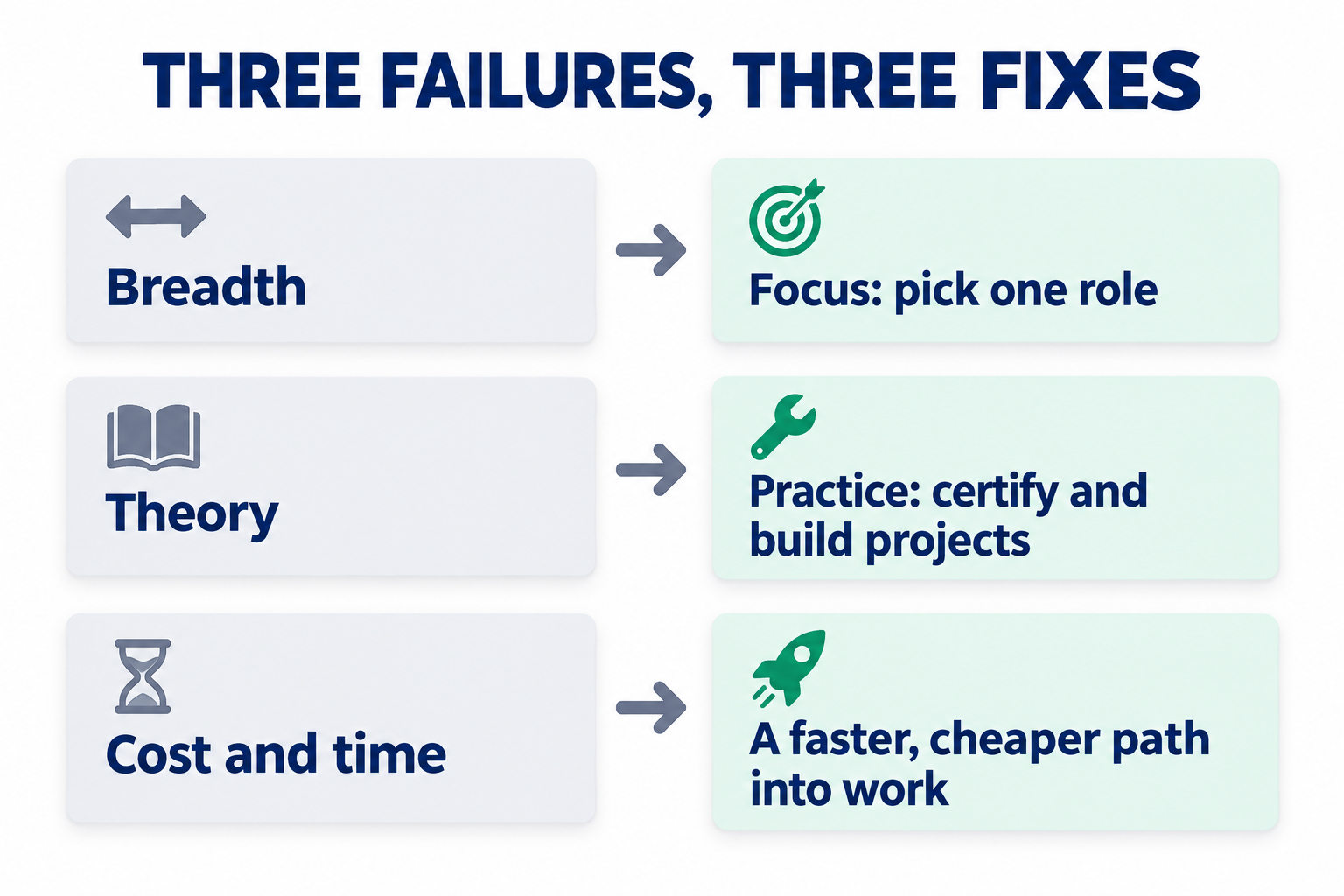
Focus: pick one role. AI security, cloud security, security governance, application security, or DevSecOps (building security checks into the way software is built and released, such as an automatic scan that blocks code with a known weakness): choose one. Employers hire specialists, so become one. You can always widen out once you're in the door.
Prove it: get certified in that role, then build projects. Not a random collection of certifications, but the ones that prove knowledge for your target role. Then build things that show you can do the work: your own AI security agent, a cloud environment you deploy and secure, a governance framework for a real organisation. Your portfolio is your CV.
Find your people. Find people who are doing the job you want right now, not academics who left the industry years ago. A mentor, and a small group of five or six people on the same path who hold each other to it. Career progress doesn't happen in a lecture hall with 200 people. It happens in small groups doing the work together, in person or online.
After teaching more than half a million students, I see the same pattern again and again. The people who pick a focus, get certified, build projects and find a mentor and a study group tend to get hired faster than people with a four-year degree and nothing else. If you want that path laid out in full, our new cybersecurity roadmap goes through it step by step.
So is there ever a good time to get a degree? Yes, there is.
When a Cybersecurity Degree Still Makes Sense
I said a degree is the wrong investment for most people. Not all. If you're aiming for the executive track, a CISO (chief information security officer, the person who runs a company's security) or a VP of Security, a degree can still act as a filter at that level. Some government and defence roles still ask for one too, although that may change if H.R. 5000 becomes law.
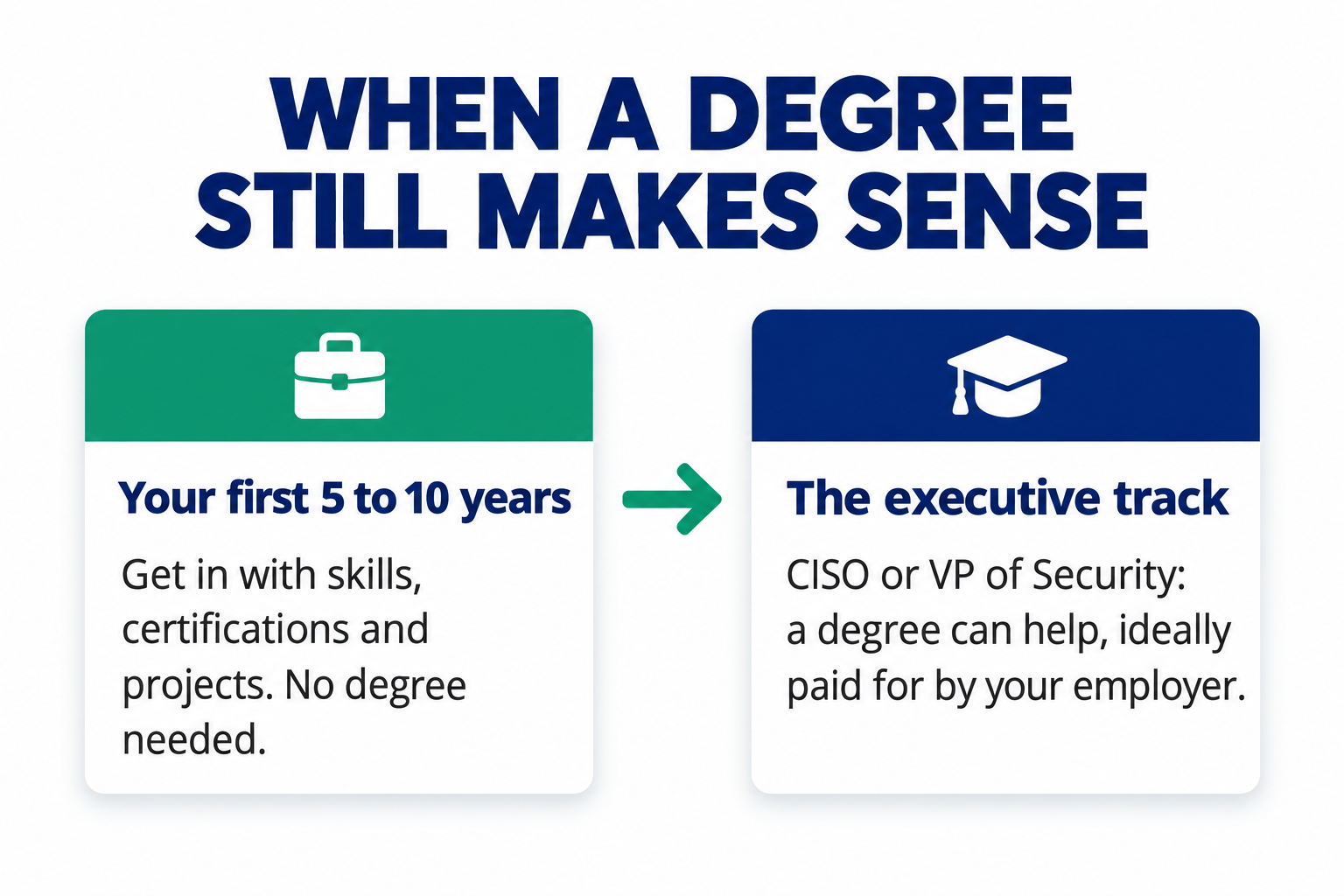
But you don't need a degree for your first five to ten years. Get in with skills and certifications, and build your career. If you need a degree later for the executive track, get it then, ideally when your employer pays for it. Don't spend $50,000 now on a credential you might not need for a decade.
That's my opinion, and you might disagree. But the one rule I'd take away is this: employers don't hire what you studied. They hire what you can do. Pick a focus, prove you can do the work, and start earning while people on the degree path are still in their second year.
If you want help doing that, our free web-book Become the Cyber Security Expert the AI Era Demands is a good place to start. And if you want mentorship, real projects you build and ship, and a group to learn with, that's what the AI Master's Program is for. It's a fraction of the cost of a degree, you can get a full refund up until the programme begins, and if you haven't proven you can build your own working solutions by the end of the year, the programme stays open until you do, at no extra cost.

Frequently Asked Questions
Is a cybersecurity degree worth it?
For most people starting out, I don't think a 50,000 dollar degree is the best investment. It teaches breadth when employers hire for depth, it teaches theory more than practice, and it costs you years of pay. It can still make sense later for the executive track, ideally paid for by an employer.
Can you get a cybersecurity job without a degree?
Yes. Many job postings still list a degree, but in ISC2's 2025 study of 929 hiring managers, 89 percent said they would consider entry-level or junior candidates whose only cyber credential was an entry-level certification, and 90 percent would consider candidates with only IT work experience.
How much does a cybersecurity degree cost?
Four years of in-state tuition at a US public university averages about 48,000 dollars (College Board, 2025-26), and about 180,000 dollars at a private nonprofit college. Count roughly three years of entry-level pay you give up and the real cost is around 350,000 to 400,000 dollars.
Is a cybersecurity degree or certification better?
For getting your first job, a focused set of certifications for one role, plus projects that prove you can do the work, is usually faster and far cheaper. A degree can still help later if you aim for the executive track, such as a CISO role.
Do federal cybersecurity jobs still require a degree?
A bill to change that, the Cybersecurity Hiring Modernization Act (H.R. 5000), would stop most federal cybersecurity jobs requiring a degree unless the law requires one. It passed the House Oversight Committee 44 to 0 in February 2026, but as of September 2026 it has not had a full House vote and is not law.
About the Author

Nathan House, Founder & CEO of StationX
Nathan House has 30 years of hands-on cybersecurity experience and is Cambridge-educated, holding CISSP, CISA, CISM, OSCP, CEH, and SABSA. He founded StationX in 1999 — one of the UK’s first cybersecurity companies — and has secured £71 billion in UK mobile banking transactions and the London 2012 Olympics, advising clients including Microsoft, Cisco, BP, Vodafone, and VISA. He authored the world’s most popular cybersecurity course — a #1 Udemy bestseller taken by over 500,000 students — and was named Cyber Security Educator of the Year 2020, AI Security Educator of the Year, and a UK Top 25 Security Influencer 2025. A DEF CON speaker and featured expert on CNN, Fox News, NBC, and the BBC, Nathan leads StationX’s training of more than half a million students worldwide.