Cybersecurity Certifications for Beginners: 7 Ranked (2026)
Which cybersecurity certifications are worth it for beginners? Some are worth every penny. Some are stepping stones. And some are, honestly, a waste of your money. The trouble is that most rankings online aren't written by people who actually hire security professionals. I've been hiring them for over 30 years, and I've taught more than 500,000 students.
So in this guide, I've ranked the seven beginner certifications worth considering, from C tier to S tier, on three things: how much they help you get hired, how much you actually learn, and what they cost. Some of the results surprised even me, and one of the most popular recommendations has changed since I made the video.
TL;DR if you've only got 30 seconds
If you can only get one, get CompTIA Security+. It's the most-requested beginner certification in US job ads.
The ISC2 CC is no longer free for new candidates. It's still a good low-cost first step at $199.
Want a SOC (security operations centre) job? Look at CCNA Cybersecurity. Have a relevant degree? SSCP. Employer paying? GSEC.
No certification gets you hired on its own. Pair it with hands-on practice you can show.
Cybersecurity Certifications for Beginners: How I Ranked Them
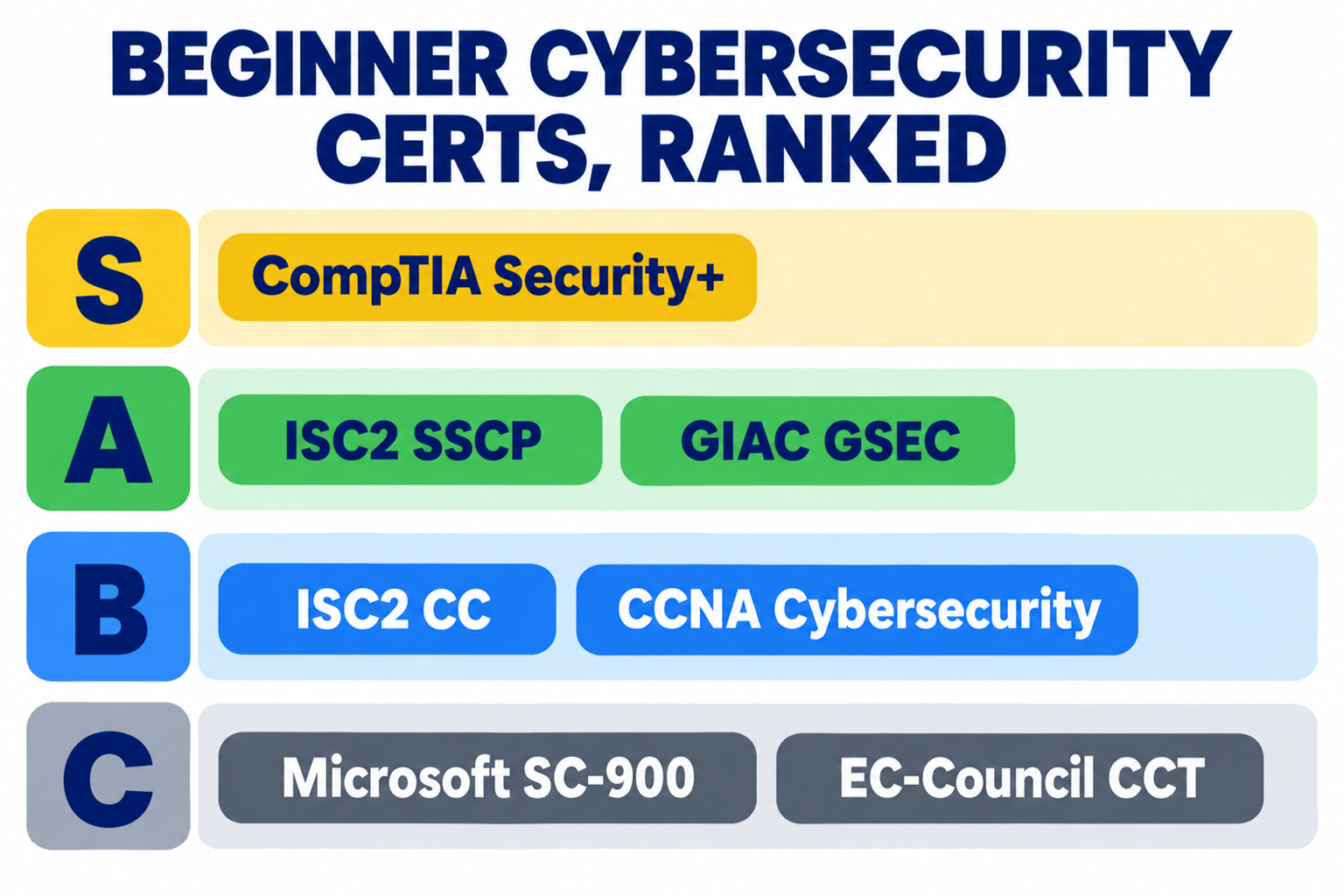
Each certification gets a tier based on three things: hiring power (does it get your CV past filters and impress the people reading it?), knowledge (how much you actually learn), and cost. The tiers assume you're paying your own way and want the one certification that counts for the most. Where that changes the answer, such as an employer paying, I'll say so. Here's the result:
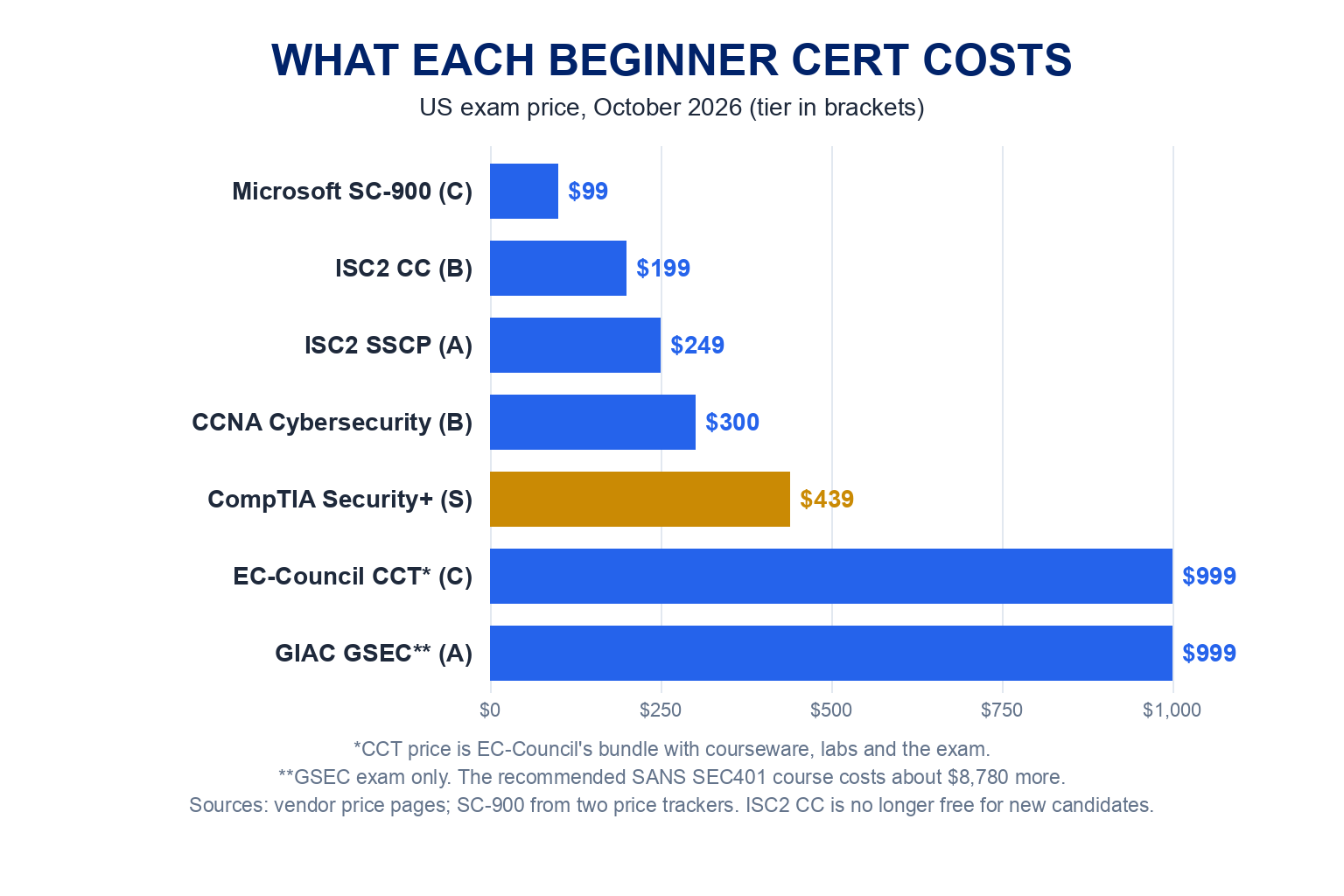
And here's what each one costs to sit in the US, as of October 2026:
C Tier: Microsoft SC-900 and EC-Council CCT
C tier doesn't mean useless. It means that if this is the only certification on your CV, you have a problem.
Microsoft SC-900
The SC-900 covers Microsoft's security tools: identity, threat protection and compliance. Almost every large company runs Microsoft, so you're likely to meet these tools.
💰 Cost
$99 in the US, the cheapest on this list.
✅ What it gives you
A grounding in Microsoft's security stack. It doesn't expire.
⚠️ The catch
It's an awareness badge, not a practitioner certification. There are no labs, and on its own it proves you watched some Microsoft Learn modules.
Tack it on alongside something real. Never make it your main security credential.
EC-Council CCT (Certified Cybersecurity Technician)
This one is more interesting. Of its 60 exam questions, 10 are hands-on tasks in a live cyber range, where you solve real problems. That's genuinely rare at entry level, where most exams are entirely multiple choice.
💰 Cost
About $999 for EC-Council's bundle with courseware, 85 labs and the exam voucher.
✅ What it gives you
Real hands-on questions, which most beginner exams don't have.
⚠️ The catch
Almost nobody knows what it is. Ask ten hiring managers and you'll get ten blank stares, and EC-Council's brand suffers from long-running criticism of its better-known Certified Ethical Hacker exam, which many hiring managers rate poorly.
It's an interesting exam with poor recognition. One to watch, rather than one to get.
B Tier: ISC2 CC and CCNA Cybersecurity
B tier certifications are real certifications with real value. Each one just has a specific limitation that stops it being a universal recommendation.
ISC2 Certified in Cybersecurity (CC)
The CC comes from ISC2, the same organisation behind CISSP, and that name carries real weight on a CV. It needs no experience, and it's approved for 20 of the 54 work roles in the US Department of Defense's DoD 8140 framework (as of July 2024), which matters if you want US government or defence work. Since September 2026, its exam outline also includes AI security content in every domain.
It's no longer free
When I made the video, the CC exam and training were free through ISC2's One Million Certified in Cybersecurity programme. ISC2 closed it to new entrants on 20 May 2026. If you already have a code, you can use it until 31 December 2026. Otherwise the exam now costs $199. I've covered what's still free in Free Cyber Security Certifications.
💰 Cost
$199 exam, plus a $50 annual maintenance fee.
✅ What it gives you
A respected name, no experience needed, and DoD 8140 approval.
⚠️ The catch
It doesn't go deep. It's foundational awareness, and some employers still don't recognise it.
It's a good stepping stone, especially if you're testing the waters. Just don't stop here.
Cisco CCNA Cybersecurity
This is one of the few entry-level certifications built specifically around SOC analyst work, and the best known: the people in a security operations centre who watch for and investigate security alerts. The exam covers security monitoring, host-based analysis, network intrusion analysis and security procedures, which maps more directly to a SOC job description than anything else at this level.
A quick note on the name, because it confuses people. It started as CyberOps Associate, became Cybersecurity Associate in January 2025, and became CCNA Cybersecurity in February 2026. It's still exam 200-201. Don't confuse it with the regular CCNA, which is Cisco's networking certification.
💰 Cost
$300.
✅ What it gives you
The most SOC-specific certification at this level. The latest version adds AI topics.
⚠️ The catch
It leans towards Cisco's tools, so some details won't transfer to a non-Cisco company, and fewer CV filters look for it.
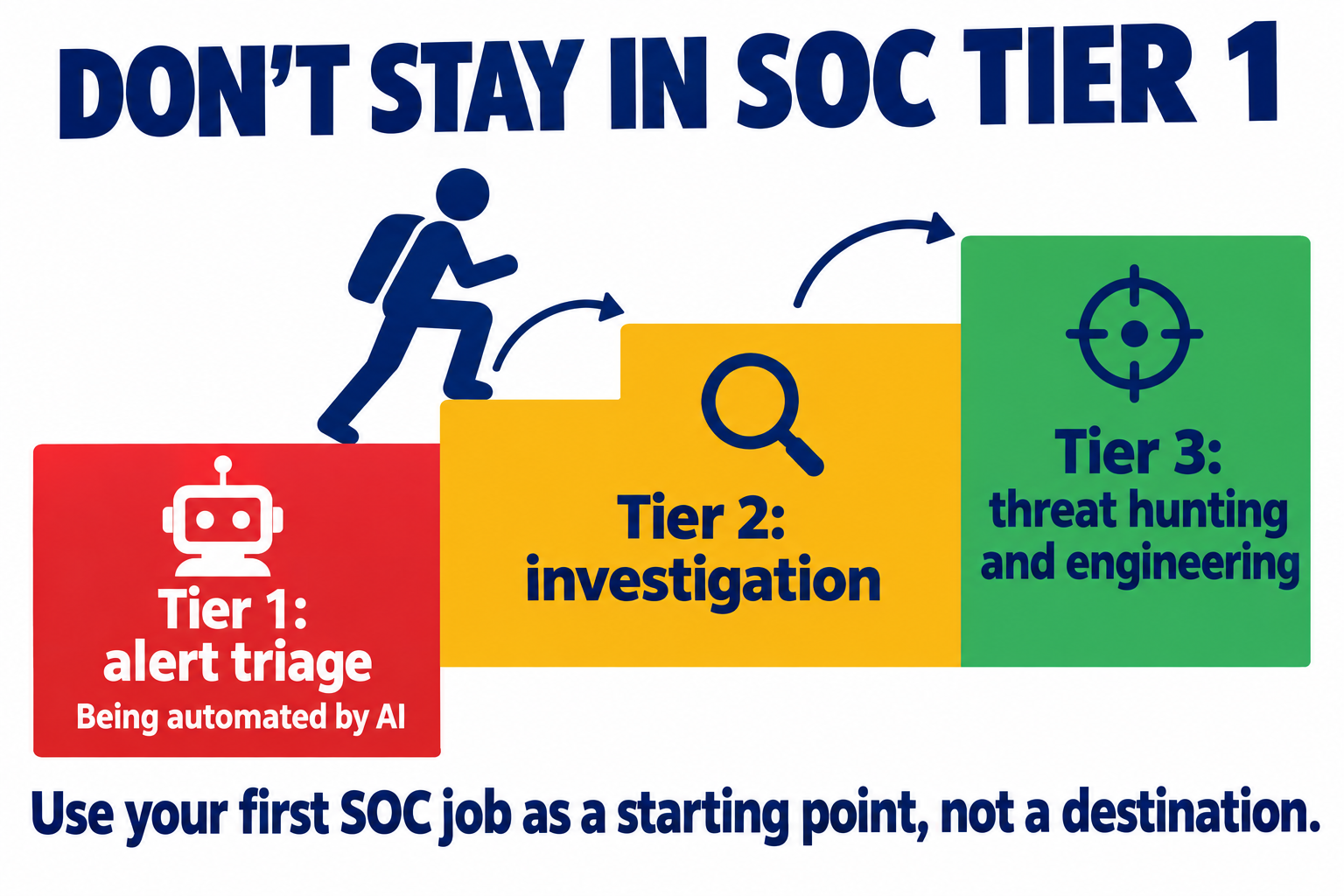
One warning if you're aiming at a SOC: tier 1, the entry-level alert triage work, is changing fast. In my view, AI is already taking over a lot of it. This certification gets you through the door, but plan to move up to tier 2 and tier 3. JobZone Risk scores a tier 1 SOC analyst at just 5.4 out of 100 for safety from AI.
A Tier: SSCP and GSEC
A tier is where certifications start making hiring managers pause on your CV.
ISC2 SSCP
The SSCP goes deeper than anything below it, and costs less than you'd expect for that depth. It covers the areas that matter in day-to-day security work: access controls, security operations, incident response and encryption. And it's the on-ramp to CISSP: same organisation, overlapping topics, lighter scope.
💰 Cost
$249 exam, plus a $135 annual maintenance fee.
✅ What it gives you
Real depth for the price, and a step towards CISSP.
⚠️ The catch
You need a year of experience, though a relevant degree counts for it. Without either, you can pass and become an Associate of ISC2 (a holding title until you have the experience), then earn the experience within two years. Outside organisations that know ISC2, few people recognise it.
This is the underrated pick. If you have a degree and want to stand out, it punches above its price.
GIAC GSEC
In terms of quality, the GSEC is the best entry-level certification there is. It's linked to SANS training, which is considered some of the best in cybersecurity, and the exam is open book (printed notes only), because the point is applying knowledge, not memorising it. Forbes contributors reported a pay boost of about $7,900 for GSEC holders in 2025, though that shows what holders earn, not that the certification causes it.
💰 Cost
$999 for the exam. The recommended SANS SEC401 course is about $8,780 on top.
✅ What it gives you
Top-quality training and an exam employers who know GIAC respect.
⚠️ The catch
It's extraordinarily expensive if you're paying yourself.
So the rule is simple. If your employer offers to pay for SANS training, take it: at someone else's expense, this jumps to the top of the list. If it's coming out of your own pocket, drop it right down.
S Tier: CompTIA Security+
And there's one certification that sits above everything else for beginners. It isn't the most technical or the deepest. It's CompTIA Security+.
It's named in 70,019 US cybersecurity job listings in a year, according to CyberSeek. Of the certifications it tracks, only CISSP appears more, and CISSP needs five years of experience, so it's a different conversation. In my experience, when an entry-level job ad mentions only one certification, it's usually this one.
💰 Cost
$439 in the US.
✅ What it gives you
The broadest recognition at this level, DoD 8140 approval (needed for many US government and defence roles), ISO 17024 accreditation (an international standard for certification bodies), no prerequisites, and it doesn't lock you into one path: SOC, pentesting, governance or cloud security.
⚠️ The catch
It proves you understand the concepts, not that you can do anything with them. You can pass without touching a firewall or a command line, and employers know it.
🎟️ Get it with StationX: Security+ exam voucher (discounted, price-matched) · Security+ course and practice test bundle
For pay, PayScale puts the average base salary of Security+ holders at about $90,000 across all experience levels. One thing to know if you're starting now: CompTIA is launching a new version of the exam, Security+ V8, on or around 17 November 2026. Check which version your study materials cover before you book.
So why S tier? Not because it's the deepest. Because if you're a beginner, paying your own way, and you can only get one certification, this is the one.
Which Beginner Cybersecurity Certification Should You Get First?
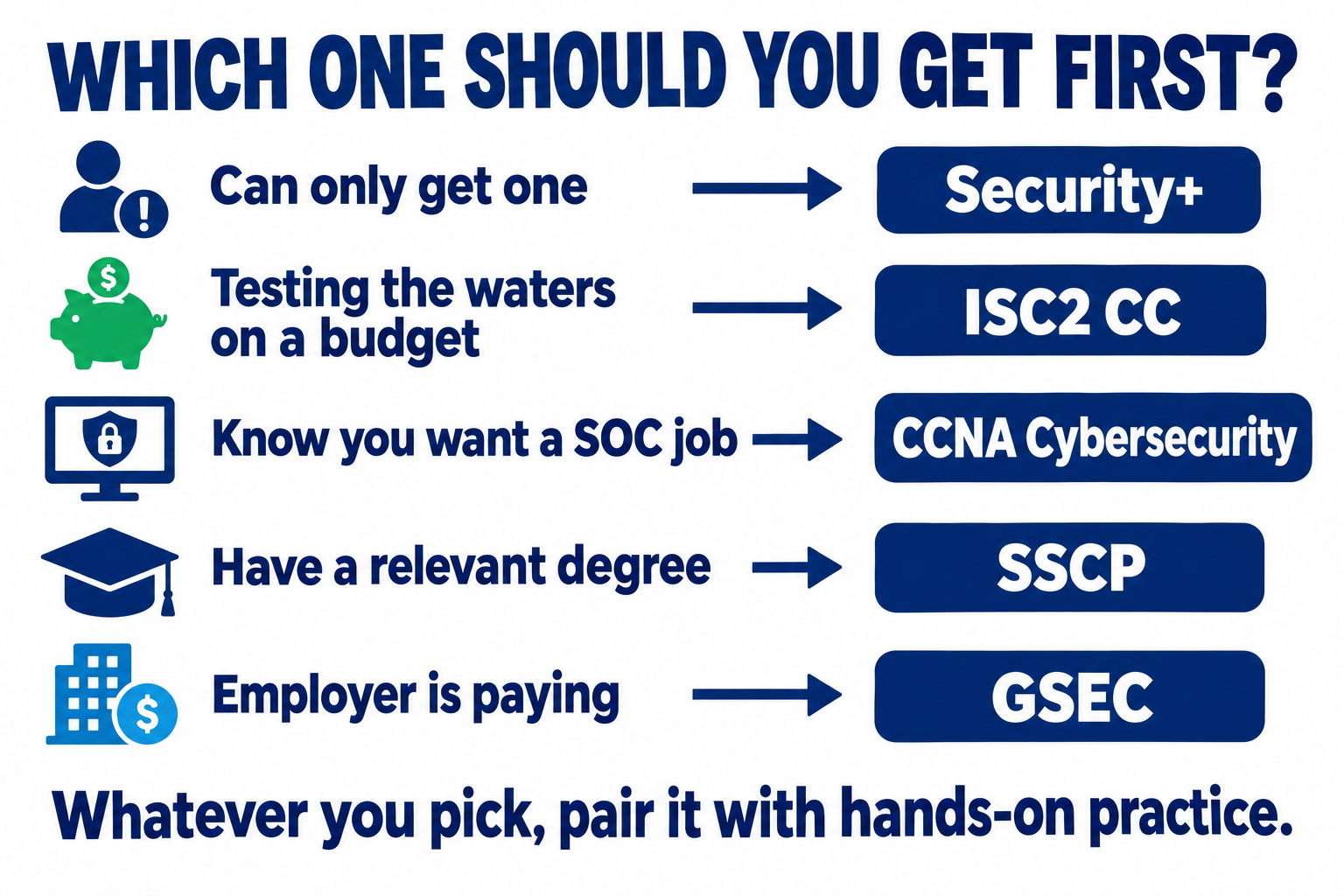
If you can only get one: Security+, no question.
If you're testing the waters on a budget: ISC2 CC at $199, then move on to Security+.
If you know you want SOC work: CCNA Cybersecurity. It's cheaper than Security+ and more targeted.
If you have a relevant degree: SSCP. More depth than Security+ for a lower exam price, and it puts you on the CISSP track.
If your employer is paying: GSEC. Don't think twice.
If more than one of these fits you, most people should still end up with Security+ at some point, because it clears more CV filters than anything else at this level. The others are either a cheaper first step or a more targeted second one.
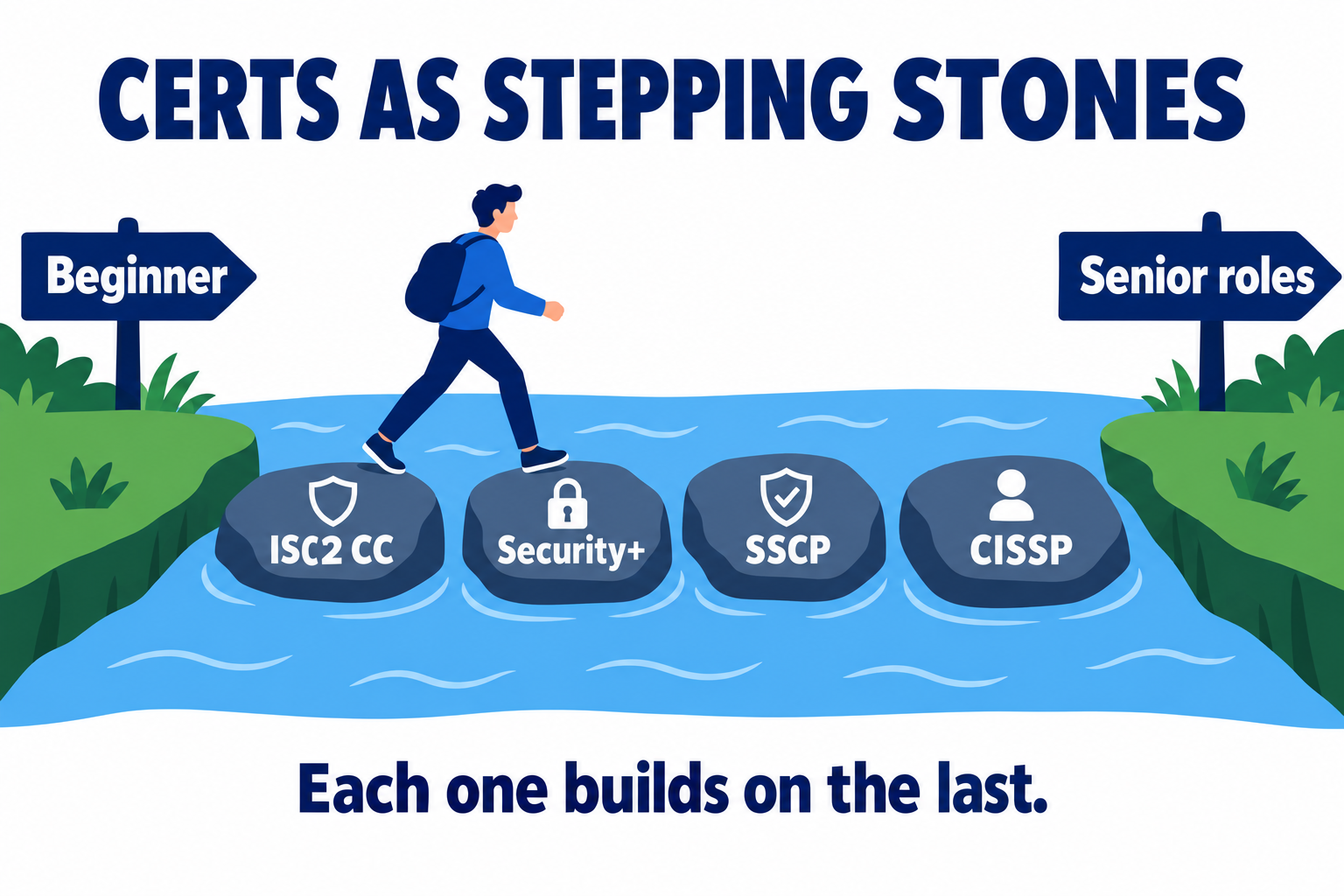
For a personalised answer, our free Certification Roadmap maps the right certifications to your goals and budget. And when you're ready for what comes after these, Best Cybersecurity Certifications That Get You Hired covers the next steps, from CySA+ and OSCP to CISSP.
The Cert Is Only Half of It
Whichever certification you choose, something matters more than the certification itself. When a CV lands on my desk, I'm not counting certifications. I'm looking for evidence that this person can actually protect my company, today. Can they do the job, or can they only pass a test about the job?
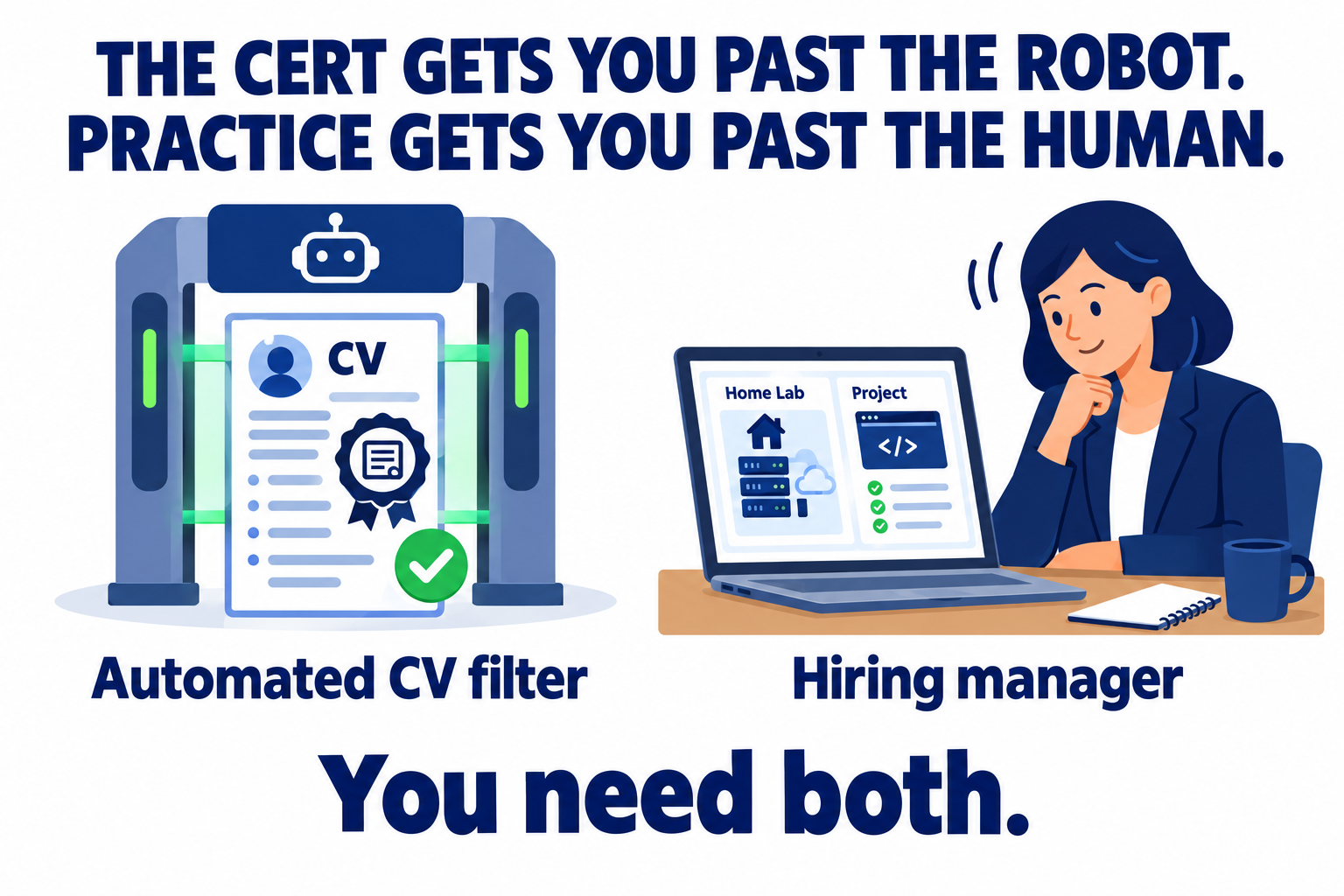
The certification gets you past the automated filter. The practical experience gets you past the human. You need both. In the AI-driven security job listings we archive, the beginner certifications on this list barely appear at all. Security+ is mentioned in about 5% of them, and the rest in a handful or fewer. Those roles are mostly senior, so this says more about senior hiring than entry level. But it fits what I see at every level: employers want to see what you can build.
So study for the certification, but build something while you study: a home lab, a capture-the-flag portfolio, a personal project, maybe a small AI agent that does a security task. Those give you something real to talk about in interviews.
If you want help with that part, with real projects, career coaching and done-for-you CV support, that's what our AI Master's Program is for (a mentored StationX programme, not a university degree). You can get a full refund up until the programme begins, and if you haven't proven you can build your own working solutions by the end of the year, the programme stays open until you do, at no extra cost.

Frequently Asked Questions
What is the best cybersecurity certification for beginners?
CompTIA Security+. It's named in 70,019 US cybersecurity job listings in a year (CyberSeek), it's approved for US Department of Defense roles, it has no prerequisites, and it doesn't lock you into one career path. It costs $439 in the US.
Is the ISC2 CC still free?
No, not for new candidates. ISC2 closed its One Million Certified in Cybersecurity programme to new entrants on 20 May 2026. If you already have a code you can use it until 31 December 2026; otherwise the exam costs $199.
What is the easiest cybersecurity certification to get?
Microsoft SC-900 is probably the easiest. It's a fundamentals exam with no hands-on component and costs $99. But it's an awareness badge, so it won't carry much weight on its own.
Which entry level cybersecurity certification is best for a SOC analyst job?
Cisco's CCNA Cybersecurity (exam 200-201) is the one built most directly around SOC analyst work: security monitoring, host-based analysis and network intrusion analysis. It costs $300. Security+ is still worth having for the broader recognition.
Can I get a cybersecurity job with just a certification?
Rarely. A certification helps you get past automated CV filters, but hiring managers want proof you can do the work. Pair it with a home lab, capture-the-flag practice and a project or two you can talk about in interviews.
About the Author

Nathan House, Founder & CEO of StationX
Nathan House has 30 years of hands-on cybersecurity experience and is Cambridge-educated, holding CISSP, CISA, CISM, OSCP, CEH, and SABSA. He founded StationX in 1999 — one of the UK’s first cybersecurity companies — and has secured £71 billion in UK mobile banking transactions and the London 2012 Olympics, advising clients including Microsoft, Cisco, BP, Vodafone, and VISA. He authored the world’s most popular cybersecurity course — a #1 Udemy bestseller taken by over 500,000 students — and was named Cyber Security Educator of the Year 2020, AI Security Educator of the Year, and a UK Top 25 Security Influencer 2025. A DEF CON speaker and featured expert on CNN, Fox News, NBC, and the BBC, Nathan leads StationX’s training of more than half a million students worldwide.