Best Cybersecurity Certifications That Get You Hired (2026)
Which are the best cybersecurity certifications if what you actually want is a job? Not the most famous ones, or the ones every list repeats, but the ones employers ask for and respect. I've been in cybersecurity for over 30 years, I hold several of these myself, and I've watched thousands of students make this exact decision. A lot of them spend money on the wrong certification.
In this guide, we'll look at what job ads actually ask for, using two sets of data: a year of US cybersecurity job listings, and our own archive of AI-driven security jobs. Then we'll go through the five certifications I'd recommend, the popular one I'd skip, and the four things employers want alongside any certification.
TL;DR if you've only got 30 seconds
Of the certifications CyberSeek tracks, CISSP and Security+ are the two US job ads name most, with 82,494 and 70,019 listings in a year.
A sensible path: Security+, then CySA+ or OSCP depending on your direction, then CISSP when you're senior. Start learning AI security (SecAI+) now.
I'd skip CEH: it's expensive, rarely mentioned in AI-driven job listings, and for hands-on pentesting OSCP proves more.
Certifications open the door, but 69% of the AI-driven listings we've archived don't mention any of the common certifications we checked. In my experience, hands-on proof matters more.
What Employers Actually Ask For
Let's start with the data, because it tells a different story from most "best certifications" lists. CyberSeek, a project backed by CompTIA and the US standards body NIST, counts how many US cybersecurity job listings name each certification. Over the 12 months to April 2025, these were the top five of the certifications it tracks:
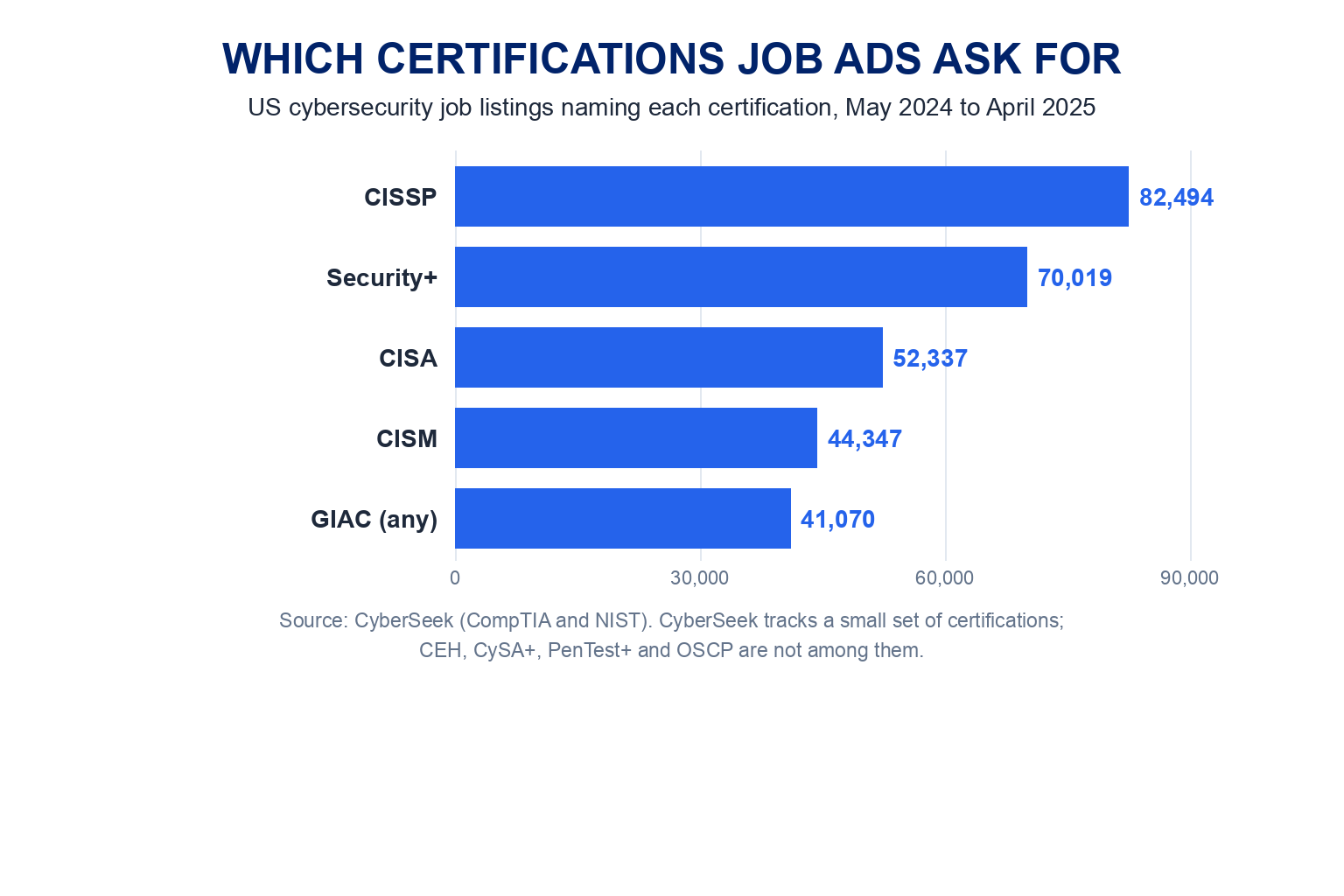
CISSP and Security+ lead by a long way. But CyberSeek only tracks a handful of certifications, so it can't tell us about CEH, CySA+ or OSCP. For that, we can look at our own data. We archive real AI-driven security job listings, the jobs that expect you to use AI in the work, in AI-Driven Cyber Security Jobs. Here's how often each certification is mentioned across 576 of them:
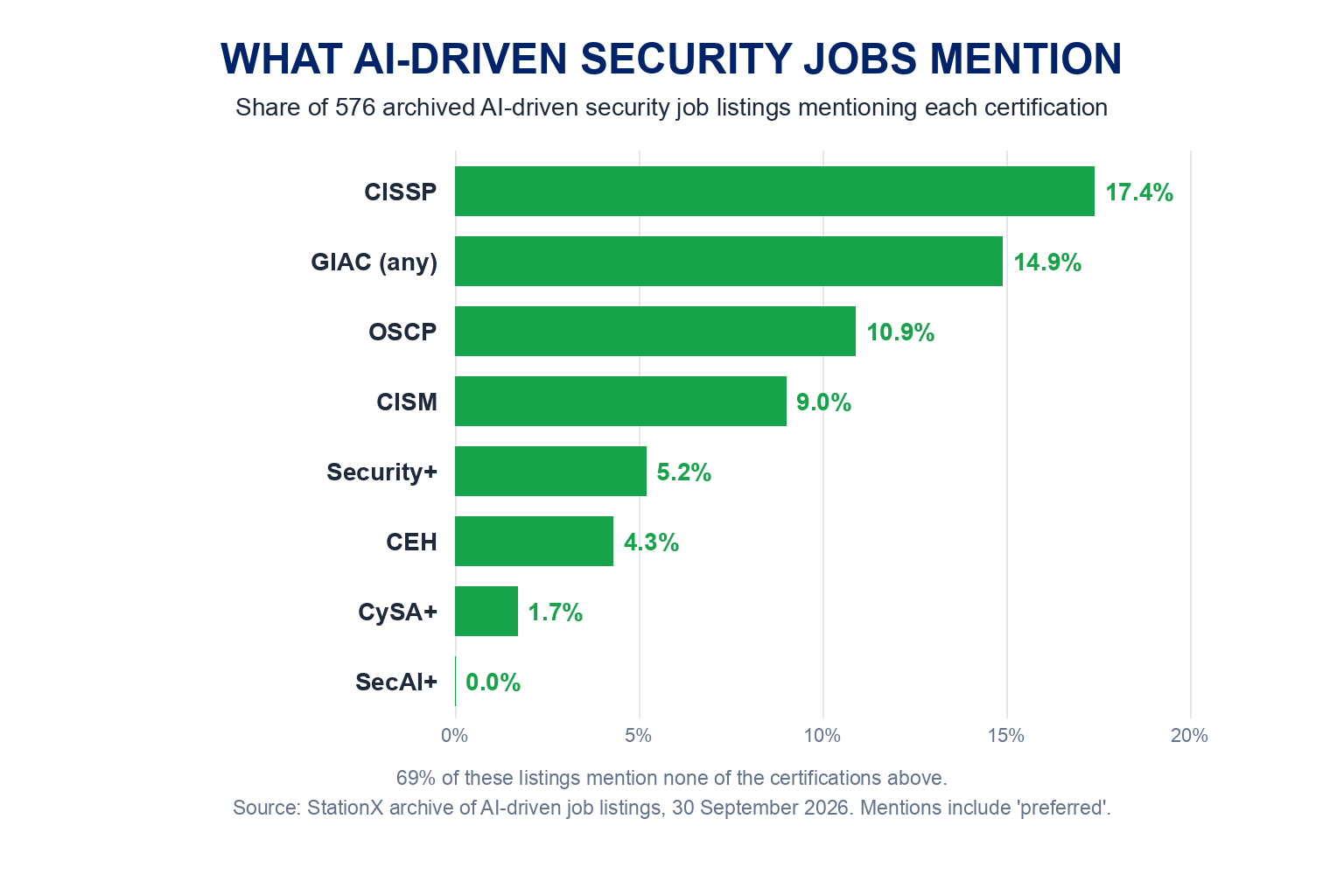
Two things jump out. First, hands-on certifications like OSCP and GIAC (a family of specialist certifications linked to SANS training, counted together here) are mentioned well above CEH in these newer, AI-driven roles. Second, 69% of these listings don't mention any of these certifications at all. A listing that doesn't name a certification doesn't mean the hiring manager ignores them, but in my experience these employers care more about what you can build. Keep that in mind as we go through the list.
1. CompTIA Security+: The Starting Point
If you're just starting out, this is where most of us begin. Security+ proves you understand the core concepts of security, and it's the certification that gets your CV past the automated screening tools many employers use, so a human actually reads it.
📈 Level
Entry level, once you have some basic IT knowledge.
💰 Cost and format
$439 exam voucher (CompTIA list price, 2026). Multiple choice plus some practical questions.
🛠️ Pair it with
A home lab, capture-the-flag exercises (online hacking challenges) and a few hands-on projects.
🎯 Best for
Your first security role, and US government and military jobs: it's approved under the Department of Defense's DoD 8140 rules.
🎟️ Get it with StationX: Security+ exam voucher (discounted, price-matched) · Security+ course and practice test bundle
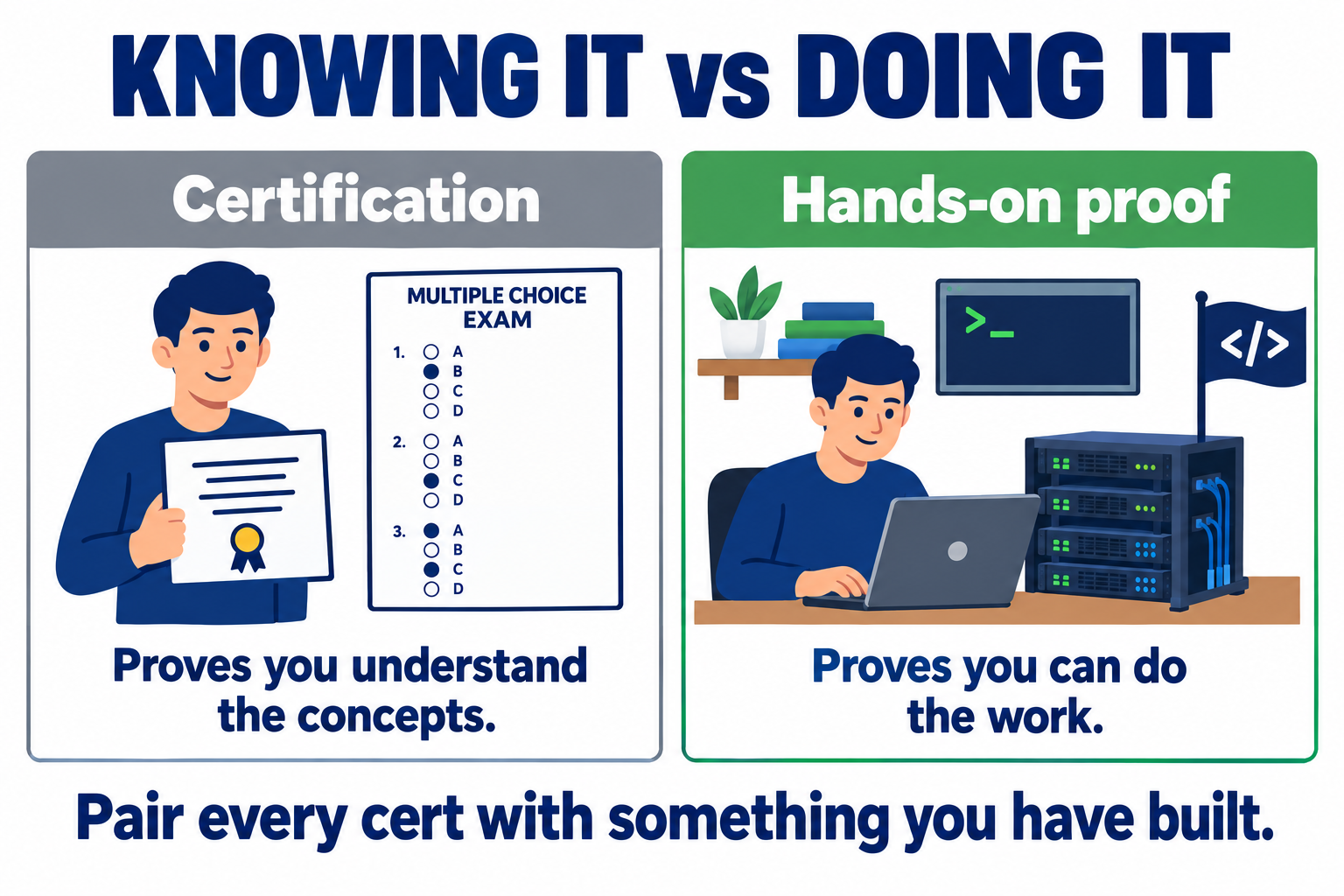
Named in 70,019 US job listings in a year, it's the second most-requested certification CyberSeek tracks. But be clear about what it proves: that you understand the concepts, not that you can do anything with them. That's why you pair it with hands-on work, and why you never stop here.
2. CompTIA CySA+: The Underrated SOC Certification
CySA+ is probably the most underrated certification on this list. Where Security+ covers broad concepts, CySA+ covers the actual work of a security analyst in a security operations centre (SOC): spotting threats, analysing logs, managing vulnerabilities and responding to incidents. The latest version, launched in June 2026, also covers SIEM tools, which collect security alerts from across a company, and EDR tools, which watch individual computers for suspicious behaviour.
📈 Level
Early career, usually after Security+.
💰 Cost and format
$439 exam voucher. Mostly multiple choice, and it won't teach you to use a specific tool like Splunk.
🛠️ Pair it with
Real SIEM experience, for example Splunk or Elastic, and threat intelligence tools.
🎯 Best for
SOC analyst and security analyst roles. Also approved under DoD 8140.
🎟️ Get it with StationX: CySA+ exam voucher · CySA+ training bundle
It's less famous than Security+, so fewer automated CV filters look for it. But hiring managers who work in security know exactly what it means: you understand security operations. If you're deciding between Security+ and CySA+, get Security+ first, then CySA+ if you're heading for a SOC.
Why I'd Skip CEH (Certified Ethical Hacker)
Before anyone asks: no, I'm not recommending this one. CEH turns up near the top of almost every certification list online, and honestly, I don't think the data we have justifies it.
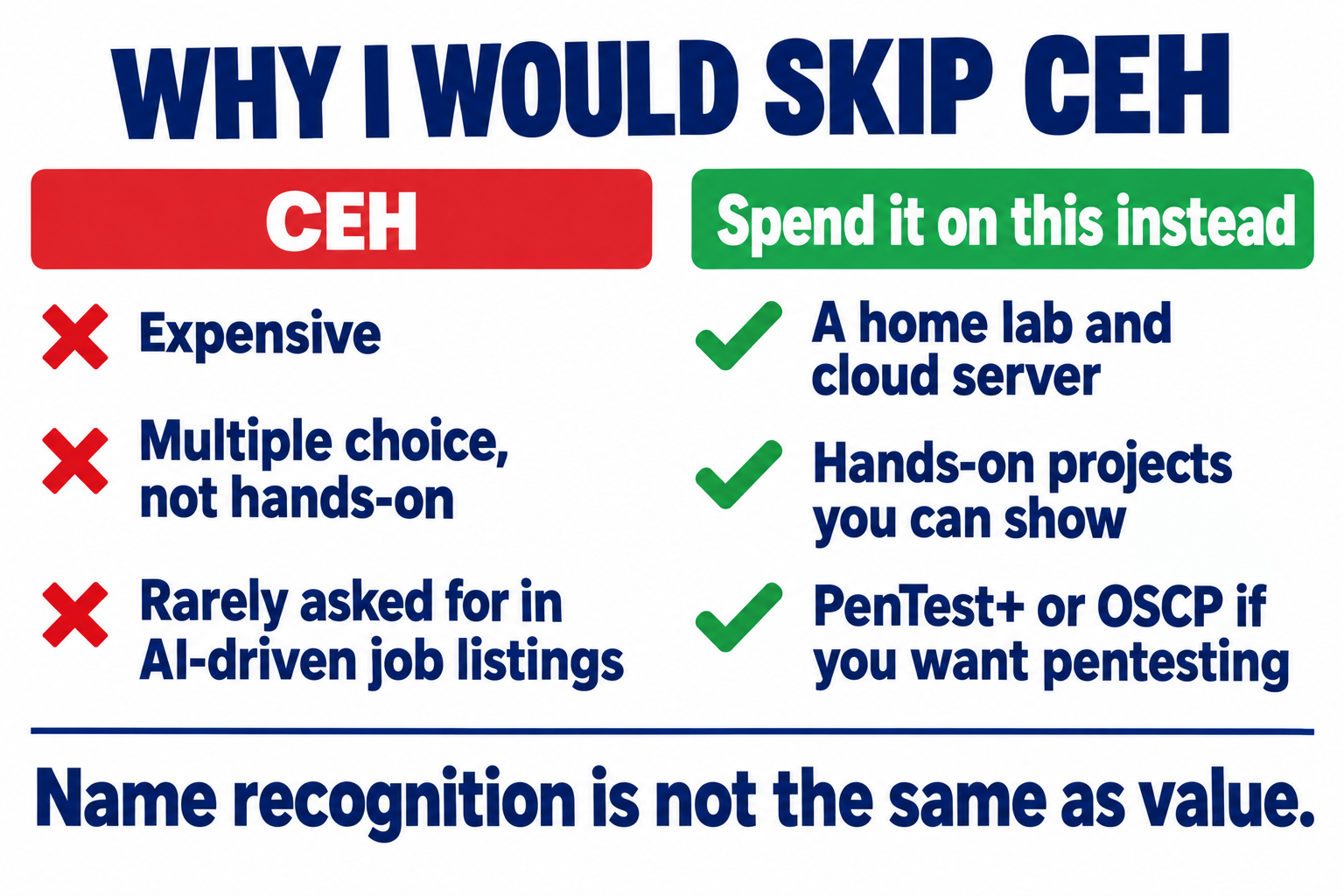
Its reputation is mostly name recognition. It sounds impressive, it's been around a long time, and HR departments put it in job ads. But the people who actually work in penetration testing, the ones who'll sit across from you in the interview, often don't value it the same way. In our archive of AI-driven security listings, it's mentioned in only 4.3% of them, well behind OSCP at 10.9%.
Some people argue CEH helps you get past automated CV filters. It can. But so do Security+ and CISSP, the two most-requested certifications in CyberSeek's data. And like Security+ and CySA+, the main CEH exam is multiple choice, so it doesn't prove more hands-on skill than they do. The real problem for me is the cost. The CEH exam costs $950 taken remotely or $1,199 at a test centre, and EC-Council's instructor-led training is $2,999. That money is better spent on a home lab, a cloud server and hands-on projects that prove you can do the work.
If you need a pentesting certification for a government or military role, CompTIA PenTest+ is approved under DoD 8140 and costs about $440. You can get a discounted PenTest+ voucher and our PenTest+ course bundle from StationX. And if you want real pentesting skills, keep reading.
3. OSCP: The Hands-On Pentesting Certification
The OSCP is completely different from everything else on this list. Passing it now earns two credentials: the OSCP, which lasts for life, and OSCP+, which you renew every three years. The exam is 23 hours and 45 minutes of hands-on hacking in a live environment, followed by 24 hours to write your report. There are no multiple choice questions. You break into the systems or you fail, and plenty of people fail. That's the point.
📈 Level
Intermediate. You need solid networking and Linux skills first.
💰 Cost and format
Hands-on exam. The course and exam bundle from OffSec costs $1,749.
🛠️ Pair it with
Lab practice, capture-the-flag competitions or bug bounty experience (finding and reporting real bugs for rewards).
🎯 Best for
Penetration testing and red team roles.
🎟️ Get it with StationX: Complete Penetration Testing course (groundwork before OSCP) · Ethical hacking courses bundle
HR departments don't always know what it is, so fewer automated CV filters look for it than for better-known names. But the person interviewing you will. Unlike most certifications, the OSCP actually teaches you the skills. You come out of it able to do a pentest.
One warning: in my view, AI is already taking over a lot of junior pentesting work, and junior SOC work too. JobZone Risk scores junior penetration testers at just 6.4 out of 100 for safety from AI. The long-term demand is for people at the expert level. OSCP is a stepping stone towards that, not the finish line. You can check how exposed any role is to AI on JobZone Risk, which is free.
4. CISSP: The Senior-Level Certification
If you've been in the field for a few years, this is the one. I hold it myself. CISSP is named in more US cybersecurity job listings than any other certification CyberSeek tracks: 82,494 in a year. It's also the most-mentioned certification in our AI-driven listings, at 17.4%.
📈 Level
Senior. Full certification needs five years of paid security experience.
💰 Cost and format
$749 exam fee (ISC2). Multiple choice, broad scope: security management, architecture, governance and risk.
🛠️ Pair it with
Real leadership experience and the ability to explain risk to the business.
🎯 Best for
Senior, management and leadership roles. Skillsoft puts the average US salary of CISSP holders at about $168,000, though holders tend to be senior, so the certification isn't the only reason they earn more.
🎟️ Get it with StationX: CISSP boot camp, part 1 of 4 (domains 1 and 2) · CISSP practice tests
You don't have to wait five years to take it, though. You can pass the exam first and become an Associate of ISC2, then you have six years to build the experience. If you're early in your career, that lets you prove the knowledge while you get the experience, and it looks great on your CV. Either way, treat it as a long-term target. Don't rush it.
5. CompTIA SecAI+: The One to Learn Now
This one is brand new. CompTIA launched SecAI+ in February 2026, so almost no job ads ask for it yet, and none of the AI-driven listings in our archive mention it. So why is it on the list?
Because of what it covers. Securing AI systems makes up 40% of the exam: things like prompt injection (tricking an AI with hidden instructions), guardrails and the risks of AI agents. And it also covers using AI to do security work, including AI agents in security operations. I believe securing AI and using AI for security is where most roles in this field are heading. I've written more about AI security certifications in Best AI Security Certifications.
It won't get you past automated filters yet. But I'd put the skills it covers at the top of your list to learn, whichever certification you take next.
🎟️ Get it with StationX: SecAI+ exam voucher · SecAI+ training bundle
Which Cybersecurity Certification Should You Get First?
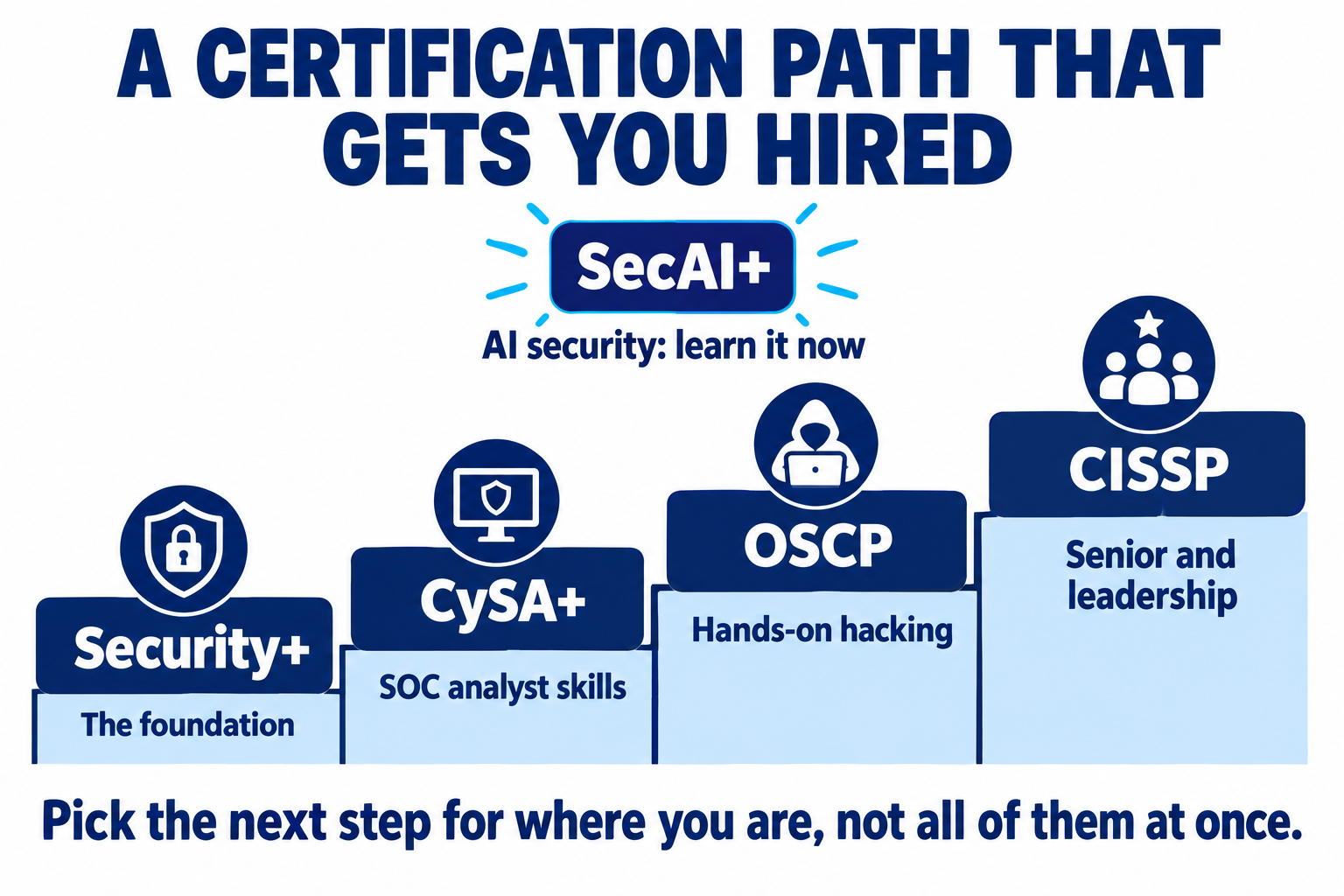
The right choice depends on where you are and where you want to go. Here's how I'd think about it:
Brand new to security: Security+, with a home lab alongside it.
Heading for a SOC or analyst role: CySA+ next, plus hands-on SIEM practice.
Heading for penetration testing: OSCP, with plenty of lab and capture-the-flag practice first.
A few years in and aiming higher: CISSP, starting as an Associate of ISC2 if you need to.
Whatever your path: Start learning AI security now, whether or not you take SecAI+.
If you want a personalised answer, our free Certification Roadmap maps out which certifications fit your situation, and you can browse free cybersecurity certifications to get started without spending anything.
Certifications Aren't Enough: 4 Things That Get You Hired
Certifications matter. They get you past filters and prove you know the material. But most people treat them as the whole picture, and they're one piece of it. Remember that 69% of the AI-driven listings in our archive don't mention any of these certifications. Over the years, working with more than 500,000 students, we've found four other things that separate the people who get hired.
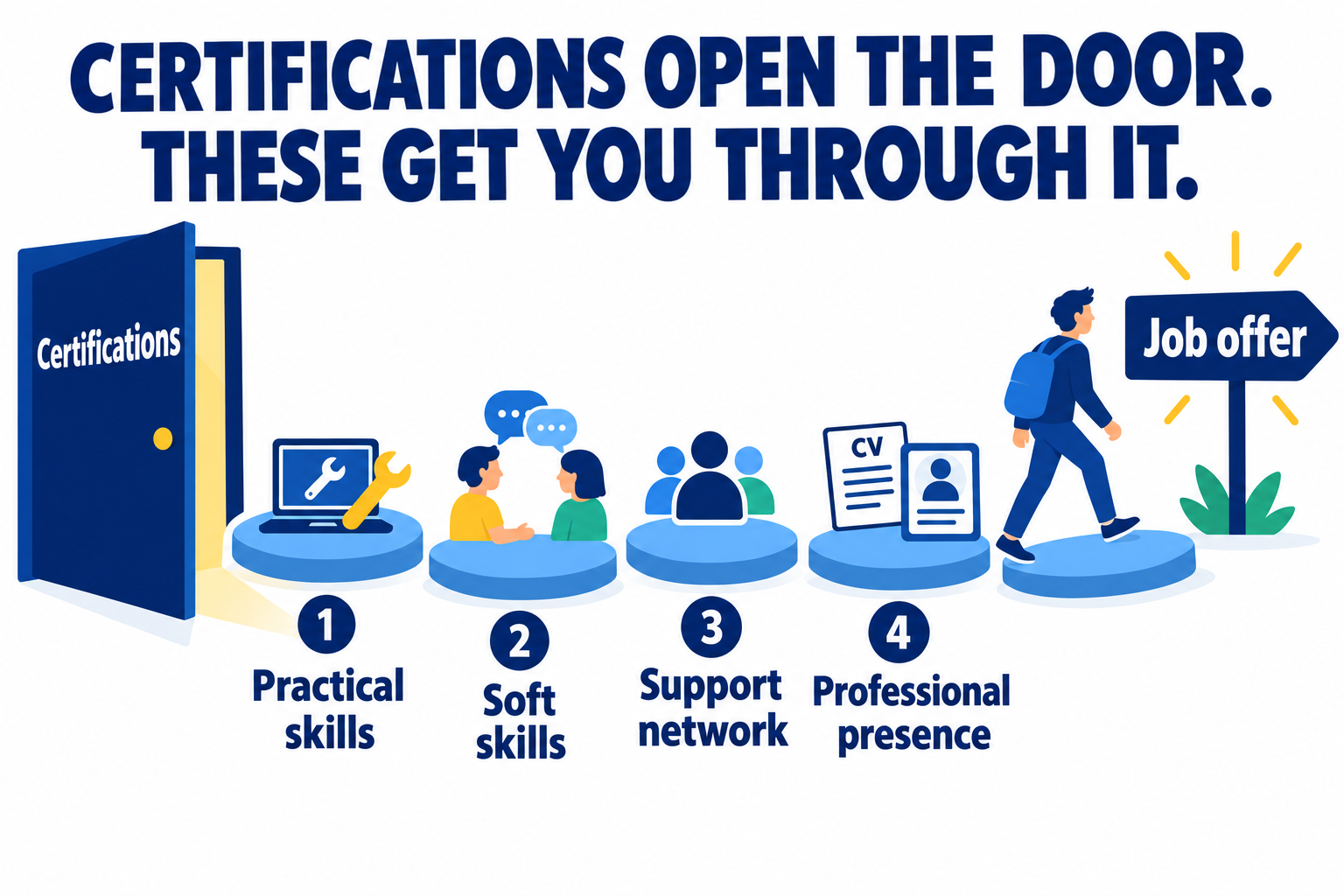
Practical skills. Home labs, capture-the-flag challenges, cloud projects, and tools like Splunk, Wireshark and Burp Suite. Something that shows you've actually done the work is what sets you apart from a pile of applicants with the same certifications.
Soft skills. In the 2025 ISC2 Workforce Study, hiring managers named problem solving (29%), collaboration (24%) and communication (22%) more often than any technical skill. They're not a nice-to-have.
A support network. Peer groups, mentors and communities. People who learn with others and have someone checking in on their progress are more likely to keep going. I cover the research in Is Cybersecurity Hard?
A professional presence. Your CV, LinkedIn and the projects you've built. Use them to show what you can do, and to give yourself something real to talk about in interviews. You need to know your stuff, and you need to be seen to know it.
That's the difference between sending 200 applications into a black hole and getting interviews from a handful. The right certifications open doors, but these four things get you through them.
If you want help building all of them, that's what our AI Master's Program is for (a mentored StationX programme, not a university degree). You can get a full refund up until the programme begins, and if you haven't proven you can build your own working solutions by the end of the year, the programme stays open until you do, at no extra cost. And if you want to see which roles these certifications lead to, and what they pay, read Highest Paying Cybersecurity Jobs.

Frequently Asked Questions
What is the best cybersecurity certification?
It depends on where you are. For beginners, CompTIA Security+ is the standard starting point and one of the two most-requested certifications in US job ads. For hands-on penetration testing, OSCP. For senior and leadership roles, CISSP, the most-requested certification overall.
Is CEH worth it?
In my opinion, usually not. The exam alone costs $950 to $1,199, and it's mentioned in only about 4% of the AI-driven security job listings we've archived. If you need a government-approved pentesting certification, PenTest+ costs less, and if you want real hands-on skills, OSCP proves more.
Security+ or CySA+: which should I get first?
Security+ first. It covers the broad concepts and is what most entry-level job filters look for. CySA+ comes next if you're heading for a security analyst or SOC role, because it focuses on the day-to-day work of detecting and responding to threats.
Is CISSP worth it?
For senior roles, yes. It's named in more US cybersecurity job listings than any other certification CyberSeek tracks (82,494 in a year), and Skillsoft puts the average US salary of CISSP holders at about $168,000. You need five years of experience to be fully certified, but you can pass the exam earlier and become an Associate of ISC2.
Do you need certifications to get a cybersecurity job?
They help you get past filters, but on their own they're rarely enough. In the AI-driven security listings we've archived, 69% don't mention any of the common certifications at all. Employers want proof you can do the work: hands-on projects, practical skills and good communication.
About the Author

Nathan House, Founder & CEO of StationX
Nathan House has 30 years of hands-on cybersecurity experience and is Cambridge-educated, holding CISSP, CISA, CISM, OSCP, CEH, and SABSA. He founded StationX in 1999 — one of the UK’s first cybersecurity companies — and has secured £71 billion in UK mobile banking transactions and the London 2012 Olympics, advising clients including Microsoft, Cisco, BP, Vodafone, and VISA. He authored the world’s most popular cybersecurity course — a #1 Udemy bestseller taken by over 500,000 students — and was named Cyber Security Educator of the Year 2020, AI Security Educator of the Year, and a UK Top 25 Security Influencer 2025. A DEF CON speaker and featured expert on CNN, Fox News, NBC, and the BBC, Nathan leads StationX’s training of more than half a million students worldwide.