Highest Paying Cybersecurity Jobs: 10 AI-Safe Roles (2026)
What are the highest paying cybersecurity jobs, and which of them will still be worth having as AI takes over more of the routine work? I've been in cybersecurity for 30 years and taught more than 500,000 students, and I think most people aim at the wrong roles. They pick a job title, get a certification and apply to whoever's hiring, without ever looking at where the money actually is.
In this guide, we'll go through ten roles, from about $106,000 up to well over $500,000 a year. For each one you'll get what the job is actually like, what it pays with the source named, the skills and certifications that matter, and how exposed it is to AI. Halfway through, I'll show you the one decision that can make more difference to your pay than the job title. And at the end, there are two bonus roles most people never consider.
There's also something the video this article is based on didn't cover, because the data didn't exist yet. We now archive real AI-driven security job listings, jobs that expect you to use AI to do the work, and they pay noticeably more than the same roles done the old way. I'll show you the numbers.
TL;DR if you've only got 30 seconds
The top three are CISO, chief privacy officer and enterprise security architect, typically paying from about $277,000 to well over $500,000.
Your employer can matter as much as your title. At the best-paying tech firms, senior security engineers earn two to three times the typical security engineering salary.
The AI-driven version of each role pays more. Across 193 US AI-driven security listings we've archived, the median advertised pay band is $159K to $227K.
Nine of the ten roles score in JobZone's green zone for AI risk. Penetration testing is yellow, because routine scanning is being automated.
Two bonus roles, cybersecurity lawyer and sales engineer, can pay as much as many of the top ten.
The Highest Paying Cybersecurity Jobs at a Glance
Salary sites disagree a lot, so here's how I've ranked these. Roles 2 to 10 are ordered by median total pay on Glassdoor in the US (September 2026), meaning half of people earn more and half earn less, including bonuses. The CISO figures come from two CISO pay surveys, which measure pay differently from Glassdoor, so CISO is number one on the strength of its typical range rather than a like-for-like median. Your own pay will depend on where you live, your experience and, as we'll see, who you work for.
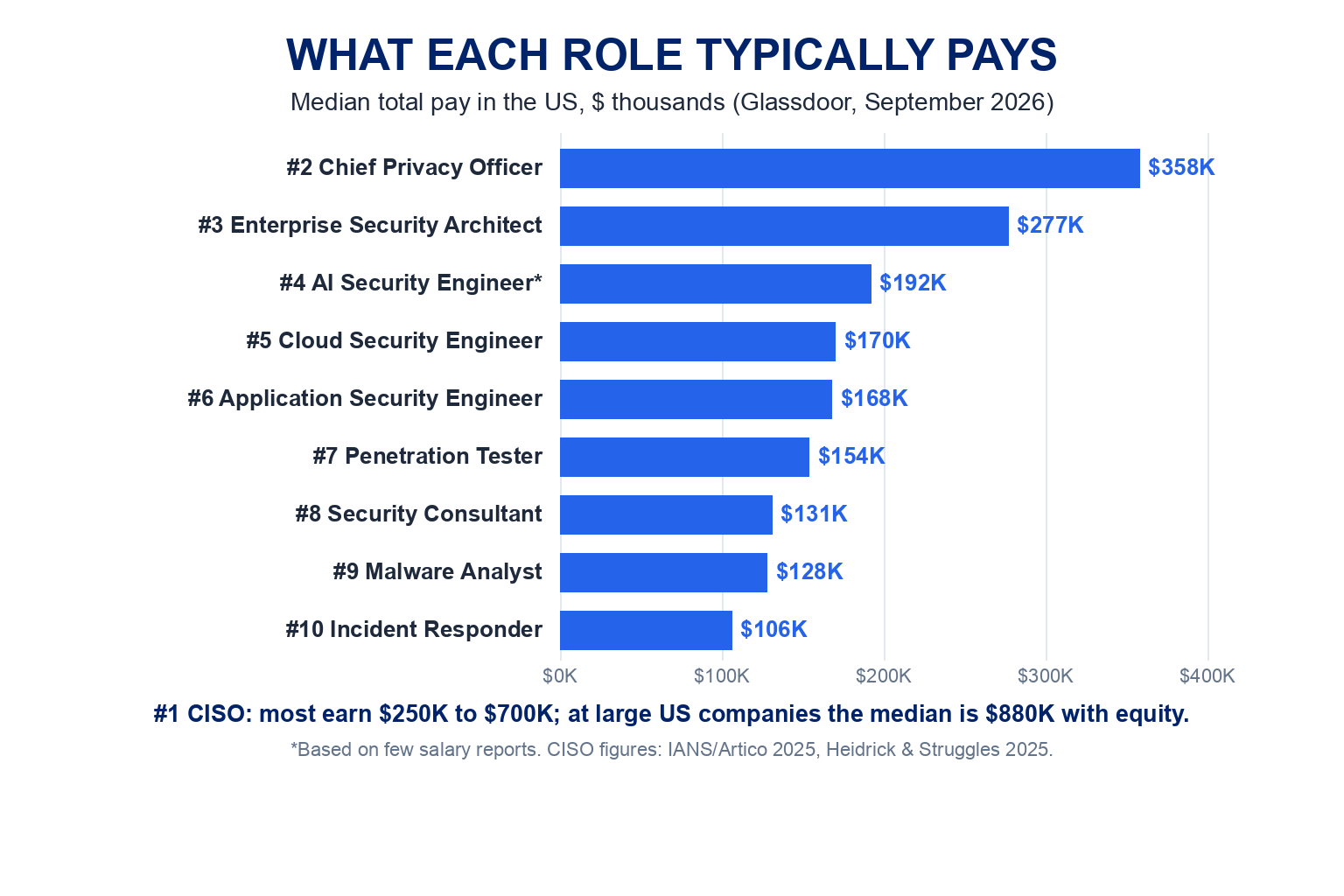
For context, the US median household income was $87,460 in 2025. So even the tenth role on this list pays more on its own than a typical household earns.
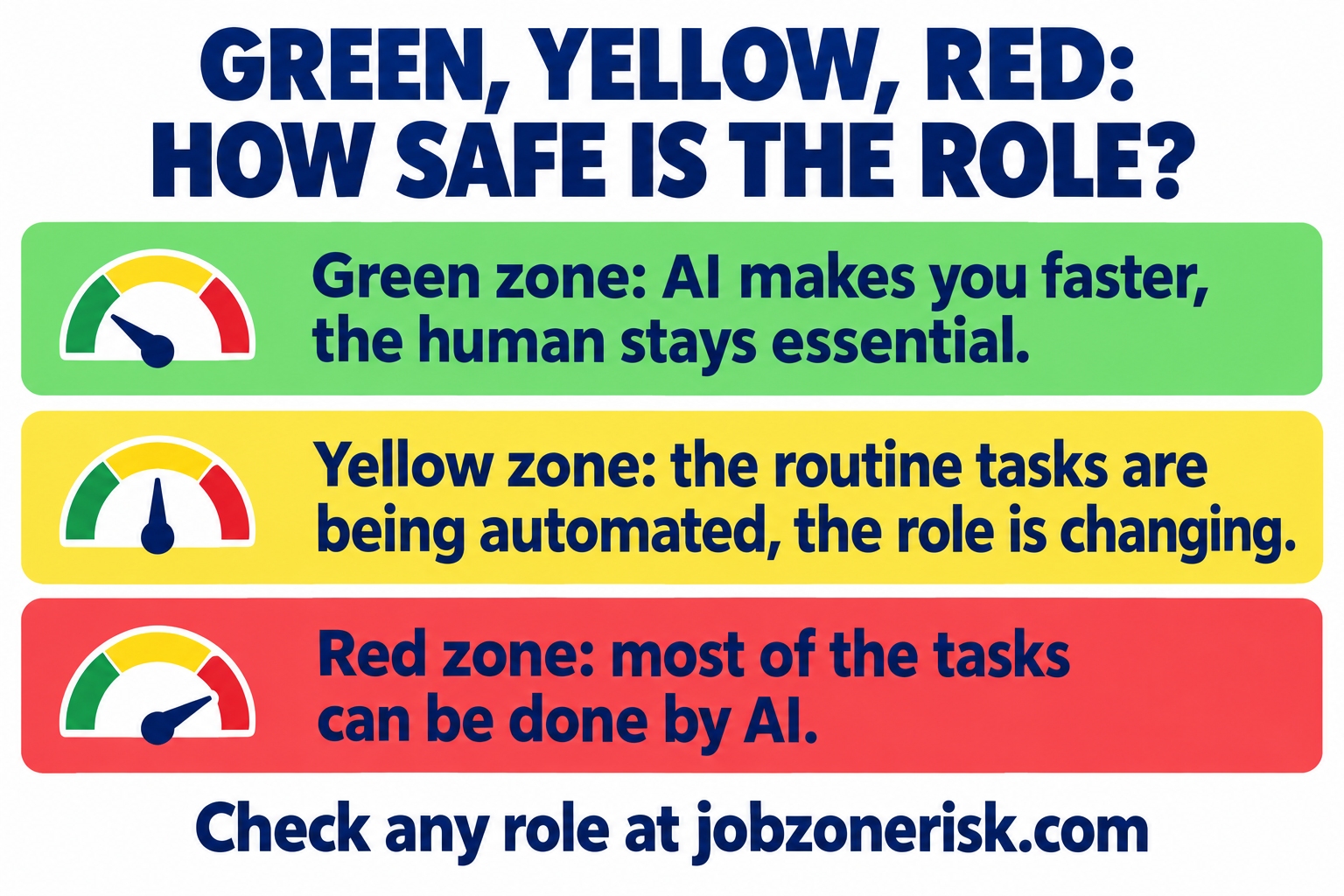
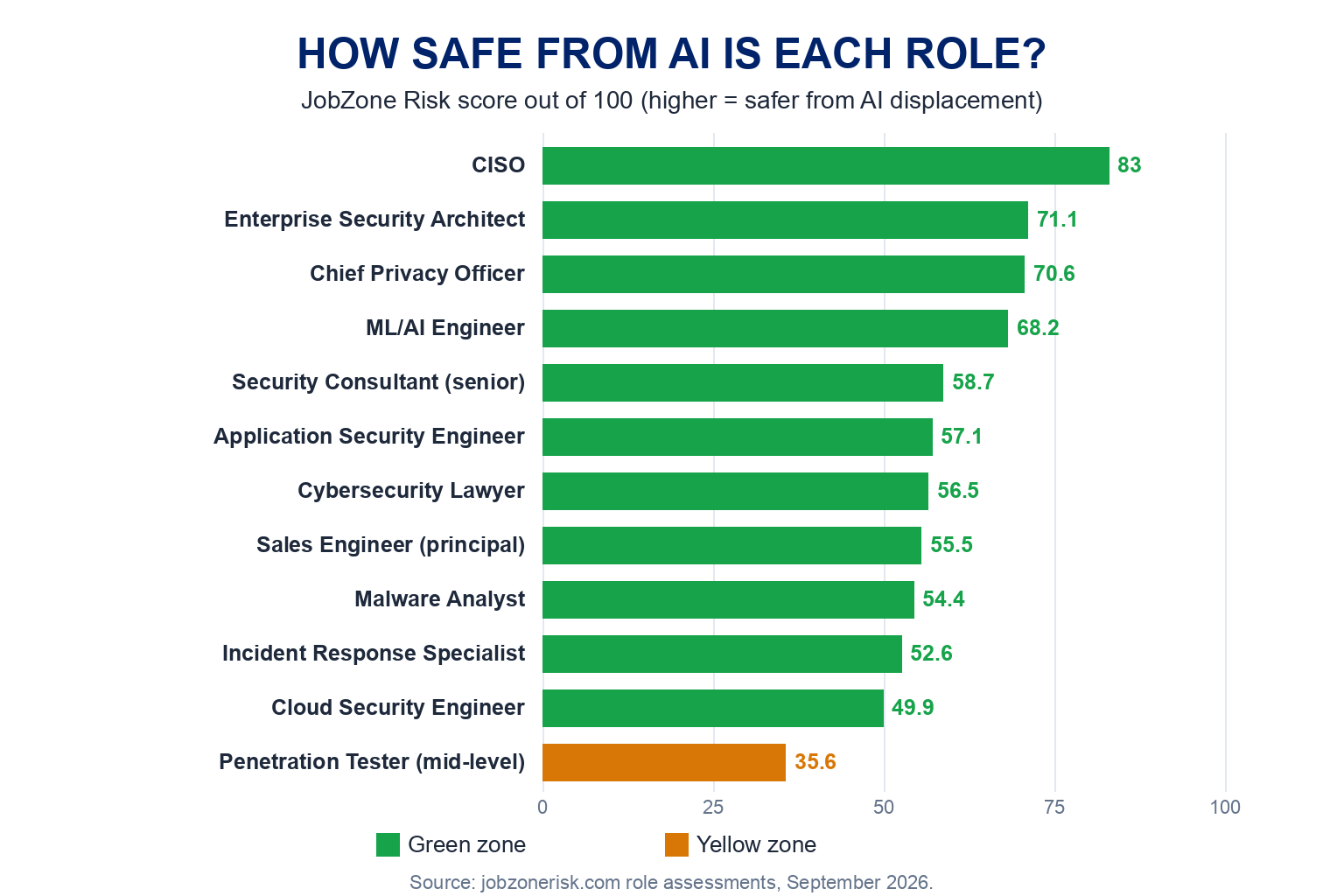
JobZone puts each role in a zone using both the score and how much of the job's work AI is taking over, so two similar scores can land in different zones. I've also given each role its score on JobZone Risk, the free tool I built that rates thousands of jobs on how exposed they are to AI, from 0 (very exposed) to 100 (safe). There's no point chasing a high salary in a job that's disappearing.
Why AI-Driven Security Jobs Pay More
Here's the part that changes this whole list. There's a new kind of security job appearing: the AI-driven version of the role. Same area of security, but the listing requires you to use AI in the work, for example building AI agents that triage alerts, find vulnerabilities or write detection rules. We track these in AI-Driven Cyber Security Jobs, where every listing is archived word for word, because postings close fast.
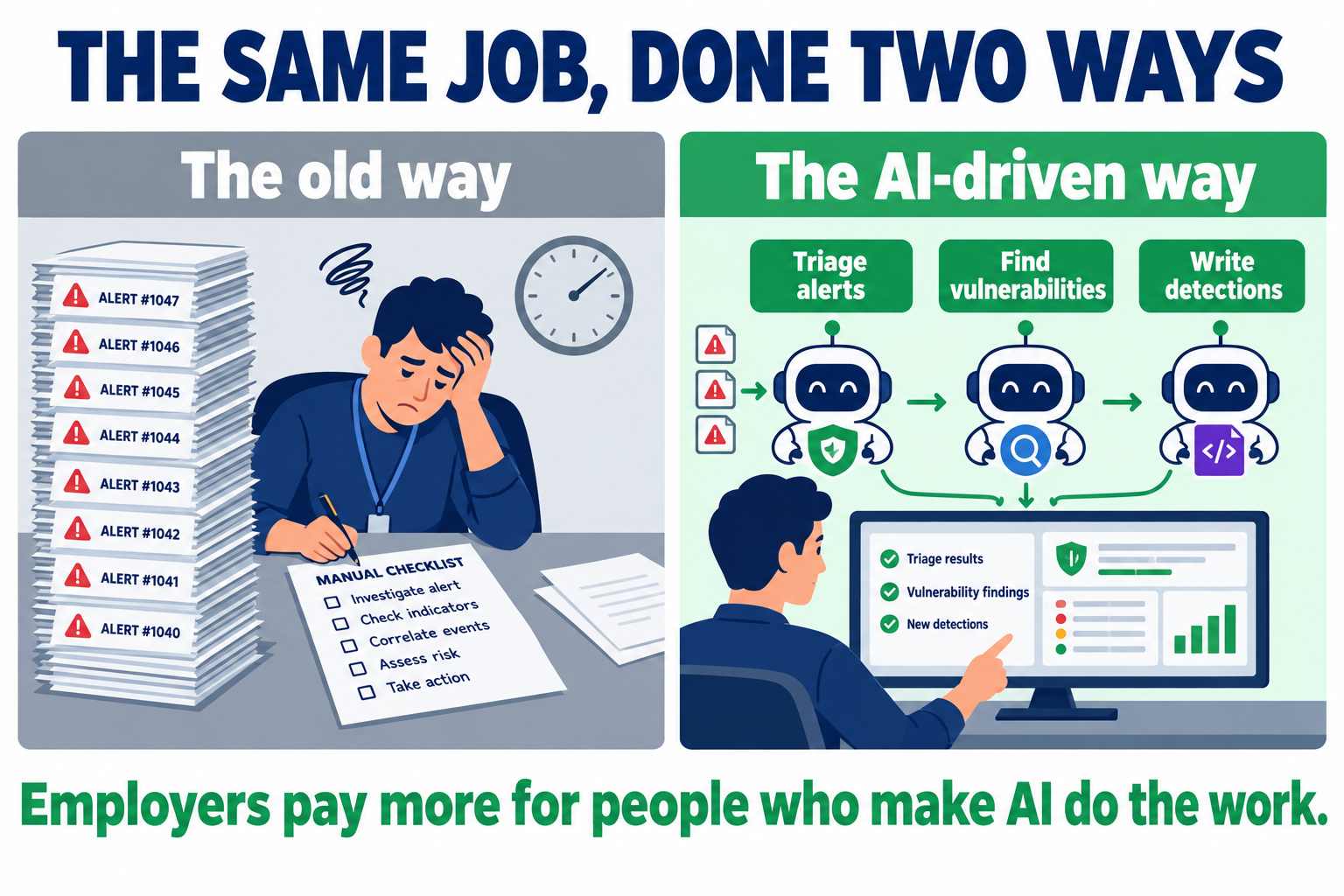
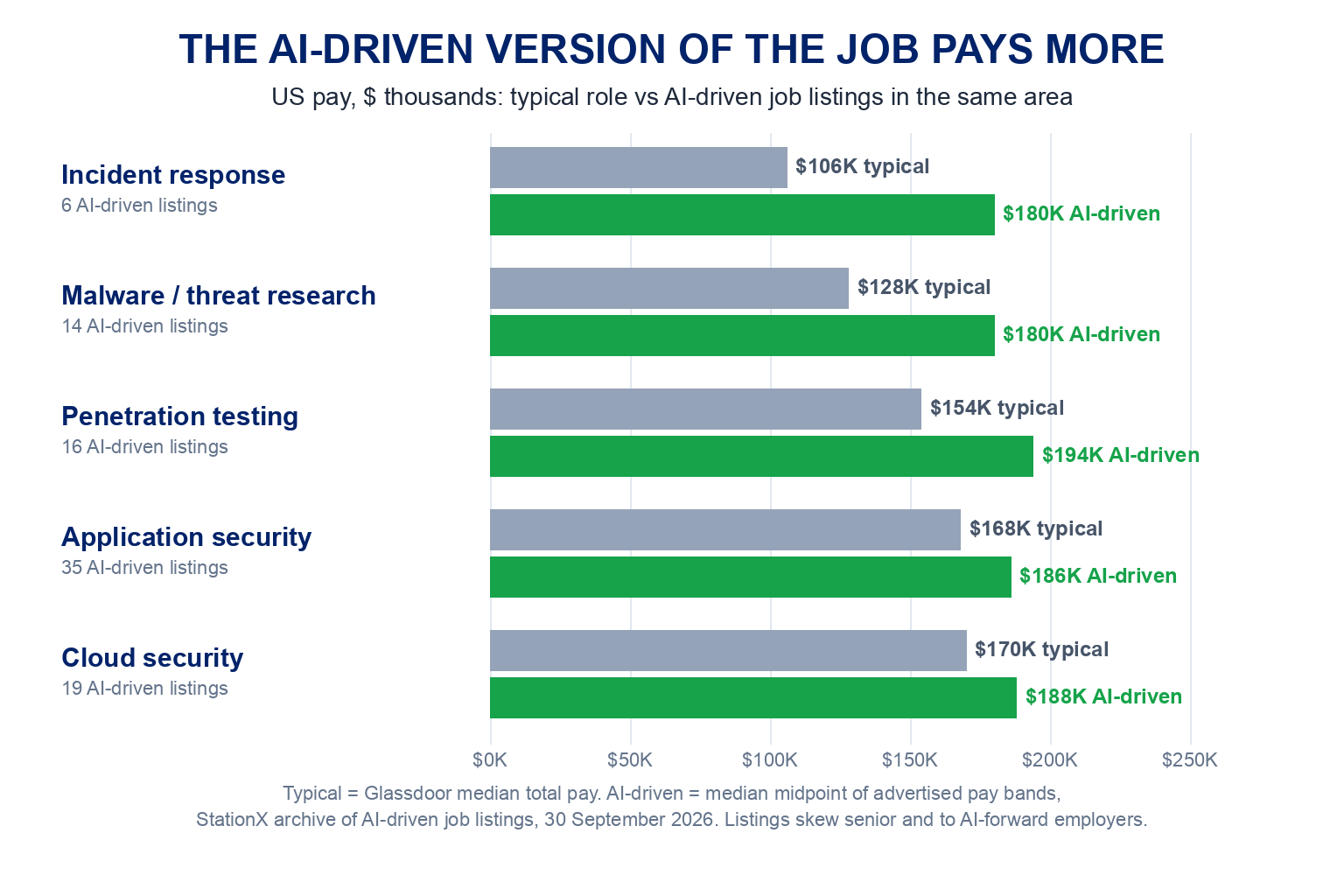
As of 30 September 2026, 193 of the US AI-driven security listings we've archived state a pay band. The median band runs from $159,000 to $227,000, with a midpoint of about $192,500. In all five areas above, what these listings advertise is higher than the typical pay for that kind of job.
To be fair about the comparison: these are advertised pay bands, and most of these listings are senior roles at employers that are leaning hard into AI. The Glassdoor figures cover everyone in the role, at every level. So this doesn't prove that AI skills alone add a set amount to your pay; part of the gap is seniority and who's hiring. Some areas are also small samples, such as six incident response listings. But it matches what I see: the people who can make AI do the security work are the ones employers are competing for.
And at the top end, the numbers are striking. These are real listings, with the employer's own words:
Netflix, Software Engineer (L6), Platform Security: $499K to $900K
"Experience using AI agents to automate security research." (captured 7 September 2026)
Bridgewater Associates, Staff AI Agentic Security Engineer: $450K to $600K
"Replace manual runbooks with intelligent agents that reason, act, and escalate." (captured 27 July 2026)
OpenAI, Principal Software Engineer, Infrastructure Security: $401K to $510K
"Leverage frontier models and agents to develop automation and detection tooling." (captured 23 September 2026)
Anthropic, Staff+ Application Security Engineer: $320K to $485K
"We use Claude as our primary tool across every part of the job." (captured 27 July 2026)
Some of these postings may have closed since, which is exactly why we archive them. Under each role below, I've added what the AI-driven listings in that area advertise. If you're choosing a direction, my advice is simple: whichever role you pick, aim for the AI-driven version of it.
#10 Incident Responder
Picture a hospital hit by ransomware at two in the morning. Patient records are frozen and surgery is delayed. You're the one called in to contain the attack, work out what happened and preserve the evidence. If you stay calm when everything's on fire, this is your job.
💰 Pay
About $106,000 median total pay for incident response analysts (Glassdoor), with the top 10% above $175,000. The broader figure for information security analysts from the US Bureau of Labor Statistics (BLS) is $129,180 (May 2025).
🛠️ Skills and tools
Forensic tools like EnCase, FTK Imager and Volatility (for memory analysis), and YARA rules for spotting malware.
📜 Certifications
GIAC Certified Incident Handler (GCIH), EC-Council Certified Incident Handler, CompTIA CySA+.
🤖 AI risk (JobZone)
Green, 52.6. High-stakes judgement under pressure is hard to hand to AI.
🚀 The AI-driven version: across 6 US AI-driven job listings in incident response and forensics we've archived, the median advertised pay band is $142K to $218K (midpoint $180K). See the incident response and forensics listings.
#9 Malware Analyst
Malware analysts take malicious software apart to find out exactly what it does. When a new strain starts spreading through large companies, the incident teams contain the damage, and the malware analyst is in the lab working out how to stop it. If you like digging into code and hunting down how things work, this is where that pays.
💰 Pay
About $128,000 median total pay (Glassdoor), with the top quarter above $175,000.
🛠️ Skills and tools
Reverse-engineering tools like IDA Pro and Ghidra, and sandboxes that safely run malware to watch what it does.
📜 Certifications
GIAC Reverse Engineering Malware (GREM), GIAC Cyber Threat Intelligence (GCTI).
🤖 AI risk (JobZone)
Green, 54.4. AI-generated malware means more samples for humans to pull apart, not fewer.
🚀 The AI-driven version: across 14 US AI-driven job listings in threat intelligence and research we've archived, the median advertised pay band is $148K to $225K (midpoint $180K). See the threat intelligence and research listings.
#8 Security Consultant
Most security jobs keep you inside one company. As a consultant, you solve a different problem every few months: a hospital this quarter, a bank the next, a startup after that. I've done consultancy myself for decades, and you learn a huge amount because you see inside so many organisations.
💰 Pay
About $131,000 median total pay (Glassdoor), about $153,000 under the "cybersecurity consultant" title, and the top 10% above $235,000.
🛠️ Skills and tools
Broad, and depends on your specialism: risk assessment, security architecture, compliance frameworks and clear report writing.
📜 Certifications
CISSP, CISM for management, CRISC for risk.
🤖 AI risk (JobZone)
Green, 58.7 (senior). Client trust and advice are hard to automate.
#7 Penetration Tester
This is the job most people picture when they think of cybersecurity. You're paid to break into a company's systems, with permission, find the weak spots before criminals do, and hand over a report on how to fix them.
💰 Pay
About $154,000 median total pay (Glassdoor), with the top quarter above $205,000.
🛠️ Skills and tools
Kali Linux, Metasploit and Burp Suite, and increasingly custom-built AI security agents.
📜 Certifications
OSCP, Burp Suite Certified Practitioner (BSCP), OSCE3.
🤖 AI risk (JobZone)
Yellow, 35.6 at mid-level. Junior pen testers score 6.4, deep in the red zone.
🚀 The AI-driven version: across 16 US AI-driven job listings in offensive security and red teaming we've archived, the median advertised pay band is $147K to $232K (midpoint $194K). See the offensive security and red teaming listings.
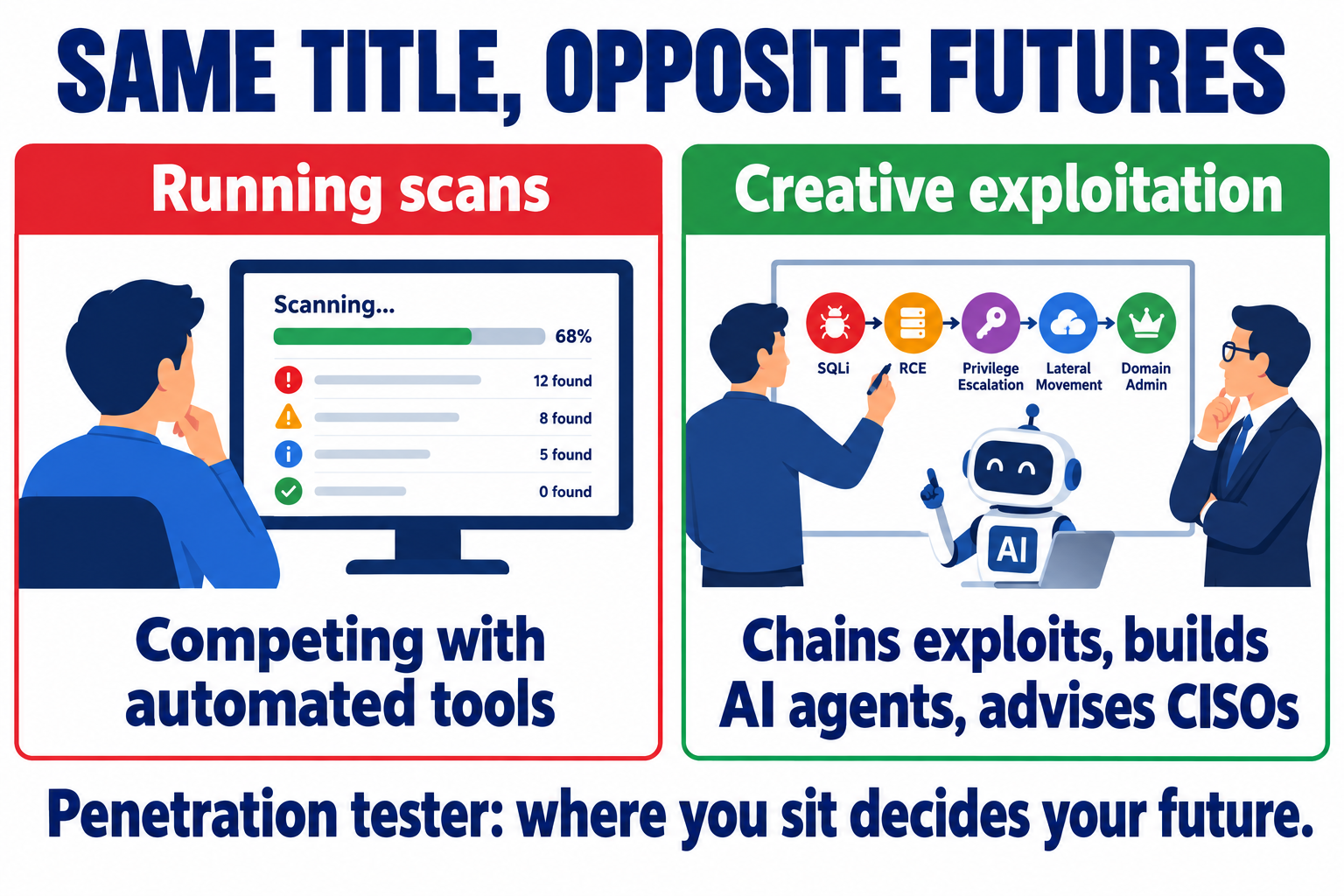
Pen testing is the one role on this list that's in the yellow zone, and it's worth understanding why. Automated tools can now run penetration scans on their own. So if your job is running scans, you're competing with software. The pen testers earning top money aren't running scans. They're chaining creative attacks together, building their own AI agents and advising CISOs face to face. Same title, opposite futures.
#6 Application Security Engineer
A new feature in the app ships on Friday. By Monday, attackers are probing it. You're the one who made sure they find nothing, because you built security into the code before it ever went live. If you come from a software development background, this is one of the most underrated paths into security.
💰 Pay
About $168,000 median total pay (Glassdoor), with the top 10% above $240,000.
🛠️ Skills and tools
Code scanning tools like Veracode and SonarQube, plus Jenkins, Docker, Kubernetes and Terraform.
📜 Certifications
CSSLP, OSWE, Certified Kubernetes Security Specialist (CKS).
🤖 AI risk (JobZone)
Green, 57.1. People still need to design the guardrails.
🚀 The AI-driven version: across 35 US AI-driven job listings in application and product security we've archived, the median advertised pay band is $159K to $215K (midpoint $186K). See the application and product security listings.
#5 Cloud Security Engineer
A developer accidentally makes a storage bucket public, and inside it are ten million customer records. You're the one who set up the automated guardrails that caught it in seconds and locked it down before it became a headline. Honestly, the demand here is kind of ridiculous. Every company needs cloud security, and most can't hire enough good people.
💰 Pay
About $170,000 median total pay (Glassdoor), with the top quarter above $215,000.
🛠️ Skills and tools
AWS Security Hub, Microsoft Sentinel, Terraform and cloud security platforms like Prisma Cloud.
📜 Certifications
AWS Certified Security Specialty, CCSP, Azure Security Engineer Associate.
🤖 AI risk (JobZone)
Green, 49.9. Demand far outstrips supply.
🚀 The AI-driven version: across 19 US AI-driven job listings in cloud and infrastructure security we've archived, the median advertised pay band is $160K to $220K (midpoint $188K). See the cloud and infrastructure security listings.
The Decision Most People Get Wrong: Who You Work For
Here's the decision most people get wrong. They pick a role, get certified and apply to whoever's hiring. But where you work can change your pay dramatically, even for similar skills.
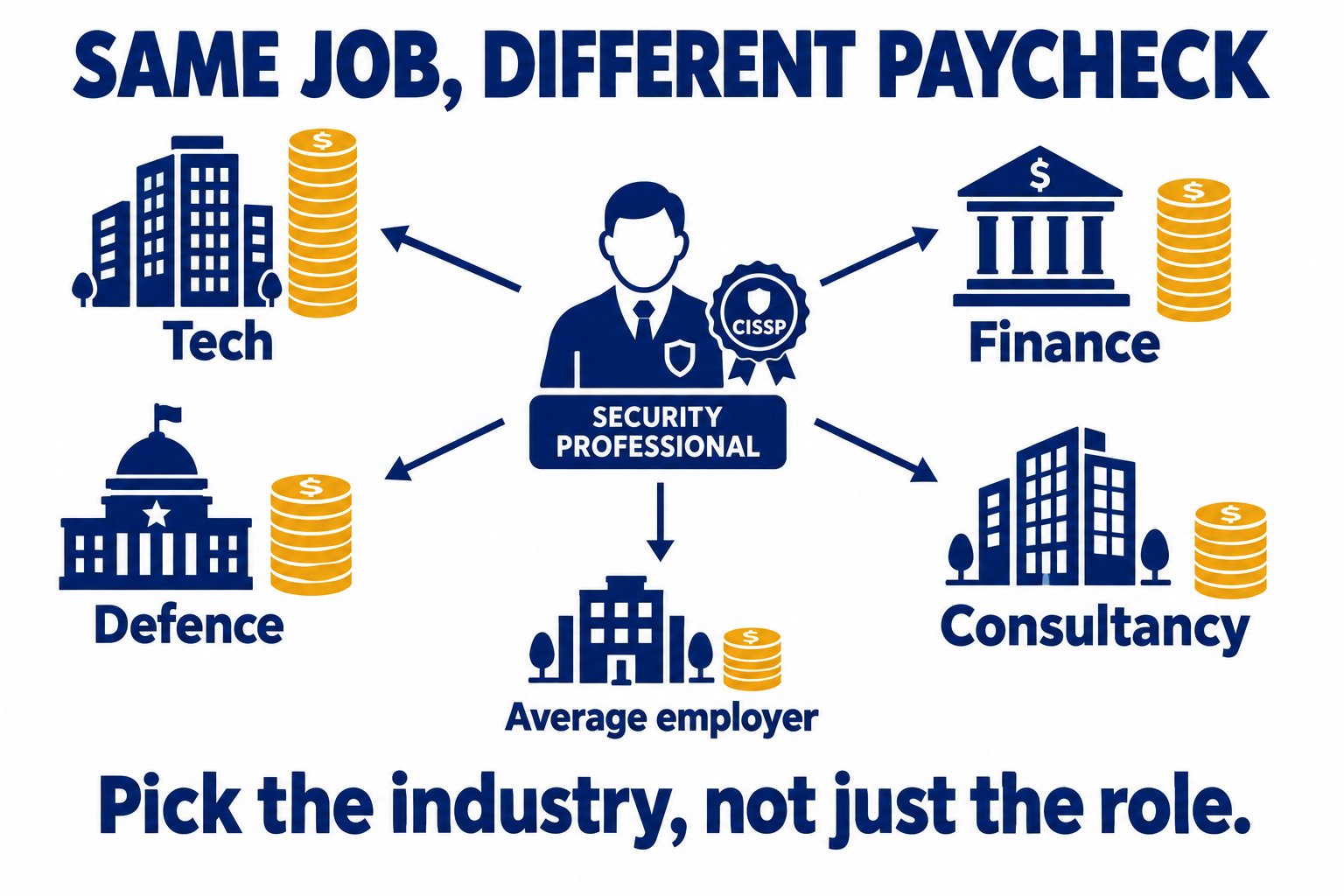
Take security engineers. The typical cloud security engineer earns about $170,000. But on Levels.fyi, which collects pay data from tech workers including stock, the median security software engineer earns about $600,000 at Netflix, $537,000 at Stripe and $407,000 at Databricks. Those are senior engineers at some of the best-paying companies in the world, so they're not typical. But they show how far the ceiling goes.
It works at the top too. In Heidrick & Struggles' 2025 CISO survey, CISOs in technology and financial services earned around a quarter more than the overall median.
The AI-driven listings show the same thing: the highest bands come from employers like Netflix, OpenAI and Anthropic that expect their security engineers to build with AI. In my experience, the biggest jumps come from getting into a large, well-funded employer, often a big tech company, a major bank or a top security vendor, rather than from the sector alone. So when you plan your career, don't just pick a role. Pick where you want to do it.
#4 AI Security Engineer
Every time a major AI model launches, people try to break it within hours. You're the person companies hire to break their AI first. The field is so new that some companies are still writing the job descriptions, and people getting in now are practically writing their own.
💰 Pay
About $192,000 median total pay (Glassdoor, based on few salary reports), with the top 10% earning above roughly $260,000. At frontier AI and chip companies, total pay including stock can be far higher.
🛠️ Skills and tools
AI coding agents, large language models, AI red teaming and context engineering (giving AI the right information to work with).
📜 Certifications
CompTIA SecAI+, AWS machine learning certifications, CISSP. Honestly, hands-on experience counts more here because the field is so new.
🤖 AI risk (JobZone)
Green, 79.3 for AI security engineer. This role exists because of AI.
If you want to see real listings for this kind of work, I track them in AI-Driven Cyber Security Jobs, and These Tech Jobs Are Evolving Into $900K Monsters covers what the top employers ask for.
#3 Enterprise Security Architect
Your company has just bought another business, with completely different systems, different regulations and a security setup that doesn't talk to yours. Someone has to make it all work together securely before the deadline. I've seen exactly this scenario at a company I consulted for. That someone is the enterprise security architect.
💰 Pay
About $277,000 median total pay (Glassdoor), with the top quarter above $358,000 and the top 10% above $445,000.
🛠️ Skills and tools
Architecture frameworks like TOGAF and SABSA, zero trust design, and deep knowledge of AWS, Azure and Google Cloud.
📜 Certifications
CISSP, CISSP-ISSAP, CISM, SABSA certifications.
🤖 AI risk (JobZone)
Green, 71.1. Enterprise-wide strategy and judgement are hard to automate.
What a lot of people underestimate about this role is how much of it is people and strategy. You're in rooms with CTOs, CISOs and the board, turning business risks into a security design everyone can follow.
#2 Chief Privacy Officer
Privacy is the part of security that deals with people's personal data, and when it goes wrong, the regulator calls. A company can have 72 hours to explain how the data of 50 million users was handled, and the wrong answer costs millions. The chief privacy officer is the executive who makes sure that call ends well.
💰 Pay
About $358,000 median total pay (Glassdoor, based on relatively few reports), with the top quarter above $480,000.
🛠️ Skills and tools
Privacy management platforms like OneTrust, TrustArc and DataGrail, plus a strong grasp of privacy law.
📜 Certifications
IAPP certifications: CIPP, CIPT and CIPM.
🤖 AI risk (JobZone)
Green, 70.6. Regulators want a named person to hold accountable.
A lot of people overlook privacy as a career path, but at executive level it pays like any other C-suite role.
#1 Chief Information Security Officer (CISO)
Your company has just made the front page. A breach has exposed millions of customer records, and the board wants answers within the hour. You're the one walking into that room. The CISO is the top of the cybersecurity ladder.
💰 Pay
Most CISOs earn between $250,000 and $700,000 (IANS/Artico, 2025). At large US companies, Heidrick & Struggles found a median base salary of $400,000 and median total pay of $880,000 including equity. Some earn well over a million.
🛠️ Skills and tools
Less about specific tools. Governance, risk and compliance platforms like ServiceNow come up a lot, but leadership is the real skill.
📜 Certifications
CISSP and CISM are expected. Executive leadership experience is what sets you apart.
🤖 AI risk (JobZone)
Green, 83, the safest on this list. Boards need a human in the room.
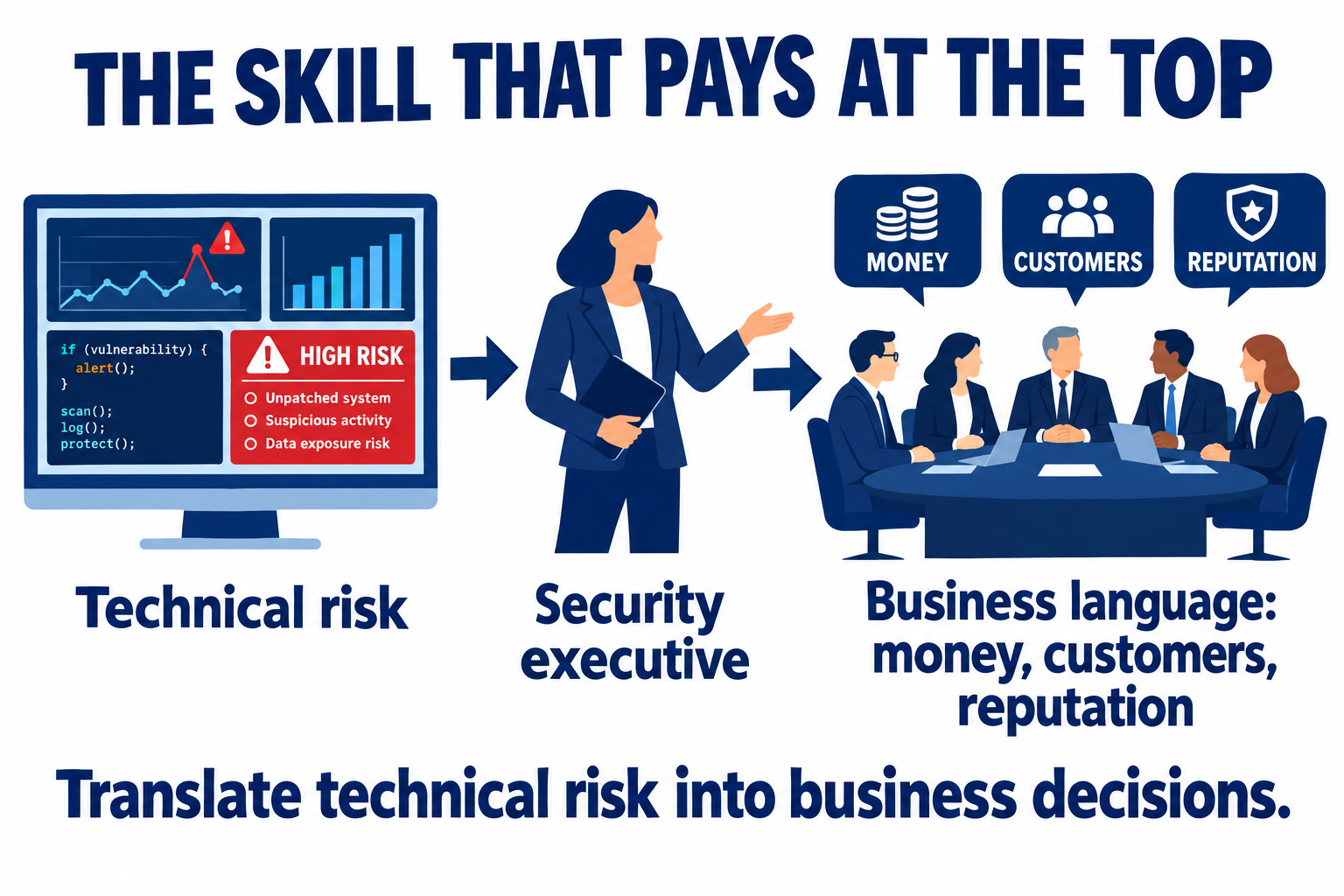
In my experience, the CISOs who do best are the ones who can translate technical risk into business language: money, customers and reputation. That's the skill that gets you to the top of that pay range.
2 Bonus Roles Most People Never Consider
Two of the best-paid jobs around cybersecurity aren't traditional security jobs at all. If you're technical but don't want to sit behind a screen all day, these might surprise you.
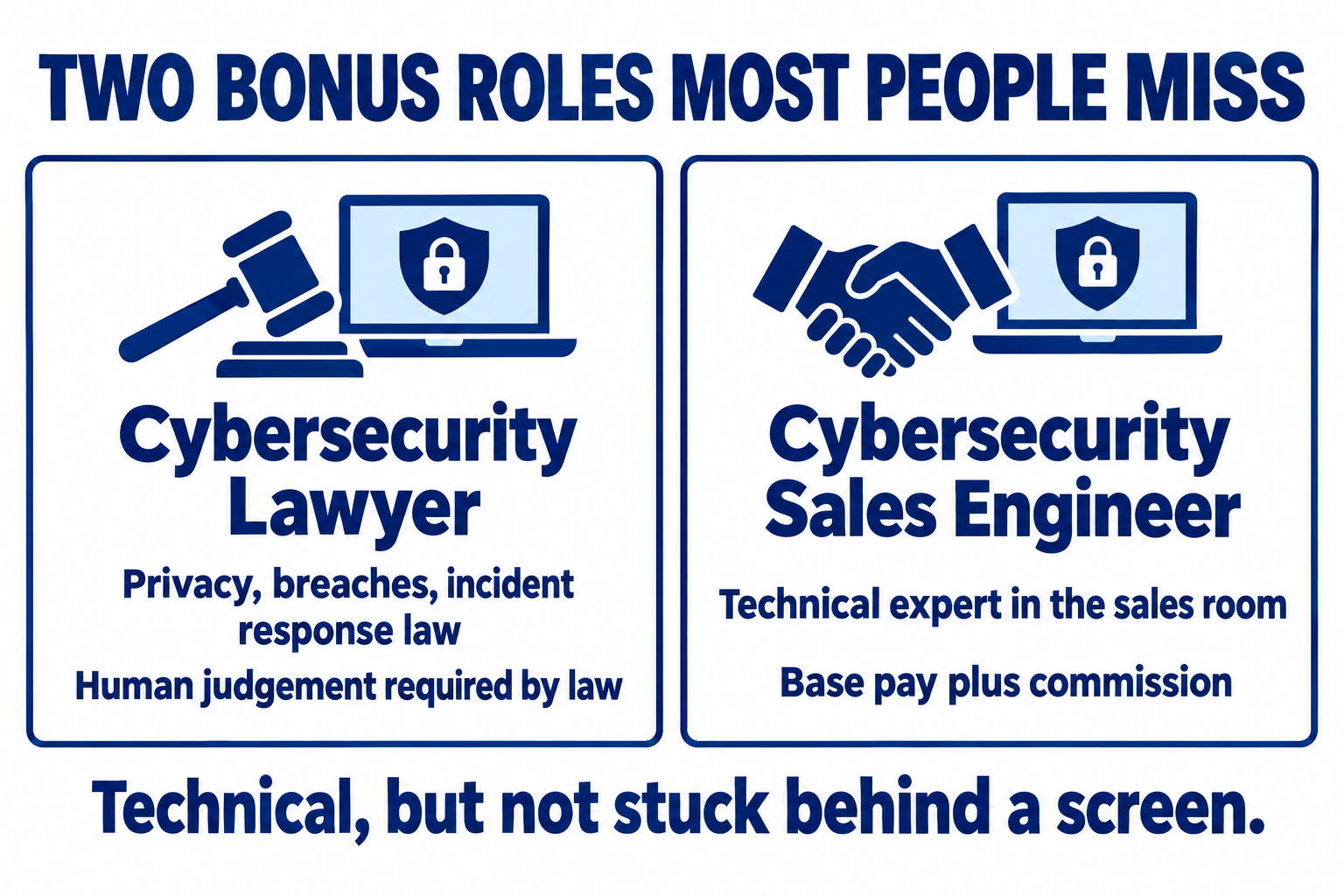
Cybersecurity lawyer. Lawyers who specialise in privacy, breaches and incident response are in demand, because one lawsuit can cost a company millions. The median US lawyer earns $159,670, but at the largest law firms, associate salaries run from about $235,000 in the first year to about $455,000 by the eighth (the 2026 market scale). You need a law degree, so it's a long route, but it's worth knowing about. JobZone score: green, 56.5.
Cybersecurity sales engineer. This is the most overlooked role, in my opinion. You combine deep technical knowledge with the ability to explain security products to executives. Pay is a base salary, typically about $100,000 to $140,000, plus commission, with median total pay of about $200,000 to $210,000 (Glassdoor and Levels.fyi). At top vendors, Levels.fyi medians run from about $270,000 at Palo Alto Networks to $321,000 for Zscaler solution architects. We've got people on our programme earning around half a million with commission. And it can be easier to get into than many roles, because companies will give you a try. If you don't sell, though, you won't last. JobZone score: yellow at mid-level (46.4), green at principal level (55.5).
How to Choose Your High-Paying Cybersecurity Job
So which one is for you? A few things I'd weigh up:
Start where you are. From development, AppSec or cloud security are natural moves. From IT support, incident response or cloud. From law, compliance or audit, privacy and governance.
Plan the ladder, not just the first step. The top three roles are senior. Most people get there through roles further down this list.
Aim at the employers that pay most. As we saw, similar skills can pay very differently depending on who you work for.
Aim for the AI-driven version. Whichever role you pick, the version that builds and directs AI pays more and is safer. Browse real AI-driven listings to see what employers ask for.
Check the AI risk first. Look up any role on JobZone Risk before you commit. Some roles, especially at entry level, are in the red zone. I cover which in Will AI Replace Cybersecurity Jobs?
If you want the full route mapped out, our cybersecurity roadmap goes step by step, and our salary statistics page has more pay data by role and certification. And if you want mentors, real projects and a group to help you get into roles like these, that's what our AI Master's Program is for (a mentored StationX programme, not a university degree). You can get a full refund up until the programme begins, and if you haven't proven you can build your own working solutions by the end of the year, the programme stays open until you do, at no extra cost.

Frequently Asked Questions
What is the highest paying job in cybersecurity?
Chief information security officer (CISO). Most CISOs earn between $250,000 and $700,000 a year (IANS/Artico, 2025), and at large US companies the median total pay including equity is about $880,000 (Heidrick & Struggles, 2025).
What is the highest paying cybersecurity job without much experience?
None of the top-paying roles are entry level. Good starting points that lead to them include SOC analyst, junior penetration tester and cloud or application security roles, then specialising. Check a role's AI exposure first, because some entry-level roles are shrinking.
How much does a penetration tester make?
Glassdoor puts the median total pay for a US penetration tester at about $154,000, with the top quarter earning more than $205,000 (September 2026).
How much does a CISO make?
Most CISOs earn between $250,000 and $700,000 (IANS/Artico, 2025). At large US companies, Heidrick & Struggles found a median base salary of $400,000 and median total pay of $880,000 including equity, and some earn well over a million.
Are high paying cybersecurity jobs safe from AI?
Most of the roles in this list score in the green zone on JobZone Risk, meaning AI makes the work faster but people remain essential. The exception is penetration testing, which is in the yellow zone because routine scanning is being automated.
About the Author

Nathan House, Founder & CEO of StationX
Nathan House has 30 years of hands-on cybersecurity experience and is Cambridge-educated, holding CISSP, CISA, CISM, OSCP, CEH, and SABSA. He founded StationX in 1999 — one of the UK’s first cybersecurity companies — and has secured £71 billion in UK mobile banking transactions and the London 2012 Olympics, advising clients including Microsoft, Cisco, BP, Vodafone, and VISA. He authored the world’s most popular cybersecurity course — a #1 Udemy bestseller taken by over 500,000 students — and was named Cyber Security Educator of the Year 2020, AI Security Educator of the Year, and a UK Top 25 Security Influencer 2025. A DEF CON speaker and featured expert on CNN, Fox News, NBC, and the BBC, Nathan leads StationX’s training of more than half a million students worldwide.