
 Security+
 CySA+
 PenTest+
 SecAI+
 Network+
 A+
 Cloud+
 Linux+
CompTIA Security+ Salary 2026: Jobs and Pay by Role
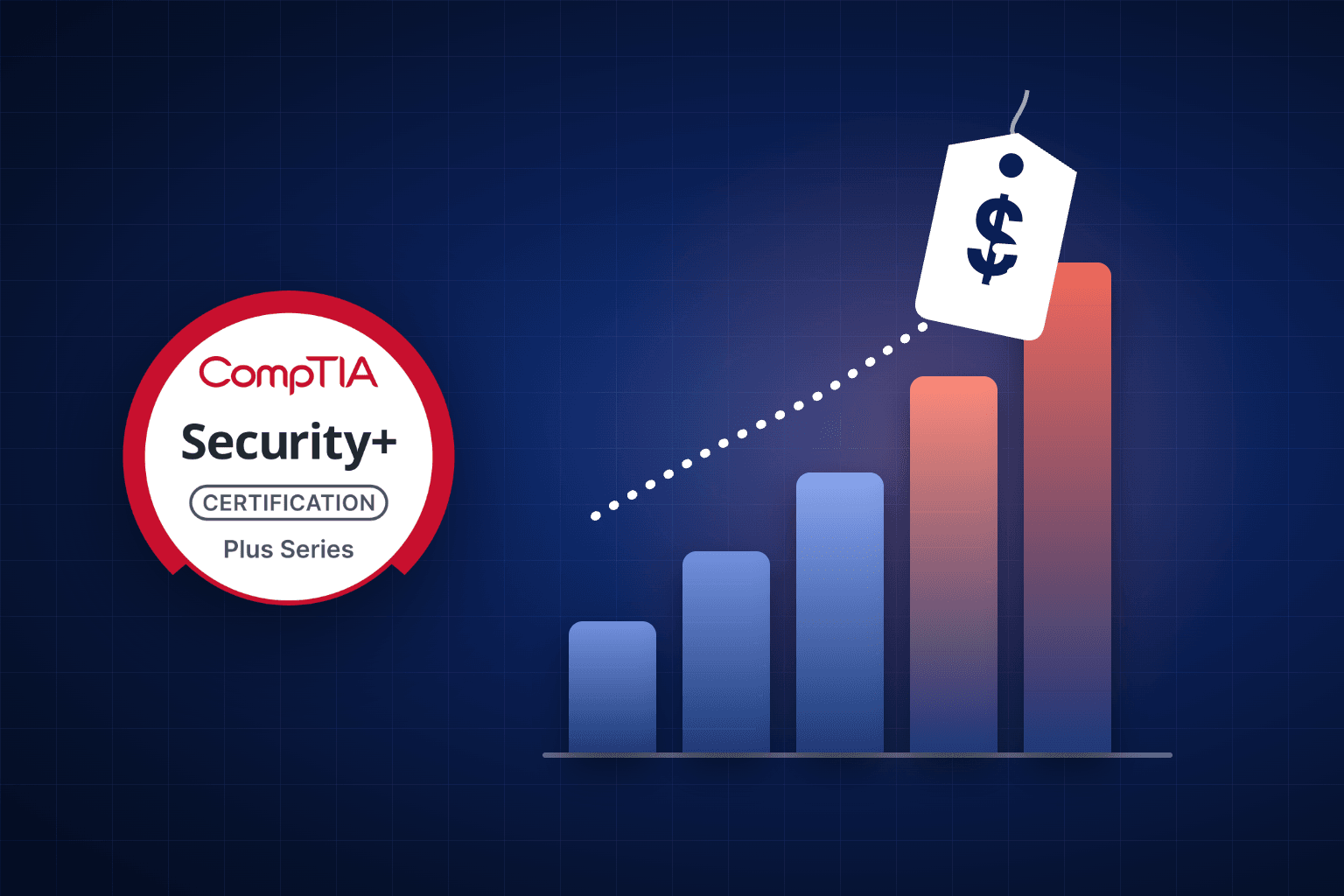
Obtaining CompTIA’s Security+ opens new career pathways for entry-level and seasoned cyber security professionals alike. Acquiring this sought-after CompTIA certification might just put you on pace for a pay bump or set you up for high-paying cyber security job roles with a bright career progression pathway.
Security+ SY0-701 or SY0-801? (updated November 2026)
CompTIA launched Security+ SY0-801 on 17 November 2026. We recommend SY0-701 for now: you can sit it in English until 11 June 2027, 801 is brand new with very little training available yet, and employers only ask whether you have Security+, not which version. Our free Security+ cheat sheet covers both.
To help you understand what your future might look like, we’ll detail the CompTIA Security+ salary expectations and job titles you should have after having passed Security+.
We will also take a closer look at the exam itself, positions that are asking for Security+, and your career trajectory after having obtained CompTIA’s Security+.
For Less.
StationX is a CompTIA Authorized Partner. The same official exam vouchers you'd buy from CompTIA, for less.
CompTIA price USD 878.00
Your exam voucher plus a free second attempt if you don't pass first time.
Today's US prices against CompTIA's US list price. Prices change and vary by country; the voucher page shows yours.
Overview of the CompTIA Security+ Certification
CompTIA Security+ is an entry-level cyber security certification covering a broad range of cyber security topics and skills.
The exam consists of a maximum of 90 questions to be answered within 90 minutes. Questions may be multiple-choice or performance-based. To pass, you’ll need a scaled score of 750 on a scale of 100–900.
While CompTIA recommends test takers have at least two years of prior experience before taking the test, there are no hard prerequisites to taking the exam. Even those without professional IT job experience can still pass this exam so long as they diligently study effective test preparation material.
Two versions of the Security+ exam are live right now: version SY0-701 and the new SY0-801, launched on 17 November 2026. Both lead to the same Security+ certification. Our advice is to take SY0-701 for now, because its training is mature and SY0-801 training is still thin everywhere. Take SY0-801 only if you can't sit the exam before SY0-701 retires in English on 11 June 2027. Employers don't ask which version you passed, and we'll switch our recommendation to SY0-801 once its training is established. See our SY0-701 vs SY0-801 comparison for the full breakdown.
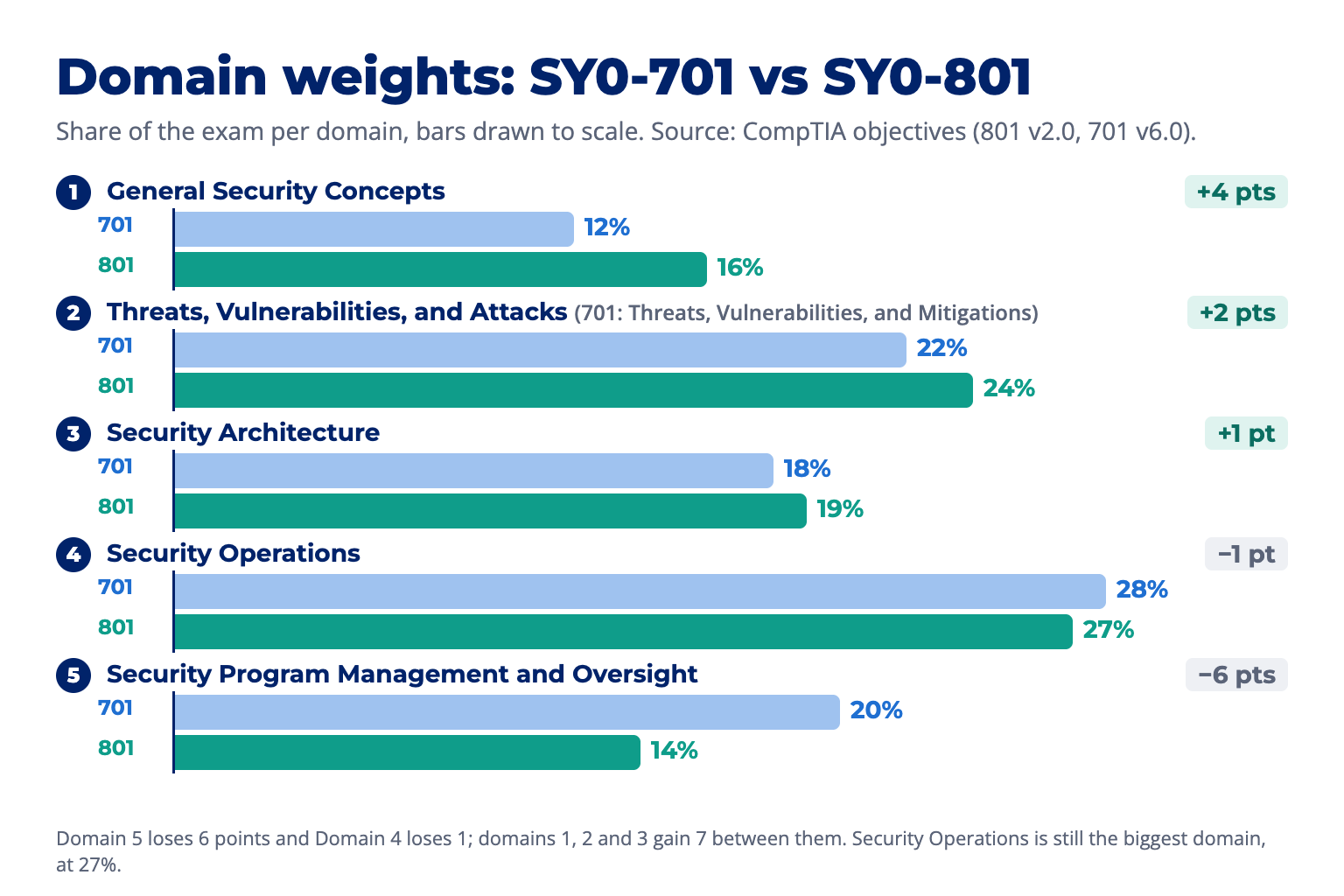
Both versions cover the following knowledge domains:
| Domain | SY0-701 | SY0-801 |
|---|---|---|
| General Security Concepts | 12% | 16% |
| Threats, Vulnerabilities, and Mitigations (801: Threats, Vulnerabilities, and Attacks) | 22% | 24% |
| Security Architecture | 18% | 19% |
| Security Operations | 28% | 27% |
| Security Program Management and Oversight | 20% | 14% |
SY0-801 also adds a new objective (2.6) on the risks of using AI.
Holding a CompTIA Security+ certification opens the door to a wide range of roles and competitive salaries. It is especially valuable for those pursuing government or defense-related roles, as it is approved for a range of DoD 8140 work roles (DoD 8140 replaced the older DoD 8570 baseline in February 2023). CompTIA lists those work roles for SY0-701; the SY0-801 page doesn’t list them yet.
Whether you're aiming for a position in a Security Operations Center (SOC), compliance, systems administration, or technical support, Security+ is a widely recognized credential that validates your foundational security knowledge. It’s frequently listed as a minimum qualification by employers across both the public and private sectors.
Search any major US job board for “CompTIA Security+” and you’ll find a steady stream of postings that name it as a required or preferred qualification, from help desk and systems administration roles to SOC and analyst jobs.

What Does CompTIA Security+ Certification Prepare You For?
Obtaining CompTIA Security+ can open up the door to a number of jobs within the cyber security field. To have a better understanding of what job titles may be available to you after passing this exam, let’s discuss six positions you may want to consider applying for after receiving the Security+ certification.
Information Security Analyst
An Information Security Analyst is responsible for protecting an organization’s data and systems from cyber threats. These analysts monitor networks, investigate incidents, and enforce security policies. This role often works closely with IT and risk management teams and may involve documenting procedures, responding to audits, or using SIEM tools for threat detection.
Many positions, especially in government or defense, require a security clearance and strong knowledge of cyber security principles.
Technical Operations Level 1
Technical Operations Level 1 personnel provide entry-level support for IT infrastructure, including monitoring alerts, documenting incidents, and escalating issues. They may also follow runbooks for routine tasks, support shift-based system uptime, and assist with log analysis or patch verification.
This role often operates in 24/7 environments and requires a solid understanding of system uptime, basic troubleshooting, and a security-first mindset.
Systems Administrator
A Systems Administrator is responsible for the upkeep, configuration, and reliable operation of computer systems and servers. They install updates, manage user accounts, monitor performance, and handle issues related to backups, patching, and system uptime.
Scripting knowledge and OS expertise are often expected.
Network Administrator
A Network Administrator oversees an organization’s computer systems and database networks. They are responsible for maintaining networks and hardening their security. They do so in part by identifying and addressing network and computer needs with the appropriate hardware and software.
Other responsibilities include updating virus protection software, monitoring the network in order to improve performance, and remedying software and hardware configuration issues.
IT Security Technician
IT Security Technicians support day-to-day operations in security teams by deploying patches, reviewing logs, and responding to basic threats.
Familiarity with tools like firewalls, intrusion detection systems (IDS/IPS), and endpoint security platforms is a plus, but not always required for entry. This role often serves as a stepping stone into more advanced security positions.
Junior SOC Analyst
A Junior SOC Analyst monitors systems for security events and assists with early-stage threat detection and response. Working in a Security Operations Center (SOC), they investigate alerts, follow escalation procedures, and document incidents.
Familiarity with SIEM tools and structured workflows is essential.
CompTIA Security+ Salary and Job Opportunities
Your CompTIA Security+ certification salary expectation should vary and will greatly depend on your prior experience and the specific position you’re applying for.
Security+ on its own doesn’t set your pay. What an employer offers depends mostly on:
- The role: analyst and engineering jobs generally pay more than support and operations jobs
- Experience: prior IT or security work counts for more than the certification alone
- Location: pay varies widely between regions and cities
- Security clearance: many government and defense contractor roles require one
- Other certifications: pairing Security+ with certifications such as CySA+, Network+ or CCNA opens better-paid roles
As you will see, Security+ holders are able to increase their pay as they add accompanying certifications and work experience.
Security+ shows up across a range of security and IT roles.
But what are these open positions, and what do they pay? Where the US Bureau of Labor Statistics (BLS) publishes pay data for the occupation, we quote it below. BLS medians cover all experience levels, so expect entry-level offers to start below them.
Information Security Analyst
Across all experience levels, the US Bureau of Labor Statistics puts the median annual wage for information security analysts at $129,180 (May 2025); the lowest 10 percent earned less than $75,090.
Entry-level pay depends on industry, responsibilities, and security clearance requirements.
Security+ is a common entry requirement, especially in government or contractor roles. Employers may also look for knowledge of SIEM tools, risk assessments, access controls, and compliance frameworks like NIST or ISO 27001. This role often serves as a stepping stone into cyber security engineering, SOC analysis, or GRC positions.
Technical Operations Level 1
Pay depends on shift coverage, industry, and required tooling knowledge. The BLS doesn’t publish pay data for this job title.
Security+ is often beneficial, especially in regulated or government environments. Employers may also look for familiarity with monitoring tools, basic scripting, and incident escalation procedures. This role is a strong entry point into NOC, SOC, or systems operations careers.
Systems Administrator
The BLS groups systems administrators with network administrators: the median annual wage for network and computer systems administrators was $99,130 in May 2025, across all experience levels.
Pay depends on experience and technical scope.
Security+ can help you land junior sysadmin roles, but employers may also look for CompTIA A+, Network+, or Server+ certifications, plus experience with Windows/Linux environments, Active Directory, and basic scripting.
Network Administrator
Network administrators fall under the same BLS occupation as systems administrators (median $99,130, May 2025). Pay varies with region, experience, and technical scope.
With CompTIA Security+, candidates may qualify for junior to mid-level roles, especially when paired with 2+ years of networking experience. Employers may also value Network+, Server+, or vendor-specific certifications like CCNA, and look for familiarity with routing protocols (OSPF, BGP), SD-WAN, network security, and cloud infrastructure.
IT Security Technician
Pay varies with location, industry, and experience level.
In addition to CompTIA Security+, certifications recruiters want to see from applicants may include CompTIA Network+, Server+, or Microsoft and Cisco credentials. They will also want applicants to have 1-2 years of relevant hands-on experience, especially with security tools, SIEM platforms, access controls, and basic incident response.
Junior SOC Analyst
Entry-level pay depends on the company, region, and skill set.
While CompTIA Security+ can qualify you for many SOC Analyst roles, employers often prefer candidates with additional certifications like CompTIA CySA+, Network+, or Microsoft SC-200. Familiarity with incident response workflows and a strong understanding of networking fundamentals are also highly valued.
The AI-Driven Version of These Jobs
Security jobs now have an AI-driven version: the same role, but you use AI to do the security work, such as triaging alerts with AI agents or writing and testing detections with an AI assistant. Our AI-driven cyber security jobs page collects real postings like these, each captured and archived with its pay range and capture date. Four detection and SOC engineering examples, exactly as the page shows them:
- Cox Automotive, Cybersecurity Detection Engineer II: $89K–$134K posted, captured 2026-11-17
- CrowdStrike, Detection Engineer, Falcon Complete (Remote): $100K–$150K posted, captured 2026-11-17
- Spotify, Security Engineer - Detection and Response: $133K–$190K posted, captured 2026-10-01
- Lumin Digital, Detection Engineer: $155K–$180K posted, captured 2026-07-26
These are individual posted ranges, not averages, and they aren’t what a Security+ holder should expect as a first salary. Most of the page’s listings are senior roles at large employers: by the years each posting asks for, only 55 of its 1,118 listings are entry-level. Keep the BLS medians above as your baseline, and see the full list for every posting and its pay. Security+ is the foundation; to learn the AI-driven side, our AI Master’s Program teaches you to direct AI to do real security work, with training, labs and mentorship.
Career Progression
As you can see from the roadmap below, CompTIA Security+ falls under the third stage of the cyber security roadmap. Tier one and two demonstrate a basic understanding of technical knowledge and enterprise networking. Tier three means you’re able to think like an information security specialist and protect enterprise networks.
Security+ is an entry-level certification. From here you can choose various career paths and specializations that suit your professional goals.
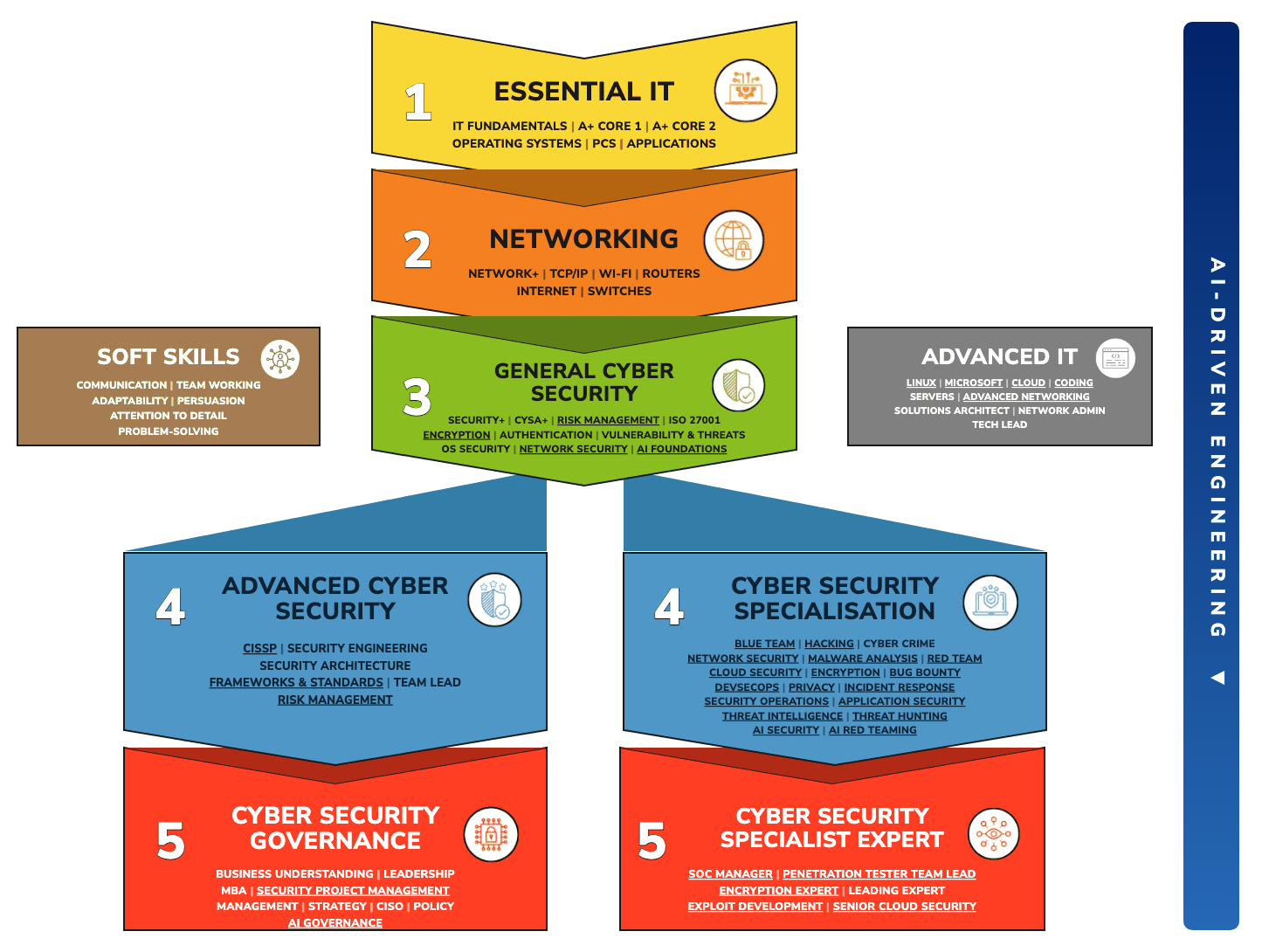
Here are a few career pathways you may want to consider for the future. Each asks for more experience and more advanced certifications than the entry-level roles above, and pay rises with them.
Security Engineer
Security Engineers are security playmakers. They make the important security decisions like how to go about securing networks and systems. They engineer and develop security solutions, create standards, implement security measures, and test for vulnerabilities.
Besides Security+, the following certifications validate advanced knowledge in cloud security, architecture, threat detection, and enterprise-level defense strategies:
SOC Analyst Level II
A SOC Analyst Level II is a mid-tier cyber security role focused on threat detection, deep log analysis, and incident response coordination. These professionals investigate escalated alerts, fine-tune SIEM tools, and help contain real-time cyber threats.
To qualify, candidates generally need 2-4 years of experience in security operations and intermediate to advanced certifications, such as:
- CompTIA CySA+
- GIAC Security Essentials (GSEC)
- SSCP
- EC-Council Certified SOC Analyst (CSA)
Senior Security Consultant
Consultants have dirtied their hands in prior security positions and are now ready to consult companies on how best to secure their systems, advise on topics like risk management, and more.
They advise security teams and the security administrator on the best solutions to implement to address security weaknesses.
Certifications that will help you obtain this position include:
Conclusion
What you earn with CompTIA Security+ depends on the role you land, your experience, your location and whether you hold a clearance. For a benchmark across all experience levels, the US Bureau of Labor Statistics puts the median annual wage at $99,130 for network and computer systems administrators and $129,180 for information security analysts (May 2025).
Obtaining Security+ can broaden your career prospects and put you on a pathway toward long-term success in the field of cyber security.
Luckily, preparing for the exam is now more accessible than ever, with our affordable, all-in-one training resources.
You can get lifetime access to the CompTIA Security+ Course & SY0-701 Practice Test Bundle, which includes two full Security+ courses plus practice exams, online quizzes, and flashcards to reinforce key concepts.
And don’t forget that we also offer a CompTIA Security+ Exam Voucher Discount with up to 50% off, so be sure to redeem it when you're ready to schedule your exam.
- ✓A step-by-step Security+ roadmap: every exam domain in order, so you always know what to study next
- ✓Free video lessons, guides and cheat sheets from our Security+ courses
- ✓Hands-on labs in your browser: nothing to install, try one free
- ✓All your progress in one place, ready for exam day
Built for SY0-701; our SY0-801 roadmap is coming soon.
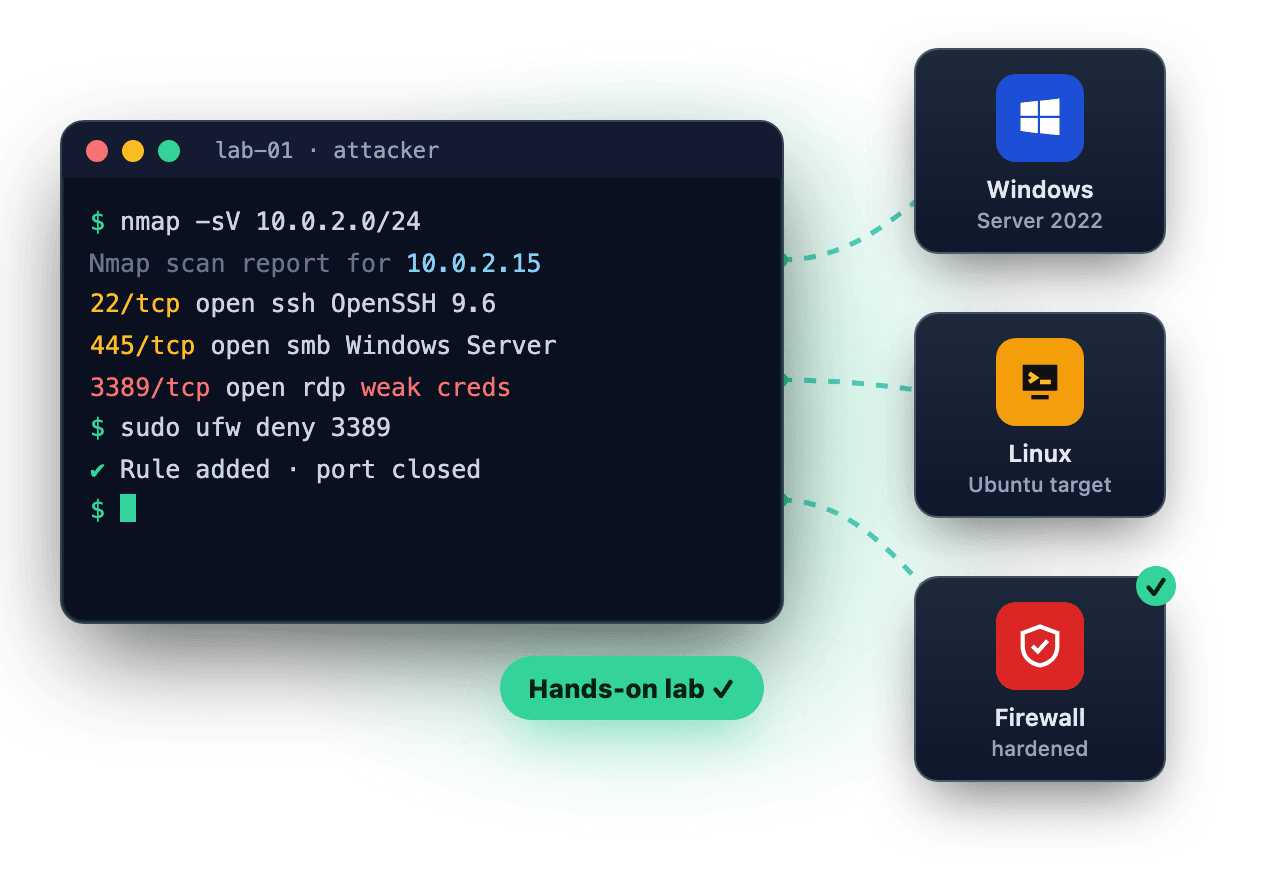
As we have seen from the job roles covered in this article, there are multitudes of career options open to those with Security+ on their resume. To get you ready for the exam, follow our Security+ roadmap on StationX Labs: video courses for each exam domain plus hands-on labs for SY0-701, with an SY0-801 roadmap coming soon, and it is free to start.
For Less.
StationX is a CompTIA Authorized Partner. The same official exam vouchers you'd buy from CompTIA, for less.
CompTIA price USD 878.00
Your exam voucher plus a free second attempt if you don't pass first time.
Today's US prices against CompTIA's US list price. Prices change and vary by country; the voucher page shows yours.
The CompTIA Security+ Course & SY0-701 Practice Test Bundle includes:
- CompTIA Security+ Study Guide: SY0-701 Total Course
- CompTIA Security+ Training: Self-Paced Course
- CompTIA Security+ SY0-701 Exam Questions and Answers
- CompTIA Security+ Practice Test Series: Ace the SY0-701
- CompTIA Security+ Exam Objectives Flash Cards: SY0-701 Prep
Frequently Asked Questions
Does CompTIA Security+ expire?
Yes, CompTIA Security+ expires every three years. There are various renewal options, including taking more advanced tests and accruing continuing education units (CEUs).
Is CompTIA Security+ worth it?
As we have seen, CompTIA Security+ is an entry-level cyber security certification that many companies want their applicants to have.
How much does Security+ cost?
Security+ costs $439. If you fail, you must pay the same amount to retake the exam.
What percentage is needed to pass CompTIA Security+?
You’ll need a scaled score of 750 on a scale of 100–900 to pass. Because it’s a scaled score, it doesn’t convert to a fixed percentage of questions.
About the Author

Nathan House, Founder & CEO of StationX
Nathan House has 30 years of hands-on cybersecurity experience and is Cambridge-educated, holding CISSP, CISA, CISM, OSCP, CEH, and SABSA. He founded StationX in 1999 — one of the UK’s first cybersecurity companies — and has secured £71 billion in UK mobile banking transactions and the London 2012 Olympics, advising clients including Microsoft, Cisco, BP, Vodafone, and VISA. He authored the world’s most popular cybersecurity course — a #1 Udemy bestseller taken by over 500,000 students — and was named Cyber Security Educator of the Year 2020, AI Security Educator of the Year, and a UK Top 25 Security Influencer 2025. A DEF CON speaker and featured expert on CNN, Fox News, NBC, and the BBC, Nathan leads StationX’s training of more than half a million students worldwide.