
 Security+
 CySA+
 PenTest+
 SecAI+
 Network+
 A+
 Cloud+
 Linux+
CISSP vs Security+: Which Is Right for You in 2026?
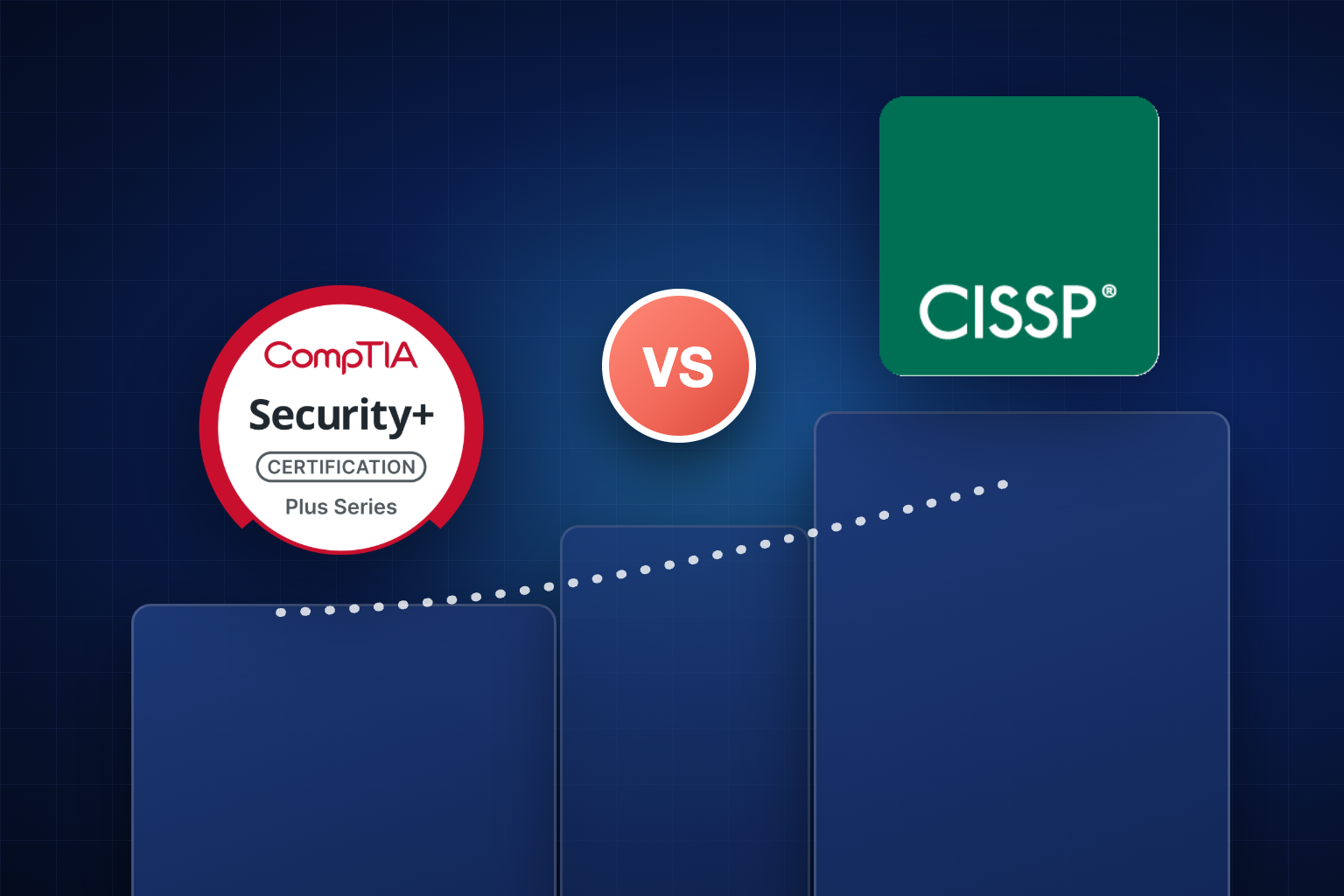
If trying to decide between pursuing Security+ or CISSP is leaving you feeling somewhat overwhelmed, rest assured you’re in good company. These certifications share similar subject matter, and the prevalence of job postings conflating beginner and advanced certifications can understandably confuse you, as it has so many others.
Security+ SY0-701 or SY0-801? (updated November 2026)
CompTIA launched Security+ SY0-801 on 17 November 2026. We recommend SY0-701 for now: it’s valid until 11 June 2027, 801 is brand new with very little training available yet, and employers only ask whether you have Security+, not which version. Our free Security+ cheat sheet covers both.
We’re often asked by students to explain the difference between these two popular certifications, CompTIA’s Security+ and ISC2’s Certified Information Systems Security Professional (CISSP).
While both are globally recognized information security certifications, Security+ and CISSP are very different and designed for people at drastically different points in their careers.
In this article, we will walk you through a CompTIA Security+ vs CISSP comparison, highlight the differences and guide you toward the best certification for you.
What Are Security+ and CISSP Certifications?
At first glance, Security+ and CISSP might appear almost equivalent.
The two are vendor-neutral, meaning they cover broader concepts that can apply to any system, not those specific to a particular company or infrastructure (such as only Cisco products or solely Linux-based systems).
They also have a wide scope of knowledge domains, covering topics like asset security, risk management, and security assessment and testing.
The tests share a similar format consisting of multiple choice questions and some hands-on style challenges - CompTIA calls these “Performance Based Questions” (PBQs) while ISC2 calls them “Advanced Innovative Questions.”
Take a closer look, however, and you will see that they are not tailored to the same audience.
Security+
According to CompTIA, Security+ is “recognized as the industry standard for entry-level cybersecurity certifications” and “equips you with the foundational skills and knowledge needed to launch or elevate your career in IT security.”
Security+ is marketed as an entry-level certification. The exam material assumes an understanding of enterprise networking and begins covering cyber security from the ground up. It tells employers you have the foundational knowledge to discuss security and apply these practices at a basic level.
CISSP
The ISC2’s website says of their certification, “the CISSP is ideal for experienced security practitioners, managers and executives interested in proving their knowledge across a wide array of security practices and principles…”
There lies what should be the most important difference to you. CISSP is geared toward industry professionals looking to level up their credentials. The exam content assumes years of experience already under your belt and builds upon that.
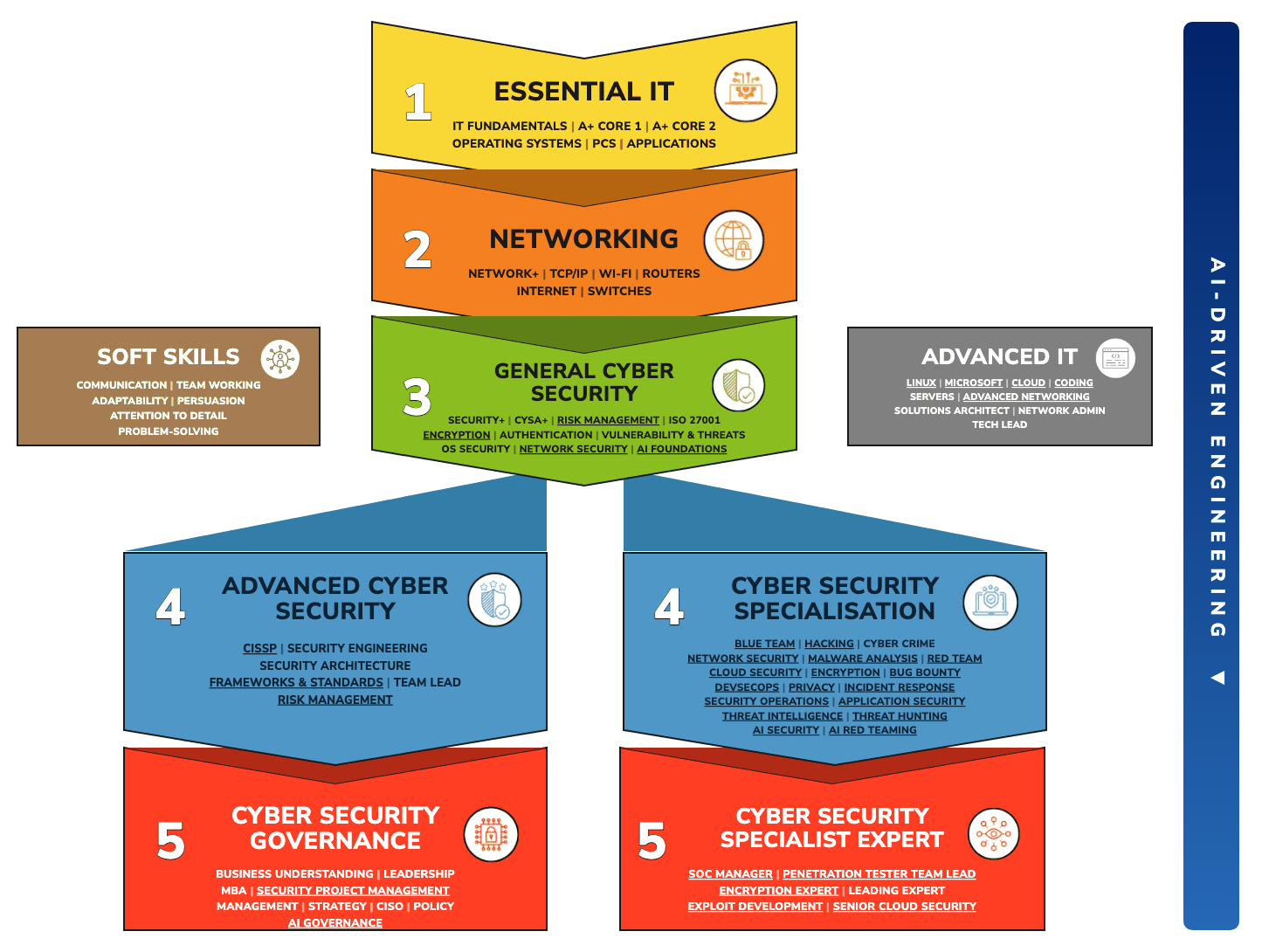
Looking at this Cyber Security Certificate Landscape, you can get a better feel for how these certifications compare. In this application, you can see what areas of focus each certification has. The higher up the column, the more advanced the level.
This app is useful for reference and consistency. It isn’t a complete picture of all areas they cover, but it does a great job of providing a high-level overview.

Career Progression and Certification Pathways
Security+ and CISSP occupy very different points on the cyber security career ladder, each serving distinct purposes depending on your experience, goals, and the direction you want your career to take.
Starting Out: Security+ as a Launchpad
Security+ is designed to be an entry point into the security field. Many professionals pursue it after gaining basic IT knowledge through certifications like CompTIA A+ or Network+, or after some hands-on experience in support or junior IT roles.
It validates essential security principles such as risk management, network security, and incident response, and signals to employers that you’re ready to take on entry-level cyber security positions like security analyst, SOC analyst, or IT security technician.
For those just beginning their cyber security journey, Security+ often acts as the first formal credential, helping to bridge the gap between general IT roles and more specialized security functions.
Moving Up: CISSP as a Strategic Career Milestone
CISSP, on the other hand, is not a starting point, but a credential earned by seasoned professionals who have already spent several years working in security. Most candidates pursue CISSP once they’ve built a solid technical foundation and want to transition into mid-level or senior-level positions, often involving strategy, governance, or leadership.
Typical roles for CISSP holders include security manager, security architect, and CISO-track positions. It’s often viewed as the certification that cements your credibility in the field and unlocks higher-level responsibilities, such as designing and governing enterprise security programs.
Typical Certification Progressions
While there’s no single required route, many professionals follow a progression like:
- A+ → Network+ → Security+/SSCP → CISSP for a traditional foundational-to-leadership path.
- A+ → Network+ → Security+ → <specialty> → CISSP if seeking a managerial position in a particular field. Specialties could include CySA+ for blue team roles, OSCP for offensive security or penetration testing roles, and various compliance certifications related to GDPR or ISO 27001 for consulting positions
Regardless of the details, Security+ is often earned to show a baseline security knowledge, whereas CISSP is used to signify leadership in security positions.
Exam Details
The significant crossover in subject matter and the similar exam format are likely reasons for the constant comparison of the two certifications. As we’ll see when we take a closer look, these similarities are only surface-level.
Security+
Two versions of the Security+ exam are now live: SY0-701 and SY0-801, which CompTIA launched on 17 November 2026. SY0-701 retires in English on 11 June 2027. Both lead to the same Security+ certification, and employers don’t ask which version you passed. Our advice right now is to take SY0-701, because its training is mature and SY0-801 training is still thin everywhere. Take SY0-801 only if you can’t sit the exam before 11 June 2027. We’ll switch our recommendation to SY0-801 once its training is established.
Both versions break their content into five domains, with different weights:
| Domain | SY0-701 | SY0-801 |
|---|---|---|
| General Security Concepts | 12% | 16% |
| Threats, Vulnerabilities, and Mitigations (SY0-801: Threats, Vulnerabilities, and Attacks) | 22% | 24% |
| Security Architecture | 18% | 19% |
| Security Operations | 28% | 27% |
| Security Program Management and Oversight | 20% | 14% |
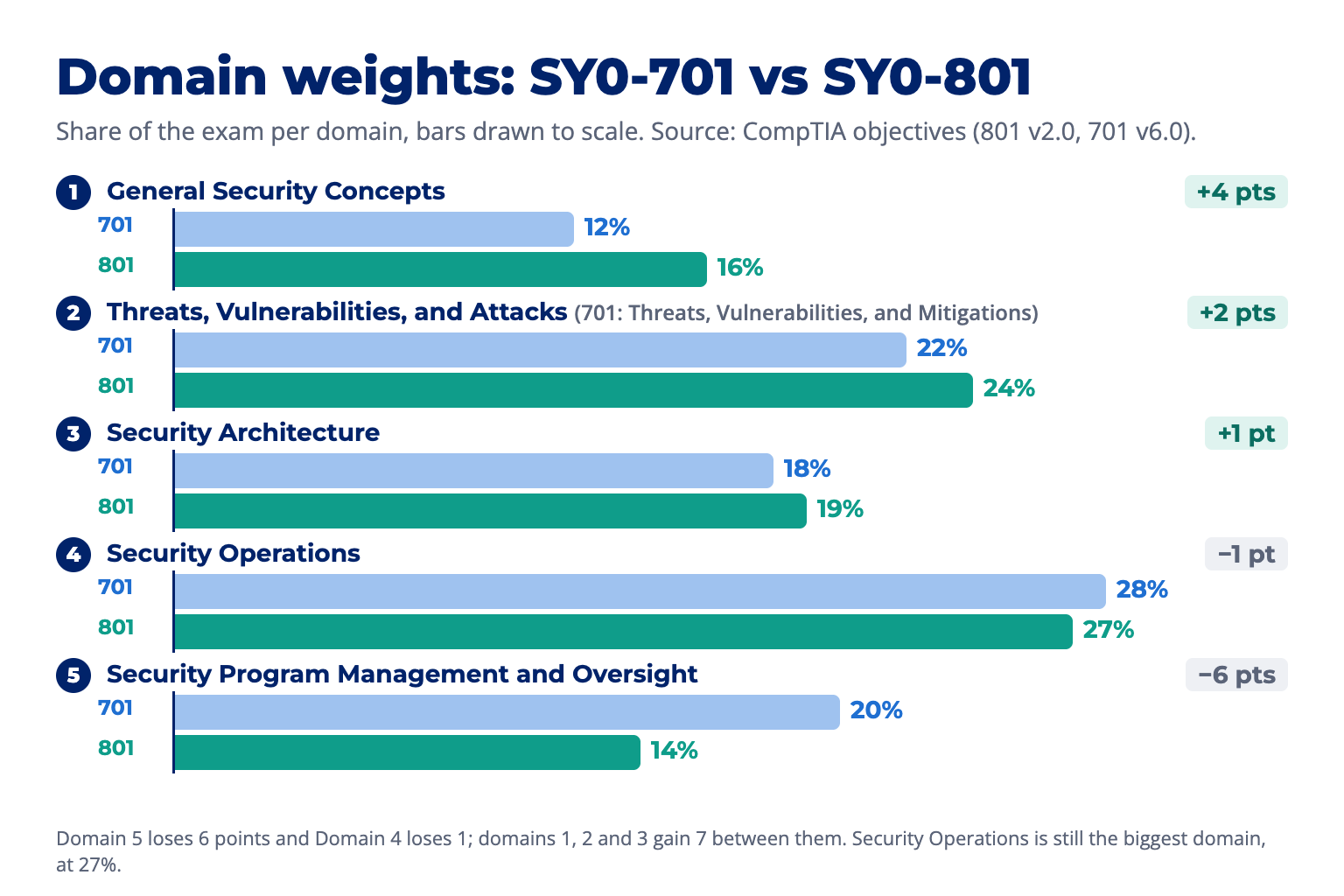
To see how each knowledge domain is broken down, review the CompTIA Security+ SY0-801 Exam Objectives document. SY0-801 has 27 objectives (SY0-701 has 28), including a new objective 2.6 on the security risks of artificial intelligence. Our SY0-701 vs SY0-801 comparison covers every change.
The exam contains a maximum of 90 questions, which will either be in the format of multiple choice or the previously mentioned PBQ. CompTIA doesn’t publish how many PBQs you will get, but expect a handful. More PBQs will result in fewer multiple-choice questions.
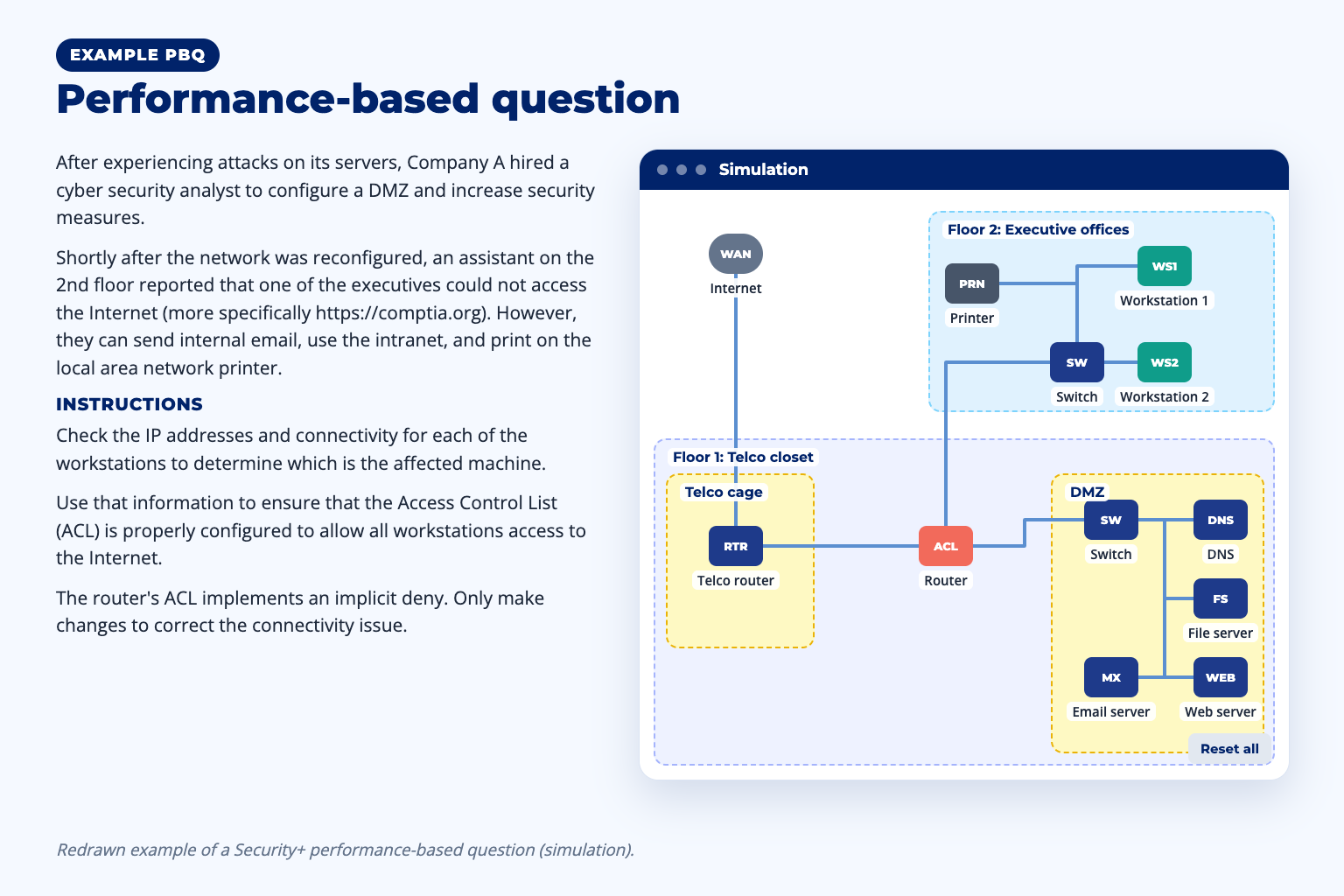
The PBQs will have you perform some basic hands-on tasks in a simulated environment. This could mean adding specific firewall rules to a table or drag-and-dropping security hardware into the correct positions of a network map.
The multiple choice questions will often follow a “given this scenario” format where you are expected to look at the circumstances presented and choose the best course of action. Others may ask you to compare and contrast concepts (such as elasticity vs. scalability).
A good example of a CompTIA-style exam question would be, “You want to implement a process that separates corporate apps from personal apps on mobile devices. Which of the following techniques will enable you to do this?”
Both versions of Security+ require a passing score of 750 (scored between 100-900) and can be written either from home or in person at a Pearson VUE testing center. You will have 90 minutes to complete the test and get your results almost immediately after the exam ends.
See our Security+ cheat sheet for a detailed break down of the domains.
CISSP
CISSP is a three-hour-long examination consisting of 100-150 questions. It is comprised of both multiple-choice and advanced innovative questions. The required passing score is 700 out of 1000.
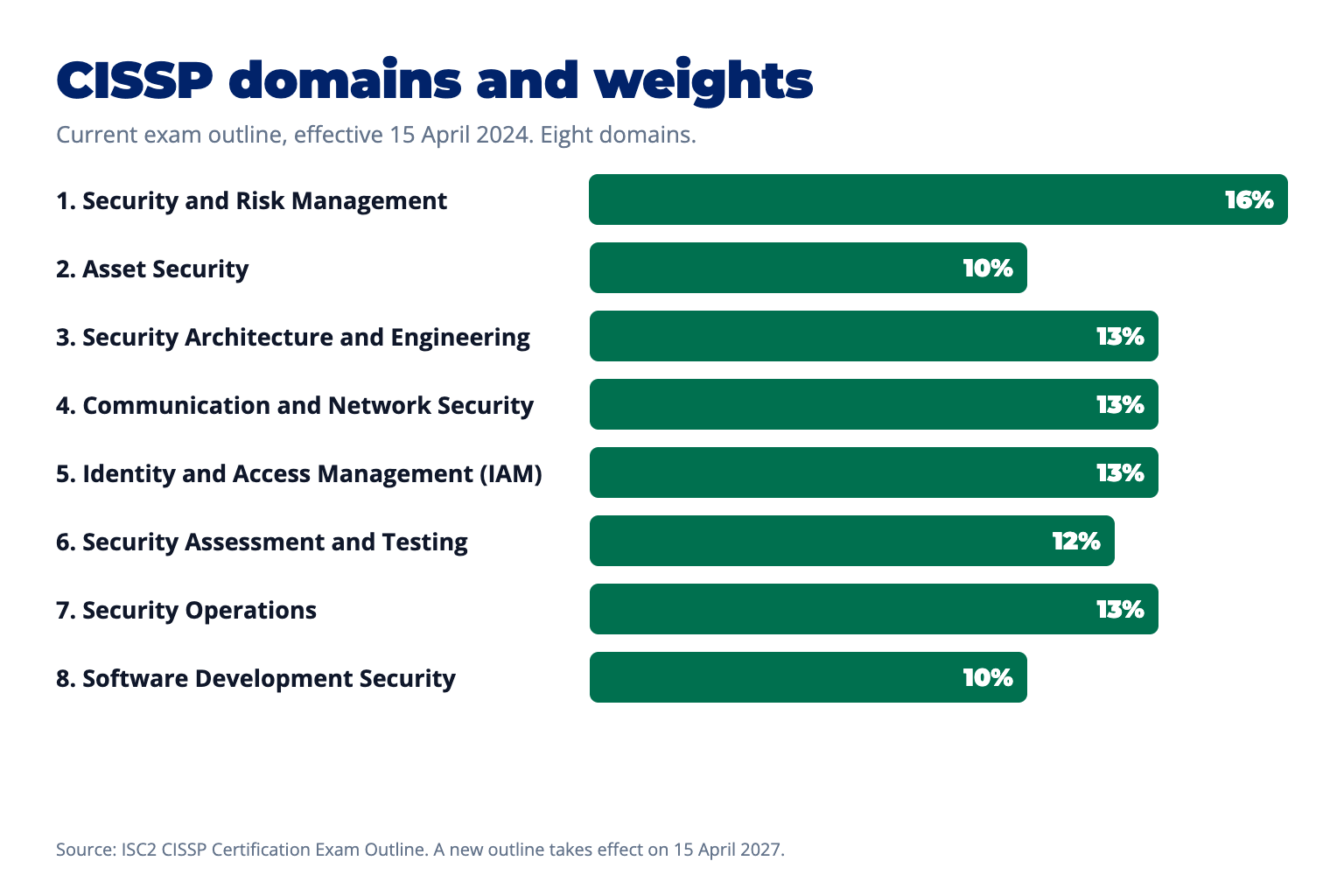
The exam content is broken down into eight domains detailed in the official CISSP Certification Exam Outline (effective 15 April 2024):
- Security and Risk Management (16%)
- Asset Security (10%)
- Security Architecture and Engineering (13%)
- Communication and Network Security (13%)
- Identity and Access Management (IAM) (13%)
- Security Assessment and Testing (12%)
- Security Operations (13%)
- Software Development Security (10%)
ISC2 has published a new outline that takes effect on 15 April 2027. It keeps eight domains but renames domain 1 to Security Governance and Risk Management and changes the weights, so check which outline applies to your exam date.
The CISSP exam now uses a Computerized Adaptive Testing (CAT) format in every language, rather than a standard linear format. This means that the number of questions and difficulty changes depending on how you’ve answered previous questions.
ISC2 explains how the CAT system works as follows:
“Following a candidate’s response to an item, the scoring algorithm re-estimates the candidate’s ability based on the difficulty of all items presented and answers provided. With each additional item answered, the computer's estimate of the candidate’s ability becomes more precise…”
Like Security+, the test is available through Pearson VUE, although the CISSP exam can only be written in person at a testing center.
There is an important difference between this exam and the Security+ exam. In the Security+ exam, you can flag questions to go back to later. Because of the way the CAT system operates, you cannot skip questions and come back to them later.
Winner: CISSP
While Security+ covers foundational concepts, CISSP delves deeper into specific topics that you are likely to encounter frequently, such as identity and access management. CISSP also has a managerial focus, which prepares you for more advanced and better-paying roles.
Eligibility Requirements
While Security+ has no hard requirements to earn, CISSP has several requirements related to industry experience.
Security+
There are no requirements to sit and write the Security+ exam.
That said, there are some recommendations made by CompTIA. It is suggested that you have at least two years of hands-on experience in a security or systems administrator role. In actual fact, a strong training course will be more than sufficient to stand for those missing years of experience. The CompTIA Security+ Course & SY0-701 Practice Test Bundle is an excellent choice for complete exam preparation.
CompTIA also recommends that you have a foundational knowledge of IT before beginning your preparation for this certification. We agree and would recommend that you earn your Network+ certification first, though it is not a prerequisite.
CISSP
The requirements for CISSP are much more demanding.
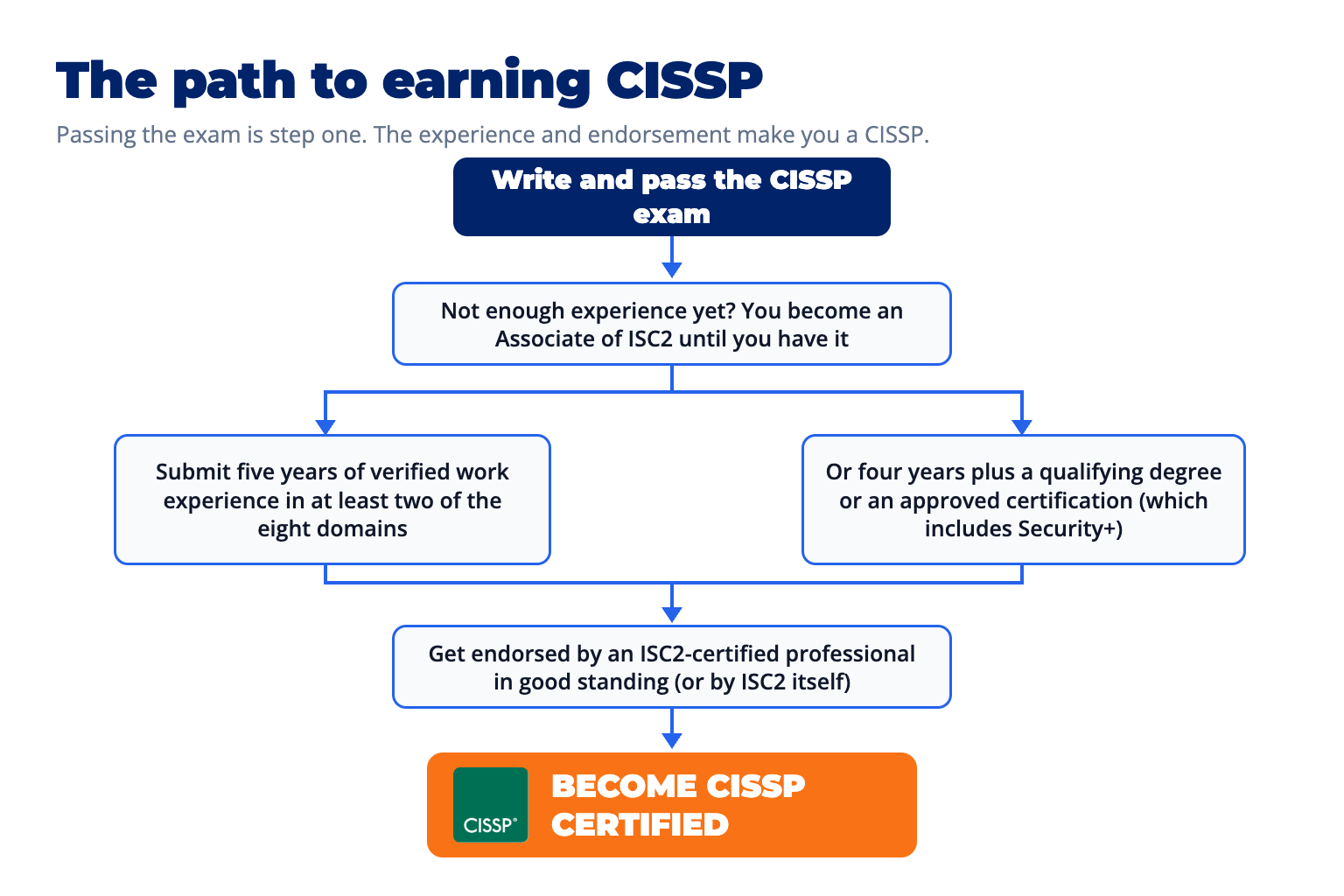
You are required to have a minimum of five years of work experience in at least two of the eight exam domains. There are specific rules regarding how many hours of work constitute full-time employment and what is permissible in terms of counting part-time hours.
You may satisfy a maximum of one of the five years of required experience if you hold a bachelor’s or master’s degree in computer science, IT or a related field, or hold one of an approved list of other security certifications (which includes Security+).
If you don’t have five years of experience, you do have the option to write the exam, but passing does not make you a CISSP. You become an “Associate of ISC2” until you gain the required experience. So you may say to potential employers that you are an associate who passed the exam but may not market yourself as a CISSP.
Winner: Security+
Security+ is far easier to obtain than CISSP. With CISSP, you need work experience and an endorsement from another ISC2-certified professional in good standing (or from ISC2 itself, with proof of employment). Security+ only requires you to show up, write the exam, and pass.
Exam Difficulty
The format of the two exams are very similar, but their respective level of difficulty is far from equivalent. As you can see in the diagram below, Security+ is a certification you earn in the third stage of your career when preparing for general security-related positions.
CISSP, on the other hand, is pursued when you enter stage four in your career, becoming an advanced cyber security professional. While it’s true the two exams have some shared subject matter, their respective difficulties reflect this difference in skill and experience.
Security+
The Security+ exam is by no means easy. It will require many tiring hours of study and practice to be successful on your exam day. However, it is an entry-level exam. It is not designed to challenge career veterans. It is made for you, the student looking to get their first security certification to hang on your wall.
CompTIA has a nasty habit of using vague phrasing on some questions, forcing you to be very careful when reading to ensure you understand what they’re asking. A single word can change the entire question, so be sure not to rush through.
The PBQs sound intimidating, especially since they’re harder to practice on your own. Fortunately, they tend to be relatively straightforward if you understand the concepts you’ve been studying.
Be sure to take extra time learning your acronyms, there is no shortage of terms to remember.
- ✓A step-by-step Security+ roadmap: every exam domain in order, so you always know what to study next
- ✓Free video lessons, guides and cheat sheets from our Security+ courses
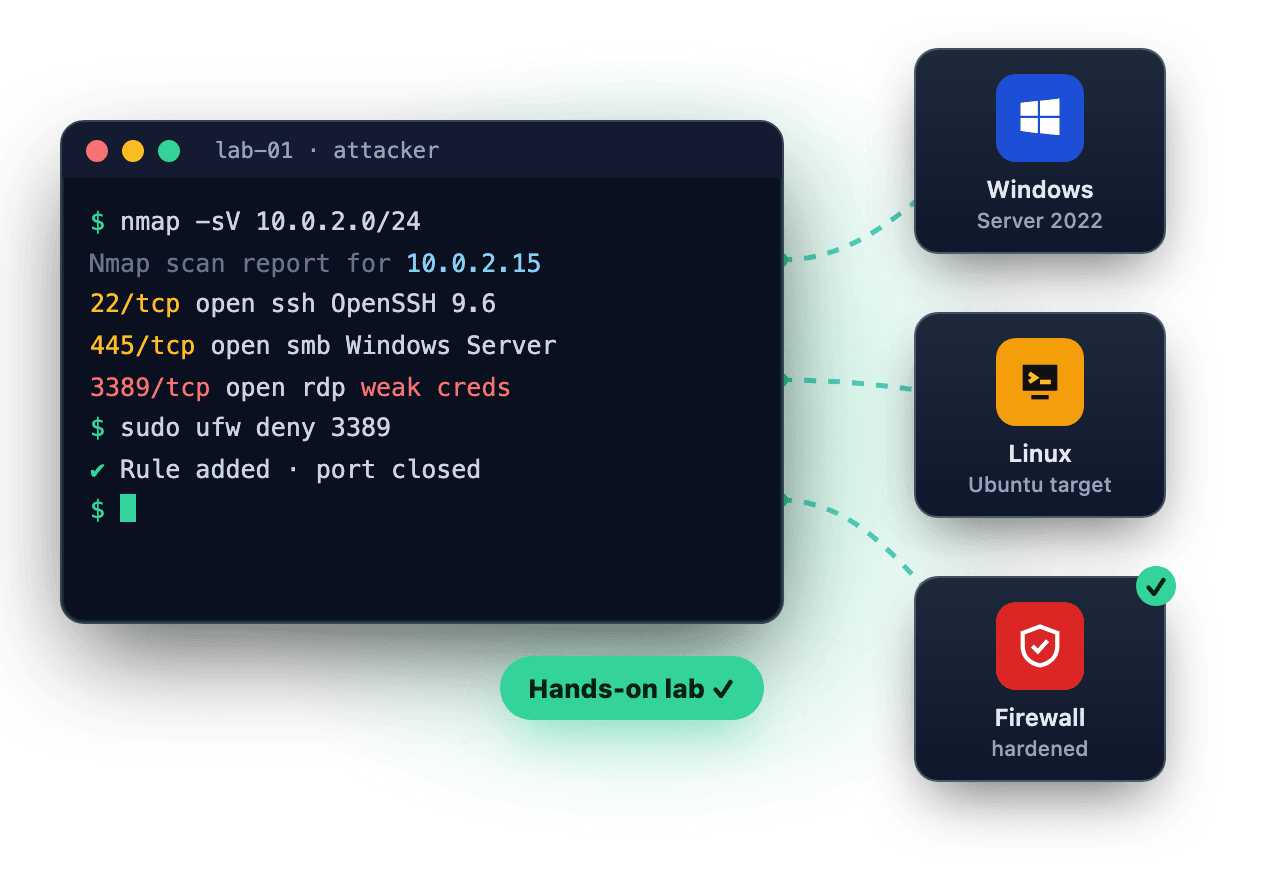
- ✓Hands-on labs in your browser: nothing to install, try one free
- ✓All your progress in one place, ready for exam day
Built for SY0-701; our SY0-801 roadmap is coming soon.
Overall, Security+ offers a challenge but is fair in its difficulty for an entry-level student.
CISSP
The new CAT exam system’s design generates a uniquely challenging exam tailored to your knowledge. As you get questions correct, the system will select more difficult questions from that domain.
While the exam becomes more and more difficult, the questions carry greater and greater value. Your continued success in answering questions will result in the exam ending earlier with a passing grade.
Specifically, the system first assesses your ability to meet the passing score at question 100. The test will end with a pass if the algorithm determines that you have a pass potential of at least 95%.
The test will instead result in a fail if the algorithm predicts your likelihood to fail at 95% or greater.
At question 100, if a 95% pass/fail judgment cannot be made, it is reevaluated after each question until question 150.
The Advanced Innovative Questions are similar in style and complexity to those of Security+.
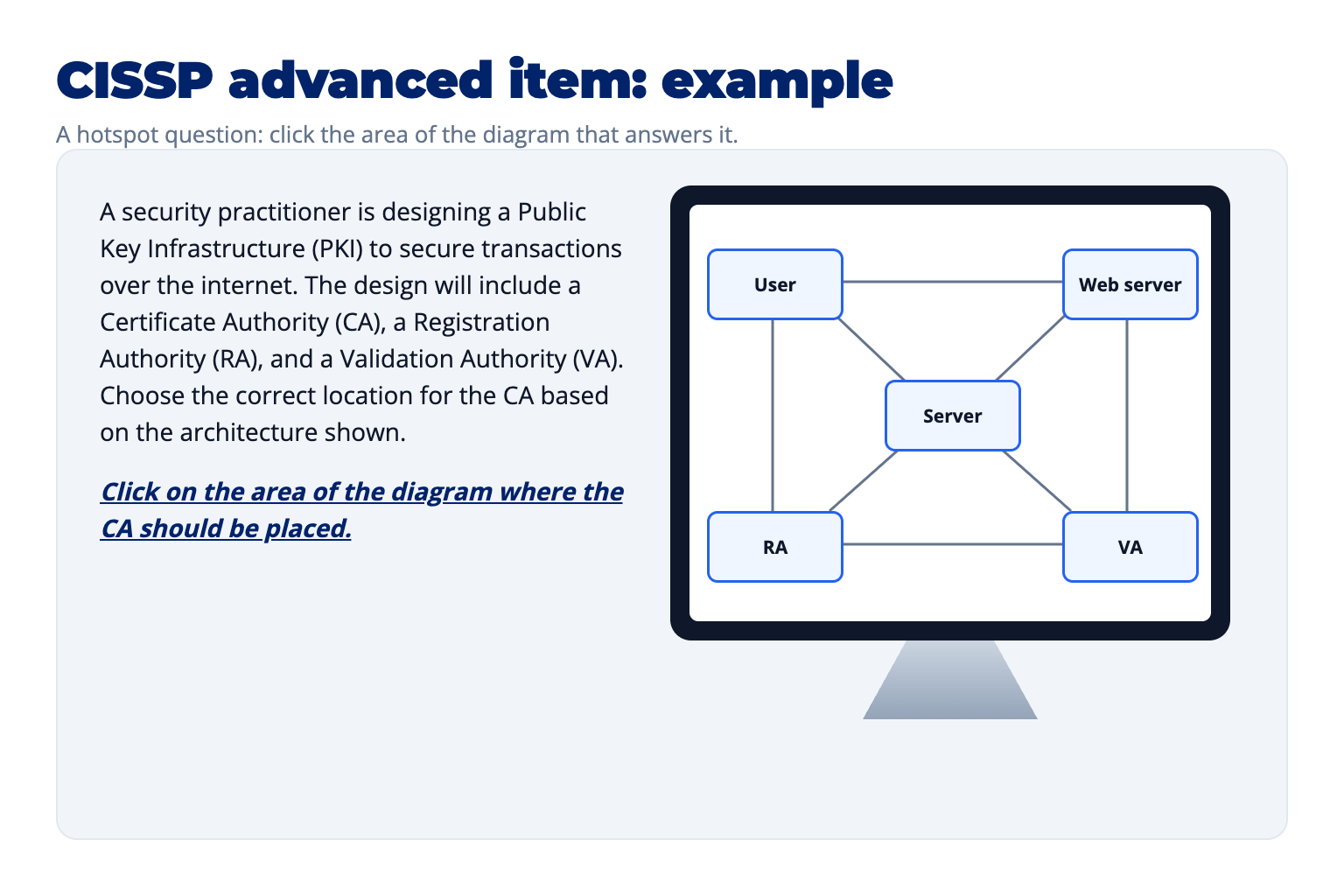
In short, the exam will be difficult. In fact, it will adapt to challenge you further. Fortunately, if it decides you’ve proven yourself sufficiently, it will end early and grant you a passing grade.
Winner: Security+
Security+ is certainly the easier exam. You are given a set pool of questions at the beginning of the exam and can return to previous questions to change your answers. CISSP does not allow you to skip a question to return to later, nor can you edit previous answers. Your next questions are chosen based on how well you answered the previous ones, creating a more challenging exam.
Job Opportunities
CISSP roles are more senior, and few of them are entry level. Security+ appears in many more entry-level and help desk postings, which is certainly not a bad thing, especially if you are starting out in your career.
Some Security+ postings also ask for more advanced certifications, often CISSP itself, which shows how the two fit together as steps on one path.
CISSP postings are mostly senior or managerial positions, and they pay considerably more than roles that only ask for Security+.
So what do we take away from this? Again, Security+ is geared toward those starting their journey into information security. The job descriptions and salaries prove this. CISSP is representative of seasoned professionals who are able to demand higher salaries.
Winner: CISSP
CISSP is one of the most in-demand cyber security certifications. Positions requiring CISSP are more senior and pay considerably more than those that only require Security+.
Cost and Recertification
CISSP is certainly a more expensive certification to earn and maintain.
The cost of writing the CISSP exam is $749 USD compared to $439 USD for Security+. ISC2 also requires an annual maintenance fee of $135, which is not the case with CompTIA and Security+.
Both certifications are valid for a period of three years. Security+ can be renewed by passing the latest version of the exam or by earning educational credits; CISSP is kept current by earning educational credits and paying the annual fee. CompTIA refers to these credits as continuing education units (CEUs), and ISC2 calls them continuing professional education (CPEs).
For Less.
StationX is a CompTIA Authorized Partner. The same official exam vouchers you'd buy from CompTIA, for less.
CompTIA price USD 878.00
Your exam voucher plus a free second attempt if you don't pass first time.
Today's US prices against CompTIA's US list price. Prices change and vary by country; the voucher page shows yours.
CompTIA and ISC2 have specific guidelines as to what counts as an educational credit, but in general, these can include taking other security-related courses, earning certifications, speaking at conferences, publishing, or attending industry events.
Security+ renews with 50 CEUs within three years of the exam’s validity. Your renewal may or may not come with an additional cost.
If you renew by earning a more advanced CompTIA certificate, such as the Pentest+ or CySA+, there is no fee. If you renew using outside certifications or other approved means, the renewal requires a $150 fee.
CISSP requires 120 CPEs over each three-year cycle to renew (ISC2 suggests about 40 a year), requiring much more of an investment to maintain.
| Cost and recertification | Security+ | CISSP |
|---|---|---|
| Exam cost | $439 USD | $749 USD |
| Annual fee | None | $135 annual maintenance fee |
| Validity | 3 years | 3 years |
| Renewal | 50 CEUs, or pass the latest version of the exam | 120 CPEs over each three-year cycle, plus the annual fee |
Winner: Security+
This comes down to numbers. Security+ is less expensive, does not require membership fees, and has easier renewal requirements.
CISSP vs Security+: The Final Verdict
As we’ve seen, CISSP vs Security+ is not an apples-to-apples comparison. CISSP and Security+ are very different in cost, testing, requirements, and outcome. Yet, there remains much confusion in this regard.
| Final verdict | Security+ | CISSP |
|---|---|---|
| Domains and content | ✅ | |
| Eligibility | ✅ | |
| Entry level | ✅ | |
| Professional recognition | ✅ | |
| Job opportunities | ✅ | |
| Salary | ✅ | |
| Cost | ✅ |
Many HR departments mistakenly list CISSP as a requirement for entry-level jobs. CISSP is a senior-level credential, not one for troubleshooting DNS issues at a help desk. For beginners, Security+ is the right starting point as it covers core security fundamentals without overwhelming you, proving you can confidently speak the language of cyber security.
Security+ and CISSP work best as a stacked progression rather than alternatives.
Security+ provides the essential technical and conceptual base, while CISSP builds on that with advanced strategy, governance, and leadership domains. Earning Security+ first can make CISSP preparation more manageable, but it’s not mandatory.
In the bigger picture, Security+ opens the door to cyber security, while CISSP positions you as a recognized authority in the field, qualifying you for leadership roles, senior US Department of Defense cyber workforce roles (CISSP is approved under DoDM 8140.03), and further specializations like CISM, CCSP, or CISA. For most professionals, Security+ is the on-ramp, and CISSP is the career accelerator.
If you’re just starting out, check out our CompTIA Security+ Course & SY0-701 Practice Test Bundle to build a solid foundation, and save up to 50% when purchasing your CompTIA Security+ Voucher through us.
For experienced professionals ready to level up, CISSP is a must-have. If you are at that point in your career or want to become an Associate of ISC2, we have a great selection of CISSP prep courses.
If you want structured guidance from start to finish, follow our Security+ roadmap on StationX Labs: video courses for each exam domain plus hands-on labs for SY0-701, with an SY0-801 roadmap coming soon, and it is free to start.
Whether you’re starting with Security+ or aiming for CISSP, choosing the right certification path today will set you up for long-term success in cyber security.
For Less.
StationX is a CompTIA Authorized Partner. The same official exam vouchers you'd buy from CompTIA, for less.
CompTIA price USD 878.00
Your exam voucher plus a free second attempt if you don't pass first time.
Today's US prices against CompTIA's US list price. Prices change and vary by country; the voucher page shows yours.
The CompTIA Security+ Course & SY0-701 Practice Test Bundle includes:
- CompTIA Security+ Study Guide: SY0-701 Total Course
- CompTIA Security+ Training: Self-Paced Course
- CompTIA Security+ SY0-701 Exam Questions and Answers
- CompTIA Security+ Practice Test Series: Ace the SY0-701
- CompTIA Security+ Exam Objectives Flash Cards: SY0-701 Prep
About the Author

Nathan House, Founder & CEO of StationX
Nathan House has 30 years of hands-on cybersecurity experience and is Cambridge-educated, holding CISSP, CISA, CISM, OSCP, CEH, and SABSA. He founded StationX in 1999 — one of the UK’s first cybersecurity companies — and has secured £71 billion in UK mobile banking transactions and the London 2012 Olympics, advising clients including Microsoft, Cisco, BP, Vodafone, and VISA. He authored the world’s most popular cybersecurity course — a #1 Udemy bestseller taken by over 500,000 students — and was named Cyber Security Educator of the Year 2020, AI Security Educator of the Year, and a UK Top 25 Security Influencer 2025. A DEF CON speaker and featured expert on CNN, Fox News, NBC, and the BBC, Nathan leads StationX’s training of more than half a million students worldwide.