
 Security+
 CySA+
 PenTest+
 SecAI+
 Network+
 A+
 Cloud+
 Linux+
Is CompTIA Security+ Hard? What You Need to Know (2026)
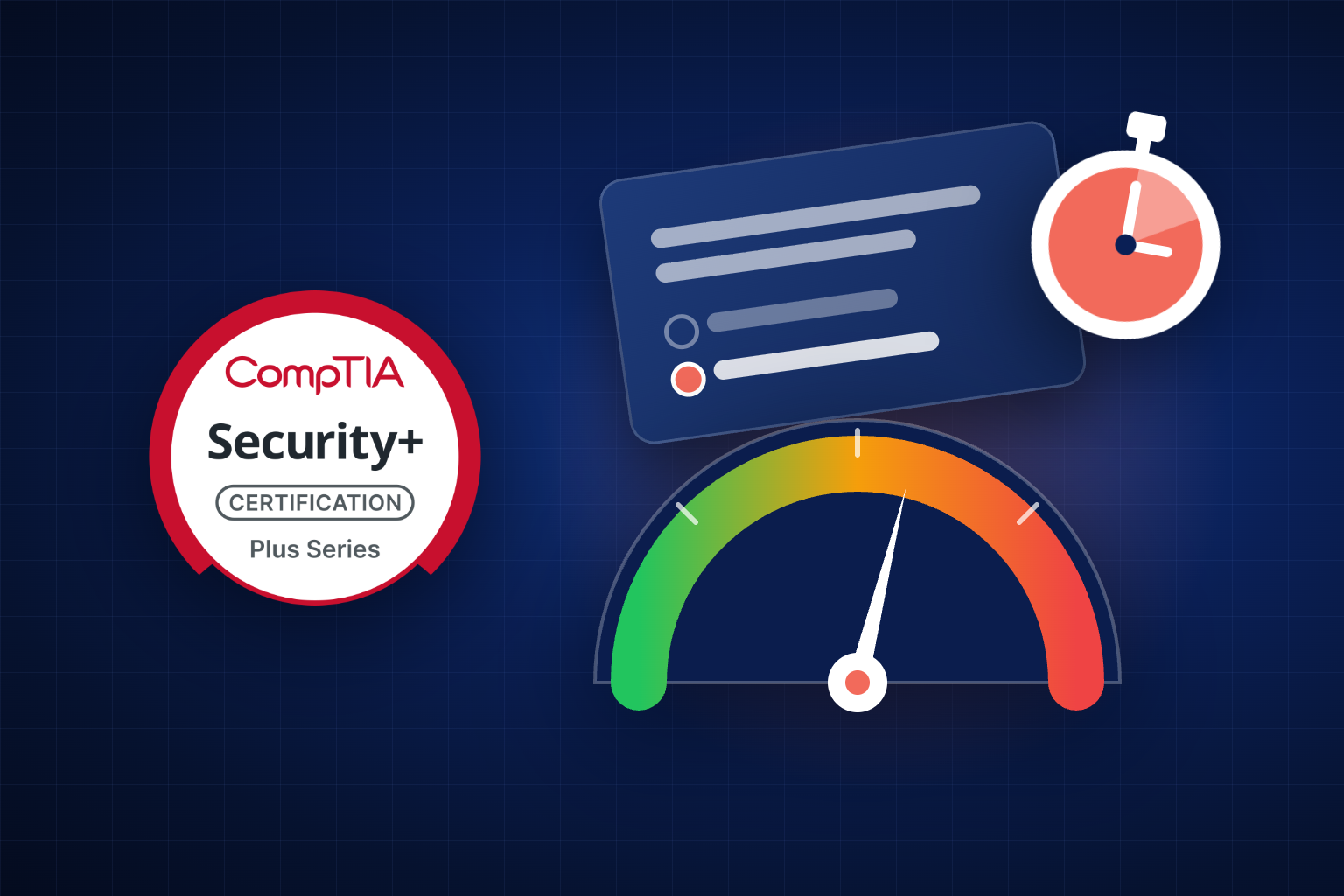
If you’re thinking about taking the CompTIA Security+ exam and wondering what you’re really getting into, this article answers your pressing question: Is CompTIA Security+ hard for beginners in security, or is it manageable with the right preparation?
Security+ SY0-701 or SY0-801? (updated November 2026)
CompTIA launched Security+ SY0-801 on 17 November 2026. We recommend SY0-701 for now: you can sit it in English until 11 June 2027, 801 is brand new with very little training available yet, and employers only ask whether you have Security+, not which version. Our free Security+ cheat sheet covers both.
In this guide, we’ll explore exactly what the Security+ certification covers, the kind of knowledge you should have before diving in, and what level of difficulty you can expect from both the study material and the exam itself.
We’ll also give you six valuable tips to help you study effectively, stay focused, and pass with confidence.
Ready to find out whether Security+ is the right next step in your career? Let’s get started.
What Is CompTIA Security+?
Security+ is an entry-level cyber security certification exam provided by CompTIA that tests you on core security functions and concepts.
It is designed to test you on foundation-level security skills and knowledge across five domains. It prepares you for positions such as security specialist, SOC (Security Operations Center) Analyst, and Incident Responder, among others.
Two versions of the CompTIA Security+ exam are live right now: SY0-701 and the new SY0-801, which launched on 17 November 2026. SY0-701 retires in English on 11 June 2027. Both versions are 90 minutes in length and composed of a mix of up to 90 multiple-choice and performance-based questions, and both lead to the same Security+ certification.
Our advice right now is to take SY0-701, because its training is mature and SY0-801 training is still thin everywhere. Take SY0-801 only if you can’t sit the English exam before 11 June 2027. Employers don’t ask which version you passed, and we’ll switch our recommendation to SY0-801 once its training is established. See our SY0-701 vs SY0-801 comparison for the full breakdown.
The exam uses a scale of 100-900 points. A minimum score of 750 points is required to pass. This is a scaled score, not a percentage, and CompTIA doesn’t say how many questions you need to get right. The cost of earning the CompTIA Security+ certification is $439 USD.
You can also purchase your Security+ exam voucher from us at a discounted rate, saving up to 50% off the official price. This is a great option for budget-conscious learners looking to reduce certification costs without sacrificing exam eligibility.
For Less.
StationX is a CompTIA Authorized Partner. The same official exam vouchers you'd buy from CompTIA, for less.
CompTIA price USD 878.00
Your exam voucher plus a free second attempt if you don't pass first time.
Today's US prices against CompTIA's US list price. Prices change and vary by country; the voucher page shows yours.
The computer-based exam can be taken at Pearson VUE testing centers or online proctored exams. This allows flexibility in how and where you can take the exam.

What Is CompTIA Security+ About?
Let’s discuss what Security+ is all about. Security+ covers five distinct domains. On SY0-701, the version we recommend for now, they include:
- General Security Concepts (12%): Covers foundational security principles, including confidentiality, integrity, and availability, as well as security frameworks and control types.
- Threats, Vulnerabilities, and Mitigations (22%): Focuses on identifying, analyzing, and mitigating various threats and vulnerabilities to secure organizational assets effectively.
- Security Architecture (18%): Examines secure system and network design, implementation of security controls, and alignment with best practices.
- Security Operations (28%): Addresses the implementation and management of security measures, including monitoring, incident response, and maintaining operational resilience.
- Security Program Management and Oversight (20%): Covers managing security programs, ensuring compliance, and providing strategic oversight to align security efforts with organizational goals.
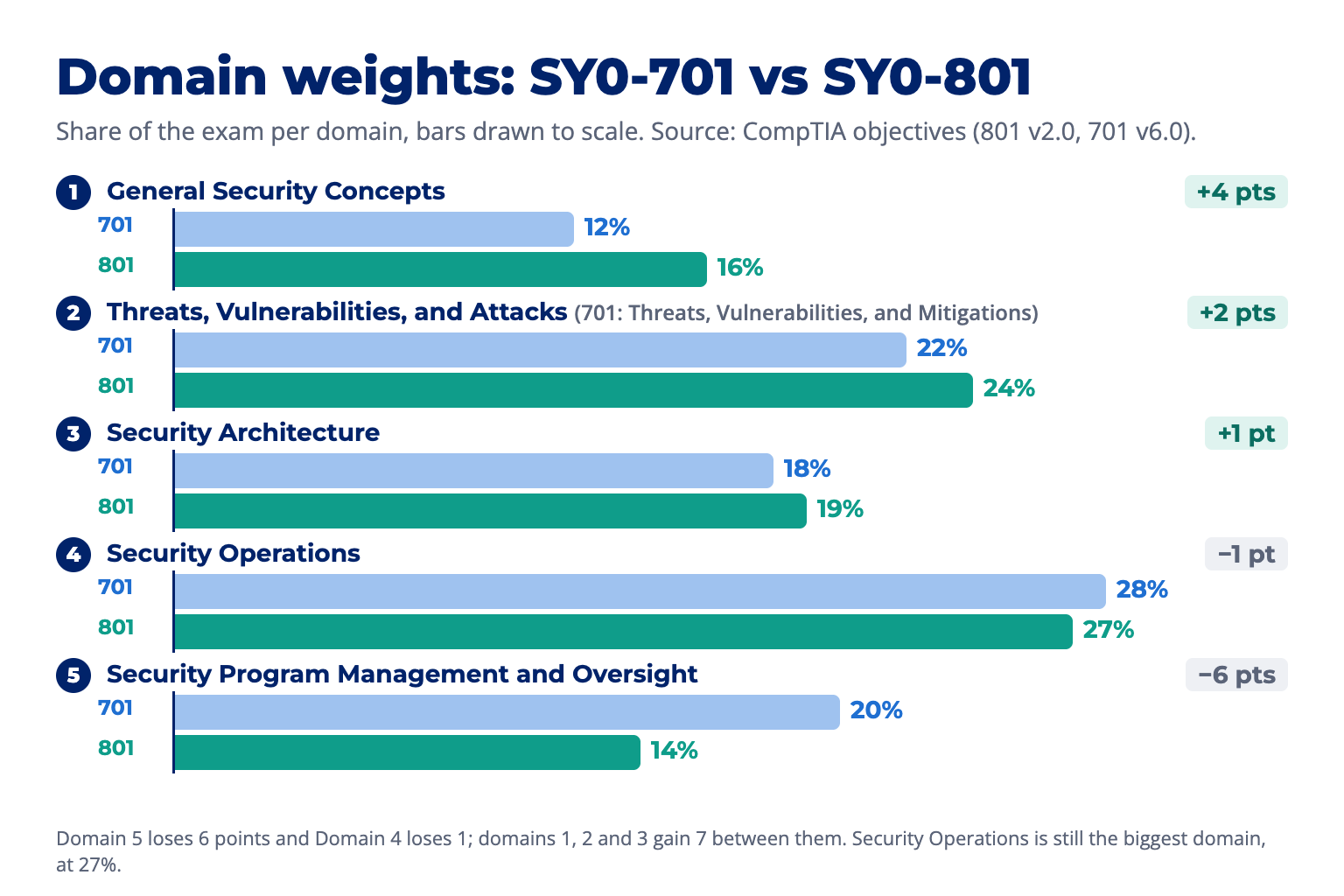
SY0-801 keeps the same five-domain structure but shifts the weights, renames domain 2, and adds objective 2.6 on the risks associated with AI:
| Domain | SY0-701 | SY0-801 |
|---|---|---|
| 1. General Security Concepts | 12% | 16% |
| 2. Threats, Vulnerabilities, and Mitigations (SY0-801: Threats, Vulnerabilities, and Attacks) | 22% | 24% |
| 3. Security Architecture | 18% | 19% |
| 4. Security Operations | 28% | 27% |
| 5. Security Program Management and Oversight | 20% | 14% |
The exam comprises multiple choice and PBQs (performance-based questions). You can expect around five to 10 PBQs; the remainder will be multiple-choice. The number of multiple-choice questions will vary between exams, as the PBQs are often more heavily weighted or counted as more than one question when scoring.
Let’s break down the two types of questions you will encounter on the exam. And what you can expect to see and what they will be testing you on.
Multiple Choice
Most of the exam will consist of traditional multiple-choice questions with four answer options. These questions may require you to select either one answer or multiple answers from the list provided. These questions will test you on the following:
- Your comprehensive understanding of cyber security.
- Your ability to analyze data to choose the most appropriate answer.
Examples
1. Which encryption algorithm provides the STRONGEST protection for data in transit over networks?
- A) AES
- B) 3DES
- C) RSA
- D) TLS
2. Which of the following are types of social engineering attacks? (Select TWO)
- A) Phishing
- B) SQL Injection
- C) Tailgating
- D) Brute Force
3. An organization is implementing a trusted network architecture. Which security control should be used to separate critical systems from the enterprise network?
- A) VLAN
- B) IDS
- C) WAF
- D) DLP
Performance-Based Questions
These questions are more complex and often simulate real-world scenarios. You may come across:
- Drag-and-Drop Questions: You’ll need to drag elements to their correct positions, such as matching definitions to terms or dragging the correct security controls to the correct areas on a company’s floor plan.
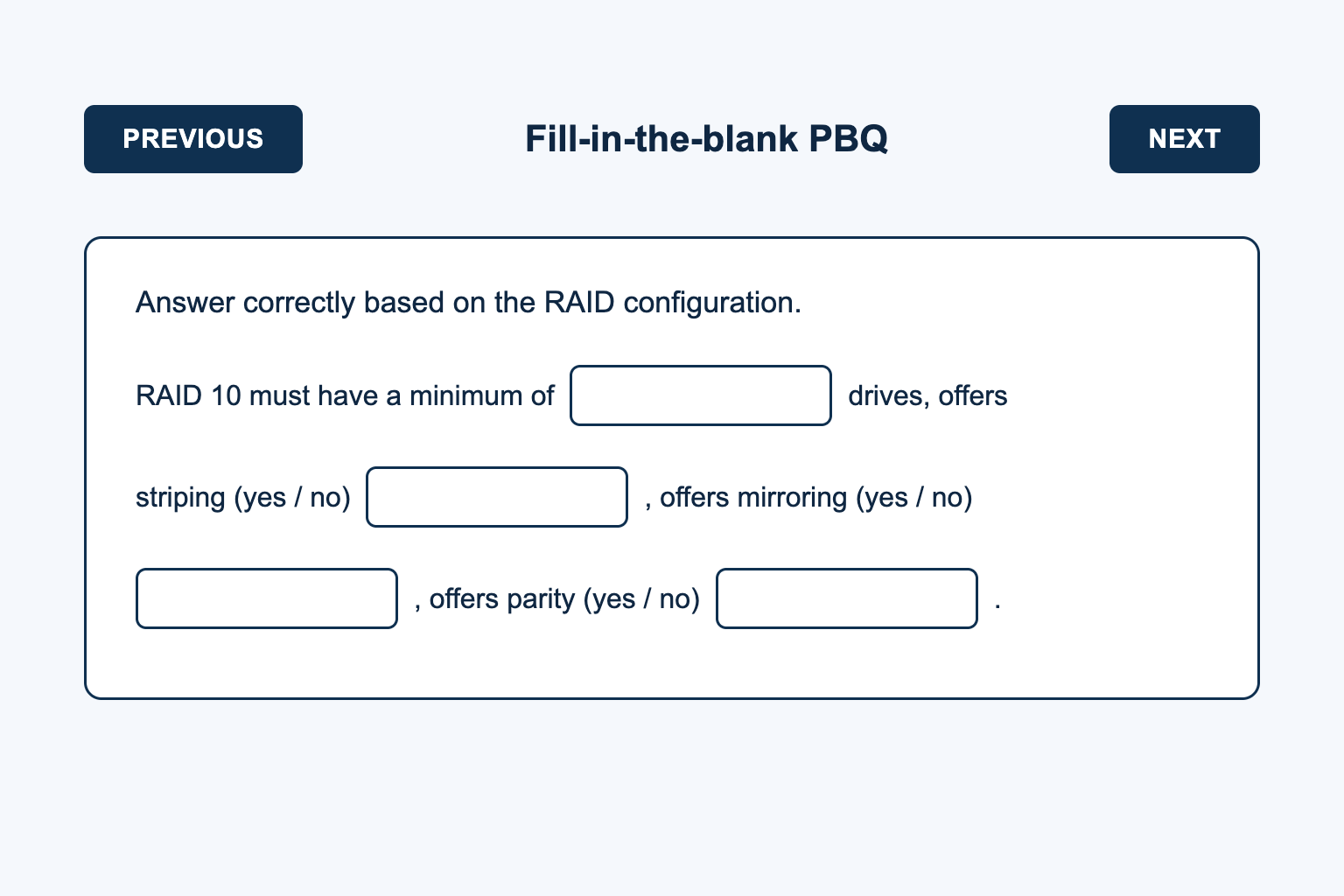
- Fill-in-the-Blank Questions: For these, you’ll be prompted to complete a sentence or terminal command by filling in the missing word or phrase.
- Scenario-Based Questions: These require you to apply your knowledge and problem-solving skills to specific, often complex, real-world situations, such as applying firewall rules in a simulated system.
These PBQs will test you on the following:
- Your ability to apply knowledge to simulated scenarios.
- Assess critical thinking and problem-solving skills.
Examples
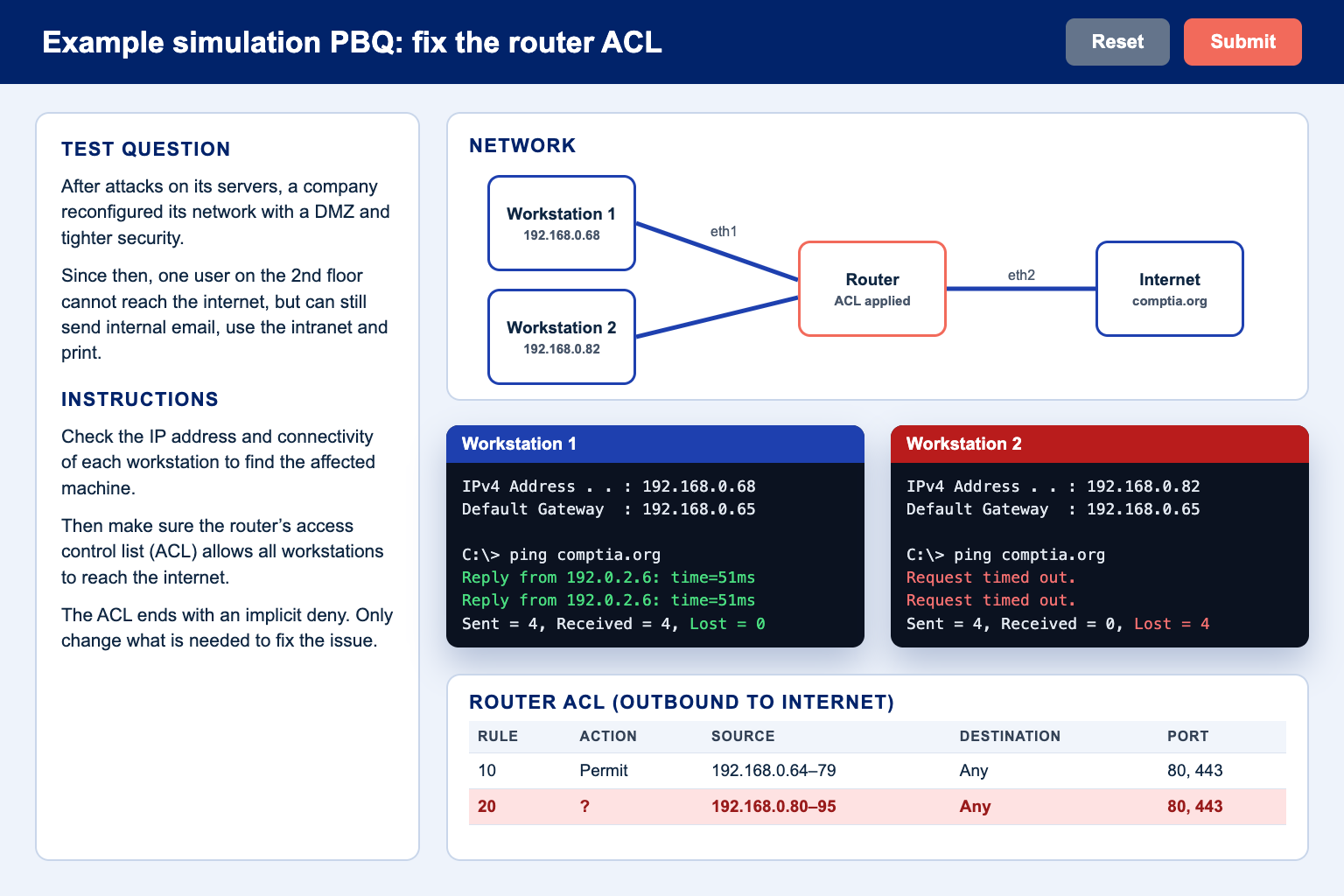
1. You are given a network diagram and asked to check access control lists (ACLs). Make the necessary changes to allow workstation access to the internet.
2. Fill in information about the RAID configuration.
What Should I Know Before Starting CompTIA Security+?
Before you begin studying for the CompTIA Security+ certification exam, it is highly recommended to have some basic IT and cyber security knowledge and experience. You do not need to be an expert, but having exposure to key concepts and technologies will help you understand the material faster.
Ideally, you should have a foundational grasp of core networking protocols and concepts like TCP/IP, common ports, firewalls, wireless technologies, routing, and switching.
Some hands-on experience in IT administration is also very helpful - things like managing user credentials, various operating systems, cloud platforms, backups, etc.
You’ll also want to possess general computer skills like installing software, using the command line interface, and editing configuration files.
These skills are covered in the CompTIA A+ and Network+. These certifications are a good measure to determine if you have the foundation skills needed to pursue Security+.
Is CompTIA Security+ Hard?
The difficulty of the CompTIA Security+ material depends on your background.
If you’re new to IT and cyber security, expect the material to be challenging. It dives into cyber security concepts and builds upon foundational IT and networking skills. Gaining a strong grasp of these subjects will require significant effort and time if you lack prior experience in the field.
The material becomes a little easier with some IT experience, like networking or system administration. Your existing knowledge helps, but you still need to learn the unique aspects of cyber security.
For those already working in cyber security or with related certifications, the Security+ material may come more easily, as it focuses on foundational knowledge that can leverage your existing experience to help prepare you more quickly.
Overall, the preparation time varies:
- Beginners may need three to six months to learn the concepts from scratch.
- Those with relevant experience can prepare in about four to six weeks.
The material in Security+ is set up so that it builds on itself. Beginning with basic ideas like identifying threats, you’ll move on to more advanced topics like putting security controls in place and understanding cryptography. Most of the time, each new topic builds on what you already know. This makes it easier to understand more difficult topics as you go along.
How Does Security+ Compare to Other Certifications?
Security+ covers a broad range of essential security domains. While it builds on networking and IT administration fundamentals, its closed-book, timed format with multiple-choice and performance-based questions makes it notably more rigorous than open‑book certification programs.
If you’re wondering how Security+ stacks up against similar entry-level and intermediate certifications, here’s a quick comparison:
| Certification | Difficulty Compared to Security+ | What to Expect |
|---|---|---|
| ISC2 SSCP | More difficult | Assumes 1+ year of hands-on experience. Focuses on access control, incident response, and operational security. Ideal for technical, system-focused professionals. |
| GSEC (GIAC Security Essentials) | More difficult | Covers advanced topics like intrusion detection, packet analysis, and command-line tools. More hands-on and in-depth than Security+. |
| Google Cybersecurity Certificate | Easier | Project-based, open-book format. Designed for beginners. Less rigorous and not DoD-recognized, but accessible and practical for career changers. |
| ISC2 CC (Certified in Cybersecurity) | Easier | High-level, concept-driven content with minimal hands-on focus. Best for absolute beginners looking for a foundational certification. |
How Difficult is the CompTIA Security+ Exam?
The Security+ exam itself presents moderate difficulty that requires a good deal of preparation and study. Time management is critical, with only 90 minutes to complete up to 90 questions of varying complexity.
Tricky Questions
The exam tends to include tricky questions, so understanding the content is crucial when taking Security+. This is more important than merely memorizing practice questions. A good grasp of the subject matter will enable you to navigate multiple-choice options and tackle the hands-on Performance-Based Questions (PBQs).
Try to identify the right answer before looking at the choices, and eliminate obviously wrong ones. Understand why the correct choice is right and why the incorrect ones are wrong - this allows you to interpret questions correctly. Read questions carefully for hints like BEST, MOST, and LEAST, which indicate the type of answer needed.
Performance Based Questions
Security+ also contains another type of question known as performance-based questions - PBQs. Simulation PBQs fill the screen and have a reset button, allowing you to retry them if necessary. Something to note is that you can skip these PBQs and return to them later. If unsure, move on and come back.
PBQs are often weighted more heavily than multiple-choice questions when scoring. For PBQs, there can be multiple solution methods that are scored appropriately. Partial credit may also be given. You will receive full credit if multiple methods can achieve the right solution.
Time Management
You have 90 minutes to finish the CompTIA Security+ exam. With about 90 questions on the exam, this means that you have, on average, one minute per question. The complexity of questions, however, can range widely from simple to longer simulations-based ones.
When answering each question on the exam, it’s important to make good use of your time. Try not to get stuck on any one question for too long. If necessary, flag it for later review. The goal should be to move steadily through the exam by answering the easier questions first. Manage your time well between carefully reading the questions, figuring out the answers, and moving forward. Our recommendation is to leave the PBQs until the end. Work on the multiple-choice ones first and come back to these later.
By planning your time carefully, you can ensure you have enough time to answer every question and still have time to review items that were flagged. Rushing can cause you to make careless mistakes, so it’s important to find the right pace.
Practice exams are useful for learning how to manage your time efficiently. Setting a timer when taking these allows you to simulate real exam conditions, helping you understand how best to allocate your time during the exam.
By setting priorities and being self-disciplined during the Security+ exam, you can score well within the 90-minute time limit.
Grab your free CompTIA Security+ exam cheat sheet
Want to keep a CompTIA Security+ exam cheat sheet at your fingertips? Our CompTIA Security+ cheat sheet covers SY0-801 and SY0-701 side by side, with a free PDF.
Tips to Prepare for CompTIA Security+
Here are six tips that will help you prepare for the Security+ exam.
- Review the exam objectives. Understanding the topics covered and their relative weight in the exam helps with your preparation. Initially, review the objectives and highlight the areas you already understand well. As you progress in your preparation, return to this list and mark off additional topics you’ve mastered. This approach helps you concentrate solely on the areas where you need improvement, making your study time more efficient.
- Use multiple study resources like books, StationX Security+ courses, practice exams, articles, or videos. We also have a great Security+ cheat sheet that can help you. Different materials explain concepts differently, helping you gain a more comprehensive understanding of the concepts. This multi-faceted approach can enrich your learning experience and increase your chances of success on the exam.
- Understand the technical skills and hands-on ability to configure, implement, and troubleshoot security controls like firewalls, IDS/IPS, encryption, access controls, etc. Acquiring this practical knowledge is essential for tackling the Performance-Based Questions (PBQs) on the exam.
- Take practice tests regularly to identify weak areas and get comfortable with the question formats and time constraints. Review what you get wrong. Practice tests also help you get used to the kinds of questions you’ll be asked and the amount of time you’ll have. It’s just as important to look over the questions you got wrong to figure out why you got them wrong. This will help you learn more and avoid making the same mistakes on the actual exam.
- Ensure you have a good understanding of the acronyms used for the exam. Many questions and answers use acronyms such as IDS (Intrusion Detection System) and VPN (Virtual Private Network). If you don’t know the terms, it may be hard to understand the questions, let alone give the right answers. So, knowing these acronyms helps you move through the exam more quickly and lets you make better choices.
- Get familiar with specific tools mentioned in the exam. The Security+ exam doesn’t just test theory, it references real-world tools you’ll be expected to recognize or apply in scenarios. The official exam objectives list tool types such as packet capture software, IDS and IPS, network mappers, and scripting. Popular examples include Wireshark, IDS and IPS tools (like Snort, Suricata, Zeek), Nmap, Bash, and PowerShell. To prepare, set up a home lab using virtual machines or cloud environments and practice using these tools. Knowing how to navigate and interpret output from these tools will help you succeed, especially on performance-based questions.
Are You Looking For More Tips To Pass Security+?
Conclusion
The Security+ exam can be challenging but achievable if you put in the required time and effort.
In this article, we’ve outlined key aspects to help you prepare for the exam. We touched on the difficulty level of the material and the exam itself, explained the types of questions you’ll encounter, and offered guidance on effective time management.
To prepare for your Security+ exam, check out our CompTIA Security+ Course & SY0-701 Practice Test Bundle. You’ll get lifetime access to approximately 20 hours of online training, three full-length practice exams, and study flashcards, a cost-effective way to build your skills and get exam-ready.
You can also purchase an official exam voucher through StationX and save on the regular $439 price.
If you’re ready to take your cybersecurity career to the next level, consider joining the StationX Master’s Program. You’ll get access to over 30,000 cybersecurity courses and labs, one-on-one mentorship, a personalized certification roadmap aligned with your career goals, and a supportive community of peers in the field.
For Less.
StationX is a CompTIA Authorized Partner. The same official exam vouchers you'd buy from CompTIA, for less.
CompTIA price USD 878.00
Your exam voucher plus a free second attempt if you don't pass first time.
Today's US prices against CompTIA's US list price. Prices change and vary by country; the voucher page shows yours.
The CompTIA Security+ Course & SY0-701 Practice Test Bundle includes:
- CompTIA Security+ Study Guide: SY0-701 Total Course
- CompTIA Security+ Training: Self-Paced Course
- CompTIA Security+ SY0-701 Exam Questions and Answers
- CompTIA Security+ Practice Test Series: Ace the SY0-701
- CompTIA Security+ Exam Objectives Flash Cards: SY0-701 Prep
Frequently Asked Questions
Can a beginner take Security+?
Yes, beginners can absolutely take the Security+ exam. While those without prior experience might require more time to grasp the concepts fully, achieving a passing score is entirely possible with focused study and preparation.
Can I pass Security+ without A+?
Yes, you can take and pass the Security+ exam even if you haven’t completed the A+ certification. While there are no prerequisites for the Security+ exam, having a solid foundation in IT will make the material easier to grasp.
What is the pass rate for Security+?
Unfortunately, CompTIA doesn’t release pass rate information.
Is Security+ easier than Network+?
The content covered in Network+ provides foundational knowledge that is reinforced in Security+. Many of the networking fundamentals and technologies from Network+ are repeated and expanded upon in the Security+ exam. Therefore, Security+ may be easier to tackle for someone who has already passed Network+.
About the Author

Nathan House, Founder & CEO of StationX
Nathan House has 30 years of hands-on cybersecurity experience and is Cambridge-educated, holding CISSP, CISA, CISM, OSCP, CEH, and SABSA. He founded StationX in 1999 — one of the UK’s first cybersecurity companies — and has secured £71 billion in UK mobile banking transactions and the London 2012 Olympics, advising clients including Microsoft, Cisco, BP, Vodafone, and VISA. He authored the world’s most popular cybersecurity course — a #1 Udemy bestseller taken by over 500,000 students — and was named Cyber Security Educator of the Year 2020, AI Security Educator of the Year, and a UK Top 25 Security Influencer 2025. A DEF CON speaker and featured expert on CNN, Fox News, NBC, and the BBC, Nathan leads StationX’s training of more than half a million students worldwide.