
 Security+
 CySA+
 PenTest+
 SecAI+
 Network+
 A+
 Cloud+
 Linux+
Network Security Certifications: The Best Options in 2026
So, you want to know what are the best network security certifications? You are in the right place. In this article, we will explore some of the best network security certifications that are suitable for your skill level, career aspirations, and interests.
Security+ SY0-701 or SY0-801? (updated November 2026)
CompTIA launched Security+ SY0-801 on 17 November 2026. We recommend SY0-701 for now: it's valid until 11 June 2027, 801 is brand new with very little training available yet, and employers only ask whether you have Security+, not which version. Our free Security+ cheat sheet covers both.
Throughout this article, we will learn about the requirements, costs, and benefits of different network security certifications, including certifications for network security concepts, certifications for applying security solutions, certifications for defensive and security operations, and certifications for network hacking and penetration testing.
So, without further ado, let’s delve deep into answering the question: “What are the best network security certifications?”
Cyber Security Certification Roadmap
Before diving into the world of cyber security certifications, it's important for you to have a basic understanding of the various stages of a cyber security career. To make your life easier, StationX has developed a straightforward and effective cyber security certification roadmap that can serve as a career path to help you achieve your goals and aspirations quickly and effortlessly.
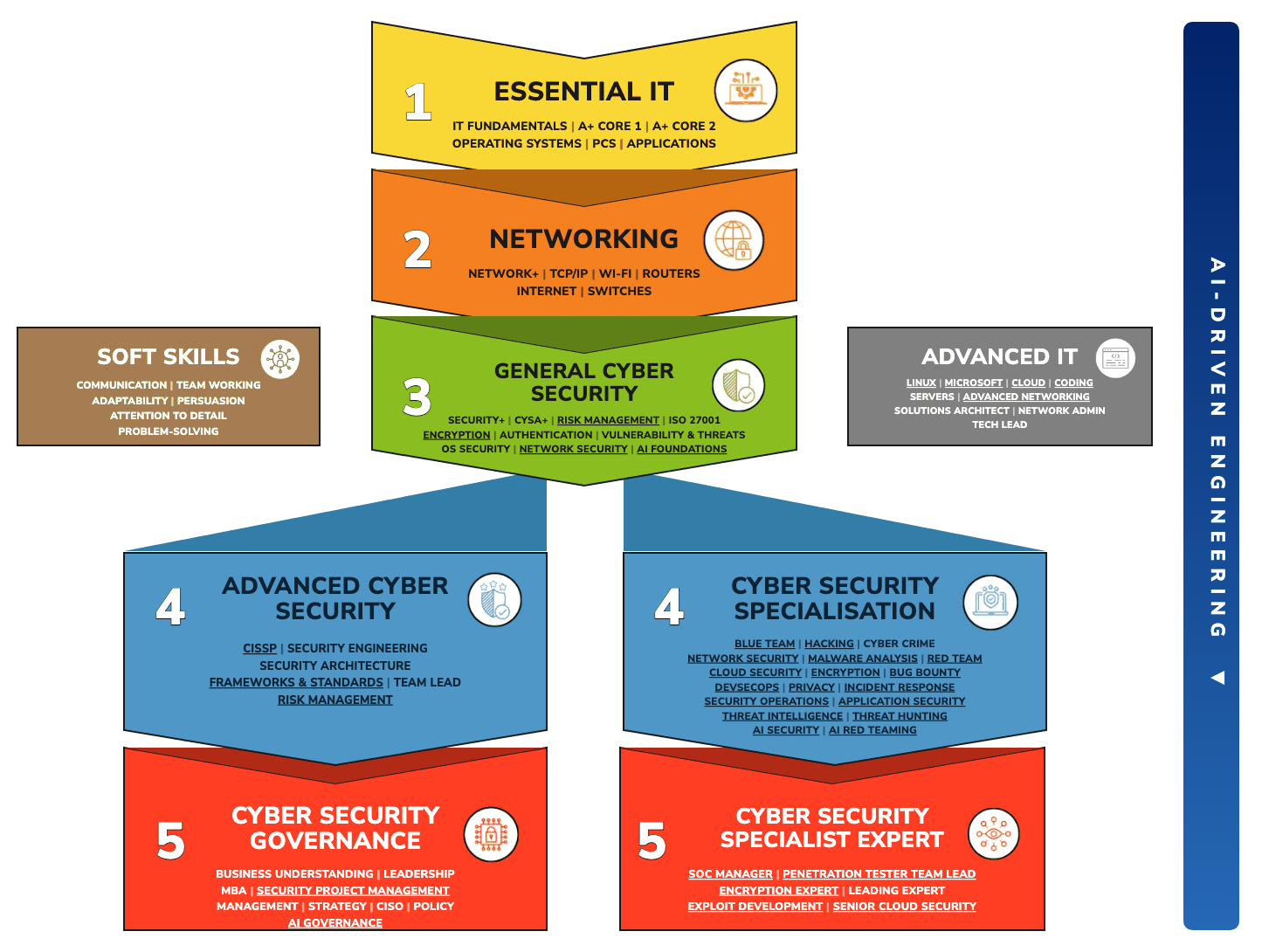
On the roadmap, Network+ sits at step 2, Security+ and CySA+ at step 3, and CISSP at step 4 (Advanced Cyber Security).
- Stage 1: Essential IT Certifications - These certifications provide a foundation in fundamental IT skills and knowledge necessary for entry-level IT positions.
- Stage 2: Networking Certifications - Networking certifications focus on the design, implementation, and management of computer networks, covering areas such as routing, switching, and network security.
- Stage 3: General Cyber Security Certifications - General cyber security certifications validate knowledge and skills in safeguarding and protecting computer systems and networks from unauthorized access, attacks, and threats.
- Stage 4: Advanced Cyber Security and Specialization Certifications - These certifications offer specialized knowledge in specific areas of cyber security, such as ethical hacking, blue teaming, red teaming, security architecture and engineering, incident response, security operations, risk management and so on.
- Stage 5: Expert Cyber Security and Governance Certifications - Expert certifications demonstrate mastery in cyber security and governance, covering advanced concepts like security project management, business understanding leadership, strategy policy, and management in addition to expertise in specialized areas like exploit development, reverse engineering, forensics, etc.
To keep things clear, we will refer to these stages throughout this article.

Network Security Concepts
Discover essential principles of network security, setting the foundation for a resilient defense against evolving cyber threats. This section explores certifications like CompTIA Security+, Certified Ethical Hacker (CEH), and Certified Information Systems Security Professional (CISSP), highlighting key concepts vital for a secure digital environment.
CompTIA Security+
The Security+ certification is offered by CompTIA and considered a foundational certification for network security professionals. It covers various topics such as network security, threats, vulnerabilities, cryptography, and access control.
Stage
Stage 3 - General Cyber Security
Details
- Exam Title: CompTIA Security+
- Exam Code: SY0-701 or SY0-801 (both are live until SY0-701 retires in English on 11 June 2027)
- Number of Questions: Maximum of 90 questions
- Test Format: Multiple choice and performance-based
- Duration: 90 minutes
- Passing Score: 750 (on a scale of 100-900)
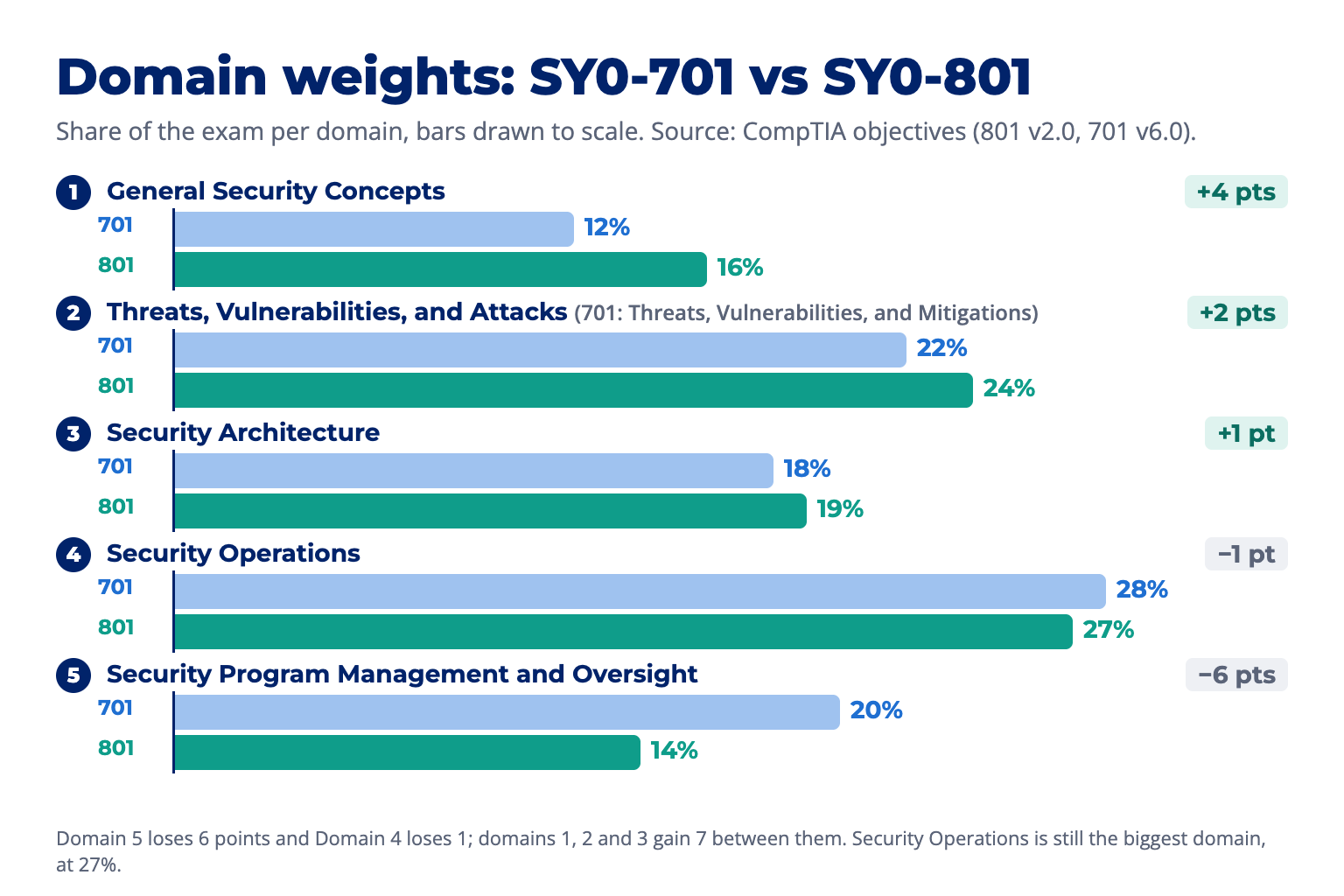
The image above shows the SY0-701 and SY0-801 domain weights side by side. Both versions lead to the same Security+ certification, and employers don't ask which version you passed. Our advice right now is to take SY0-701, because its training is mature and SY0-801 training is still thin everywhere. Take SY0-801 only if you can't sit the exam before 11 June 2027. We'll switch our recommendation to SY0-801 once its training is established. See SY0-701 vs SY0-801 for the full comparison.
| Domain | SY0-701 | SY0-801 |
|---|---|---|
| General Security Concepts | 12% | 16% |
| Threats, Vulnerabilities, and Mitigations (SY0-801: Threats, Vulnerabilities, and Attacks) | 22% | 24% |
| Security Architecture | 18% | 19% |
| Security Operations | 28% | 27% |
| Security Program Management and Oversight | 20% | 14% |
Requirements
There are no hard requirements. For SY0-701, CompTIA recommends CompTIA Network+ and two years of experience in a security or systems administrator role. For SY0-801, it recommends two years of hands-on experience as a security administrator.
Cost
CompTIA Security+ certification exam costs $439 USD (the same for SY0-701 and SY0-801).
Benefits
CompTIA Security+ is a global certification that validates the baseline skills necessary to perform core security functions and pursue an IT security career. Security+ provides a fundamental understanding of network security principles, making it a valuable asset for entry-level professionals aiming to secure network infrastructure. Security+ equips professionals with essential skills in network security, enhancing employability and providing a strong foundation for advanced certifications.
Certified Ethical Hacker (CEH)
The Certified Ethical Hacker (CEH) certification is provided by the International Council of E-Commerce Consultants (EC-Council). It focuses on ethical hacking and penetration testing techniques. CEH-certified individuals possess the skills necessary to identify vulnerabilities in computer networks and systems and provide recommendations to enhance their security.
Stage
Stage 3 - General Cyber Security
Details
- Exam Title: Certified Ethical Hacker (CEH)
- Exam Code: 312-50 (ECC EXAM), 312-50 (Pearson VUE)
- Number of Questions: 125 Questions
- Test Format: Multiple-Choice
- Duration: 4 hours
- Passing Score: Ranges from 60% to 85%.

Requirements
You will be eligible to attempt CEH certification exam if:
- You have two years of IT/security experience (or)
- You attend the official partnered training.
Cost
The CEH exam cost is $950 USD (online proctored) or $1,199 USD (Pearson VUE) if you buy the exam voucher directly from EC-Council after completing official training. If you have to pursue the EC-Council training, the cost of CEH training courses including the exam voucher starts at:
- On-Demand Training: $1,699 USD
- Unlimited On-Demand: $3,999 USD
- Live: $2,499 USD
Benefits
Understanding hacking techniques is vital for network security professionals to devise robust defense mechanisms and safeguard networks from malicious actors. CEH provides in-depth knowledge of hacking methodologies, aiding professionals in identifying vulnerabilities and strengthening network defenses. In addition, CEH is highly sought after by companies and validates essential ethical hacking skills.
Certified Information Systems Security Professional (CISSP)
The Certified Information Systems Security Professional (CISSP) certification is offered by (ISC)² and is considered one of the most prestigious certifications in the field of network security.
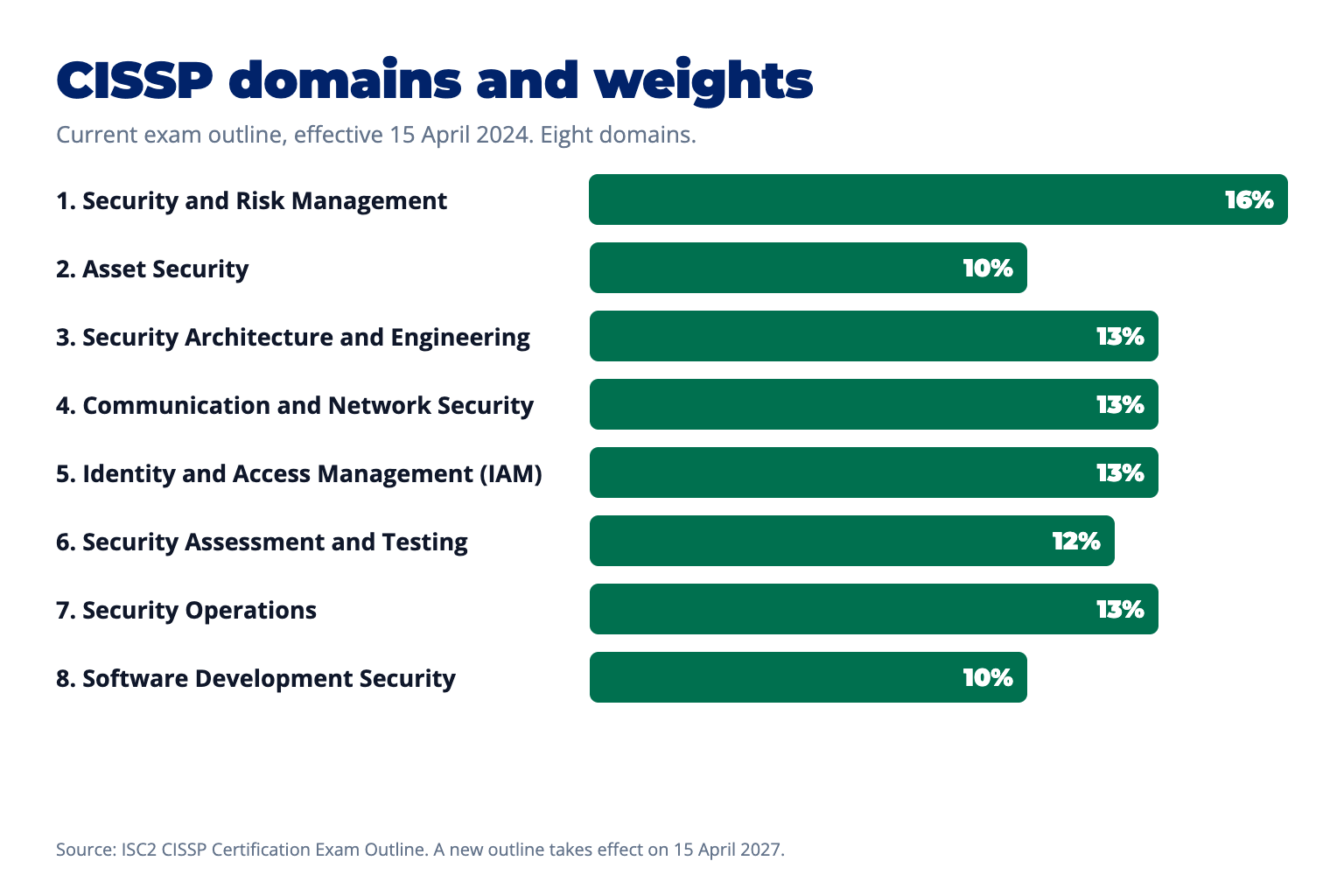
It covers various domains such as security and risk management, asset security, security architecture and engineering, communication and network security, identity and access management, security assessment and testing, security operations, and software development security.
Stage
Stage 4 - Advanced Cyber Security
Details
- Exam Title: Certified Information Systems Security Professional (CISSP)
- Exam Code: CISSP (ISC)²
- Number of Questions: 100-150 questions
- Test Format: Multiple choice and advanced innovative questions
- Duration: 3 hours
- Passing Score: A scaled score of 700 out of 1000 points
Requirements
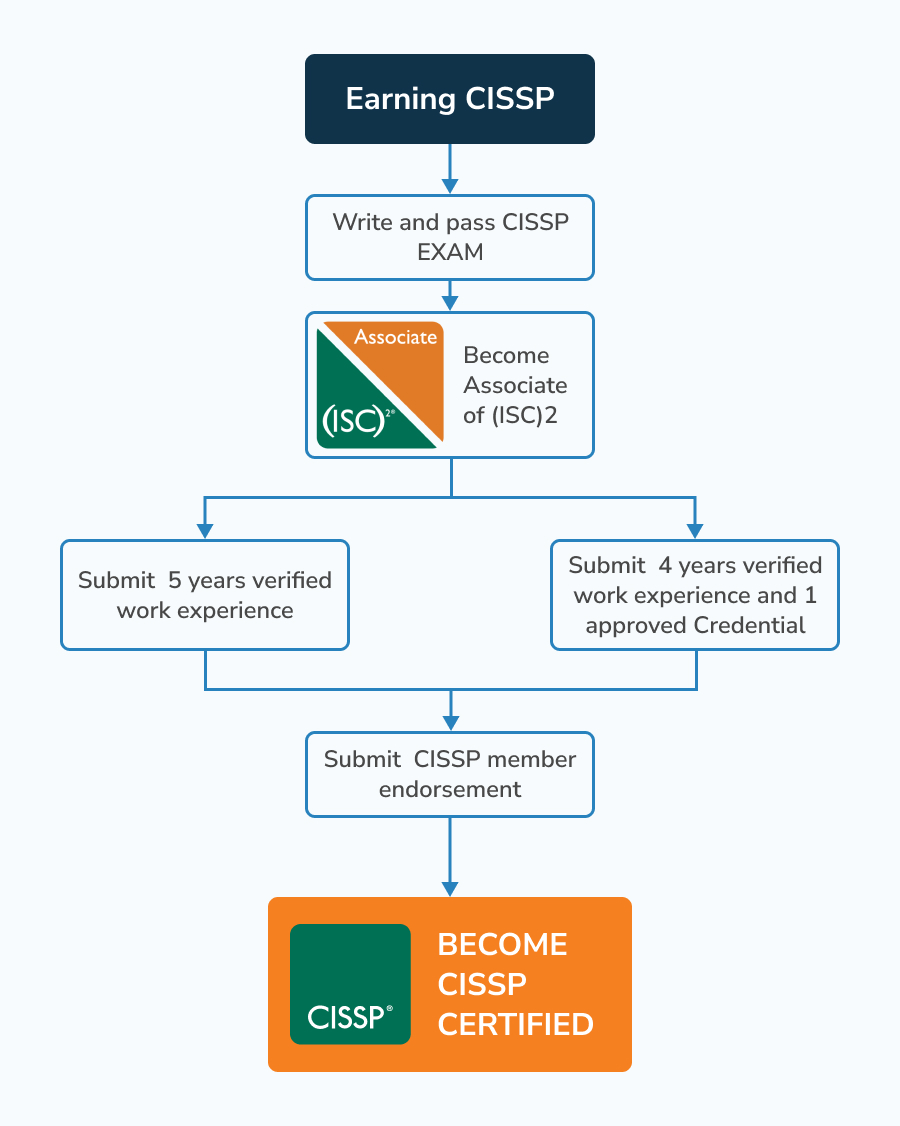
Minimum of five years of cumulative paid work experience in two or more domains of the CISSP Common Body of Knowledge (CBK).
Cost
CISSP exam costs $749 USD
Benefits
CISSP is considered as the elite certification in cyber security. CISSP imparts advanced knowledge about network security principles and practices, empowering professionals to design and maintain secure network infrastructures. CISSP validates expertise and mastery in designing, implementing, and managing a secure business environment, making it highly prestigious in the field of network security.
Courses
CompTIA Security+ roadmap on StationX Labs
Video lessons, guides, cheat sheets and hands-on browser labs. Free to register, with a free lab to try.
The Complete Ethical Hacker Course
★★★★★ 4.9
★★★★★ 4.8
Applying Security Solutions
Implementing robust security solutions is crucial to mitigating cyber risks effectively. This section focuses on certifications like CCNP Security and PCNSA (Palo Alto Networks Certified Network Security Administrator), providing the expertise needed to design, deploy, and manage security solutions within complex network infrastructures.
Cisco Certified Network Professional (CCNP) Security
Cisco Certified Network Professional (CCNP) Security is an advanced Cisco certification that validates the skills required to design, implement, and manage security solutions in complex network environments. It covers topics like secure access, VPNs, and intrusion prevention systems.
Stage
Stage 4 - Advanced Cyber Security
Details
- Exam Title: Cisco Certified Network Professional (CCNP) Security
- Exam Code: 350-701 SCOR + Security Concentration exam of your choice
- Number of Questions: Not published by Cisco
- Test Format: Multiple choice
- Duration: 120 minutes
- Passing Score: Varies (on a scale of 300-1000)
Requirements
To earn CCNP Security, you pass two exams: a core exam and a concentration exam of your choice.
- The core exam, Implementing and Operating Cisco Security Core Technologies (350-701 SCOR), focuses on your knowledge of security infrastructure.
- The Concentration exams focus on emerging and industry-specific topics such as Cisco Secure Firewall (formerly Firepower), Identity Services Engine (ISE), secure cloud access, and security infrastructure design.
Cost
CCNP Security costs $700 USD (Core exam costs $400, the Concentration exams are $300).
Benefits
The CCNP Security certification and training program provides real-world, job-focused skills in key areas. Professionals with CCNP Security certification are equipped to secure network infrastructures effectively using Cisco security solutions.
Cisco is one of the largest networking hardware vendors, and having CCNP Security certifies professionals to work on Cisco security solutions, enhancing their ability to design and implement secure networks. Even the companies that don’t operate Cisco products always value the professionals with Cisco certifications.
Palo Alto Networks Certified Network Security Administrator (PCNSA)
Palo Alto Networks Certified Network Security Administrator (PCNSA), managed by Palo Alto Networks, certifies knowledge in operating Palo Alto Networks' next-generation firewalls. It covers topics like firewall configurations, security policies, and threat detection.
Update: Palo Alto Networks has retired PCNSA as part of its move to role-based certifications. The closest current option is the Palo Alto Networks Certified Network Security Analyst, alongside the Network Security Professional and Next-Generation Firewall Engineer certifications. The details below are for the retired PCNSA exam, so check Palo Alto Networks for current exam details and pricing.
Stage
Stage 4 - Advanced Cyber Security
Details
- Exam Title: Palo Alto Networks Certified Network Security Administrator
- Exam Code: PCNSA
- Number of Questions: Approximately 60-75 questions
- Test Format: Multiple choice and scenarios
- Duration: 80 minutes
- Passing Score: 70%
Requirements
Though there are no mandatory requirements, it is recommended to have familiarity with basic networking concepts and Palo Alto Networks technologies.
Cost
The exam cost is approximately $155 USD.
Benefits
PCNSA equips professionals to configure and manage Palo Alto Networks' firewalls effectively, bolstering network security. Palo Alto Networks is one of the leading vendors in the network security appliance market, and those who earn the PCNSA certification demonstrate their ability to operate the Palo Alto Networks firewall to protect networks from cutting-edge cyberthreats.
Courses

Defensive and Security Operations
Defending against cyber threats and ensuring smooth security operations are paramount in cyber security. This section introduces certifications such as CySA+ (CompTIA Cybersecurity Analyst), GCIA (GIAC Certified Intrusion Analyst), and CCNA Cybersecurity (formerly Cisco Certified CyberOps Associate), validating the skills required to proactively analyze, detect, and respond to security incidents.
CompTIA Cybersecurity Analyst (CySA+)
CompTIA Cybersecurity Analyst (CySA+) is an intermediate-level certification from CompTIA, focusing on behavioral analytics, vulnerability management, and threat detection. It aims to validate skills in defending against cyber threats.
Stage
Stage 3 - General Cyber Security
Details
- Exam Title: CompTIA Cybersecurity Analyst (CySA+)
- Exam Code: CS0-004 (CS0-003 retires in English on 22 December 2026)
- Number of Questions: Maximum of 85 questions
- Test Format: Multiple choice and performance-based questions
- Duration: 165 minutes
- Passing Score: 750 (on a scale of 100-900)
Requirements
Though there are no mandatory requirements, CompTIA recommends about 4 years of experience in a security operations center (SOC) analyst or vulnerability analyst role. Network+, Security+ or equivalent knowledge is also helpful.
Cost
- The CompTIA CySA+ certification exam costs $439 USD.
Benefits
CySA+ enables professionals to proactively defend against cyber threats and enhance overall network security. CySA+ certifies professionals to analyze data and identify vulnerabilities to secure network environments effectively.
GIAC Certified Intrusion Analyst (GCIA)
GCIA is an advanced certification from GIAC, focusing on intrusion detection, incident response, and advanced networking protocols. The GIAC Intrusion Analyst (GCIA) certification validates a practitioner's knowledge of network and host monitoring, traffic analysis, and intrusion detection. GCIA certification holders have the skills needed to configure and monitor intrusion detection systems, and to read, interpret, and analyze network traffic and related log files.
Stage
Stage 4 - Cyber Security Specialization
Details
- Exam Title: GIAC Certified Intrusion Analyst (GCIA)
- Exam Code: GCIA
- Number of Questions: 106 questions
- Test Format: Multiple choice and performance-based questions
- Duration: 4 hours
- Passing Score: 67%
Requirements
No Specific requirements however, familiarity with TCP/IP and networking concepts is recommended.
Cost
A GIAC GCIA certification attempt costs $999 USD when bought with or after official GIAC training.
Benefits
GCIA validates expertise in detecting, responding to, and mitigating network intrusions. Professionals with GCIA certification possess advanced skills in intrusion detection, critical for maintaining robust network security.
CCNA Cybersecurity (formerly Cisco CyberOps Associate)
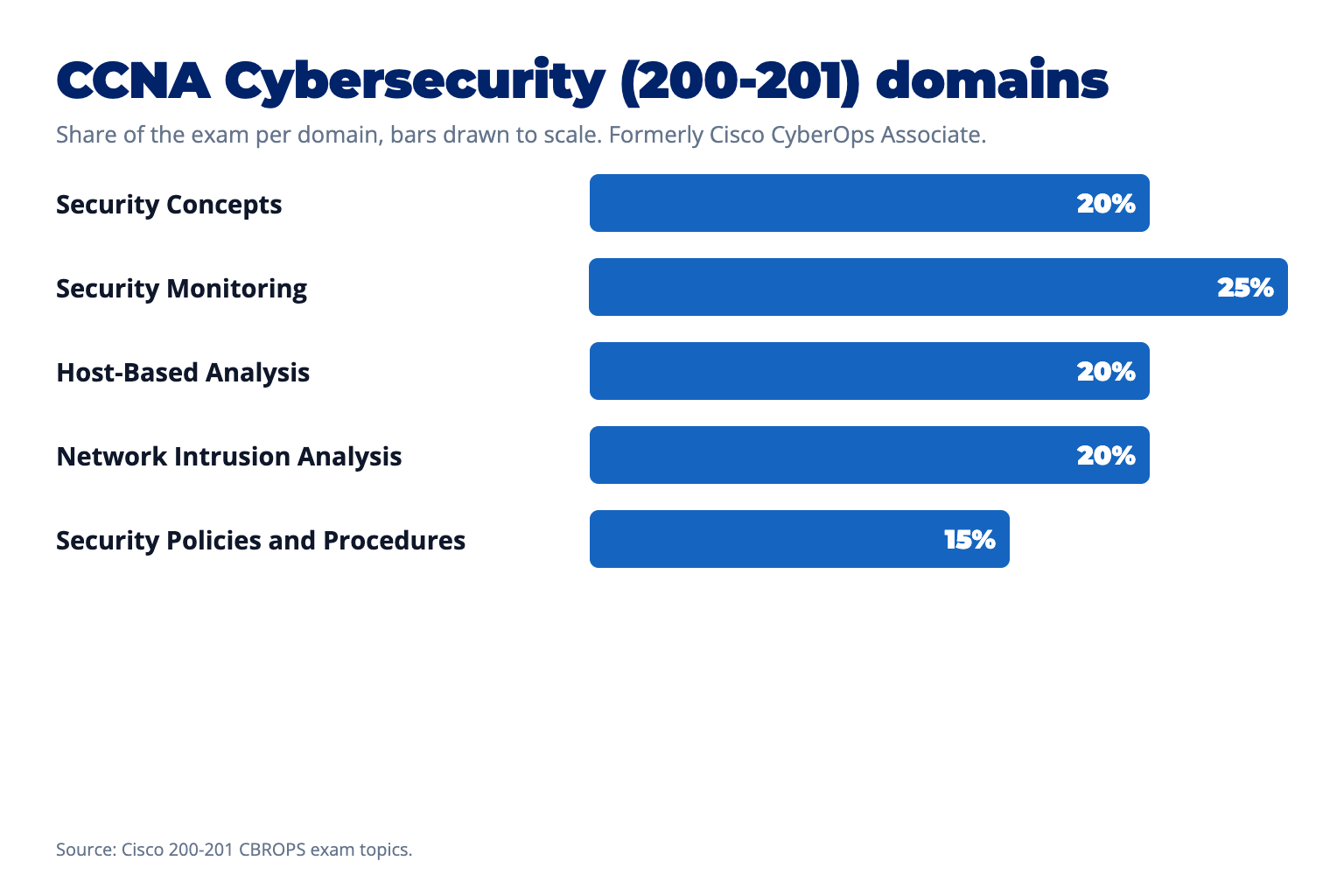
The Understanding Cisco Cybersecurity Operations Fundamentals (CBROPS) training offered by Cisco teaches you security concepts, common network and application operations and attacks, and the types of data needed to investigate security incidents.
This training teaches you how to monitor alerts and breaches, and how to understand and follow established procedures for response to alerts converted to incidents.
Stage
Stage 3 - General Cyber Security
Details
- Exam Title: CCNA Cybersecurity, formerly Cisco CyberOps Associate (200-201 CCNACBR)
- Exam Code: 200-201 CCNACBR
- Number of Questions: Not published by Cisco
- Test Format: Multiple choice and performance-based questions
- Duration: 120 minutes
- Passing Score: Varies (on a scale of 300-1000)
Requirements
There are no requirements to write this exam.
Cost
The CCNA Cybersecurity (formerly CyberOps Associate) exam costs $300 USD.
Benefits
Professionals can apply the knowledge gained from this certification to enhance security operations and respond to cyber security incidents within a networked environment. This certification equips professionals with skills to monitor and respond to security threats effectively.
Courses
CompTIA CySA+ roadmap on StationX Labs
Video lessons, guides, cheat sheets and hands-on browser labs. Free to register, with a free lab to try.


Network Hacking and Penetration Testing
Understanding offensive strategies is vital to crafting an effective defense against cyber threats. The Network Hacking and Penetration Testing section focuses on certifications like OSCP (OffSec Certified Professional) and OSEP (OffSec Experienced Penetration Tester), providing a deep dive into ethical hacking and penetration testing techniques to fortify networks against potential intrusions.
OffSec Certified Professional (OSCP)
OffSec Certified Professional (OSCP), provided by OffSec, is a highly regarded penetration testing certification. It assesses the ability to exploit various systems and networks. Learners who complete the course PEN-200: Penetration Testing with Kali Linux and pass the exam will earn the OffSec Certified Professional (OSCP) certification.
Stage
Stage 4 - Cyber Security Specialization
Details
- Exam Title: OffSec Certified Professional (OSCP)
- Exam Code: PEN-200
- Number of Questions: Practical exam, no fixed questions
- Test Format: Practical penetration testing in a controlled environment
- Duration: 23 hours and 45 minutes for the exam
- Passing Score: 70 points (OffSec uses scaled scoring for exams from 1 December 2026)
Requirements
It is recommended to have solid understanding of TCP/IP networking, reasonable Windows and Linux administration experience, and familiarity with basic Bash and/or Python scripting.
Cost
- OffSec offers OSCP as a bundle for $1,749 USD that includes OSCP exam, PEN-200 course, and 90 days lab access.
- In addition, you can also choose the $2,749 USD annual subscription where you will receive two OSCP exam attempts and 1 year access to course labs.
Benefits
Professionals with OSCP certification possess advanced skills in identifying vulnerabilities and securing networks through penetration testing. The OSCP exam requires students to breach and control a three-machine Active Directory network - Active Directory is the most common network infrastructure used by companies today. In addition, OSCP certification holders are highly preferred by companies globally with high paying jobs.
OffSec Experienced Penetration Tester (OSEP)
OffSec Experienced Penetration Tester (OSEP) is an elite-level certification from OffSec, focusing on advanced penetration testing techniques. Learners who complete the course PEN-300: Evasion Techniques and Breaching Defenses and pass the exam will earn the OffSec Experienced Penetration Tester (OSEP) certification.
Stage
Stage 4 - Cyber Security Specialization
Details
- Exam Title: OffSec Experienced Penetration Tester (OSEP)
- Exam Code: PEN-300
- Number of Questions: Practical exam, no fixed questions
- Test Format: Practical penetration testing and exploit development
- Duration: 47 hours and 45 minutes for the exam
- Passing Score: at least 100 Points
Requirements
Though there are no hard requirements for OSEP, it is recommended to have OSCP. It is also recommended to have solid ability in enumerating targets to identify vulnerabilities. In addition, the ability to identify and exploit vulnerabilities like SQL injection, file inclusion, and local privilege escalation is an added advantage.
Cost
- OffSec offers OSEP as a bundle for $1,749 USD that includes OSEP exam, PEN-300 course, and 90 days lab access.
- In addition, you can also choose the $2,749 USD annual subscription where you will receive two OSEP exam attempts and 1 year access to course labs.
Benefits
The OSEP exam is designed to mimic a real corporate network with common security features. Those who pass this certification have demonstrated their ability to perform real network penetration tests and bypass real-world defences.
Courses



Conclusion
Understand that network security is a critical aspect of modern technology, and obtaining relevant certifications is vital for professionals aiming to excel in this field. In navigating the myriad options of network security certifications, the key lies in aligning your choice with your aspirations.
If you're just starting, CompTIA Security+ offers a solid foundation. For those intrigued by ethical hacking, the Certified Ethical Hacker (CEH) route awaits. Aspiring to climb the career ladder? Certified Information Systems Security Professional (CISSP) is a valuable step.
If you lean towards Cisco technologies, CCNP Security holds expertise in that domain, while PCNSA (now succeeded by Palo Alto's Network Security Analyst certification) is ideal for those inclined towards Palo Alto solutions. For enthusiasts of threat detection, CompTIA CySA+ and GCIA provide a solid pathway.
If your ambition lies in cyber security operations, explore CCNA Cybersecurity (formerly Cisco CyberOps Associate). For the adventurous aiming to master penetration testing, the challenging OSCP or OSEP certifications await.
Match your certification choice with your ambitions, for your journey towards becoming a network security expert begins with the right step—choose wisely and define your cyber security destiny.
Whether you're starting your career or looking to advance to the highest levels of expertise, these certifications can significantly impact your professional growth and contribute to a more secure digital world.
For certification training, follow our roadmaps on StationX Labs for CompTIA Network+, Security+ and CySA+: video lessons, guides, cheat sheets and hands-on browser labs. Free to register, with a free lab to try.
Frequently Asked Questions
Is there a CCNA Security?
No, Cisco discontinued CCNA Security. This means that individuals who were planning to pursue this certification will no longer have the opportunity to do so. Cisco offers other security-focused certifications such as the Cisco Certified Network Professional Security (CCNP Security) and the Cisco Certified Internetwork Expert Security (CCIE Security).
Is CompTIA Security+ worth it?
Yes, CompTIA Security+ is highly regarded in the industry and serves as an excellent starting point for those looking to pursue a career in cyber security. It provides fundamental knowledge and is recognized by many employers.
Can a beginner get the CISSP certification?
While CISSP is an advanced certification, beginners can work towards it by gaining relevant experience and progressively obtaining lower-tier certifications. However, it's advisable to build a solid foundation in cyber security before attempting CISSP.
About the Author

Nathan House, Founder & CEO of StationX
Nathan House has 30 years of hands-on cybersecurity experience and is Cambridge-educated, holding CISSP, CISA, CISM, OSCP, CEH, and SABSA. He founded StationX in 1999 — one of the UK’s first cybersecurity companies — and has secured £71 billion in UK mobile banking transactions and the London 2012 Olympics, advising clients including Microsoft, Cisco, BP, Vodafone, and VISA. He authored the world’s most popular cybersecurity course — a #1 Udemy bestseller taken by over 500,000 students — and was named Cyber Security Educator of the Year 2020, AI Security Educator of the Year, and a UK Top 25 Security Influencer 2025. A DEF CON speaker and featured expert on CNN, Fox News, NBC, and the BBC, Nathan leads StationX’s training of more than half a million students worldwide.