
 Security+
 CySA+
 PenTest+
 SecAI+
 Network+
 A+
 Cloud+
 Linux+
Best Cyber Security Courses for Beginners: The 2026 Roadmap
Ready to start a cyber security career but not sure which courses are worth your time? The honest answer is that the best beginner course is not one course. It is the right courses, in the right order, so each one builds on the last and you never wonder what to learn next.
That order is the StationX cyber security roadmap. This guide walks you through it step by step, and for each beginner step points you to the matching roadmap on StationX Labs, where the courses and hands-on labs for that step are laid out in order. The roadmaps are free to view, and a free account opens the free lessons.
CompTIA launched Security+ SY0-801 on 17 November 2026. We recommend SY0-701 for now: the English exam stays available until 11 June 2027, 801 is brand new and study material for it is still arriving, and we expect employers to care that you hold Security+ more than which version you sat. Our free Security+ cheat sheet covers both.
Why a Roadmap Beats a List of Courses
Most beginners don't fail because the material is too hard. They stall because they jump between random courses, hit a topic that assumes knowledge they don't have yet, and lose momentum.
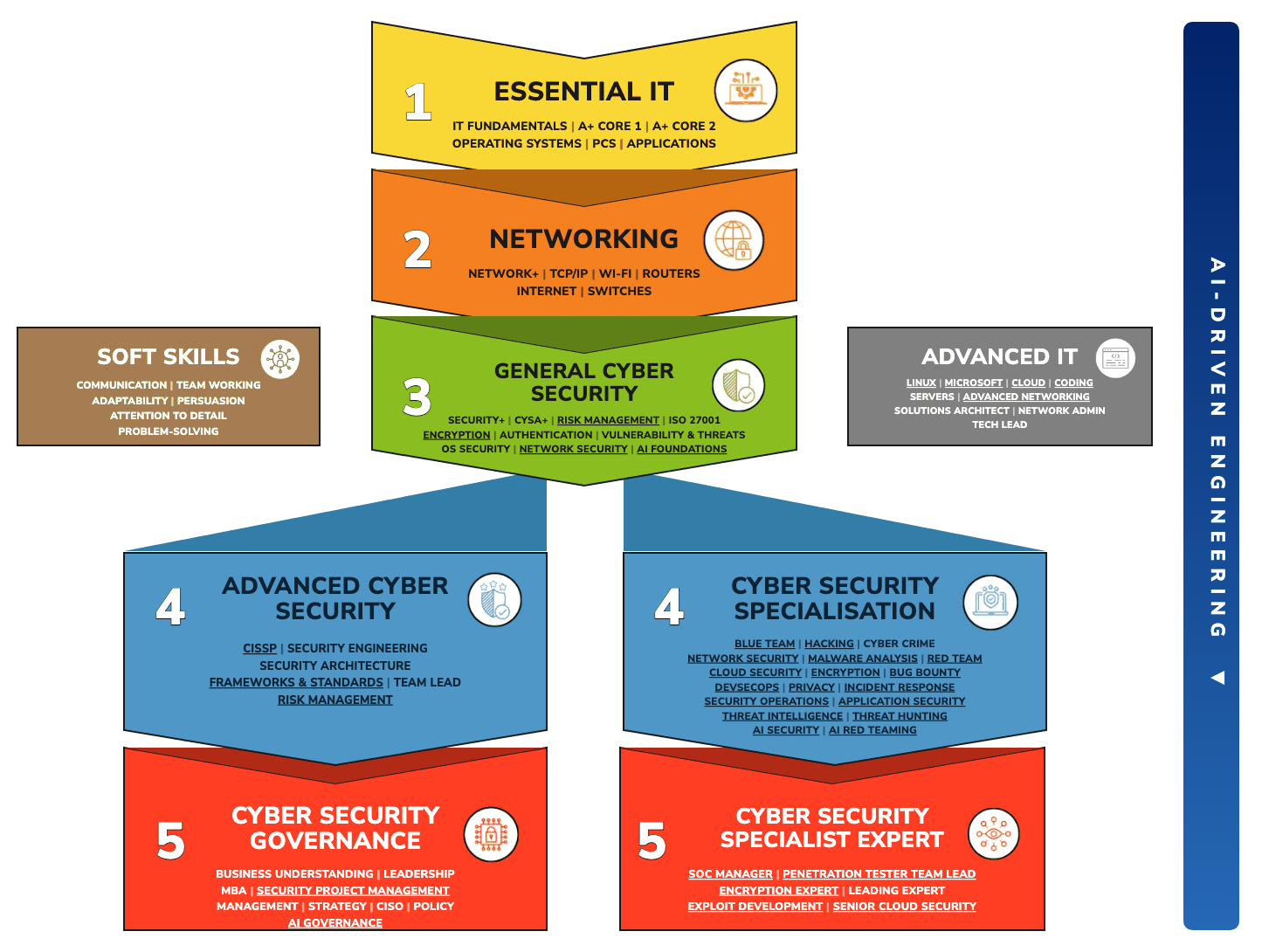
A roadmap fixes that. Security sits on top of IT and networking: you can't secure a network you don't understand, or investigate an alert on a system you couldn't troubleshoot. So the roadmap starts with how computers and networks work, then moves into security, then lets you specialise.
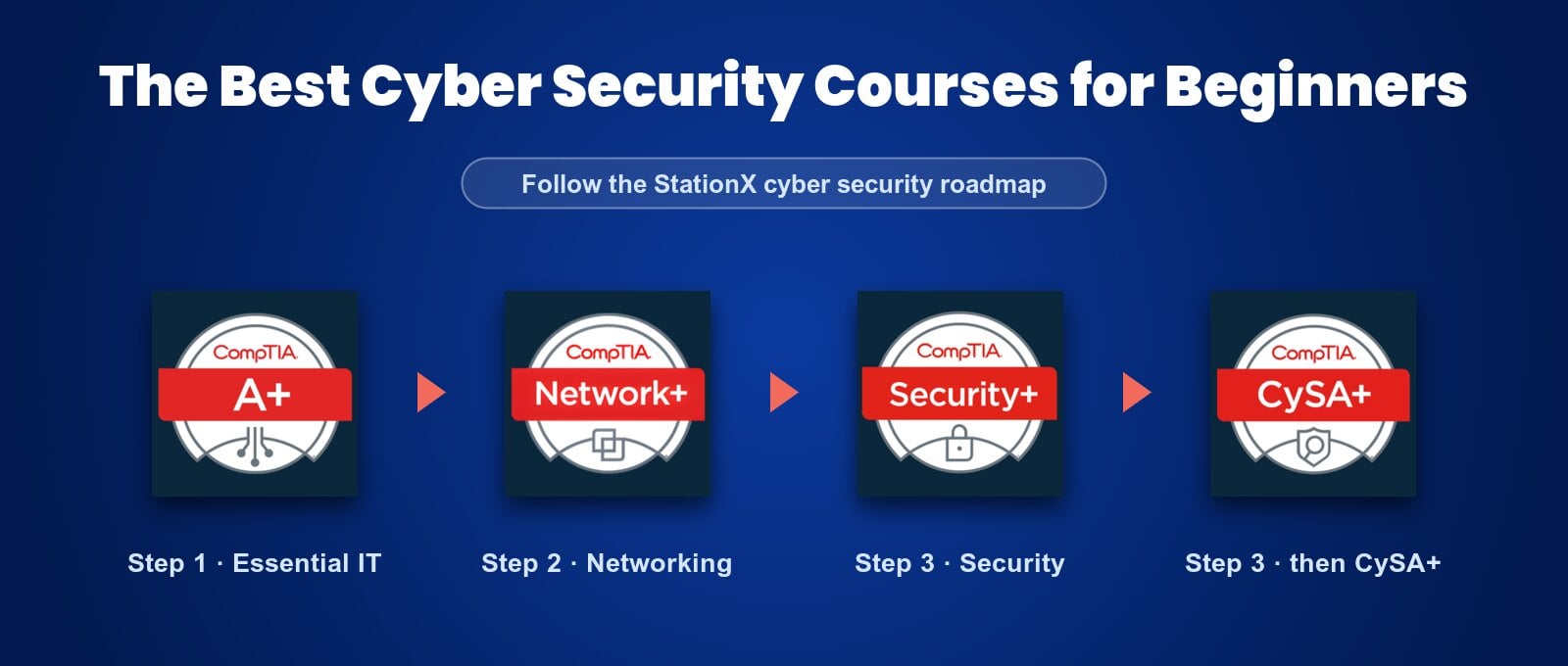
The first three steps line up with CompTIA certifications that employers recognise:
- Step 1, Essential IT: CompTIA A+
- Step 2, Networking: CompTIA Network+
- Step 3, General Cyber Security: CompTIA Security+, then CySA+
Earning each certificate isn't required, especially if you're just exploring the field. But since you're studying the material anyway, the exams give you a clear target and something credible to put on your CV. For how these certs compare, see our guide to cyber security certifications for beginners, and for the whole map, our cyber security roadmap.

Step 1: Essential IT (CompTIA A+)
Step 1 is IT fundamentals: hardware, PCs, operating systems, applications and basic troubleshooting. This is the knowledge help desk and support staff use every day, and the usual first job in IT.
CompTIA A+ is the certification for this step. It is two exams: Core 1 (220-1201) covers hardware, mobile devices, networking basics, virtualisation and cloud, and troubleshooting; Core 2 (220-1202) covers operating systems, security, software troubleshooting and operational procedures.
StationX Labs roadmap
CompTIA A+ roadmap (220-1201 / 220-1202)
Core 1 and Core 2 in order: courses, then hands-on labs.
Completely new to IT? If terms like operating system, RAM or IP address are new to you, start one step earlier with CompTIA Tech+ (FC0-U71). It covers core terminology, hardware, software and basic security before A+.
StationX Labs roadmap
CompTIA Tech+ roadmap (FC0-U71)
The starting point if you're new to IT altogether.
Not sure whether you need A+ before Security+? Our A+ vs Security+ comparison goes through it.
Step 2: Networking (CompTIA Network+)
Networking is the foundation security is built on. Attacks travel over networks, and most detection work means reading network traffic and logs. At this step you learn TCP/IP, routers and switches, Wi-Fi and how the internet fits together.
CompTIA Network+ (N10-009) is the certification for this step. Its domains are networking concepts, implementation, operations, network security and troubleshooting. It is the recommended step between A+ and Security+.
StationX Labs roadmap
CompTIA Network+ roadmap (N10-009)
Topologies, protocols, addressing, routing and switching, then labs.
You can start learning cyber security without IT and networking behind you, but it is harder. For more networking options, see Best Networking Courses for Beginners.
Step 3: General Cyber Security (Security+ and CySA+)
Step 3 is where you learn security itself: threats and vulnerabilities, encryption, authentication, risk management, operating system and network security.
CompTIA Security+
CompTIA Security+ is widely treated as the baseline credential for entry-level security roles. It covers five domains: general security concepts; threats, vulnerabilities and mitigations; security architecture; security operations; and security program management and oversight.
SY0-701 and the new SY0-801 are both live. We recommend SY0-701 for now because its training is mature; take SY0-801 only if you can't sit before 11 June 2027. See our SY0-701 vs SY0-801 comparison, and when you're ready to plan your study, how to pass Security+.
Even if you don't plan to sit the exam, Security+ gives you a broad, job-relevant framework: threats, controls, risk, policy, identity, network defence and cryptography, organised the way employers expect you to understand them.
CompTIA CySA+
CySA+ is the blue-team analyst certification and the natural step after Security+. It trains you to think and work like a security analyst: security operations, vulnerability management, incident response and reporting. That makes it a strong bridge into SOC and analyst roles.
CompTIA launched CySA+ CS0-004 on 23 June 2026, and the English CS0-003 exam retires on 22 December 2026, so if you plan to sit the exam, take CS0-004. For how the two certs differ, see CySA+ vs Security+, and for the job itself, how to become a cyber security analyst.
StationX Labs roadmap
CompTIA CySA+ roadmap (CS0-004)
Security operations, vulnerability management, incident response and reporting.
- ✓A step-by-step roadmap for each exam: every domain in order, so you always know what to study next
- ✓Free lessons and guides on each roadmap
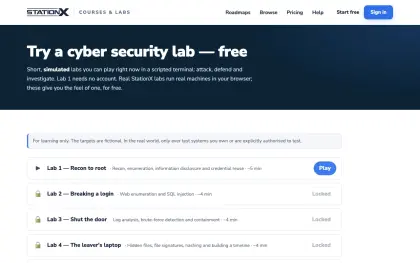
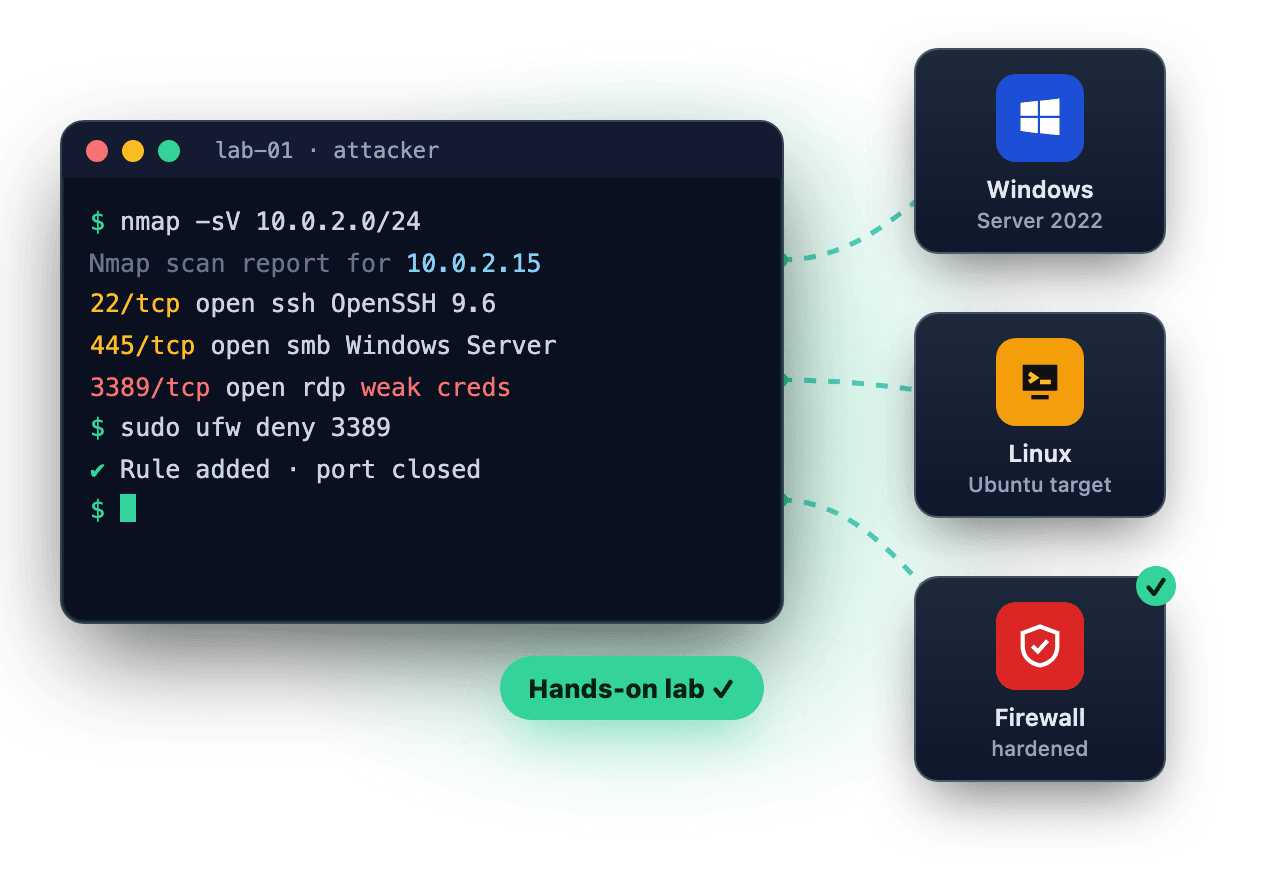
- ✓Hands-on labs in your browser, nothing to install: try a free lab on each roadmap, no account needed. The full lab sets need a paid membership
- ✓All your progress in one place, ready for exam day
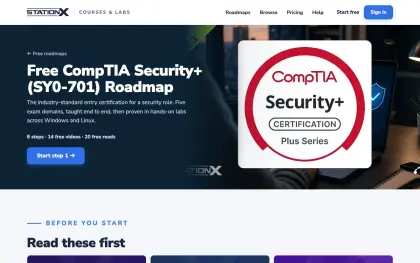
 CompTIA Security+
Built for SY0-701; our SY0-801 roadmap is coming soon.
See the Security+ roadmap →
 CompTIA CySA+
Built on CS0-004. CS0-003 can still be booked until 22 December 2026.
See the CySA+ roadmap →
Steps 4 and 5: Advanced, Specialist and Governance
Once you have the general security foundation, the roadmap splits into two directions.
- Step 4, Advanced Cyber Security (CISSP, security engineering and architecture, frameworks and standards, risk management) leads to step 5, Cyber Security Governance: leadership, strategy, policy and the CISO track. See CISSP vs Security+ and our GRC career guide.
- Step 4, Cyber Security Specialisation (blue team, hacking and red team, cloud security, malware analysis, incident response, threat intelligence and hunting, AI security) leads to step 5, Cyber Security Specialist Expert: roles like SOC manager or penetration testing team lead. See our penetration tester career guide.
Alongside every step sit soft skills (communication, teamwork, problem-solving) and advanced IT such as Linux and cloud. StationX Labs has roadmaps for these next steps too:
CompTIA PenTest+ (PT0-003): the offensive counterpart to CySA+
CompTIA Linux+ (XK0-006): Linux administration, the platform most security tools and servers run on
CompTIA Cloud+ (CV0-004): vendor-neutral cloud deployment, security and troubleshooting
You don't need to choose your step 4 direction on day one. Most people find out what they enjoy while working through Security+ and CySA+.
What You Get on StationX Labs
Every roadmap on StationX Labs puts the courses and hands-on labs for one certification in order, so you always know what to study next. Here's what you can use:
- The roadmap itself, with the exam domains and each step laid out in order, free to view
- Free video lessons, guides and cheat sheets from the courses, once you create a free account (no card, no trial)
- A free taster lab that runs in your browser, with no account needed
- Hands-on labs in your browser, with nothing to install, and the full courses, which come with a StationX membership
- All your progress in one place: every course and lab you finish
The easiest way to see it is to create a free account on StationX Labs and open the roadmap for your step.
Conclusion
The best cyber security courses for beginners are the ones you take in the right order. Start with essential IT (A+, or Tech+ if you're brand new), learn networking (Network+), then move into security with Security+ and CySA+. From there, choose between the advanced and governance route or a specialist route.
Pick the step you're at, open its roadmap on StationX Labs, and start with the free lessons. Then keep going, one step at a time.
About the Author

Nathan House, Founder & CEO of StationX
Nathan House has 30 years of hands-on cybersecurity experience and is Cambridge-educated, holding CISSP, CISA, CISM, OSCP, CEH, and SABSA. He founded StationX in 1999 — one of the UK’s first cybersecurity companies — and has secured £71 billion in UK mobile banking transactions and the London 2012 Olympics, advising clients including Microsoft, Cisco, BP, Vodafone, and VISA. He authored the world’s most popular cybersecurity course — a #1 Udemy bestseller taken by over 500,000 students — and was named Cyber Security Educator of the Year 2020, AI Security Educator of the Year, and a UK Top 25 Security Influencer 2025. A DEF CON speaker and featured expert on CNN, Fox News, NBC, and the BBC, Nathan leads StationX’s training of more than half a million students worldwide.