Penetration Tester Career in 2026: Is AI Killing It?
TL;DR — if you've only got 30 seconds
Our read of the data: the penetration testing market isn't shrinking, it's splitting in two. The money's growing fast, but it's flowing to autonomous platforms and senior specialists, not an expanding junior tier.
AI now does the work the junior tester used to cut their teeth on: scanning, triage, first-draft reports.
A raw LLM can't reliably find business-logic flaws or chain bugs into real impact. But an LLM wrapped in a system — the harness a pentester builds around it — can. That system is the genius. It's what we call AI-driven penetration testing.
The survival move: don't be the person who runs the tools, or even the one who just uses AI. Be the one who builds the AI system — specialist agents, cross-model checks, verification, human gates — and governs what it produces. Using AI is becoming ordinary. Engineering the system around it is the skill that pays.
The Penetration Tester Career Isn't Dying — It's Splitting in Two
Most of what you've read on this is either doom or denial. The truth is more useful than both.
The penetration tester career is not disappearing. The global pentest market is growing. One widely cited industry tracker puts it at roughly $3.09 billion in 2026, heading for $7.41 billion by 2034 (Fortune Business Insights). More systems, more code, more attack surface, more regulation. Demand for offensive security keeps climbing.
But the money is growing faster than the demand for junior human testers, and that's the part nobody wants to say out loud. The growth is being soaked up by autonomous platforms and a smaller number of senior people. Our read is that the career is bifurcating: the top half getting more valuable, the bottom rung getting pulled away. The rest of this article is the evidence that points that way.
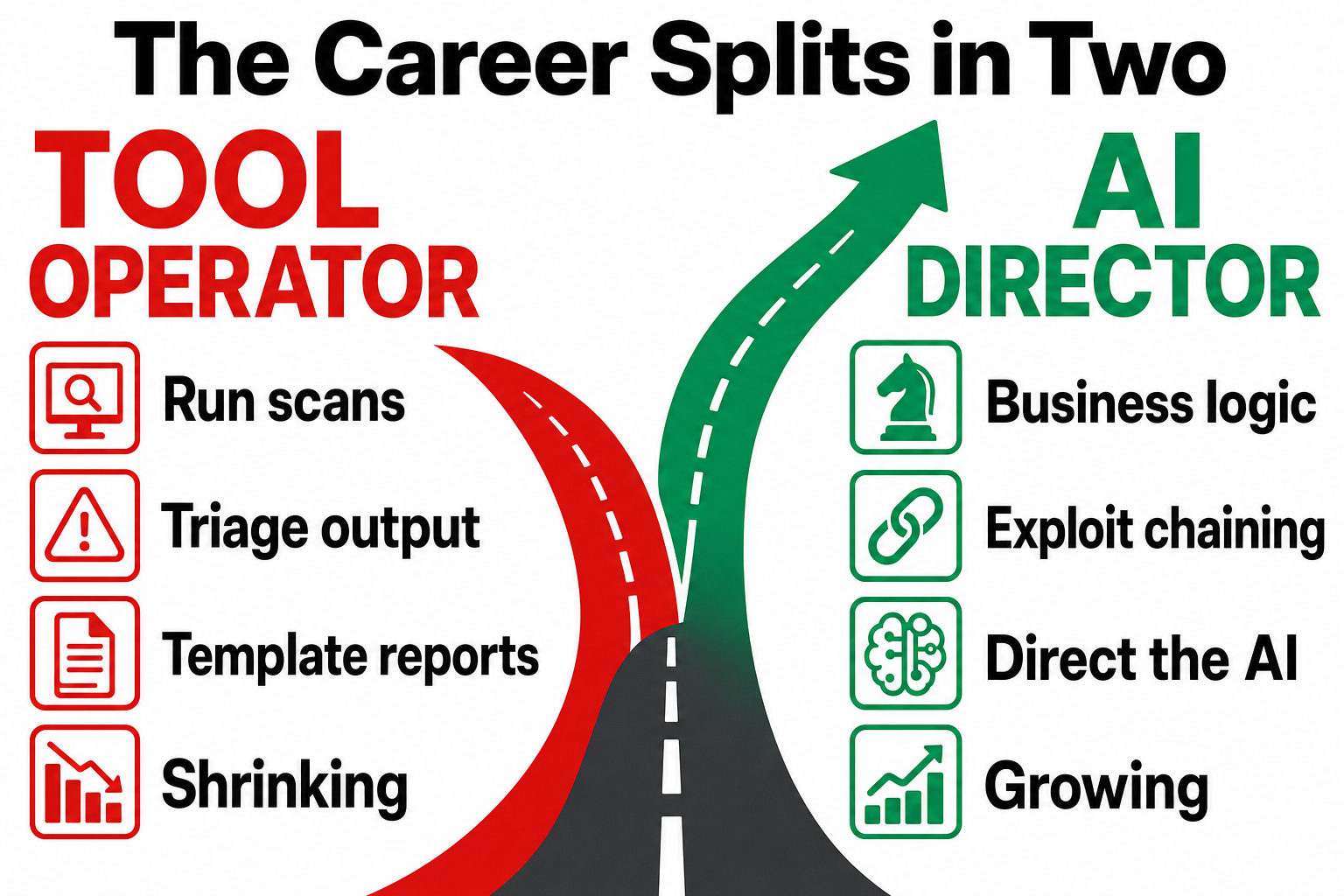
This is one corner of a much wider shift: from performing repeatable knowledge work to building the systems that perform it. The role that's shrinking is the operator executing a procedure. The role that's growing is the one who turns hard-won expertise into a repeatable, verified AI operation. In offensive security, that's the whole game.
So the honest answer to “is AI killing the penetration tester career?” is: it's killing one version of it. Which version, and whether you're on the right side of the split, is what the rest of this is about.

Why the Junior Penetration Tester Rung Is Vanishing
Think about what an entry-level tester actually does on a typical engagement. Run the scans. Triage the output. Fire known exploits at known CVEs. Write the templated sections of the report. Assist the senior tester. It's a tool-operator role — and the tools now operate themselves.
Look at the scale of what's now automated. Horizon3.ai's NodeZero — one of the autonomous pentest platforms — states it has “surpassed 100,000 pentests conducted by over 3,000 customers, with projections exceeding 400,000 by the end of 2026.” That's production scale, and it's aimed squarely at the scan-triage-exploit loop the junior used to own. When one platform runs pentests at that volume, it's hard to see the market creating junior headcount at the old rate.
Our own JobZone AI-risk index (StationX's tool for scoring how exposed a role is to AI displacement) rates the junior penetration tester 6.4 out of 100, the “red zone.” That's not an industry-standard metric. It's our own analysis. But it lines up with what we're seeing: the junior scanner-operator looks like one of the most exposed roles in offensive security, because the work is the most automatable.
There's a knock-on nobody's solved, and it has a name: the pipeline paradox. The junior role was never just cheap labour. It was the apprenticeship — how you became a senior in the first place. So if AI eats the entry rung, where do the next senior testers come from?
The honest answer is that the industry is improvising one. The training ground is shifting off the payroll and into the places where you can still prove creative exploitation skill: CTF competitions, hands-on labs, and bug bounty programs, where a track record of real findings now does what a junior job used to. It's messier and less funded than the old apprenticeship, but it's the path that's actually open. Which is exactly what the rest of this article is about: how to walk it.
Where Raw AI Fails — and Why System-Builders Win
Here's the distinction almost everyone gets wrong, and it's the hinge of your whole career. It's not that "AI can't find the hard bugs." It's that a raw model, on its own, can't do it reliably. Ask a single LLM to find a business-logic flaw and sometimes it will, sometimes it will hallucinate one that isn't there, and you'll have no way to tell which. Reliability doesn't come from the model. It comes from the system you build around it.
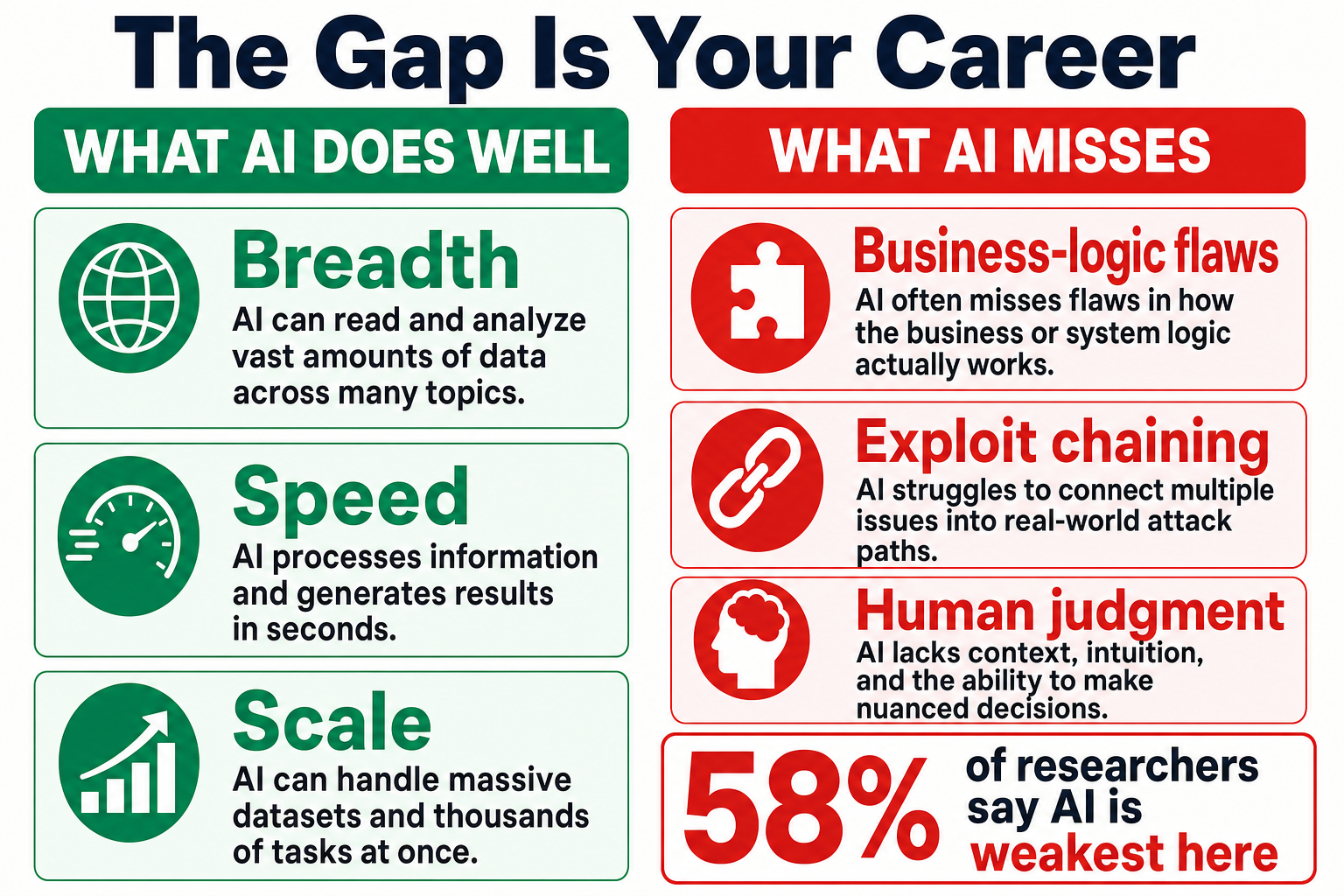
The people closest to the work see this clearly. In HackerOne's 2025 survey of the bug bounty researcher population — adjacent to, though not identical with, salaried pentesters — only 12% believe AI will replace them, and 58% say AI is weakest at exactly the bugs that matter most: business-logic flaws and multi-step, chainable exploits. These are the vulnerabilities where you have to understand what the application is supposed to do, then abuse that intent. A raw model, prompted once, doesn't do that consistently enough to trust.
There's a sharp piece of evidence, and it's usually read backwards. In a December 2025 Stanford study, an AI agent placed second overall on an ~8,000-host network, outperforming 9 of 10 human participants — but it missed a critical remote-code-execution vulnerability that 80% of the human testers found, because exploiting it needed fiddly, GUI-based interaction. The lazy takeaway is "humans beat AI." The real one: that agent failed because it was a raw model acting alone. Wrap the same model in a system — agents that cover each other's blind spots, tools for the interaction it couldn't do, a human directing the plan — and that RCE is well within reach. The agent didn't lose to humans. It lost to the absence of a system.
So the genius was never the LLM. It's the system you build around it. Take that same unreliable model and wrap it in engineered structure — multiple agents on different model families checking each other, tools it can drive, a test environment to prove findings, verification, and a human holding the plan — and the unpredictability gets engineered out. The system turns a model that sometimes finds a bug into one that finds it, proves it, and hands you a verified result. That's the discipline we call AI-driven penetration testing: not prompting an AI, but engineering a system around it.
So the real divide isn't "human versus AI." It's the gap between someone who uses an LLM and someone who builds the system that makes the LLM reliable — and that second role gets more valuable as the models improve, not less. That's your career. Let me show you what it looks like in practice.
The Human-in-the-Loop Advantage: A Proof
This is the part the doom headlines miss, so I'll show you exactly what that gap looks like — and why the system, not the model, is what does the work.
Take a WordPress security plugin running on more than four million sites. The irony matters: it's a security plugin. No single LLM reliably finds a subtle authentication flaw in that code — ask one directly and you'll get guesses. So don't ask one. Point a multi-agent system at it instead. Several agents on different model families — Claude, OpenAI's, and Google's — reviewed the source independently, then challenged one another's findings, and a separate referee adjudicated the disputes. No model was allowed to mark its own homework. They were scoped to the authentication component and told nothing more than “review this.”
The system surfaced a critical authentication bypass without being told what to look for. The login check runs correctly — but the code ignores its answer, then authenticates the user with the raw, attacker-supplied user ID. In plain terms: send a request naming any account you like, and the plugin hands you a valid administrator session. On four million sites. That's not evidence a raw LLM can be trusted alone. It's evidence the review architecture works.
For your career, though, finding it is only step one:
Find it. The multi-agent review surfaces the bypass in the source. And note this: a standard pattern-matching scanner finds nothing here, because it's a logic and control-flow flaw, not a known-bad pattern. The AI has to reason about the flow to catch it.
Build the proof. Download the vulnerable version, stand up a test environment.
Write the exploit and run it.
Prove it. Drive a real browser to demonstrate the admin login actually works, end to end.
The workflow is human-directed and human-gated throughout, and none of it works because the AI is magic — it isn't. It works because it follows a discipline: screen the task, frame the scope, spike the uncertain parts, build the proof, verify it independently, and gate anything consequential through a human (we call it Screen, Frame, Spike, Build, Verify, Gate). Multiple agents improve the scrutiny; the verification and the human gates are what make the result safe to act on. The engineering is the edge, not the model.
That wasn't a better prompt. It was a system — the kind of AI infrastructure a pentester builds and owns. The value isn't in running a scanner, and it isn't in the AI running by itself. It's in a human who builds and directs an AI system to do offensive work at a scale and quality neither could reach alone, and who has the judgement to know the finding is real and the skill to prove it. Three decades of finding bugs like this by hand is what tells you which of the system's findings to trust. The system is what lets you do it in minutes instead of days — and it's yours, not a product you rent.
Penetration Tester Salary in 2026: The Bifurcation in Numbers
If the career is splitting, you'd expect the salaries to show it. The numbers don't prove the split on their own — but read alongside the automation of junior work, they're exactly what you'd expect from value moving toward the experienced end.
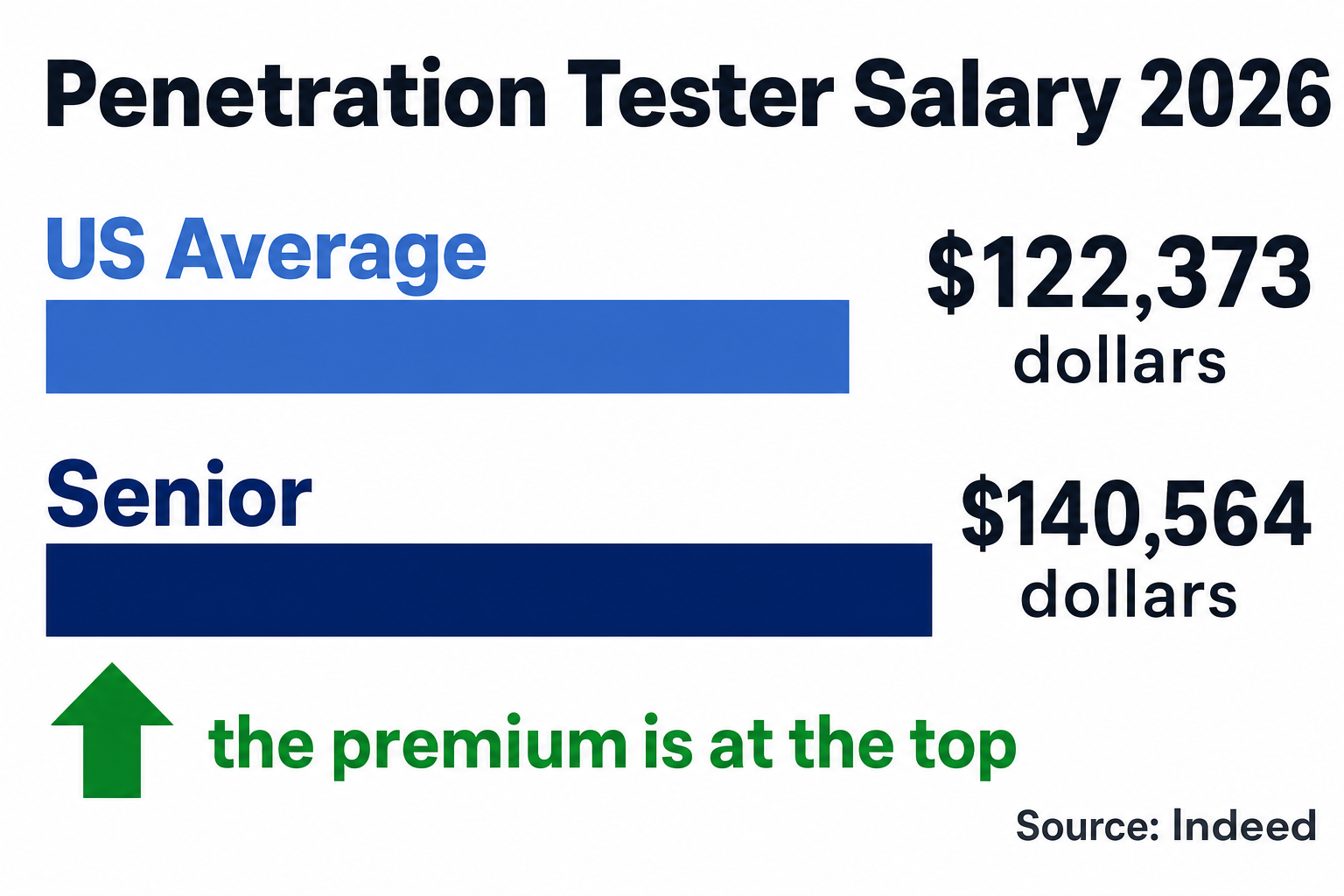
The average US penetration tester salary sits around $122,373 (Indeed) — a healthy number. But the average hides the story. Senior penetration testers average around $140,564 (Indeed), and the strongest specialists go well beyond that. The value sits at the experienced end.
In our experience the single highest-leverage credential on that curve is the OSCP — the hands-on certification that proves you can do the creative exploitation AI can't. As firms increasingly treat OSCP-level skill as the baseline they'll hire for, the old “run scans under supervision” junior tier gets squeezed.
Read the salary data as a map, not just a number: the premium is at the top. Which raises the obvious question…
Is a Penetration Tester Career Still Worth It?
Yes — with a condition.
The demand is real and durable. The US Bureau of Labor Statistics projects 29% growth for information security analysts from 2024 to 2034 — “much faster than the average for all occupations.” That's the closest official category to pentesting, broader than the specialty itself, but it tells you the wider field is expanding fast, not contracting.
But “worth it” now depends on which penetration tester you become. The term emerging across the industry is the “bionic” tester, a human who uses AI as a force multiplier rather than competing with it. And this is already the norm: Bugcrowd's 2026 survey found 82% of hackers now use AI in their workflow, up from 64% in 2023. The tool-operator version of the job is a shrinking, poorly-paid corner of the market. The version where you direct the AI and supply the judgement is worth more than it has ever been.
So it's worth it if you bypass the vanishing scan-operator phase and build straight toward the surviving role. You can't skip experience. But you can substitute the old junior job with a portfolio of independent findings, chained exploits, and a bug bounty track record that proves senior-level judgement from the start. So how do you do that?
How to Become a Penetration Tester Who Survives AI
If you're starting out — or retraining — the strategy has changed. The old path was “learn the tools, run them under supervision, work up.” That path is being automated. The new path is about how much system you build around the AI, and there's a ladder to climb.
The four tiers of building around AI
Tier 1 — the tool. An LLM with tools bolted on (an AI assistant, a scanner). Powerful, but it forgets you and it's unreliable on its own. Most people never leave here — and it's the rung being commoditised.
Tier 2 — a personal AI. You add memory, identity, and reusable skills, so it starts to work the way you do.
Tier 3 — AI infrastructure. The AI stops being a chatbot and becomes a system that runs your operation — orchestration, cross-model checks, verification, gates. The WordPress example was Tier 3. This is where the durable career is.
Tier 4 — shared infrastructure. You build that operation into something others can run too.
Using an AI pentesting tool is Tier 1. Building a cross-model, adversarial, verified testing operation is Tier 3. That's the shift.
So the moves that matter:
Build and prove offensive fundamentals. OSCP is still one of the best market signals for hands-on exploitation skill, so it's worth getting — but a certificate alone is no longer the finish line. Pair it with a portfolio that shows original findings, exploit chaining, and rigorous verification. Proof beats paper.
Specialise in what AI misses — business-logic flaws, exploit chaining, and the judgement to tell a real critical from a plausible false positive. This is the 58% AI is weakest at.
Climb from using AI to building AI systems. This is the whole game. Most people stop at using a tool — a chatbot, an AI scanner, a coding assistant. That's the exposed bottom rung, and it's exactly what's being commoditised. The survivors move up to building the infrastructure: multi-agent systems, adversarial cross-model testing like the WordPress example, verification and gates — offensive work orchestrated at scale. That's AI-driven penetration testing, and it's engineered, not prompted. (For a worked example, see our hands-on review of AI penetration testing.)
Codify your judgement into the system. Threat modelling, risk communication, the accountability an AI can't hold — these matter, but the real moat is turning that experience into infrastructure: what the system tests, how it challenges findings, what evidence it demands, when it escalates, and what only a human may approve. Judgement in your head is capacity-limited. Judgement built into a system scales.
This is exactly the human+AI hybrid our AI Master's Program is built around: the AI-driven engineering approach, applied to offensive security.
The Future of Penetration Testing
Look a little further out and the shape of the job keeps shifting the same way.
Our read is that the annual pentest gives way to continuous validation — testing that runs constantly rather than once a year, because autonomous tools make constant testing affordable. At the same time, AI is creating brand-new attack surface, and here the data is unambiguous: HackerOne reported a 540% surge in valid prompt-injection reports and 1,121 customer programs now include AI in scope, up 270% year over year. Someone has to test those AI systems — and that someone is a human who understands both security and how models fail.
That's worth sitting with. Every wave of automation that eats one kind of security work spins up another kind that needs human judgement even more. The tester who moves up the value chain — from running tools to directing them and testing the AI itself — doesn't get automated away. They get more essential.
None of this is as clean as a two-lane road, of course. Plenty of juniors do work a scanner never touches, some firms will keep training people the old way for years, and the “tool operator vs. AI director” split is a spectrum, not a wall. But the direction of travel is hard to argue with: the scan-and-triage rung is thinning, and the people who direct AI and bring judgement are pulling ahead. Which way you build matters more now than it did five years ago.
Frequently Asked Questions
Will AI replace penetration testers?
Not the ones who build systems. A raw LLM on its own is unreliable — in HackerOne's 2025 survey of bug bounty researchers (adjacent to, though not identical with, salaried pentesters), only 12% believed AI would replace them, and 58% said AI is weakest at business-logic and chained exploits, the highest-value bugs. But that's the raw model. Wrap it in an engineered system — multiple agents on different models, a referee, verification, human gates — and it becomes reliable. That's AI-driven penetration testing, and it's the thing the surviving tester builds, not a product they buy. AI automates the routine tool-operator work; the person who engineers and governs the system becomes more valuable as the models improve, not less.
Is penetration testing a dying career?
No — it's bifurcating. The market is growing (roughly $3.09B in 2026 toward $7.41B by 2034, Fortune Business Insights) and the US Bureau of Labor Statistics projects 29% growth for information security analysts through 2034. But the value is concentrating at the senior, AI-directing end while the junior tool-operator rung shrinks.
Do junior penetration tester jobs still exist?
They exist but they're compressing fast. Autonomous platforms like NodeZero (100,000+ pentests, projected 400,000+ by end of 2026) do the scan-triage-exploit work juniors used to do. The entry path is shifting from “run scans under supervision” toward validating AI output and learning creative exploitation through CTFs, labs, and bug bounties.
What's the penetration tester salary in 2026?
The US average is around $122,373 (Indeed), with senior testers averaging around $140,564. The value sits at the experienced end, and in our experience OSCP is the highest-leverage certification for getting there.
How do I become a penetration tester if the junior jobs are disappearing?
Bypass the vanishing scan-operator phase. You can't skip experience, but you can substitute the old junior job with a portfolio of independent findings, chained exploits, and a bug bounty track record that proves senior-level judgement from the start. Get OSCP, specialise in what AI misses (business logic and chaining), and learn to direct AI tools rather than compete with them.
About the Author

Nathan House, Founder & CEO of StationX
Nathan House has 30 years of hands-on cybersecurity experience and is Cambridge-educated, holding CISSP, CISA, CISM, OSCP, CEH, and SABSA. He founded StationX in 1999 — one of the UK’s first cybersecurity companies — and has secured £71 billion in UK mobile banking transactions and the London 2012 Olympics, advising clients including Microsoft, Cisco, BP, Vodafone, and VISA. He authored the world’s most popular cybersecurity course — a #1 Udemy bestseller taken by over 500,000 students — and was named Cyber Security Educator of the Year 2020, AI Security Educator of the Year, and a UK Top 25 Security Influencer 2025. A DEF CON speaker and featured expert on CNN, Fox News, NBC, and the BBC, Nathan leads StationX’s training of more than half a million students worldwide.