
 Security+
 CySA+
 PenTest+
 SecAI+
 Network+
 A+
 Cloud+
 Linux+
CompTIA Security+ vs Google Cybersecurity Certificate (2026)
CompTIA Security+ and Google Cybersecurity Professional Certificate are entry-level cyber security certifications. Still, you must become aware of some key differences before pursuing either in your quest to break into cyber security.
Security+ SY0-701 or SY0-801? (updated November 2026)
CompTIA launched Security+ SY0-801 on 17 November 2026. We recommend SY0-701 for now: it's valid until 11 June 2027, 801 is brand new with very little training available yet, and employers only ask whether you have Security+, not which version. Our free Security+ cheat sheet covers both.
Both certifications aim to demonstrate to employers your understanding of cyber security fundamentals and competence in cyber security implementations. Despite targeting aspiring cyber security professionals, these certifications aren’t identical in the material covered, price, complexity, passing score, and other features.
Before investing your time and money, it's essential to understand the key differences between the CompTIA Security+ vs Google Cybersecurity Professional Certificate—what each offers, how they compare, and which is the better fit for your current stage in the cybersecurity field.
Let’s find out together.
What Are CompTIA Security+ and Google Cybersecurity Professional Certificate Certifications?
Despite being entry-level cyber security certifications with no formal prerequisites, CompTIA Security+ and Google Cybersecurity Professional Certificate differ significantly.
The most important distinction between them is that Security+ is a vendor-neutral certification covering a broad range of topics in depth.
In contrast, the Google Cybersecurity course leading to the certificate misses out on the Windows operating system, which is most popular in enterprise IT environments. Plus, its quizzes are open-book, reducing their effectiveness in testing how well you internalize the course content.

CompTIA Security+
CompTIA Security+ is a globally recognized entry-level cyber security certification focusing primarily on up-to-date best practices for risk management and risk mitigation. It emphasizes the practical aspects of identifying and addressing security threats, attacks, and vulnerabilities.
According to CompTIA, the target audience of the Security+ certification is IT professionals with at least two years of experience in a security or systems administrator role. They should have experience in IT administration with a focus on security, hands-on experience with technical information security, and a broad knowledge of security concepts.
In other words, despite its popular designation as an entry-level cyber security certification, Security+ has a steep learning curve. Those with prior networking or cyber security expertise will have a clear advantage over complete beginners.
That said, dedicated study using strong materials can compensate for a lack of hands-on experience. This is an entry-level cyber security certification, after all, and it is well within reach of those without security administration experience who have a passion for learning.
Google Cybersecurity Professional Certificate

The Google Cybersecurity Professional Certificate is a Google career certification in cyber security. Its target audience is anyone who wants to become job-ready for high-growth, high-demand careers in under six months with no prior degree or experience required.
It’s more beginner-friendly than Security+:
Is any background knowledge necessary?
None! Whether you’re completely new to the field or have had some exposure, a Google Career Certificate is the right learning path for you.
You obtain this certificate once you’ve passed their self-paced Coursera cyber security online course of the same name. It indicates that you’ve completed every video module, achieved at least a score of 80% in each quiz, and completed the hands-on lab assignments, which constitute a portfolio showcasing your cyber security experience.
Exam Details
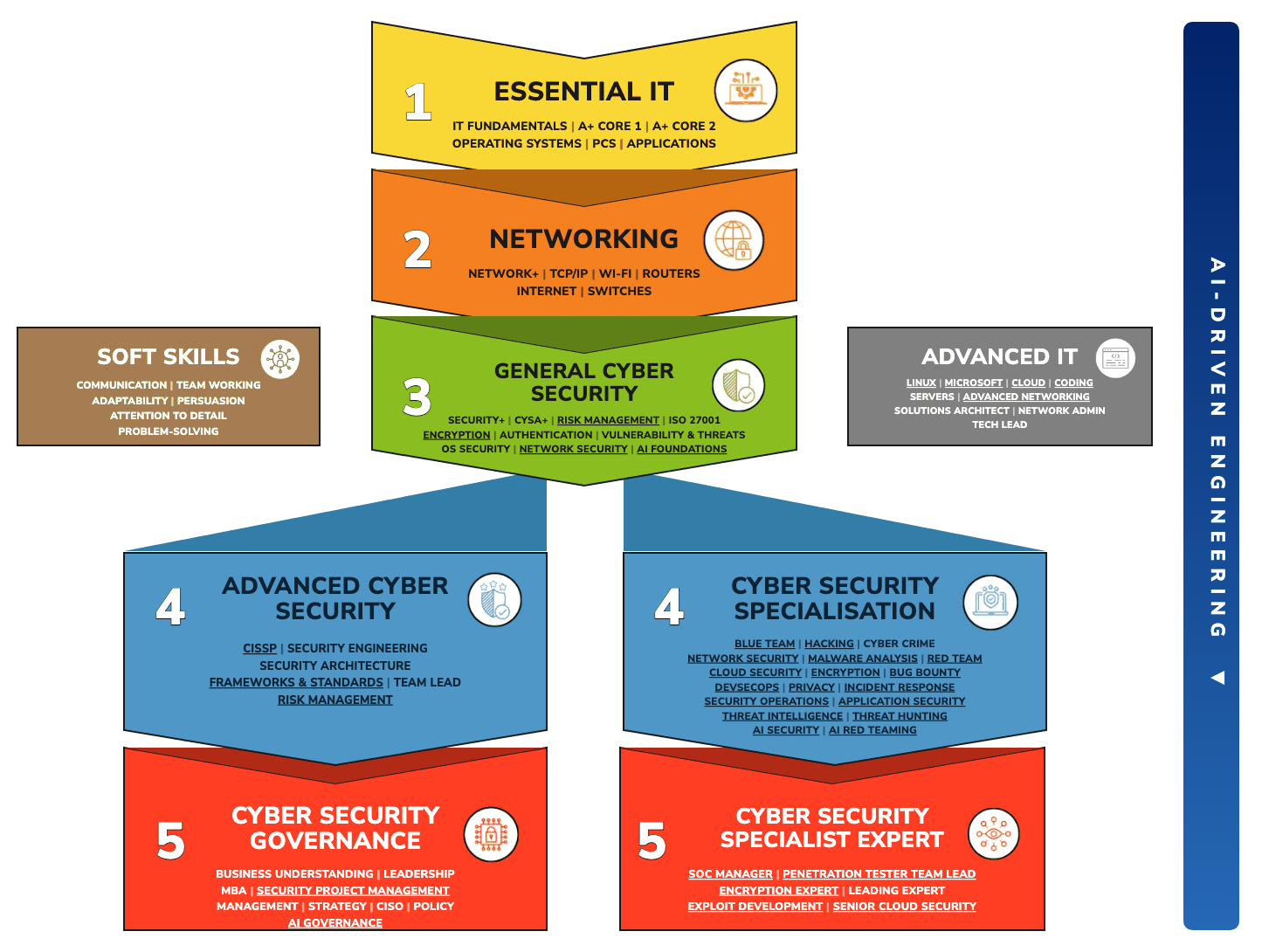
This section gives you an overview of CompTIA Security+ vs Google Cybersecurity Professional Certificate certifications. Both entry-level cyber security certifications fall within Stage 3 of our certification roadmap, but the major similarities end here.
CompTIA Security+
A huge reason for Security+’s popularity, especially in the United States, is its full compliance with ISO 17024 standards and approval by the US Department of Defense for its DoD 8140 Cyberspace Workforce program (which replaced the older 8570.01-M rules). This approval makes Security+ a common requirement for US government and defense contractor roles.
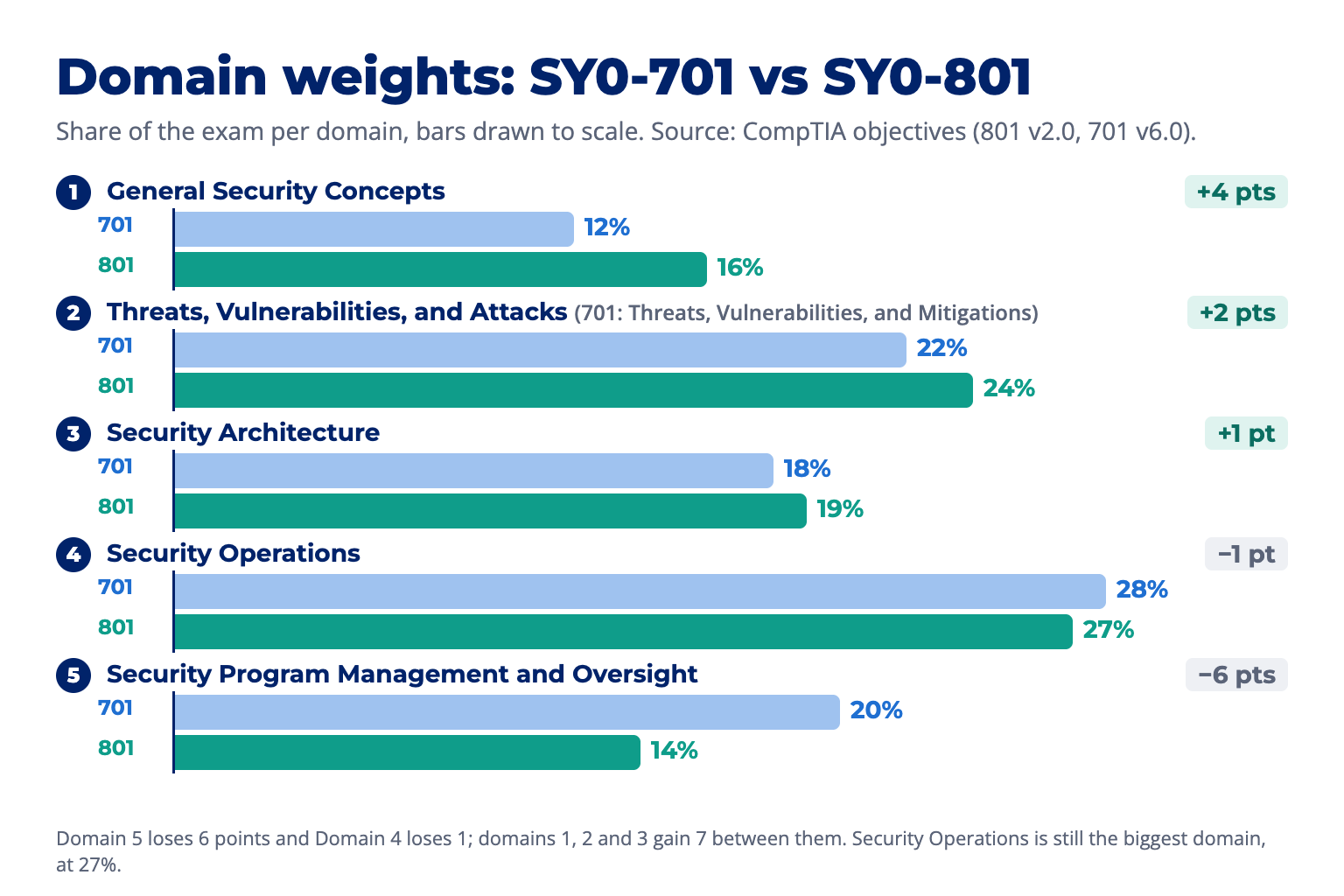
Two versions of the CompTIA Security+ exam are live: SY0-701 and SY0-801, which launched on 17 November 2026. SY0-701 retires in English on 11 June 2027. We recommend SY0-701 for now because its training is mature, while SY0-801 training is still thin everywhere. Take SY0-801 only if you can't sit the exam before 11 June 2027. Employers don't ask which version you passed. See our SY0-701 vs SY0-801 comparison for the details. The exam domains are:
| Domain | SY0-701 | SY0-801 |
|---|---|---|
| General Security Concepts | 12% | 16% |
| Threats, Vulnerabilities, and Mitigations (701) / Threats, Vulnerabilities, and Attacks (801) | 22% | 24% |
| Security Architecture | 18% | 19% |
| Security Operations | 28% | 27% |
| Security Program Management and Oversight | 20% | 14% |
SY0-701 has 28 objectives and SY0-801 has 27. SY0-801 also adds objective 2.6 on the risks of using AI.
The Security+ exam is an industry-leading certification for aspiring cyber security professionals, IT administrators, and related roles because it validates the practical skills needed for baseline security readiness and incident response. It equips candidates to handle current threats, understand advanced security responsibilities, and proactively prevent future attacks.
Topics in these core knowledge domains include the latest trends in threats, attacks, vulnerabilities, automation, zero trust, risk, the Internet of Things (IoT), operational technology (OT), and the latest techniques for cyber security professionals working in hybrid environments in the cloud and on-premises. Pay attention to cloud environments, communication, reporting, and teamwork.
The CompTIA Security+ exam includes two types of questions:
- Multiple-choice questions, which may admit single or multiple answers
- Performance-based questions (PBQs), which test your ability to solve problems in a simulated environment. These make CompTIA Security+ a valuable certification, demonstrating the holder’s excellence in practical cyber security skills. CompTIA doesn’t publish how many PBQs you’ll get, but test takers usually report a handful, often near the start of the exam.
Both versions use the same format. You’ll answer up to 90 questions in this 90-minute examination and complete a survey afterward. The passing score is 750 on a scale of 100–900. For more information, refer to our guide to Security+.
Google Cybersecurity Professional Certificate
The Google Cybersecurity Professional Certificate isn’t an exam but a series of video lectures, graded assessments, and ungraded practical coursework associated with video lectures on Coursera. It comprises eight core courses, plus a short ninth course on using AI in your job search, that teach the tools, platforms, and technical skills required to fulfill an entry-level role.
Unlike CompTIA Security+, it has no DoD designation. The tools used in this course include Python, Linux, SQL, Google SecOps (formerly Chronicle), Splunk, Suricata, tcpdump, Wireshark, and Google Cloud.
The courses are:
- Foundations of Cybersecurity: This course teaches the core skills and knowledge required to become a cyber security analyst, such as cloud and network security, security hardening, security ethics, and how security attacks impact a business.
- Play It Safe: Manage Security Risks: This course demonstrates how to identify threats, risks, and vulnerabilities that impact an organization and how to implement security frameworks and controls to manage them.
- Connect and Protect: Networks and Network Security: This course describes how networks work, how they are attacked, and how to secure them.
- Tools of the Trade: Linux and SQL: This course explains the relationship between operating systems, applications, and hardware and showcases how to use Linux commands, the Bash shell, and SQL to perform security-related tasks.
- Assets, Threats, and Vulnerabilities: This course teaches you how to classify assets, analyze your attack surface to identify risks and vulnerabilities, and perform threat modeling.
- Sound the Alarm: Detection and Response: This course details the incident response process, how Intrusion Detection Systems (IDS) and Network Intrusion Detection Systems (NIDS) work, and how to use Security Information and Event Management (SIEM) tools to investigate an incident.
- Automate Cybersecurity Tasks with Python: This course explores using Python programming to automate common cyber security tasks.
- Put It to Work: Prepare for Cybersecurity Jobs: This course details how to land a cyber security role and prepare for job interviews.
- Accelerate Your Job Search with AI: This short course shows how to use AI tools to explore career options, build your resume, and prepare for interviews.
Once you complete each course, you must complete a quiz or assignment related to the course content.
While you must score 80% or above on the quizzes to pass a course—each of which counts towards successful certification—the assignments are projects you can showcase to prospective employers on your resume. To obtain the certificate, you must complete all lessons, quizzes, and assignments.
About the quizzes
The quizzes are all multiple-choice questions based on content covered in the course material. Don’t worry if you fail a quiz; you can retake it until you pass, though Coursera may make you wait between attempts.
There are 170 hours of course lectures, quizzes, and practical assessments. Google says you’ll finish in around six months if you spend seven hours a week studying for the certificate.
The Google Cybersecurity Professional Certificate is for those looking to enter the cyber security industry but who lack the time or resources to complete a University degree. The course’s flexible scheduling allows you to learn online asynchronously at your own pace and costs far less than online degree programs.
This flexible scheduling and spaced-out assessments could make it a suitable choice for anyone looking to make a career change or accelerate their entry into cyber security.
The downside is its abundance of theoretical material and omission of the basic principles an entry-level starter may not know. You’ll have to fill in knowledge gaps with supplementary training yourself.
🏆 Most Comprehensive: CompTIA Security+
Security+ delves deep into cyber security's technical and theoretical aspects, especially in its PBQs. Although preparation may take more or less time depending on your prior IT knowledge, this closed-book exam will give you a clear pass or fail. If you’re aiming for a career in cyber security and want to expand your options, Security+ is the way to go.
🏆 Most Flexible: Google Cybersecurity Professional Certificate
If you’re worried about how much time you’ll spend on the certification and the risk of failure, the Google Cybersecurity Professional Certificate will help you systematically master the concepts needed and gain hands-on experience building cyber security solutions.
For Less.
StationX is a CompTIA Authorized Partner. The same official exam vouchers you'd buy from CompTIA, for less.
CompTIA price USD 878.00
Your exam voucher plus a free second attempt if you don't pass first time.
Today's US prices against CompTIA's US list price. Prices change and vary by country; the voucher page shows yours.
Eligibility Requirements
Neither certification has any formal prerequisites.
CompTIA Security+
According to the CompTIA Security+ (SY0-701) exam objectives, you should have at least two years of experience in IT administration with a focus on security, hands-on experience with technical information security, and broad knowledge of security concepts. Passing the Network+ can help you master Security+ concepts.
Google Cybersecurity Professional Certificate
The Google Cybersecurity Professional Certificate doesn’t require any prior experience in IT or cyber security. Thus, it’s beginner-friendly and has a lower entry barrier (knowledge-wise) than Security+.
🏆 Most Beginner-Friendly: Google Cybersecurity Professional Certificate
If you know nothing about cybersecurity, Google can give you a module-by-module head start on cybersecurity basics.
Exam Difficulty
CompTIA Security+
As a proctored exam with a strict policy against cheating, the CompTIA Security+ exam tests your understanding of foundational cyber security concepts, especially in its PBQs.
Google Cybersecurity Professional Certificate
In comparison, the final grade for the Google Cybersecurity Professional Certificate is based solely on your performance in quizzes and hands-on labs. However, since there's no way to verify whether you completed them independently or with external help, the course falls short on accurately measuring your true skills.
🏆 Easiest: Google Cybersecurity Professional Certificate
You can pass the assessments and do the labs open-book. They involve basic skills in cyber security.
🏆 Most Rewarding: CompTIA Security+
Security+ evaluates you on the cyber security knowledge you’ve internalized and prepares you for more advanced security responsibilities.
Job Opportunities
We’ll discuss the employment prospects of Security+ holders and those with the Google Cybersecurity Professional Certificate. US job sites and job postings based in the US form the basis for our conclusions below.
CompTIA Security+
Job opportunities abound for holders of CompTIA Security+. Many open cyber security positions in the US, especially government and defense contractor roles, require or prefer candidates who have earned their Security+.
When we searched US job boards such as Indeed and Glassdoor, Security+ turned up across a wide range of listings, with roles such as Security Analyst and Server Administrator among the top results, and even specialist roles like Biomedical Systems Engineer.
For what those roles pay, see our Security+ salary guide, which uses US Bureau of Labor Statistics data.
Google Cybersecurity Professional Certificate
Despite our best efforts, we couldn’t locate any explicit mention of “Google Cybersecurity Professional Certificate” among the most relevant job listings. It’s a curious observation, considering that Google is a US-based multinational company.
A job candidate who has somehow gained the Google Cybersecurity Professional Certificate will have to persuade an employer to take it seriously or focus solely on the experience gained through the hands-on labs.
Among the Indeed job search results for “Google Cybersecurity Professional Certificate”, an entry for a Cybersecurity Engineer role specifies Security+.
Moreover, among the Glassdoor search results on the same certification, the job listings mentioning Google point to Google Suite and Google Cloud Platform, not to any cyber security certification by Google.
Salary sites do publish pay figures for this certificate, but scrutinizing the job postings behind them reveals zero mention of “Google Cybersecurity Professional Certificate” in part or in full.
In the first such job listing, a Director of Cybersecurity role at AT&T, it turns out “Google” points to “Google Cloud”. The second listing, for an Assistant Professor role, mentions Google in light of the company’s location, as a nearby company.
With such low-quality data on how much people get paid if they only hold the Google Cybersecurity Professional Certificate, we couldn’t make any definite conclusions.
🏆 More Established in the Job Market: CompTIA Security+
Security+ is the longer-established credential, widely recognized by employers and named in DoD 8140, while the Google certificate is newer and has far less pay data behind it.
Cost and Recertification
CompTIA Security+
The exam cost is $439 USD for either version, or $878 with Retake Assurance, and a Security+ voucher works for SY0-701 or SY0-801. Both versions lead to the same Security+ certification, which is valid for three years, after which you can renew by retaking the exam (CompTIA updates the Security+ syllabus every three years) or earning 50 Continuing Education Units (CEUs). You can also automatically renew the certification by obtaining a more advanced certification such as the CySA+ or the PenTest+.
Note that as an authorized CompTIA partner, you can purchase a Security+ exam voucher at a tremendous discount through StationX! See the offer below for details.
For Less.
StationX is a CompTIA Authorized Partner. The same official exam vouchers you'd buy from CompTIA, for less.
CompTIA price USD 878.00
Your exam voucher plus a free second attempt if you don't pass first time.
Today's US prices against CompTIA's US list price. Prices change and vary by country; the voucher page shows yours.
Google Cybersecurity Professional Certificate
To gain the certification, you simply sign up for a Coursera subscription of $49 USD per month, enroll in the course, and complete the course with no additional costs. Once complete, you will receive a certificate from Google to share on LinkedIn and your CV/resume.
The certificate is valid for life. If you focus on finishing the course as soon as possible, you’ll save time and money—or so you think.
Google recommends getting both its own and CompTIA Security+ in their FAQ:
Google FAQ
The Google Cybersecurity Certificate helps prepare graduates for the CompTIA Security+ exam. Graduates of the Google Cybersecurity Certificate can access the CompTIA Security+ exam and additional training at a discounted price. You’ll earn a dual credential when you complete the Google Cybersecurity Certificate and the CompTIA Security+ exam, which can be shared with potential employers.
While the Google Cybersecurity Professional Certificate is more affordable and grants you a permanent credential, it ultimately encourages you to pursue the CompTIA Security+ as well—offering a discount and promoting the combination as a “dual certification.”
It’s also important to consider that you may train for Security+ in any way you like. Google Cybersecurity Professional requires you to complete their training, which Google says most learners complete for less than $300 USD (depending on how long they keep their course subscription active).
🏆 Best Value for Money: CompTIA Security+
Despite the appeal of double certification, Google appears to undermine its course’s inherent value.
It’s far more time- and cost-effective to aim high and focus on only getting the CompTIA Security+.
CompTIA Security+ vs Google Cybersecurity Professional Certificate: What’s Better?
Here’s a comparison table:
| CompTIA Security+ | Google Cybersecurity Professional Certificate | |
|---|---|---|
| Format | Closed-book exam with at most 90 questions in 90 minutes (multiple-choice and performance-based) | Eight core Coursera courses plus a short ninth on AI job search, with video lectures, graded quizzes and ungraded portfolio assignments |
| Focus | Fundamental cyber security principles and best practices, going broadly and in depth | Practical skills using tools such as Python, Linux, SQL, Splunk and Wireshark, and a portfolio of cyber security work |
| Duration | Three to six months for beginners; four to six weeks with relevant experience | Around six months at seven hours a week (170 hours) |
| Cost | $439 per attempt ($878 with Retake Assurance), excluding training | $49 USD per month for Coursera; Google says most learners spend less than $300 USD |
| Prerequisites | None. CompTIA suggests two years in IT administration with a security focus; Network+ helps | None, designed for beginners |
| Recognition | Widely recognized, including US government and defense contractor roles (DoD 8140) | Relies on the Google name; no DoD designation, and the assignments may count as relevant experience |
| Vendor neutrality | Vendor-neutral and covers all operating systems, including Windows | Includes Python, Linux, SQL, Google SecOps, Splunk, Suricata, Wireshark and Google Cloud; doesn’t cover Windows |
| Renewal | Every three years, by retaking the exam or earning 50 CEUs | None, valid for life |
| Ideal candidate | Those with some IT or networking experience who want jobs in cyber security, including US government jobs, and a comprehensive foundation | Complete beginners, or those who want to build a portfolio systematically to show cyber security experience |
🏆 Winner: CompTIA Security+
Different certifications exist to cater to students with various needs.
If, like many others entering the field, you’re looking to break into cybersecurity and land a job as soon as possible, CompTIA Security+ stands out as the clear winner. Its broad industry recognition and comprehensive coverage of core cybersecurity topics make it a worthwhile investment to boost your chances of getting hired.
If you're not yet confident about taking the Security+ exam, prefer a more gradual entry into cybersecurity, have a limited budget, or want hands-on experience first, the Google Cybersecurity Professional Certificate can be a good starting point with its gentler learning curve. However, it comes with a curious catch-22.
Google’s notion of a “dual certification” sounds appealing but may hint at Google’s lack of confidence in the inherent industry value of its certification. If you’re not in a hurry, saving up for a CompTIA Security+ exam voucher appears more prudent and preparing well, skipping the Google Cybersecurity Professional Certificate altogether.
To prepare for your Security+ exam, you can check out our CompTIA Security+ Course & SY0-701 Practice Test Bundle. Get 50+ hours of online training, 15 practice exams, quizzes, and study flashcards. You can also purchase an official exam voucher at a discount price through StationX.
The bundle includes:
- CompTIA Security+ Study Guide: SY0-701 Total Course
- CompTIA Security+ Training: Self-Paced Course
- CompTIA Security+ SY0-701 Exam Questions and Answers
- CompTIA Security+ Practice Test Series: Ace the SY0-701
- CompTIA Security+ Exam Objectives Flash Cards: SY0-701 Prep
Lastly, to rocket your cyber security career, follow our Security+ roadmap on StationX Labs: video courses for each exam domain plus hands-on labs for SY0-701 (our SY0-801 roadmap is coming soon), free to start.
- ✓A step-by-step Security+ roadmap: every exam domain in order, so you always know what to study next
- ✓Free video lessons, guides and cheat sheets from our Security+ courses
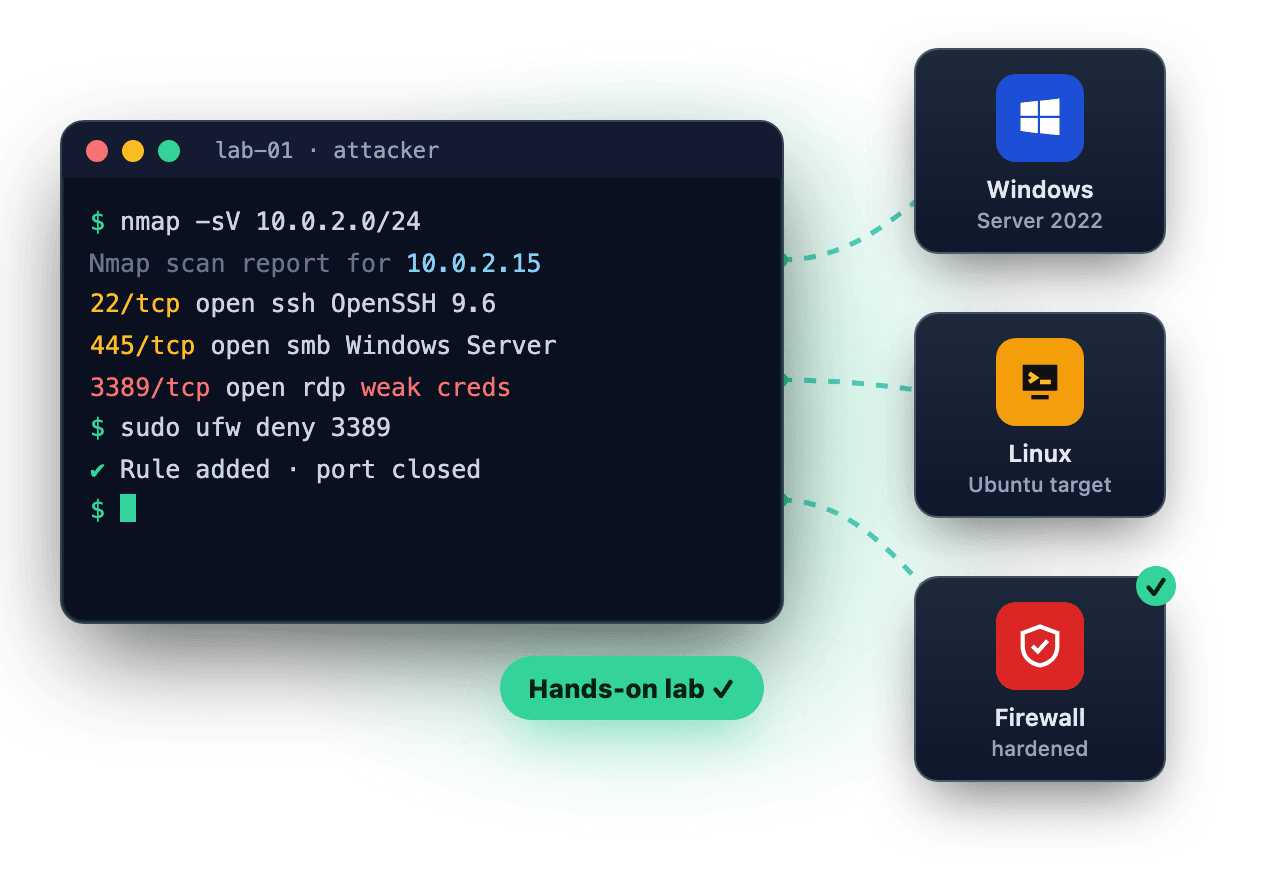
- ✓Hands-on labs in your browser: nothing to install, try one free
- ✓All your progress in one place, ready for exam day
Built for SY0-701; our SY0-801 roadmap is coming soon.
Frequently Asked Questions
Is Security+ harder than the Google Cybersecurity Professional Certificate?
Yes. Security+ delves deeply into the topics covered by its exam objectives. Plus, you take a single proctored exam, as opposed to labs and assessments in the Google Cybersecurity Professional Certificate course. You can find the details here.
Which one is better, the Google Cybersecurity Professional Certificate or CompTIA Security+?
The answer is CompTIA Security+. The Google Cybersecurity Professional Certificate is more affordable, provides more hands-on experience through its portfolio-ready projects, and connects you with Google’s hiring network. However, CompTIA’s Security+ enjoys greater employer recognition and covers a much wider range of cyber security topics, especially essential topics the former doesn’t cover.
How hard is the Security+ exam?
Beginners will need three to six months to grasp the content. Security+ candidates with relevant experience can get ready in four to six weeks. For details, refer to our article “Is CompTIA Security+ Hard?: What You Need to Know.”
Does the Google Cybersecurity Professional Certificate require a course?
Yes, the required course is on Coursera here.
Can you take the Security+ exam without experience?
Yes, you can. All you need is the right training and community to help you stay motivated. Our Security+ roadmap on StationX Labs is free to start.
About the Author

Nathan House, Founder & CEO of StationX
Nathan House has 30 years of hands-on cybersecurity experience and is Cambridge-educated, holding CISSP, CISA, CISM, OSCP, CEH, and SABSA. He founded StationX in 1999 — one of the UK’s first cybersecurity companies — and has secured £71 billion in UK mobile banking transactions and the London 2012 Olympics, advising clients including Microsoft, Cisco, BP, Vodafone, and VISA. He authored the world’s most popular cybersecurity course — a #1 Udemy bestseller taken by over 500,000 students — and was named Cyber Security Educator of the Year 2020, AI Security Educator of the Year, and a UK Top 25 Security Influencer 2025. A DEF CON speaker and featured expert on CNN, Fox News, NBC, and the BBC, Nathan leads StationX’s training of more than half a million students worldwide.