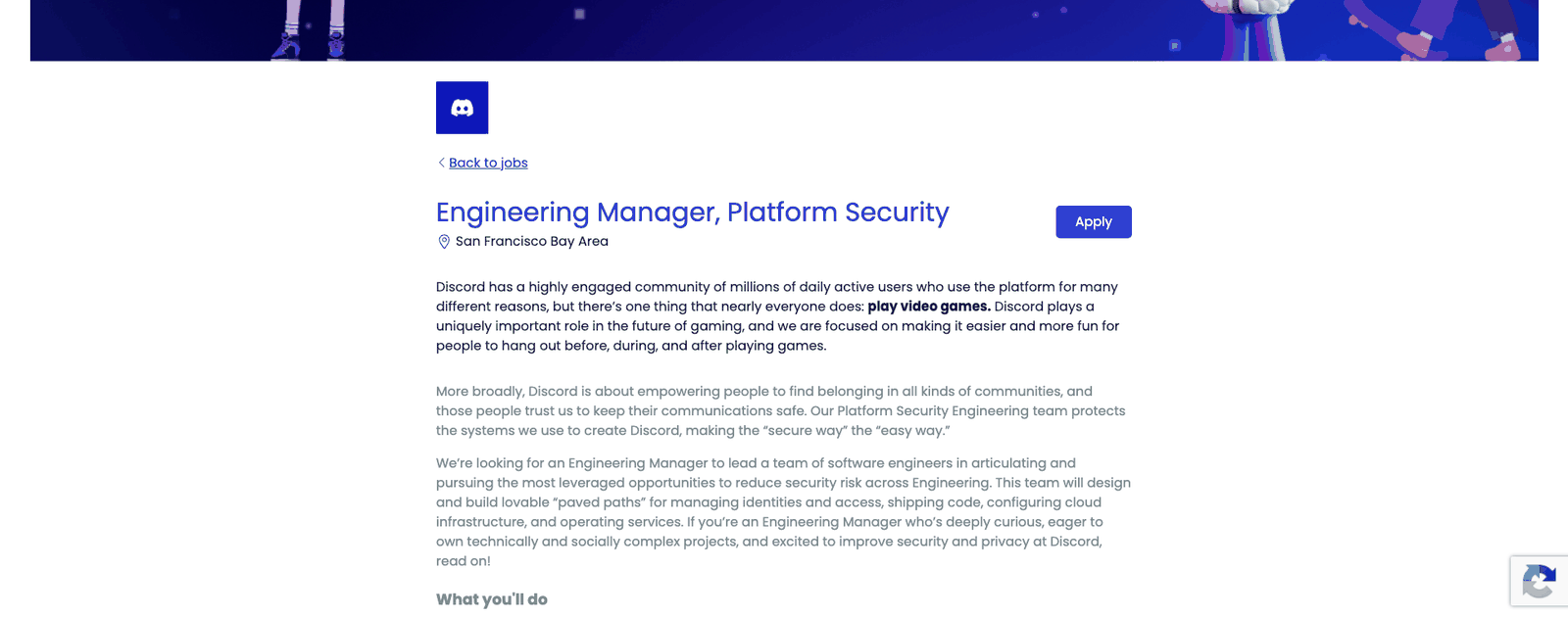
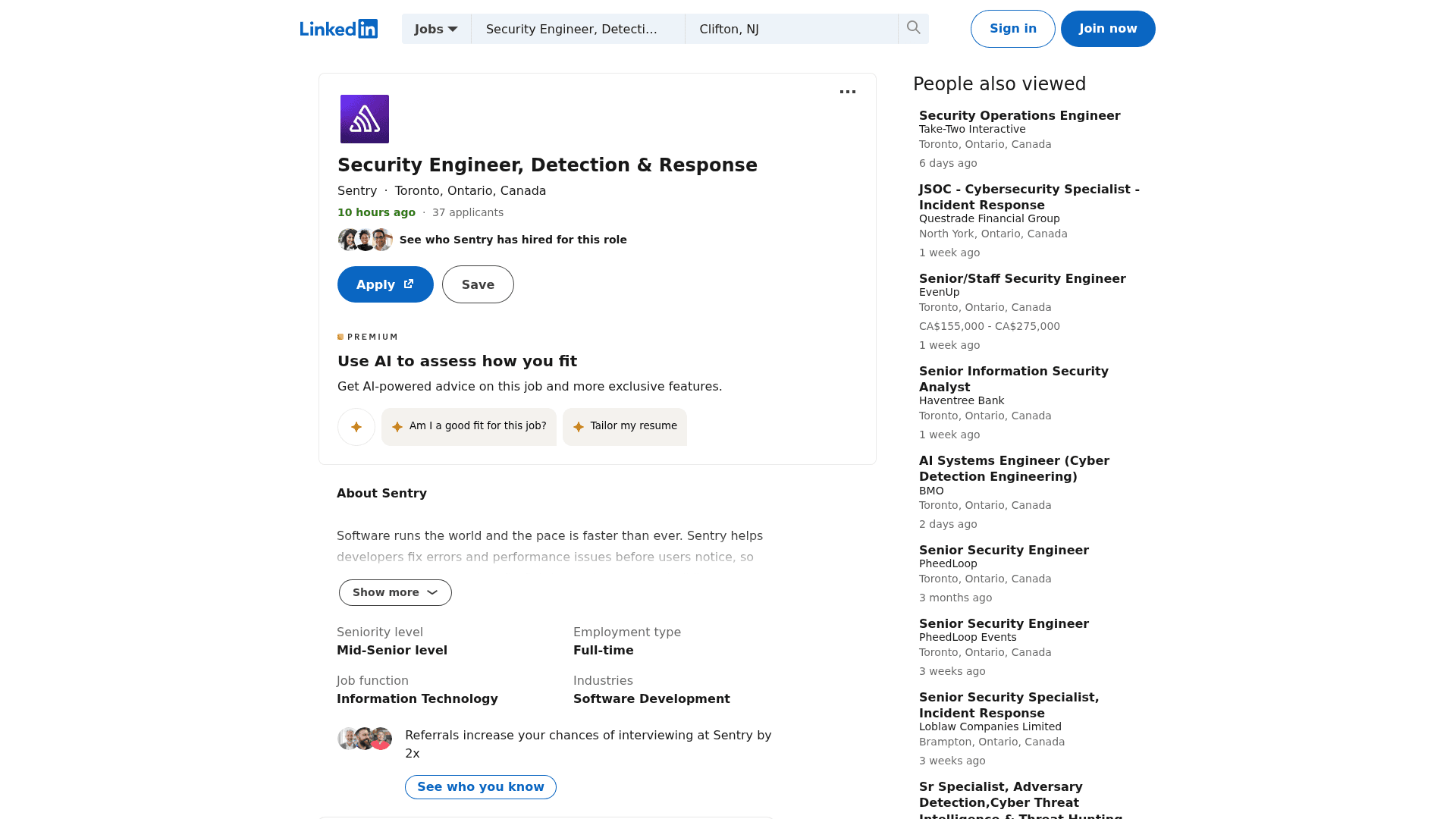
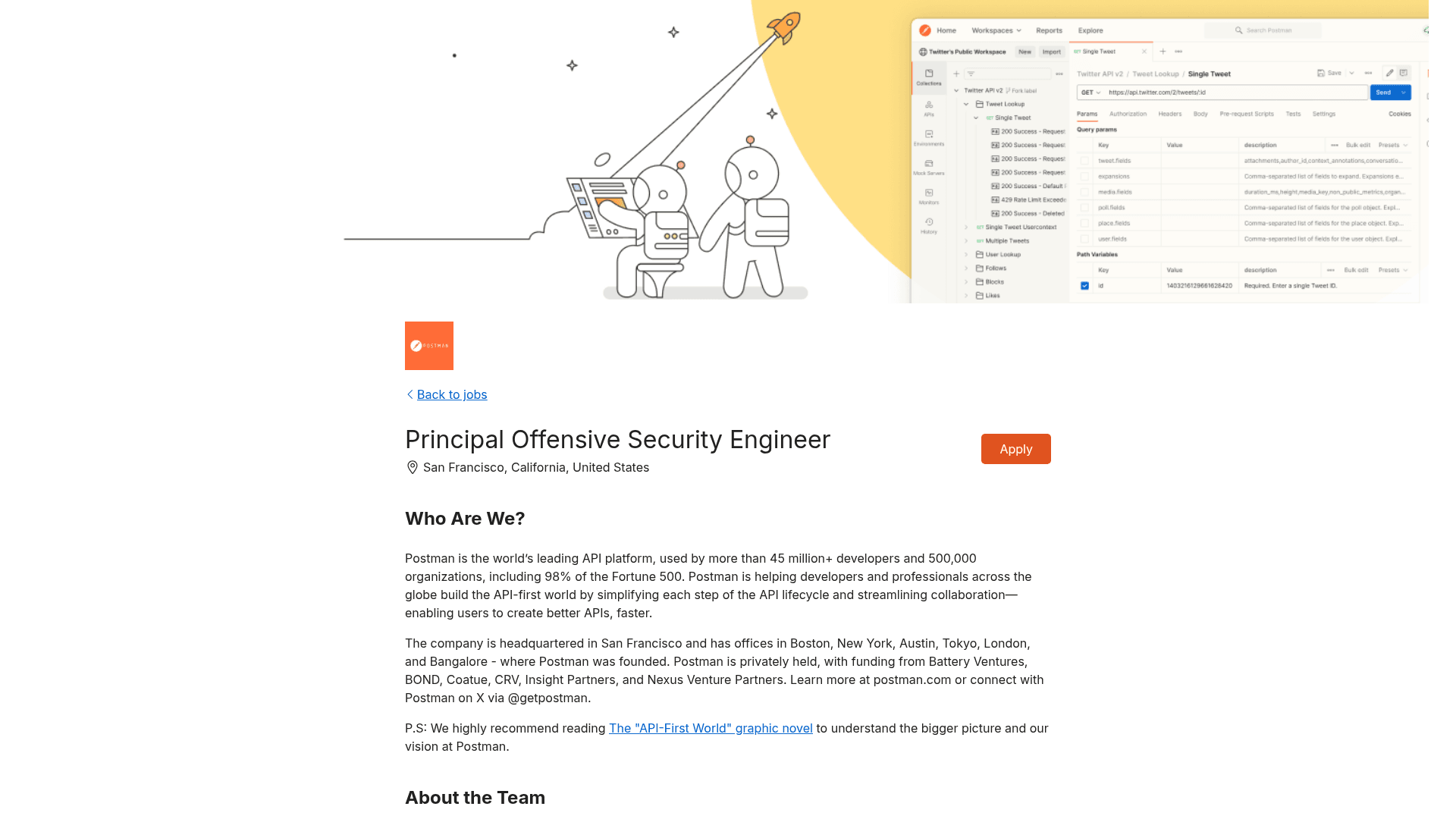
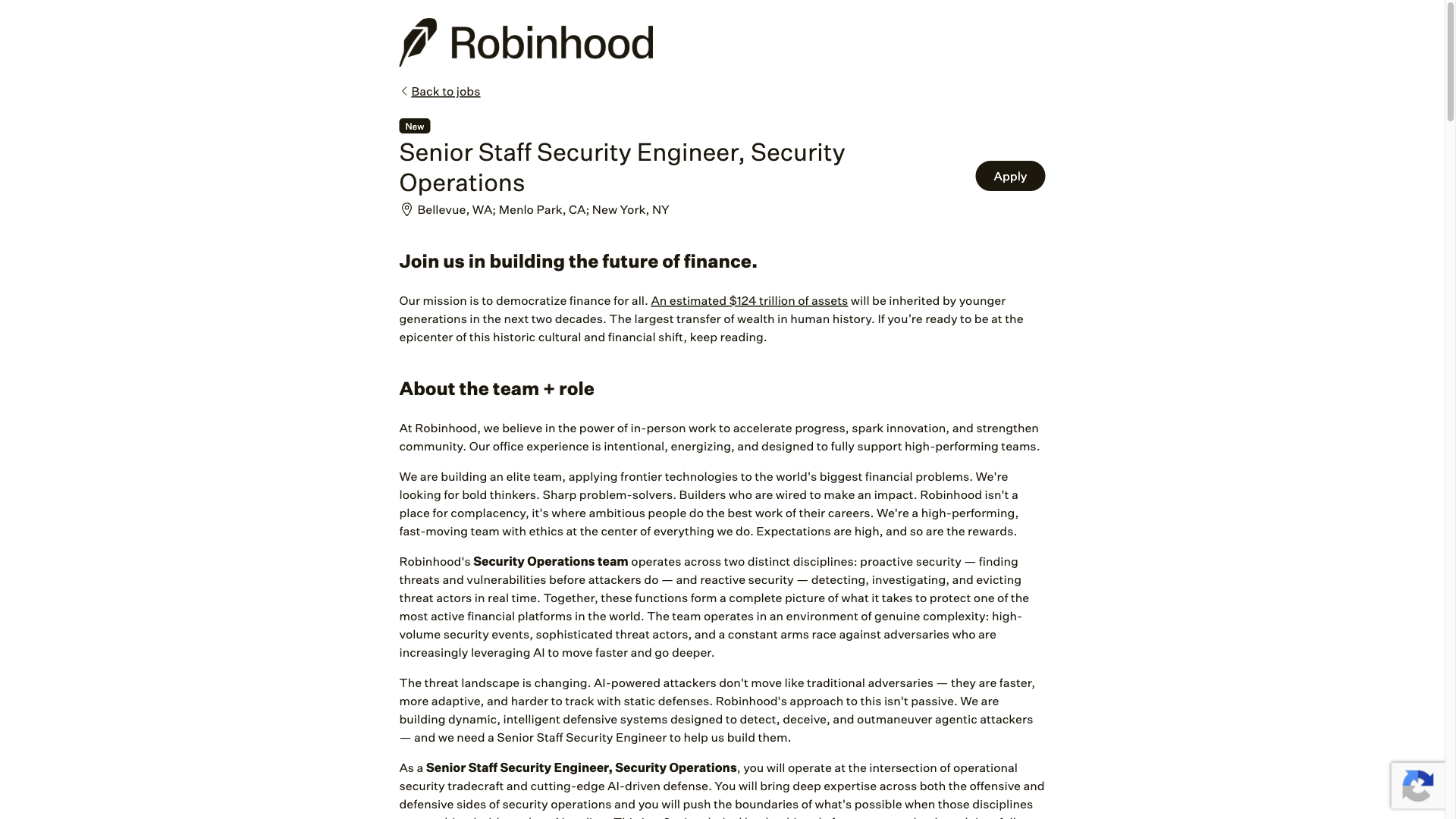
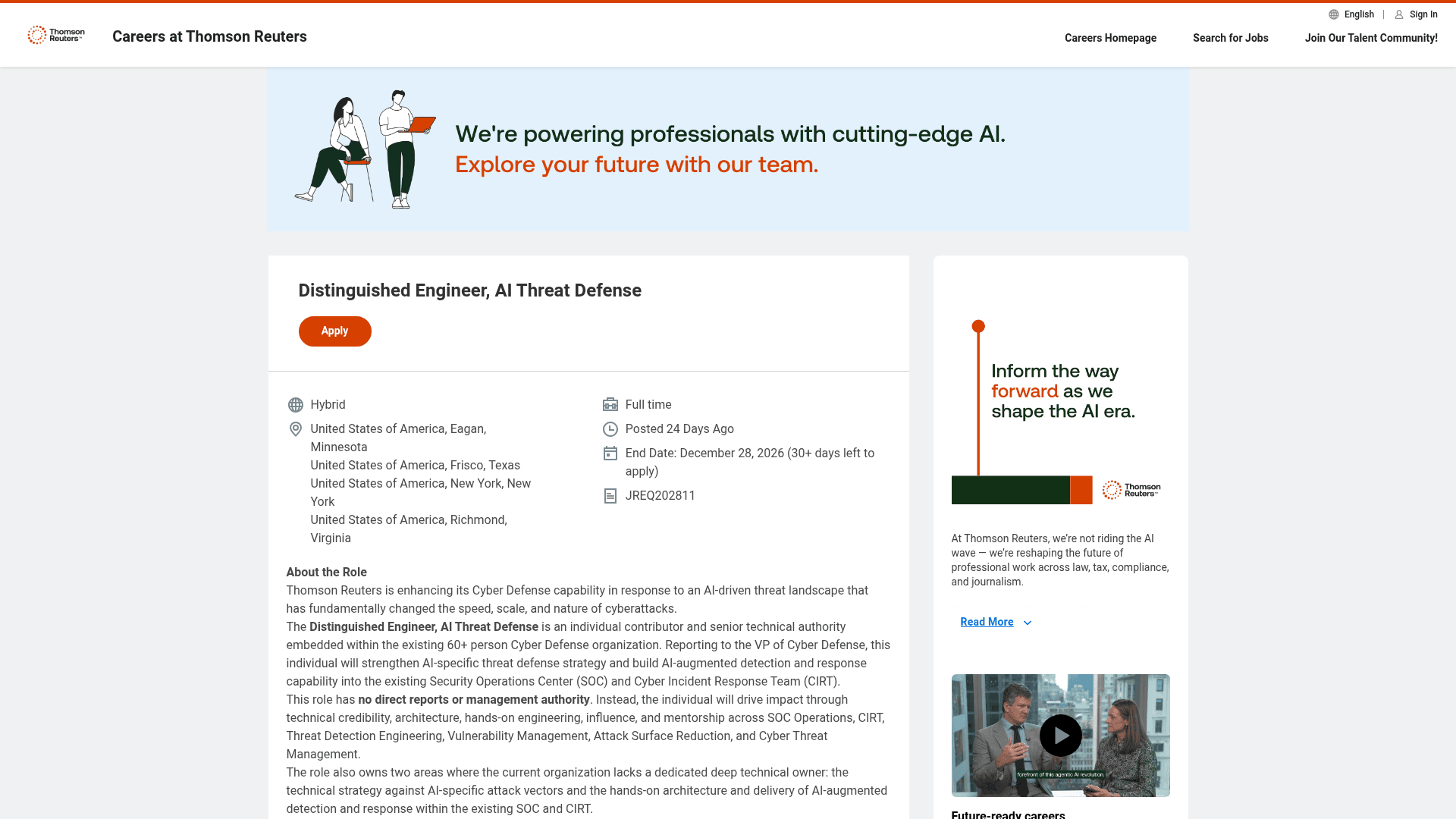
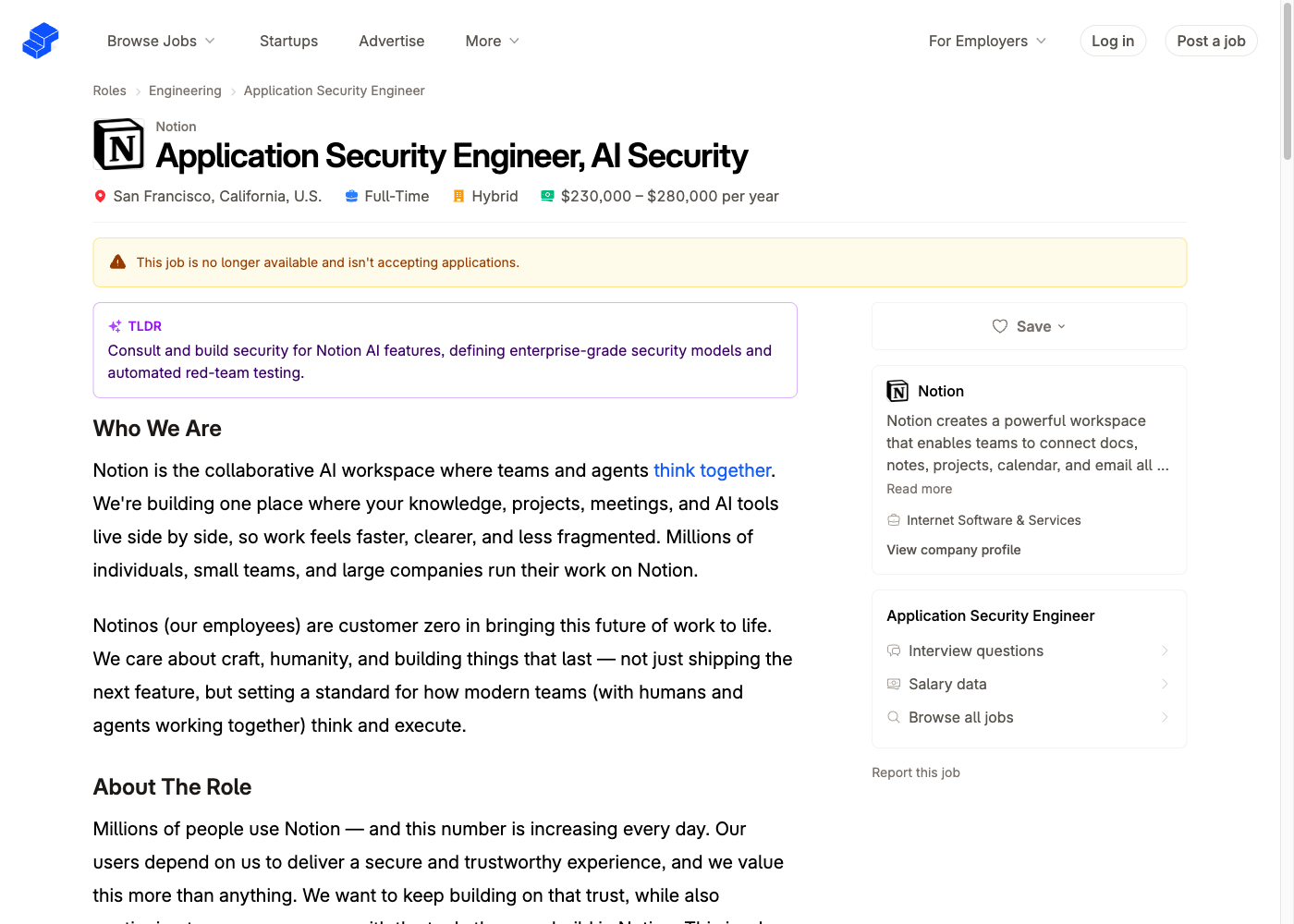
Click a logo to see that employer's listings. Logos are the trademarks of their respective owners, shown to identify the companies whose job postings are archived below.
While everyone argues about whether AI will take cyber security jobs, employers are already writing AI into the job description, and attaching serious money to it. These roles are real, and the pay runs to $900,000. We've been collecting the proof: 889 listings from named employers in 32 countries (Amazon, JPMorgan, Lloyds, Citi, Microsoft, CrowdStrike, NCSC and more), every one expecting AI, LLM, or agentic tools to be part of how the security work gets done, and every one captured here with the employer's exact wording and its salary where disclosed. In this guide, you'll see who's hiring, which specializations are moving first, what they pay, and what these employers actually require. Then we'll look at how you position yourself for one. The listings come first; the analysis follows them.
Listen
How to use this page
3 min · audio guide
The sentence being read lights up as you listen. Tap any sentence to jump to it.
This page collects real job adverts for AI-driven cyber security roles.Every listing is a genuine posting from a named employer.We read each one in full, saved the employer's exact wording, and took a screenshot of the advert, stamped with the date we captured it.Postings close all the time, so the capture is the evidence.Even after a job has gone, you can still read what the employer asked for.
Here is the shift this page is about.Security work is now being done through AI.Analysts triage alerts with AI agents.Detection engineers write and test their rules with AI assistants.Penetration testers point AI tools at the code they review.The job titles haven't caught up yet.Most of these roles are still called security engineer or detection engineer.But read the adverts, and the way the work gets done has changed.
There is one distinction worth holding on to.AI-driven security is not the same as AI security.AI security means protecting AI systems, such as models, agents and the data behind them.AI-driven security means using AI to do the security job itself.This page is about the second one.A role only appears here if the advert expects the person to do their work through AI.
Not every listing leans on AI to the same degree, so each one is graded.Tier one means AI is central to how the job gets done, and it runs through the duties.Tier two means AI is expected as part of the work, but it is a smaller strand of the role.If an advert only lists AI as a nice-to-have, or as a bonus, it is not included at all.
Each listing opens into the same layout.At the top is the line from the advert that proves the AI requirement, quoted word for word.Below it is the requirement stack.It shows what the employer wants in layers: AI as the target, meaning any AI security work; AI as the tool, meaning how AI is used in the job; the specialist skills; and the foundations underneath.Then come the salary, when the employer states one, the location, the seniority, and the full archived posting with its screenshot.
To find roles that fit you, use the search box and the filters.You can narrow the list by country, by role area, by seniority, by tier, and by the career path a role leads to.You can also sort by pay.If you are coming from networking, systems administration, development or data, look for the roles whose foundations match what you already know.That is usually the shortest way in.
So how do you get one of these jobs?Start with the security foundations.The AI requirement sits on top of the traditional skills, not instead of them.Then learn to direct AI, not just use it.There is a big gap between having tried a chatbot and building AI into your day-to-day security work.Finally, build evidence.Every one of these adverts asks for demonstrated experience.A detection pipeline you built with AI, an automated review workflow, or a testing harness you can show will beat any claim on a CV.
That is the page.Pick a role that interests you, open it, and read the employer's own words.Then work backwards from the requirement stack to the skills you need next.
0:00 / 3:174 min left
⏱️ TL;DR — if you've only got 30 seconds
🏢
Who's hiring: Amazon, JPMorgan, Lloyds, Citi, Microsoft, CrowdStrike, NCSC and more. 889 postings from 32 countries below, 886 of them with a screenshot of the posting itself. 136 employers are running more than one of these roles at the same time.
💰
What they pay: up to $900K. Of the 364 US-dollar listings that disclose pay, 261 have ceilings at $200K+ and 61 at $300K+, with a median ceiling around $227K. GRC and risk reaches $405K and cloud and infrastructure security $900K, so the premium runs well past AppSec. Salaries are shown in each country's own currency and never converted. The essay quotes US ranges; pick a country below for its own.
🛠️
What they require: real security experience. By the years each posting states, 46 of the 889 are entry-level (7 of those are internships, apprenticeships or graduate programmes), 215 mid, 414 senior, 116 staff or principal and 98 leadership plus demonstrated AI fluency. Claude Code is named in the requirement text of 65 postings, and MCP in the requirement text of 19.
Who's Hiring: 889 Real AI-Driven Cyber Security Jobs
Below is every listing in our collection. Click a country on the map or its pill; then narrow by area (the security domain the role defends), path (the AI-driven role family the listing leads to), background (the prior craft its requirements section names, read from the posting’s own words), level (seniority read from the posting's own stated years, not its title), tier, company, US state or minimum salary. The two tiers are the strength of the AI requirement: Tier 1, 576 listings, means the job, or a large part of it, is done through AI-driven engineering; Tier 2, 313 listings, means AI working is required but is a small part of the job. Nothing that only mentions AI under "preferred" or "nice to have" is on this page. Each row opens the proof: a screenshot of the posting where we captured one, the AI requirement in the employer's exact words, and the full archived text. Every listing carries its capture date.
Where the listings are — click a country to filter
Loading map…
889example listings
261ceilings ≥ $200K
$900Khighest disclosed ceiling
$227Kmedian ceiling of 364
salaries: USD listings only · 475 of 889 disclose pay
Country
Area
Level
Tier
Path
Background
Refine
Pay is shown as posted, in each listing's own currency. Sorting by pay ranks listings on an approximate US-dollar equivalent (rates as of 6 September 2026); the figures themselves are never converted. A monthly scale (Dutch and Singapore postings state a gross monthly salary) is shown per month; the strip and the sort count it at twelve months.
Digital Forensics & Incident Response, Vice President -Cybersecurity Operations
🚨Incident Response & ForensicsSeniorTier 2
JPMorganChase
Not disclosed
▼
Security Infrastructure Engineer - HSM Management
☁️Cloud & Infrastructure SecurityMidTier 2
JPMorganChase
Not disclosed
▼
Software Engineer III - DevSecOps - Kubernetes Security
☁️Cloud & Infrastructure SecuritySeniorTier 2
NVIDIA
Not disclosed
▼
Cyber Security Engineer
🔑Identity & AccessStaff / principalTier 2
No listings match — clear a filter or try a different search.
🔒 Every listing was captured from a real posting — full verbatim text, plus a screenshot and an archive.org snapshot where we could capture them — stamped with its capture date. Postings may since have closed; the capture is the evidence.
The Tide Has Turned: Cyber Security Hiring Is Now AI-Driven
The clearest description of the shift I've seen anywhere wasn't written by an analyst or a YouTuber. It was written by a hiring manager, inside a job posting. Lumin Digital — a cloud-native banking platform serving credit unions — opened its Detection Engineer listing ($155,000–$180,000) with this:
"This is not a traditional SOC analyst seat. AI-driven triage and SOAR platforms now handle the bulk of routine alert processing, and the analysts who thrive in the modern SOC are the ones who build the detections those platforms execute, author the automation playbooks that accelerate response, and hunt proactively for threats that evade automated pipelines."
Read that again, because it's the whole story in one paragraph. In that team, the routine work has moved to AI: alert triage, the classic entry-level SOC grind. But the job didn't vanish. It moved up a level: the human now builds and directs what the AI executes. Same company, same security team, different seat. Further down that same posting, working proficiency with AI-assisted development tools — it names Claude Code and Codex CLI — "is required."
This isn't an American story. We read the security postings on fifteen security vendors' boards (sixteen attempted; Fortinet's board was down) and searched nine other countries, and the same requirement is turning up in five languages. In the UK, JPMorgan's SOC analysts, the vulnerability researchers at Lloyds and the NCSC's AI technologists all carry it. A Toyota-group company in Japan says it is turning threat detection into AI agents. BMO in Toronto describes a SOC where detection development is done primarily by LLMs and orchestrated agents rather than by hand. ABN AMRO's cyber defence team wants proficiency in agentic workflows. The French and Japanese markets even use the distinction we make below, AI for security versus security for AI. Pick a country on the map and the numbers follow.
One posting could be a single opinionated hiring manager. That's the honest objection, and the collection answers it as far as adverts can: 136 of the employers here have more than one of these roles open at the same time, which is repeated demand inside a single employer rather than one manager's preference — Amazon (29), JPMorganChase (22), Microsoft (21), Anthropic (14). When one team writes AI into a job advert, that's a preference. When four separate teams at the same company do it in the same window, it's a policy.
This is what I call AI-driven cyber security: the security professional who directs AI to do the work, rather than competing with it. It's the same shift Andrej Karpathy calls agentic engineering, seen from the hiring side.
✅ And here's the context that makes this remarkable: the evidence above was gathered July to October 2026, at a time when the loudest story in tech is how hard it is to get hired. Both things are true at once. Whatever is happening to hiring generally, these employers are still writing these adverts.
One distinction matters before the rest of the analysis, because the job market mixes two different things under "AI" and you should know which one you were looking at in those listings.
AI-Driven Security vs AI Security: Not the Same Thing
The job market currently mixes two different things under "AI security jobs", and if you're planning a career move you need to keep them straight, because they lead to different places.
🤖 AI-Driven Security
Using AI to do your security job. Detection engineer, AppSec engineer, network engineer — the role stays a security role; AI is how you now work: Claude Code in the daily workflow, agents running triage. It's a way of working — and every listing on this page passes that bar.
🛡️ AI Security — NOT what this page covers
Securing AI systems themselves — the LLMs, RAG pipelines, and agents your organisation deploys become the thing you protect. A different field with its own three career tracks: Defensive, Offensive, and Governance — we keep full role guides for each.
The two worlds overlap in the best postings: the AppSec role at Notion secures agentic features and asks you to stay current with Claude Code and to put MCP enabled tools in developers' hands; the AI Red Team at Capital One is "essentially building AI to attack AI", which is offensive AI security done in an AI-driven way. But keep them straight when you're reading the listings above: everything on this page is the AI-driven side — security roles where AI is how the work gets done. Which raises the obvious question: who exactly is hiring for this, today?
What the Same Requirement Looks Like in Each Market
Security vendors. We read every security-titled posting on fifteen vendor boards (sixteen attempted; Fortinet's board was down), and about one practitioner role in nine carried a real AI mandate. Those mandates sit in AppSec, product security and research. Snyk's product security engineer is told to "Use AI coding agents (for example Claude Code) to draft the Terraform, Kubernetes, and pipeline changes that fix identified security gaps", and Microsoft's Windows penetration tester reviews code "using agents and automated tools built by you and others". The vendors' own SOC and MDR roles, the people running the products they sell, mostly still read as traditional; Proofpoint's internal security operations engineer, asked to "Support practical Agentic SOC use cases for alert triage, investigation enrichment, case documentation, and response under defined human oversight", is the exception we found.
Banks. Canada's banks write it into the posting. BMO describes a SOC "where detection development is performed primarily by LLMs, automation pipelines, and orchestrated agent systems, rather than manual engineering", and CIBC wants someone to "build an emerging AI-supported, agentic Red Teaming capability within the bank". In the UK the signal came through JPMorgan, Lloyds and Citi and through contract and agency listings; the high-street banks' own career boards gave us nothing.
Japan and France. Both markets use the same distinction we draw above. MBSD's AI security engineer posting is written in two halves headed "AI for Security" and "Security for AI", and Hermès files the missions of its Lead AI Security under "Augmenter la cyber par l’IA (AI for Cyber)". KINTO, a Toyota-group company, says "当グループのコアミッションの多くを AI エージェント化し" (turning many of the security group's core missions into AI agents), and LINE Yahoo's internal SOC engineer is expected to use "SIEM・EDR・SOAR・生成AI/LLMなどを活用し、検知精度・分析効率・対応品質を継続的に向上させる" (SIEM, EDR, SOAR, generative AI and LLMs to keep raising detection precision, analysis efficiency and response quality).
India. 100 of the 889 listings are Indian, the largest set outside the United States. The outsourcers sell the practice by name: EY GDS wants a manager to "Architect agentic AI-driven SOC solutions" and Deloitte's Indian arm is hiring "AI SOC" consultants, while Mastercard's Pune engineer will "Embed with SOC and DFIR analysts to identify high-toil workflows and convert them into automated, AI-assisted, or fully autonomous playbooks with appropriate guardrails." Only 4 of the 100 disclose pay, so we make no pay claim for India.
Country
Listings
Disclose pay
Highest ceiling
Median ceiling
Currency
United States
441
358
$900K USD
$228K
USD
India
100
4
₹45.0L INR
too few
INR
United Kingdom
78
20
£189K GBP
£90K
GBP
Canada
64
40
CA$420K CAD
CA$169K
CAD
Singapore
36
10
S$264K SGD
S$156K
SGD
Australia
32
4
A$260K AUD
too few
AUD
Germany
23
7
€150K EUR
€120K
EUR
Japan
22
14
¥15.0M JPY
¥10.7M
JPY
Netherlands
21
7
€129K EUR
€100K
EUR
France
19
5
€74K EUR
€60K
EUR
Israel
14
0
none
too few
Ireland
10
2
€173K EUR
too few
EUR
Countries with 10 or more listings. Pay as posted, in each country's own currency and never converted; a monthly scale is counted at twelve months; a median appears only where 5 or more listings disclose a ceiling. Disclose pay counts a listing priced in any currency; highest and median use listings priced in the country's main currency.
AI-Driven Security Jobs by Specialization
We read every posting in full and put it in the security domain it actually defends, not the one its title suggests. That produced the most useful finding on this page: there is no new AI-driven job category in security. Every listing here belongs to a discipline that existed before any of this — detection, application security, vulnerability management, GRC — with AI-driven engineering layered on top of it. Only 56 of 889 roles are genuinely cross-cutting security platform work serving the whole organisation.
The second finding is what employers expect you to do with it. 473 of the 889 postings ask you to build the agents and pipelines, against 318 that ask you to use them and 98 that ask you to lead a team through the change. In detection and SOC, the largest area, it is 131 building against 64 using. The bar is not familiarity with a chatbot. It is shipping something that does security work.
The hiring isn't spread evenly. Across this collection, the AI-driven signal clusters differently by specialization — judged on the language employers use and the pay they attach:
Security domain
Listings
Highest disclosed ceiling
☁️Cloud & Infrastructure Security
73
$900K
🧭Security Leadership
97
$635K
📡Detection & SOC
203
$600K
🛡️AppSec & Product Security
148
$485K
🏛️Security Architecture
27
$465K
🐞Vulnerability Management
43
$445K
🔑Identity & Access
30
$410K
⚖️GRC & Risk
74
$405K
🚨Incident Response & Forensics
31
$327K
🎯Offensive & Red Team
63
$320K
🕵️Threat Intel & Research
44
$319K
🧰Security Platform & Tooling
56
$308K
Use the Area row in the filter panel above to see any one of those on its own. What follows is what the postings in each say, in their own words.
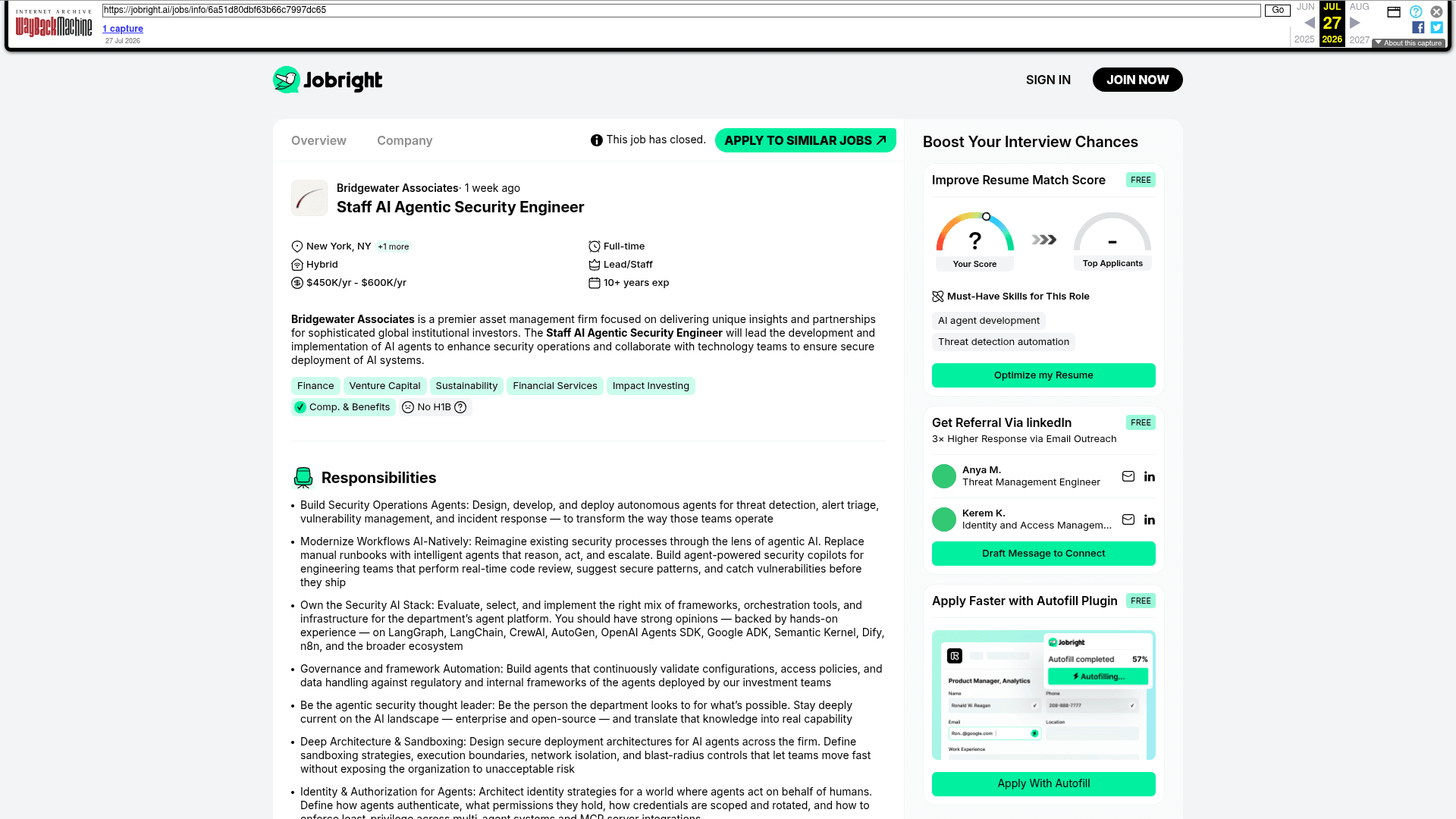
Detection & SOC is the biggest area by a distance. 203 of the 889 listings defend a SOC or write detections, and it reaches $600,000: Bridgewater Associates wants an engineer to "Design, develop, and deploy autonomous agents for threat detection, alert triage, vulnerability management, and incident response" and to "Replace manual runbooks with intelligent agents that reason, act, and escalate." AI-native detection shops are building whole operations this way: Spectrum Security posted a role for a team building "AI systems that understand adversary tradecraft, reason about logs, and automatically generate and maintain high-quality detections".
▶Watch it done: SOC & incident response · 2:45
Security Platform & Tooling is the one genuinely new shape, and it is smaller than the job titles suggest: 56 roles whose customer is the whole security organisation rather than one discipline. Amazon's Security Automation engineer must "Ensure our agentic workflows deliver high impact security value" across Amazon's security infrastructure, and both Airwallex AI-tooling roles sit inside information security serving every team in it. AbbVie is blunter about the bar for this kind of role: "we expect you to build with agents, not just build agents". These existed as security tooling and automation teams long before agents; what changed is that the tooling is now AI.
▶Watch it done: Security engineering · 4:24
Offensive & Red Team roles are building AI to attack with. Capital One says outright in the posting that its "AI Foundations team is forming a brand new AI Red Team" — building AI to attack AI — and Amazon's Senior Manager role calls for "scalable offensive security automation and AI-augmented testing tools". Replit wants offensive engineers who "build AI-assisted testing tools to automate the discovery of common bug classes". A household-name bank announcing a brand-new AI Red Team in the posting itself is not a trend forecast. It's an org chart.
▶Watch it done: Penetration testing · 2:42
AppSec & Product Security expects AI in your toolbelt. Notion, at $230,000 to $280,000, puts "leverage skills, MCP enabled tools, and hooks to help prevent vulnerabilities for developers using agentic coding tools" under "What You'll Achieve", and under "Skills You'll Need to Bring" asks that "You stay current with tools like Cursor, Claude Code, and other AI-assisted development environments". Heartflow requires "AI code tools such as Claude Code and Github Copilot for development and security testing." Fireblocks wants you to build autonomous agents that hunt vulnerabilities for you.
▶Watch it done: Application security · 2:04
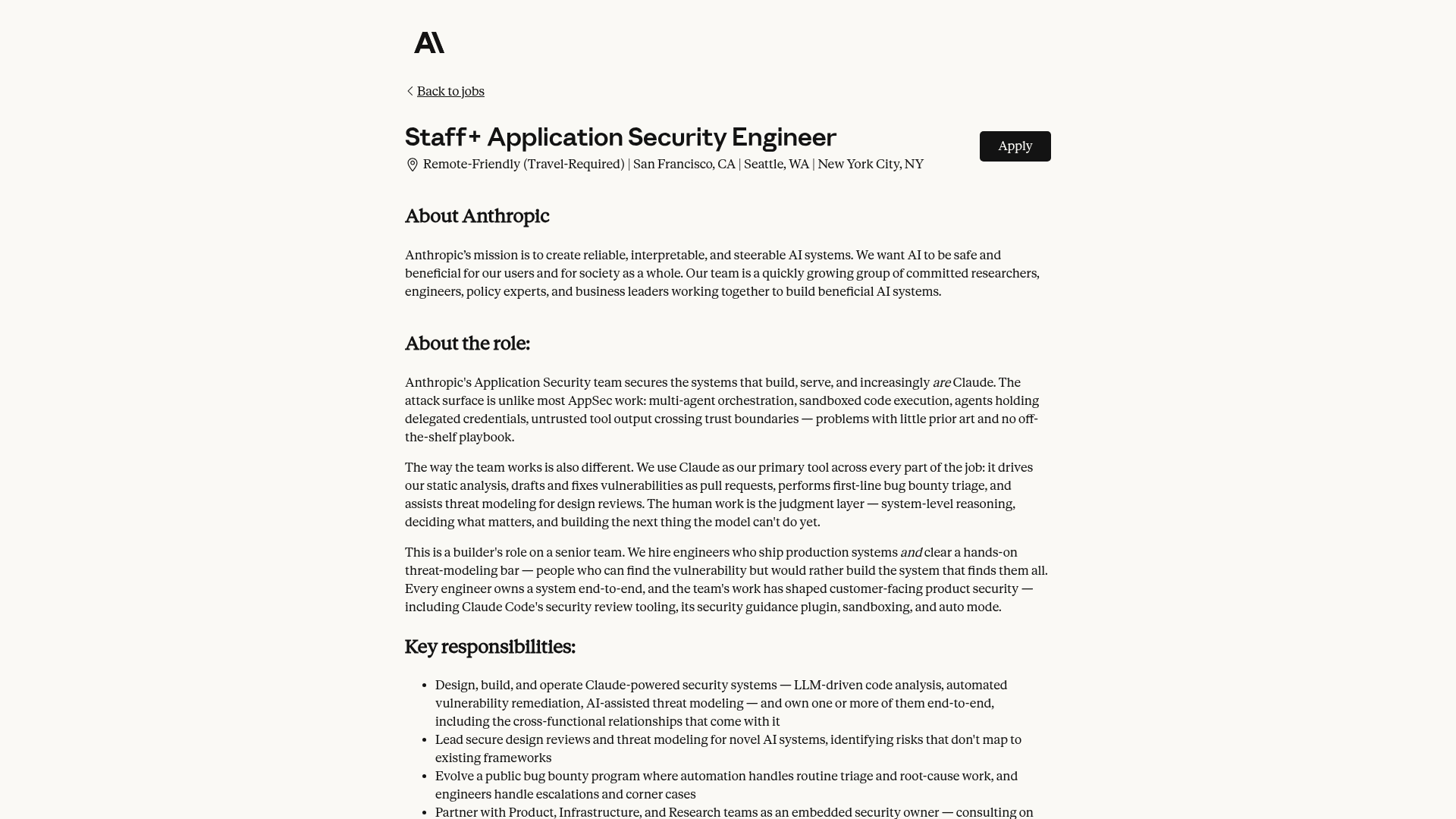
Even GRC & Risk is going AI-driven. Norm Ai "expects all team members to be fluent in AI." Anthropic's Staff+ Risk Engineering role will "Design and build AI-native risk tooling that uses Claude to classify incoming risks, augment triage, and continuously sense changes in our risk landscape". INSPYR is hiring a program manager specifically to transition "traditional cyber operations into an AI-enabled Cyber Ops model."
▶Watch it done: GRC & audit · 3:20
Security Leadership now writes agentic AI into the manager's brief. Woolworths Group's General Manager for Cyber Defence will direct engineering functions "leveraging agentic AI to accelerate automated detection, triage, and response at scale." Atlassian's incident response manager is measured on getting investigative AI tools adopted by the analysts, and KPN's SOC manager in Hilversum owns the AI transformation of its security operations.
▶Watch it done: Security leadership · 1:34
Threat Intel & Research is putting agents on the hunt. CrowdStrike's senior threat hunting intelligence analyst will be "creating, directing, and supervising AI agents to accelerate your hunting and intelligence work." The analyst still owns the finding. The agents do the running.
▶Watch it done: Threat intelligence · 4:15
Vulnerability Management is automating the lifecycle. Cloudflare's lead vulnerability management engineer gets the mandate in one line: "A key focus of this role is leveraging emerging technologies, including AI, to automate the vulnerability lifecycle and enhance operational efficiency." SentinelOne's staff AppSec engineers triage the output of an "agentic code scanning pipeline", and Palo Alto Networks is hiring a principal researcher whose title is AI-assisted vulnerability research.
▶Watch it done: Vulnerability management · 2:15
Incident Response & Forensics is rebuilding the investigation itself. TikTok's detection and response engineer in Singapore will "Design and build AI-native forensic investigation workflows for evidence retrieval, enrichment, entity normalization, timeline reconstruction, evidence indexing, evidence packaging, and investigation report generation." ING's senior incident responder and Amazon's AWS incident response team ask for the same fluency from the individual responder.
▶Watch it done: SOC & incident response · 2:45
Identity & Access is a smaller set, but Roblox's principal IAM engineer must be able to "reason about what it means to give an AI agent an identity and permissions", and Salesforce and SWIB name Claude Code in their IAM requirements.
▶Watch it done: Identity & access · 3:56
Security Architecture asks the architect to set the culture. Leidos wants its principal architect to "Champion an AI-first engineering culture by identifying and applying AI-assisted development capabilities", and Kinross Gold wants one who can "design, supervise, and validate AI- and analytics-driven detection and response".
▶Watch it done: Security architecture · 4:59
Cloud & Infrastructure Security is 73 of the listings. The AI language there is mostly automation of the platform itself; Jefferies is the clearest network example: a Wall Street investment bank paying $185,000 to $200,000 base for a network security engineer who is "knowledgeable with Integrating Automation (Python, LLM’s) into the Network Security stack of tools and services".
▶Watch it done: Cloud security · 5:18
If you want to map any of these against a career path, our cybersecurity roadmap scores every role's AI exposure. But specialization only answers half the question you came here with — the other half is money.
What These Roles Pay
The honest headline: the ceilings on these roles are high. From the 364 listings with disclosed salaries:
$900K
highest ceiling (Netflix)
261/364
disclosed ceilings ≥ $200K
$227K
median ceiling
61
ceilings ≥ $300K
The top of the market as captured: Netflix $900K · Netskope $635K · Bridgewater Associates $600K · OpenAI $510K · Anthropic $485K.
Two caveats, because numbers like these attract wishful reading. First, salaries are shown in each country's own currency and never converted. The essay quotes US ranges; pick a country above for its own. Second, ceilings are ceilings — the floors are real too. What I take from the distribution isn't any single number: it's that employers across finance, healthcare, and tech are consistently attaching serious money to security people who bring AI fluency with them. But every one of these employers filters on the same thing, and it's worth being blunt about what that is.
What Employers Actually Require
Reading these postings back to back, the requirement pattern is unmistakable. It's a stack, and it is the same stack in every domain: foundations (years, a language, cloud and infrastructure), the specialisation you'd have needed five years ago (detection, threat modelling, pentesting, GRC), and AI as the tool layered on top. In the roles that build or defend agentic systems a fourth layer appears, AI as the target: prompt injection, agent identity, guardrails. Seniority doesn't add foundations; those are the base you get early and every posting states them as a gate. What deepens is the specialisation, measured in years. AI as the tool is required on every listing on this page, the 46 entry-level ones included, and what changes with seniority is what it asks for: 59% of entry-level postings already ask you to build the tooling rather than just use it, 61% at staff level, and at leadership level 72% ask you to lead its adoption. The fourth layer is the one that varies. Not every posting asks for it, and it is asked for more often as roles get more senior.
Six Tier 1 roles, one per domain, each broken into those layers in the employer's own words. Three ask you to secure AI as well as use it; three do not.
Thomson Reuters$198K–$368KDistinguished Engineer, AI Threat Defense📡Detection & SOC
AI as the target"Deep hands-on knowledge of AI-specific attack vectors"Required / What You'll Do
AI as the tool"architecting or delivering AI-assisted detection and response"What You'll Do / Required
Specialisation"SOC Operations, CIRT, Threat Detection Engineering, Vulnerability Management"About the Role / Required
Foundations"12+ years of progressive cybersecurity engineering experience"Required Skills / Qualifications
Notion$230K–$280KApplication Security Engineer, AI Security🛡️AppSec & Product Security
AI as the target"develop automated red teaming for AI and agentic features"What You'll Achieve
AI as the tool"You stay current with tools like Cursor, Claude Code"Skills You'll Need / What You'll Achieve
Specialisation"finding architectural solutions that eliminate classes of vulnerabilities"Skills You'll Need / What You'll Achieve
Foundations"at least 6+ years of experience working with product teams"Skills You'll Need to Bring
Censys$220K–$278KSenior Security Researcher🕵️Threat Intel & Research
AI as the target"understanding of the failure modes of this agentic tooling"What you'll do / Skills and experience
AI as the tool"Hands-on experience with agentic systems for offensive security"Skills and experience / What you'll do
Specialisation"5+ years of hands-on penetration testing, red teaming, or adversary emulation"Skills and experience / What you'll do
Foundations"Proficiency in scripting or coding (Python, Go, or similar)"Skills and experience you'll have
Palo Alto Networks$163K–$263KPrincipal Security Researcher🎯Offensive & Red Team
AI as the targetNot asked for in this posting
AI as the tool"Use LLMs, AI agents, fuzzing, static/dynamic analysis"Your Impact
AI as the tool"Prototype and ship agents, custom MCP servers, and LLM-assisted automations"what we're looking for / day-to-day
Specialisation"Cloudflare WAF, DDoS protection, Bot Management, WARP, Gateway, and Access"day-to-day / what we're looking for
Foundations"10+ years of hands-on security engineering experience"Here's what we're looking for
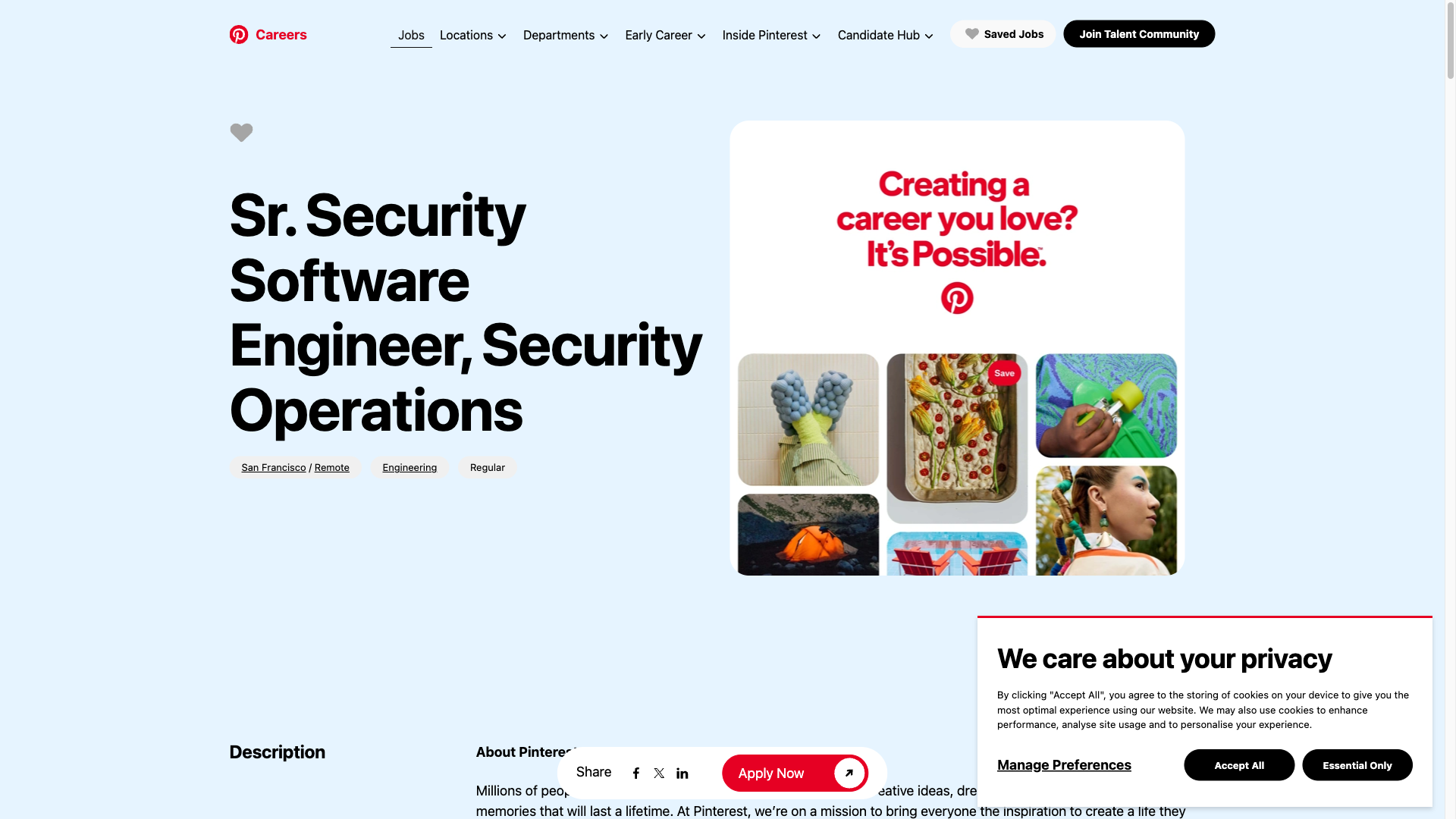
Pinterest$146K–$300KStaff Technical Program Manager, Security⚖️GRC & Risk
AI as the targetNot asked for in this posting
AI as the tool"Use GenAI as the default operating model"What you'll do
Specialisation"5+ years of information security, risk and/or compliance experience"What we're looking for / What you'll do
Foundations"10+ years of technical program management"What we're looking for
Every listing on this page carries the same breakdown. Open a row's proof panel to see that employer's four layers, quoted from the archived posting with the section each line sits under.
Two of those layers are stated in every posting on this page:
1
Real security experience. Read by the years each posting states rather than its title, 46 of the 889 are entry-level, 215 mid, 414 senior, 116 staff or principal and 98 leadership. Only 7 are internships, apprenticeships, working-student or graduate programmes (NXP Semiconductors, QAware, Dassault Systèmes, Wavestone, SERMA Safety and Security, Shopee and Copart), all of them in France, Germany, Singapore and United States. Everything else demands experience. The floors run from two to three years at the AI-native end (Spectrum Security, Capital One with a Master’s) through five-plus (Lumin, Replit) up to ten or more (Jefferies, Homebase), and across the postings we read five years or more was the most common floor.
2
Demonstrated AI fluency, with tools named by brand. Claude Code appears somewhere in 126 of the 889 postings and in the requirement text of 65 (Lumin, Notion, and Heartflow among them). MCP, the Model Context Protocol, the standard for wiring AI agents to tools, appears somewhere in 117 and in the requirement text of 19. Norm Ai goes as far as a dedicated "AI Fluency" section in the posting.
⚠️ If you're at entry level: this trend is genuinely uncomfortable — the routine work that used to be the first rung is exactly what the AI now does. We've covered whether AI will replace cyber security jobs separately.
But if you already have security experience, I think this is the biggest repricing of a skill set I've seen in thirty years in this industry — the market is putting serious money on a capability you can genuinely build in months, because almost nobody has it yet.
How to Get an AI-Driven Cyber Security Job
The stack these employers want is the one worth building deliberately:
1
Security foundations first. The AI requirement sits on top of the traditional skill set, not instead of it — every posting above pairs its AI language with SIEM, cloud, AppSec, or offensive fundamentals. Our certification roadmap maps that base, and if you're weighing certifications, start with the best AI security certifications.
2
Learn to direct AI, not just use it. The difference between "I've tried ChatGPT" and what Lumin means by "integrate these tools into day-to-day detection engineering and scripting workflows" is the discipline of agentic engineering — specs, verification, guardrails, fleets of agents doing real work. That's learnable; it's what I do all day. Around 80% of StationX now runs on AI infrastructure I built this way, including the security scanning across our own servers and repositories.
3
Build evidence. Every posting asks for demonstrated experience. A detection pipeline you built with AI assistance, an automated review workflow, a red-team harness — one real artifact beats any claim. The AI Master's Program trains the full path with structure, and the free web-book Become the Cyber Security Expert the AI Era Demands is the right starting point if you're earlier.
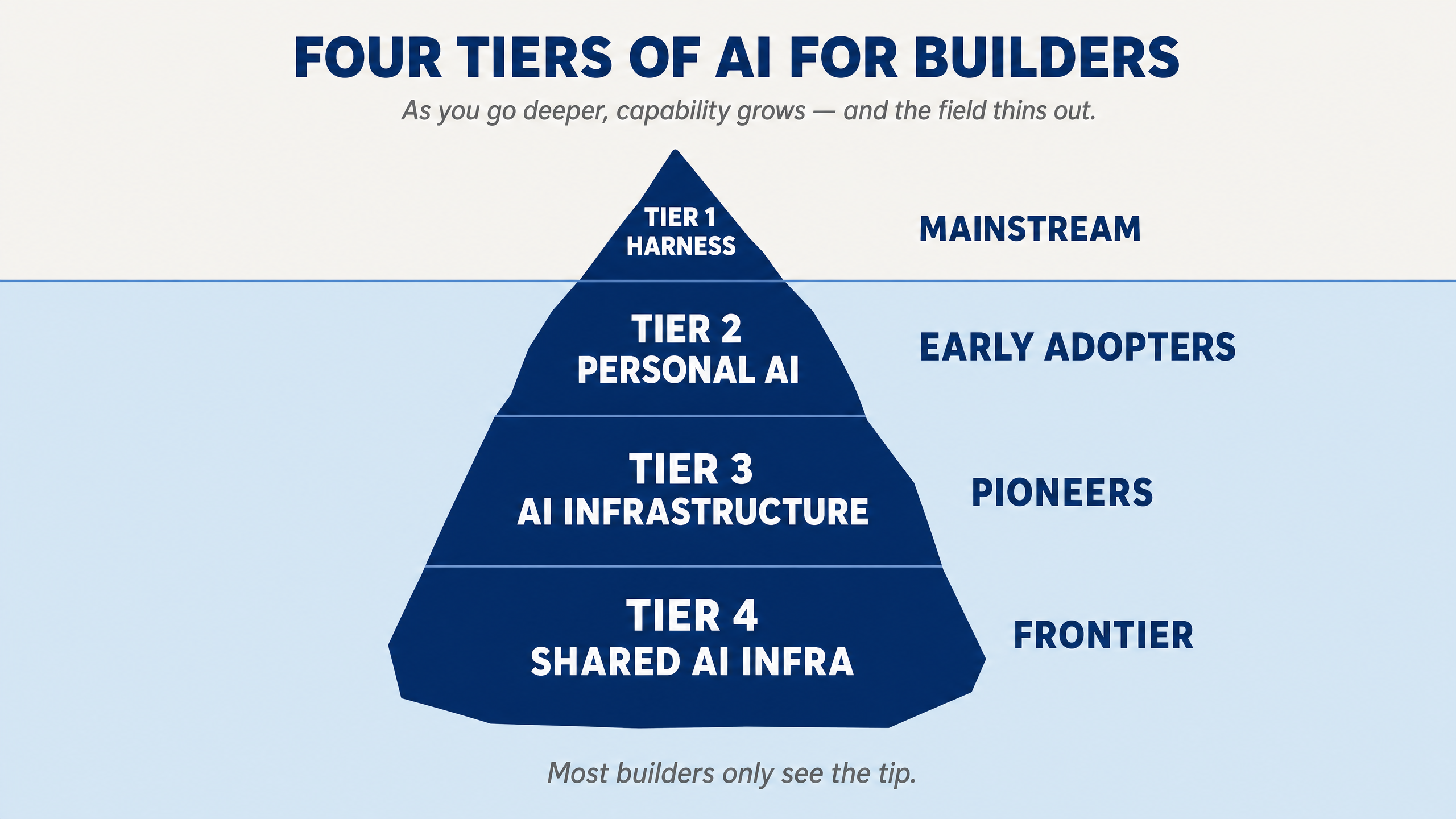
If "directing AI" still sounds abstract, the picture below is the map I use. There are four tiers of building around an AI — from a bare harness like Claude Code, up to shared AI infrastructure running a whole team — and the employers above are effectively hiring for people who can climb it. The full framework, with a real five-agent security review run in four sentences, is in the Agentic Engineering guide; and if you're wondering what happened to "just vibe code it" — vibe coding is dead; disciplined AI-driven engineering is what replaced it.
The job titles haven't fully caught up with the work — most of these roles are still called Security Engineer or Detection Engineer, not "AI-driven security engineer." That's exactly what makes this the right moment: the requirements have changed ahead of the labels, and the people who move before the labels catch up are the ones who set the price.
Frequently Asked Questions
Are AI-driven cyber security jobs real, or just hype?
Real and verifiable. This page lists 889 job postings from named employers — including Amazon, Capital One, Notion, and Jefferies — each expecting AI, LLM, or agentic tools to be part of how the security work gets done, each archived with the original wording.
What do AI-driven cyber security jobs pay?
From the disclosed salary ranges in our collection: ceilings run to $900,000, 261 listings carry ceilings of $200,000 or more (61 at $300,000+), and the median ceiling is around $227,000. Floors vary with seniority and sector. Salaries are shown in each country's own currency and never converted. The essay quotes US ranges; pick a country above for its own.
What tools do these jobs require?
The most-named: Claude Code (named in the requirement text of 65 of our 889 archived postings), MCP (the Model Context Protocol, named in the requirement text of 19), Codex CLI, GitHub Copilot, and Cursor, plus building autonomous agents and LLM-based triage and automation into security workflows.
Are any of these jobs entry-level?
Almost none. 7 of the 889 listings are internships, apprenticeships, working-student or graduate roles, all of them in France, Germany, Singapore and United States. Every other listing demands experience, most commonly five years or more. The routine work that used to be the first rung is exactly what the AI now does, which is why the surviving roles pay more.
What is the difference between AI-driven security and AI security?
AI-driven security means using AI to do your security job — Claude Code in your workflow, agents running triage, LLMs wired into your tooling. AI security is a different field: securing AI systems themselves, split into defensive, offensive, and governance tracks. The best postings are both.
Will AI replace cyber security jobs?
It is replacing tasks — routine alert triage most visibly — while creating better-paid roles for the people who direct it. Several postings on this page say exactly that in the employer's own words.
Nathan House has 30 years of hands-on cybersecurity experience and is Cambridge-educated, holding CISSP, CISA, CISM, OSCP, CEH, and SABSA. He founded StationX in 1999 — one of the UK’s first cybersecurity companies — and has secured £71 billion in UK mobile banking transactions and the London 2012 Olympics, advising clients including Microsoft, Cisco, BP, Vodafone, and VISA. He authored the world’s most popular cybersecurity course — a #1 Udemy bestseller taken by over 500,000 students — and was named Cyber Security Educator of the Year 2020, AI Security Educator of the Year, and a UK Top 25 Security Influencer 2025. A DEF CON speaker and featured expert on CNN, Fox News, NBC, and the BBC, Nathan leads StationX’s training of more than half a million students worldwide.
Become the one in the room everyone turns to — the expert AI can’t replace.
The StationX Master’s Program gives you a rare ability companies will pay almost anything for — then it’s yours to point wherever you want your life to go.
A senior role at the top of your pay grade. Your own consultancy. Or a business of your own. One capability, three futures — you choose, and you can change your mind.



 Security+
 CySA+
 PenTest+
 SecAI+
 Network+
 A+
 Cloud+
 Linux+