

 Security+
 CySA+
 PenTest+
 SecAI+
 Network+
 A+
 Cloud+
 Linux+
CompTIA vs Cisco Certifications (2026): Which Should You Get?
CompTIA and Cisco are two leading IT certifying bodies, but which of their certifications are best suited to your career goals?
Security+ SY0-701 or SY0-801? (updated November 2026)
CompTIA launched Security+ SY0-801 on 17 November 2026. We recommend SY0-701 for now: it's valid until 11 June 2027, 801 is brand new with very little training available yet, and employers only ask whether you have Security+, not which version. Our free Security+ cheat sheet covers both.
In this article comparing CompTIA vs Cisco, we break down the roles of these organizations in the IT industry, their certifications - including CompTIA exams for general IT knowledge and Cisco's advanced certifications for specialized skills - and the types of candidates each is designed for.
Whether you’re looking to enter the networking industry, strengthen your understanding of network fundamentals, or gain hands-on experience with Cisco Systems, this Cisco vs CompTIA guide will help you decide the right path. Let’s begin!
What Are CompTIA and Cisco?

The Computing Technology Industry Association (CompTIA) is a vendor-neutral nonprofit organization that provides education and training for aspiring and existing IT professionals.
Well-known CompTIA certifications include:
- A+
- Network+
- Security+
- PenTest+
- CySA+
- SecurityX
- Linux+
- Cloud+
- Project+
CompTIA certifications are vendor-neutral, providing a foundational understanding of IT concepts like networking and security across a broader range of technologies. They build a comprehensive understanding useful for career advancement.
Cisco certifications, in contrast, focus on hands-on skills with Cisco Systems equipment, testing your ability to configure, manage, and troubleshoot it at different proficiency levels. Highlighting the key differences: CompTIA emphasizes concepts, while Cisco emphasizes practical, product-specific expertise.

Cisco certifications are organized into four levels: Entry, Associate, Professional, and Expert. The best-known among them are:
- Cisco Certified Support Technician (CCST)
- Cisco Certified Network Associate (CCNA)
- CCNA Cybersecurity (formerly Cisco Certified Cybersecurity Associate and, before that, CyberOps Associate)
- Cisco Automation (formerly DevNet)
- On February 3, 2026, Cisco renamed its DevNet certifications to CCNA, CCNP, and CCIE Automation.
- Cisco Certified Network Professional (CCNP)
- Cisco Certified Internetwork Expert (CCIE)
- Cisco Certified Design Expert (CCDE)
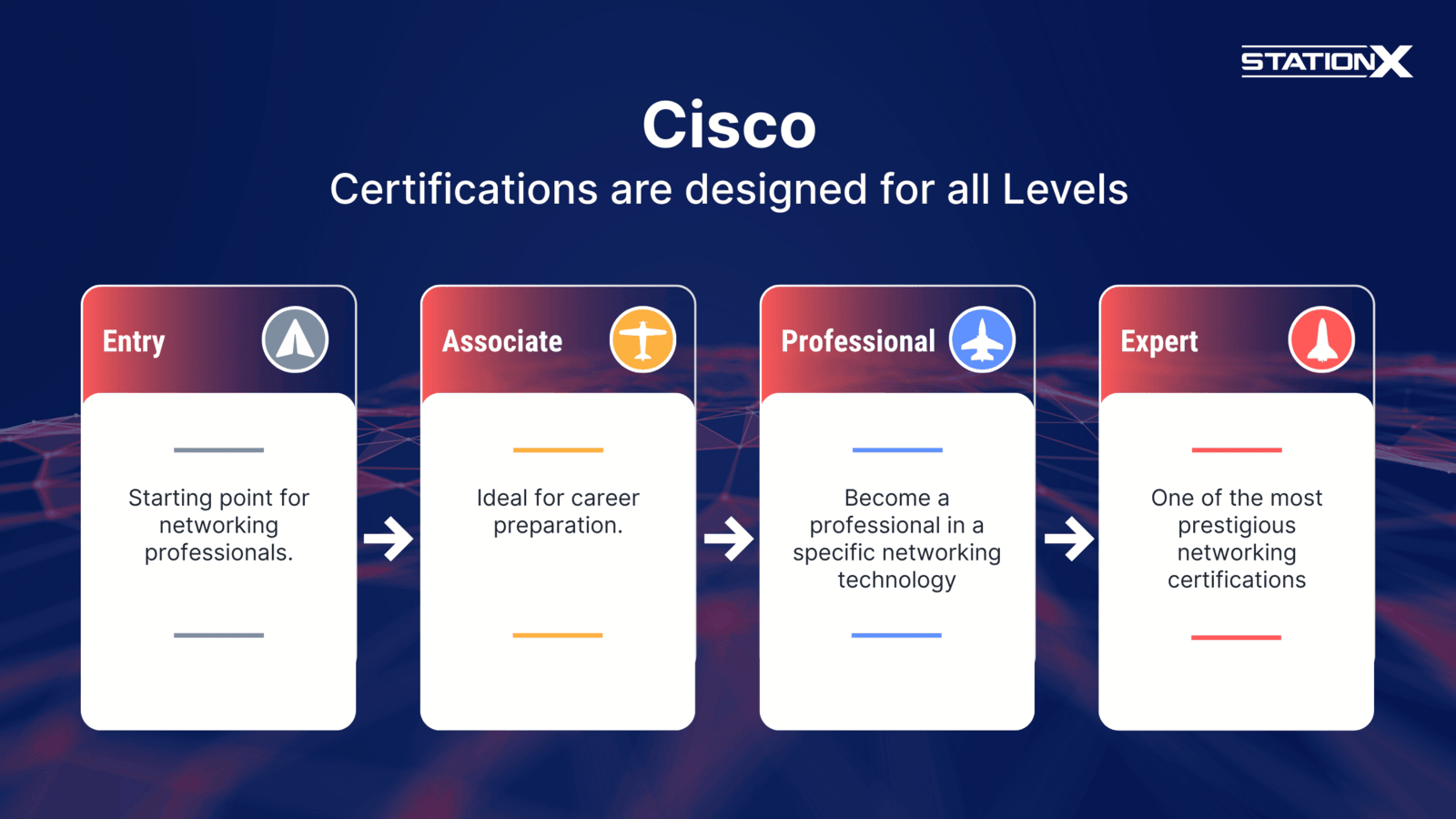
CompTIA and Cisco offer training programs for all their certifications, starting with entry-level certifications that cover basic networking and fundamental networking concepts, such as Internet Protocol and IT infrastructure. Both organizations also offer more advanced certifications to support ongoing professional development and career growth in networking and information technology.
Most CompTIA and Cisco certifications follow a three-year lifecycle. Renewal mechanics and fees vary by credential, but the options are broadly similar: you can earn continuing education credits (CEUs) or complete approved training, pass an updated or higher-level exam, or demonstrate qualifying work experience or approved activities.
Costs and the exact accepted activities differ by cert and vendor, so check the specific certification page for details.
Additionally, these certifications can be taken either in-person at Pearson VUE test centers or Certiport Authorized Testing Centers (CATCs), or online through Pearson VUE (OnVUE) or Certiport’s remote proctoring, depending on the certifying body and exam you choose.
Who Are CompTIA and Cisco Certifications For?
If you’re just starting in IT or cyber security or want to demonstrate a broad understanding of tech concepts across multiple disciplines, CompTIA is an excellent choice. As a vendor-neutral certification body, CompTIA provides foundational knowledge that applies across systems and platforms.
Its certifications are especially valued by government agencies and the Department of Defense, where they fulfill specific credential requirements, and they’re ideal for individuals planning a career in cyber security or IT support.
On the other hand, Cisco certifications are geared toward professionals with a solid IT foundation who plan to focus on networking administration or engineering. While Cisco is primarily a hardware company, its certifications, such as the CCNA, demonstrate hands-on proficiency with Cisco equipment and command-line interfaces.
Employers in the private sector highly value Cisco certifications because they require candidates to actually perform tasks, not just demonstrate high-level theoretical knowledge. That said, the skills gained are transferable: someone certified in Cisco can quickly adapt to other networking hardware, such as Juniper devices, thanks to the strong practical and systematic networking skills these programs provide.
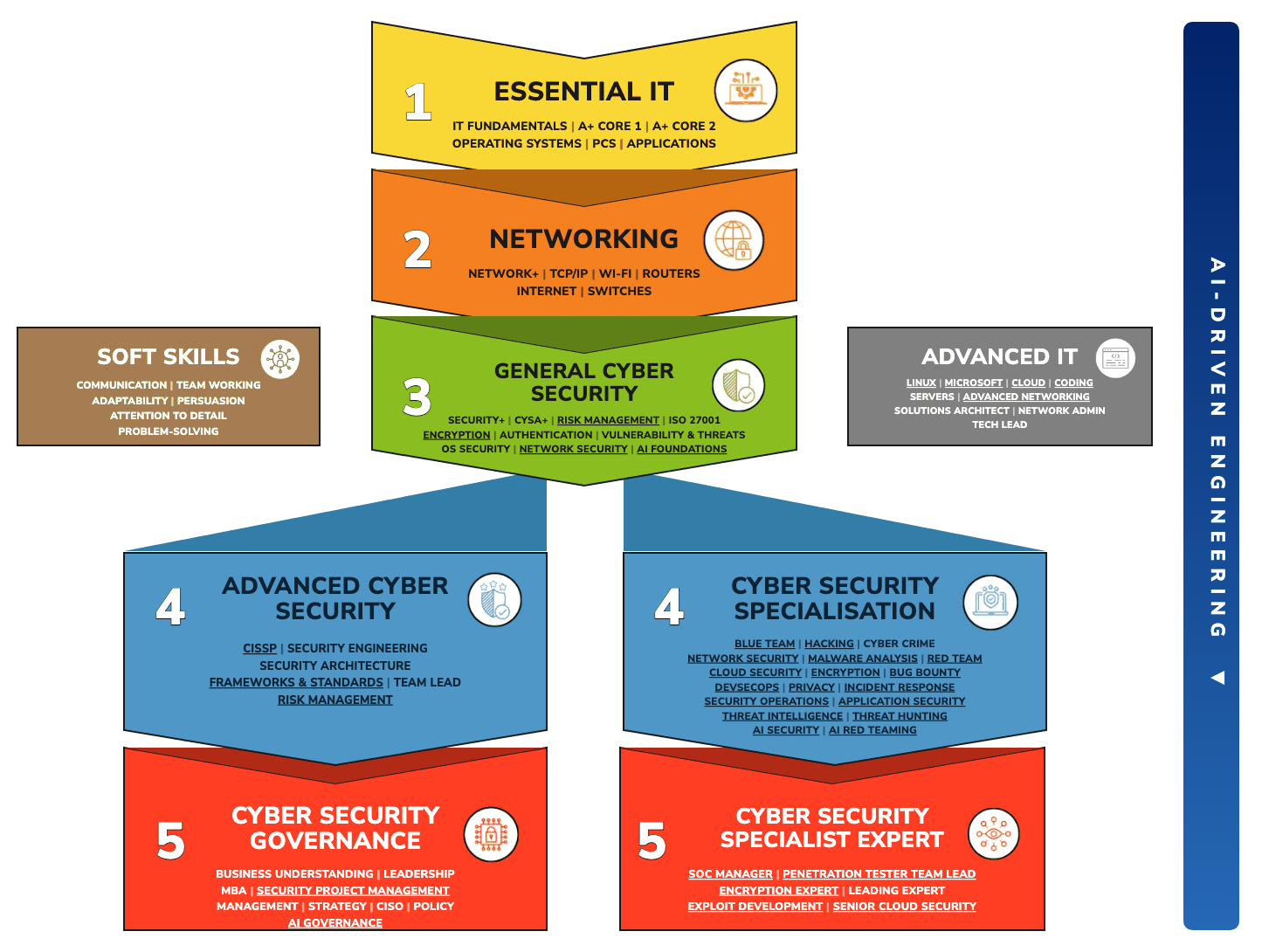
The StationX cyber security roadmap shows where the certifications in this comparison sit: A+ in step 1 (Essential IT), Network+ and CCNA in step 2 (Networking), and Security+ in step 3 (General Cyber Security).
Comparable CompTIA and Cisco Certifications
This section explores the key similarities and differences between the most widely recognized Cisco and CompTIA certifications, helping you understand which path aligns best with your career goals.
CompTIA A+ and Cisco Certified Support Technician

Let’s compare these two entry-level IT certifications to see how they differ in focus, skills, and career value.
CompTIA A+ Exam Details
CompTIA A+ comprises two certification exams. The latest exam codes are 220-1201 for Core 1 and 220-1202 for Core 2, and you must pass both to obtain the CompTIA A+ certification with a passing score of at least 675/900 for Core 1 and 700/900 for Core 2.
Each exam costs $274 USD and consists of a maximum of 90 questions that you’ll have 90 minutes to answer.
For Less.
StationX is a CompTIA Authorized Partner. The same official exam vouchers you'd buy from CompTIA, for less.
CompTIA price USD 548.00
Your exam voucher plus a free second attempt if you don't pass first time.
CompTIA price USD 548.00
Your exam voucher plus a free second attempt if you don't pass first time.
Today's US prices against CompTIA's US list price. Prices change and vary by country; the voucher page shows yours.
The vast majority of questions will be multiple choice; however, there may also be drag-and-drop and performance-based questions (PBQs). PBQs are more hands-on questions that will test your critical thinking skills in addition to your technical skills. The more PBQs you have, the fewer multiple-choice questions you will receive.
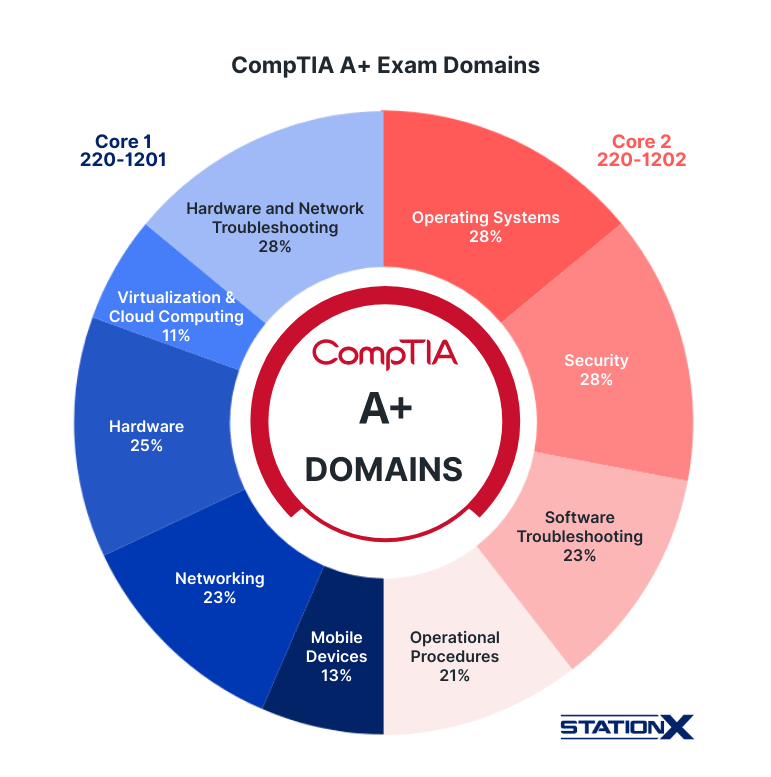
CompTIA A+ Domains
Core 1 Domains (220-1201)
Core 1 focuses on the technical foundation of IT support and infrastructure:
- Mobile Devices (13%)
- Networking (23%)
- Hardware (25%)
- Virtualization & Cloud Computing (11%)
- Hardware & Network Troubleshooting (28%)
Core 2 Domains (220-1202)
Core 2 builds on operational and security competencies:
- Operating Systems (28%)
- Security (28%)
- Software Troubleshooting (23%)
- Operational Procedures (21%)
CCST Exam Details
CCST consists of three domains: CCST Networking, CCST Cybersecurity, and CCST IT Support. You need to pay $125 USD per exam.
Unlike the A+ certification, earning a passing score in any one domain grants a CCST certification in that specific concentration - for example, passing the CCST Cybersecurity exam earns a certification in cyber security.
CCST Domains
- Standards and Concepts
- Addressing and Subnet Formats
- Endpoints and Media Types
- Infrastructure
- Diagnosing Problems
- Security
- Essential Security Principles
- Basic Network Security Concepts
- Endpoint Security Concepts
- Vulnerability Assessment and Risk Management
- Incident Handling
- IT Support Job Tasks and Responsibilities
- Hardware Issues
- Connectivity and Resource Access Issues
- Operating System and Application Issues
- Common Threats and Preventions
- Job Tools
A+ vs CCST Key Takeaways
It’s important to understand why we compare CompTIA A+ and CCST and what the differences actually mean for your career path.
CompTIA A+ is the foundational certification of the CompTIA ecosystem.
Because of this wide scope, it’s split into two exams. The result is a well-rounded baseline skill set that prepares you for general IT roles such as help desk technician, IT support specialist, or junior systems technician. A+ is designed for learners who want broad exposure to multiple areas of IT before choosing a specialization.
Cisco’s CCST, on the other hand, takes a choose-your-focus approach.
Rather than one broad certification, CCST lets you earn a credential in Networking, Cybersecurity, or IT Support by passing just one exam. This structure allows you to build foundational skills in a specific direction from day one. It’s especially useful if you already know you want to pursue a Cisco-aligned path in networking or security, or if you prefer to gain deeper early experience in a single discipline.
What Does This Mean for Your Career?
Both certifications build entry-level competency, but they prepare you for slightly different starting points in IT:
- CompTIA A+ provides a broad foundation, making it ideal for roles that require supporting a variety of technologies, troubleshooting diverse issues, or working across multiple IT functions. It’s a strong first step if you want flexibility or if you're still exploring which IT specialization fits you best.
- Cisco CCST helps you gain focused foundational skills aligned to a specific career direction.
- CCST Networking supports early progress toward routing, switching, and infrastructure roles.
- CCST Cybersecurity helps you start building the fundamentals of cyber security.
- CCST IT Support aligns closely with help desk responsibilities but with a Cisco-flavored technical approach.
Finally, A+ is broader and more general, while CCST is foundational but more targeted. Your choice depends on whether you want breadth first or specialization early.
CompTIA Network+ and Cisco Certified Network Associate
The following sections outline what each exam is about. Don’t forget to check out our in-depth Network+ vs CCNA comparison article for more information.
Network+ Exam Details
The latest CompTIA Network+ exam is N10-009 and costs $399 USD per attempt.
For Less.
StationX is a CompTIA Authorized Partner. The same official exam vouchers you'd buy from CompTIA, for less.
CompTIA price USD 798.00
Your exam voucher plus a free second attempt if you don't pass first time.
Today's US prices against CompTIA's US list price. Prices change and vary by country; the voucher page shows yours.
The exam includes up to 90 questions, a mix of multiple-choice and performance-based questions, and must be completed in 90 minutes. It is scored on a 900-point scale, with a passing score of 720.
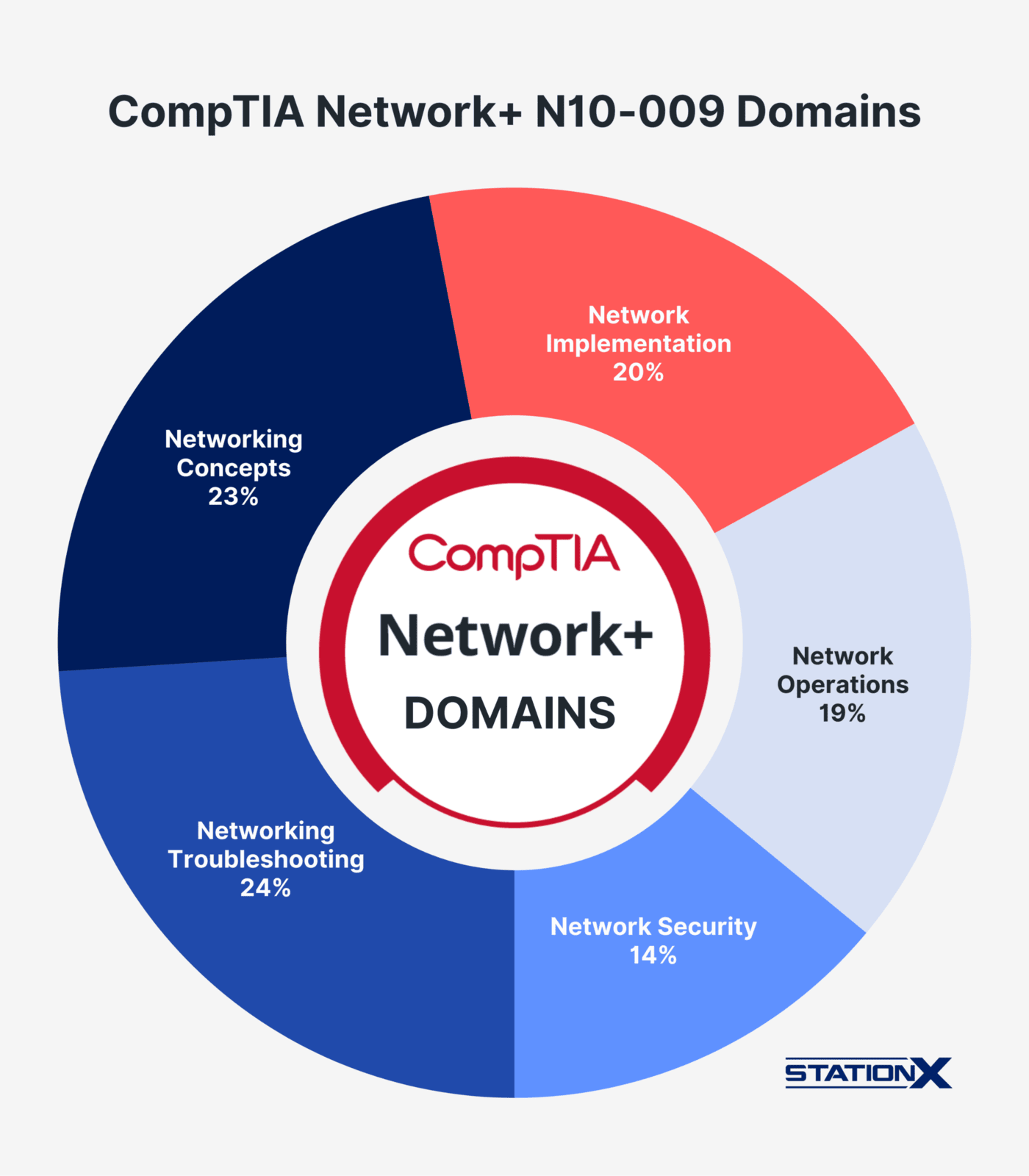
Network+ Domains
- Network Troubleshooting (24%)
- Networking Concepts (23%)
- Network Implementation (20%)
- Network Operations (19%)
- Network Security (14%)
CCNA Exam Details
Like Network+, CCNA candidates must pass a single exam: 200-301, the most recent version of the CCNA certification test, and a key component of the updated CCNA certification pathway.
The exam costs $300 per attempt and has a duration of 120 minutes. It mixes multiple-choice questions with performance-based lab questions. Cisco doesn’t publish the number of questions or the passing score: grading is pass/fail. Cisco replaces CCNA v1.1 with CCNA v2.0 (still exam 200-301) on February 3, 2027; the domains below are for v1.1.
The total number of exam questions varies depending on the number of performance-based lab tasks included. These performance-based questions are hands-on scenarios that require you to configure, troubleshoot, or analyze network setups rather than simply selecting the right multiple-choice answer.
Because the labs are more involved, budget roughly 5-7 minutes per lab task as a rule of thumb. Plan your time accordingly, prioritize easier items first, and leave a small window at the end for review. Treat each lab as a mini practical exercise: read the requirements carefully, make incremental changes, and verify results before submitting.
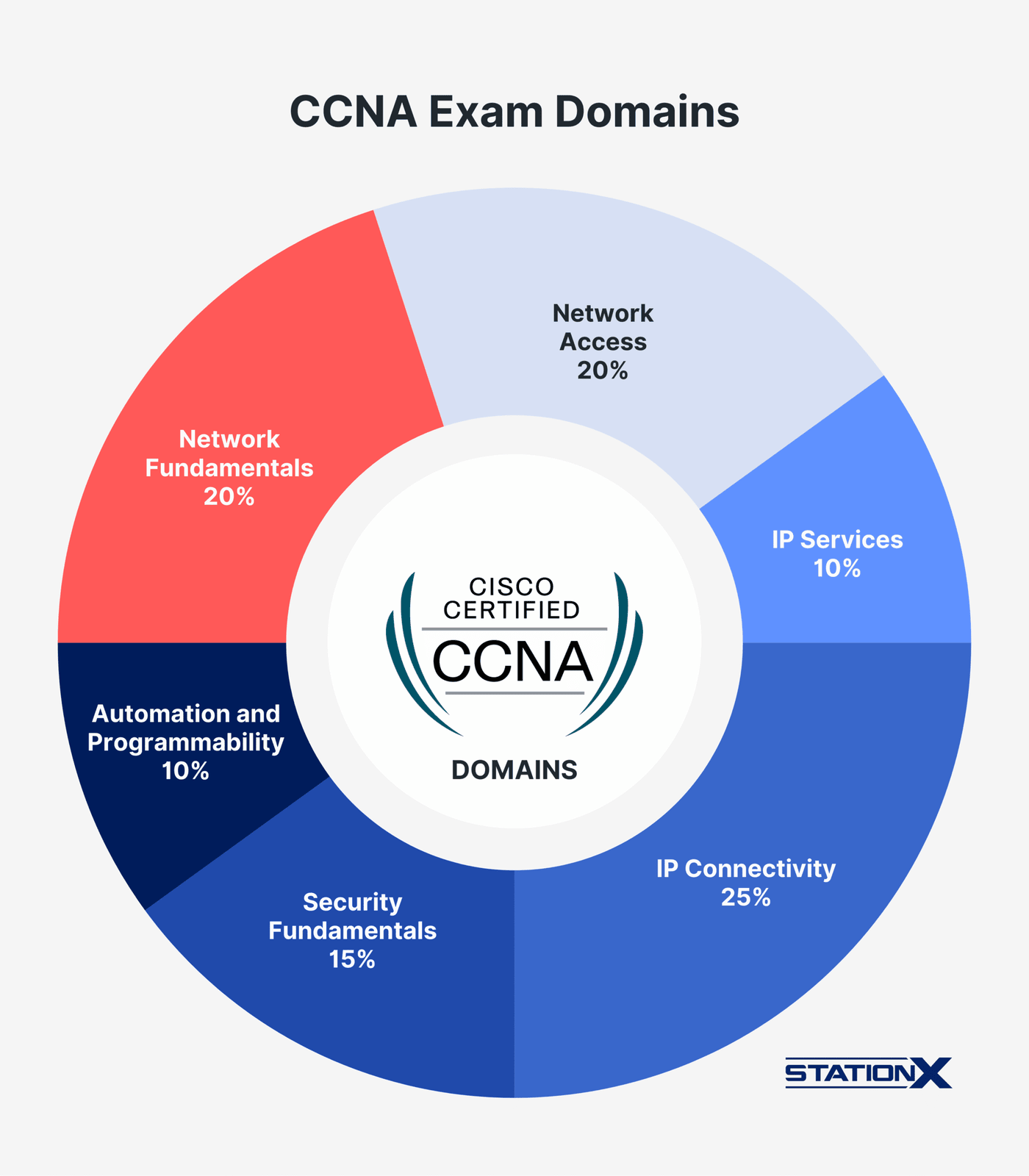
CCNA Domains
- Network Fundamentals (20%)
- Network Access (20%)
- IP Connectivity (25%)
- IP Services (10%)
- Security Fundamentals (15%)
- Automation and Programmability (10%)
Network+ vs CCNA Key Takeaways
While both certifications cover similar networking fundamentals, their approaches and depths differ significantly.
CompTIA Network+ offers a wide-ranging overview, providing a foundational understanding of networking concepts across multiple technologies and platforms. It’s ideal for IT professionals seeking a comprehensive overview of networking basics, troubleshooting, and operations without being tied to a specific vendor.
Network+ prepares learners for generalist networking roles and is a strong stepping stone to more specialized certifications.
Cisco CCNA, in contrast, provides a more focused, in-depth understanding. It focuses on Cisco hardware and software and requires candidates to demonstrate practical, hands-on skills through performance-based lab questions.
CCNA teaches detailed, actionable knowledge on configuring, troubleshooting, and managing Cisco networks. This makes it especially valuable for those planning to specialize in network administration or engineering, where Cisco systems are widely deployed.
What Does This Mean for Your Career?
- Network+ provides a broad foundation suitable for general IT roles, IT support, or anyone exploring networking before choosing a specialization.
- CCNA delivers practical, in-depth expertise in Cisco systems, preparing you for networking-centric roles and giving you a head start toward advanced Cisco certifications such as CCNP or CCIE.
To sum it up, Network+ is ideal for breadth and foundational knowledge, while CCNA is best for depth and hands-on networking skills. Your choice depends on whether you want a broad introduction to networking or focused, practical skills on a specific platform.
FREE Cyber Security Career Guide
Thinking of a career in cyber security? Our Cyber Security Career Guide walks you through the industry landscape, skill-paths, certifications, and realistic timelines to become job-ready.
CompTIA Security+ and CCNP Cybersecurity

We might once have compared CompTIA Security+ with CCNP Security, but with Cisco’s updated certification paths, CCNP Cybersecurity (formerly Cisco Certified Cybersecurity Professional, renamed in February 2026) is now the more appropriate comparison.
Security+ Exam Details
CompTIA Security+ is a single exam that covers several key domains of cyber security.
Two exam versions are currently live: SY0-701 and the new SY0-801, launched on 17 November 2026. SY0-701 retires in English on 11 June 2027. Both cost $439 per attempt and earn the same Security+ certification. According to CompTIA, each 90-minute test will consist of no more than 90 questions. It is marked out of 900, and 750 is the passing score.
Our advice right now is to take SY0-701, because its training is mature and SY0-801 training is still thin everywhere. Take SY0-801 only if you can't sit the exam before 11 June 2027. Employers don't ask which version you passed, and we'll switch our recommendation to SY0-801 once its training is established. See SY0-701 vs SY0-801 for the full comparison.
Obtaining Security+ demonstrates to employers that you have a baseline understanding of the most significant cyber security topics. It prepares you for roles with a security focus, such as SOC analyst, systems security administrator, or junior security engineer, while also opening the door to more specialized certifications, such as CySA+, PenTest+, or SSCP.
Security+ Domains
SY0-701 domains:
- General Security Concepts (12%)
- Threats, Vulnerabilities, and Mitigations (22%)
- Security Architecture (18%)
- Security Operations (28%)
- Security Program Management and Oversight (20%)
Here are the SY0-701 domain weights next to the new SY0-801 weights:
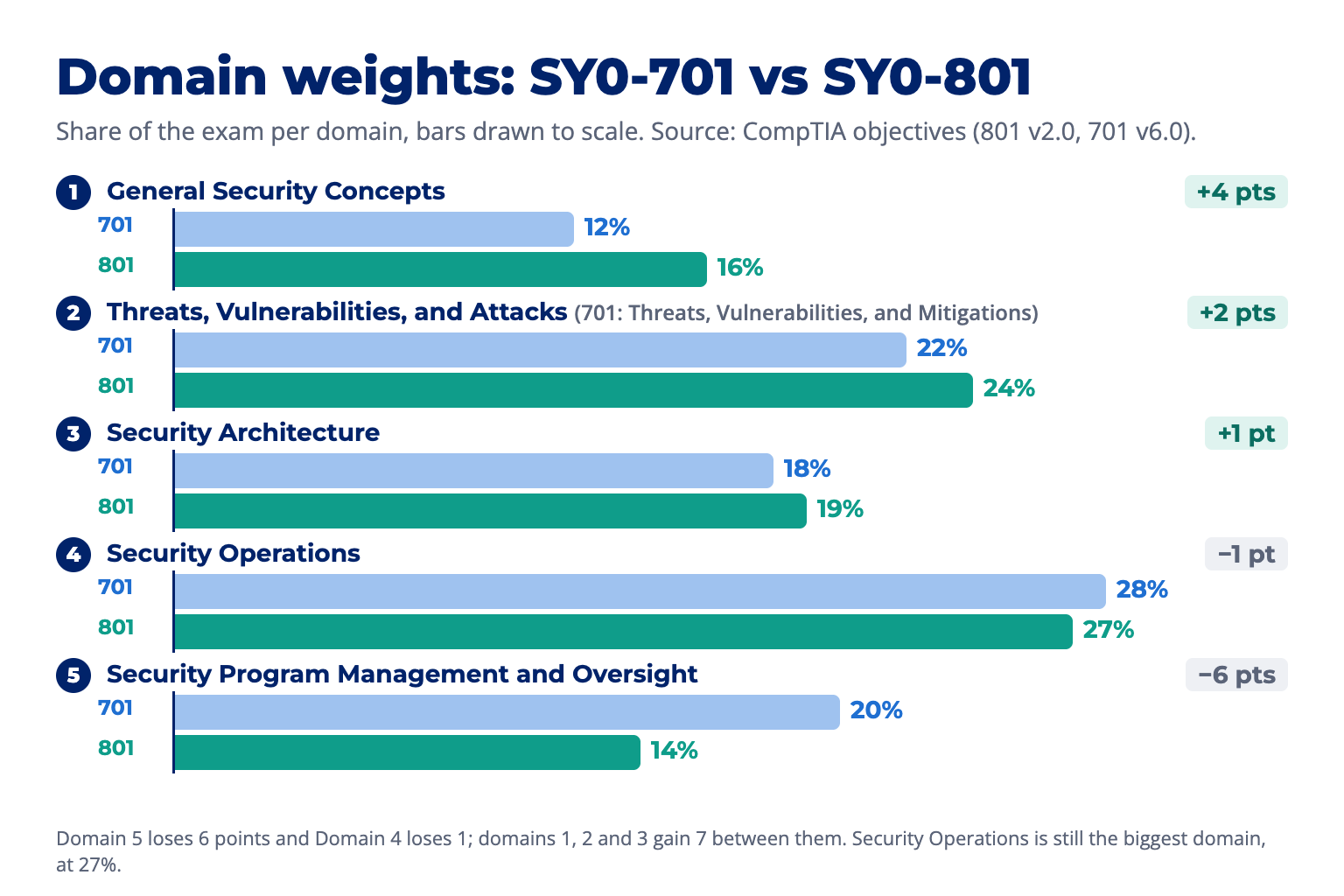
SY0-801 domains (it also adds a new objective on the risks of using AI):
- General Security Concepts (16%)
- Threats, Vulnerabilities, and Attacks (24%)
- Security Architecture (19%)
- Security Operations (27%)
- Security Program Management and Oversight (14%)
CCNP Cybersecurity Exam Details
To obtain CCNP Cybersecurity, you must pass two exams: the Core Exam and one Concentration Exam.
The Core Exam, officially called Performing Cybersecurity Using Cisco Security Technologies v1.2 (CBRCOR 350-201), is a 120-minute exam that evaluates your knowledge of essential cyber security concepts and technologies, including threat detection, incident response, network security, cloud security, and automation. Cisco’s short code for this exam is CBRCOR.
Once you pass the Core Exam, you will need to take a Concentration Exam in a specialized area of cyber security. Cisco’s Core Exam costs $400 USD. Once you pass the Core Exam, you’ll need to take a Concentration Exam, which costs $300 USD.
At the time of this writing, there are two Concentration Exams to choose from, each focusing on a specific cyber security area:
- CBRFIR: Covers forensic investigation processes, evidence handling, incident response, and security monitoring.
- CBRTHD: Focuses on proactive threat detection, mitigation strategies, monitoring tools, and network defense operations.
Cisco may expand concentration options in the future, including specialized cloud security, automation, and DevSecOps topics.
The Core Exam must be completed in 120 minutes, and each Concentration Exam in 90 minutes. Cisco doesn’t publish question counts or passing scores for these exams: grading is pass/fail.
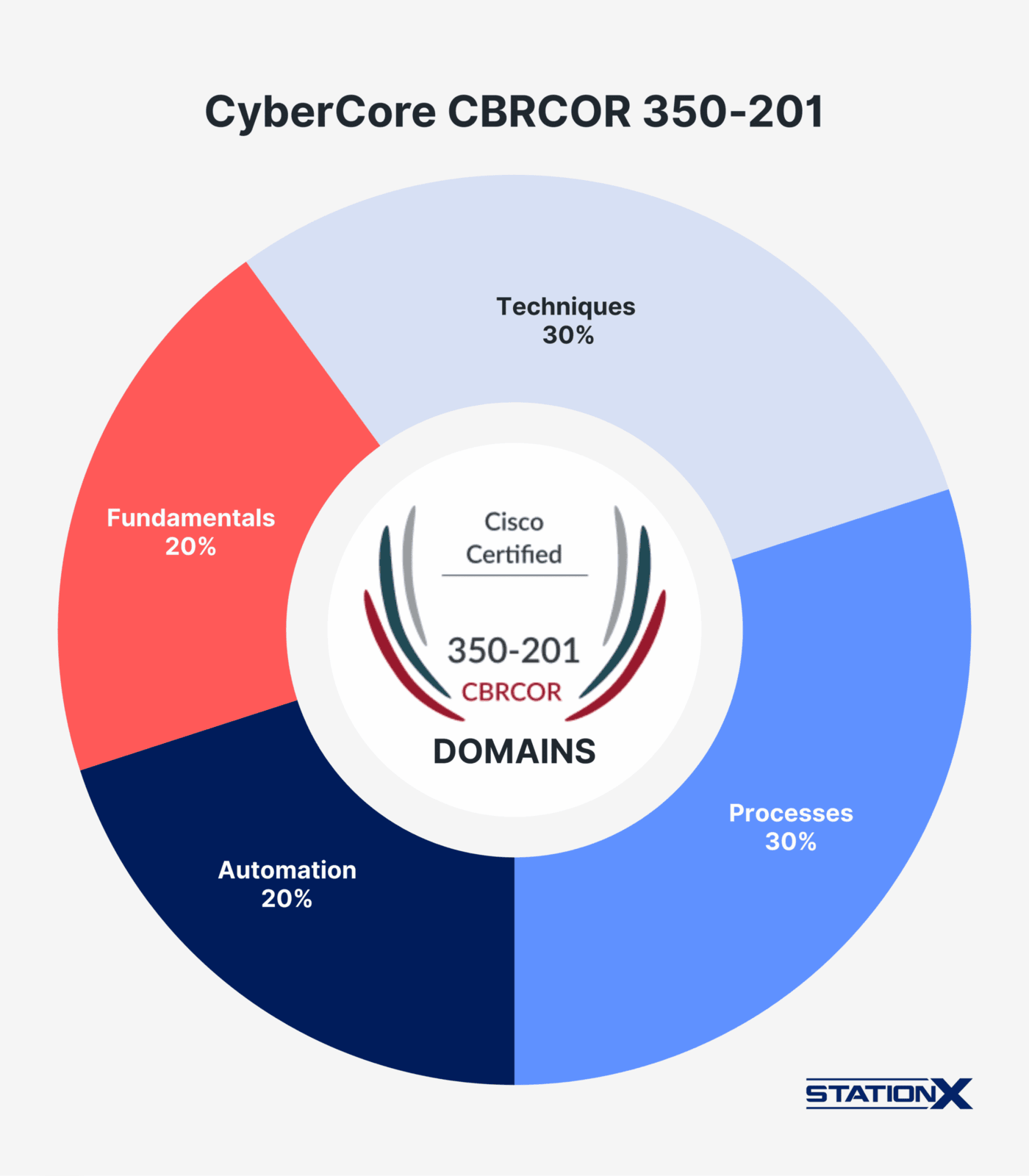
CCNP Cybersecurity Core (CBRCOR) Domains
- Fundamentals (20%)
- Techniques (30%)
- Processes (30%)
- Automation (20%)
Security+ vs CCNP Cybersecurity Key Takeaways
The differences between CompTIA Security+ and CCNP Cybersecurity are clear: they serve different purposes and target different levels of cyber security expertise.
CompTIA Security+ is broad but relatively shallow. It covers a wide range of security topics, from general concepts and threat mitigation to security architecture and operations, without focusing on a particular technology or vendor. Security+ equips you with the terminology, high-level concepts, and foundational knowledge necessary to understand and discuss cyber security scenarios across a variety of environments.
It’s ideal for roles that require general cyber security knowledge, and it gives you a head start in real-world situations even if you haven’t done hands-on work yet.
CCNP Cybersecurity, in contrast, is narrower but much deeper. Candidates pass a Core Exam (CBRCOR) and choose a Concentration Exam, such as Forensic Analyst & Incident Handling or Threat Hunting & Defending, demonstrating specialized knowledge in a specific cyber security domain.
It’s important to note that Cisco offers a wide range of specialized certification tracks (CCNP Security, CCNP Enterprise, CCNP Automation, etc), while CompTIA’s offerings are broader and less granular.
For example, CompTIA has Network+ as a general networking certification, but there isn’t a one-to-one equivalent to Cisco’s Enterprise Networking or other specialized tracks. This means that with Cisco, you can become hyper-focused on a specific networking or cyber security specialty in a way that CompTIA does not offer.
However, for general cyber security knowledge, CompTIA Security+ aligns more closely with Cisco’s CCNP Cybersecurity certification, providing a fair comparison between a broad vendor-neutral credential and a Cisco-specific professional-level certification.
Regardless of which concentration you choose, your certification is recognized as CCNP Cybersecurity, signaling that you are a technical specialist rather than a generalist. This makes it ideal for roles that require hands-on expertise with Cisco security technologies and focused cyber security practices.
What Does This Mean for Your Career?
- Security+ provides a comprehensive overview of cyber security concepts, making it ideal for professionals who need to “talk the talk” and understand high-level security operations across systems and networks. It is also approved for DoD 8140 (DoDM 8140.03), which replaced DoD 8570. CompTIA lists DoD 8140 work roles for SY0-701 but doesn’t list any for SY0-801 yet.
- CCNP Cybersecurity establishes you as a cyber security specialist with in-depth technical knowledge, preparing you for positions that demand hands-on, domain-specific expertise.
Your choice depends on whether you want broad, foundational knowledge across cyber security or a focused, specialist-level credential in Cisco technologies.

CompTIA vs Cisco Certifications: Which Should You Choose?
Both organizations offer well-respected certifications, so your goals are the primary determining factor when choosing between CompTIA and Cisco certifications.
CompTIA is vendor-neutral and teaches broad, transferable concepts across IT. Its certifications (A+, Network+, Security+, etc.) are ideal if you want a broad foundation for roles in help desk, IT support, cloud, cyber security, auditing, or consulting. CompTIA is widely recognized in the U.S., much of Europe, and parts of Asia, and is often preferred by government and DoD hiring panels.
Cisco is networking-focused and intensely practical. Cisco certs (CCNA, CCNP Cybersecurity, etc.) show hands-on ability with real networking equipment and CLI configuration, which is exactly what employers hiring network admins, engineers, and architects want. Cisco skills transfer to other vendors (eg, Juniper), but the pathway is best for people committed to a networking career.
Practical recommendations
- Entry-level/broad recognition: go with CompTIA A+, rather than CCST - more people and employers recognize it as the standard foundation.
- Want a broad networking foundation but not vendor-specific: CompTIA Network+ is useful - good for generalist roles or if you’ll work across cloud & security.
- Aiming to be a networking specialist: pursue Cisco (start with CCNA). Cisco gives a stronger, job-aligned base for enterprise networking roles.
- Going into cyber security/SOC/DoD roles: Security+ is the common, practical starting point (and often a DoD requirement). For many security jobs (SOC analyst, penetration testing, incident response), Security+ plus hands-on labs is more directly useful than CCNP Cybersecurity.
- Need deep, hands-on security expertise: choose CCNP Cybersecurity - ideal for operational roles like incident response or threat hunting where mastery of Cisco security tools matters.
Finally, always check job listings in your region or at the companies you want to work for. That will tell you which certs employers actually value.
Conclusion
We’ve highlighted the key similarities and differences of beginner- to intermediate-level Cisco vs CompTIA certifications, and we hope this article comparing the merits of CompTIA vs Cisco certifications has been helpful in your IT learning and career journey.
Whichever route you take, follow our roadmaps on StationX Labs for CompTIA A+, Network+ and Cisco CCNA: video lessons, guides, cheat sheets and hands-on browser labs. Free to register, with a free lab to try.
If you want to study Security+ step by step, follow our Security+ roadmap on StationX Labs: video courses for each exam domain plus hands-on labs for SY0-701 (our SY0-801 roadmap is coming soon), free to start.
When you're ready to book, you can save up to 50% on a CompTIA Security+ exam voucher purchased through StationX.
For Less.
StationX is a CompTIA Authorized Partner. The same official exam vouchers you'd buy from CompTIA, for less.
CompTIA price USD 878.00
Your exam voucher plus a free second attempt if you don't pass first time.
Today's US prices against CompTIA's US list price. Prices change and vary by country; the voucher page shows yours.
We wish you all the best in gaining your preferred certifications!
Frequently Asked Questions
What is the Cisco equivalent to CompTIA A+?
The Cisco equivalent to CompTIA A+ is Cisco Certified Support Technician (CCST).
Which is better: CCNA or CompTIA Network+?
It depends on your career goals. Generally, CCNA is for aspiring networking professionals, while Network+ is for those looking to build a solid foundation in networking for advanced certifications such as Security+. Our in-depth article, “Network+ vs CCNA,” answers this question.
Should I take A+ before CCNA?
You don't have to take both exams, but if you intend to do so, the answer is a resounding “yes.” A+ will supply you with the necessary background knowledge behind the networking concepts in Network+ and CCNA.
About the Author

Nathan House, Founder & CEO of StationX
Nathan House has 30 years of hands-on cybersecurity experience and is Cambridge-educated, holding CISSP, CISA, CISM, OSCP, CEH, and SABSA. He founded StationX in 1999 — one of the UK’s first cybersecurity companies — and has secured £71 billion in UK mobile banking transactions and the London 2012 Olympics, advising clients including Microsoft, Cisco, BP, Vodafone, and VISA. He authored the world’s most popular cybersecurity course — a #1 Udemy bestseller taken by over 500,000 students — and was named Cyber Security Educator of the Year 2020, AI Security Educator of the Year, and a UK Top 25 Security Influencer 2025. A DEF CON speaker and featured expert on CNN, Fox News, NBC, and the BBC, Nathan leads StationX’s training of more than half a million students worldwide.