You Don't Need to Code for Cybersecurity (2026)
Do you need to code for cybersecurity? For years, my answer was "it depends on the role". My answer has changed. If you're about to spend months learning to code so you can get into security, read this first.
I've been in cybersecurity for 30 years and helped over half a million people into the field, and I held that "it depends" position for most of it. In this guide, we'll look at what changed, what the job ads now ask for (from our own archive of 661 of them), and what to learn instead of syntax.
TL;DR if you've only got 30 seconds
AI coding tools can now write working code from a plain-English description, and AI is getting better at security work fast. Typing code from memory matters less than it did.
The job ads haven't dropped code: 61% of the AI-driven security ads we archive mention Python. But 26% also name an AI coding tool like Claude Code or Cursor.
So you don't need to be a programmer. You need to read code, describe what to build, and test what the AI hands back.
Learn five principles instead of syntax: APIs, requirements, testing, system design, and directing AI agents with good context.
Does Cybersecurity Require Coding?
Here's the old answer. Some roles needed scripting: penetration testers wrote Python exploits, and security engineers automated jobs with Bash. Most roles, like GRC (governance, risk and compliance), management, audit and compliance, rarely touched code day to day. So "it depends" was fair.
It was correct, past tense. Something fundamental changed in the last year or so, and in my view it changes the answer for nearly every role. The new answer: you don't need to be a coder, but you do need to work with the AI that writes the code. That's a different skill, and it's the one this guide is about.
What Changed: AI Writes the Code Now
Code is deterministic. Give it the same input and you get the same output, so you can check whether an answer is right. That makes it exactly the kind of work AI masters first. And the evidence that it's mastering security work, not just everyday code, keeps getting stronger:
500 zero-days, then thousands. In February 2026, Anthropic said Claude Opus 4.6 had "found and validated more than 500 high-severity vulnerabilities" in open-source software. Two months later, its Claude Mythos Preview model found thousands of previously unknown flaws across every major operating system and browser. I break that down in The Future of Cybersecurity.
Exploits, not just bugs. Back in 2024, a University of Illinois study found GPT-4 could exploit 87% of a set of 15 known vulnerabilities when given their descriptions, but only 7% without them. (A vulnerability is a flaw; an exploit is working code that uses the flaw to break in.)
The labs are locking models down. OpenAI says GPT-6 Astra "meets our Critical threshold" for cybersecurity capability under its Preparedness Framework. Anthropic has held Mythos back from general release, sharing it only with partners in its Project Glasswing defence programme. The labs themselves are worried about what attackers could do with these models.
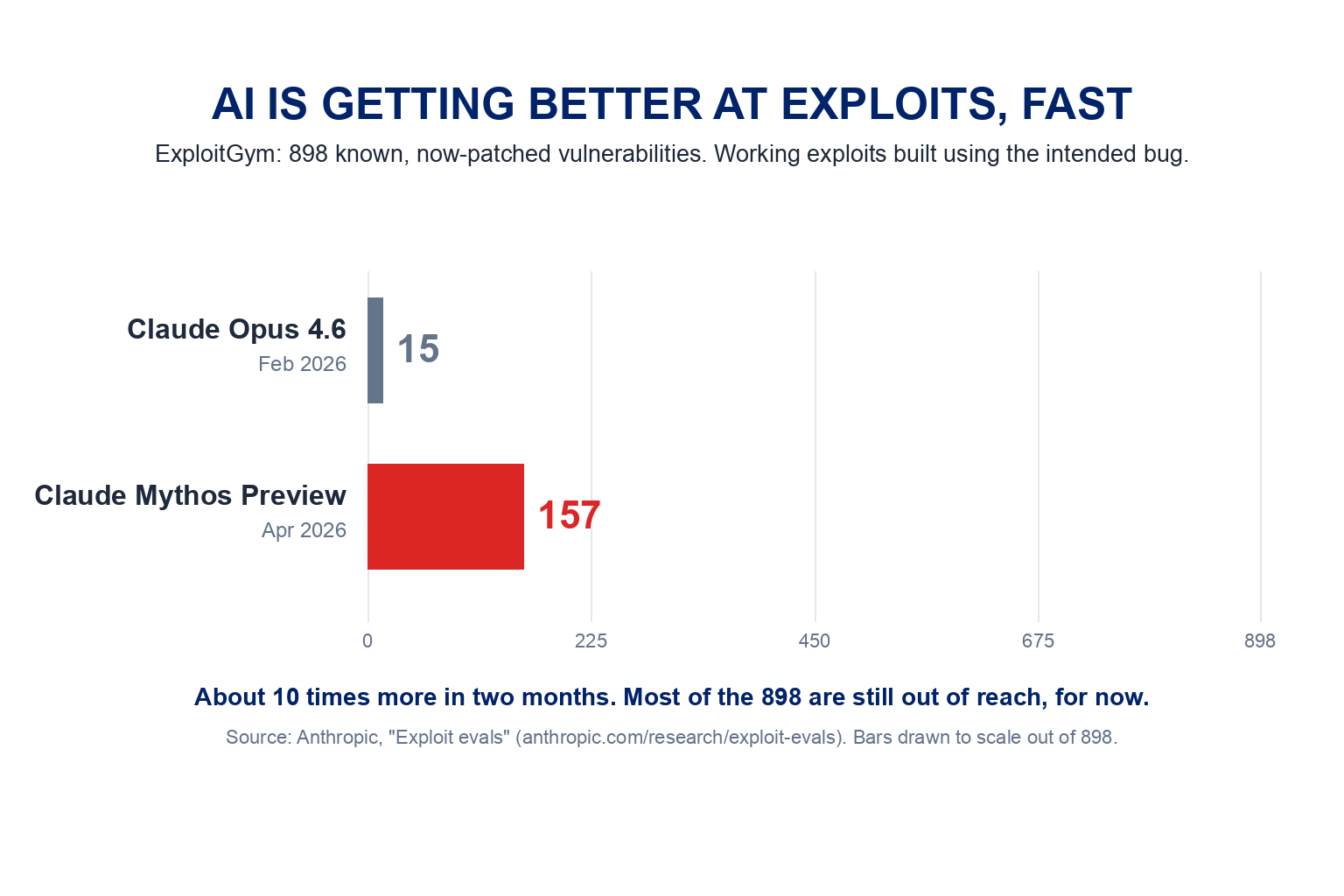
On Anthropic's ExploitGym test of 898 known, patched vulnerabilities, Opus 4.6 built 15 working exploits using the intended bug. Mythos Preview built 157. That's a different, larger test from the 2024 study, so don't compare the percentages; compare the two models on the same test. Most of the 898 are still out of reach, but that's roughly ten times more in about two months. These models aren't only writing code. They're finding flaws humans missed and exploiting them. If AI can do this much, I think being able to type code from memory is worth less every year, and the job ads below show employers already asking for AI tools alongside it.
Entry-Level Work Is Changing
It's already showing up in hiring. In May 2025, CrowdStrike cut about 500 jobs, roughly 5% of its workforce. CEO George Kurtz's memo said it outright: "AI flattens our hiring curve." The memo doesn't say which roles went. But the work AI handles best is the scripted, playbook-driven kind: tier 1 alert monitoring, basic scanning, routine log checks.
And security leaders expect more of the same. In a McKinsey survey of 104 large enterprises, 35% said they expect AI agents to replace their tier 1 SOC (security operations centre) analysts within three years.
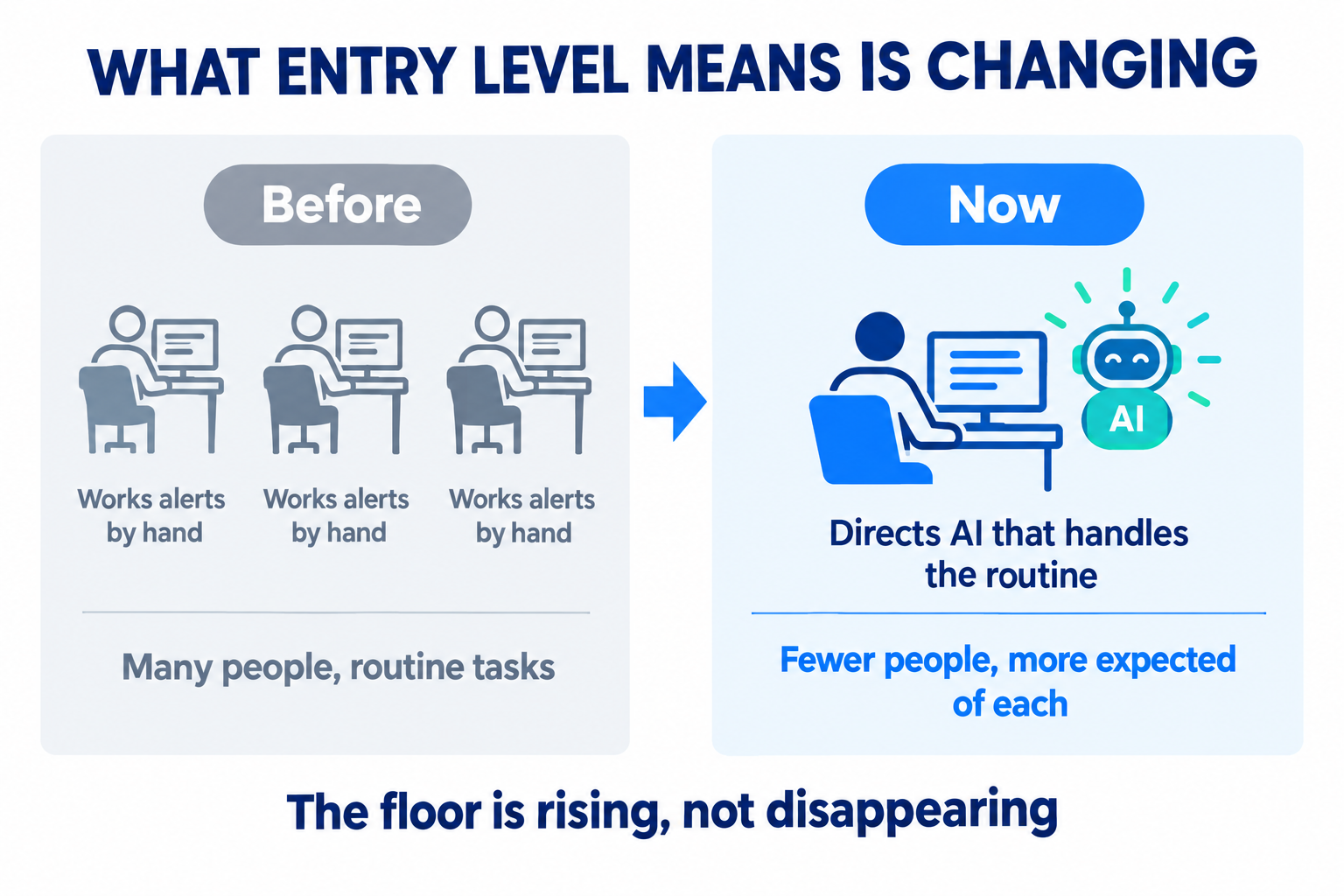
That doesn't mean cybersecurity jobs are going away. The field is growing. What I expect to change is what entry level means: fewer people doing tier 1 work by hand, more expected of each one, and AI doing the routine part. If you want to know which roles hold up best, I cover that in Will AI Replace Cybersecurity Jobs?
Writing Code vs Creating Solutions
This is the most important idea in this guide. There's a big difference between writing code and creating solutions, and we still need solutions.
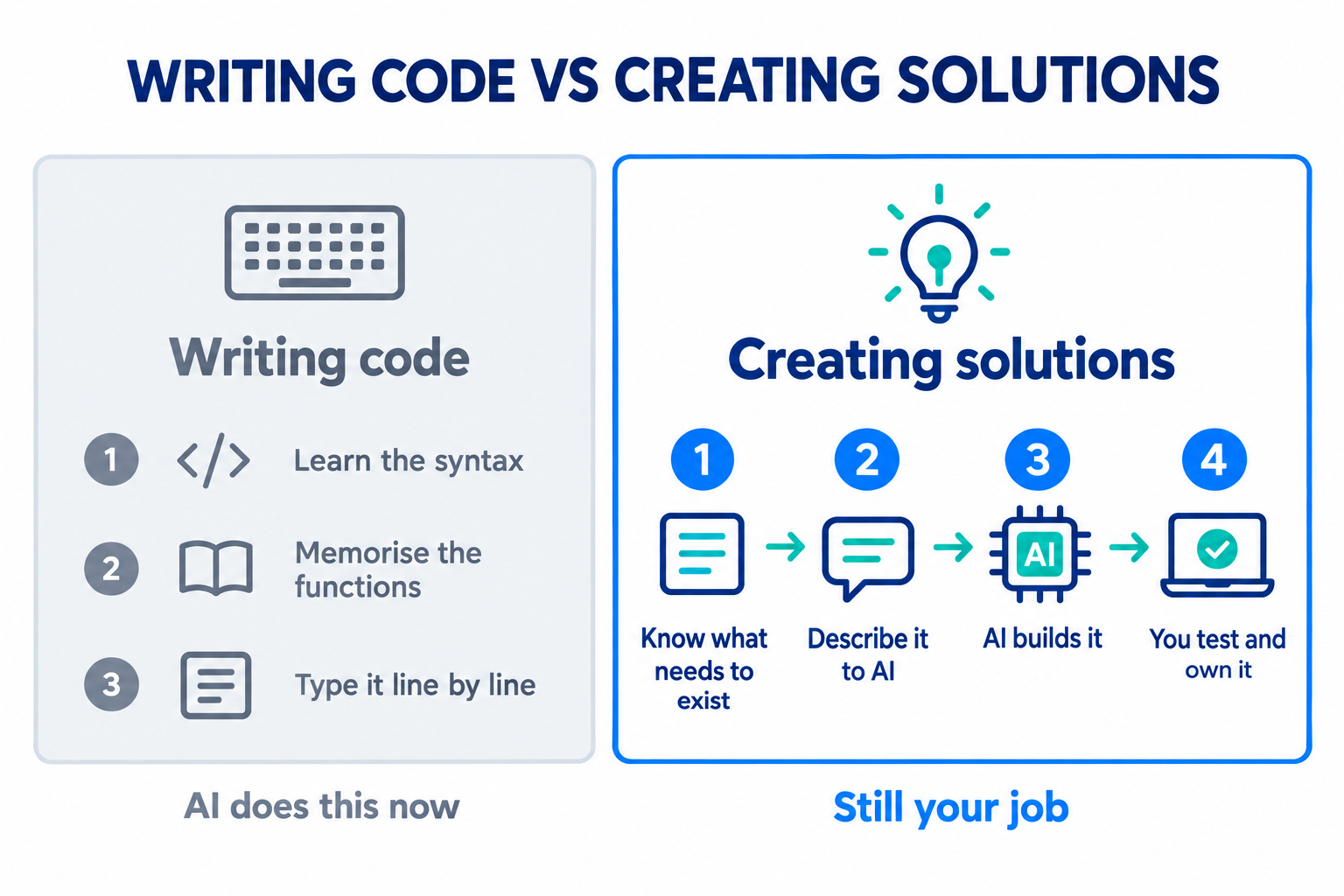
Writing code means translating an idea into a language a computer understands: learning the syntax, memorising the functions, typing it line by line. That's the part that's being automated. Creating solutions means knowing what needs to exist and why, then using AI to make it happen.
AI can't do that part for you. It doesn't know your organisation's strategy or your network. It doesn't know why you need a particular detection rule, in this order, for this threat. That's the human part, and it's becoming more valuable, not less.
You can see it in every role:
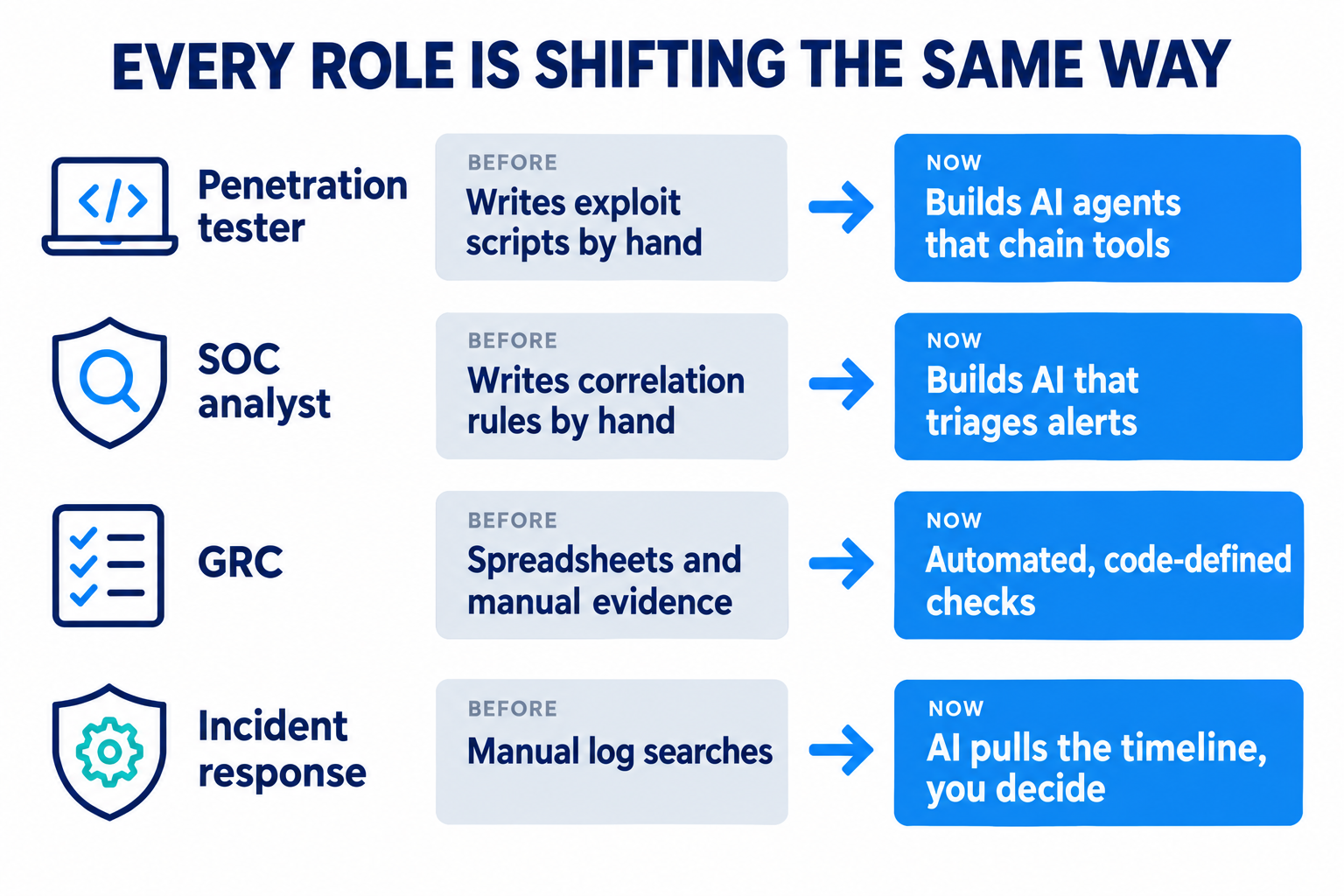
A penetration tester builds AI agents that chain tools and techniques at scale, rather than writing every exploit script by hand. A SOC analyst builds systems that triage alerts and correlate signals, rather than writing every rule. GRC, blue team, audit and incident response are heading the same way. So the question isn't "should I learn Python?" It's "what do I actually need to know?"
What the Job Ads Actually Ask For
Before we get to that, let's check this against real hiring. We archive job ads for AI-driven cyber security jobs, the security roles that build or direct AI systems, and I counted how many mention Python and how many name an AI coding tool such as Claude Code, Cursor, Copilot or Codex:
What AI-driven security job ads ask for
Let me be straight with you: the ads haven't dropped code. 61% of the 661 ads mention Python. So "coding is dead" isn't true. What's changed is how they expect you to do it. 26% of the ads name an AI coding tool, and some name both in the same sentence:
A GRC role at Affirm (archived August 2026) wants someone comfortable "shipping automation using modern tooling (Python, Cursor, Claude, and other agentic coding platforms) to replace manual GRC work". That's a compliance job, not a developer job.
A security and automation engineer at Mindtickle (archived August 2026, asking for 1 to 3 years' experience) says: "Use Claude Code, Python, and GCP to design and ship automations across multiple environments."
A founding security engineer at Boom (archived July 2026) puts it bluntly: "Daily Claude Code use is table stakes."
Python appears less in some specialisms than others: 29% of security leadership ads and 45% of GRC ads mention it, against 70% in detection and SOC. A keyword count can't tell you how much code each job writes by hand. But when ads name Python and an AI coding tool in the same breath, as the first two do, I read that as: be able to work with code, and use AI to produce it. That's the skill set I'd aim for.
What to Learn Instead of Python Syntax
So if not syntax, what? Principles. Here are the five I'd focus on:
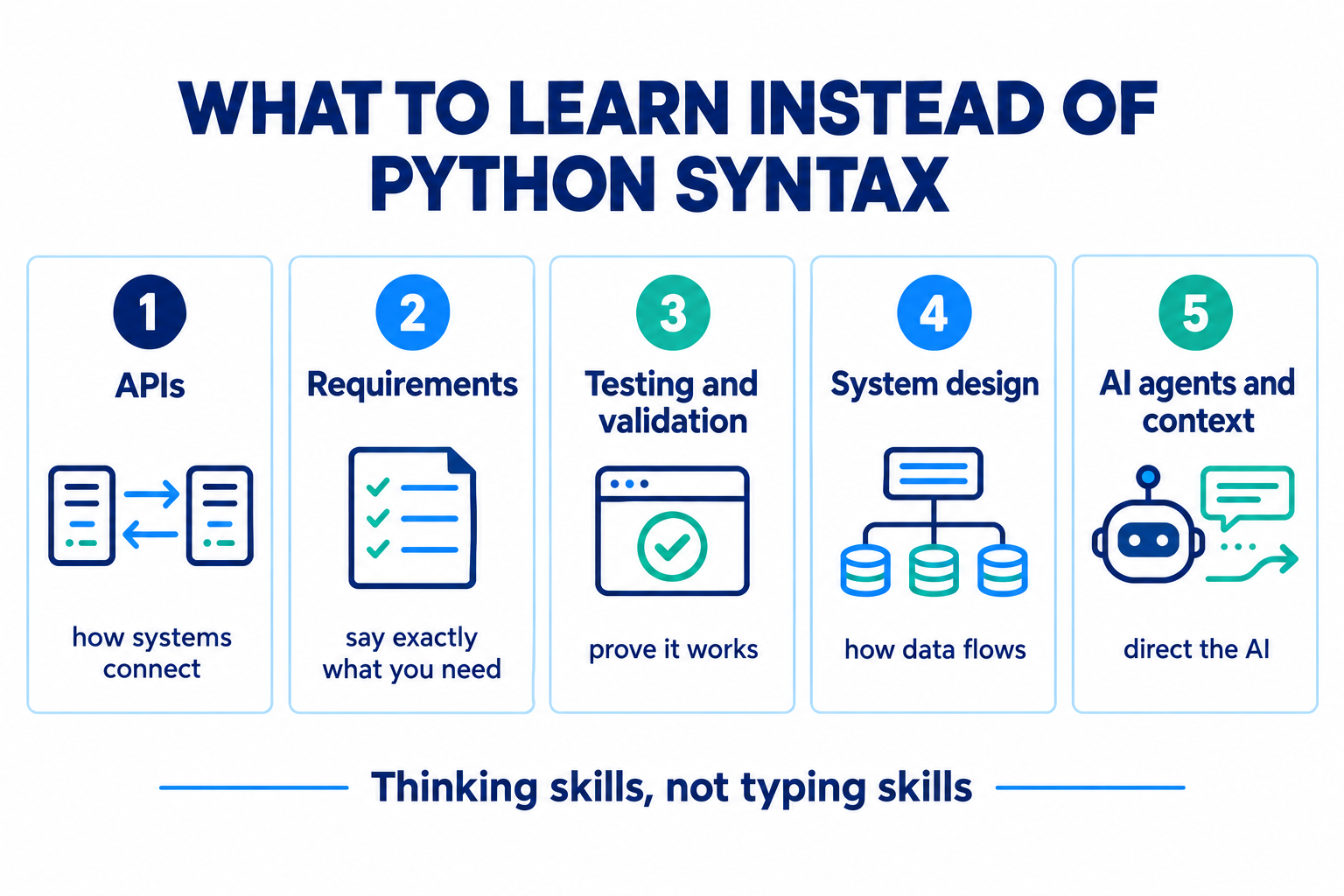
1. APIs. Not how to code one, but how systems connect. When you build an AI security workflow, you're joining tools together, so you need to know what an API does and when to call it.
2. Requirements. It sounds boring, but it's everything. AI can't read your mind. The more precisely you describe what you need, the better the output. This is what separates people who get mediocre AI results from people who get great ones.
3. Testing and validation. You can't supervise what you don't understand. When AI writes a detection rule or a scanning script, you need to know whether it actually works. Not how to write it, but how to prove it.
4. System design. How things connect across a complex environment: how data flows, where the dependencies are, and whether you're meeting the business's tactical, operational and strategic security needs.
5. AI agents and context. Directing AI agents is the new technical skill replacing hand-coding: briefing them well, chaining tools together, and checking their work. More on this below.
Notice that none of the first four requires you to write a line of code. These are thinking skills, not typing skills. If you want to see which of them employers pay most for, my cyber skills analysis scores six security skills against 3,500 jobs.
How Much Code Do You Actually Need?
"Read code" is vague, so here's what I mean. You should be able to:
Read a short script and explain it. Take a 50-line Python script and say, in plain English, what it does and what it touches.
Run it, change it and read the errors. Run a script, change a value such as a file path or a threshold, and understand the error message when it breaks.
Spot when it's wrong. Notice when AI-written code does something you didn't ask for, like deleting files, sending data somewhere or skipping a check.
Test it before you trust it. Check it against a case where you already know the right answer.
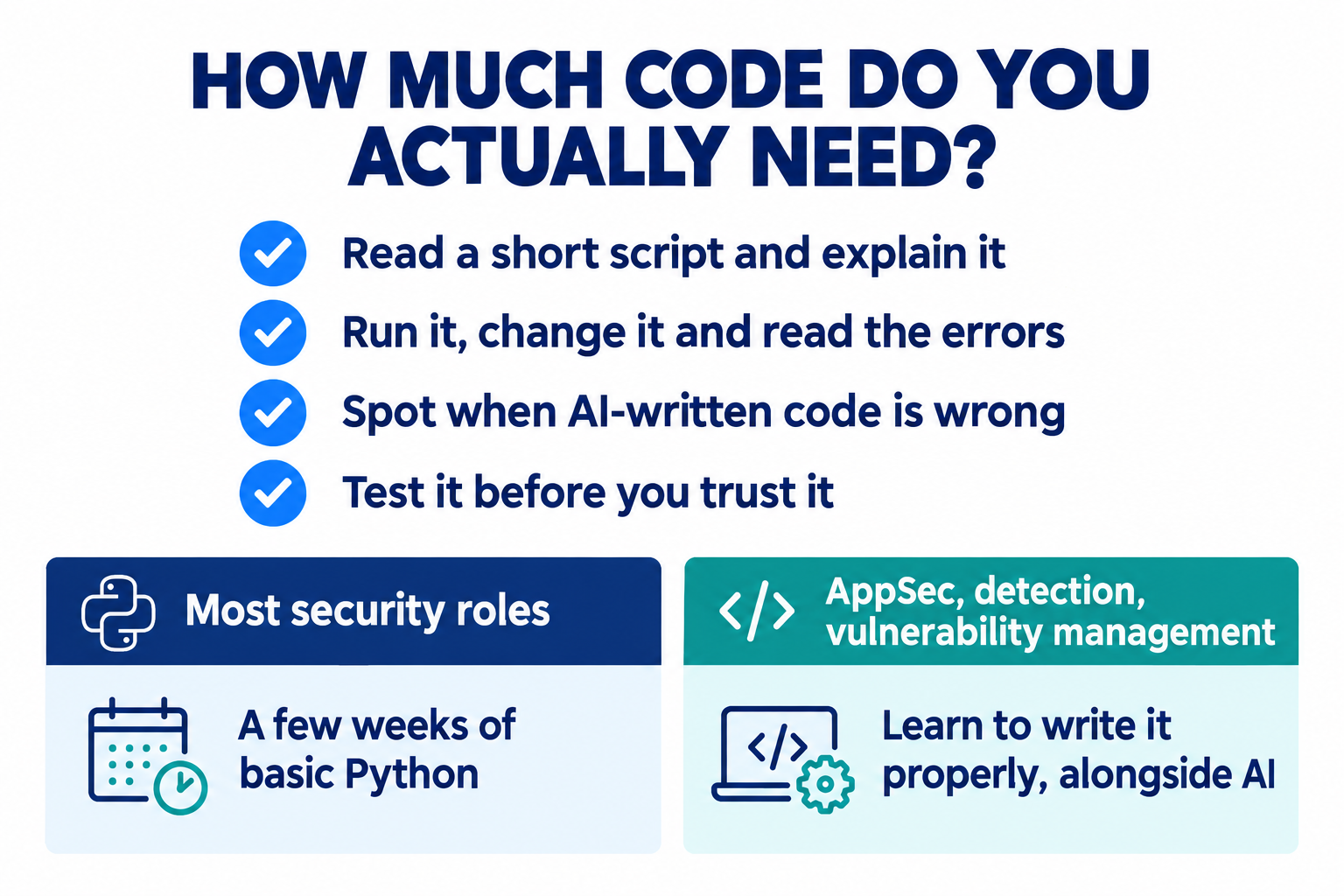
In my experience, a few weeks of basic Python gets most people there: variables, loops, functions and reading error messages. When is it worth going further and learning to write code properly? If you're aiming for application security, detection and SOC engineering, or vulnerability management. Those are the specialisms where 65% to 74% of the ads mention Python, and you'll be reviewing AI-written code all day. Even then, learn it alongside an AI coding tool, not instead of one.
How I Built HAL With 95% AI
How do I know this works? Because I've built it. I run my business on an AI system I built called HAL. I can describe a SOC monitoring setup in plain English and have it built in minutes. I use it to run security scanning across our domains, automate threat detection and manage incident response.
About 95% of HAL's code was written by AI. But I had to know what to ask for, how to test it, how to check it for vulnerabilities and bugs, and how to fit the pieces together. That's the job now.
Here's a small example. Say I need a script that checks the SSL certificates on 50 domains and alerts me if any expire within 30 days. I describe that in a few sentences. AI writes it. I check the logic and test it. Done. That used to be an afternoon of Python. Now it takes minutes, depending on how much context the AI already has about my environment.
The Tools You'll Use
The workflow has changed. You don't open a text editor and start typing Python. You open an AI coding agent and describe what you need. These are the main ones:
Claude Code. A terminal agent, meaning you run it in a command-line window and talk to it in plain English. It's the one I use most. You tell it what you need; it reads your code, writes the changes, runs tests and commands, and manages Git (the system that tracks changes to code). I built HAL with it.
Cursor. An AI-native code editor. You work alongside the AI in real time, and it understands your whole project and suggests changes across many files.
The rest of the field. OpenAI's Codex CLI, Google's Antigravity CLI (which replaced Gemini CLI for most users in June 2026) and Devin Desktop (the editor formerly called Windsurf) are all strong. New ones launch every month.
Keeping track of them is a job in itself, so we keep an AI tool landscape of more than 400 AI tools, from coding agents to agent frameworks and security tools. It's free. If you want the deeper version of how to work with these tools properly, read Agentic Coding: What It Is and Why It Still Needs You.
You don't configure things by hand or drag boxes around a workflow builder anymore. You describe the problem, the AI builds a solution, and you check it and direct it.
Context Engineering: The Real New Skill
The real skill is giving the AI the right context: your environment, your requirements and your constraints. That's what makes the output good.
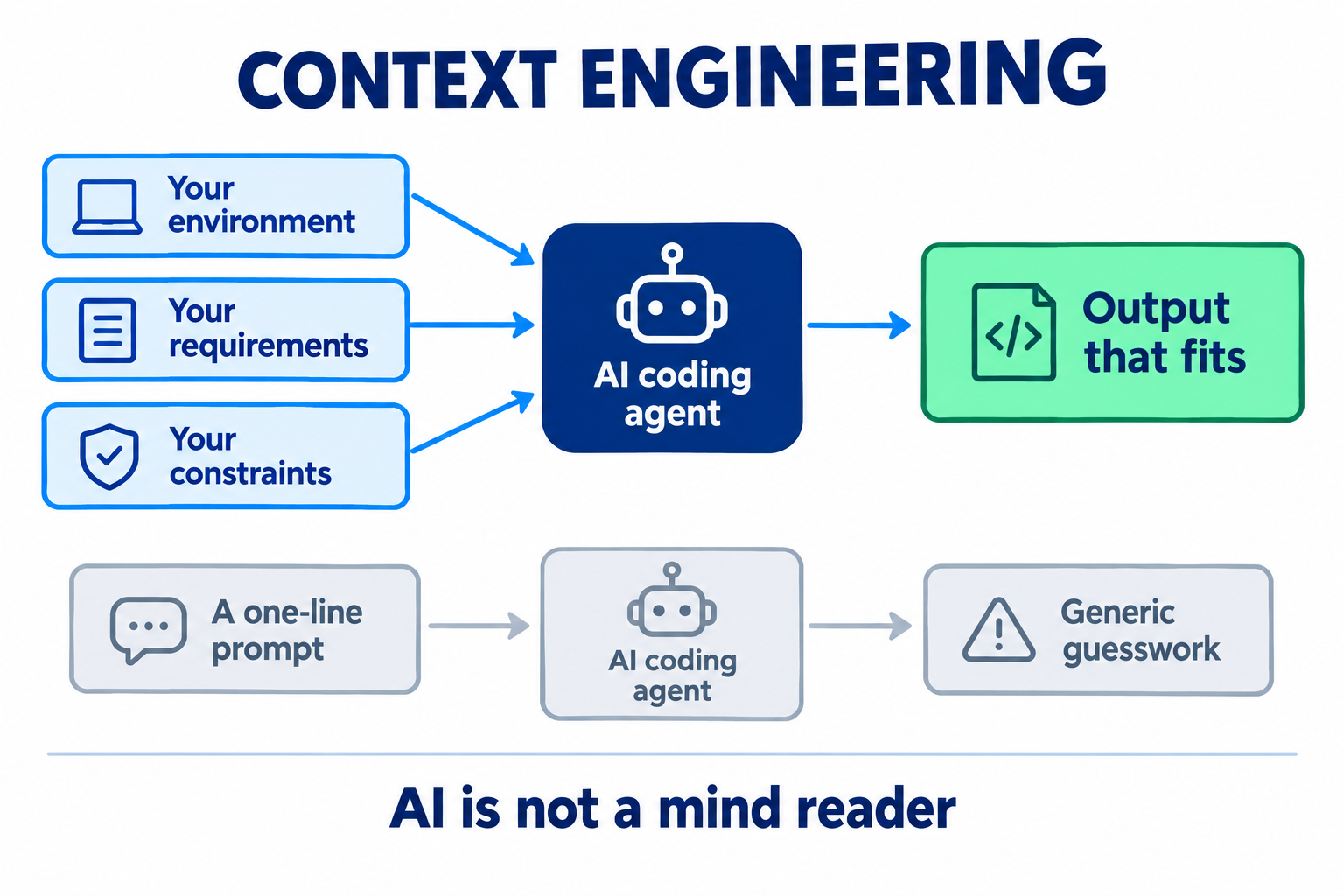
You can't rely on the model knowing what to do. It isn't a mind reader. It doesn't know your network, your policies or what "done" looks like for your team. Brief it well and it builds what you need. Give it one line and you get generic guesswork. That gap is context engineering, and it's the skill that will separate good security people from average ones.
Why Defenders Must Use AI Now
I want to be direct about this. Attackers are already using AI. Google's threat intelligence team reported in September 2026 that it continues to see "widespread adoption" of AI by threat actors, naming state-backed groups linked to China, Russia, Iran and North Korea, plus criminal gangs. In November 2025, Anthropic disrupted a state-backed espionage campaign where AI performed 80 to 90% of the work.
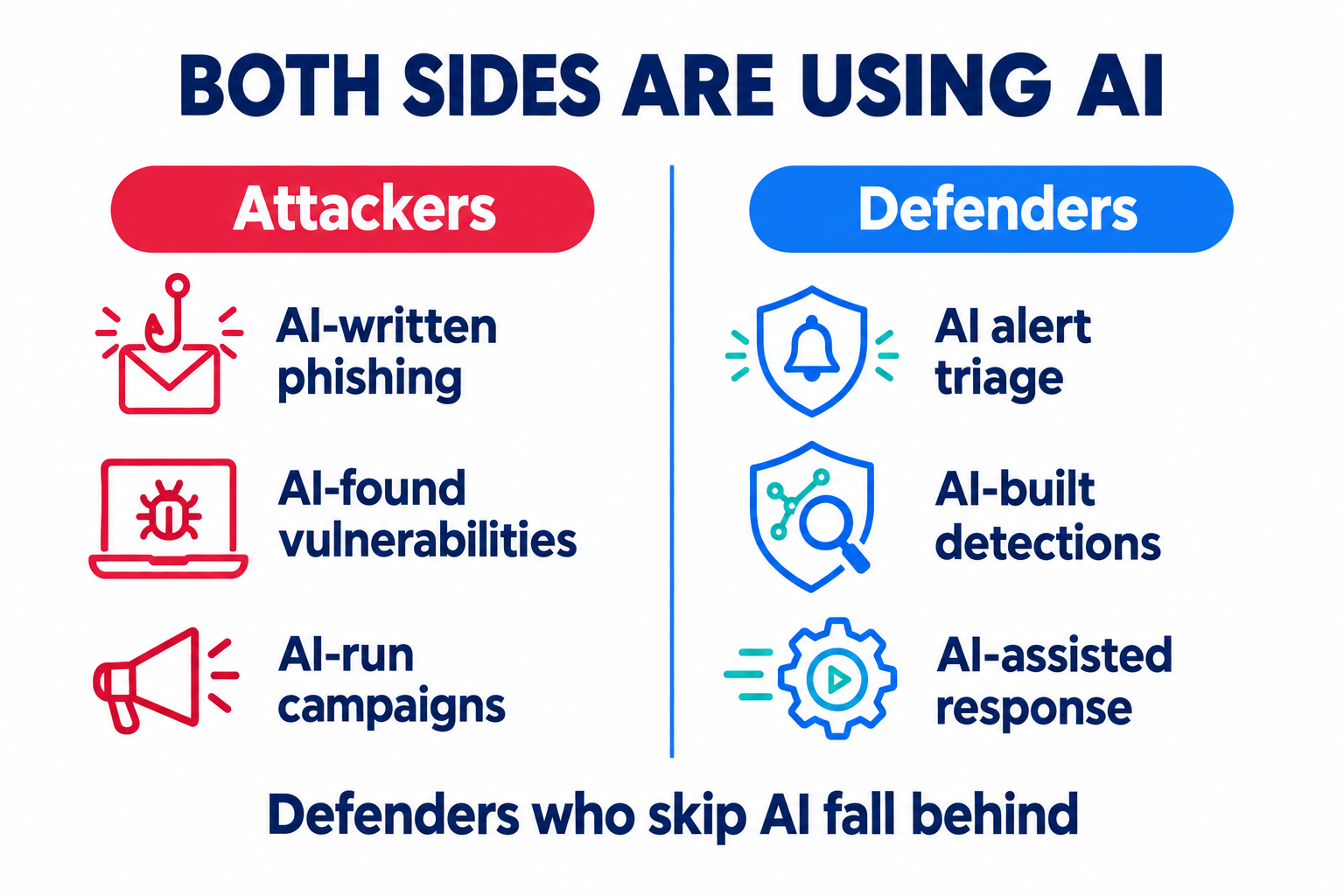
So defenders have to use AI too, and so do pen testers. Learning Python isn't wrong. But if you're spending three months memorising syntax before you've touched an AI coding tool, I think you're solving yesterday's problem. Syntax isn't the bottleneck anymore. Thinking is.
The skill isn't coding. It's knowing what to build and getting the AI to build it well. The people who master the fundamentals and learn to work with AI will design the systems everyone else uses. That's where the career is, and that window is open right now.
You don't need to code, but you do still need to get hired. My free career guide and course shows you how to map the route. And if the "is it too hard for me?" question is what's holding you back, read Is Cybersecurity Hard?
If you want to go further and become an AI-driven security engineer, that's what our AI Master's Program is for (a mentored StationX programme, not a university degree). You learn to direct AI to solve real security problems, with a weekly peer group, and you finish able to build credible commercial security solutions and your own AI infrastructure. You can get a full refund up until the programme begins, and if you haven't proven you can build your own working solutions by the end of the programme year, the programme stays open until you do, at no extra cost.

Frequently Asked Questions
Does cybersecurity require coding?
Not in the way it used to. You don't need to be a programmer, because AI coding tools can now write much of it for you. But you do need to read code, describe precisely what you want built, and test what the AI hands back. In our archive of 661 AI-driven security job ads, 61% mention Python and 26% name an AI coding tool such as Claude Code or Cursor.
Which cybersecurity jobs don't require coding?
Governance, risk and compliance (GRC), security leadership, audit and most management roles need the least. In our archive, 29% of security leadership ads and 45% of GRC ads mention Python, against 70% of detection and SOC ads. But some GRC ads now ask for automation built with AI tools, so expect to direct AI rather than avoid it.
Should I still learn Python for cybersecurity?
Learn enough to read it, not to write it from memory. You need to understand what a script does, spot when it's wrong and test it. Spending months memorising syntax is the least valuable way to spend that time now, because AI writes the syntax for you.
What should I learn instead of coding for cybersecurity?
Five things: how APIs connect systems, how to write precise requirements, how to test and validate what AI builds, system design, and how to direct AI agents with good context. These are thinking skills, and they apply to every security role.
What is context engineering?
It's giving an AI tool the information it needs to do the job well: your environment, your requirements and your constraints. A one-line prompt gets generic guesswork. A well-briefed AI gets output that fits your organisation.
About the Author

Nathan House, Founder & CEO of StationX
Nathan House has 30 years of hands-on cybersecurity experience and is Cambridge-educated, holding CISSP, CISA, CISM, OSCP, CEH, and SABSA. He founded StationX in 1999 — one of the UK’s first cybersecurity companies — and has secured £71 billion in UK mobile banking transactions and the London 2012 Olympics, advising clients including Microsoft, Cisco, BP, Vodafone, and VISA. He authored the world’s most popular cybersecurity course — a #1 Udemy bestseller taken by over 500,000 students — and was named Cyber Security Educator of the Year 2020, AI Security Educator of the Year, and a UK Top 25 Security Influencer 2025. A DEF CON speaker and featured expert on CNN, Fox News, NBC, and the BBC, Nathan leads StationX’s training of more than half a million students worldwide.