Agentic Coding: What It Is and Why It Still Needs You [2026]
If you write code for a living, you've probably had the same uncomfortable thought we all have lately: the AI just did in four minutes what would have taken me all afternoon. Agentic coding is what working looks like on the other side of that thought: AI agents write, test, and iterate the code, while you decide what gets built, how to attack the problem, and whether the result actually ships. Elon Musk told The Economist in July 2026 that AI will soon write code so well "there's just no way to compete." He might be right about the typing. This guide covers what agentic coding is, the evidence on what AI genuinely does better than you, the three capability gaps that still need a human, and the skills worth building this quarter.
TL;DR — if you've only got 30 seconds
Google says 75% of its new code is now AI-generated and engineer-approved; Anthropic reports over 80% of its merged code is authored by Claude.
What AI doesn't do: decide what to build, invent methodology, or learn your systems on the job. Those decisions are the job now.
No safe zones: ARC-AGI-3, the benchmark for open-ended problem solving, went from under 1% to 30.2% in four months. Skills need re-earning, not sheltering.
The compounding move: build your library of commands, skills, and context files — organizational memory that persists while model contexts reset.
What Is Agentic Coding?
Agentic coding is a way of building software where AI agents do the implementation: writing code, running tests, fixing their own failures, iterating until the task completes. You direct four things: the intent (what we're building and why), the methodology (how we attack it), the architecture (how the pieces fit), and the verification (whether it's actually right).
That last sentence is the whole discipline. The agent handles the part of programming we used to think was the job. You handle the part that turns out to have been the job all along.
It's different from autocomplete-style AI assistance, where you write the code and the model suggests the next line. In agentic coding you might not touch the code at all — you write the instructions, review the diffs, and manage a fleet of agents the way a tech lead manages a team. And it's different from vibe coding, where you accept whatever the model produces without reading it. We've covered that distinction in depth in our agentic engineering guide; the short version is that vibe coding outsources the understanding, and agentic coding deliberately keeps it.
So if the agents write the code, what exactly are you being paid for? That question has a surprisingly precise answer, and it starts with conceding something a lot of us would rather not concede.

AI Already Writes Most of the Code — Take the Claim at Face Value
In his July 2026 Economist interview, Musk claimed AI is already better than "at least 90%" of professional software engineers at writing software, and that it's heading for what he calls Stockfish level — the chess engine so far beyond humans that the world champion playing against a phone isn't a contest.
Is the 90% figure measured anywhere? No. It's his estimate, and we should label it as such. But the measurable numbers around it are striking enough that we don't need to argue with him. Sundar Pichai announced at Google Cloud Next in April 2026 that "75% of all new code at Google is now AI-generated and approved by engineers, up from 50% last fall." That's an adoption figure, not a quality comparison. But adoption at that scale inside one of the most engineering-proud companies on earth tells you something. At Anthropic, Dario Amodei says some engineers no longer write any code at all, and as of May 2026 the company reported more than 80% of code merged into its codebase was authored by Claude, with engineers "directing and reviewing, rather than typing it themselves." And SWE-bench Verified, the benchmark built from real GitHub issues, no longer separates frontier models: most clear 70%, with the top verified entry just under 80%.
When I'm working with students, my advice is to accept this cleanly rather than looking for reasons it isn't true. The evidence doesn't support "AI code is better than yours in every way" — we'll get to the quality caveats, and they matter. But the trend only points one direction, and building your career plan on the hope that it reverses is not a plan.
Accepting it is the easy part. The hard part is working out why, if the machine plays chess better than you, anyone keeps paying you to sit at the board.
The Chess Trap — and the Benchmark That Keeps Moving
The Stockfish comparison smuggles in an assumption worth examining. Chess is a closed world. The rules are fixed, the goal is defined, and every move can be verified perfectly. When a problem has that shape (clear spec, clear success test), AI is genuinely superhuman at it, and writing code that compiles and passes tests is close to that shape.
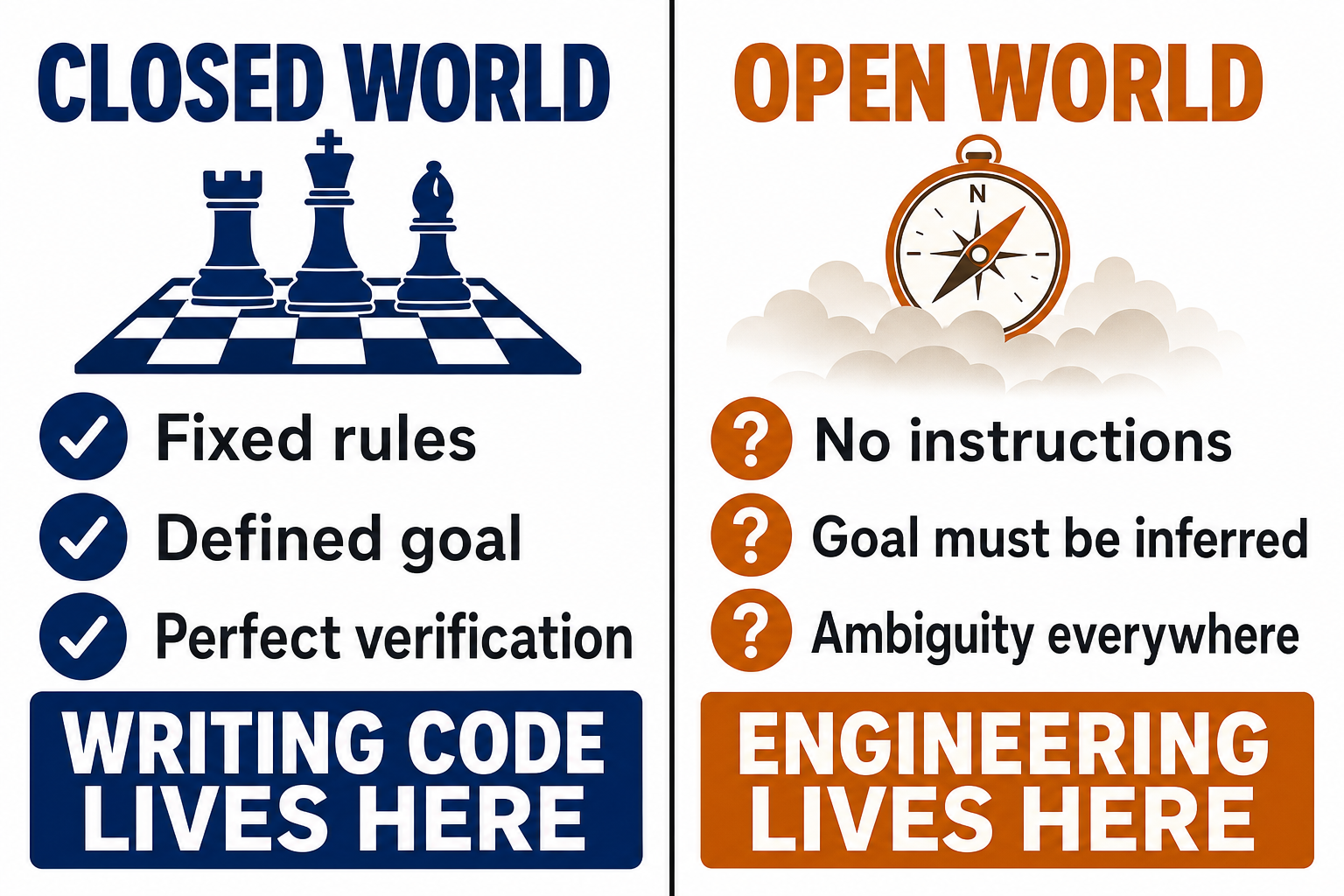
Most engineering isn't. Nobody hands you the goal. A customer describes a symptom that isn't the disease. A codebase behaves oddly in a way nobody has characterized yet. The actual work starts with questions no test suite can answer: what is really being asked for here, what should we build, what matters most, what do we check first?
There's a benchmark designed to measure exactly that open-world layer. ARC-AGI-3, launched in March 2026, drops the model into interactive environments with no instructions, no rules, and no stated goals. It has to explore, work out what the game even is, and then plan. At launch, frontier AI scored 0.51%. Every environment is human-solvable, and humans score 100%.
Now the part that should stop you building a bunker out of that statistic: on July 24, 2026, Claude Opus 5 scored 30.2%, verified by the ARC Prize team, nearly quadrupling the previous record of 7.8%. Within four months of launch, the top score had gone from 0.51% to 30.2%. Humans still lead comfortably, and the gap is real as of July 2026. But we nearly published the launch number as if it were permanent, and it had expired within a season. That's the honest lesson of the capability research: the gaps are genuine, and none of them is a wall you can safely stand behind.
To be fair to the other side of the argument: much of commercial software work arrives with tickets, logs, failing tests, and acceptance criteria attached — more closed-world than ARC's puzzles. A lot of engineering can be automated without AI ever solving open-ended goal discovery. The chess trap doesn't prove your job is safe. What it shows is where the remaining human advantage sits: upstream, in the deciding layer.
So what does the research actually say lives in that layer?
The Three Gaps That Keep Humans in the Loop — For Now
Three limitations show up consistently across the 2025–26 research, and each maps directly onto part of the agentic coder's job. Dates matter here, because as we've just seen, these numbers have a shelf life.
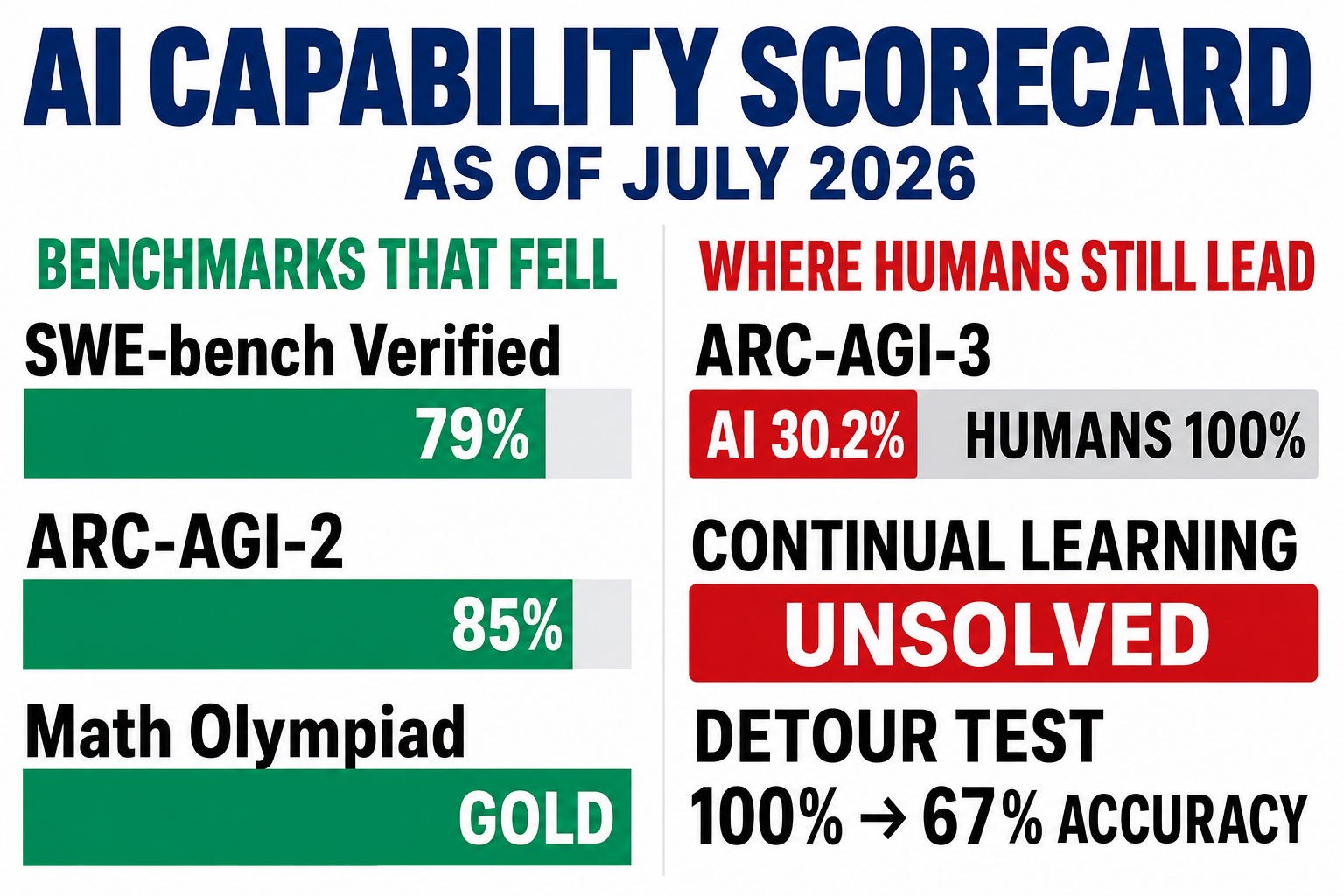
Gap one: generalizing from thin evidence. Ilya Sutskever, the researcher behind much of the scaling era, put it bluntly in his November 2025 interview with Dwarkesh Patel: "These models somehow just generalize dramatically worse than people. It's a very fundamental thing." That's an expert observation rather than a measurement, but it matches what the benchmarks show: models ace the test and then stumble on the variant no one wrote down. Humans do the opposite — we see two examples and form a hypothesis that transfers.
Gap two: learning on the job. A model's weights don't update while it works for you. Whatever it learned about your codebase yesterday is gone when the context window resets. "They don't have continual learning. You can't just tell them something and they'll remember it," as Andrej Karpathy puts it — one of the deficits behind his line that this is "the decade of agents," not the year. Your accumulated understanding of a system, a team, a threat model? The models don't have an equivalent yet.
Gap three: coherent world models. Researchers from Harvard, MIT, and Cornell (led by Keyon Vafa) found that a transformer giving near-perfect New York City driving directions had built an internal "map" full of streets that don't exist — and closing just 1% of streets with detours collapsed its accuracy from nearly 100% to 67%. The finding is contested (a 2025 study, arXiv 2511.05963, found next-latent-prediction transformers can learn compact world models), so hold it loosely. But it rhymes with something every one of us who reviews AI code has seen: output that's locally perfect and globally confused.
For wider context: of the 475 respondents to AAAI's 2025 community survey (about a fifth of them students), 76% said scaling up current AI approaches to yield general intelligence was unlikely or very unlikely to succeed. That's opinion, not measurement, but it tells you the field mostly doesn't believe today's architecture erases these gaps soon. Demis Hassabis's test is my favorite framing: could an AI trained only on knowledge up to 1911 come up with general relativity by 1915? "It's clear today's systems couldn't do that."
Notice what those three gaps have in common. They're all versions of the same skill — forming a view of a situation nobody has fully specified, and updating it as you go. Which is easiest to see not in a benchmark, but in the field.
The Methodology Test: The Decision AI Didn't Make
Security work makes the division of labor unusually visible. An AI agent can scan a target at superhuman speed: fuzz endpoints, trace data flows, check a codebase against every published vulnerability class faster than any of us. The UK's AI Security Institute found Claude Mythos Preview succeeding 73% of the time on expert-level capture-the-flag tasks in April 2026. That's the class of capability behind the US Commerce Department's decision to briefly force Anthropic's frontier models offline under export controls in June 2026, an order lifted on June 30. But in every case we've watched, the agent doesn't originate the hunt. A bounty hunter's methodology, like noticing who wrote the code and asking whether that developer repeats the same class of mistake elsewhere, comes from experience aimed at a target nobody specified.
The clearest example I can give you, though, is one from our own engineering, because I can show you exactly where the human decision sat.
When we started using AI to review our code and content at StationX, the reviews looked authoritative and kept missing things. The reason, once I saw it, was almost embarrassing: I was asking a model to catch the kinds of mistakes a model makes. Its blind spots and the author's blind spots were the same blind spots. Running the review three times didn't help — three copies of the same model are, for practical purposes, one model.
So I designed the review the way you'd design a court, not a spellchecker. Independent reviewers drawn from different model families (Claude, OpenAI, Google) each hunt separately, because different families fail differently. A validator then attacks every finding, hunting for the false positives. And a fresh referee from yet another family adjudicates, with the findings' origins hidden so the judge weighs each claim on its merits rather than trusting its favorite source. We later stress-tested the design by having five different models critique it; their top structural fix (never let one model family be both validator and judge) is now part of the system.
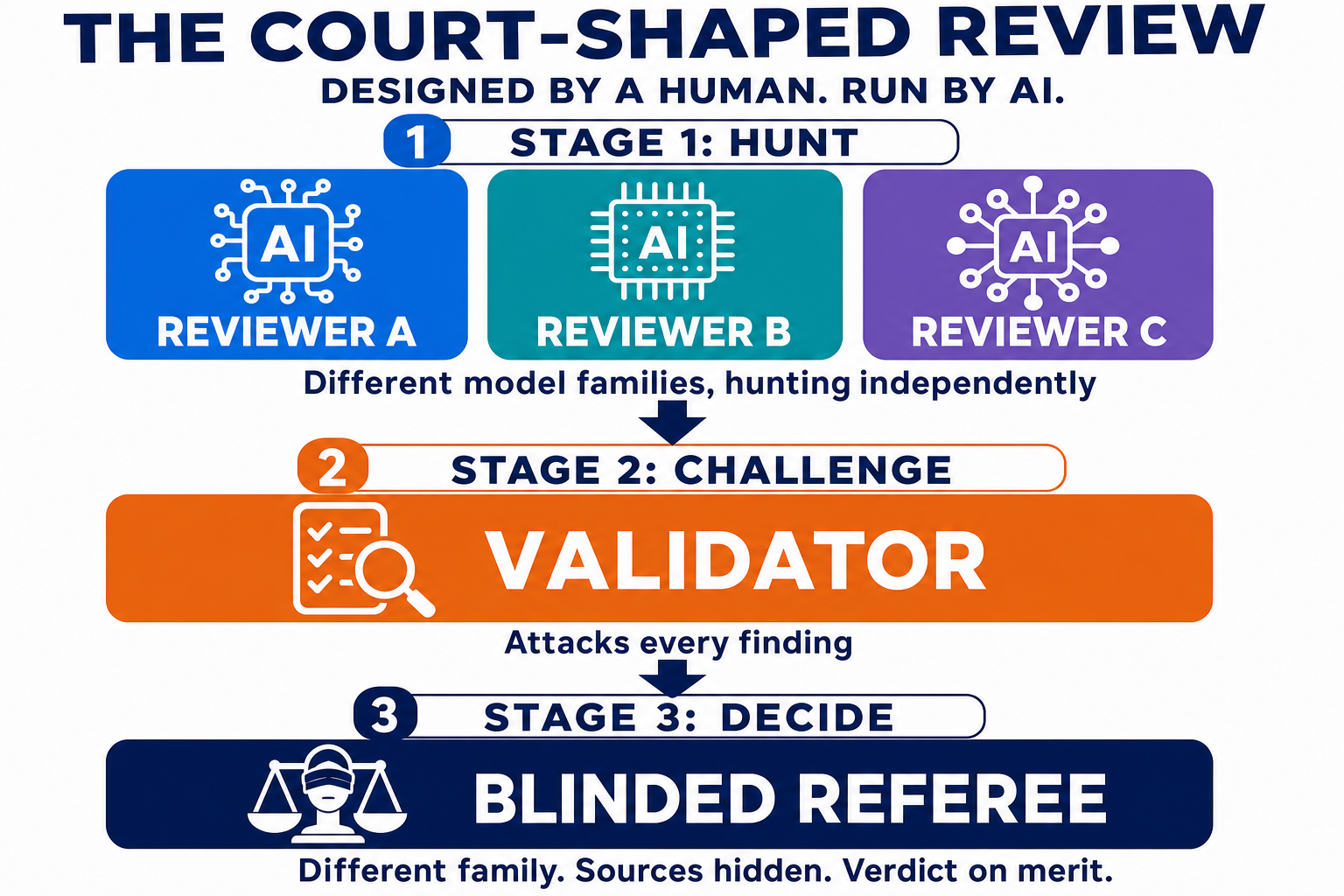
That architecture surfaced seven real AI-specific security issues in one of our products that a generic review had sailed past, and went ten-for-ten on the planted vulnerabilities in a deliberately vulnerable training application we test against. And in July 2026, while we were producing this article, the same adversarial machinery caught that our centerpiece number (the 0.51% ARC launch score) had expired. The review panel flagged it; a source-capture pass that string-matches every statistic against its primary page then forced corrections to five more figures before you ever saw them.
Now the punchline. The core of that design didn't come from a model: one AI reviewer can't catch its own family's mistakes, so make different families fight and let a blinded outsider decide. We later had five models critique the finished design, and they strengthened it (the rule that the judge must come from a different family than the validator is theirs to keep). But they were improving an architecture a human originated. In every run we've logged, the models execute the roles of hunter, prosecutor, and judge; the decision about how to organize them stayed human. It's the same decision layer as the bounty hunter choosing the hunt: judgment, transferred from one domain (how courts correct error) to another (how to review machine output). Sutskever's generalization gap, showing up in a real workflow.
The agent executes the search; the human decides what's worth searching for and how the searching should be organized. And that hand-off creates a second job most people underestimate — because everything the agents produce still has to get past someone.
Verifying AI-Written Code: The Half That Doesn't Ship
One statistic should reshape how you think about AI-written code: in March 2026, METR had active maintainers of the SWE-bench repositories review 296 test-passing AI solutions from 2024–2025 frontier models — and roughly half would not have been merged into the codebase. Passing the test and being acceptable turn out to be different standards.
The failure modes are familiar to anyone doing this daily. Dependencies that don't exist: a USENIX Security study found commercial models hallucinate package names at least 5.2% of the time, and attackers now register the fake names and wait, a genuine supply-chain attack surface. Code that satisfies the letter of the task while missing its point. Fixes that resolve the failing test by special-casing the test.
None of this contradicts the concession we made earlier — AI code quality is high and rising. The point is that "mostly excellent" without verification is a liability, because the errors that remain are confident, plausible, and buried in diffs nobody reads. Which is why verification is not the boring leftover of agentic coding. It is the daily craft:
Review gates. No agent-written diff merges unread. The moment you stop reading, you've switched from agentic coding to vibe coding, whatever you call it.
Tests as specification. Write the acceptance tests yourself, or review them hardest of all. The agent optimizing against tests it also wrote is the fox auditing the henhouse.
Adversarial checks. Set agents with different biases against each other's work: the court-shaped review from the last section, doing its daily job. Between the panel and the source-capture pass, it caught this article's expired centerpiece statistic and corrected five more figures before you read it.
The verification discipline is also what shows up in the pay packet: the person who can look at ten thousand lines of AI-written code and know which two hundred to distrust is worth more than the person who could have typed it. But discipline alone doesn't compound. For that you need infrastructure.
The Ladder: From Autocomplete to Organizational Memory
In our agentic engineering guide we describe four tiers of working with AI: using a harness out of the box, customizing it with your own commands and skills, orchestrating multiple agents, and finally building shared AI infrastructure your whole team runs on. Most people are still on tier one. The compounding happens at tier four, and the reason connects directly to gap two above.
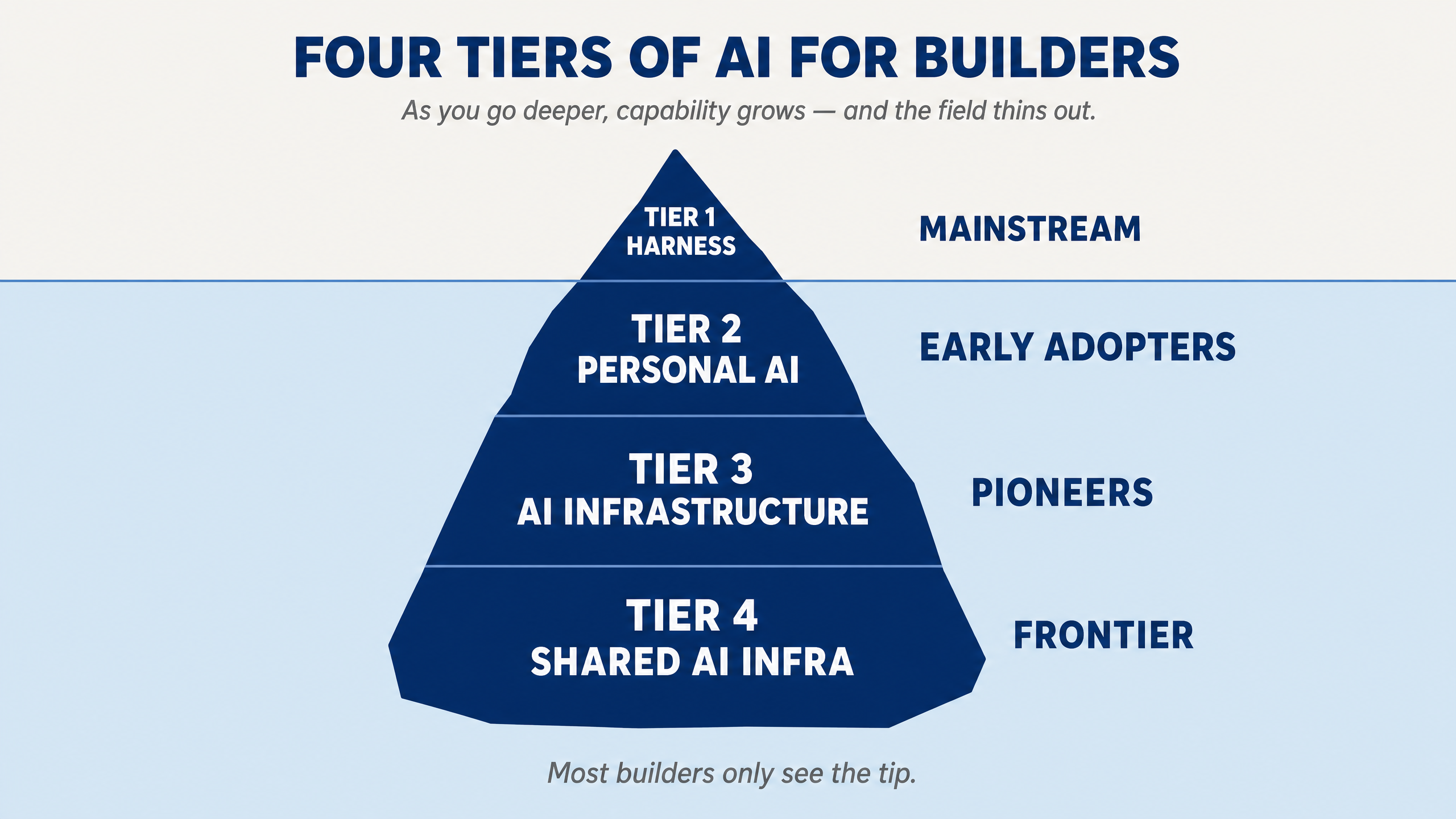
Models can't yet learn on the job at the weight level. But your infrastructure can hold what they can't. Every command you write that encodes "here's how we transcribe videos / review PRs / validate keywords," every skill that captures a methodology, every context file that records what your team learned last quarter — that's organizational memory the agents load on demand. The model forgets; the library remembers.
Let me be precise about the claim, because it's easy to oversell. Context files don't change model weights — this is a systems workaround, not a solution to continual learning, and a fresh model reading your notes is not the same as a colleague who lived through the incident. It's also not immortal: libraries need maintenance, and if native model memory improves dramatically, some of this scaffolding loses value. But as a practical matter, it changes the economics of the gap today: at StationX we run our whole content and engineering operation on a shared library of commands, skills, and context files, and the useful knowledge from every project outlives the session that produced it. When the next model generation arrives, the library transfers. Prompt tricks are model-specific; a methodology library moves with you.
Which brings us to the part of this article most guides skip, and the part I'd want you to trust most.
What This Doesn't Guarantee
An honest version of this argument has to say what it can't promise.
It can't promise headcount. Everything above describes tasks that stay human. It doesn't prove the same number of humans stay employed. One architect directing agent fleets may replace several implementation roles; that's arithmetic no amount of upskilling changes for the group, even if it changes everything for the individual who becomes the architect. If you want the career-risk analysis by role and sector, our jobs research covers it in detail at JobsZoneRisk.com; it's a different question from the one this article answers.
It can't dodge the pipeline problem. If agents absorb junior implementation work, where does the next generation of architects get the experience that makes their judgment worth anything? Nobody has a good answer yet — Amodei himself warned about entry-level displacement. My honest advice to anyone early in their career is uncomfortable but actionable: you'll have to build judgment deliberately, through projects where you read and verify everything, rather than absorbing it slowly from years of typing. The old path taught understanding as a side effect. You'll have to choose it on purpose.
And it can't freeze the frontier. This article's own working assumption, that open-ended problem solving stays human, is exactly the kind of claim the ARC jump should make us hold with humility.
What would change my mind
So let me put on record what would change my mind:
- ARC-AGI-3 reaching human parity;
- weight-level continual learning being solved;
- or an agent originating a hunting methodology, unprompted, that finds a class of bug nobody directed it toward.
If those land, the decision layer is falling too, and this guide will say so in its next update.
What survives all three caveats is the strategy itself. At every point on the capability curve so far, the leverage has belonged to whoever owns the deciding layer: what to build, how to attack it, how the pieces fit, whether it is right. The curve moving doesn't change who captures the value at each stage — it changes how fast you have to climb.
What to Learn This Quarter
If we've convinced you the decision layer is the job now, three skills are worth deliberate practice in the next ninety days. This is where we'd point you regardless of whose training you use — ours or anyone's.
First: orchestration. Move from chatting with one assistant to directing several agents with defined roles — a builder, a reviewer, a researcher. Start with one real task you already understand well enough to verify. The skill you're building is decomposition: turning a fuzzy goal into agent-sized pieces with checkable outputs.
Second: your library. Every time you give an agent the same instructions twice, that's a command waiting to be written. Capture your methodology in reusable files — how you review a diff, how you validate a finding, what your project's constraints are. This is tier-two-to-four progress, and of everything you could practice, it's the work most likely to keep its value across model generations.
Third: verification. Practice reading AI-written code the way editors read journalists — assuming competence, hunting for the confident error. Write the tests yourself. Run adversarial reviews on work that matters. If you can only build one reputation in the next few years, make it "nothing broken gets past them."
We teach all three inside our AI-driven engineering workshops, built around the same infrastructure we run StationX on — but honestly, the tools to start are already on your machine. The engineers who thrive from here won't be the ones who typed the best code. They'll be the ones who decided what the code should be, and could prove it was right.
Frequently Asked Questions
What is agentic coding?
Agentic coding is a software development approach where AI agents write, test, and iterate code autonomously while a human directs the intent, methodology, architecture, and verification. The human works like a tech lead managing a team, reviewing output rather than typing implementation.
Is agentic coding the same as vibe coding?
No. In vibe coding you accept AI output without reading it; understanding is outsourced. In agentic coding every diff is reviewed, tests act as specifications, and the human retains responsibility for correctness. The difference is verification discipline, not the tools.
Can AI write code that is production-quality?
Often, but not reliably without review. Frontier models clear most software benchmarks, yet a March 2026 METR study found roughly half of test-passing SWE-bench solutions would not have been merged by the repositories' own maintainers, and hallucinated dependencies remain a live supply-chain risk. Treat AI code as strong first drafts requiring verification.
Do I still need to learn to code in 2026?
Yes — but the reason changed. You read code to verify, architect, and debug what agents produce, not to type most of it yourself. Judgment about code you didn't write is now the core skill, and it's hard to build without understanding how the code works.
About the Author

Nathan House, Founder & CEO of StationX
Nathan House has 30 years of hands-on cybersecurity experience and is Cambridge-educated, holding CISSP, CISA, CISM, OSCP, CEH, and SABSA. He founded StationX in 1999 — one of the UK’s first cybersecurity companies — and has secured £71 billion in UK mobile banking transactions and the London 2012 Olympics, advising clients including Microsoft, Cisco, BP, Vodafone, and VISA. He authored the world’s most popular cybersecurity course — a #1 Udemy bestseller taken by over 500,000 students — and was named Cyber Security Educator of the Year 2020, AI Security Educator of the Year, and a UK Top 25 Security Influencer 2025. A DEF CON speaker and featured expert on CNN, Fox News, NBC, and the BBC, Nathan leads StationX’s training of more than half a million students worldwide.