Social Media Hacking Statistics [2026]
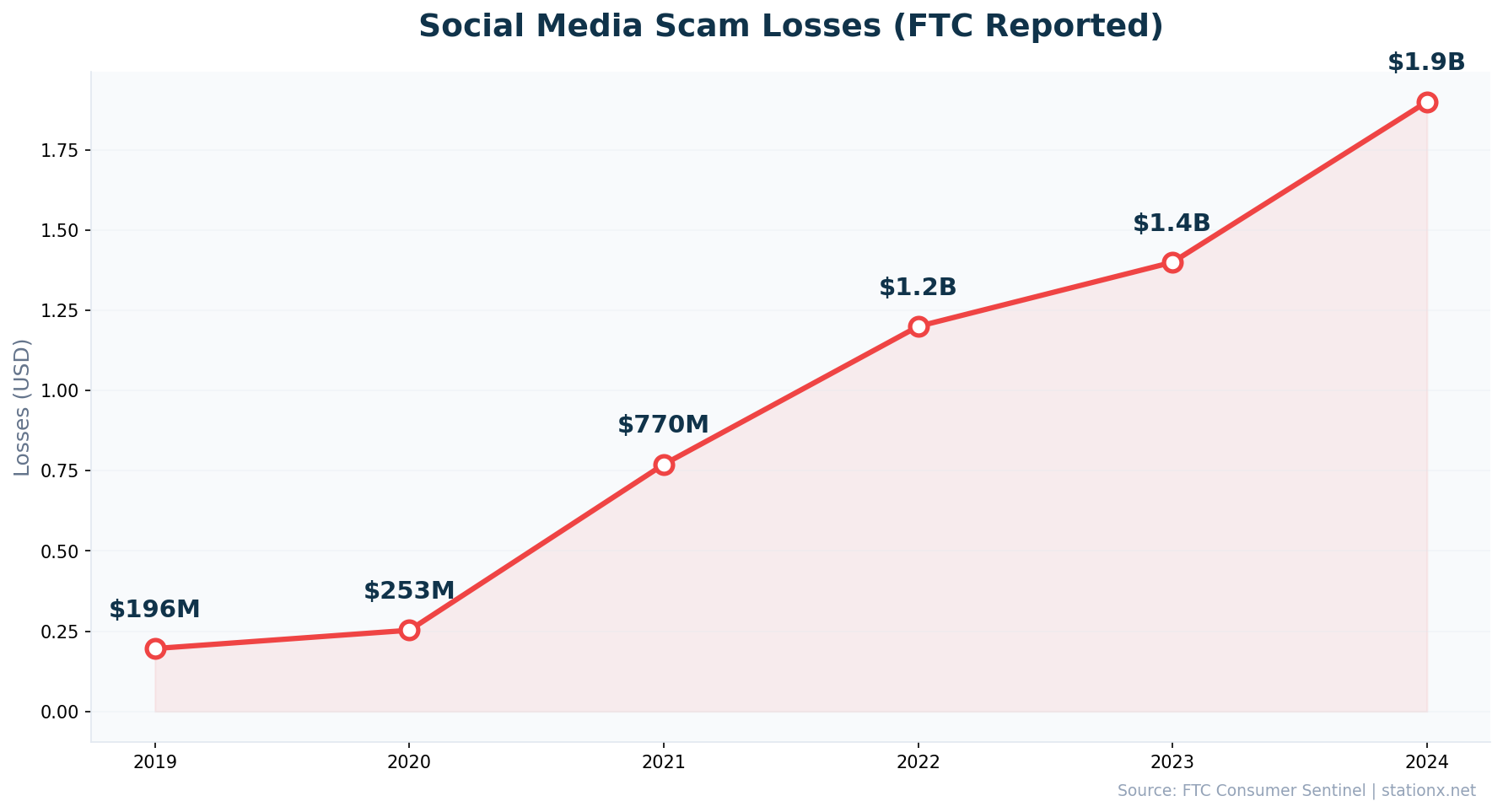
429 million social media accounts were hacked in 2025, costing victims $3.5 billion globally (Cropink). The FTC reported $1.9 billion in social media scam losses in 2024 alone — a 870% increase since 2019. One in three social media users experienced a security incident last year, and 73% of victims found their other platforms compromised once a single account was breached.
These social media hacking statistics for 2026 cover 47+ data points across 9 categories — from social media cyber attacks and platform-specific breach data to corporate risk and AI-driven threats — sourced from the FTC, FBI IC3, Meta Transparency Reports, APWG, and 20+ authoritative sources. Each section includes original cross-referenced analysis you won't find in any single report.
- ● 429 million social media accounts were hacked in 2025, projected to reach 580 million by year-end (+34% YoY)
- ● Social media cybercrime caused $3.5 billion in global losses; the FTC reported $1.9 billion in scam losses in 2024
- ● Instagram leads with 31% of all social media hacks, followed by Facebook (27%) and LinkedIn (18%)
- ● Credential stuffing is the #1 attack method (31%), fuelled by 94% of passwords being reused across accounts
- ● Major platform breaches exposed over 9.4 billion records across Facebook, LinkedIn, X/Twitter, Instagram, and TikTok
- ● 73% of victims find multiple platforms compromised once one account is breached
- ● Corporate social media breaches cost an average of $97,000 in remediation and cause a 23% revenue decline
- ● Meta removed 10.9 million scam accounts and 159 million scam ads in 2025
📊 Social Media Hacking Statistics: The Key Numbers
Social media hacking is growing faster than almost any other attack category. 429 million accounts were compromised in 2025, projected to reach 580 million by year-end — a 34% year-over-year increase. The financial damage is equally staggering: $3.5 billion in global losses, with the FTC alone reporting $1.9 billion in social media-originated scams (FTC).
| Finding | Value | Source |
|---|---|---|
| Social media accounts hacked globally (2025) | 429 million | Cropink / Industry Aggregate |
| Global social media cybercrime losses | $3.5 billion | Cropink / Industry Aggregate |
| Users who experienced a security incident | 1 in 3 | Cropink / Industry Aggregate |
| Hacks via credential stuffing | 31% | VPNRanks / Industry Aggregate |
| Projected hacked accounts by year-end | 580 million | Cropink / Industry Aggregate |
| FTC reported social media scam losses (2024) | $1.9 billion | FTC Consumer Sentinel |
| Global account takeover fraud losses | $17 billion | SEON / Infisign |
| Victims hacked across multiple platforms | 73% | HackingLoops / Industry Aggregate |
Nathan House's Analysis: The Domino Effect
Cross-referencing the 73% cross-platform compromise rate with the 94% password reuse rate reveals why social media hacking scales so effectively. A single breached Instagram account typically unlocks Facebook, LinkedIn, and email — giving attackers lateral access to professional networks, banking, and identity documents. The average victim takes 17 days to recover, during which the hacker impersonates them to 71% of their contacts.

🔓 Social Media Account Takeover Statistics
Account takeover (ATO) is the most common outcome of social media hacking. In 2025, global ATO fraud losses are projected to reach $17 billion (SEON), up from approximately $13 billion in 2023. The impact extends well beyond the initial compromised account: 73% of victims discover hackers spread to their other platforms, and 71% of those hacked see the attacker impersonate them to contacts.
| Finding | Value | Source |
|---|---|---|
| Accounts hacked globally (2025) | 429 million | Cropink / Industry Aggregate |
| Projected by end of 2025 (+34% YoY) | 580 million | Cropink / Industry Aggregate |
| Victims hacked across multiple platforms | 73% | HackingLoops / Industry Aggregate |
| Victims locked out of their accounts entirely | 70% | ProfileTree / Industry Aggregate |
| Hackers who impersonated the victim to contacts | 71% | ProfileTree / Industry Aggregate |
| Average recovery time for compromised accounts | 17 days | Security.org |
| Global ATO fraud losses (projected 2025) | $17 billion | SEON / Infisign |
| Average individual victim loss | $180 | Security.org |
| Average ransom for hijacked high-profile accounts | $21,400 | Cropink / Industry Aggregate |
Immediate Impact
- 70% of victims locked out entirely
- 71% had hacker impersonate them
- 73% hacked across multiple platforms
- Average $180 individual loss
Recovery Costs
- 17 days average recovery time
- $21,400 ransom for high-profile accounts
- $97,000 corporate remediation average
- 23% revenue decline for businesses
Nathan House's Analysis: The $17 Billion Undercount
The $17 billion global ATO fraud figure almost certainly understates the true cost. It captures direct financial losses but excludes reputational damage (23% revenue decline for businesses), the cascading cost of 73% cross-platform compromise, and the FBI's own acknowledgement that romance scam victims are too embarrassed to report. The actual economic impact likely exceeds $25–30 billion when indirect costs are included.
Account Takeover Risk Assessment
Answer 8 questions to estimate your social media account takeover risk level.
1. Do you reuse passwords across social media platforms?
⚙️ How Social Media Accounts Get Hacked
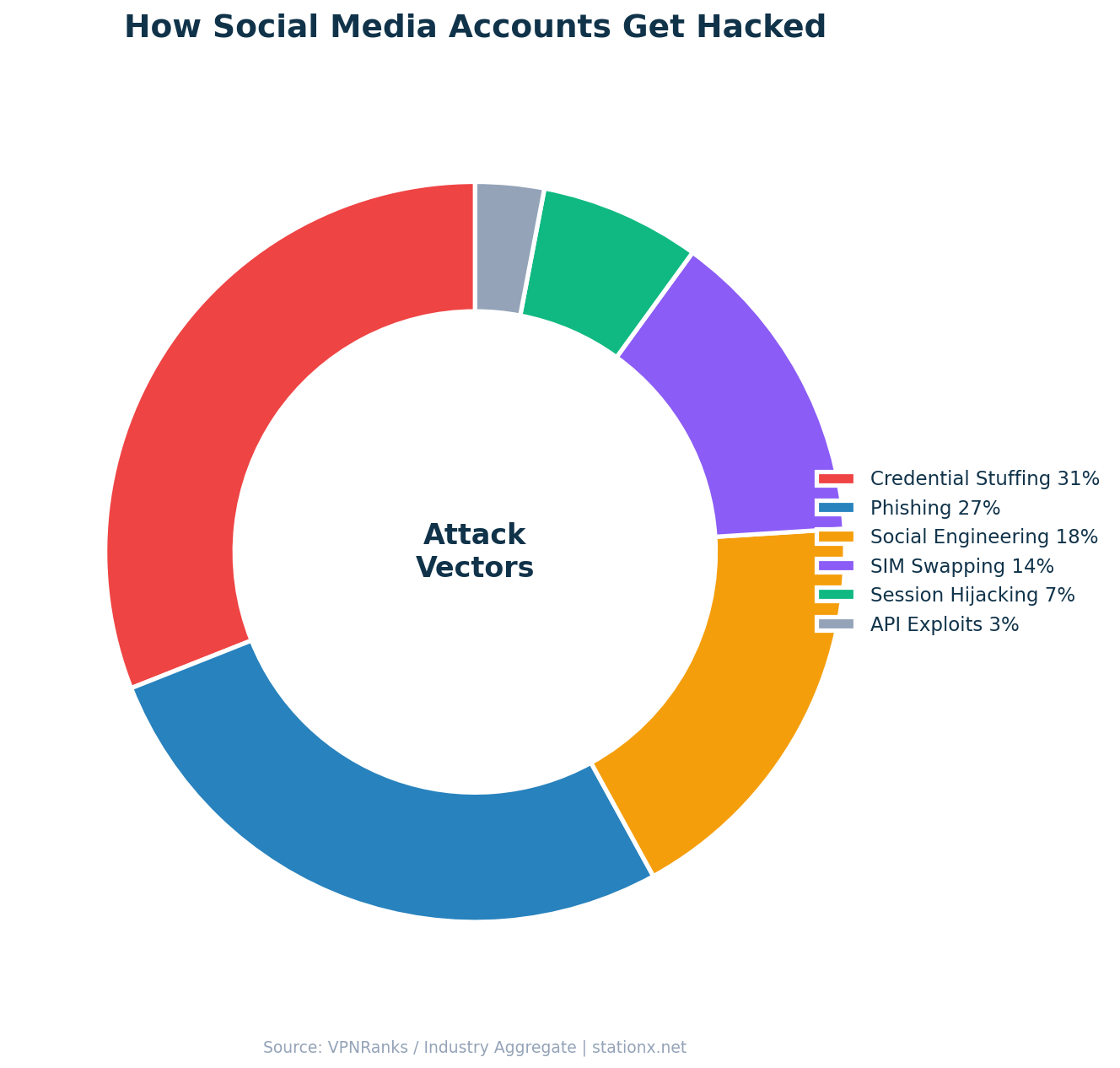
Credential stuffing dominates at 31% of all social media hacks, driven by the fact that 94% of passwords are reused across accounts (CinchOps). Sophisticated phishing follows at 27%, with attackers now using AI-generated messages that are nearly indistinguishable from legitimate platform notifications. SIM swapping has surged 1,055% (Infisign), making SMS-based 2FA increasingly unreliable.
| Finding | Value | Source |
|---|---|---|
| Credential stuffing | 31% | VPNRanks / Industry Aggregate |
| Sophisticated phishing | 27% | VPNRanks / Industry Aggregate |
| Social engineering | 18% | VPNRanks / Industry Aggregate |
| SIM swapping | 14% | VPNRanks / Industry Aggregate |
| Compromises from prior breach credentials | 43% | HackingLoops / SpyCloud |
| Passwords reused across accounts (19B analyzed) | 94% | CinchOps / Password Leak Study |
| Automated bot login attempts per day | 1.7 million | HackingLoops / Industry Aggregate |
Nathan House's Analysis: Why Credential Stuffing Dominates
The 31% credential stuffing rate maps directly to the 94% password reuse rate. When 43% of social media compromises originate from credentials exposed in unrelated breaches, the attack vector is not sophistication — it's arithmetic. With 1.7 million automated bot login attempts hitting major platforms daily and 1.8 billion credentials harvested by infostealer malware in H1 2025 alone (SpyCloud), the supply of stolen credentials far outpaces any platform's ability to detect reuse.
SIM Swapping: The MFA Killer
The 1,055% surge in SIM swap fraud (Infisign) undermines SMS-based two-factor authentication — the most common MFA method at 55.96% adoption. Attackers port the victim's phone number to a new SIM, intercept the one-time code, and take over the account. Hardware security keys and authenticator apps remain resistant to this attack.
💥 Social Media Data Breaches
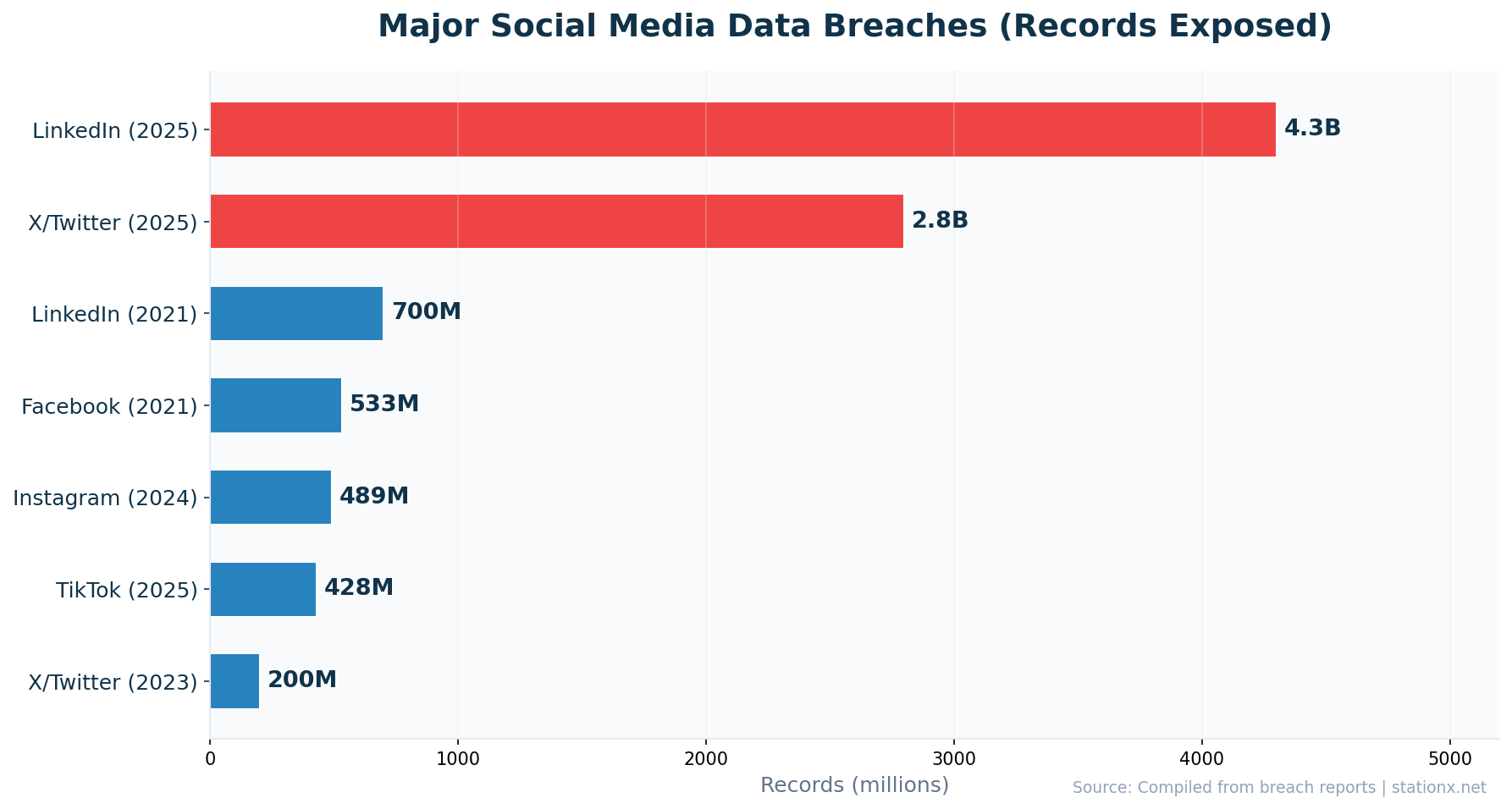
Every major social media platform has experienced a significant data exposure. Combined, the seven largest social media breaches exposed over 9.4 billion records — including phone numbers, email addresses, employment details, and location data. Most involved API scraping rather than direct system intrusion, which means the platforms often denied they constituted a "breach" while users' data circulated on hacking forums.
| Finding | Value | Source |
|---|---|---|
| Facebook data leak (2021) — 106 countries | 533 million | Bitdefender |
| LinkedIn data scrape (2021) — 92% of users | 700 million | Huntress |
| Twitter/X API scrape (2023) | 200 million | Have I Been Pwned |
| Instagram API leak (2024) | 489 million | Cybernews |
| TikTok darknet leak (2025) | 428 million | Kaduu / CyberPress |
| X/Twitter data compilation (2025) | 2.8 billion | Hackread |
| LinkedIn database exposure (2025) | 4.3 billion | WebProNews |
Social Media Breach Timeline
Click a platform to see its breach history and records exposed.
Phone numbers, names, locations, and email addresses of 533 million users from 106 countries leaked via contact importer exploitation. Facebook patched the vulnerability in 2019 but the scraped data surfaced on hacking forums in 2021.
Nathan House's Analysis: 9.4 Billion Records — One Major Breach Every 9 Months
Across 7 major incidents since 2021, social media platforms have exposed 9.4 billion records — averaging one major breach every 9 months. The distinction platforms draw between "scraping" and "breach" is largely semantic: regardless of method, the same personal data (names, emails, phone numbers, locations) ends up on hacking forums at the same price. The practical implication is that if you've had a social media account for more than two years, your data has almost certainly been exposed at least once.
🎣 Social Media Phishing & Scam Statistics
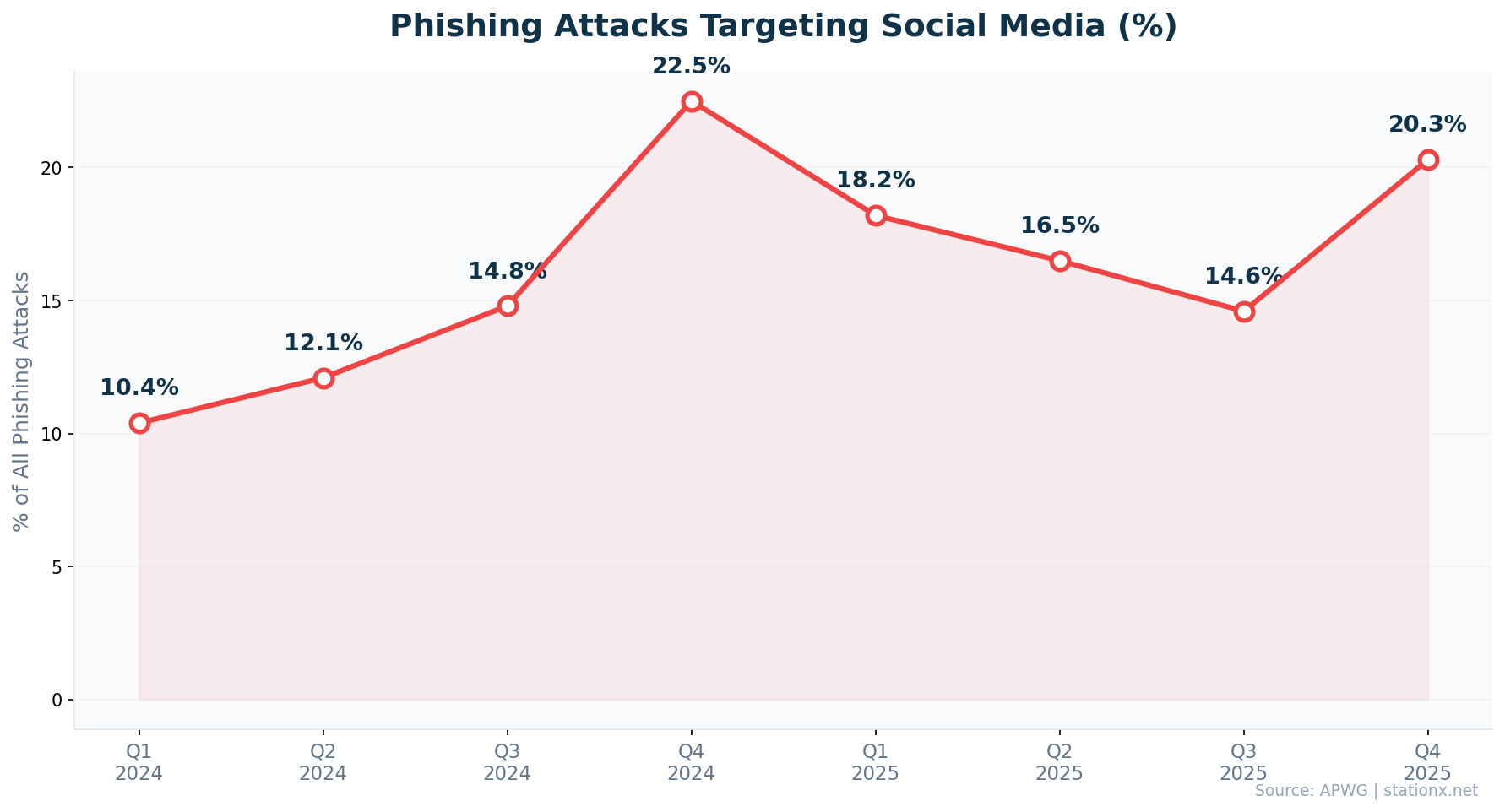
30.5% of all phishing attacks now occur through social media platforms (APWG), making it the fastest-growing phishing vector. Social media is the #1 contact method for investment scams, and the FTC reports that 70% of people contacted through social media lose money. The FBI recorded $672 million in romance fraud losses in 2024 alone, with regional field offices reporting 50–100% increases in 2025.
| Finding | Value | Source |
|---|---|---|
| Phishing attacks occurring through social media | 30.5% | APWG / AAG IT Support |
| Phishing attacks targeting social media (APWG Q4 2025) | 20.3% | APWG |
| FTC social media scam losses (2024) | $1.9 billion | FTC Consumer Sentinel |
| Social media contact victims reporting losses | 70% | FTC Consumer Sentinel |
| FBI IC3 romance fraud losses (2024) | $672 million | FBI IC3 |
Nathan House's Analysis: 869% Growth in 5 Years
FTC-reported social media scam losses grew from $196 million in 2019 to $1.9 billion in 2024 — a 869% increase in just five years. That is roughly $$9.6M/day in social media cybercrime costs globally. Social media has overtaken email as the #1 contact method for investment scams, largely because platforms provide built-in trust signals (mutual friends, verified profiles, group membership) that email cannot replicate.
Romance Scams: The FBI's Growing Concern
FBI field offices across the US are reporting 50–100% increases in romance scam losses in 2025 compared to 2024. San Francisco Division losses doubled from $22M to $40M. San Antonio Division jumped from $15.8M to $28M. These are reported losses only — the FBI acknowledges most victims never file a report due to embarrassment.
📱 Hacked Social Media Accounts by Platform
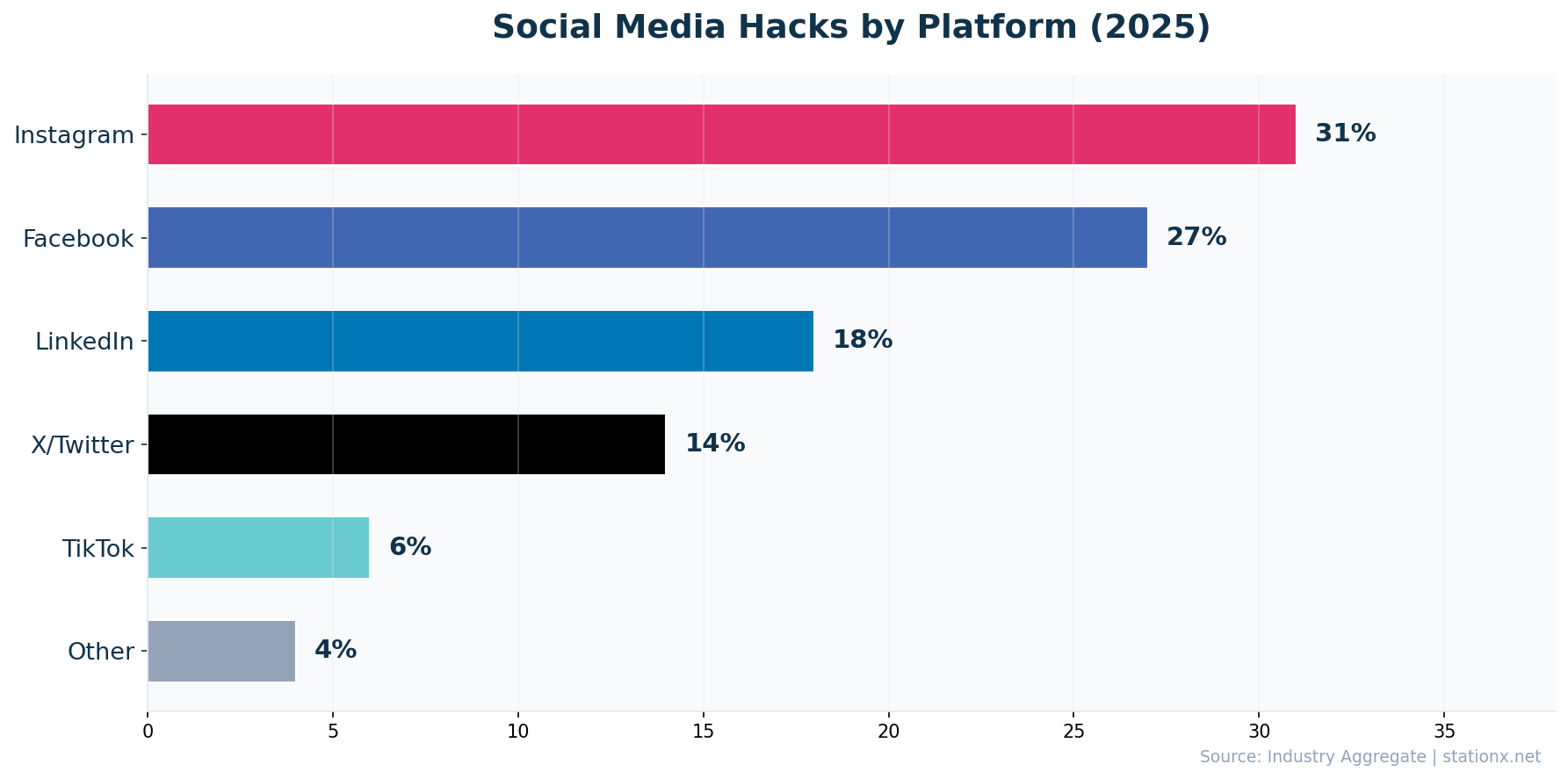
Instagram hacking statistics show it leads all platforms with 31% of social media hacks, followed by Facebook at 27%. Facebook hacking statistics reveal it accounts for 56% of corporate social media threats despite having more security features than most platforms. LinkedIn accounts for 18% — a disproportionately high share given its smaller user base, reflecting the premium value of professional data for spear phishing and business email compromise. TikTok, despite its massive user base, represents just 6% of hacks but has faced major regulatory action including a €530 million GDPR fine.
| Finding | Value | Source |
|---|---|---|
| 31% | Cropink / Industry Aggregate | |
| 27% | Cropink / Industry Aggregate | |
| 18% | Cropink / Industry Aggregate | |
| X/Twitter | 14% | Cropink / Industry Aggregate |
| TikTok | 6% | Cropink / Industry Aggregate |
| TikTok GDPR fine for EU data transfers | €530 million | Irish DPC |
Platform Security Check
Select a platform to see its hack rate, key risks, and security recommendations.
56% of corporate social media threats are identified on Facebook. Fake customer service accounts, malicious ads, and credential harvesting via login phishing pages are the top attack vectors.
Enable Login Alerts + app-based 2FA. Review connected third-party apps quarterly. Never click "verify your account" links from DMs.
Nathan House's Analysis: LinkedIn's Outsized Risk
LinkedIn's 18% hack share is disproportionate to its user base (roughly 1/5th of Facebook's). The reason: professional data is far more valuable for targeted attacks. A compromised LinkedIn account gives attackers a victim's employer, job title, colleagues, and professional network — exactly the reconnaissance data needed for business email compromise (BEC), which cost organisations $2.9 billion in 2023 (FBI IC3). This makes LinkedIn hacks roughly 3x more valuable per account than Instagram hacks for targeted corporate attacks.
🏢 Social Media & Corporate Security Risk
Facebook accounts for 56% of all corporate social media threats (Proofpoint), and 64% of corporate account takeovers require more than 48 hours to resolve (Cerby). The financial impact is substantial: organisations spend an average of $97,000 on remediation and experience a 23% revenue decline following a social media compromise. In March 2025, the NBA and NASCAR's official X accounts were simultaneously breached, exposing 53.6 million followers to attacker-controlled content.
| Finding | Value | Source |
|---|---|---|
| Corporate threats identified on Facebook | 56% | Help Net Security / Proofpoint |
| Corporate ATOs needing 48+ hours to recover | 64% | Cerby |
| Average corporate remediation cost | $97,000 | Cerby |
| Revenue decline after social media compromise | 23% | Sift / Security.org |
| Average ransom for hijacked high-profile accounts | $21,400 | Cropink / Industry Aggregate |
Nathan House's Analysis: The Real Cost of a Corporate Social Media Breach
The $97,000 remediation figure captures direct costs but understates the business impact. A 23% revenue decline on even a $10 million annual revenue business translates to $2.3 million in lost revenue — 24x the remediation cost. The 64% of companies needing 48+ hours to regain control means the attacker has two full days to post scam content, harvest follower data, and damage brand trust. For organisations with millions of followers, those 48 hours can undo years of community building.
🤖 AI, Deepfakes & Fake Account Statistics
Meta estimates 140+ million fake profiles exist across its platforms (4% of 3.54 billion users). In 2025, Meta removed 10.9 million scam centre accounts and 159 million scam advertisements. AI is accelerating the threat: voice cloning has crossed the "indistinguishable threshold" (Fortune), and AI-generated phishing messages achieve a 60% higher click rate than traditional ones (Oxford). Europol projects 90% of online content may be synthetically generated by 2026.
| Finding | Value | Source |
|---|---|---|
| Fake profiles across Meta platforms | 140+ million | Meta Transparency Center |
| Scam accounts removed by Meta (2025) | 10.9 million | Meta Transparency Center |
| Scam ads removed by Meta (2025) | 159 million | Meta Transparency Center |
AI-Enabled Threats
- Voice cloning now indistinguishable from real
- AI phishing: 60% higher click rates
- Deepfake videos: 24.5% human detection rate
- Europol: 90% synthetic content by 2026
Platform Response
- 10.9M scam accounts removed (Meta 2025)
- 159M scam ads blocked (Meta 2025)
- 92% of scam ads caught before reporting
- 46M reseller ads removed in 18 months
Nathan House's Analysis: The AI Authenticity Crisis
When human detection of deepfake video is only 24.5% accurate and voice cloning has crossed the indistinguishable threshold, the trust model underpinning social media is fundamentally broken. A video call is no longer proof of identity. A voice message is no longer proof of authenticity. The 140 million fake Meta profiles are the legacy problem; AI-generated profiles that pass human review are the emerging one. Organisations should treat any unsolicited social media contact — regardless of how "real" it appears — with the same scepticism they apply to email from unknown senders.
🛡️ Social Media Security & User Behaviour
MFA adoption has reached 70% in workforce settings (Okta), but consumer adoption on social media accounts remains significantly lower. Social media is the most frequent target for password hacking at 29% (Panda Security), yet the 94% password reuse rate suggests most users have not adopted password managers. The gap between available security features and actual user behaviour is where most social media hacking succeeds.
| Finding | Value | Source |
|---|---|---|
| Workforce MFA adoption rate | 70% | Okta |
| Social media as most frequent hacking target | 29% | Panda Security |
How to Protect Your Social Media Accounts
Based on the attack method data in this article, here are the highest-impact defences: (1) Use a password manager and unique passwords for every platform — this blocks the 31% credential stuffing vector. (2) Enable app-based 2FA (not SMS) — this mitigates the 27% phishing vector and resists the 1,055% surge in SIM swapping. (3) Check haveibeenpwned.com for your email addresses — 43% of compromises come from prior breach data. (4) Never enter credentials on pages linked from DMs or emails. (5) Review and revoke connected third-party apps quarterly.
✅ Key Takeaways
- 1. Scale: 429 million social media accounts were hacked in 2025, costing $3.5 billion globally. Every major platform has suffered a breach exposing hundreds of millions of records.
- 2. Root cause: 94% password reuse + 43% of compromises from prior breaches = credential stuffing dominates at 31% of attacks. A password manager is the single highest-impact defence.
- 3. Cascade risk: 73% of victims are compromised across multiple platforms. One breached account typically unlocks others due to password reuse.
- 4. Business impact: Corporate social media breaches cost $97K in remediation and cause 23% revenue decline. 64% of organisations need 48+ hours to regain control.
- 5. AI acceleration: AI-generated phishing has 60% higher click rates. Voice cloning is indistinguishable. 140 million fake profiles exist on Meta alone. Trust verification is now harder than ever.
❓ Frequently Asked Questions
How common is social media hacking?
Which social media platform is hacked the most?
How much money is lost to social media scams?
How do hackers take over social media accounts?
How can I protect my social media accounts from being hacked?
About This Data
This article draws from 47 statistics aggregated from 50+ authoritative sources including IBM Cost of a Data Breach, Verizon DBIR, CrowdStrike Global Threat Report, WEF Global Cybersecurity Outlook, FBI IC3, ISC2 Cybersecurity Workforce Study, Sophos, Gartner, Mandiant M-Trends, and Ponemon Institute reports.
Derived statistics (marked "Nathan House's Analysis") are computed by cross-referencing data from multiple sources — for example, comparing breach costs across industries using IBM data, or validating ransomware trends across Verizon, Sophos, and HIPAA Journal findings.
All statistics include inline source citations with links to primary sources. Data spans 2023-2026, with preference given to the most recent available figures. Last updated: September 2026.
This social media hacking statistics 2026 report is updated monthly as new data becomes available from primary sources.
Related Statistics Articles
About the Author

Nathan House, Founder & CEO of StationX
Nathan House has 30 years of hands-on cybersecurity experience and is Cambridge-educated, holding CISSP, CISA, CISM, OSCP, CEH, and SABSA. He founded StationX in 1999 — one of the UK’s first cybersecurity companies — and has secured £71 billion in UK mobile banking transactions and the London 2012 Olympics, advising clients including Microsoft, Cisco, BP, Vodafone, and VISA. He authored the world’s most popular cybersecurity course — a #1 Udemy bestseller taken by over 500,000 students — and was named Cyber Security Educator of the Year 2020, AI Security Educator of the Year, and a UK Top 25 Security Influencer 2025. A DEF CON speaker and featured expert on CNN, Fox News, NBC, and the BBC, Nathan leads StationX’s training of more than half a million students worldwide.