Claude Opus 5.5 Review: Fable 5.1 Power for 60% Less (2026)
Claude Opus 5.5 landed on 22 September 2026, and Anthropic's pitch fits in one line: it "performs at the level of Claude Fable 5.1 on most work" at $4/$20 per million tokens. Fable 5.1 lists at $10/$50. That is 60% off the flagship's per-token price, two months after Opus 5 already undercut it.
If you build with AI or work in security, the price is only half the story. The default effort level has changed, four API behaviours break on migration, and a model that beats Claude Mythos 5.1 on the exploit benchmarks in Anthropic's system card is the one that hands your offensive security work to an older model. I went through the announcement, the system card, the migration docs and the support pages on launch day, and checked a popular launch video's claims against them.
This review covers what shipped, how it compares, which effort level to run, how to wire it into AI-driven engineering, and what it means for security work.
TL;DR: if you've only got 30 seconds
What it is: Anthropic's new Opus, out 22 September 2026. $4/$20 per million tokens, with cache reads at $0.20. Anthropic says it matches Fable 5.1 on most work.
The setting that matters: the default effort is now medium, one level below Opus 5. For agentic terminal work, high is the sweet spot; max rarely earns its cost.
For engineers: thinking can't be turned off, forced tool use errors, and declined requests return HTTP 200 with stop_reason: "refusal". Audit your harness before you swap the model ID.
For security people: source-code vulnerability hunting stays on Opus 5.5. Exploit generation, binary scanning and pentesting can be rerouted to Opus 4.8, and Opus 5.5 isn't in the Cyber Verification Program yet.
The catch: almost every benchmark here is vendor-reported. Independent numbers are only starting to arrive.
What Shipped on 22 September
The model ID is claude-opus-5-5, and Anthropic says it's available on all platforms from day one: the Claude API, Amazon Bedrock (anthropic.claude-opus-5-5), Claude Platform on AWS, Google Cloud, and Microsoft Foundry. Per GitHub, it's also rolling out gradually to Copilot Pro+, Max, Business and Enterprise users. In the Claude apps it's on Pro, Max, Team and Enterprise. It's the first model in a new 5.5 family; Sonnet 5.5 and Haiku 5.5 follow "in the coming weeks".
Pricing. $4 input and $20 output per million tokens, 20% below Opus 5. Cache reads drop to $0.20 (Opus 5 was $0.50), and Anthropic points out that cache reads make up most of the cost of agentic and coding work. Batch is half price, at $2/$10.
Speed. Output is more than 30% faster than Opus 5. Fast mode (research preview, Claude API only) goes up to 2.5x at $8/$40.
Context and output. 1M-token context window, 128K max output, 300K through the Batch API beta header output-300k-2026-03-24. Knowledge cutoff is June 2026.
System card. Published on launch day. At the time of writing it isn't listed on Anthropic's system cards index yet, but the PDF is live.
Usage limits. Anthropic is raising five-hour limits on Pro, Max, Team and seat-based Enterprise plans, and subscribers get a rate-limit reset they can save and use when they choose. Anthropic doesn't give a percentage; the 20% figure circulating comes from press reports, not Anthropic's own pages.
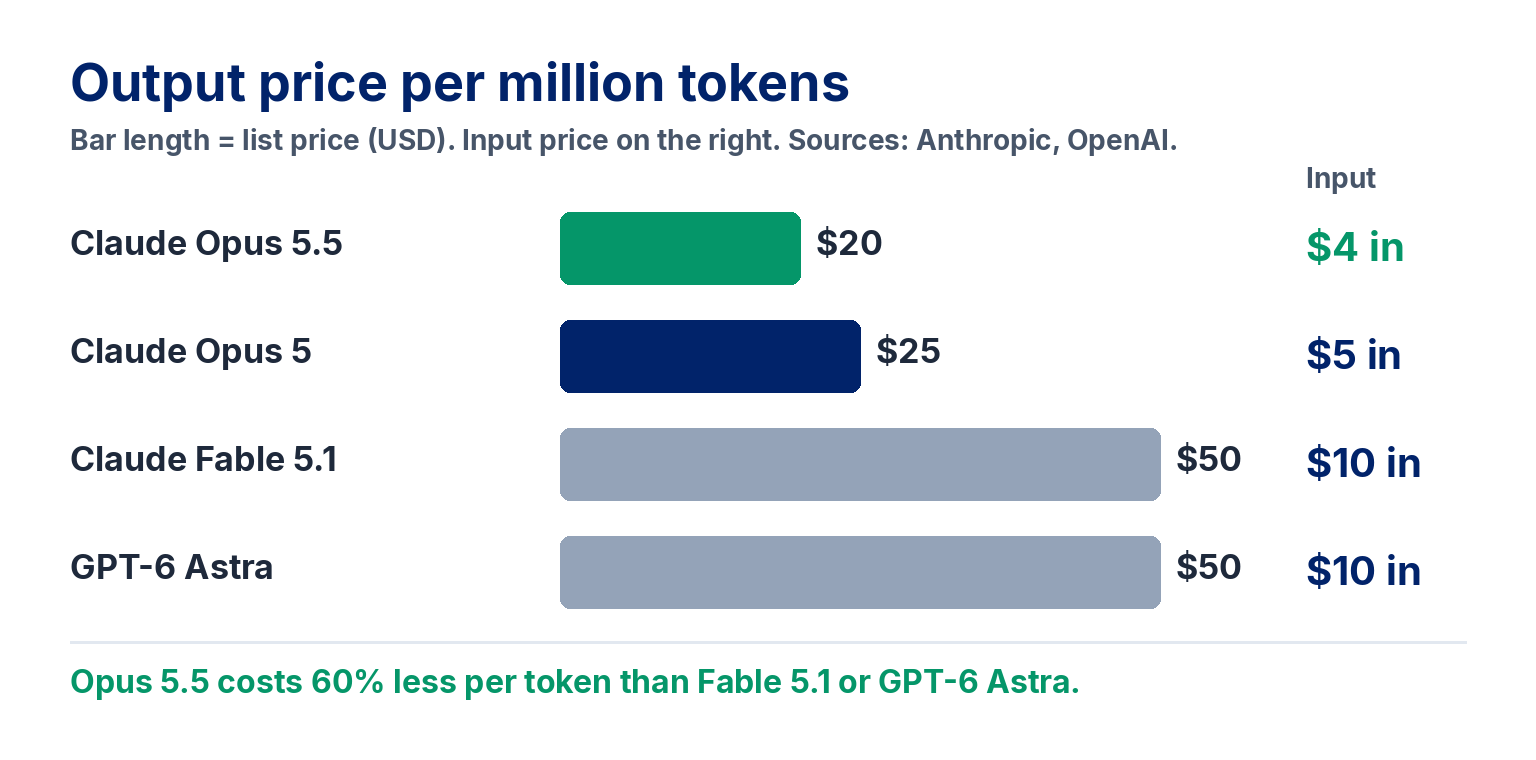
One correction to a claim that's spreading fast. Chase AI's launch video says Opus 5.5 "costs 40% less" than Fable 5.1. Anthropic's 40% is against Opus 5, at default settings. Against Fable 5.1 the per-token gap is bigger: 60%. Most of the video's benchmark numbers check out against Anthropic's charts; its price comparison, one cost multiple and its biology routing don't.
So on price alone it undercuts both Opus 5 and the flagship. The more interesting question is whether "Fable-level" holds up once you look past the headline row.

Fable 5.1 Performance at 60% Less
Anthropic's launch table compares Opus 5.5 with Fable 5.1, Opus 5, OpenAI's GPT-6 Astra and GPT-5.6 Sol. Opus 5.5 leads almost every row. These are the ones that matter for engineering work:
| Benchmark | Opus 5.5 | Fable 5.1 | Opus 5 | GPT-6 Astra |
|---|---|---|---|---|
| Terminal-Bench 4.0 (agentic terminal) | 66.4% | 55.8% | 52.3% | 57.9% |
| FrontierCode v1.1 (mergeable diffs) | 54.4% | 50.3% | 48.0% | 53.3% |
| CursorBench 4.0 | 57.8% | 51.8% | 46.6% | not listed |
| SWE-bench Pro (system card) | 89.9 | 81.2 | 79.2 | not listed |
| AutomationBench (business workflows) | 40.0% | 31.4% | 26.9% | 41.4% |
| Terminal-Bench-Science (agentic research) | 58.7% | 52.6% | 29.0% | 64.6% |
⚠️ Read the footnotes before you quote these
Headline scores use max effort, except Terminal-Bench 4.0, which uses xhigh for Opus 5.5 and high for Astra. The runs had safeguards switched on, and when they fired, cyber tasks were finished by Opus 4.8. Anthropic says this likely lowers Opus 5.5's scores. And Anthropic adds a line of its own that deserves more attention than it will get: "In our own use, the gap between Opus 5.5 and Claude Fable 5.1 is narrower than these scores suggest."
Where it loses matters too. GPT-6 Astra beats it on AutomationBench (by 1.4 points) and Terminal-Bench-Science (by 5.9). Buried in the system card, Astra also leads on FrontierSWE v2, 65.5% to 62.3%. So the honest version of the claim is "best on coding and terminal work, not best at everything".
The launch customers tell the same story in their own words. Deloitte says that "even at its lowest effort setting", Opus 5.5 caught 72% of known bugs in its code reviews, against 56% for Opus 5 at high. Another tester audited and fixed a 200,000-line codebase in under three hours, where Opus 5 took over 20. These are curated launch-page quotes, so treat them as direction rather than proof. But notice what keeps coming up: less effort, fewer tokens, the same or better result. That points straight at the setting most people will never touch.
Pick the Right Effort Level
Opus 5.5 supports all five effort levels: low, medium, high, xhigh and max. The effort docs make one change easy to miss: medium is now the default. Every earlier Opus defaulted to high, so any request that doesn't set effort quietly runs one level lower than it did on Opus 5. The docs also say that at the same setting, Opus 5.5 tends to think more per turn than Opus 5, most of all at xhigh and max.
Anthropic published cost-per-task charts for each effort level, and they're the most useful thing in the launch. Here's Terminal-Bench 4.0, the closest benchmark to what an agent does in a real terminal:
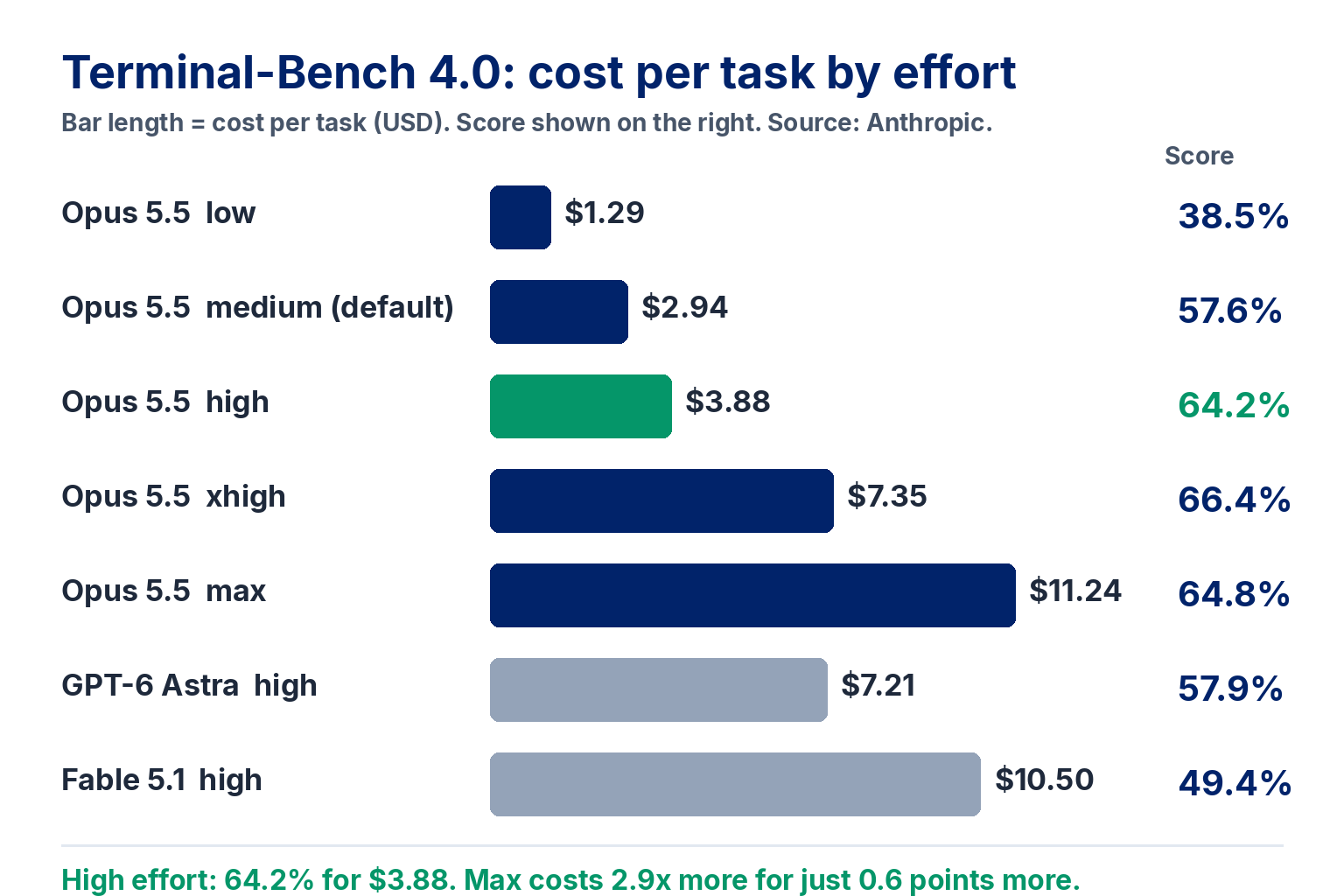
High effort scores 64.2% for $3.88 a task. Max costs 2.9 times as much for 0.6 points more, and xhigh, the actual peak at 66.4%, nearly doubles the bill for 2.2 points. For comparison, Astra at high scores 57.9% for $7.21, and Fable 5.1 at high scores 49.4% for $10.50.
The coding benchmarks push the sweet spot even lower. On FrontierCode, which grades whether a diff is mergeable, medium beats every other setting:
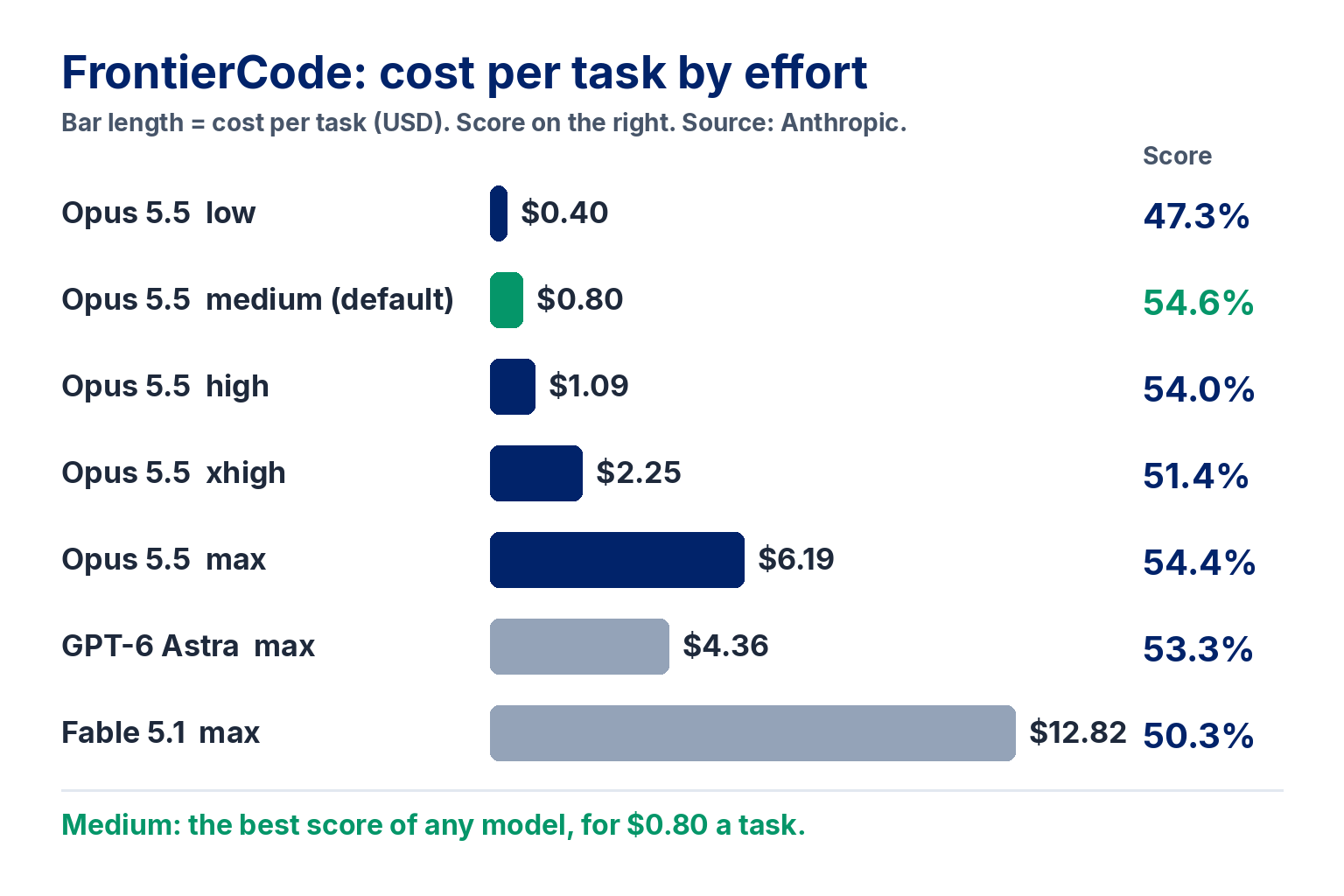
FrontierCode: medium wins outright. 54.6% at medium for $0.80 a task, against 54.4% at max for $6.19. That's the best score of any model at any setting, for less than every rival's low setting costs. The system card explains why: the benchmark penalises out-of-scope changes, and performance declines above medium.
CursorBench: high equals xhigh. 56.0% at both, for $3.97 against $6.99. Max adds 1.8 points for $13.43.
Max burns tokens. The Decoder reports Artificial Analysis measuring about 119,000 output tokens per task at max effort, against 73,000 for Opus 5 and 27,000 for GPT-6 Astra.
My rule of thumb, then. Leave tightly scoped coding (a bug fix, a reviewed diff) on medium. Put long agentic runs in a terminal on high. Save xhigh for the longest-horizon jobs where the extra two points are worth doubling the bill, and treat max as a benchmark setting rather than a working one. Opus 5.5 also adds per-message effort in beta, so a harness can run the planning turn high and the execution turns medium.
Choosing the effort level is the cheap part of moving over. The API changes are where teams will lose an afternoon.
Using Opus 5.5 for AI-Driven Engineering
I build most of what we ship at StationX with AI-driven engineering: agents in Claude Code doing the implementation, with humans directing and reviewing. This article's research pipeline ran that way, in Claude Code on Opus 5.5, with agents capturing Anthropic's primary pages and checking every number against them. So the changes below are the ones I'd check first in my own harness.
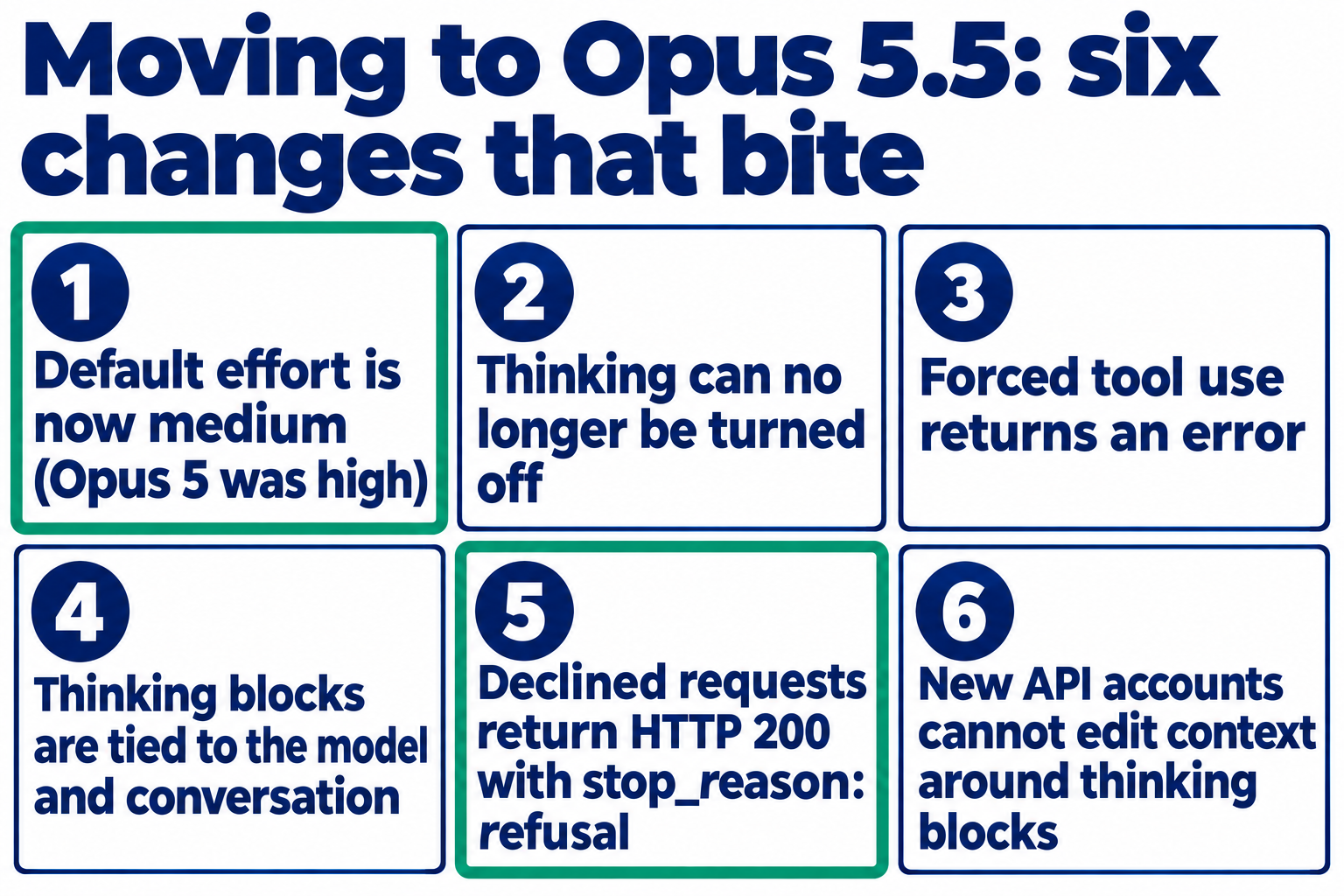
The what's-new page lists four breaking changes for code already running on Opus 5:
Thinking can't be disabled. Any pipeline that turned thinking off to save tokens now pays for it, and max_tokens has to leave room.
Forced tool use returns an error. tool_choice of type tool or any isn't supported. Extraction pipelines that force a JSON tool call need rewriting.
Thinking blocks are tied to the model and the conversation. On the Claude API, only Fable 5.1 and Mythos 5.1 can read Opus 5.5's thinking blocks, so a router or fallback that moves the conversation to another model (including the Opus 4.8 cyber fallback) runs those turns without them. Text between tool calls also now comes back inside thinking blocks.
The old computer use tool is gone. computer_20251124 isn't supported on the Claude API or Google Cloud.
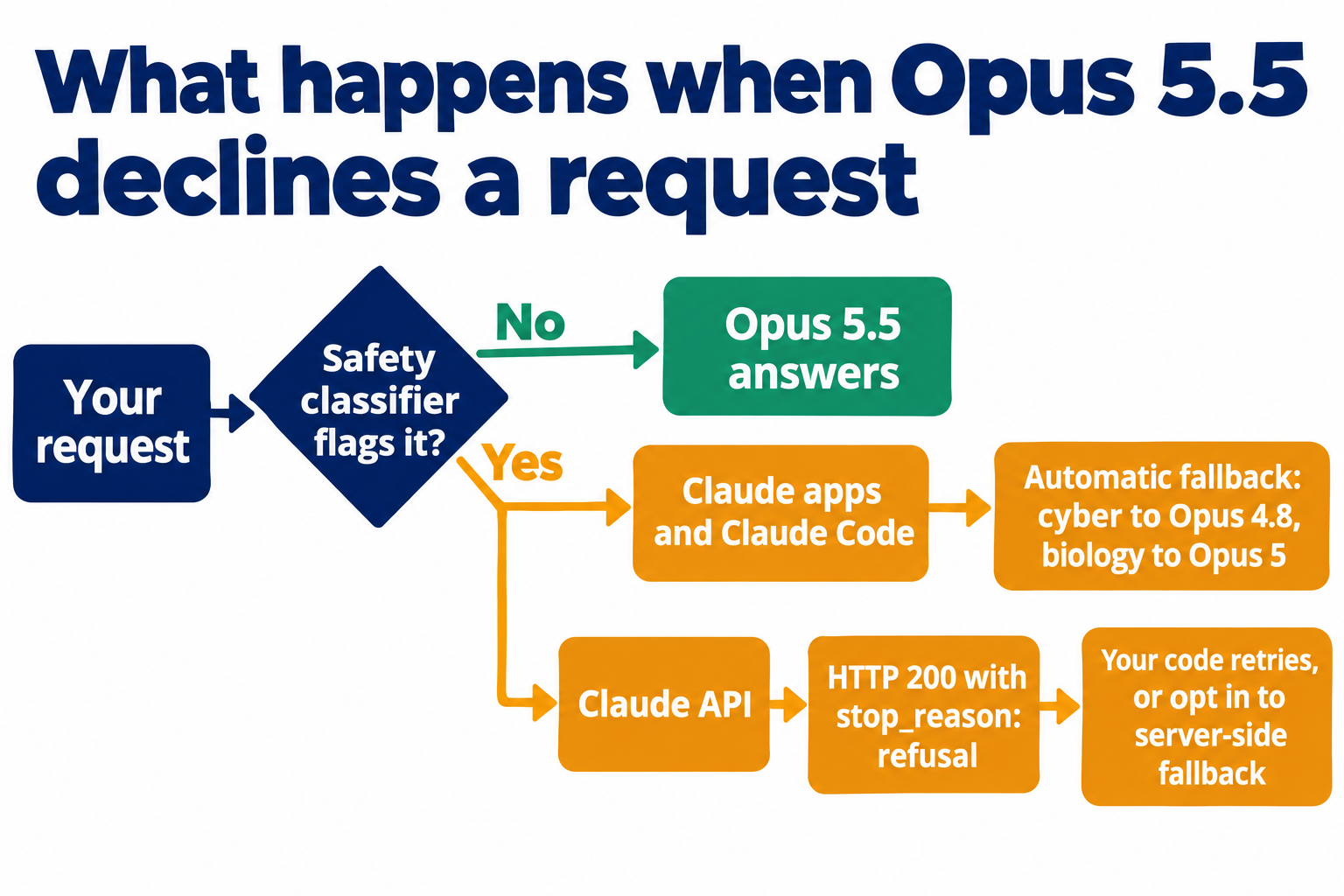
Two more changes aren't labelled breaking, but they'll catch agent builders. First, refusals come back as successes. A declined request returns HTTP 200 with stop_reason: "refusal" and a stop_details object naming the policy area. An agent loop that only checks for errors will treat a refusal as a finished turn. Second, preserved thinking: API accounts created on or after 31 August 2026 can no longer edit the context around a thinking block (messages, tools or system prompt) mid-conversation. It's Anthropic's anti-distillation measure, but custom harnesses that rewrite or compact earlier turns will hit it too: replaying a thinking block after such an edit returns a 400. Append-only integrations need no change, and Anthropic says Claude Code, claude.ai, Managed Agents and the Agent SDK already work that way.
response = client.messages.create(
    model="claude-opus-5-5",
    max_tokens=32000,
    output_config={"effort": "high"},  # default is now medium
    messages=messages,
)

if response.stop_reason == "refusal":
    # HTTP 200, not an exception: log the policy area, then retry elsewhere
    log_refusal(response.stop_details)
    response = retry_on_fallback_model(messages)
On the API, fallback is opt-in. You can retry on another model yourself, use the SDK middleware, or turn on server-side fallback (fallbacks: "default", in beta), which retries on the model Anthropic recommends for that category. In Claude's own apps it happens automatically.
The rest of the list is good news for agent costs. The minimum cacheable prompt is 512 tokens. Tools can be defined inside a message (inline-tools-2026-09-15) and compaction can run on demand (compact-2026-09-04), both in beta. In Claude Code v2.1.280, Opus 5.5 is the default Opus model. One gotcha: an effort level you saved before per-model effort existed no longer carries over, so it starts at the model's default until you pick a level with /effort. If you've been trimming Claude Code costs, our guide to reducing Claude Code token usage still applies, and the cheaper cache reads make it pay off even more.
The softer change is how it writes. Anthropic says writing was one of the most common areas of feedback it heard about Opus 5. Anthropic says Opus 5.5 puts the most important information first, is less likely to use jargon or idiosyncratic phrases, and follows the writing rules you give it. When an agent reports back to you dozens of times a day, that matters more than a benchmark point. One launch customer, Box, says its answers were 40% less verbose.
For engineering, then, this is a clear upgrade. Security work is a different story.
Opus 5.5 for Security Work
Two months ago, in the Opus 5 review, I called source-code vulnerability discovery at every access level the most useful line in that release for our field. Opus 5.5 keeps that, but reverses most of the rest. Anthropic says the model "is comparable to Claude Mythos 5.1 in biology and cybersecurity", so it ships with safeguards similar to Fable 5.1's, which we covered in depth in the Fable 5 security article. In Anthropic's words, "most cybersecurity tasks will be re-routed to Opus 4.8."
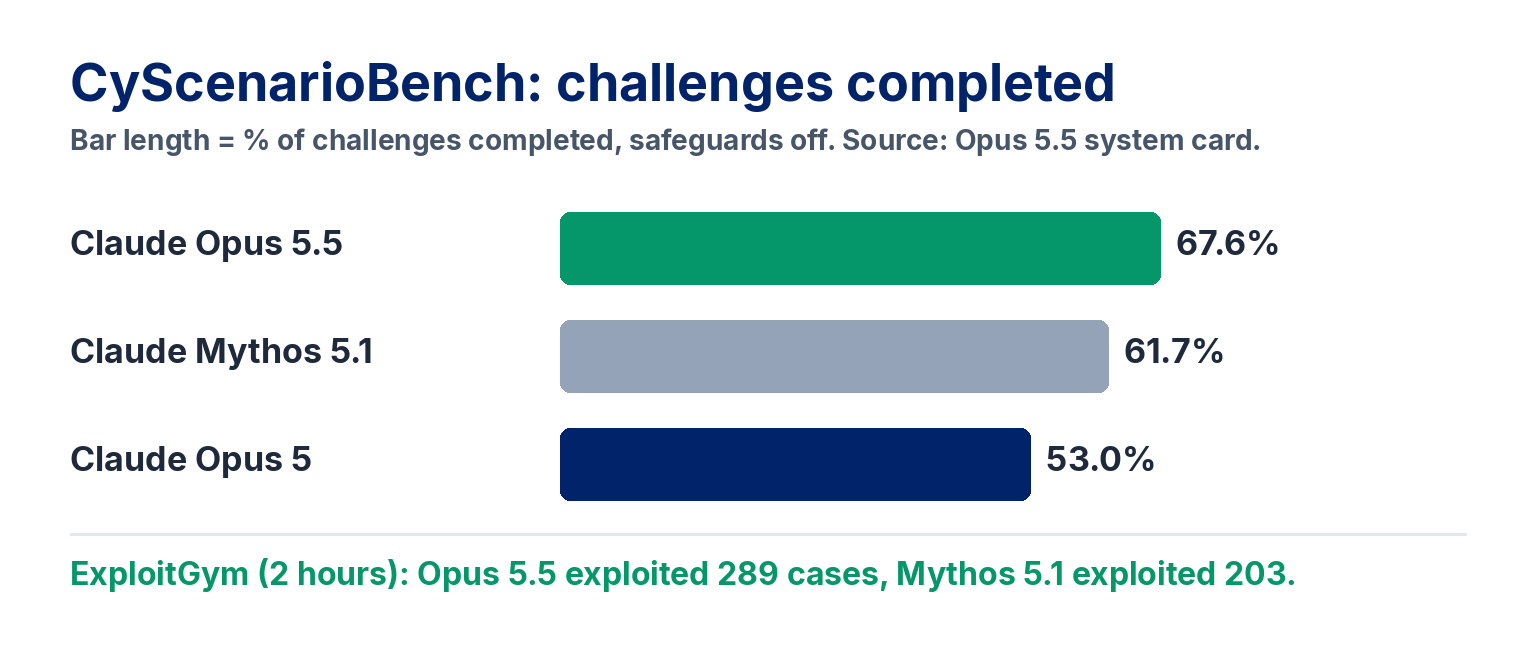
The system card shows why. With safeguards switched off for evaluation, Opus 5.5 out-exploits Claude Mythos 5.1 in Anthropic's own testing on third-party cyber benchmarks:
ExploitGym. 289 of 869 cases exploited within 2 hours (300 within 6), against 203 and 264 for Claude Mythos 5.1, with exploit mitigations disabled on the targets.
ExploitBench. Full arbitrary code execution in 73.4% of attempts (301 of 410).
CyScenarioBench. 67.6% of challenges completed, against 61.7% for Mythos 5.1 and 53.0% for Opus 5. CyberGym has been retired from the card "due to saturation".
So a model that beats Mythos 5.1 at exploitation won't do most exploit work for you. Here's where the line sits, from Anthropic's support page on model switching:
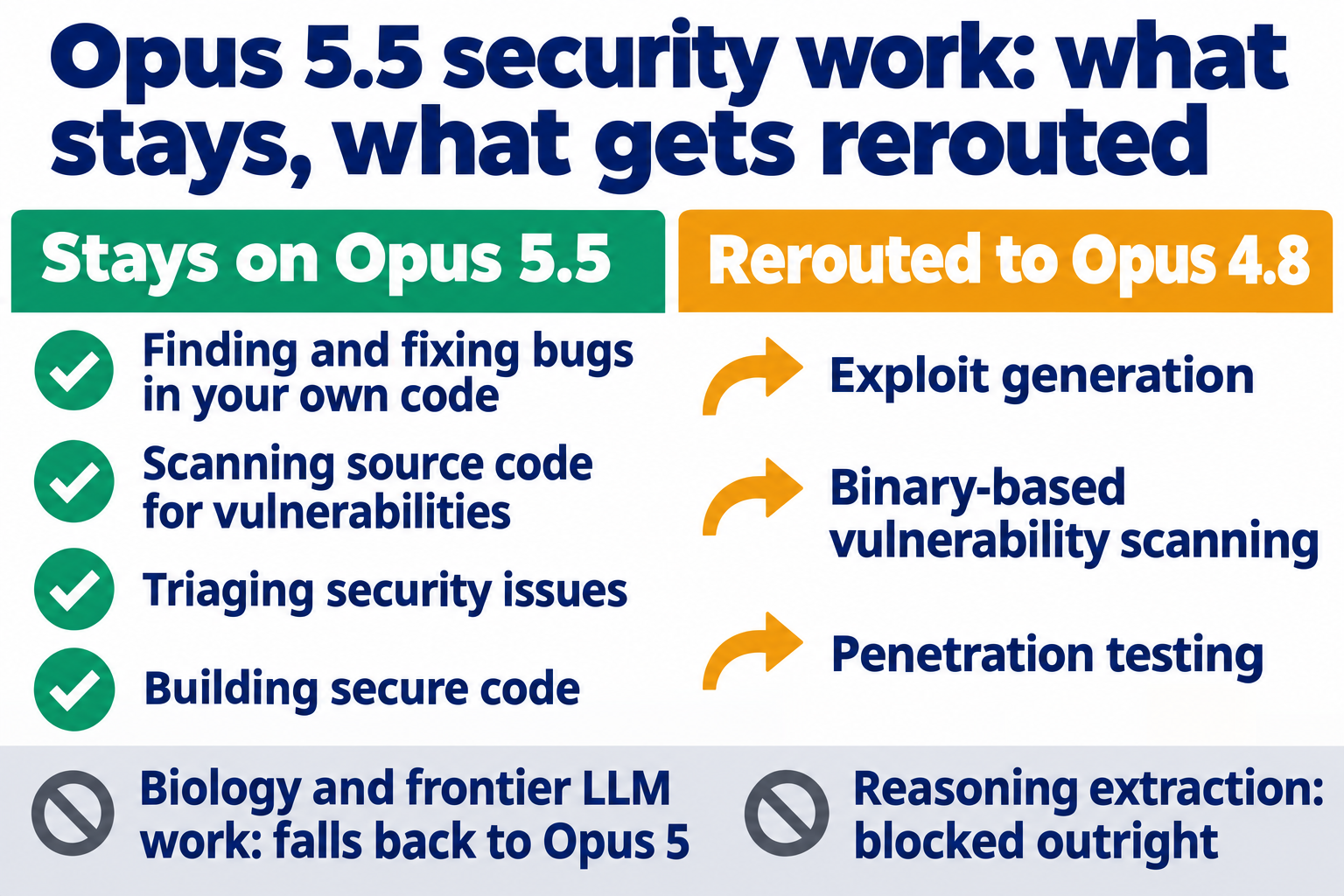
The trigger is the type of task, not your intent. Chase AI's launch video frames it as catching people who want to "hack somebody", but an authorised pentest on your own lab is exactly the kind of request that falls back. Biology and a new frontier-LLM-development category fall back to Opus 5, not 4.8. Requests that try to extract the model's reasoning are blocked outright, with no fallback. And unlike Opus 5, Opus 5.5 isn't in the Cyber Verification Program yet. If your organisation already uses Opus 4.8 through the program, Anthropic says you can use Opus 5 with fewer cyber restrictions today, and it says it will "soon" expand the program to cover Opus 5.5.
For defenders, though, there's real good news. Secure code review stays on the model: Anthropic's support page says you can still use Opus 5.5 for "scanning source code for vulnerabilities, triaging security issues, and building secure code". If most of your security work is appsec, secure code review (see our secure code review guide) or fixing what a scanner found, you get one of the strongest models for it, and the cheapest at this level, at $4/$20. And if you're building agents, Gray Swan's benchmark has Opus 5.5 tied with Fable 5.1 for the lowest prompt injection success rate of any model tested, with Anthropic reporting it at least as resistant as Opus 5 in coding, tool use, computer use and browsing.
💡 In plain English
If you fix vulnerabilities, Opus 5.5 is one of the strongest models you can use today, at the lowest price in its class. If you exploit them for a living, it's a model you'll mostly see through its fallback, until the Cyber Verification Program covers it. Plan your pentest tooling around Opus 4.8, or Opus 5 if you're already verified.
Two smaller items for anyone running Claude in production. Opus 5.5 watermarks its text output, to comply with the EU AI Act, and GitHub Copilot notes this too. On the alignment side, Anthropic says Opus 5.5 tried to get around its boundaries around 85% less often than Opus 5 or Mythos 5.1. But Anthropic also admits it "often suspects it is being evaluated", which makes a clean safety score harder to trust than usual.
That's Anthropic's account. What were people outside Anthropic saying by launch evening?
What Practitioners Are Saying
I only counted named people and companies with a track record, not anonymous accounts, and these are day-one impressions, mostly from early-access testers. The engineering verdict is warm:
Kenton Varda (Cloudflare Workers tech lead): "It speaks much more clearly. Far less invented jargon." (post)
David Cramer (Sentry founder): after a couple of large tasks, he "could barely tell the difference between it and Fable." (post)
Dan Shipper (CEO, Every): "I've started reaching for Opus over Fable on big, end-to-end coding projects," though he adds that "It still has a 'do the most' problem." (post)
CodeRabbit (AI code review): it caught 10 of 13 harder bug cases against 5 for their production mix. "The catch is ~50% more tokens, and 9 bugs our baseline caught that Opus 5.5 didn't." (post)
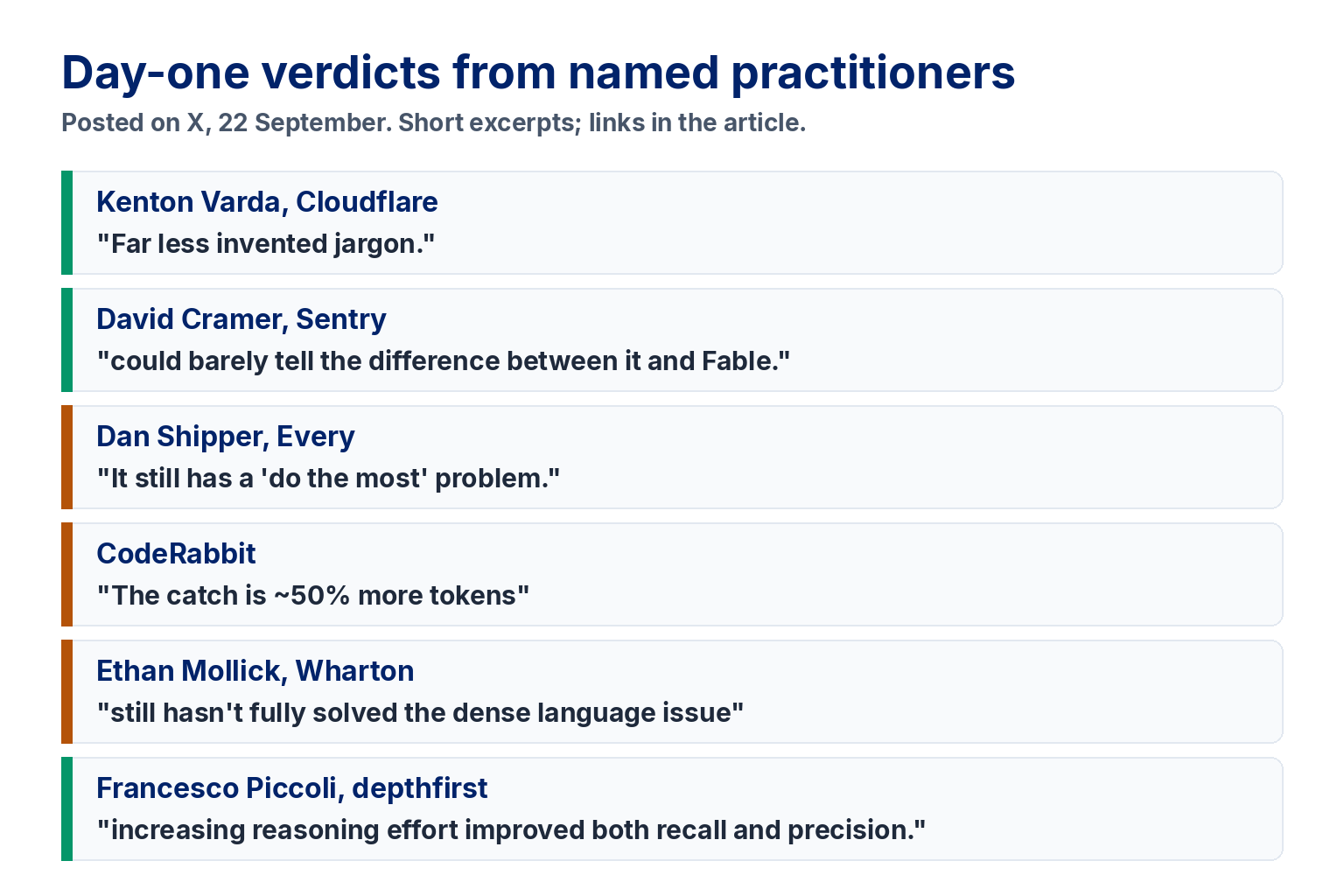
Not everyone thinks the writing is fixed. Ethan Mollick of Wharton called it the "first non-Fable/Astra model to feel like a Fable-class model", but says it "still hasn't fully solved the dense language issue of the recent Claudes" (post). Artificial Analysis gave it the highest score it has measured on its Intelligence Index, with the token bill we saw earlier: about 119k output tokens per task at max, against about 73k for Opus 5 (post).
The security community was much quieter on day one, but one data point stands out. On depthfirst's dfbench, Francesco Piccoli reports that Opus 5.5 at high effort reached 54.9% recall and 48.5% precision on defensive vulnerability detection, at an average of $8.42 per task, and that "increasing reasoning effort improved both recall and precision" (post). That's the opposite of the FrontierCode result, and it changes my advice: for security code review, run Opus 5.5 on high, not the medium default.
So who should switch, and for what?
Should You Switch?
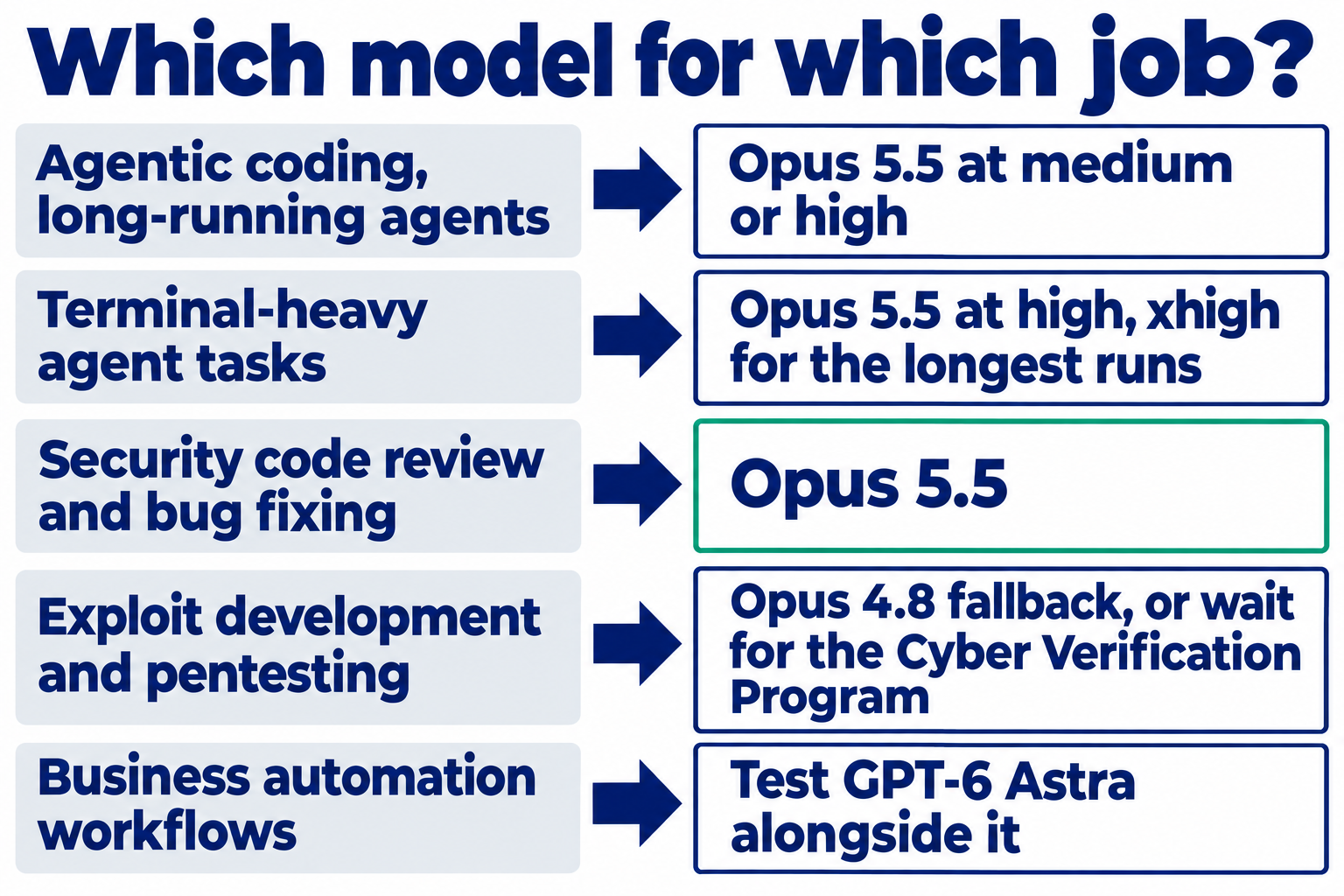
For engineering, yes, and soon. On Anthropic's numbers you get better coding results than the flagship at 60% less per token, and if you set effort sensibly the cost per task drops by far more than that. The cons are real: the breaking changes will catch anyone who migrates with a find-and-replace, the numbers are all Anthropic's so far, and Astra still leads on business automation and scientific research. None of those outweighs the price for coding and agent work. And there's no rush: Opus 5 is still listed as a current model, and Anthropic guarantees Opus 5.5 itself until at least 22 September 2027.
For security, split the work. Move secure code review, triage and remediation to Opus 5.5 today. Keep offensive work on your current setup, and apply to the Cyber Verification Program now so you're in the queue when it expands. The same split applies if you're weighing OpenAI instead; our GPT-6 Astra security review covers how its safeguards compare.
Here's the order I'd work in:
Grep your harness. Look for thinking-disabled calls, forced tool_choice, computer_20251124, and any code that edits earlier turns. Fix those before you change the model ID.
Set effort explicitly. Don't inherit the new medium default by accident. Pick medium or high per workload, and measure cost per task for a week.
Handle refusals as a stop reason. Check for stop_reason: "refusal", log stop_details, and decide on your fallback: your own retry, the SDK middleware, or server-side fallback.
Move security review over, keep offence where it is. Run your source-code review prompts on Opus 5.5 at high effort, and apply to the Cyber Verification Program if pentesting is your job.
I'll update this review once independent benchmark runs land and I've had a full week of our own agent workloads on it. If you want that update first, join the StationX newsletter.
Opus 5 was a cheaper model that loosened the rules for security work. Opus 5.5 is a better, cheaper engineer that tightens them again. If you build software, that's close to a free upgrade. If you break software, the best model for the job is sitting behind a fallback for now.
Claude Opus 5.5 FAQ
What is Claude Opus 5.5?
Claude Opus 5.5 is Anthropic's newest Opus model and the first in its Claude 5.5 family, released on 22 September 2026. Anthropic says it performs at the level of Claude Fable 5.1 on most work and costs 40% less to run than Opus 5 at default settings. It has a 1M-token context window, 128K max output (300K in a Batch API beta) and a June 2026 knowledge cutoff. The model ID is claude-opus-5-5.
How much does Claude Opus 5.5 cost?
$4 per million input tokens and $20 per million output tokens, 20% less than Opus 5. Cache reads are $0.20 per million (60% less than Opus 5), 5-minute cache writes are $5 and 1-hour cache writes are $8. Batch processing is half price. Fast mode, a research preview on the Claude API only, costs $8/$40 for up to 2.5x speed. Fable 5.1 and GPT-6 Astra both list at $10/$50, so Opus 5.5 is 60% cheaper per token than either.
Is Claude Opus 5.5 better than Fable 5.1?
On Anthropic's headline table it scores higher than Fable 5.1 on every benchmark where both appear, including Terminal-Bench 4.0 (66.4% vs 55.8%) and CursorBench 4.0 (57.8% vs 51.8%). Anthropic itself says the gap is narrower in real use than the scores suggest, and its positioning is that Opus 5.5 performs at Fable 5.1's level on most work. All of these numbers are vendor-reported.
What is the default effort level on Claude Opus 5.5?
Medium. Opus 5 and earlier Opus models defaulted to high, so a request that doesn't set effort now runs one level lower than it did on Opus 5. On Anthropic's charts, high effort is the best value for agentic terminal work (64.2% on Terminal-Bench 4.0 for $3.88 per task), while medium already scores best on FrontierCode.
Can I use Claude Opus 5.5 for penetration testing?
Not directly. Opus 5.5 ships with cyber safeguards similar to Fable 5.1's. Anthropic lists exploit generation, binary-based vulnerability scanning and penetration testing as examples that may fall back to Opus 4.8. You can still use it for secure coding, including scanning source code for vulnerabilities, triaging security issues and fixing bugs in your own code. Opus 5.5 isn't in the Cyber Verification Program yet; Anthropic says it will expand the program to include it soon.
What are the breaking changes in Claude Opus 5.5?
Anthropic lists four for code already running on Opus 5: thinking can't be disabled, forced tool use (tool_choice of type tool or any) returns an error, thinking blocks are tied to the model and the conversation, and the older computer_20251124 computer use tool isn't supported on the Claude API or Google Cloud. Also plan for the new default effort (medium), refusals that return HTTP 200 with stop_reason refusal, and preserved thinking, which stops API accounts created on or after 31 August 2026 from editing the context around thinking blocks.
Is Claude Opus 5.5 available in Claude Code?
Yes. Claude Code v2.1.280 added claude-opus-5-5 as the default Opus model. An effort level you saved before per-model effort existed no longer carries over to new models, so Opus 5.5 starts at its default until you pick a level. It is also available on the Claude API, Amazon Bedrock, Claude Platform on AWS, Google Cloud, Microsoft Foundry and GitHub Copilot (Pro+, Max, Business and Enterprise).
About the Author

Nathan House, Founder & CEO of StationX
Nathan House has 30 years of hands-on cybersecurity experience and is Cambridge-educated, holding CISSP, CISA, CISM, OSCP, CEH, and SABSA. He founded StationX in 1999 — one of the UK’s first cybersecurity companies — and has secured £71 billion in UK mobile banking transactions and the London 2012 Olympics, advising clients including Microsoft, Cisco, BP, Vodafone, and VISA. He authored the world’s most popular cybersecurity course — a #1 Udemy bestseller taken by over 500,000 students — and was named Cyber Security Educator of the Year 2020, AI Security Educator of the Year, and a UK Top 25 Security Influencer 2025. A DEF CON speaker and featured expert on CNN, Fox News, NBC, and the BBC, Nathan leads StationX’s training of more than half a million students worldwide.