Claude Opus 5 Review: Everything New in 2026
Anthropic released Claude Opus 5 on 24 July 2026, following quickly on Opus 4.8. Same $5 input / $25 output pricing as 4.8, half of what Fable 5 costs, and Anthropic's own system card states plainly that it is not more capable overall than Fable 5. A model priced below the flagship it sometimes beats: if that leaves you confused, the Hacker News launch thread is full of developers asking the same question.
We've reviewed every release in this series (the 4.7 review and the 4.8 review), and this one follows the same method: launch day spent in the announcement, the 194-page system card, and the migration docs, checked against what developers are actually reporting.
The plan: what shipped, why the smaller-but-cheaper positioning matters, the migration changes that can break or silently alter your API calls, the security story nobody else is leading with, and whether you should switch. So let's get into it.
TL;DR: if you've only got 30 seconds
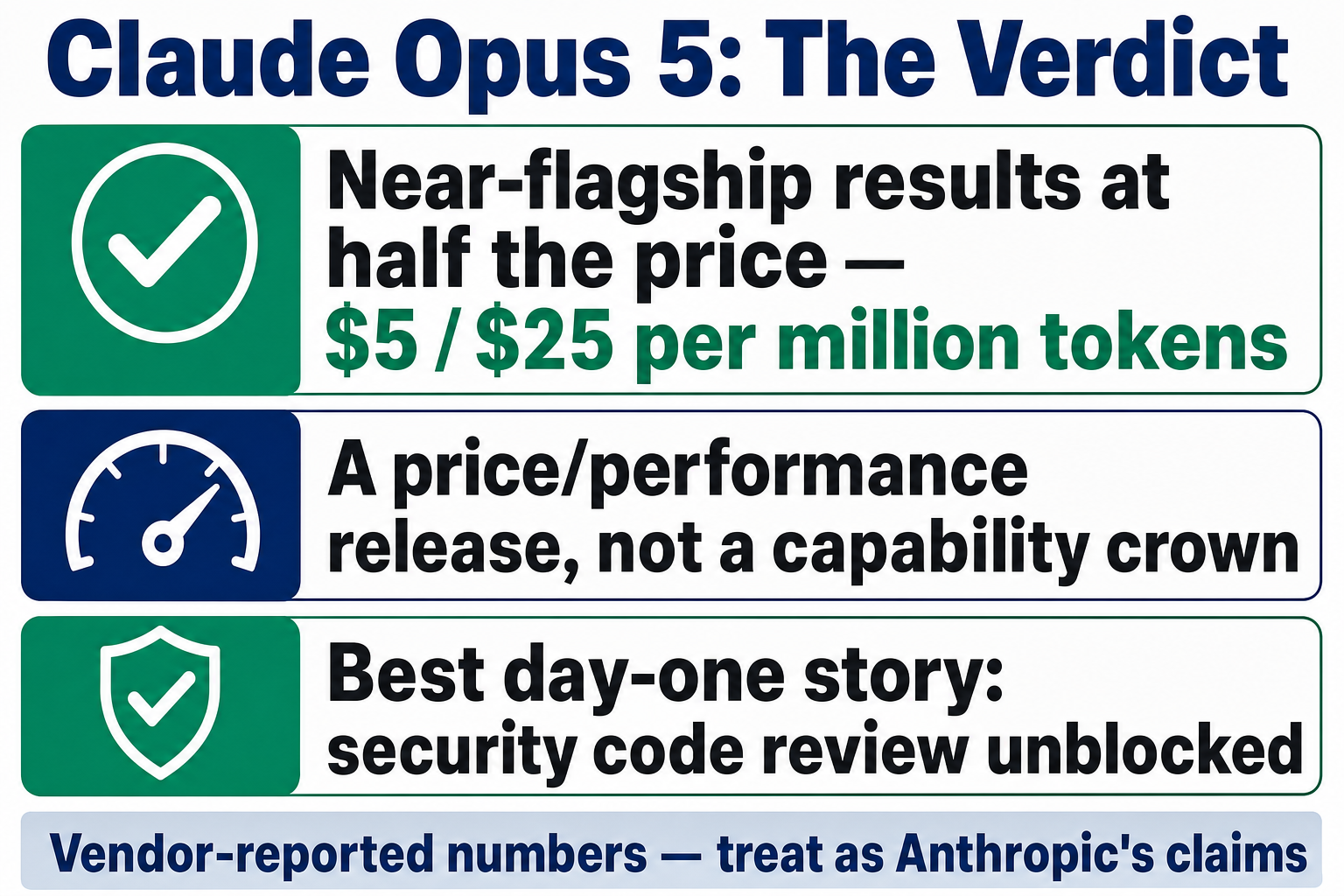
What it is: Anthropic's new Opus model, out 24 July 2026. $5/$25 per million tokens: same as Opus 4.8, half of Fable 5.
The odd part: Anthropic's system card says it's not more capable overall than Fable 5, yet it matches or beats Fable 5 on several vendor-reported benchmarks at a fraction of the cost.
The breaking change: thinking is on by default, and turning it off while asking for xhigh or max effort now returns an HTTP 400. Your 4.8 code may not just work.
For security people: cyber safety classifiers are expected to intervene around 85% less often than for Fable 5, and source-code vulnerability discovery is permitted at all access levels. Pentesting needs Cyber Verification Program membership.
Upgrading: Opus 4.8 stays available, with no retirement before 28 May 2027 on Anthropic's platforms, so there's no forced move. But at this price, most working setups should at least trial it.
The catch: every headline number is Anthropic's own: ratios in the announcement, self-reported scores in the system card. Nothing is independent yet.
What Actually Shipped on 24 July
If you're just after the Claude Opus 5 release date: 24 July 2026, with Anthropic saying it's "available today on all platforms". Their docs list the Claude API, Claude Platform on AWS, Amazon Bedrock, Google Cloud, and Microsoft Foundry. The model ID is claude-opus-5 (anthropic.claude-opus-5 on Bedrock), and you'll see it written as "Claude 5 Opus" in places (same model).
The spec sheet, from Anthropic's docs:
Pricing. $5 per million input tokens, $25 per million output, the same as Opus 4.8. Pre-launch rumours had it at $10/$50; hold that thought for the fast mode section. The "Honeycomb" codename that testers reported spotting in Cursor on 9 July and Vertex on 14 July is widely believed to have been this model.
Context. 1M tokens, both the default and the maximum. Max output is 128K, with 300K available through a Batch API beta header (output-300k-2026-03-24).
Knowledge cutoff. May 2026.
System card. 194 pages, published at launch. Credit where it's due: we flagged the missing system card in the 4.8 review; this time it landed on day one.
⚠️ Benchmark numbers are vendor-reported
Anthropic's announcement gives ratios ("more than doubles", "within 0.5%"), not raw scores, and the comparators labelled "next-best" are Anthropic's own choice. One more wrinkle: Anthropic's internal Frontier-Bench run fell back to Opus 4.8 on refusals, so even their own number is partly a blended result (the detail behind HN user justindotdev's "ffs just keep it man"). Same rule as the last two reviews: treat everything in the table below as Anthropic's claims until independently reproduced.
| Benchmark | Anthropic's claim | Caveat |
|---|---|---|
| Frontier-Bench v0.1 | "more than doubles Opus 4.8's performance" | internal benchmark, run fell back to 4.8 on refusals |
| CursorBench 3.2 | "within 0.5% of Fable 5's peak score" at "half the cost per task" | vendor ratio |
| ARC-AGI 3 | "three times as high as the next-best" | system card table shows 30.2 vs 7.8 (~3.9x, so the announcement is conservative) |
| OSWorld 2.0 | beats Fable 5's best at "just over a third of the cost" | vendor ratio |
| Zapier AutomationBench | "around 1.5x the next-best" | system card: 26.0% vs 18.1 |
| SWE-bench Verified | Anthropic's system card reports 96.0% | §8.2 only: 500-problem subset, average of 5 trials, self-reported, no confidence interval |
| SWE-bench Pro | 79.2 | trails Fable 5's 80.0 |
The specs are straightforward and the price familiar. The line that actually explains this launch sits outside the benchmark table entirely: a sentence in the system card about what Opus 5 is not.

Smaller Than Fable 5, and It Beats It Anyway
The RSP section of the system card says it outright: "Claude Opus 5 is not more capable overall than our most capable general-access model, Claude Fable 5." TechCrunch framed the launch the same way: a smaller model that still beats Fable 5 on several benchmarks. Anthropic shipped a model below its own flagship and priced it at half of Fable 5's $10/$50.
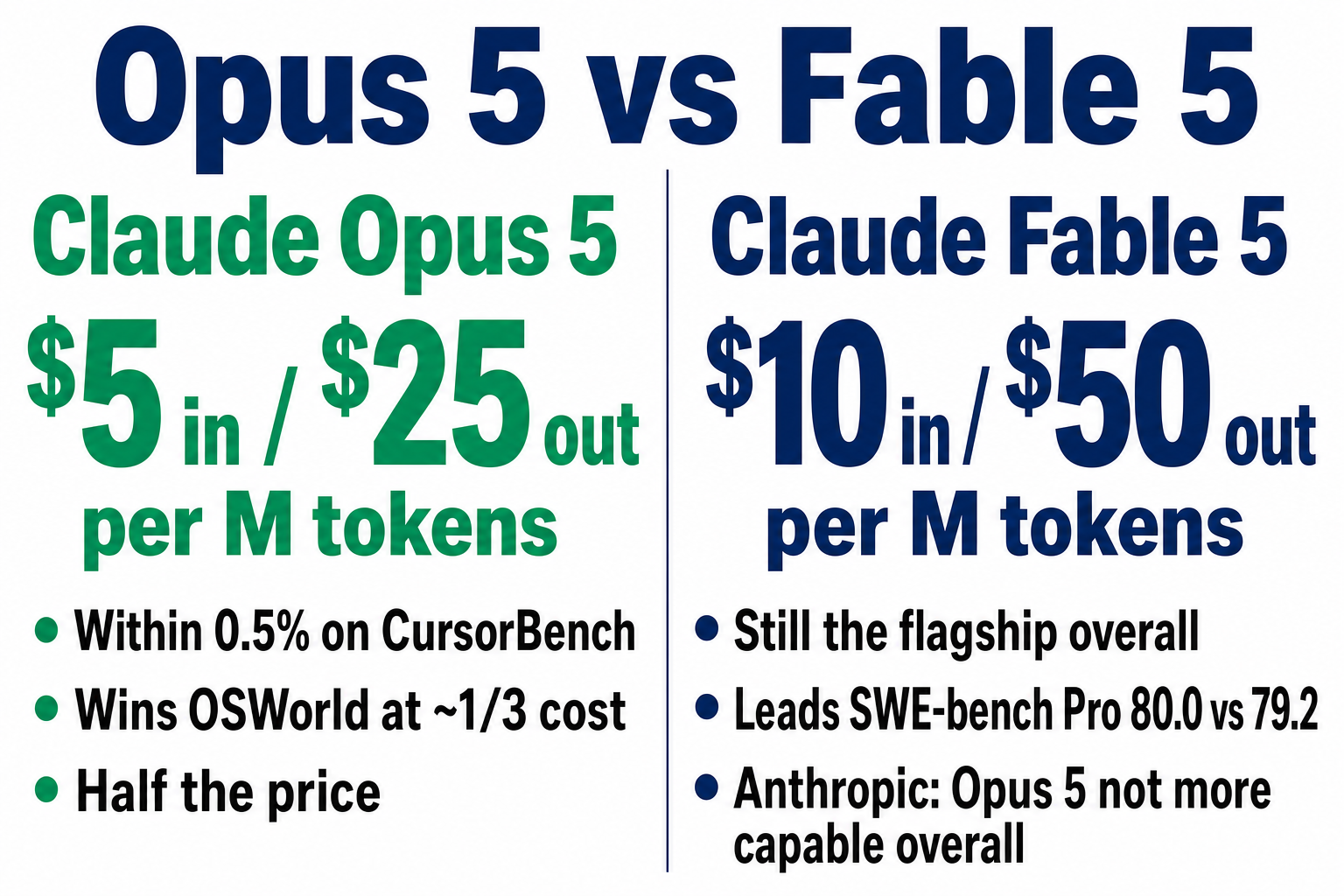
On Anthropic's own numbers, the smaller model gets uncomfortably close. Within 0.5% of Fable 5's peak CursorBench 3.2 score at half the cost per task. Beating Fable 5's best OSWorld 2.0 result at just over a third of the cost. Cursor's Sualeh Asif, quoted in the launch post, called it "near Fable 5 intelligence at Opus speed and cost". It's a curated marketing quote, but it matches the pattern the ratios describe.
The honest counterweight, and it's Anthropic's own: Opus 5 trails Fable 5 on SWE-bench Pro, 79.2 against 80.0. Close, but the flagship is still the flagship.
One number needs defusing. Zapier's Wade Foster says in his launch testimonial that Opus 5 "hit 100%". That refers to one churn-prevention workflow in Zapier's own testing, not a benchmark. On Zapier's AutomationBench, the system card shows 26.0% against a next-best of 18.1. Big relative gap, modest absolute score. Anyone telling you Opus 5 scored 100% on Zapier's benchmark has confused a testimonial with a result.
The developer reaction split exactly along this line. The Hacker News launch thread (1,100+ points and 600+ comments within hours of launch) has datakan asking "Ok then so what's the point?" while zuzululu answers it in effect: "so almost fable 5 with 50% cheaper cost? sign me up". My take, as someone who builds agent infrastructure on Claude Code daily and actually reads the token bill: zuzululu has it right. For agentic work billed by the token, price/performance is the product, and "nearly the flagship at half price" is a better deal than a marginal capability bump would have been.
Therefore the upgrade should be a no-brainer. It would be. Except this time, unlike 4.8, swapping the model ID can break your code.
Thinking On by Default: The Breaking Change
In the 4.8 review we wrote "swap the model ID and your 4.7 code keeps working." Not this time.
Claude Opus 5 ships with thinking on by default, and the effort ladder (low, medium, high, xhigh, max) no longer needs a beta header. The loud breaking part: if you disable thinking and request xhigh or max effort, the API now returns an HTTP 400. Anthropic's docs call this "a breaking change from Claude Opus 4.8", unusually direct labelling from them. If any of your pipelines run thinking-off with high effort settings, a common cost-tuning pattern, those calls fail the moment you swap the ID.
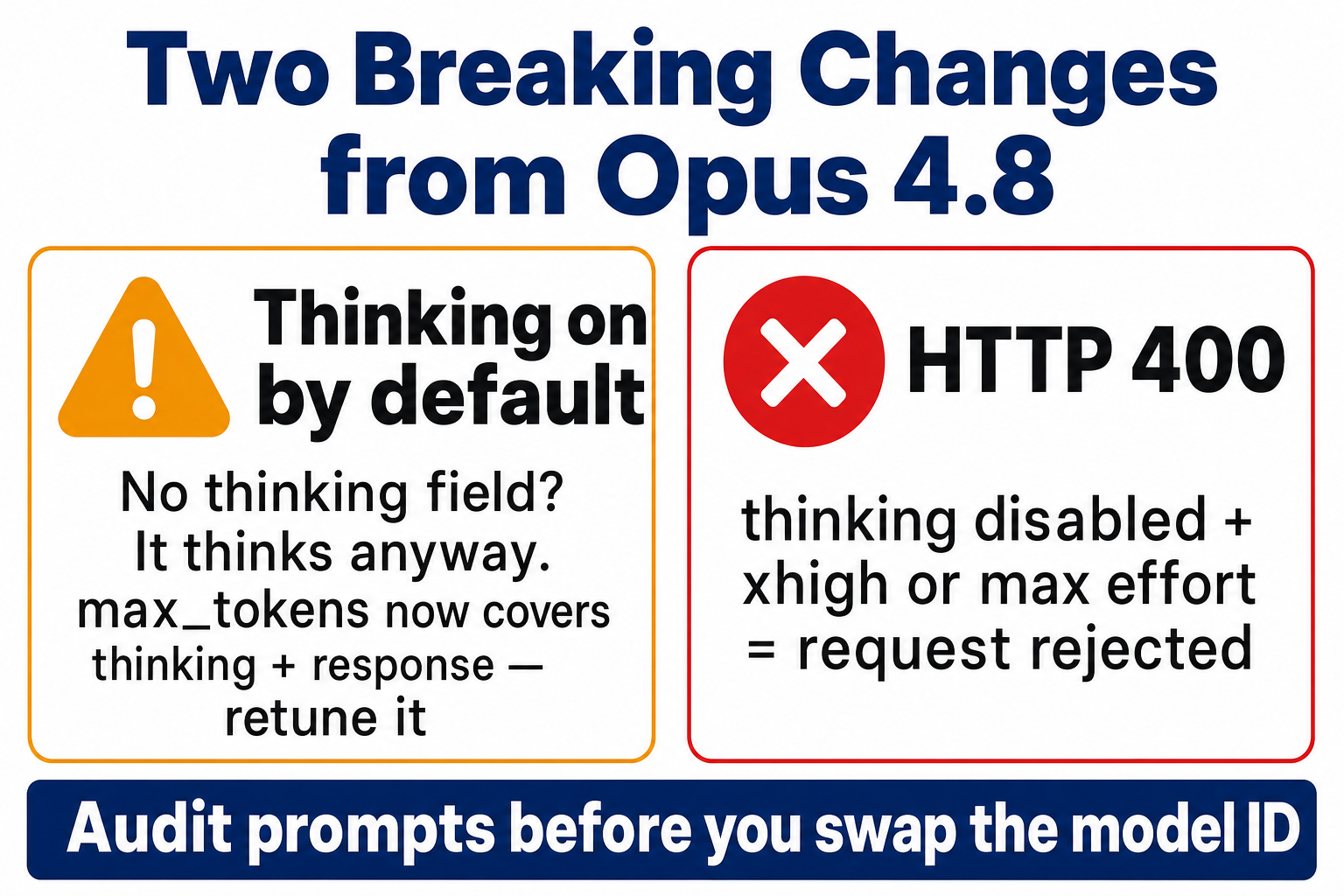
Strictly, the migration guide counts two breaking changes, and the quieter one costs money rather than throwing errors: requests that send no thinking field at all, which ran without thinking on 4.8, now run with adaptive thinking. Your max_tokens still caps total output, thinking plus response text, so a limit tuned for a thinking-free 4.8 workload can now truncate responses mid-answer. Revisit max_tokens on any call you migrate, or pass thinking: {"type": "disabled"} (at high effort or below) to keep the old behaviour.
There's a quieter migration note that will save you money too. The docs advise removing verification instructions carried over from earlier models, lines like "include a final verification step" or "use a subagent to verify", because on Opus 5 they cause over-verification. We've all got prompts with those exact sentences in them; they were the standard fix for models that shipped unchecked work. On Opus 5 they make it check twice at your expense. Delete them.
Two prompt-file audits, then, before you migrate anything. Still, for this audience the change I'd rank highest has nothing to do with API behaviour. It's what the model will now agree to work on.
Security Work Unblocked
I've spent 30 years in security, and the last two of them watching frontier models refuse legitimate security work. It's been a running theme in this series since the "malware reminder" complaints in the 4.8 launch thread, and the subject of our Fable 5 security article. Every StationX student who's had a model refuse to explain a vulnerability class they're studying knows the frustration.
Opus 5 is the first release where Anthropic has moved meaningfully the other way. Anthropic's announcement says it expects the cyber safety classifiers to intervene around 85% less often than they do for Fable 5. Note both qualifiers: relative, and expected. That's not a measured refusal rate in the wild. Still, an 85% reduction against their own flagship is not a tweak.
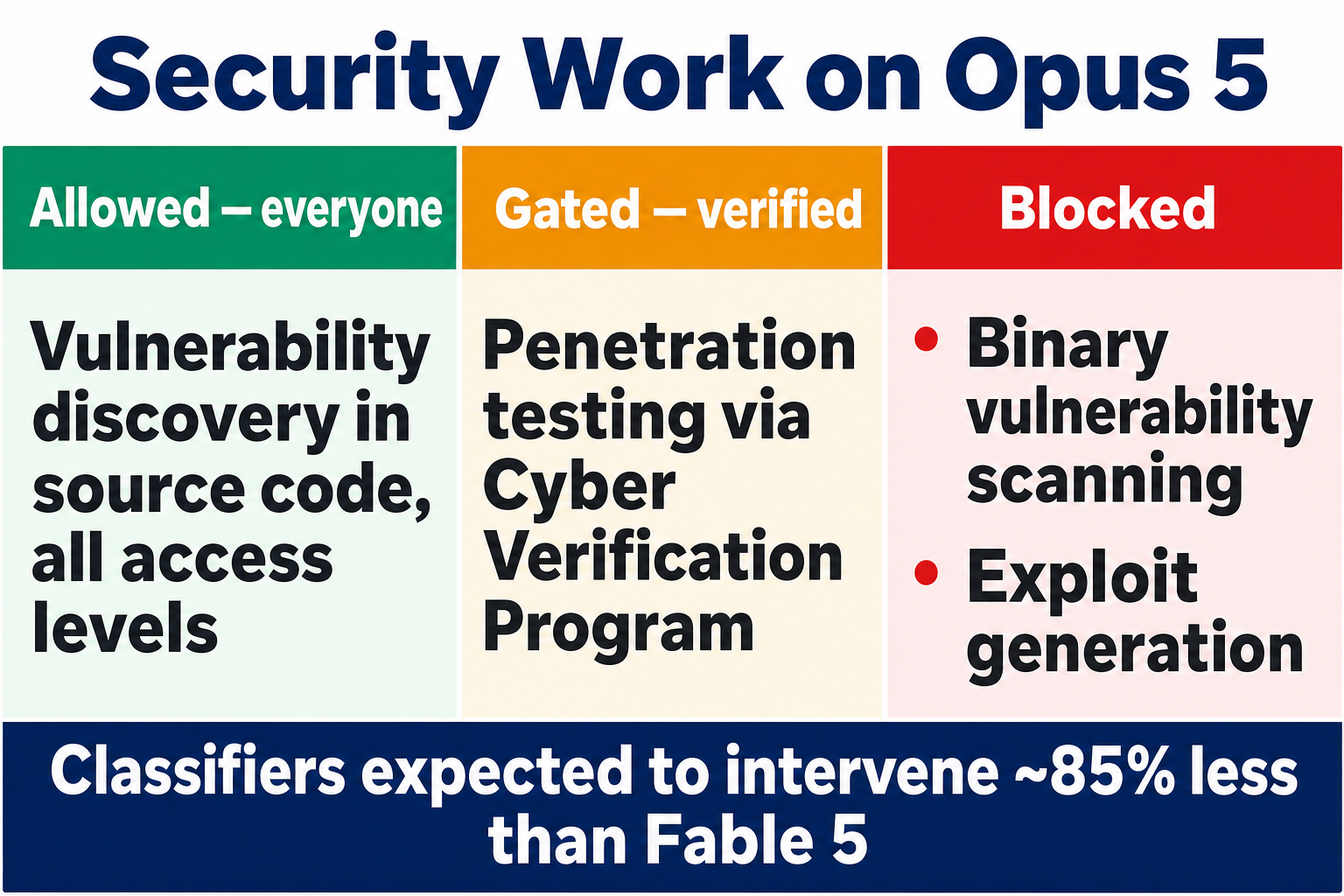
More concretely: vulnerability discovery in source code is permitted at all access levels. No enterprise tier, no special agreement: code review for security flaws is now sanctioned work for everyone. Given how much of modern appsec, bug bounty triage, and secure-code training is exactly that, this is the single most useful line in the release for our field.
What's still gated: binary-based vulnerability scanning and exploit generation remain blocked, and penetration testing is blocked by default, but it's available to members of Anthropic's Cyber Verification Program. That exception matters. If pentesting is your day job, the path forward is verification, not jailbreaks.
Some launch-day reactions misread this. HN user not_a9 concluded "Okay so it's worse than Opus 4.8 for my purposes I guess?" But the documented change loosens the safeguards for source-code work; unless your work sits in the still-blocked categories, the docs point the other way.
One behaviour to know before your users hit it: on consumer surfaces (Claude.ai, Claude Code, Cowork), flagged requests fall back to Opus 4.8 by default: you ask for Opus 5, you sometimes get 4.8. On the API, though, fallback works differently — and it arrived alongside a set of API changes worth five minutes of your attention.
Fast Mode and the API Changes
Four things shipped alongside the model, and all four change how you'd wire it up.
Fast mode: $10/$50, research preview, first-party Claude API only. Yes — the price the rumour mill assigned to Opus 5 itself turned out to be its fast mode (and Anthropic's pricing page lists fast mode for Opus 4.8 as well, so it's a platform feature, not an Opus 5 exclusive). It's not on Bedrock or the other clouds, and in Claude Code it draws usage credits. Research preview means behaviour and pricing can move.
Server-side fallback is opt-in beta on the API (server-side-fallback-2026-07-01), covering safety-refusal cases only. Read that against the previous section: on consumer surfaces fallback to 4.8 is the default; on the API it only happens if you ask for it, which is the right design.
Mid-conversation tool changes no longer invalidate the prompt cache (beta header mid-conversation-tool-changes-2026-07-01). If your agents swap tools mid-session, this is real money on a 1M-token context.
The prompt-cache minimum drops to 512 tokens, from 1,024. Short-prompt callers (chat frontends, fast-turn agents) can now cache what previously fell under the bar. And if you batch, the 300K output header from the spec sheet stacks with all of this.
A long parts list, and cheaper on almost every line. Whether it adds up to a switch depends on which of four camps you're in.
Should You Upgrade?
First, the comparison half the search traffic wants: Opus 5 vs GPT-5. The honest day-one answer is that we haven't seen a trustworthy head-to-head yet. Anthropic's launch material compares Opus 5 against its own models and unnamed "next-best" scores, and until a third party publishes a like-for-like run, any Opus-5-vs-GPT-5 verdict this week is vibes. We'll update this section when real numbers land, as we did for 4.8's late benchmark table.
Against Anthropic's own lineup, the picture is clear enough to commit:
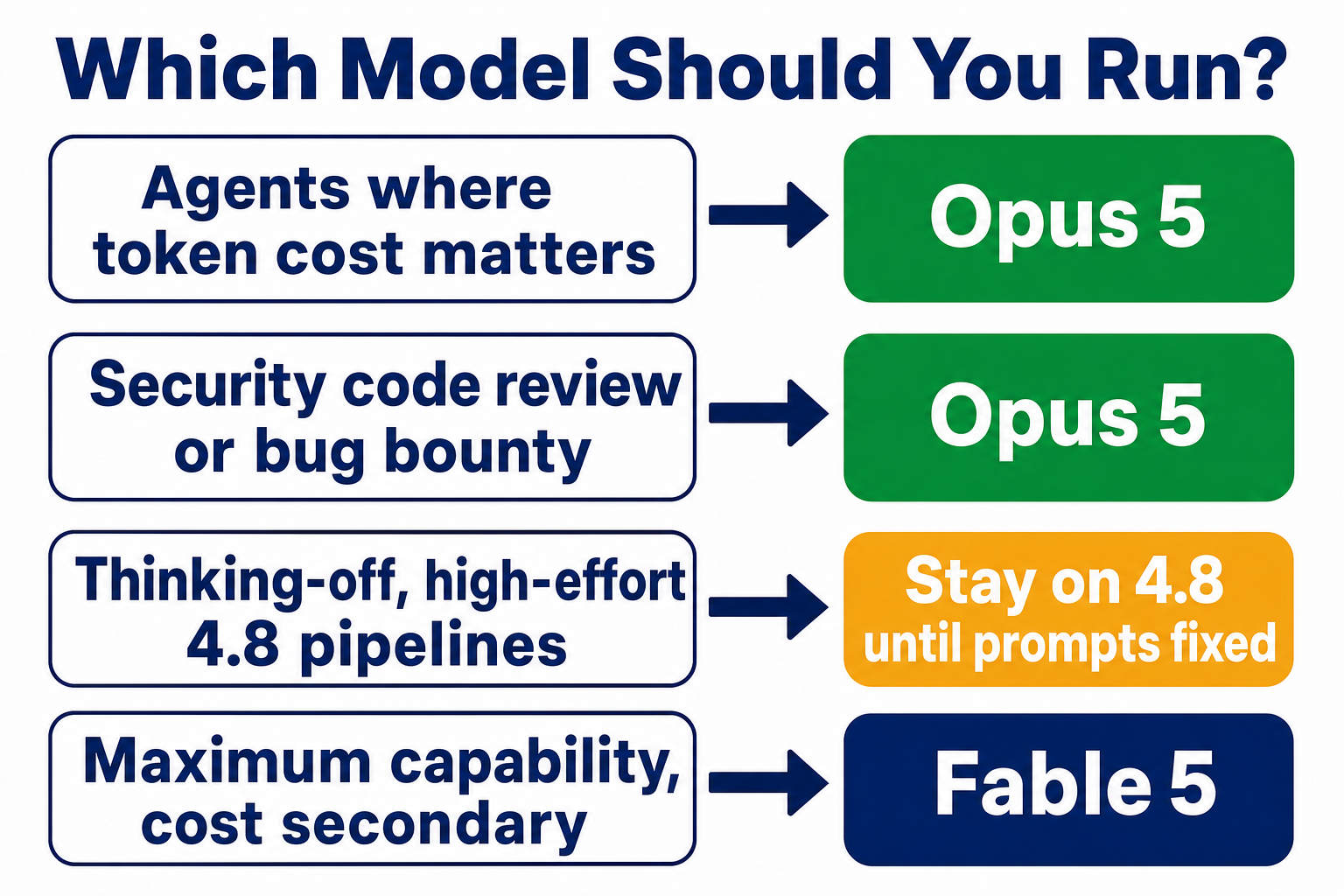
| If you mainly... | Use |
|---|---|
| Run agents where token cost is a line item | Opus 5: near-Fable-5 results at half price is the whole pitch |
| Do security code review, appsec, bug bounty triage | Opus 5: permitted at all access levels, and classifiers intervene far less |
| Pentest professionally | Opus 5 via the Cyber Verification Program; otherwise pentesting stays blocked |
| Run thinking-off / high-effort tuned 4.8 pipelines | Stay on 4.8 until you've fixed prompts. The 400 will find you |
| Need maximum capability, cost secondary | Fable 5: Anthropic's own positioning, and it still leads SWE-bench Pro |
| Want no changes at all | 4.8: Active, no retirement date, guaranteed until at least 28 May 2027 on Anthropic's platforms |
My answer: switch your agentic and security workloads now. The price/performance case is strong and the security unblock genuinely useful. The cons are real: the consumer-surface fallback to 4.8 means you won't always get the model you asked for, the breaking changes will bite anyone who migrates by find-and-replace, and every impressive number in this launch is still Anthropic marking its own homework. None of those outweighs half-price near-flagship performance for the work we actually do. And Opus 4.8 is listed Active with no retirement date; the deprecation page guarantees it can't retire before 28 May 2027 on Anthropic-operated platforms (the clouds set their own schedules). So the cost of me being wrong is a config rollback, not a stranded stack.
That's who should move. What follows is what I'd actually do, in order.
What I'd Do First
Audit before you swap. Search your prompt and config files for thinking-disabled calls paired with xhigh or max effort. Fix those first; that's the HTTP 400 waiting to happen.
Delete your verification boilerplate. Every "include a final verification step" and "use a subagent to verify" carried over from older models now costs you over-verification tokens. Anthropic's own migration advice; take it.
Re-run your refused prompts. If you do security work, dig out the source-code review requests that Fable 5 or 4.8 refused and run them on Opus 5. Log the before/after as your evidence for whether the 85% figure holds on your workload, and if you pentest, start the Cyber Verification Program conversation now.
Decide your fallback stance deliberately. On the API it's opt-in beta; on Claude.ai and Claude Code it's on by default. Know which model actually answers your users before they tell you.
Test the cache changes. Mid-conversation tool swaps without cache invalidation plus the 512-token minimum can cut real cost from agent workloads; measure hit rates over a week.
Treat fast mode as an experiment. Research preview, first-party API only. Benchmark it; don't build on it.
I'll update this article once I've run Opus 5 against a full week of my own agent workloads, particularly the security prompts in step 3, and the moment any independent benchmark reproduction lands. If you want that update first, subscribe to the StationX newsletter or join the Circle community.
Last release, 4.8's pitch was a model that stopped hiding its mistakes. Opus 5's pitch is narrower and, for us, better: nearly the flagship, at half the price, finally allowed to hunt vulnerabilities in source code. That's a trade I'll take.
Claude Opus 5 FAQ
What is Claude Opus 5?
Claude Opus 5 is Anthropic's new Opus-class model, released on 24 July 2026. It costs $5 per million input tokens and $25 per million output (the same as Opus 4.8, half of Fable 5), has a 1M-token context window as both default and maximum, 128K max output (300K in a batch-processing beta), and a May 2026 knowledge cutoff. Anthropic's system card positions it as not more capable overall than Fable 5, though vendor-reported benchmarks show it matching or beating Fable 5 in several areas at lower cost.
Is Claude Opus 5 free?
No. Standard pricing is $5 per million input tokens and $25 per million output. A fast mode research preview costs $10/$50 and is available on the first-party Claude API only; in Claude Code it draws usage credits.
When was Claude Opus 5 released?
24 July 2026. Anthropic says it's available on all platforms and lists the Claude API, Claude Platform on AWS, Amazon Bedrock, Google Cloud, and Microsoft Foundry. The model ID is claude-opus-5 (anthropic.claude-opus-5 on Bedrock).
Is Claude Opus 5 better than Fable 5?
Not overall. Anthropic's own system card says "Claude Opus 5 is not more capable overall than our most capable general-access model, Claude Fable 5," and it trails Fable 5 on SWE-bench Pro (79.2 vs 80.0). But on Anthropic's reported numbers it comes within 0.5% of Fable 5's peak CursorBench 3.2 score at half the cost per task, and beats Fable 5's best OSWorld 2.0 result at a third of the cost.
What's the difference between Claude Opus 5 and Opus 4.8?
Same price, but Anthropic reports Opus 5 more than doubling Opus 4.8's score on its internal Frontier-Bench v0.1 (a run that partly fell back to 4.8 on refusals). Opus 5 also turns thinking on by default, removes the beta header from the effort ladder, loosens the cyber safety classifiers substantially, and adds a fast mode research preview. Unlike the 4.7-to-4.8 move, there is a breaking API change.
What are the breaking changes in Claude Opus 5?
There are two. First, thinking is on by default: requests without a thinking field now run with adaptive thinking, and max_tokens caps thinking plus response text, so limits tuned for thinking-free 4.8 workloads can truncate responses. Second, disabling thinking while requesting xhigh or max effort returns an HTTP 400, which Anthropic's docs explicitly call "a breaking change from Claude Opus 4.8." Anthropic also advises removing verification instructions carried over from earlier models ("include a final verification step," "use a subagent to verify"), which cause over-verification on Opus 5.
Is Claude Opus 4.8 deprecated?
No. It's listed as Active with no retirement date, and Anthropic's deprecation page guarantees it can't retire before 28 May 2027 on Anthropic-operated platforms (Bedrock and Google Cloud set their own schedules). Consumer surfaces also use 4.8 as the default fallback when Opus 5 flags a request.
Does Claude Opus 5 refuse security work?
Far less often, on Anthropic's numbers. Anthropic expects the cyber safety classifiers to intervene around 85% less often than they do for Fable 5, and vulnerability discovery in source code is permitted at all access levels. Binary-based vulnerability scanning and exploit generation remain blocked, and penetration testing is blocked by default but available to Cyber Verification Program members. On Claude.ai, Claude Code, and Cowork, flagged requests fall back to Opus 4.8 by default; on the API, server-side fallback is an opt-in beta for safety-refusal cases only.
About the Author

Nathan House, Founder & CEO of StationX
Nathan House has 30 years of hands-on cybersecurity experience and is Cambridge-educated, holding CISSP, CISA, CISM, OSCP, CEH, and SABSA. He founded StationX in 1999 — one of the UK’s first cybersecurity companies — and has secured £71 billion in UK mobile banking transactions and the London 2012 Olympics, advising clients including Microsoft, Cisco, BP, Vodafone, and VISA. He authored the world’s most popular cybersecurity course — a #1 Udemy bestseller taken by over 500,000 students — and was named Cyber Security Educator of the Year 2020, AI Security Educator of the Year, and a UK Top 25 Security Influencer 2025. A DEF CON speaker and featured expert on CNN, Fox News, NBC, and the BBC, Nathan leads StationX’s training of more than half a million students worldwide.