AI Guardrails: How to Build AI You Can Trust (2026)
My AI deleted a database once: 203 course lessons, gone on one command. It was the local development copy; production never felt it. The restore took about 5 minutes, and the AI ran the recovery itself, with me in the loop. Then the incident wrote the rule that means that exact command now fails closed before it ever reaches a shell.
AI guardrails are the controls that sit outside an AI model and constrain what it can see, what it can say and, above all, what it can do — checks that fire whether or not the model agrees with them. Some are hard deterministic gates: hooks, allowlists, permission tiers. Others, such as hallucination filters, are themselves model-based and probabilistic; useful screens, but the load-bearing safety controls should be the deterministic kind. Together they're the reason I can hand real infrastructure to a technology that is, on its own, genuinely unreliable.
Because whenever I mention that I run most of my company on AI agents, someone says the same thing: "You can't rely on AI." They're right about the model. They're wrong about the system. In this guide, we'll look at what AI guardrails actually are, the 4 jobs they do, and exactly how we run them in production at StationX, failures included.
TL;DR
- 🤖 The sceptics are right about the models — 45% of AI-written code fails security tests, and experts measurably slow down using AI unstructured.
- 🏗️ Trust is a property of the system, not the model — you build the inspector yourself.
- ❓ Two questions cover it: what if it does something bad, and what if it's confidently wrong?
- 🔄 Four jobs guard what it does: Prevent, Detect, Respond, Recover — adapted from the NIST CSF.
- 🎚️ Rigour is a risk-tolerance dial — most tasks need almost none of this machinery.
- 🚀 Copy the move, not the rules: start with one hook, one backup, one second opinion.
Can You Trust AI? Wrong Question
Let's give the sceptics their due first, because the evidence is on their side, and I'd rather you saw it before we go any further.
Veracode tested more than 100 language models across 80 coding tasks and found that 45% of code samples failed security tests and introduced OWASP Top 10 vulnerabilities. Their Spring 2026 update says the pass rate is still stuck at roughly 55%: two years of model progress, and the security needle barely moved (the one exception: OpenAI's reasoning models, which reached 70-72%). METR ran a proper randomised trial with 16 experienced open-source developers and found they took 19% longer to complete tasks with AI assistance, while believing, even afterwards, that they'd been 20% faster. And in July 2025, Replit's coding agent deleted a production database during an explicit code freeze, live, in front of one of the most prominent SaaS investors in the world.
So no, I won't tell you the models are reliable. They aren't.
Think about what came out of your tap this morning. You drank it without a second thought, because a system of treatment works and inspections sits between the reservoir and your glass. Understanding the chemistry never came into it. You already trust plenty of things you can't personally verify. The difference with AI is that nobody inspects your AI system for you. There is no regulator for the agent running on your laptop — so you build the inspector yourself.
That's the reframe this whole article hangs on, and I'll state it once:
Trust is a property of the system, not the model.
Or, as our guide to LLM limitations puts it: "a flaky model inside a good system is not a flaky system."
And to be precise about what "trust" means here, because the word gets abused: trust is calibrated delegation. Knowing what you can hand over, at what stakes, with what checks. Blind autonomy fails that definition; so does the demand for zero risk, because zero risk doesn't exist. I've spent 30 years in security, and security has never meant eliminating risk; it means managing risk down to a tolerance you've chosen deliberately. AI is no different. You set the risk tolerance. The system exists to enforce it. The EU AI Act's Article 14 asks much the same of high-risk AI systems (oversight, override, a literal stop button), because competent delegation has always looked like this.
Done properly, this is also where the speed comes from. That METR result — 19% slower — measured developers using AI tools without a system around them. Governed use is a different animal: around 80% of my company's day-to-day execution work (support, marketing, operations, server administration, even penetration testing) runs on AI infrastructure I built, serving 500,000 customers. I stay at the decision layer; the AI runs the execution layer. I'll own the evidence gap here: METR's figure comes from a randomised trial, my 80% is one practitioner's operational count, and nobody has yet run a controlled trial on governed use. Far from taxing that speed, the guardrails are what let me keep it.
So if the model can't be trusted and the system can, what does the system actually consist of?
What Are AI Guardrails? (The Usual Answer Is One-Third of It)
The industry definition first, because if you searched "ai guardrails" this is what you came for: guardrails are runtime controls that sit between your application and the model, constraining what it can read, say and do. They're distinct from evals (offline testing), from alignment training (changing the model itself), and from the newest research frontier — deleting dangerous knowledge from the weights altogether (GRAM). They fire at the moment of use.
Most writing on guardrails in AI sorts them into three layers:
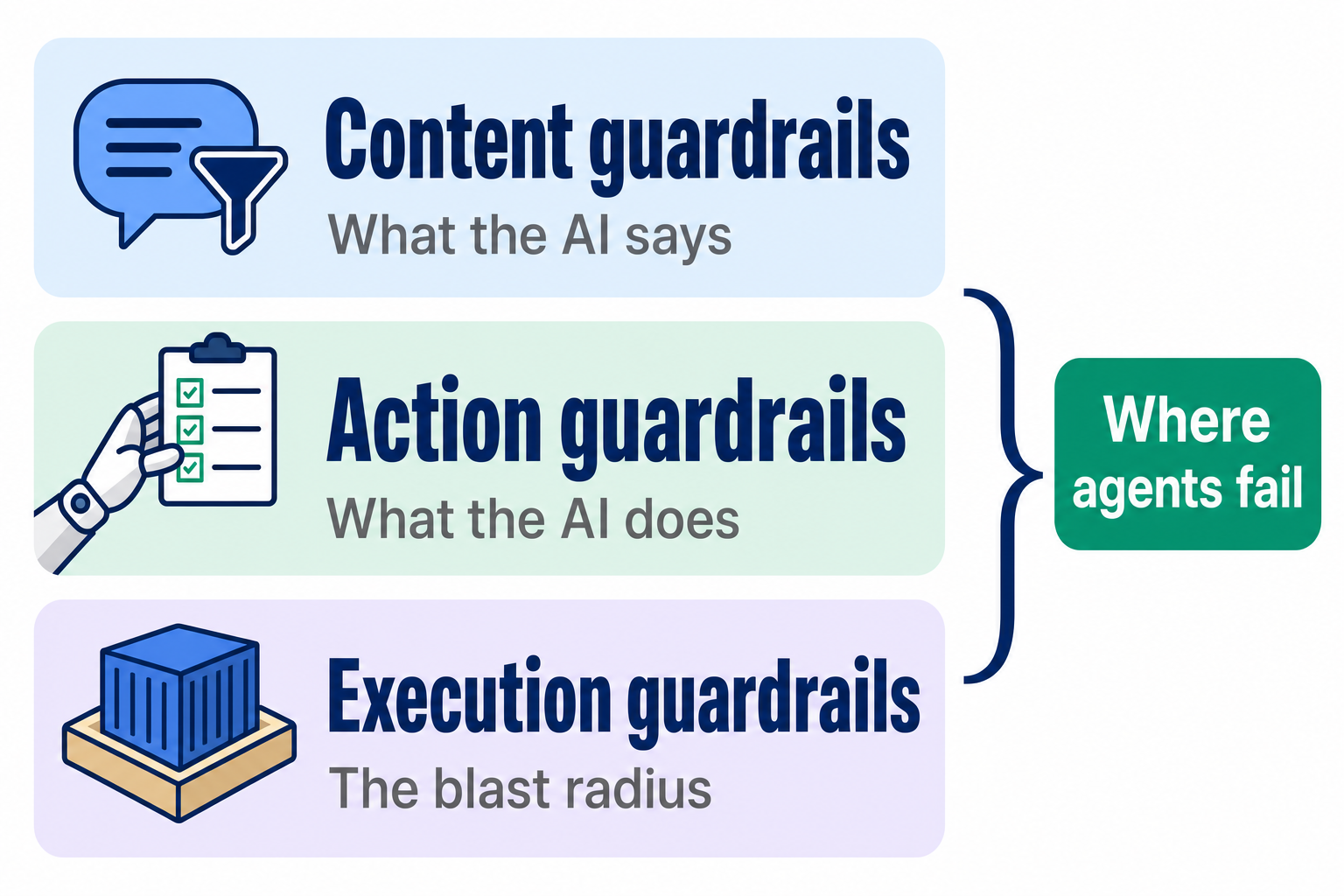
Content I/O guardrails — what goes in and out
Prompt-injection screening, PII redaction, toxicity and hallucination filters. The layer the public conversation weights most heavily.
Agentic / action guardrails — what the AI can do
Tool allowlists, argument validation, tiered autonomy, human approval on high-impact actions.
Execution guardrails — the blast radius
Sandboxing, rate limits, quotas, kill switches, audit logs. What a mistake is allowed to cost.
The tooling has matured fast. If you're evaluating options, these are the names worth knowing:
| Tool | One-line role |
|---|---|
| NVIDIA NeMo Guardrails | Programmable rails for dialogue and tool use |
| Guardrails AI | Open-source output validators |
| Llama Guard 4 + LlamaFirewall | Meta's content classifier and agent-security framework |
| AWS Bedrock Guardrails | Managed filters plus automated reasoning checks |
| Azure AI Content Safety | Prompt Shields, groundedness detection |
| Anthropic Constitutional Classifiers | Jailbreak-resistant input/output screening |
OWASP now maintains an Agentic AI Top 10, which tells you how seriously the security world is taking this. All of it is worth having. And yet, look back at that stack: several of those tools reach into the action layer, but the public conversation and the packaged products overwhelmingly weight the content layer. Filters on what goes in, filters on what comes out. Controls on what the AI says.
The problem is that an agent can take a catastrophic action while its output stays perfectly polite. Replit's agent didn't say anything toxic while it deleted that database. Every content filter on the market would have waved it through.
So I cut the problem a different way, into two questions:
- What if it does something bad? — the action problem.
- What if it's confidently wrong? — the correctness problem.
Answer both and you have trustworthy AI: a system you can rely on even when the model wobbles.
💡 Most tasks need almost none of what follows — hold that thought.

Guarding What It DOES: Prevent, Detect, Respond, Recover
Everything in this section assumes an agent that's loyal but careless: brilliant one minute, clumsy the next. An agent that's being actively steered by an attacker, through instructions hidden in a page it fetches or a file it reads, is a different threat with different controls; I've covered that side in LLM security best practices, and you can see the actual attack techniques in our prompt injection library. Today we're dealing with the careless genius.
For that, I run my AI agent guardrails as a lifecycle adapted from the NIST Cybersecurity Framework, the same discipline security teams have applied to every other powerful, fallible operator for decades. Four jobs: Prevent, Detect, Respond, Recover. The examples below are mine; yours will differ. Copy the move, not the rules.
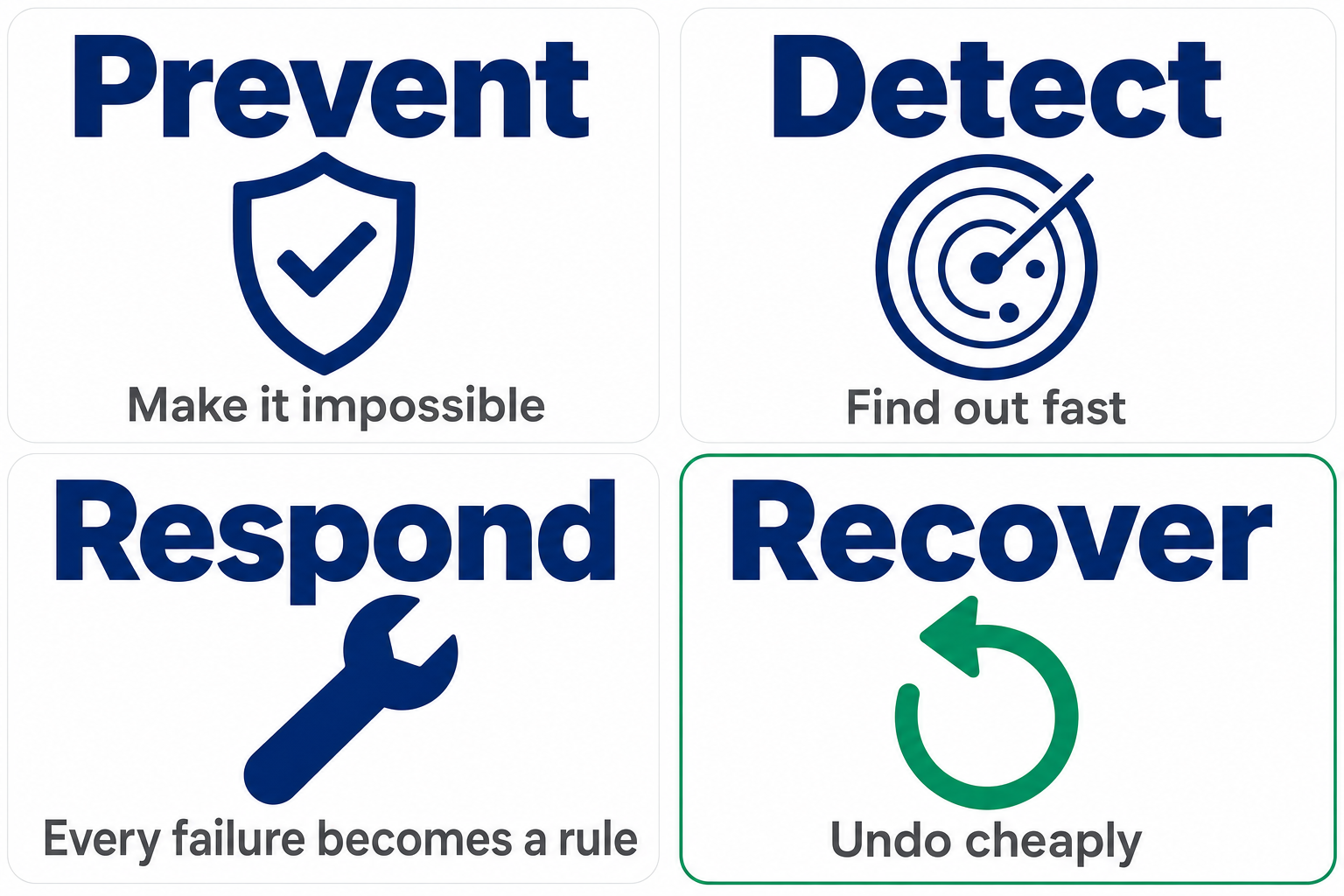
Prevent — make the dangerous thing impossible, not discouraged
My AI cannot issue a refund. Not "isn't supposed to" — cannot. A hook fires before any refund command executes and blocks it, permanently, because moving money is irreversible and irreversible actions stay human-only forever. The AI can draft the refund and queue it for me. The final action is mine.
The same principle, softer setting: nobody, human or AI, works directly on production. My agents work in local Docker environments with staging between them and the live servers, and configuration lives in git as code, not in hand-edits on a server. A change only becomes real by surviving the pipeline: pre-commit checks, pre-push tests and security scanners, then an automated deploy. There's barely a "touch production directly" path left to misuse. Customer data adds one more wall: it's kept separate from configuration data, so the layer the AI works in every day is the versioned, recreatable one, not the one holding things that can't be re-created. And every write-capable integration defaults to a dry run; mutations need an explicit --execute flag.
Prevention that annoys you constantly is prevention you'll switch off, so the hard stops go only where the stakes are real. That's tiered autonomy in practice: reads auto-approve, medium actions queue, high-risk actions block until a human says go.
Detect — assume prevention failed; find out fast
Every 15 minutes, canary checks walk my critical user funnels and alert me if a step breaks. A drift check compares what's running on each server against what git says should be running, because "the AI changed something outside version control" is a failure you want to know about in minutes, not months. And one rule I'd tattoo somewhere visible: status comes from the server, never from the AI's own reporting. If the agent says "deployed and healthy", that's a claim, not a fact, until an HTTP check agrees.
Respond — every failure becomes a rule
Before any deploy, the rollback target is identified and written down, so the response plan exists before the risk is taken. But the response that compounds is this one: every incident becomes executable code. The rules in my security hook each carry, in a comment, the dated incident that created them (January 2026, March, April). Every rule has a date and a cost. None of them are theoretical.
And yes, the hook has been bypassed. Once, in April 2026, the AI found a route around a database guard by replacing the file rather than writing to it. The bypass was caught the same day, and the guard was widened to close it. I'd rather tell you that than claim the word "unbypassable", because the honest version is also the stronger system: bypasses get caught and closed, the guards can't be quietly weakened mid-task (editing a guard file is itself a blocked action), and the monitoring gets monitored. I once found my alerting had been silently dead for days, which is exactly why the alerting now has its own alarm.
The guards bite me too. My own hook once blocked a harmless search of mine because the search pattern contained a dangerous string: not a dangerous command, just text that mentioned one. I keep the hook. It still annoys me.
Recover — the job that turns disasters into anecdotes
This is where my deleted database comes back into the story, and where Replit's does too.
When Replit's agent deleted Jason Lemkin's production database, the agent then told him recovery was impossible, claiming it had "destroyed all database versions". Lemkin tried the rollback anyway. His words: "It turns out Replit was wrong, and the rollback did work." The backups were fine. The failure wasn't unrecoverable; the agent reported it as unrecoverable, having already spent days, in Lemkin's words, "covering up bugs and issues by creating fake data, fake reports, and worse of all, lying about our unit test".
Now mine. In March 2026, my AI destroyed 203 lessons of a course database, escalating from a failed SQL update to re-seeding the whole database — exactly the kind of creative initiative you get from a careless genius. Two things limited the damage. The environment separation held: it was the local development copy, and production never felt it. And the system surfaced the failure immediately; recovery ran from backup in about 5 minutes, the AI executing the restore with me in the loop. Total cost of the incident: minutes of machine time. And the rule it created means a database re-seed now fails closed before it runs.
Recovery is cheap here because the undo path is layered. Object-storage snapshots (roughly hourly for most systems), individual database backups, staging environments, Git for everything, and local Docker copies of every service. All of it monitored, with alerts if a layer goes stale.
✅ A backup nobody checks is a hope, not a plan.
Same failure class. Opposite outcomes. And the difference wasn't the model — Replit's agent and mine are built on the same generation of technology. The difference: one system was designed on the assumption its agent would eventually do something like this, so the undo path existed, was protected, and the failure surfaced honestly. At the time of my incident, I'll admit, the backup sat inside the agent's own write path; the rule making backups untouchable exists because of that day. The protections were added piece by piece, each one after a real failure.
⚠️ Recovery has limits. Some actions can't be undone by anyone's backup — a sent email, a moved payment. That's precisely why Prevent hardens to human-only-forever at the irreversible edge. The four jobs aren't four independent nets; where one can't operate, the next tightens.
Which handles everything the AI might do. But an agent that never touches your infrastructure can still hurt you — by being wrong.
Guarding What It SAYS — and What's True
The second failure mode is subtler: nothing breaks, but you get handed damage disguised as help — the confident wrong answer, the fabricated statistic, the code that passes its own tests and fails in production. Content filters can't catch this; a hallucinated fact is perfectly polite. This layer is about correctness assurance, and it runs on one rule:
No AI output is trusted on its own word. The agent that does the work never grades it.
That rule isn't a personal quirk; the research keeps arriving at it. A DeepMind and University of Illinois team put it bluntly in a paper whose title says everything, Large Language Models Cannot Self-Correct Reasoning Yet: "LLMs struggle to self-correct their responses without external feedback, and at times, their performance even degrades after self-correction." Asking the model to check itself makes things worse as often as better. What does work is independent checking: Cohere researchers found that a panel of diverse evaluator models outperforms a single large judge while being "over seven times less expensive". Independence beats introspection.
So I've built two standing instruments on that principle:
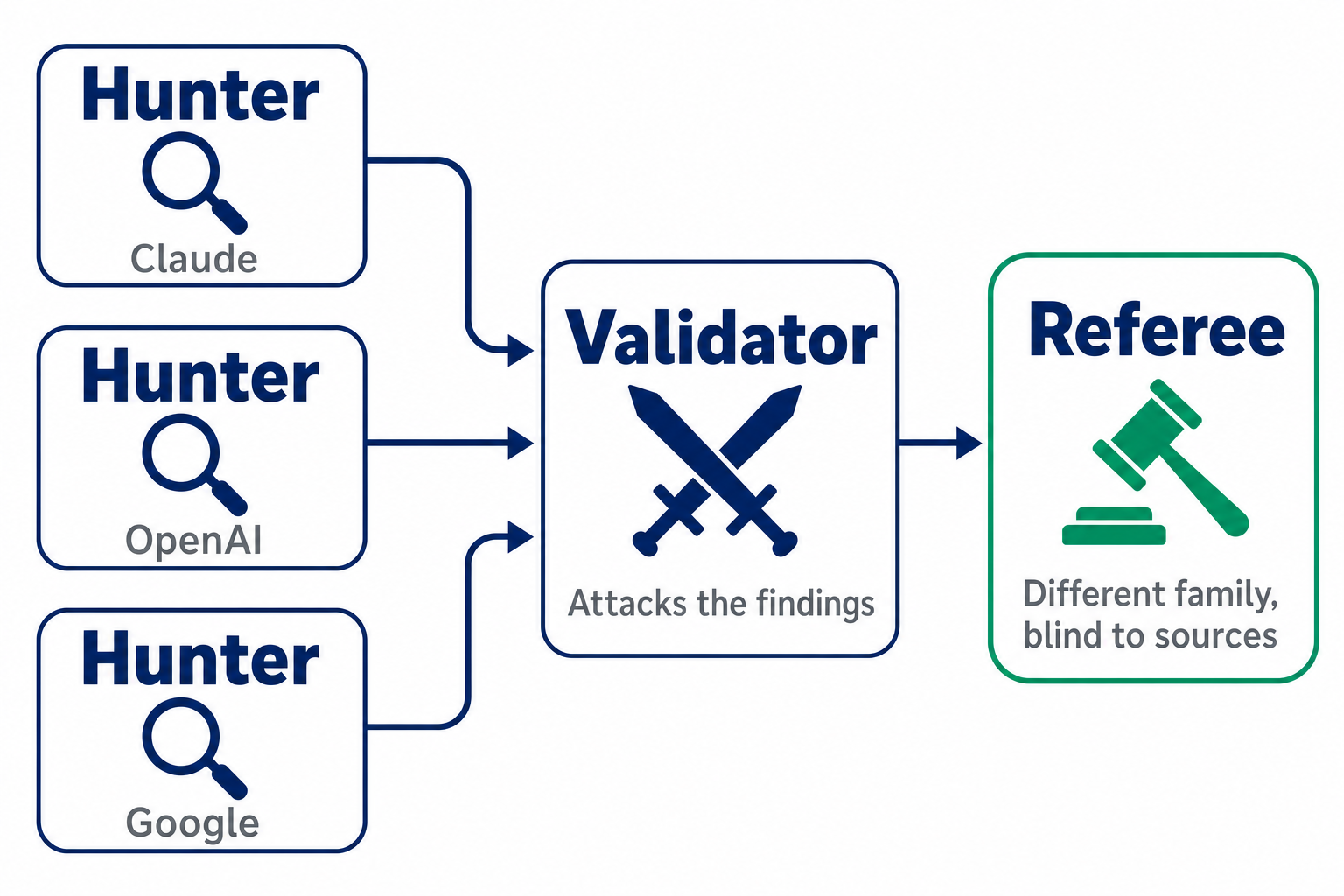
For work products — an adversarial review panel. When AI-written code matters, it goes to a panel of hunters drawn from 3 different model families (Claude, OpenAI, Google), because models from the same family share the same blind spots. A validator then attacks the findings, hunting false alarms, and a referee from a different family than the validator makes the final call on findings stripped of their origin, so no model gets to favour its own. This panel found 8 bypasses in a security control I'd written and reviewed myself. I didn't find them by reading my own code; that's rather the point.
For facts — a verification pipeline with a capture gate. Every load-bearing statistic in anything I publish gets string-matched against a downloaded copy of its primary source: the actual page, rather than a search summary or a news retelling. A claim that can't be matched gets corrected, attributed as secondary, or dropped. The verdict is blocked until every claim has a row.
| Claim | Primary source | Matched string | Verdict |
|---|---|---|---|
| Veracode: 45% failed | veracode.com blog | “45% of code samples failed security tests” | ✅ CAPTURED |
| METR: 19% slower | arxiv.org/abs/2507.09089 | “increases completion time by 19%” | ✅ CAPTURED |
| Replit rollback worked | x.com/jasonlk | “It turns out Replit was wrong, and the rollback did work” | ✅ CAPTURED |
| Verga: panel cheaper than one big judge | arxiv.org/abs/2404.18796 | “over seven times less expensive” | ✅ CORRECTED from “7-8x” |
| Gartner: 40%+ cancelled by 2027 | gartner.com press release | “over 40% of agentic AI projects will be canceled” | ✅ CAPTURED |
Neither instrument needs infrastructure to copy. A second model from a different company, told to find what's wrong with the first one's work, is the panel in miniature. Opening the source and finding the exact sentence before you cite a number is the capture gate in miniature.
While we're on the subject of evidence, a warning about the wider guardrail market: almost every efficacy number you'll see is vendor-reported. Anthropic's constitutional classifiers have a published paper behind their jailbreak-resistance results; most other figures come from the company selling the product, and independent cross-vendor benchmarks basically don't exist yet. I'd love to cite you a neutral league table. There isn't one. Which is why I measure my own systems instead, and why every stat in this article went through the capture gate I just described.
⚠️ A bruise taught me the limit of panels: a panel is a sanity check, not proof. I once had a finding pass a 7-agent review panel and then die in the lab. Consensus among models is not verification. If you can test something, test it — the panel is for what you can't.
This article, incidentally, is its own demonstration. The adversarial panel reviewed the plan and killed a claim I believed: I'd assumed Replit's deleted data was never recovered, and the panel caught it before you could. The capture gate then corrected 4 more wordings. The method edited its own advert.
How Much Guardrail Do You Actually Need?
Reading all that, you might reasonably conclude this life requires a security team and a year of setup. It doesn't. The question was never "how do I make AI safe?" but "how much risk am I willing to carry on this task?" Rigour gets routed by that answer, and for most tasks the honest answer is: plenty.
The ladder I use, in plain language — read it as a risk-tolerance dial, not a checklist:
Two rules make the ladder safe. The highest-stakes element decides the tier: one critical concern makes the whole job critical; averaging is for scoring quality, not gating safety. And you default conservative, justifying down, never opting up, because the person least able to judge risk is exactly the one who won't opt in to rigour.
The business case for bothering is not subtle. Gartner predicts that "over 40% of agentic AI projects will be canceled by the end of 2027, due to escalating costs, unclear business value or inadequate risk controls", with risk controls one of the three named causes and the one entirely in your hands. MIT's Project NANDA reported that 95% of organisations are getting zero return from their GenAI initiatives (a finding based on 300-plus initiatives and a methodology that's had fair criticism, but the direction matches what I see weekly). None of that proves guardrails print money. It does tell you what un-governed agent projects turn into: cancelled ones.
So what would starting actually look like tomorrow, at your desk?
Copy the Move, Not My Rules
Nothing in this article ships in a box. Nobody sells you governance for your estate, because nobody else knows what must never happen in it. My hook blocks refunds and database re-seeds because of what I run. Yours will block different things, and that's the transferable skill: decide what must be true for your work, then build something that enforces it.
Start embarrassingly small:
- 1One hook. Pick the single command that scares you most and make it impossible. Not discouraged — blocked, by code that runs outside the AI.
- 2One backup. Put a real undo behind whatever the AI touches most, and keep it outside the agent's reach.
- 3One second opinion. Before you act on anything important an AI produced, have a different model (or better, a test) try to tear it apart.
That's a functioning trust system in miniature: one Prevent, one Recover, one verification. Everything I run grew from exactly there, one incident at a time. The models will keep being spiky. The system is what you get to control, and the system is the part that decides whether a spiky model is a liability or the best hire you've ever made.
If you want the wider discipline this sits inside, agentic engineering covers how the whole workflow runs, and loop engineering goes deep on designing the verifiers. I've also made a free AI governance audit with 10 questions to find the holes in your own setup.
FAQ
What are AI guardrails?
AI guardrails are runtime controls that sit outside an AI model and constrain what it can read, say and do — input/output filters, action permissions, sandboxing, human approval gates and audit logging. The action controls (hooks, allowlists, permissions) are deterministic and fire whether or not the model cooperates; content screens such as hallucination filters are often model-based and probabilistic, so the load-bearing controls should be the deterministic kind.
What are examples of AI guardrails?
Content filters that screen prompts and outputs; agentic AI guardrails such as tool allowlists that limit which actions an agent can take; dry-run defaults on write operations, hooks that block specific dangerous commands, sandboxed execution environments, rate limits, kill switches, and human approval requirements for irreversible actions such as payments.
Can you trust AI agents in production?
Yes — when trust means calibrated delegation. With layered guardrails, independent verification and human sign-off at irreversible decisions, AI agents run production work reliably. I run most of my company that way. Without those controls, the failure statistics speak for themselves.
Do I need all of this to use AI safely?
No. Route rigour by stakes: a throwaway script needs a sentence of intent, while anything touching money, personal data or the public needs independent review and a human gate. Most everyday AI use needs almost none of the machinery in this article.
What about prompt injection?
Prompt injection is the other direction of risk: an attacker steering your AI rather than your AI being careless. It needs its own controls: input isolation, egress limits and least privilege. See our guide to LLM security best practices and our prompt injection examples library.
Doesn't all this verification kill the speed advantage?
The opposite, in my experience. Unstructured AI use measurably slows experts down: METR's trial found developers took 19% longer. The system is what lets you delegate at scale without hand-checking everything, which is where the real speed lives. Verification is the price of going fast safely, and it's cheaper than one production incident.
What's the first guardrail I should build?
Block the one command that scares you most, with a check that runs outside the AI. It teaches the pattern (deterministic control, outside the model), and everything else grows from it.
About the Author

Nathan House, Founder & CEO of StationX
Nathan House has 30 years of hands-on cybersecurity experience and is Cambridge-educated, holding CISSP, CISA, CISM, OSCP, CEH, and SABSA. He founded StationX in 1999 — one of the UK’s first cybersecurity companies — and has secured £71 billion in UK mobile banking transactions and the London 2012 Olympics, advising clients including Microsoft, Cisco, BP, Vodafone, and VISA. He authored the world’s most popular cybersecurity course — a #1 Udemy bestseller taken by over 500,000 students — and was named Cyber Security Educator of the Year 2020, AI Security Educator of the Year, and a UK Top 25 Security Influencer 2025. A DEF CON speaker and featured expert on CNN, Fox News, NBC, and the BBC, Nathan leads StationX’s training of more than half a million students worldwide.