AI Agent Security: Why Only 21% Have Real Control [2026]
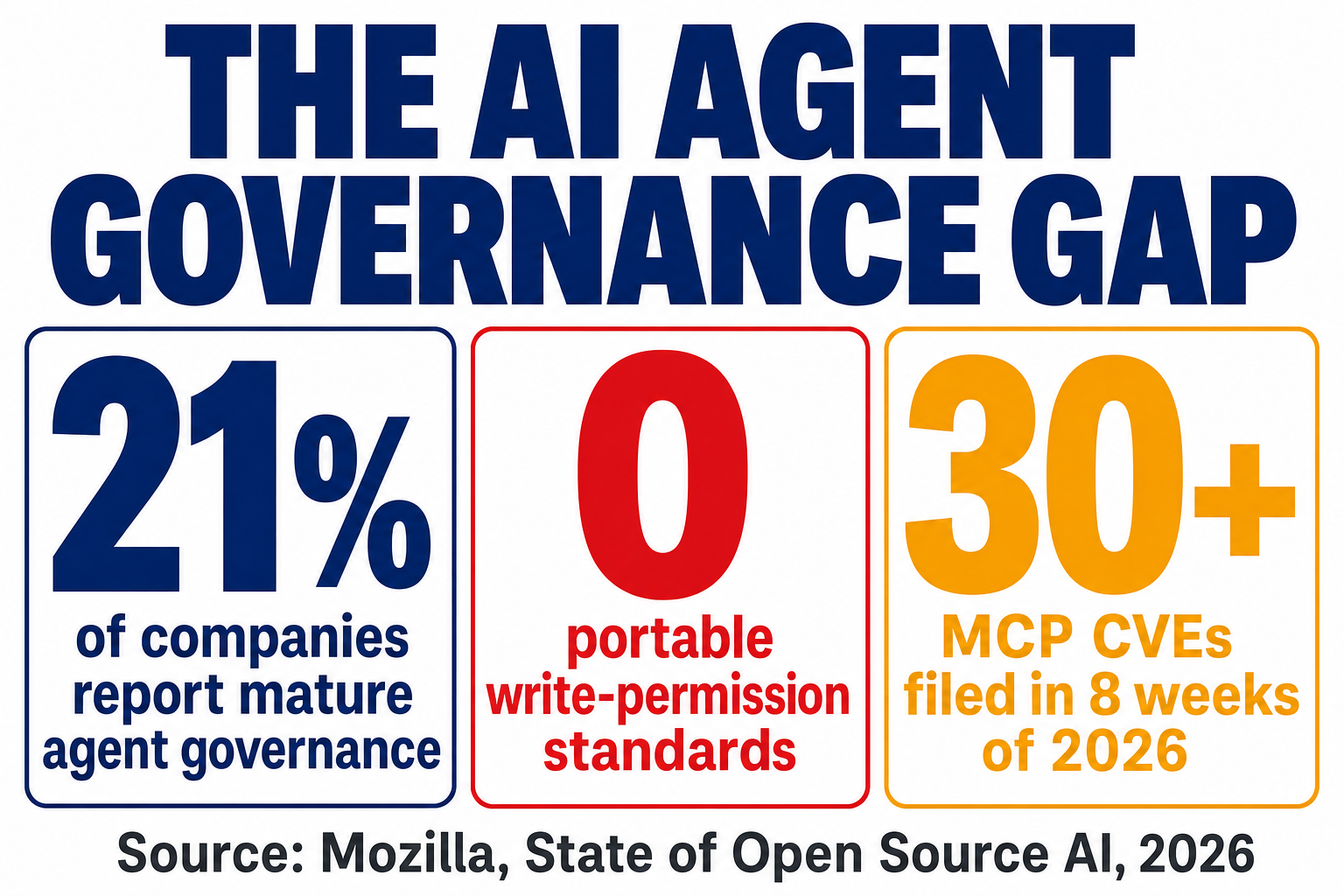
If you've connected an AI agent to your email, your codebase, or your CRM this year, you're part of the fastest tool adoption I've seen in 30 years of security — and AI agent security has not kept up. Mozilla's first State of Open Source AI report (July 2026) puts numbers on it: monthly downloads of the MCP developer kits that connect agents to your systems grew 4,750% in 16 months, 28% of the Fortune 500 now run MCP in production, and across the industry surveys Mozilla cites, only about 21% of companies report mature governance of what their agents do.
That gap is where the next wave of security failures is already forming: researchers disclosed four critical agent vulnerabilities in the past year alone, and every one shares the same shape.
We'll walk through what AI agent security actually involves, what Mozilla's data says about how fast agents are spreading, the four flaws that show the pattern, and why I think this gap is one of the biggest career opportunities in security right now.
TL;DR — if you've only got 30 seconds
Monthly downloads of the official MCP SDKs grew from ~2M to 97M in 16 months (4,750%), and 28% of the Fortune 500 run MCP in production (Mozilla, 2026).
Only ~21% of companies report mature agent governance, per the industry surveys Mozilla cites. Adoption is outpacing control.
Researchers disclosed four critical agent vulnerabilities in 2025, all in closed commercial systems, all the same flaw: authorized retrieval, unchecked output.
Nobody has standardised what an agent may DO (the "write surface"). That unsolved gap is a career opportunity.
What Is AI Agent Security — and Why 2026 Changed the Stakes
AI agent security is the practice of controlling what an AI agent can access and, more importantly, what it can do: the tools it calls, the data it reads, the messages it sends, the records it changes, and the money it spends.
That's a different problem from securing a chatbot. A chatbot answers you. An agent acts for you. The industry calls the machinery around the model the agentic harness: the loop that lets a model reason and act, plus its tools, memory, sandboxes, and permission model. Mozilla's report argues the competitive fight in AI has moved off the model itself and onto this layer, and their reasoning is hard to argue with: model prices collapsed 50× in 36 months (a GPT-4-class model went from $20 to about $0.40 per million tokens), open-weight models now carry roughly a third of all tokens on OpenRouter, and when the engine becomes a cheap commodity, the value moves to the machinery wrapped around it. So does the risk.
I wrote about the commercial side of that shift in Everyone's Watching the Wrong AI Story. This article is about the security side, because the numbers there are far more uncomfortable. (Securing the model itself is a separate job with its own method — that's LLM security best practices. This piece is about the layer above it.)

Agentic AI Security by the Numbers: Adoption Is Outpacing Control
Mozilla's own phrase for the state of agentic AI security is blunt: "adoption is outpacing governance."
Plain English: what MCP is
Most of the numbers that follow concern the Model Context Protocol, so one plain-English definition first. MCP is the open standard that lets an agent plug into tools such as your inbox or your CRM through small connector programs called MCP servers, and its SDKs are the developer kits used to build those connections. Think of it as USB for agents: one port, thousands of devices.
The report's data, drawn from the MCP registry, Anthropic's published figures, and the industry governance surveys Mozilla cites:
97 million monthly downloads of the official MCP SDKs (Python and TypeScript combined), up from a ~2M monthly baseline at launch in November 2024. That's the 4,750% growth figure.
10,000+ public MCP servers, up from roughly 200 at protocol launch.
28% of the Fortune 500 running MCP in production by March 2026.
~21% of companies report mature agent governance, a figure from the governance surveys Mozilla cites rather than its own developer survey.
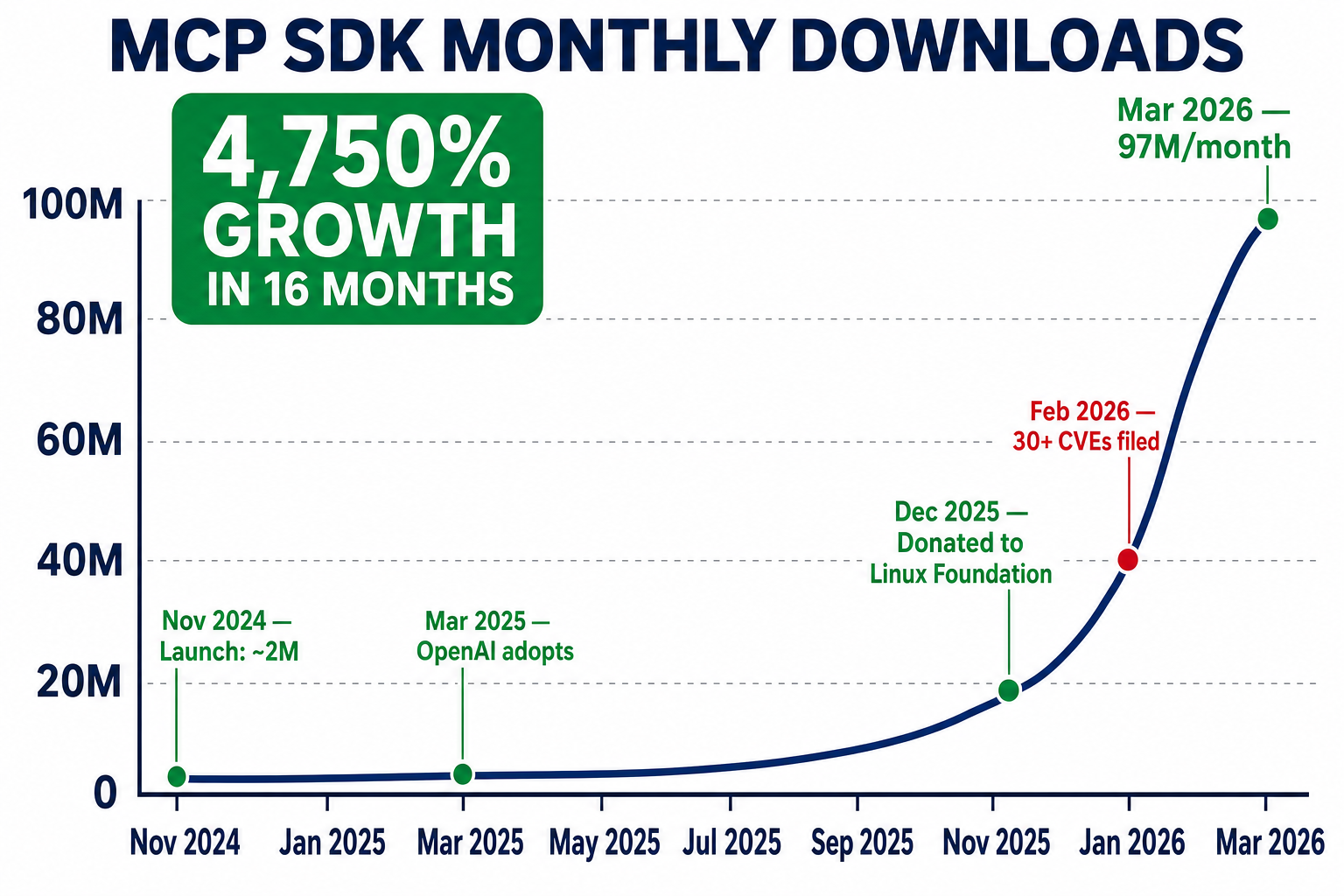
Those are two different measurements from two different populations, so don't read them as one ratio. Read them side by side instead, because the picture is still uncomfortable: more than a quarter of the biggest companies on earth wired a brand-new protocol into production within 16 months of its launch, while across companies in general, mature governance of agents remains the exception. In any other corner of our field we'd call that shadow IT at civilisational scale.
MCP itself isn't the villain here. It became Linux Foundation infrastructure in December 2025 under the Agentic AI Foundation, with platinum members including AWS, Google, Microsoft, and OpenAI, and the spec now mandates OAuth 2.1 with PKCE for its authorization flows. The plumbing is maturing fast. The problem is what happened the moment serious researchers started looking at it.
MCP Security: 30+ CVEs in Eight Weeks
In the first eight weeks of 2026, right after MCP became neutral, foundation-governed infrastructure, security researchers filed more than 30 CVEs against MCP implementations. That's the report's number, and to me it's the healthiest statistic in the whole document. It means the security community finally showed up.
The MCP security picture in mid-2026, as Mozilla's report reads it: authentication is broadly solved (where MCP uses authorization flows, OAuth 2.1 plus PKCE is now mandatory, and the Agent2Agent protocol ships signed Agent Cards) but authorization is not. I think that assessment is right. Both standards stop at proving who an agent is. Neither says what that agent should be allowed to do. Mozilla counts zero portable write-permission standards across the field's 12 frameworks, 10 harnesses, and 3 peer protocols.
We've been here before. It took the web years to get from "SSL proves the server's identity" to meaningful authorization frameworks, and we paid for that gap in breaches. The agent world is speed-running the same curve, except this time the client can send emails, modify records, and spend money on its own.
Which is exactly what the last year of incidents shows.
The Real AI Agent Security Risks: Four Critical Flaws, One Pattern
The report documents four critical agent vulnerabilities disclosed by researchers in 2025 (an Okta analysis cited by Mozilla scores the class at CVSS 9.3–9.4), and every one was found in a closed, commercial system:
Anthropic Slack MCP (June 2025, CVE-2025-34072). Zero-click data exfiltration through Slack link unfurling, found by researcher Johann Rehberger.
Retrieval was checked against admin OAuth.
Output went to an attacker's server, unchecked.
Microsoft Copilot "EchoLeak" (June 2025, CVE-2025-32711). Hidden instructions in an email the victim never opened, found by Aim Labs.
Retrieval respected the victim's M365 permissions.
Output went to an attacker's URL, unchecked.
Salesforce Agentforce "ForcedLeak" (September 2025). A whitelisted domain that had expired, bought by Noma Labs for $5, became a trusted exfiltration channel.
Retrieval was checked against the employee's CRM permissions.
Output wasn't checked at all.
ServiceNow "BodySnatcher" (reported October 2025, published January 2026, CVE-2025-12420). An email plus a hardcoded secret produced full impersonation, MFA bypassed. AppOmni's find.
Retrieval was checked against the impersonated user's permissions.
Output (the acting identity) wasn't checked.
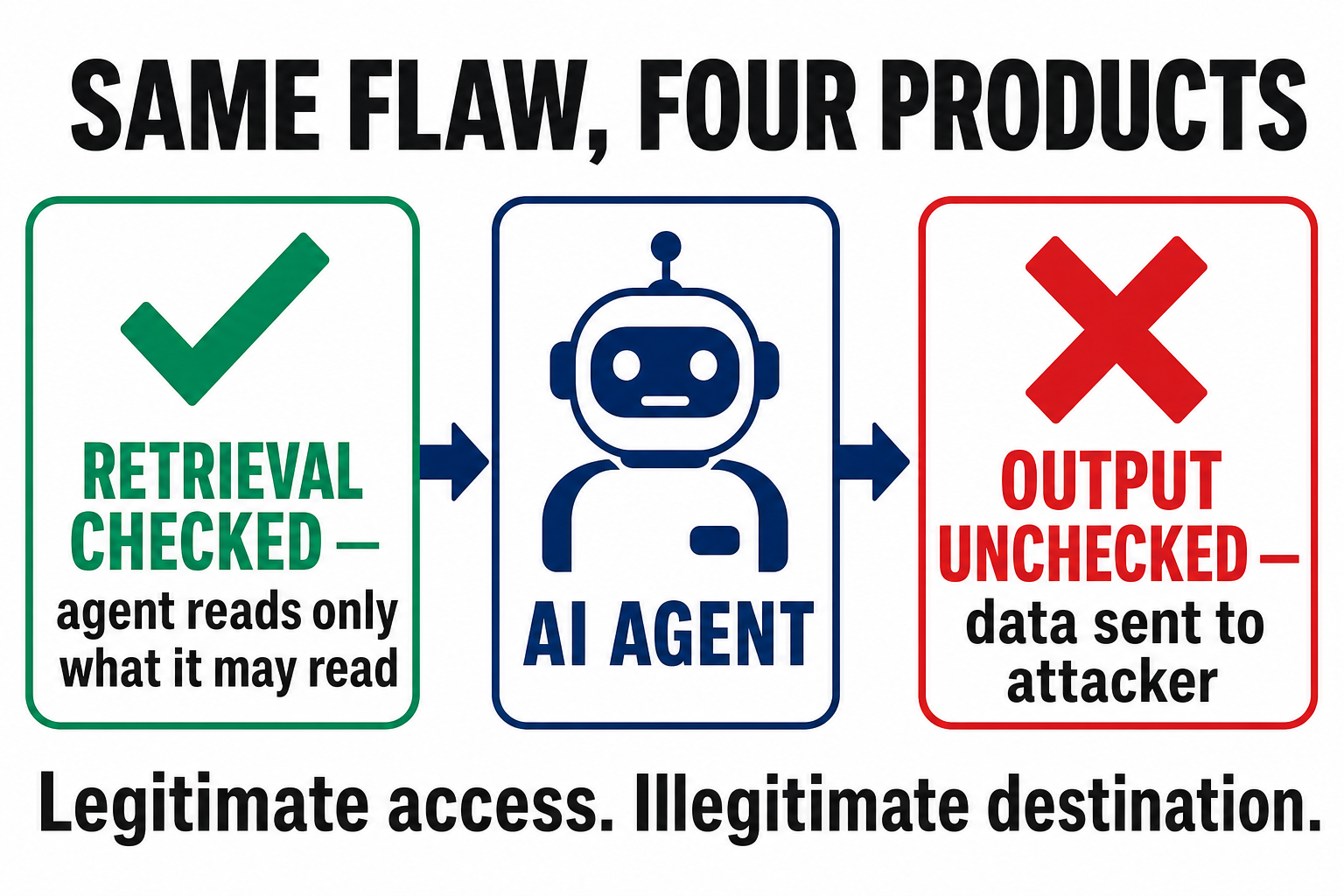
The pattern in all four
Look at the pattern, because it repeats in all four: retrieval was authorized, output was not. The agent only read data it was allowed to read. Then it handed that data to somewhere it should never have sent anything.
Legitimate access, illegitimate destination. Prompt injection is usually the trigger, but the injection isn't really the vulnerability. The missing output control is. (If you test these systems, our library of prompt injection examples and attack techniques is the hands-on companion to this section.)
There's a lesson in there that cuts against the marketing. Developers associate closed models with privacy and security by a wide margin (41% vs 29% for open models, in the SlashData survey of 1,494 developers Mozilla commissioned in May 2026), yet all four of these flaws were in closed systems. Secrecy of the weights protected nobody, because the failures live in the harness around the model, not in the model itself. Closed vendors do ship safeguards on by default while self-hosted deployments make you wire in your own controls; that difference is real, and the report is fair about it. But "closed" and "secure" are different claims, and 2025 proved it.
So if identity checks pass and the model behaves, what's actually missing?
AI Agent Governance: The 21% Problem
The missing piece is what Mozilla calls the write surface. It's the core of any serious AI agent governance framework.
Think of agent actions in two buckets:
Reads are mostly reversible and low-consequence. You can permit a lot of them by default.
Writes (sending a message, spending a budget, changing a record, executing a transaction) have costly or irreversible side effects. Confirmation, thresholds, cost caps, and revocation all need to concentrate here.
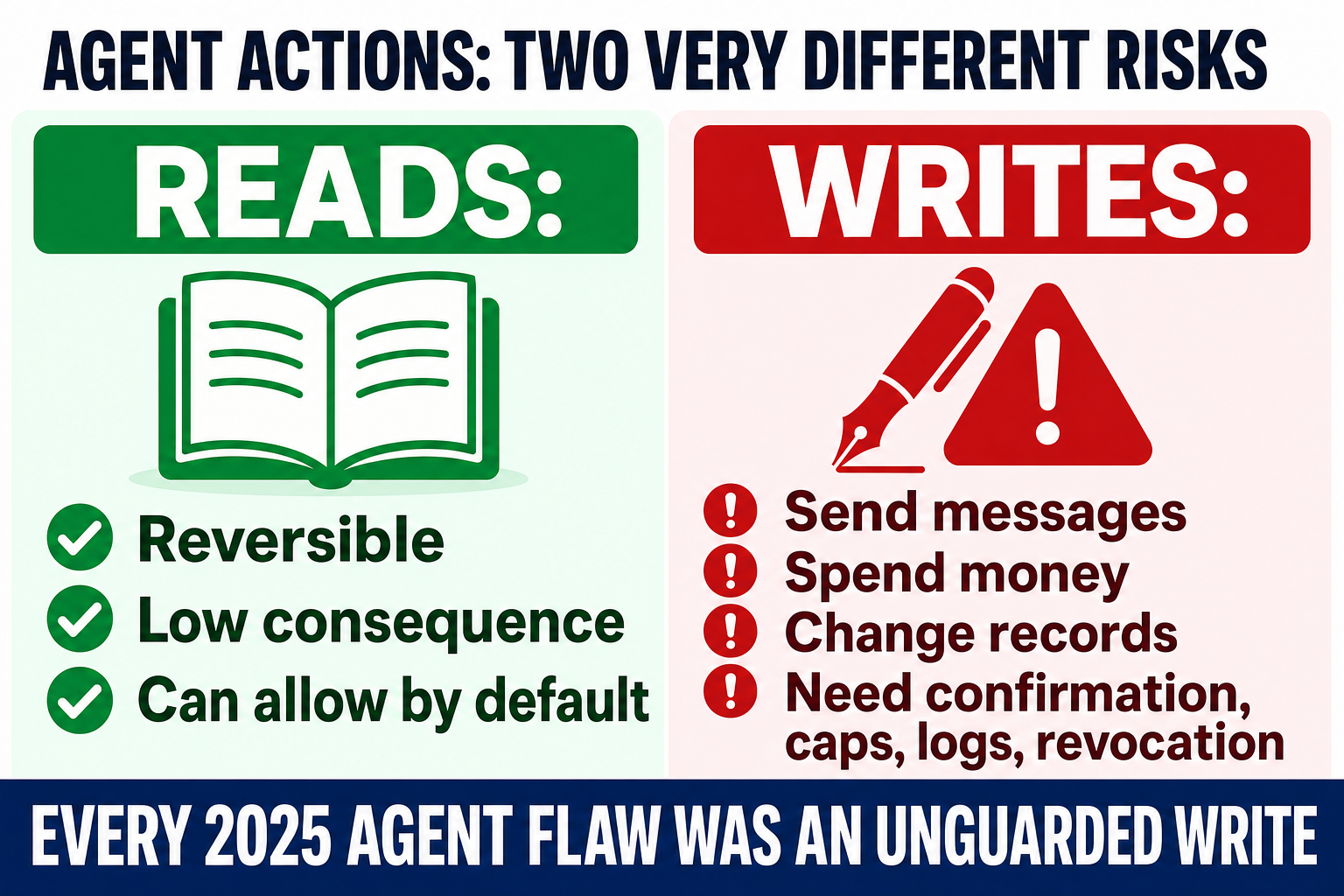
Every flaw in the previous section came down to an unguarded write. And the human backstop we all quietly rely on, "the user approves each action", is failing too. The Coalition for Secure AI's MCP security taxonomy documents consent fatigue as one of its named threats (Mozilla's report calls it top-tier; CoSAI itself just lists it, so I'll stick with "documented"): people approve most permission prompts, and the prompts that matter are precisely the ones authorizing action. Anyone who watched users click through UAC dialogs in 2007 knows how this movie goes.
My take: this is the defining access-control problem of the next decade, the way cloud IAM was for the last one. The teams working on it are building what will eventually be a mandatory layer of every enterprise stack: identity players like Okta, WorkOS, and Auth0 on one side; policy engines like OpenFGA and Cedar on the other; plus "meta-harness" layers that gate the next write on what the session already did. It isn't standardized yet. That's the window.
If you're the one who has to build that governance
The ten questions I'd ask before signing off on any agent deployment. Twenty minutes, and it's the practical companion to the 21% problem above.
Why the Market Won't Fix This on Its Own
One chart in the report genuinely alarmed me. Mozilla maps investment intensity across the AI stack: models, inference, compute, data, tooling, applications, and safety/evaluation/governance. Models, inference, and compute glow green with venture capital. The safety, evaluation, and governance row is nearly empty, sustained by philanthropy and government money alone.
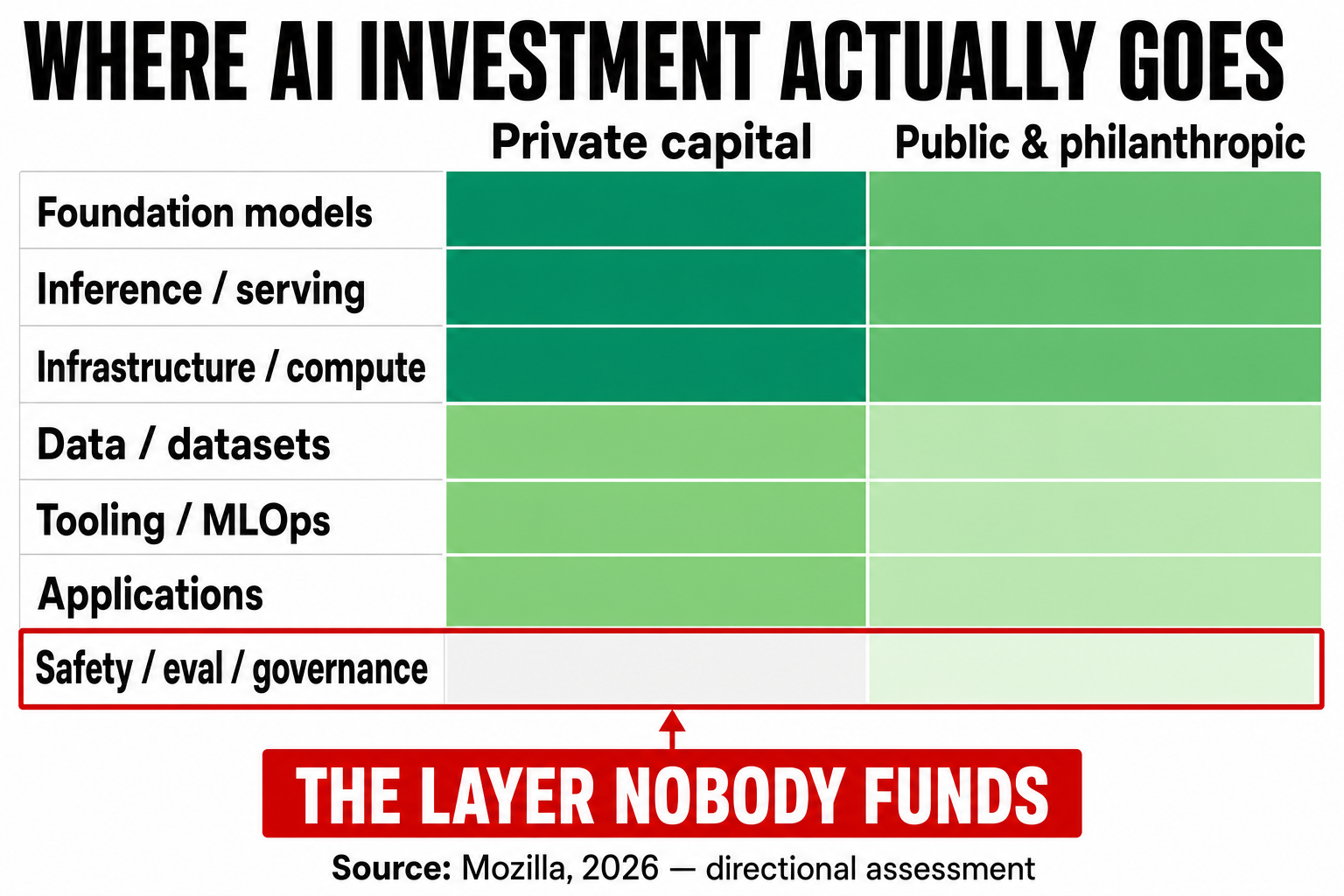
The reason is plain incentives: guardrails don't generate revenue, so private capital funds engines and leaves the brakes to whoever cares. Two caveats before I build on that chart: it maps the open-source AI stack specifically, and Mozilla describes it as a directional judgment rather than a measurement. But the direction matches what I see in the market, and it means the agentic AI risks documented above won't be engineered away by default. Somebody has to be paid to do it — which brings us to you.
Disclosure: Mozilla has a stake in this fight
Because I'd want it disclosed to me: Mozilla is not a neutral bystander. The report is openly an argument for an open agent layer, and Mozilla builds AI developer tooling through Mozilla.ai; they have a commercial stake in the fight they're describing. I've checked every number in this article against the report and, for the security claims, against the original disclosures, all linked above so you can verify for yourself. (That checking caught Mozilla overstating one of its own citations, which is exactly why it's worth doing.) Just read the "five bets" framing at the end of their report as advocacy, because it is.
What This Means for You (and Your Career)
If you work in security, or you're trying to get in, read that funding gap again: a control layer almost nobody is paying to build, attached to the fastest-spreading protocol in the industry. My judgment is that means under-staffed too, for years. Gaps like that are where careers get built.

I run agents in production every day (HAL, the assistant infrastructure I direct everything through, plus Titus, the vulnerability-management system that watches our servers), and the write surface is where all my real design effort goes. None of it relies on a single control. It's the same defence in depth we'd apply to any privileged user: permissions that deny access by default, pre-execution hooks that inspect commands before they run, and an egress firewall on what can leave. Each layer has earned its keep. I've watched one of my own agents decide that the fastest way to fix a data problem was to wipe the database and start again — not malicious, just being helpful. The hook layer caught the command before it ran, because agents chase the goal you gave them, not the damage along the way. And when I use AI agents for penetration testing, the egress rules plus those hooks mean nothing they touch can leave by a route I haven't approved. That's the exact control the four flaws above were missing.
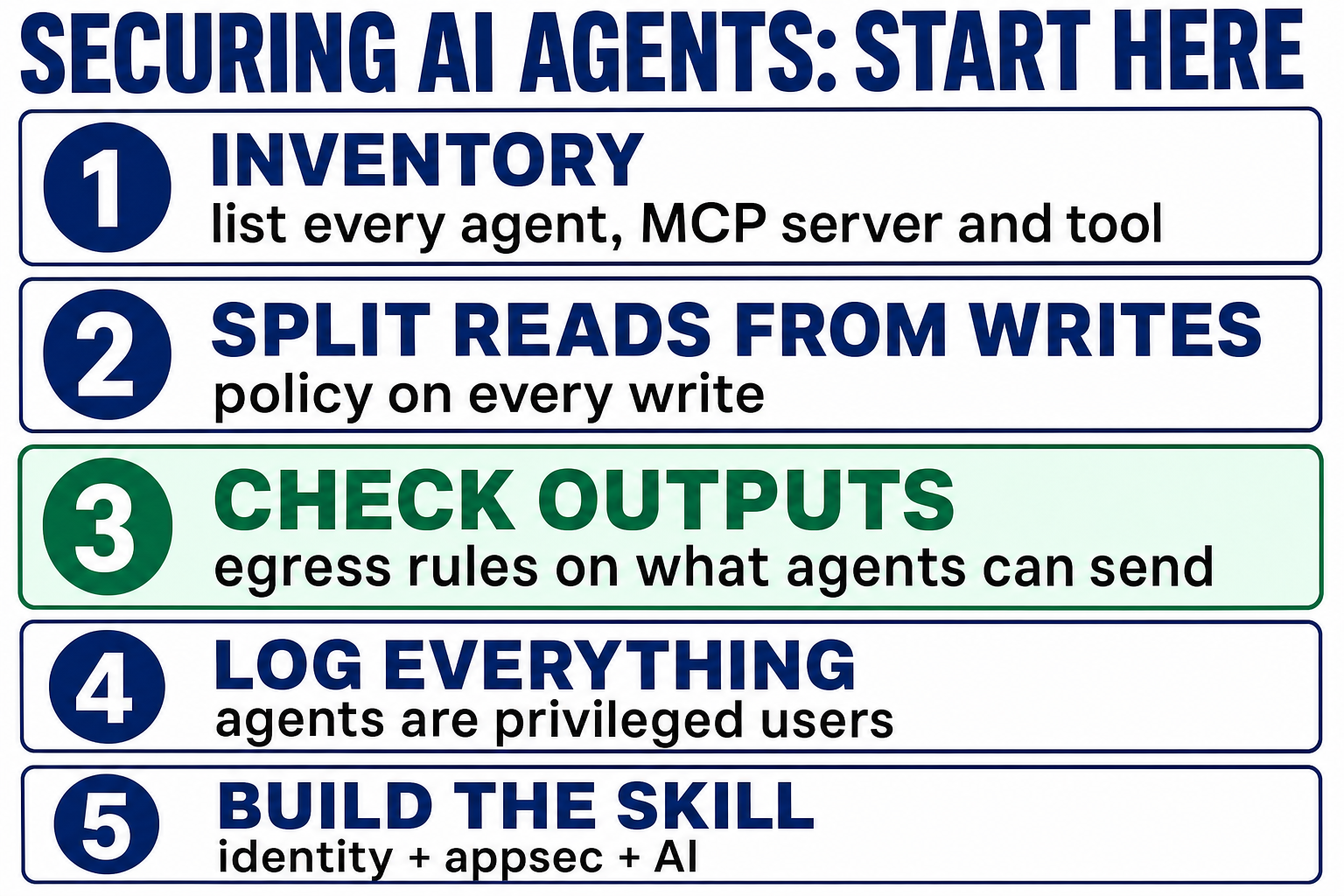
Practical steps, in the order I'd do them:
Inventory your agents and their tools. Every MCP server, every plugin, every integration an agent can call. You cannot govern what you haven't listed. Treat third-party MCP servers as supply chain: the same discipline you'd apply to an npm dependency. OWASP's AI Agent Security Cheat Sheet makes a solid companion checklist for this step and the next two.
Split reads from writes. Default-allow harmless reads if you like, but enumerate every write an agent can perform and put explicit policy on each: confirmation, spend thresholds, rate limits, revocation.
Check outputs, not just inputs. All four 2025 flaws passed retrieval checks and failed on output. Egress filtering (where can this thing send data?) would have stopped the three exfiltration flaws outright. The fourth, an impersonation via a hardcoded secret, is the case for output identity checks and basic secret hygiene on top.
Log agent actions like you log privileged users. Because that's what they are: fast, tireless privileged users with no fear of being fired.
Build the skill deliberately. This sits at the junction of identity, application security, and AI: the combination our AI-Driven Security Engineering program trains for, and our MCP course covers the protocol layer itself. If you're earlier in the journey, incident response and cyber security fundamentals still come first; agent security is a specialisation, not an entry point.
My read, from living through the cloud and mobile shifts: the security discipline professionalises a few years after the attack surface arrives. AWS launched in 2006; the Cloud Security Alliance formed in 2009, and cloud security hiring took off from there. The agents arrived in 2025. Do the arithmetic on when the hiring wave lands, and how few people will have two years of hands-on agent security experience when it does.
And if you'd rather help solve this than wait for someone else to standardise it: that's the exact capability the AI Master's Program trains. You stand up your own HAL — your own agent infrastructure, with the deny-by-default permissions, pre-execution hooks, and egress controls you've just read about, and you earn the StationX Certified AI-Driven Security Engineer by shipping real security solutions with it. The next section of this page has the details.
AI Agent Security FAQ
What is AI agent security?
AI agent security is the practice of controlling what AI agents can access and do. That means the tools they call, the data they read, and above all the writes they perform: messages sent, records changed, money spent. It spans identity (OAuth 2.1, signed Agent Cards), authorization policy, output/egress control, and audit logging.
Is MCP secure?
The Model Context Protocol now mandates OAuth 2.1 with PKCE and sits under Linux Foundation governance, which is real progress. But researchers filed 30+ CVEs against MCP implementations in the first eight weeks of 2026, and the protocol standardises authentication, not authorization. Treat every MCP server you connect as a supply-chain dependency and gate what it's allowed to write.
What is the biggest agentic AI risk?
Based on the vulnerabilities disclosed in 2025: authorized retrieval reaching unauthorized recipients. Agents read data they legitimately can access, then send it somewhere they never should — triggered by prompt injection, enabled by missing output controls. Consent fatigue compounds it, because users approve the very prompts that authorize damaging actions.
Are closed AI models safer than open ones?
Closed platforms ship safeguards on by default, while self-hosted open models make you build your own controls, so the operational burden differs. But the four critical agent flaws disclosed in 2025 (Slack MCP, EchoLeak, ForcedLeak, BodySnatcher) were all found in closed systems. The dangerous failures live in the harness, the agent layer both kinds share.
What is an AI agent governance framework?
A defined set of policies and controls over agent behaviour: an inventory of agents and tools, read-vs-write permission tiers, spend and rate thresholds, output/egress rules, revocation, and audit trails. Per Mozilla's 2026 report, only ~21% of companies have anything mature in place — there's no dominant standard yet.
Sources & methodology
Primary: Mozilla, The State of Open Source AI, v1.0, July 2026 (stateofopensource.ai; SlashData survey n=1,494, May 2026; MCP registry; Anthropic-reported download figures). Independently traced and captured primaries: Okta "AI Agent Authorization Gap" (Feb 2026); CoSAI MCP security taxonomy (Jan 2026); Anthropic/Linux Foundation AAIF announcement (Dec 2025); Embrace The Red Slack MCP advisory; Aim Labs/Cato EchoLeak; Noma ForcedLeak; AppOmni BodySnatcher; OWASP AI Agent Security Cheat Sheet; MCP spec authorization section.
Corrections applied vs the report: CoSAI "top-tier" downgraded to "documented"; "all closed systems" stated as our observation, not Okta's; disclosure dates precise (Slack MCP June 2025; BodySnatcher public January 2026). Figures verified against the report PDF. Caveats stated in-article: OpenRouter-scoped usage data; Mozilla's declared interest in the open agent layer.
About the Author

Nathan House, Founder & CEO of StationX
Nathan House has 30 years of hands-on cybersecurity experience and is Cambridge-educated, holding CISSP, CISA, CISM, OSCP, CEH, and SABSA. He founded StationX in 1999 — one of the UK’s first cybersecurity companies — and has secured £71 billion in UK mobile banking transactions and the London 2012 Olympics, advising clients including Microsoft, Cisco, BP, Vodafone, and VISA. He authored the world’s most popular cybersecurity course — a #1 Udemy bestseller taken by over 500,000 students — and was named Cyber Security Educator of the Year 2020, AI Security Educator of the Year, and a UK Top 25 Security Influencer 2025. A DEF CON speaker and featured expert on CNN, Fox News, NBC, and the BBC, Nathan leads StationX’s training of more than half a million students worldwide.