Everyone's Watching the Wrong AI Story

Almost every conversation about AI right now is the same one: is AI a bubble, and is it about to burst? It's a fair thing to ask — your pension, your job, and a big chunk of the stock market are all riding on the answer. I wrote a whole white paper on the AI bubble question back in 2025.
But after another year watching this closely, I think we're nearly all looking in the wrong direction. While everyone argues about whether the boom is real or fake, a different shift is happening quietly underneath — in plain sight, in the actual usage data — and almost nobody is pricing it in. It's not about whether the market crashes. It's about who ends up making the money from AI at all. And the answer might not be the companies pouring hundreds of billions into building it.
So in this article we're going to do three things. First, we'll be honest about the warning signs everyone's fixated on — because they're not nonsense. Second, I'll show you the shift hiding underneath them. And third, I'll show you who I think actually wins — with a proof point from my own work that I still find slightly absurd. Let's get into it.
Everyone's Having the Same Argument — and Missing the Real Story
The standard conversation goes like this: AI companies are spending insane amounts of money, they're not making it back, the valuations look detached from reality, and one day the music stops. Brace for the crash — that's the debate.
And I get why. The numbers genuinely are eye-watering, and we'll look at them honestly in a moment. But notice the shape of that debate: everyone is arguing about whether the boom is real or fake. Almost nobody is asking a different, more interesting question — what if the technology completely succeeds, and the companies building it still don't capture the value?
That sounds like a contradiction. It isn't. History is full of world-changing technologies that made everyone richer except the people who built them. So before we get to that, let's give the warning signs their due, because part of the worry is solidly true.

Is AI a Bubble? Yes, the Warning Signs Are Real
I'm not going to pretend the bubble worriers are imagining things. Three pieces of evidence stand out, and they're all from credible sources.
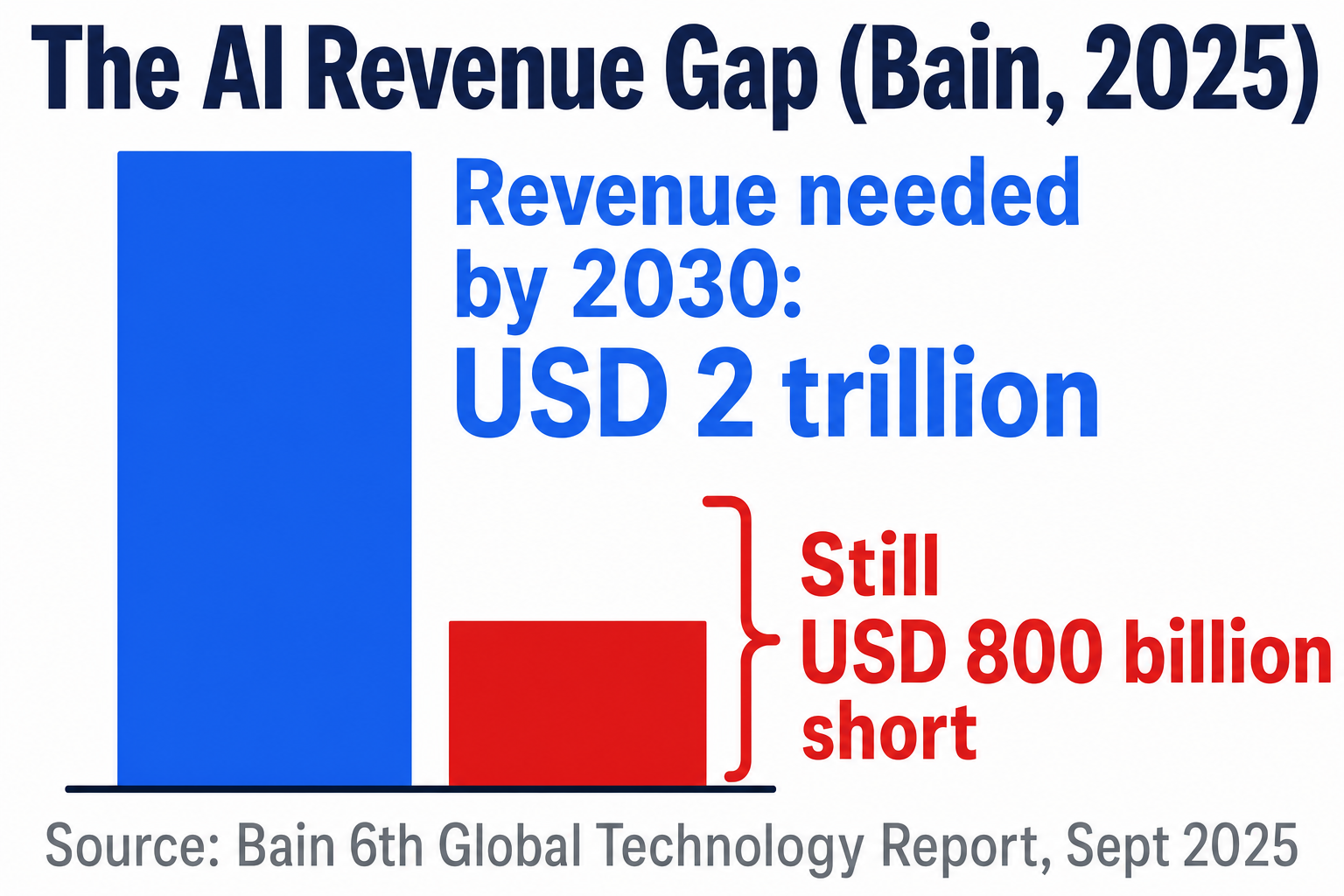
The spending doesn't add up — yet. Bain & Company, in their 6th annual Global Technology Report (September 2025), worked out that to fund the computing power AI demand implies, the industry needs around $2 trillion in annual revenue by 2030. Even after accounting for AI-related savings, they estimate the world is still about $800 billion short. That's not a rounding error. That's a gap the size of a large economy.
The returns mostly aren't landing. This is the one that should give the optimists pause. An MIT study — the NANDA "State of AI in Business 2025" report — found that 95% of organisations are getting zero return from generative AI so far. In their words, "just 5% of integrated AI pilots are extracting millions in value, while the vast majority remain stuck with no measurable P&L impact." Adoption is everywhere; profit is almost nowhere.
The money moves in circles. The financing tying together the big AI players — chipmakers investing in model labs that then buy their chips — has had analysts at the Wall Street Journal, Yale, and Bloomberg all reaching for the word "bubble." I covered this in detail in my article on OpenAI's leaked finances, so I won't repeat it here. The short version: real demand is being amplified by circular financing in a way that inflates how healthy the whole thing looks.
So yes — if your question is "are there warning signs?", the honest answer is clearly yes. But here's the thing the warning signs don't tell you.
What the Bubble Talk Misses: AI Is Becoming Free
While everyone argues about valuations, something more fundamental is happening to the product itself. The models are commoditising. They're getting cheaper, they're getting good enough, and increasingly they're being given away.
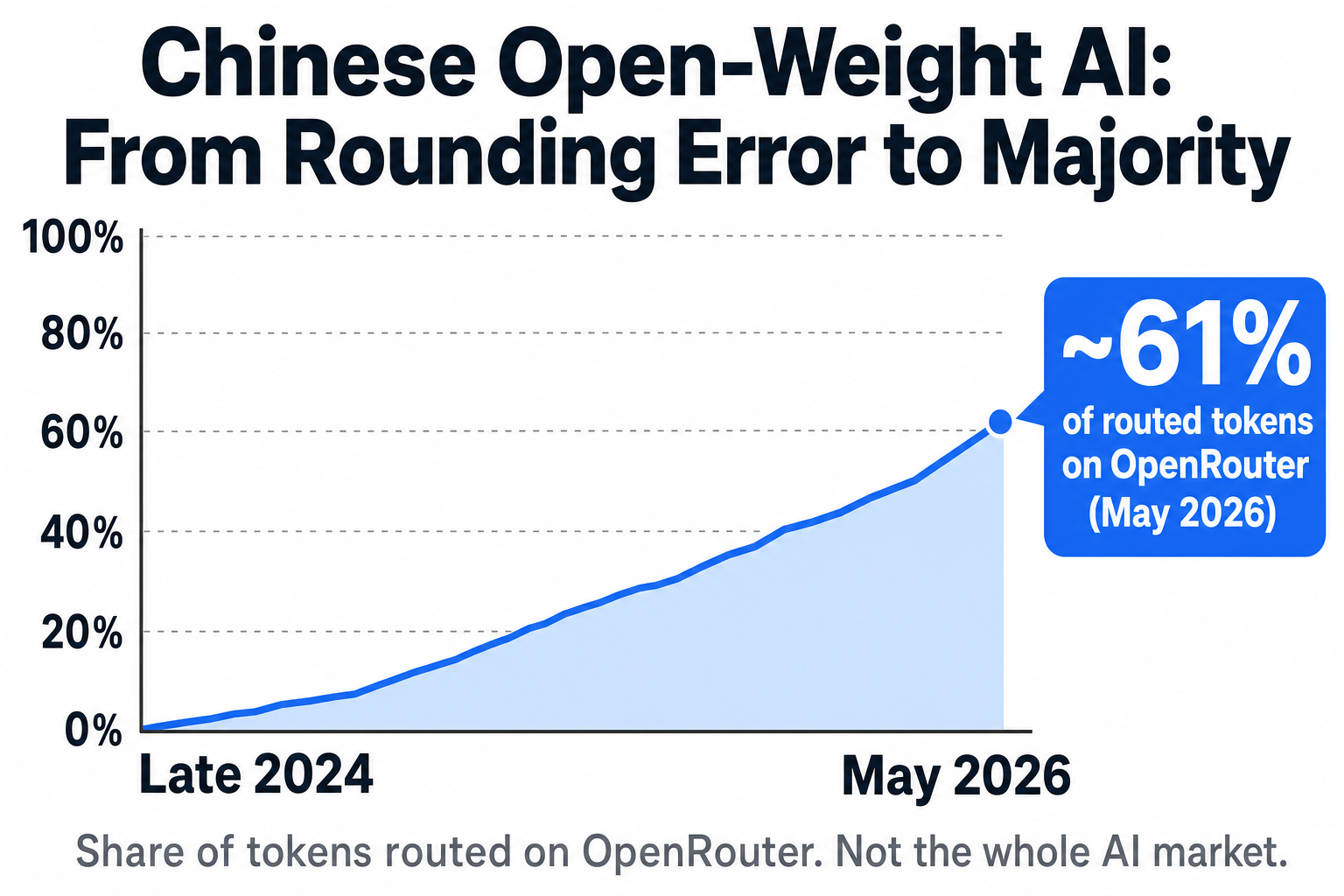
Look at where the world's AI usage is actually going. On OpenRouter — one of the largest neutral routers of model traffic — Chinese open-weight models reached roughly 61% of all routed tokens by May 2026. They went, in the words of the analyst who tracked it, from "a rounding error to the majority of consumption inside eighteen months." (Worth being precise here: that's routed inference on one major platform, not the entire global market, and US labs still take most of the industry's revenue. But the direction is unmistakable.)
And it's not just volume — it's price. In May 2026 DeepSeek made a roughly 75% price cut on its flagship V4-Pro model permanent, taking it to about $0.87 per million output tokens. That's not a discount; a permanent cut like that is a price floor the rest of the market now has to live with.
Here's why that matters. These are open-weight models. You don't have to send your data to anyone — you download the model and run it on your own hardware, or on a Western cloud. As hardware keeps improving, self-hosting a near-frontier model goes from "hard" to "default" for any capable company. The capability that cost a fortune two years ago is becoming a free, ownable commodity. (Owning a model you can run yourself is a genuine shift — though, as I'll come to, a weight file you can't see inside brings its own security problem. Hold that thought.)
When the core product of an industry trends toward free, you have to ask the uncomfortable question.
So Who Actually Captures the Value?
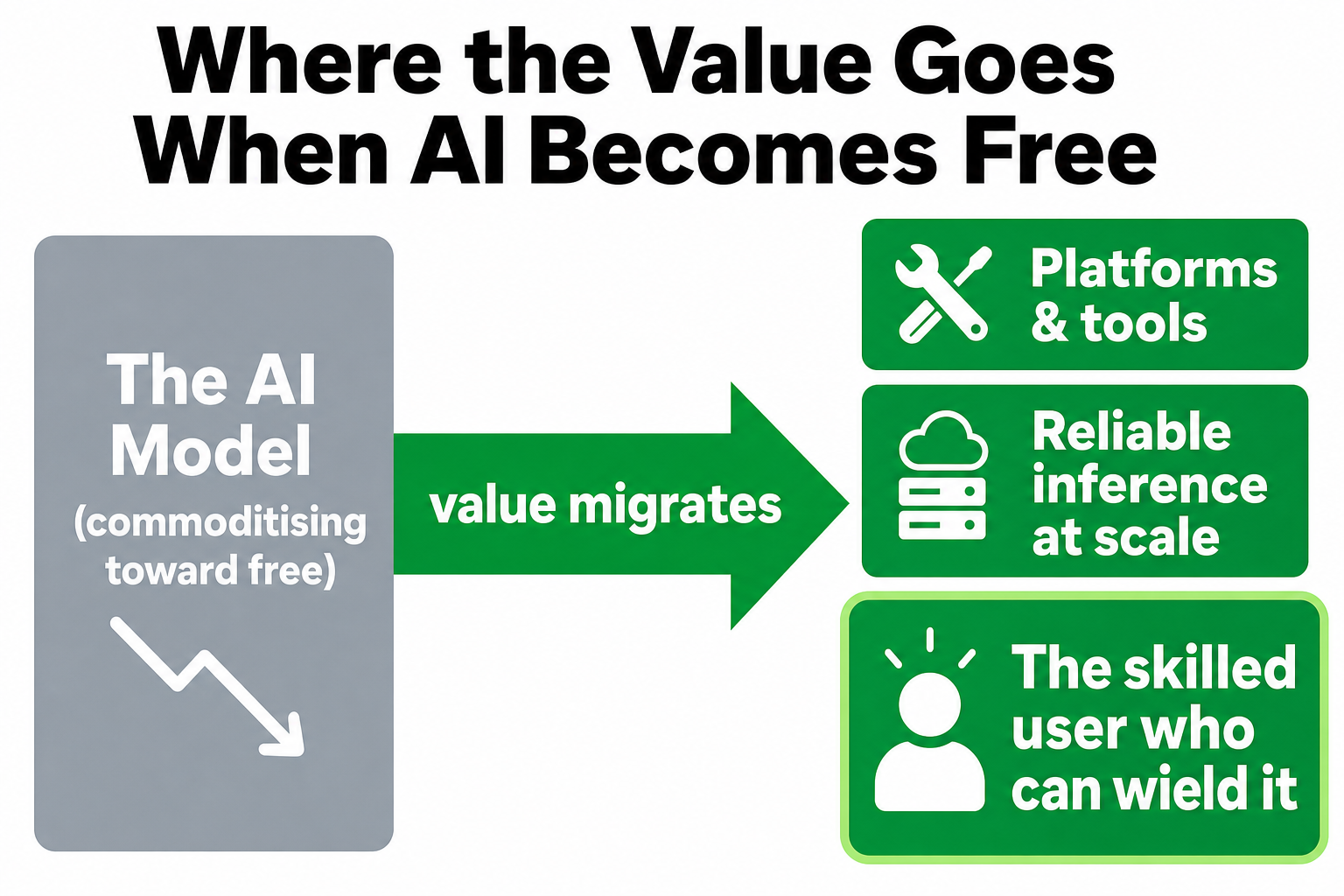
Here's the part that I think genuinely reframes the whole debate. AI can be a complete, world-changing success — and the companies building the models can still fail to get rich from it. Because if the model itself becomes a free commodity, the value doesn't disappear. It moves.
We've seen this before. Jet aviation transformed the world; the airline industry, totalled up across its history, has barely made money. The personal computer changed everything; almost nobody got rich selling the PC itself — the value moved to software and, later, the iPhone. Vaccines are arguably one of the greatest technologies in history; for most of that history they were a low-margin business, and even the recent windfalls didn't build a lasting trillion-dollar empire. A technology can be seminal and still be a terrible place to be a shareholder.
But notice where the value went in those cases, because it matters: often to an adjacent giant — Microsoft and Apple, not the people typing on the keyboards. So the value leaving the model-makers doesn't automatically land in your lap. It splits. Some goes to the platforms and tools built around the models, and some — genuinely — goes to the people who can actually wield them. That second share is the one you can claim, and it's bigger than it's ever been.
That's the real risk the bubble debate is mispricing. Not "AI fails," but "AI succeeds, commoditises, and the value flows somewhere other than the model makers." The market concentration is staggering — Apollo's Torsten Sløk notes that the ten largest stocks now make up around 40% of the S&P 500 by weight, much of that an AI bet — and a lot of that bet assumes the model layer stays a money-making moat. If it doesn't, the value has to go somewhere — and this is the part that matters for you and me.
Let me show you what I mean by that, because I have an example I lived.
The Proof: I Built a £500k System for €10.79 a Month
I run a tool called JobZone — it assesses how exposed any job is to AI. To build it the traditional way, you'd need a team: a product manager, a solutions architect, a security architect, a full-stack developer, a data engineer, a researcher, a designer, a penetration tester, a DevOps engineer, a QA engineer, and more. Sixteen distinct professional roles. Costed out at UK day rates over the time it would take, that's somewhere between £350,000 and £600,000, and the better part of a year.
I built it with AI, directing the whole thing myself, in about a fortnight. It runs on a server that costs €10.79 a month. It has thousands of job assessments, a news pipeline, a full security stack, automated tests — the lot.
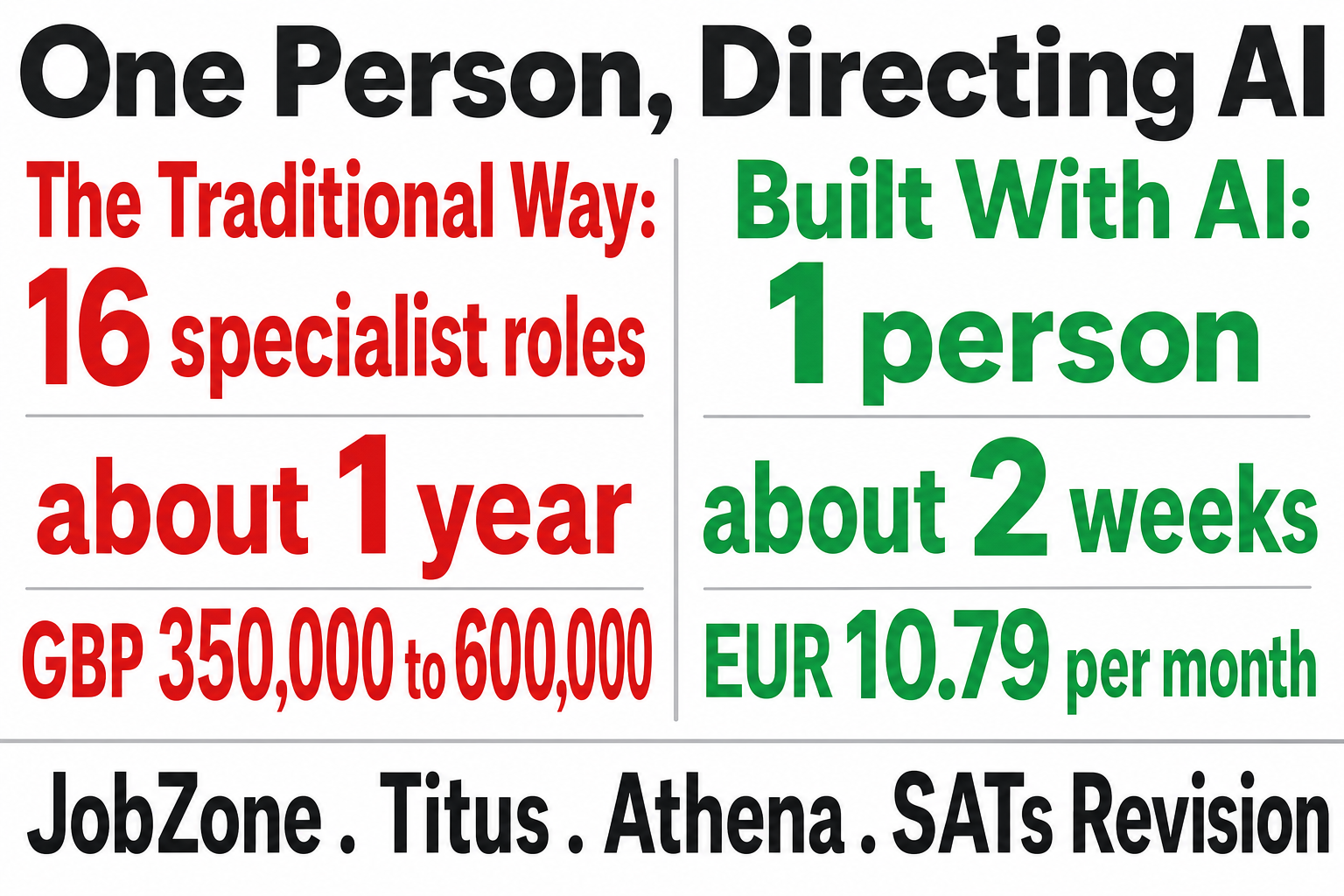
And here's the thing — and I'm not saying this to brag, it's the whole point — JobZone isn't a one-off. The same approach built Titus, the continuous vulnerability-management and DevSecOps infrastructure that keeps our systems secure, and several others besides. Each one would traditionally have been its own project, its own team, its own budget. Built this way, they're the output of one person directing AI.
Behind all of that sits the system I direct everything through — I call it HAL. And honestly, the clearest example is the page you're reading right now. The research behind it — pulling sources across multiple search engines, then running every figure in this article through a multi-model fact-checking system I call Truth Seeker, which checks each claim against its original primary source — was done through HAL. So was shaping the writing, the layout and design, the images, publishing it to the site, and monitoring the server it's being served from. My job was the direction and the judgement — the ideas, the standards, knowing when the output was wrong. Everything else was me directing AI to do the work a small team used to do.
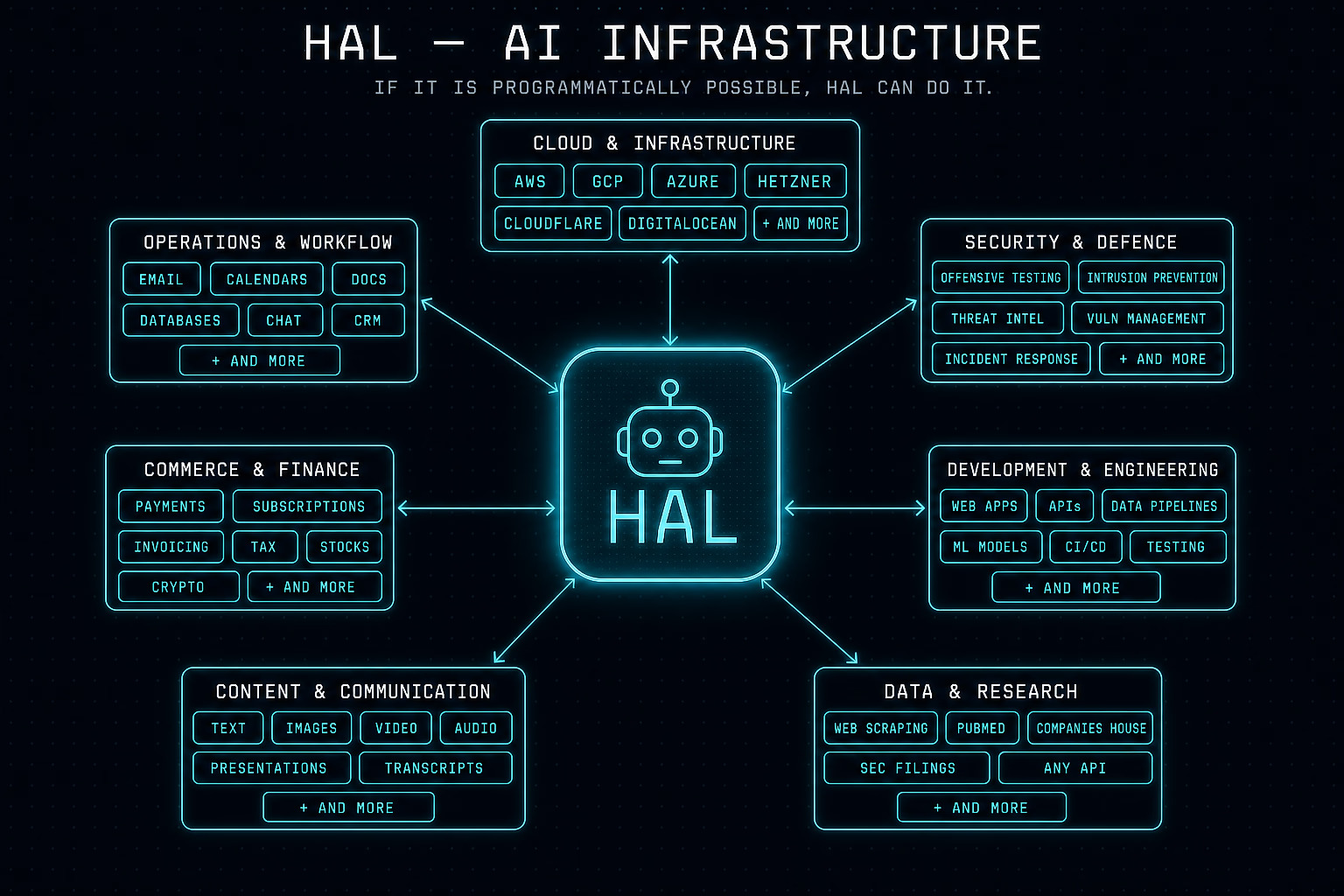
I'm telling you this because it's the thesis made concrete. None of it replaces the craft — knowing what "good" looks like, what to build, and where it breaks is exactly the hard-won skill that makes the direction work. But across all of it, I captured the value of frontier AI — systems that would traditionally have cost millions and filled an org chart — without paying any AI company a meaningful, lasting fee for the privilege. The value flowed to the skilled user, not to the model owner. Now imagine that pattern playing out across every capable company on earth. That's the shift the bubble debate keeps missing.
What This Means for Your Job and Your Skills
If the value of AI flows to the people who can wield it rather than the people who build it, then the move — for you, for your career — is obvious: become one of the people who can wield it.
This is the opposite of the doom narrative. The fear is "AI will take my job." The more accurate version is the one I keep coming back to: AI won't take your job — someone who understands AI will. And increasingly, that person won't take one job, they'll do the work of five. The leverage is real, and it's available to anyone willing to learn to direct these tools properly rather than just chat with them.
That's the whole idea behind what I've started calling AI-driven engineering — using AI to deliver complete solutions end-to-end, where you're the architect, the builder, and the reviewer all at once. You don't need to master sixteen professions. You need to learn to direct a system that can.
If you want a concrete first step, here it is: take one task you already do by hand, and instead of chatting with an AI about it, direct it end-to-end. Give it the goal, the constraints, and your standard for "done" — then review and correct its work as if you're the senior signing it off, not the typist. That shift, from asking to directing, is the entire skill in miniature. Do it on ten real tasks and you're most of the way there.
The Cybersecurity Angle: Where the Durable Ground Is
I spend my life in security, so let me add the part that's closest to home — because it points to the most durable ground in this whole shift.
First, defence is keeping up. There's a real fear that AI hands attackers a massive advantage, and in places it does. But look at DARPA's AI Cyber Challenge final in 2025: autonomous systems identified 86% of the synthetic vulnerabilities in the contest, discovered 18 real vulnerabilities in live open-source software, and submitted patches in an average of about 45 minutes. The same technology that helps attackers is dramatically strengthening defenders too — and that's a profession, not a commodity.
Second, the "free models everywhere" world creates a brand-new security problem that's right in our wheelhouse. When you self-host an open-weight model, you've removed the network dependency — but you've taken on a supply-chain trust problem. You're now running a multi-gigabyte weight file, often trained by a lab in another country, as a core dependency. A model's behaviour can be conditioned in ways no firewall will ever see, because there's no network call to inspect — the risk is baked into the artefact itself. That's almost certainly why model provenance is becoming a national-security conversation. "Can I trust this model I can't see inside?" is going to be one of the defining security questions of the next decade.
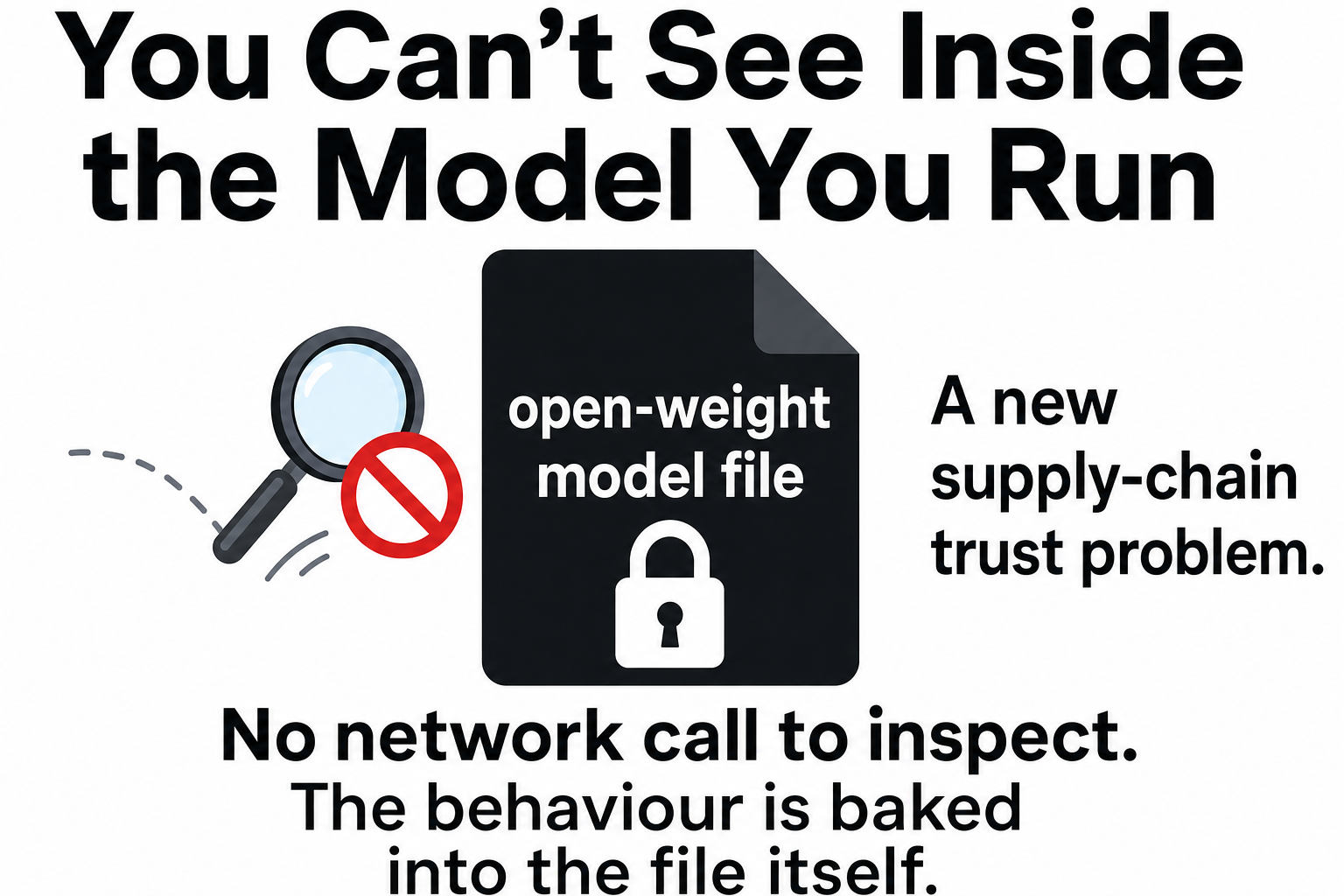
So the durable ground, as I read it, sits in three places: the judgement to use AI well, the work of defending systems with it, and the trust-and-security layer around models that no commodity can replace.
The Bottom Line
Is AI a bubble? Honestly — yes and no, and both can be true at once. The financial warning signs are real. But the bubble question is the surface. Underneath it, AI is commoditising toward free, and that's the development that actually decides who wins and who loses.
My read is this: the technology will succeed, and that won't be enough to save the economics of selling the model itself. The value is migrating — off the companies building the models and onto the people, the platforms, and the security professionals who can put them to work. So the lesson isn't to panic about the crash. It's to position. Become the skilled, secure user. Whatever happens to the share prices, that's the bet I'd make.
AI Bubble FAQ: Your Questions Answered
Is AI a bubble?
There are genuine bubble warning signs — circular financing, an ~$800 billion revenue gap by 2030 (Bain, 2025), and MIT NANDA's 2025 finding that 95% of organisations are getting zero return from generative AI so far. But "is it a bubble" misses the bigger story: AI is commoditising toward free, which reshapes who profits whether or not valuations correct.
Will the AI bubble burst?
Nobody can say for certain — that is only ever clear in hindsight, and serious analysts sit on both sides. What is more predictable is that the model layer is losing its pricing power as open-weight models become "good enough" and nearly free to run.
Does free, open-source AI threaten OpenAI and Anthropic?
It threatens their margins, not the technology. When near-frontier open-weight models — like China's DeepSeek and Qwen — are free to download and run, it is hard to charge a premium for a closed equivalent. The value migrates to platforms, inference, and skilled users.
Will AI replace my job?
The more accurate framing is that someone who understands AI will — and they will do the work of several people. The defensible move is to become a skilled director of these tools rather than a competitor to them.
Is DeepSeek (or any Chinese open model) safe to use?
Running an open-weight model locally keeps your data off the network, but it introduces a supply-chain trust question: you are trusting a weight file you cannot fully inspect. For sensitive use, model provenance and behavioural testing matter — this is a real, emerging security discipline, not a settled question.
About the Author

Nathan House, Founder & CEO of StationX
Nathan House has 30 years of hands-on cybersecurity experience and is Cambridge-educated, holding CISSP, CISA, CISM, OSCP, CEH, and SABSA. He founded StationX in 1999 — one of the UK’s first cybersecurity companies — and has secured £71 billion in UK mobile banking transactions and the London 2012 Olympics, advising clients including Microsoft, Cisco, BP, Vodafone, and VISA. He authored the world’s most popular cybersecurity course — a #1 Udemy bestseller taken by over 500,000 students — and was named Cyber Security Educator of the Year 2020, AI Security Educator of the Year, and a UK Top 25 Security Influencer 2025. A DEF CON speaker and featured expert on CNN, Fox News, NBC, and the BBC, Nathan leads StationX’s training of more than half a million students worldwide.