Cybersecurity Skills Gap Statistics [2026]: The Real Data

4.8 million unfilled cybersecurity positions. That's the headline number you'll see everywhere — but it's misleading. ISC2 itself dropped the figure from its 2025 study after Ira Winkler and others challenged the methodology. The number measures what organizations say they need, not what they're actually hiring for. CyberSeek counts 514,359 real US job postings. 25% of organizations reported cybersecurity layoffs in 2024 — during a supposed shortage.
The cybersecurity skills gap is real, but it's more nuanced than most articles admit. Below you'll find 100+ statistics for 2026 from ISC2, ISACA, Fortinet, WEF, CompTIA, IBM, and 15+ additional sources across 14 sections. I've cross-referenced the data to separate the genuine cybersecurity skills shortage from the hiring practices problem and the budget problem — because they're three different issues with three different solutions.
Key Cybersecurity Skills Gap Statistics at a Glance
- 4.8 million — global workforce gap (ISC2 2024, perceived need — not job openings; dropped from 2025 study)
- 514,359 — actual US cybersecurity job postings (CyberSeek, 12-month period)
- 90% of organizations report skills gaps; only 14% have the talent they need (ISC2/WEF)
- Budget overtook talent as #1 staffing barrier for the first time ever (ISC2 2024)
- 25% had cybersecurity layoffs while the gap widened 19% (ISC2 2024)
- 38% of employers demand CISA for entry-level roles — a cert requiring 5+ years experience (ISC2)
- $1.76M — extra breach cost for understaffed organizations (IBM 2024)
- AI/ML is the #1 skills need at 41%, up from 34% (ISC2 2025)
Last updated: September 2026
📊 Cybersecurity Skills Gap: Key Numbers (2026)
The cybersecurity skills shortage dominates industry discussion, but the data tells a more complex story than the headlines suggest. ISC2 reports a 4.8 million workforce gap, but that number measures organizational aspiration, not labor market reality. CyberSeek tracks 514,359 actual US job postings. The gap grew 19.1% in 2024 while 25% of organizations simultaneously laid off cybersecurity staff. If you're evaluating whether cybersecurity is in demand, the answer is yes — but with significant caveats about what kind of demand and where.
90% of organizations report at least one skills gap on their teams (ISC2 2024), and only 14% say they have the talent they need (WEF 2025). But for the first time in ISC2's tracking history, budget replaced talent as the primary staffing barrier. The cybersecurity job market is constrained by funding, not just by a shortage of qualified people.
| Finding | Value | Source |
|---|---|---|
| Global workforce gap (ISC2 2024 — perceived need, not job openings) | 4,763,963 | ISC2 Cybersecurity Workforce Study 2024 |
| Active cybersecurity workforce globally | 5.5 million | ISC2 Cybersecurity Workforce Study 2024 |
| Organizations reporting skills gaps | 90% | ISC2 Cybersecurity Workforce Study 2024 |
| Organizations with critical/significant skills needs (2025) | 59% | ISC2 Cybersecurity Workforce Study 2025 |
| Actual US job postings (12-month period) | 514,359 | CyberSeek / NIST |
| US projected job growth (2024-2034) | 29% | BLS Occupational Outlook Handbook |
| US median cybersecurity analyst salary | $124,910 | BLS Occupational Outlook Handbook |
| Teams reporting understaffing | 55% | ISACA State of Cybersecurity 2025 |
| Organizations with necessary cybersecurity talent | 14% | WEF Global Cybersecurity Outlook 2025 |
| Extra breach cost from skills shortages | $1.76 million | IBM Cost of a Data Breach 2024 |
| Organizations that reported cybersecurity layoffs | 25% | ISC2 Cybersecurity Workforce Study 2024 |
| Organizations that faced budget cuts | 37% | ISC2 Cybersecurity Workforce Study 2024 |
| Organizations breached in past 12 months | 86% | Fortinet 2025 Cybersecurity Skills Gap Report |
| Women in the cybersecurity workforce | 22% | ISC2 Cybersecurity Workforce Study 2024 |
4.8 Million vs 514,000: The Number Gap
ISC2 reports a 4.8M workforce gap, but CyberSeek counts only 514,359 actual US job postings. The ISC2 number measures what organizations say they need, not what they're hiring for. ISC2 themselves acknowledged this distinction and dropped the gap number entirely from their 2025 study after criticism from Ira Winkler and others. The gap is real — but it's not 4.8M open jobs. (ISC2 2024, CyberSeek 2025)
Three Gaps, Not One
The data reveals three distinct problems conflated into a single number: (1) a skills gap — 90% of organizations report skill deficiencies in AI/ML and cloud on existing teams; (2) a staffing gap — 67% report staffing shortages driven by budget, not talent availability; (3) a hiring gap — 38% demand impossible credentials for entry-level while 31% of teams have zero junior staff. Treating this as one problem leads to one-size-fits-all solutions that address none of them effectively. (ISC2 2024, ISACA 2025)

📈 The Gap by the Numbers: ISC2 Data Explained
ISC2's Cybersecurity Workforce Study is the most-cited source on the cybersecurity workforce shortage. In 2024, they surveyed 15,852 practitioners and decision-makers globally (conducted by Forrester Research). The headline: 4,763,963 unfilled positions, up 19.1% year-over-year. The global workforce reached 5,468,173, growing just 0.1% — the slowest rate since tracking began. Total demand: 10.2 million professionals. The workforce would need to grow 87% to close the current gap.
How ISC2 calculates the gap: They use OECD and BLS data as a baseline, then survey respondents about how many cybersecurity professionals their organization needs versus has. The gap equals demand (what organizations want over 12 months) minus supply (workers entering minus departing). It measures underlying organizational need, not active job postings. Most countries' estimates are extrapolated from the US baseline. ISC2's own CISO, Jon France, acknowledged: "That doesn't mean there are 4.8 million jobs out there."
The Ira Winkler controversy: In October 2024, renowned cybersecurity professional and CISO at CYE wrote an open letter to ISC2's board accusing them of "knowingly pushing a false narrative of a plentiful job market." He pointed to stagnant actual employment while ISC2 promoted a 4.8M gap, and conducted discussions with "dozens of unemployed cybersecurity professionals." ISC2 subsequently dropped the gap number entirely from their 2025 study, shifting focus to "critical skills as more important than the need for more people."
| Finding | Value | Source |
|---|---|---|
| Global workforce gap (ISC2 2024) | 4,763,963 | ISC2 Cybersecurity Workforce Study 2024 |
| Current global workforce | 5.5 million | ISC2 Cybersecurity Workforce Study 2024 |
| Total professionals needed globally | 10.2 million | ISC2 Cybersecurity Workforce Study 2024 |
| Workforce growth needed to close gap | 87% | ISC2 Cybersecurity Workforce Study 2024 |
| Gap year-over-year increase | 19.1% | ISC2 Cybersecurity Workforce Study 2024 |
| Actual workforce growth rate (slowest ever) | 0.1% | ISC2 Cybersecurity Workforce Study 2024 |
| Organizations reporting staffing shortages | 67% | ISC2 Cybersecurity Workforce Study 2024 |
| Organizations with one or more skills gaps | 90% | ISC2 Cybersecurity Workforce Study 2024 |
| Skills gaps putting organization at significant risk | 58% | ISC2 Cybersecurity Workforce Study 2024 |
| WEF: moderate-to-critical skills gaps | 67% | WEF Global Cybersecurity Outlook 2025 |
| Organizations with necessary talent | 14% | WEF Global Cybersecurity Outlook 2025 |
| Organizations with unfilled positions | 65% | ISACA State of Cybersecurity 2025 |
Why ISC2 Dropped the Number
ISC2's 2025 study (16,029 respondents) made a significant pivot: they discontinued reporting the workforce gap number entirely. The stated reason was to shift focus to 'critical skills as more important than the need for more people.' The criticism from Ira Winkler and the broader cybersecurity community — that the 4.8M figure was being misrepresented as job openings — likely influenced this decision. The 2025 study found 59% reporting critical/significant skills needs (up from 44% in 2024), suggesting the problem is deepening even as the headline number disappeared. (ISC2 2025)
Workforce Growth Rates by Region (2024)
| Region | Growth Rate | Direction |
|---|---|---|
| Middle East & Africa | +7.4% | Growing |
| Asia-Pacific | +3.8% | Growing |
| Europe | -0.7% | Contracting |
| Latin America | -0.9% | Contracting |
| North America | -2.7% | Contracting |
| Global Average | +0.1% | Near stagnant |
The workforce growth data is striking: North America, Europe, and Latin America are all contracting their cybersecurity workforces while reporting growing gaps. Only Middle East & Africa and Asia-Pacific show meaningful growth. The global 0.1% growth rate — the slowest since ISC2 began tracking — reflects budget-driven workforce reductions in Western markets, not an inability to find talent.
ISC2 Gap Timeline
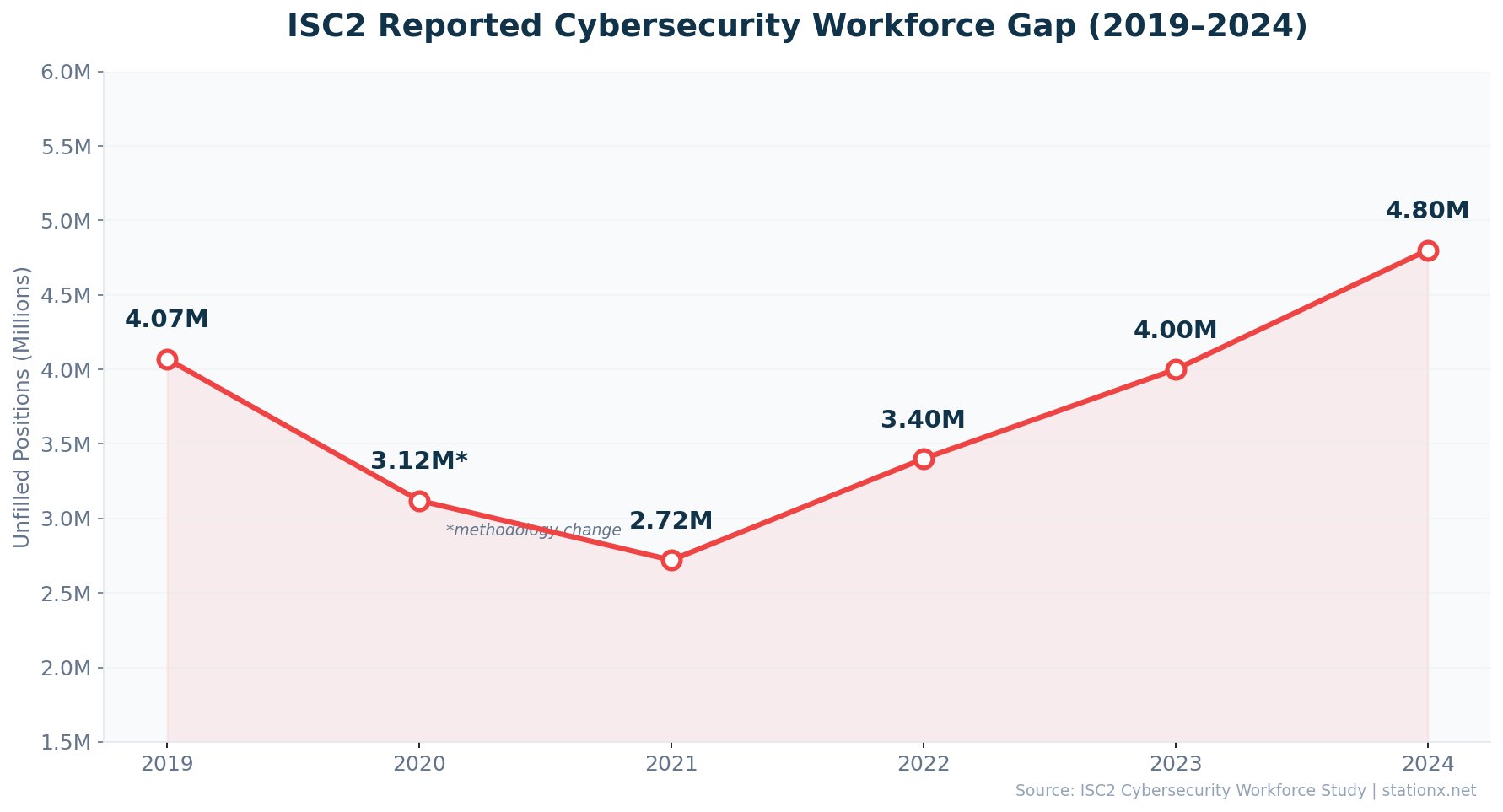
| Year | Workforce | Gap | Change |
|---|---|---|---|
| 2019 | 2.8M | 4.07M | — |
| 2020 | 3.5M | 3.12M | -23% |
| 2021 | 4.2M | 2.72M | -13% |
| 2022 | 4.7M | 3.4M | +26% |
| 2023 | 5.5M | 4.0M | +12.6% |
| 2024 | 5.47M | 4.8M | +19.1% |
| 2025 | Not reported | Discontinued | — |
The Layoffs-During-a-Shortage Paradox
25% of organizations reported cybersecurity layoffs in 2024, while the workforce gap widened 19.1% to 4.8 million. How? Budget is now the #1 barrier — companies recognize they need cybersecurity talent but won't or can't fund it. The gap measures perceived need, not funded positions. When ISC2 asks 'how many professionals do you need?' the answer is aspirational. When CFOs ask 'what can we afford?' the answer is layoffs. (ISC2 2024)
🔍 Cybersecurity Skills Shortage: Skills Gap vs Staffing Gap vs Hiring Gap
The Narrative
- 4.8 million unfilled positions globally
- Workforce needs to grow 87%
- 90% of organizations report skills gaps
The Counter-evidence
- 514K actual US job postings (CyberSeek)
- 25% had layoffs; 37% cut budgets
- Budget is now #1 barrier, not talent
Most articles treat "the cybersecurity skills gap" as a single problem. It's actually three distinct issues with different causes and different solutions:
1. Skills Gap (existing staff lack skills)
90% of organizations report skills gaps on current teams (ISC2 2024). The top gaps: AI/ML (41%), cloud security (36%), risk assessment (29%). This is a training problem, not a hiring problem. ISC2's 2025 study explicitly pivoted to focusing on "critical skills as more important than the need for more people."
2. Staffing Gap (not enough funded positions)
67% report staffing shortages, but budget is now the #1 barrier. 37% faced budget cuts, 38% under hiring freezes, 25% had layoffs. This is a funding problem. Companies know they need people but won't or can't pay for them.
3. Hiring Gap (employers won't hire available talent)
38% demand CISA for entry-level roles (requires 5+ years). 31% of teams have zero entry-level professionals. Entry-level postings dropped from 25% to 17% of all UK cyber postings since 2022. This is a hiring practices problem. The talent exists but employers set impossible requirements.
Conflating these three gaps into a single "4.8 million shortage" obscures the real solutions. Training existing staff (skills gap), funding positions (staffing gap), and reforming hiring practices (hiring gap) are fundamentally different interventions. The data suggests hiring practices and budget allocation deserve far more attention than they currently receive in the cybersecurity hiring debate.
| Finding | Value | Source |
|---|---|---|
| Skills gap: existing staff lack skills | 90% | ISC2 Cybersecurity Workforce Study 2024 |
| Staffing gap: not enough people | 67% | ISC2 Cybersecurity Workforce Study 2024 |
| Budget now #1 barrier (not talent availability) | #1 barrier | ISC2 Cybersecurity Workforce Study 2024 |
| Organizations that laid off cybersecurity staff | 25% | ISC2 Cybersecurity Workforce Study 2024 |
| Under hiring freezes | 38% | ISC2 Cybersecurity Workforce Study 2024 |
| Faced budget cuts | 37% | ISC2 Cybersecurity Workforce Study 2024 |
| Struggle to retain cyber talent | 50% | ISACA State of Cybersecurity 2025 |
| Current staff transitioned from non-security roles | 46% | ISACA State of Cybersecurity 2025 |
| Teams with zero entry-level professionals | 31% | ISC2 Cybersecurity Workforce Study 2024 |
| Fortune 100 roles offering fully remote | 8% | Industry analysis |
Indeed Job Postings Index: What Employers Are Actually Doing
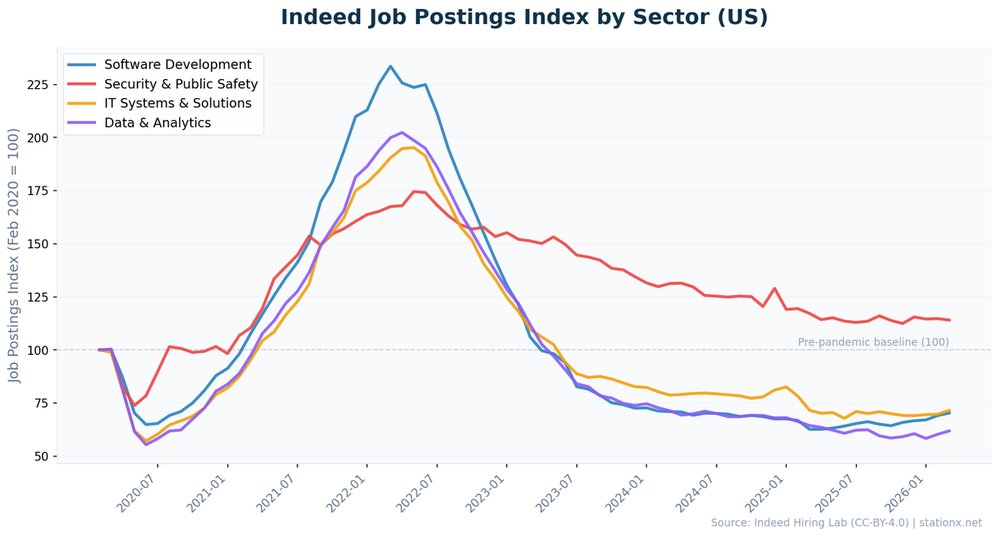
Indeed Hiring Lab publishes a Job Postings Index tracking employer activity across sectors (Feb 2020 = 100 baseline). The data paints a starkly different picture from the "millions of unfilled positions" narrative.
Software development postings peaked at 233.92 in 2022-02. They've since collapsed to 70.92 — 29% below pre-pandemic levels. IT Systems & Solutions followed a nearly identical trajectory: peak of 197.27, now 71.93 (28% below baseline). Data & Analytics fared worst at 61.74 (38% below baseline).
Only Security & Public Safety remains above baseline at 113.3 — but it has dropped 36% from its 2022 peak.
Important caveat: Indeed's "Security & Public Safety" primarily covers physical security (security officers, guards), not cybersecurity. Cyber roles are spread across Software Development (security engineers), IT Systems (SOC analysts), and Management (CISOs). This data doesn't isolate cybersecurity postings directly. But the broader IT job market contraction across every tech-adjacent sector provides important context for evaluating claims of millions of unfilled positions.
| Sector | Feb 2020 (Baseline) | Peak (2022) | Current (2026-03) | Change from Peak |
|---|---|---|---|---|
| Software Development | 100 | 233.92 (2022-02) | 70.92 | −70% |
| IT Systems & Solutions | 100 | 197.27 (2022-04) | 71.93 | −64% |
| Security & Public Safety | 100 | 176.87 (2022-01) | 113.3 | −36% |
| Data & Analytics | 100 | 202.65 (2022-03) | 61.74 | −70% |
Source: Indeed Hiring Lab, Job Postings Index (Feb 2020 = 100). Data: hiring-lab/job_postings_tracker on GitHub (CC-BY-4.0).
| Finding | Value | Source |
|---|---|---|
| Software Development (current index) | 70.92 (vs 100 baseline) | Indeed Hiring Lab |
| IT Systems & Solutions (current index) | 71.93 (vs 100 baseline) | Indeed Hiring Lab |
| Security & Public Safety (current index — only sector above baseline) | 113.3 (vs 100 baseline) | Indeed Hiring Lab |
| Software Development peak (2022-02) | 233.92 | Indeed Hiring Lab |
| Security & Public Safety peak (2022-01) | 176.87 | Indeed Hiring Lab |
Indeed Job Postings Reality Check
Software development postings: 70.92 — that's 29% below pre-pandemic. IT systems: 71.93 (28% below). Data & analytics: 61.74 (38% below). Only Security & Public Safety remains above baseline at 113.3, but that's dropped 36% from its 2022 peak. If there were truly millions of unfilled positions, job postings would be at record highs. They're not. They're declining. (Indeed Hiring Lab, CC-BY-4.0, 2026 03)
Indeed Wage Tracker: Are Security Wages Spiking?
Wages are the clearest market signal. If employers were truly desperate, wage growth would be sustained. It's not.
Indeed's Wage Tracker for Security & Public Safety peaked at 12% YoY in Jan-22. By mid-2023 it was 5–7%. As of Feb-26: 2% YoY — back to pre-pandemic levels. Barely above inflation.
| Period | Wage Growth (YoY) | Context |
|---|---|---|
| Pre-pandemic (2019) | 3–3% | Baseline |
| Peak (Jan-22) | 12% | Hiring frenzy |
| Mid-2023 | 5–7% | Cooling |
| Current (Feb-26) | 2% | Pre-pandemic levels |
Important caveat: Indeed's "Security & Public Safety" wage data covers the broader security sector (mostly physical security), not cybersecurity specifically. It serves as a directional indicator of the broader security labour market, not a precise cybersecurity wage measure. Source: Indeed Hiring Lab Wage Tracker (CC-BY-4.0).
| Finding | Value | Source |
|---|---|---|
| Security & Public Safety wage growth peak (Jan-22) | 12% YoY | Indeed Hiring Lab Wage Tracker |
| Security & Public Safety wage growth current (Feb-26) | 2% YoY | Indeed Hiring Lab Wage Tracker |
Wage growth tells the real story. Indeed's Wage Tracker for Security & Public Safety shows growth peaked at 12% YoY in Jan-22. It has since declined to 2% YoY by Feb-26 — back to pre-pandemic levels. If employers were truly desperate to fill millions of positions, wages would still be spiking. They're not. Caveat: this covers "Security & Public Safety" broadly (mostly physical security), not cybersecurity specifically. But as a directional indicator, it reinforces the pattern: the hiring frenzy peaked in 2022 and has not returned.
UK Indeed Data: The Pattern Is Global
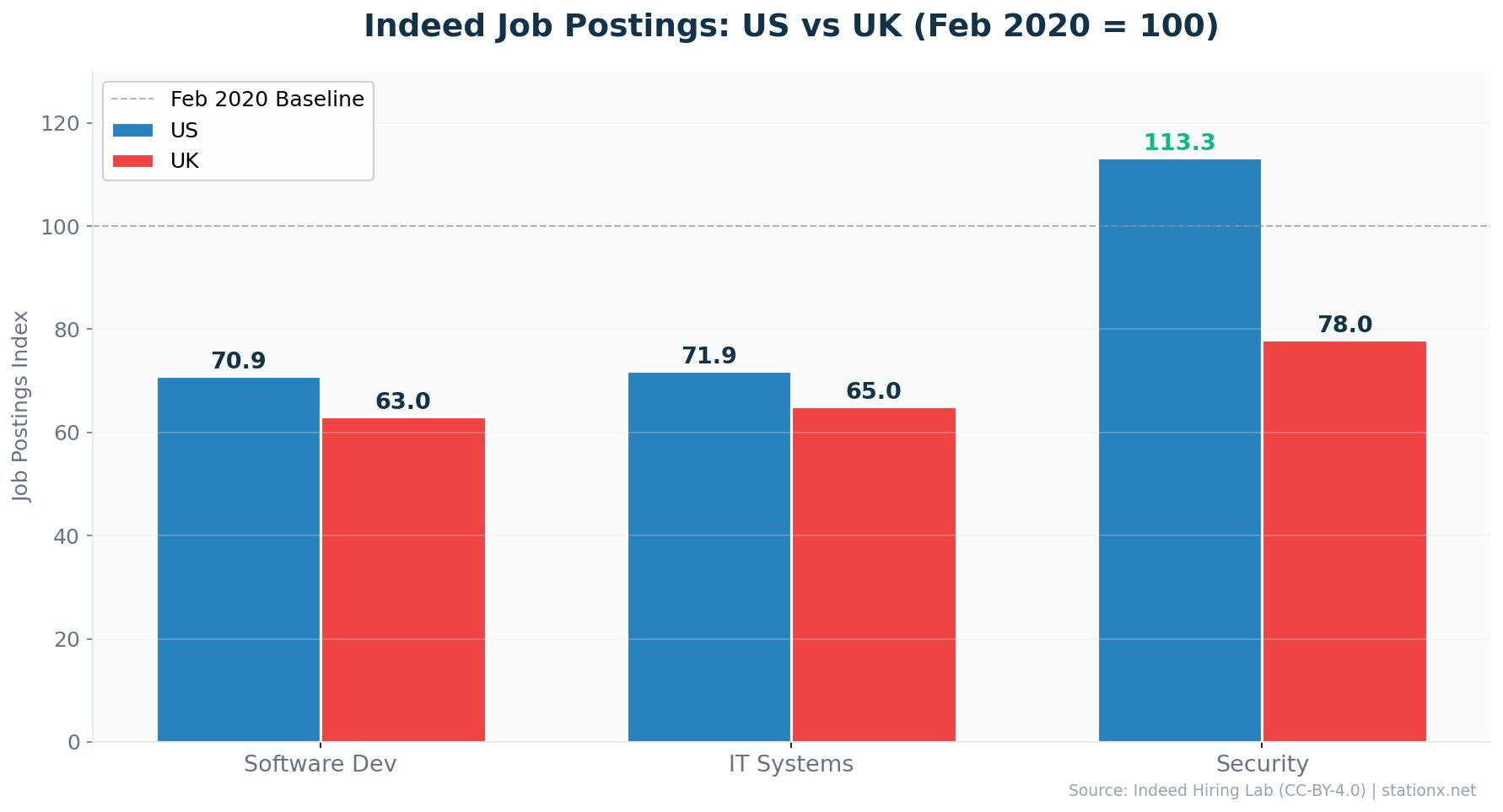
The job market contraction is not a US anomaly. Indeed's UK Job Postings Index shows an even steeper decline. Every tech-adjacent sector in the UK is now below pre-pandemic levels — including Security & Public Safety, which in the US remains slightly above baseline.
| Sector | UK Current | UK Peak (2022) | vs Pre-pandemic | US Current |
|---|---|---|---|---|
| Software Development | 63.25 | 181.57 (2022-04) | 37% below | 70.92 |
| IT Systems & Solutions | 64.66 | 185.26 (2022-04) | 35% below | 71.93 |
| Security & Public Safety | 78.21 | 192.42 (2022-02) | 22% below | 113.3 |
Source: Indeed Hiring Lab, UK Job Postings Index (Feb 2020 = 100). Data: hiring-lab/job_postings_tracker on GitHub (CC-BY-4.0). Same sector caveats apply — "Security & Public Safety" covers physical security broadly, not cybersecurity specifically.
| Finding | Value | Source |
|---|---|---|
| UK Software Development (vs 100 baseline) | 63.25 (37% below pre-pandemic) | Indeed Hiring Lab |
| UK Security & Public Safety (vs 100 baseline) | 78.21 (22% below pre-pandemic) | Indeed Hiring Lab |
| UK IT Systems & Solutions (vs 100 baseline) | 64.66 (35% below pre-pandemic) | Indeed Hiring Lab |
The UK pattern is worse. UK Software Development postings sit at 63.25 (37% below baseline) vs US 70.92. UK IT Systems at 64.66 vs US 71.93. Even UK Security is at 78.21 (22% below baseline), while the US equivalent remains at 113.3 (13% above). The job market contraction is global, not a US anomaly.
The Numbers Don't Add Up: ISC2 vs Indeed
ISC2 claims 4.8M. CyberSeek counts 514K actual US openings. Indeed shows IT posting volumes declining, not surging. Three data points, one conclusion: the gap is not about insufficient job openings. It's about skills mismatch, budget constraints, and unrealistic hiring requirements. Software dev postings peaked at 233.92 in 2022-02. Today: 70.92. That's a 70% collapse. Stop citing 4.8M as evidence of a hiring boom. (Indeed 2026, ISC2 2024, CyberSeek 2025)
CyberSeek US Heatmap: Where the Jobs Actually Are
CyberSeek (powered by CompTIA and NIST/NICE) tracks actual cybersecurity job postings at the state level. The distribution is heavily concentrated: the top five states — Virginia, California, Texas, Maryland, and Florida — account for roughly 37% of all US cybersecurity postings. Virginia's dominance (#1 by a wide margin despite being the 12th most-populous state) reflects federal spending: the NSA, Cyber Command, CISA, and major defense contractors are concentrated in Northern Virginia and the DC metro area. The national supply-demand ratio is 74 workers per 100 openings.
Cybersecurity Job Openings by State
Source: CyberSeek / NIST 2025| State | Openings | Key Driver |
|---|---|---|
| Virginia | 53,855 | Federal/defense (NSA, CISA, DoD contractors) |
| California | 44,344 | Silicon Valley, tech industry |
| Texas | 42,559 | Austin/Dallas tech hubs, military |
| Maryland | 27,050 | NSA/Cyber Command (Fort Meade) |
| Florida | 23,792 | Defense, finance, growing tech sector |
Source: CyberSeek / NIST (2025). Hover over states on the map above for individual figures. Top 5 states verified from CyberSeek; remaining states are directional estimates based on CyberSeek proportional data.
| Finding | Value | Source |
|---|---|---|
| Virginia (#1 — federal/defense hub) | 53,855 | CyberSeek / NIST |
| California (#2 — Silicon Valley) | 44,344 | CyberSeek / NIST |
| Texas (#3 — Austin/Dallas tech) | 42,559 | CyberSeek / NIST |
| Maryland (#4 — NSA/Cyber Command) | 27,050 | CyberSeek / NIST |
| Florida (#5) | 23,792 | CyberSeek / NIST |
| National supply/demand ratio (workers per 100 openings) | 74 | CyberSeek / NIST |
💻 Most In-Demand Cybersecurity Skills (2026)
AI/ML security tops the demand list at 41% (ISC2 2025), up from 34% in 2024. Cloud security follows at 36%, risk assessment at 29%, application security at 28%, and security engineering and GRC at 27% each. 97% of organizations are using or planning AI-enabled cybersecurity solutions (Fortinet 2025), but 67% note a shortfall in AI skills investment (WEF 2025) and only 37% have processes to assess AI security risks (WEF 2025).
ISC2's 2025 Hiring Trends Study revealed that hiring managers rank non-technical skills higher than expected. Teamwork, problem-solving, and analytical thinking outranked data security and cloud security. ISACA found 59% of organizations identify soft skills — critical thinking, communication, problem-solving — as their primary gap concern. The cybersecurity skills shortage isn't just about technical expertise.
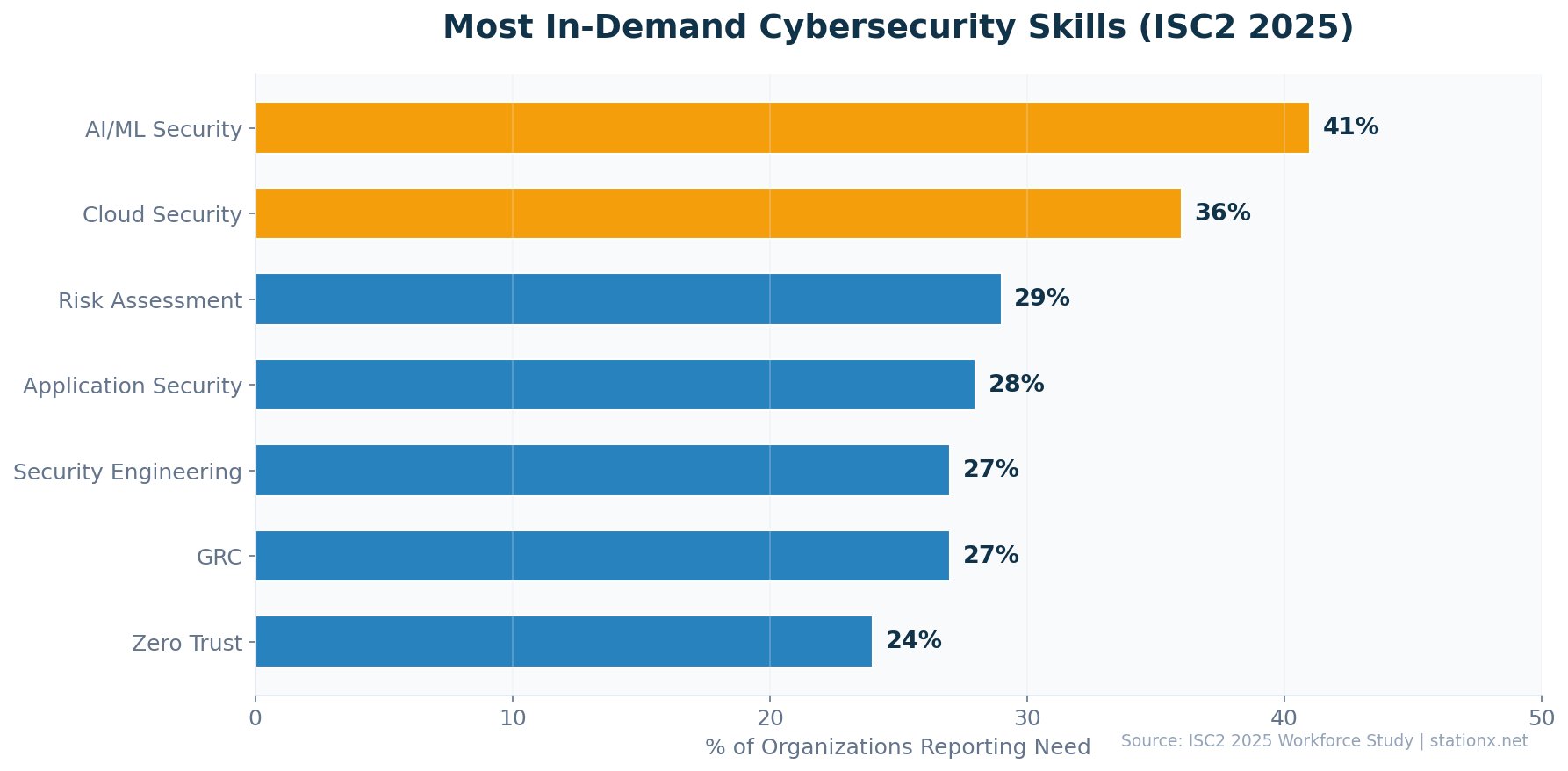
Top Skills Demand Ranking (ISC2 2025 vs 2024)
| Skill Area | 2025 | 2024 | Trend |
|---|---|---|---|
| AI/ML Security | 41% | 34% | +7pp |
| Cloud Security | 36% | 30% | +6pp |
| Risk Assessment | 29% | N/A | New in 2025 |
| Application Security | 28% | N/A | New in 2025 |
| Security Engineering | 27% | N/A | New in 2025 |
| GRC | 27% | N/A | New in 2025 |
| Zero Trust | N/A | 27% | Merged into other categories |
| DFIR | N/A | 25% | Not top 6 in 2025 |
The year-over-year shift is telling. AI/ML jumped 7 percentage points in a single year to claim the #1 position. Cloud security rose 6 points. Risk assessment, application security, and GRC appeared as newly prominent categories in 2025, reflecting the growing regulatory burden (NIS2, DORA, SEC cyber rules) and the shift-left movement in development. DFIR and zero trust dropped from the top rankings — not because demand disappeared, but because AI/ML and cloud absorbed so much more attention. The market increasingly rewards multi-disciplinary professionals who combine technical depth with business risk understanding.
| Finding | Value | Source |
|---|---|---|
| AI/ML (top skills need) | 41% | ISC2 Cybersecurity Workforce Study 2025 |
| Cloud security | 36% | ISC2 Cybersecurity Workforce Study 2025 |
| Risk assessment | 29% | ISC2 Cybersecurity Workforce Study 2025 |
| Organizations citing soft skills as primary gap | 59% | ISACA State of Cybersecurity 2025 |
| Shortfall in AI skills investment | 67% | WEF Global Cybersecurity Outlook 2025 |
| Organizations using/planning AI-enabled security | 97% | Fortinet 2025 Skills Gap Report |
| Organizations with AI security assessment processes | 37% | WEF Global Cybersecurity Outlook 2025 |
| Gap between certifications and practical skills | 52% | Kaspersky IT Security Survey 2024 |
The Soft Skills Surprise
ISACA found 59% of organizations cite soft skills as their primary gap concern. ISC2's Hiring Trends Study ranked teamwork, problem-solving, and analytical thinking above technical skills like data security and cloud security. This is counterintuitive for a technical field, but reflects a maturation: cybersecurity has moved from back-room IT function to board-level business concern. Professionals who can communicate risk to non-technical stakeholders, write clear incident reports, and think critically under pressure are more valuable than pure technicians. Training programs that focus exclusively on technical skills are missing what employers actually want. (ISACA 2025, ISC2 2025)
Skills Demand Explorer
Select a skill area to see demand level, salary premium, and recommended certifications.
The #1 skills need. Organizations are deploying AI tools (97%) but lack staff who understand AI-specific threat models, prompt injection, model poisoning, and adversarial ML.
🚫 The Entry-Level Paradox: Why Cybersecurity Jobs Are Hard to Get
What Employers Demand
- 38% require CISA for entry-level
- 34% require CISSP for entry-level
- Both certifications require 5+ years experience
What Actually Works
- 81% of entry-level hires productive in < 1 year
- 76% trained for under $5,000
- 46% of current staff came from non-security roles
If there's a massive cybersecurity workforce shortage, why can't entry-level candidates find jobs? Because the pipeline is broken by design. 38% of employers require CISA for entry-level roles — a certification that itself requires five or more years of auditing experience. 34% expect CISSP for entry-level, which similarly demands five years. ISC2's own Hiring Trends Study found that only three certifications actually align with entry/junior levels: ISC2 CC, CompTIA Security+, and CompTIA CASP+.
31% of security teams have zero entry-level professionals (ISC2 2024). UK DSIT data shows entry-level job postings for candidates with less than one year of experience dropped from 25% to 17% of all cyber postings since 2022. Enterprises training non-security staff for security roles fell from 41% to 29% (ISACA 2025). The cybersecurity job market is simultaneously claiming a shortage while shrinking the entry point.
Here's the contradiction the data exposes: when companies do hire entry-level, 81% of those hires are productive within a year (ISC2 2025). Training costs are modest: 31% under $1,000, 45% between $1,000 and $4,999. And 46% of current cybersecurity staff transitioned from non-security roles (ISACA 2025). The talent pool is available. The investment is affordable. The outcomes are proven. The barrier is employer willingness.
| Finding | Value | Source |
|---|---|---|
| Employers requiring CISA for entry-level (needs 5+ years) | 38% | ISC2 Hiring Trends Study 2025 |
| Employers expecting CISSP for entry-level (needs 5+ years) | 34% | ISC2 Hiring Trends Study 2025 |
| Security teams with zero entry-level staff | 31% | ISC2 Cybersecurity Workforce Study 2024 |
| Entry-level hires productive within 1 year | 81% | ISC2 Hiring Trends Study 2025 |
| Training cost under $5,000 | 76% | ISC2 Hiring Trends Study 2025 |
| Enterprises training non-security staff (down from 41%) | 29% | ISACA State of Cybersecurity 2025 |
| Current staff who transitioned from other roles | 46% | ISACA State of Cybersecurity 2025 |
| Projected US job growth rate (2024-2034) | 29% | BLS Occupational Outlook Handbook |
| Annual analyst openings projected | 19,500 | BLS Occupational Outlook Handbook |
The Entry-Level Catch-22
38% of employers require CISA and 34% require CISSP for entry-level roles — certifications that themselves require 5 years of experience. Meanwhile, 81% of entry-level hires are productive within a year for under $5,000 in training. The math doesn't add up: employers demand impossible credentials while entry-level candidates can't break in, yet when companies actually invest in training, it works. 31% of security teams have zero entry-level staff. (ISC2 2025 Hiring Trends Study)
🌍 Unfilled Cybersecurity Positions by Region
Asia-Pacific accounts for more than 70% of the global workforce gap (ISC2 2024). China alone has a 2.05M gap (+19% YoY) and India 1.07M (+35.9%). Both countries are digitalizing faster than their security workforces can scale. North America's gap is 522K (+19.7%), but the workforce contracted 2.7% — not from lack of talent but from budget cuts and layoffs. Europe's gap is 348K, with the EU facing a 300,000 shortage (ENISA). The workforce contracted 0.7%.
Latin America is the only region where the gap significantly shrank (-32.5%), and Middle East & Africa has the fastest workforce growth (+7.4%). The global "4.8 million" figure is overwhelmingly an APAC-driven number that doesn't reflect the realities in Western labor markets.
| Finding | Value | Source |
|---|---|---|
| Asia-Pacific gap | 3.37 million | ISC2 Cybersecurity Workforce Study 2024 |
| North America gap | 522,000 | ISC2 Cybersecurity Workforce Study 2024 |
| Europe gap | 348,000 | ISC2 Cybersecurity Workforce Study 2024 |
| Latin America gap | 348,000 | ISC2 Cybersecurity Workforce Study 2024 |
| Middle East & Africa gap | 112,000 | ISC2 Cybersecurity Workforce Study 2024 |
| China gap | 2.048 million | ISC2 Cybersecurity Workforce Study 2024 |
| India gap | 1.074 million | ISC2 Cybersecurity Workforce Study 2024 |
| United States gap | 504,000 | ISC2 Cybersecurity Workforce Study 2024 |
| United Kingdom gap (ISC2) | 93,000 | ISC2 Cybersecurity Workforce Study 2024 |
| EU estimated shortage (ENISA) | 300,000 | ENISA |
APAC Accounts for 70%+ of the Global Gap
Asia-Pacific's 3.37M gap dwarfs every other region combined. China (2.05M) and India (1.07M) account for the vast majority. North America (522K) and Europe (348K) are significantly smaller — and both regions actually contracted their workforces in 2024. The global '4.8 million' headline is overwhelmingly an APAC story, driven by rapid digitalization outpacing security workforce development. (ISC2 2024)
Country-Level Gap Breakdown
| Country | Gap | YoY Change |
|---|---|---|
| China | 2.048M | +19.0% |
| India | 1.074M | +35.9% |
| United States | 504K | +4.4% |
| Japan | 170K | +53.8% |
| Germany | 120K | +15.0% |
| United Kingdom | 93K | +27.1% |
Japan's gap surged 53.8% — the fastest growth of any major economy — driven by digital transformation in a traditionally conservative tech adoption environment. India's 35.9% growth reflects the country's booming IT services sector creating cybersecurity demand that outpaces local training capacity. The US gap grew a relatively modest 4.4%, but the 1.3M US workforce actually contracted 3.0% — meaning the gap widened because the workforce shrank, not because demand grew dramatically.
US CyberSeek Data: Where the Jobs Actually Are
| State | Openings |
|---|---|
| Virginia | 53,855 |
| California | 44,344 |
| Texas | 42,559 |
| Maryland | 27,050 |
| Florida | 23,792 |
The top 5 US states account for 37% of all cybersecurity job postings (CyberSeek 2025). Virginia and Maryland's dominance reflects the federal government and defense contractor ecosystem around Washington D.C. Only 8% of Fortune 100 cybersecurity roles offer fully remote positions — geographic barriers compound the skills gap for candidates who cannot relocate to these hubs.
Regional Gap Explorer
Select a region to see gap size, workforce trends, and key context.
China (2.05M) and India (1.07M) dominate. Rapid digitalization outpacing security workforce growth.
🇬🇧 UK-Specific Data
The UK presents a fascinating case study in methodology differences. ISC2 estimates the UK gap at 93,000. The UK government's own DSIT survey (conducted by Ipsos, published September 2025) puts it at 3,800. 143,000 individuals are employed in cybersecurity roles (up 5% YoY). 49% of UK businesses report basic technical skills gaps. Core cybersecurity job postings fell 33%. Women represent just 17% of the UK cybersecurity workforce (12% in senior positions, versus 48% in the wider UK workforce).
| Finding | Value | Source |
|---|---|---|
| UK cybersecurity workforce size | 143,000 | UK DSIT Cyber Security Skills 2025 |
| UK workforce gap (DSIT methodology) | 3,800 | UK DSIT Cyber Security Skills 2025 |
| UK businesses with basic skills gaps | 49% | UK DSIT Cyber Security Skills 2025 |
| Women in UK cyber workforce | 17% | UK DSIT Cyber Security Skills 2025 |
| UK job postings decline | 33% | UK DSIT Cyber Security Skills 2025 |
| UK gap (ISC2 estimate — very different from DSIT) | 93,000 | ISC2 Cybersecurity Workforce Study 2024 |
Same Country, 24x Different Gap
ISC2 estimates the UK gap at 93,000. The UK government's own DSIT survey puts it at 3,800. That's a 24x difference for the same country. The DSIT figure comes from direct employer surveys using a standardised methodology. The ISC2 figure is extrapolated from a global model using US data as a baseline. Which one you cite shapes the entire narrative. (ISC2 2024, UK DSIT 2025)
Indeed Job Postings by Country: Software Development
Indeed Hiring Lab tracks job postings across 10 countries with sector-level data available for six. The Software Development sector — which includes many cybersecurity engineering roles — shows deep contractions in every Western market except Australia. Germany and France are hit hardest, with postings at roughly half of pre-pandemic levels.
Index: Feb 2020 = 100. Values below 100 indicate fewer job postings than pre-pandemic. Source: Indeed Hiring Lab (CC-BY-4.0).
Indeed Job Postings by Country: Security & Public Safety
The Security & Public Safety sector (which covers physical security more than cybersecurity) paints a different picture. Australia, Germany, France, and the US all remain above pre-pandemic levels. The UK is the notable outlier — security postings are 22% below baseline, suggesting the UK's security hiring contraction is broader than just tech roles.
Index: Feb 2020 = 100. Values above 100 indicate more postings than pre-pandemic. Source: Indeed Hiring Lab (CC-BY-4.0).
Aggregate Job Postings: Full 10-Country View
For countries without sector-level data, aggregate job postings provide a market-level signal. Italy, Spain, and Ireland show total job postings well above pre-pandemic levels, while the Netherlands has recovered to roughly baseline. This contrasts sharply with the software development contraction visible in the US, UK, Germany, and France.
Aggregate total postings (seasonally adjusted). Index: Feb 2020 = 100. GB data last updated Aug 2024. Source: Indeed Hiring Lab (CC-BY-4.0).
Country Comparison: Who's Worst Hit?
The Indeed data reveals two distinct patterns. Software development hiring has collapsed globally — Germany (56.8) and France (55.0) are worst hit at nearly half of pre-pandemic levels, followed by the UK (63.3) and US (70.9). Only Australia (119.6) remains above baseline for software roles. Security hiring is more resilient but uneven: Australia (182.8) and Germany (130.5) are well above pre-pandemic, while the UK (78.2) is the only country where security postings are significantly below baseline. The divergence between software development contraction and security sector resilience suggests that organizations are cutting general IT hiring while maintaining (or growing) physical security and compliance roles. (Indeed Hiring Lab, CC-BY-4.0)
💰 Skills Gap Cost to Organizations
Let me be blunt: the financial cost of understaffing is measurable. IBM's 2024 data shows organizations with high staffing shortages pay $5.74 million per breach. Those with low or no shortages: $3.98 million. That's a $1.76 million premium — a 44% cost increase directly attributable to understaffing. If you're building a business case for cybersecurity headcount, this is the number that resonates with CFOs.
Fortinet's 2025 data reinforces this. 86% of organizations experienced at least one breach, up from 80% in 2021. 28% reported five or more breaches. 54% cite lack of skills as a leading breach cause. 52% say incidents cost over $1 million. Organizations with critical skills gaps are nearly twice as likely to experience material breaches: 22% versus 17% (ISC2 2024).
| Finding | Value | Source |
|---|---|---|
| Breach cost with high staffing shortages | $5.74 million | IBM Cost of a Data Breach 2024 |
| Breach cost with low/no shortages | $3.98 million | IBM Cost of a Data Breach 2024 |
| Cost premium from skills shortages | $1.76 million | IBM Cost of a Data Breach 2024 |
| Organizations breached (Fortinet) | 86% | Fortinet 2025 Cybersecurity Skills Gap Report |
| Incidents costing over $1M | 52% | Fortinet 2025 Skills Gap Report |
| Citing lack of skills as breach cause | 54% | Fortinet 2025 Skills Gap Report |
| Five or more breaches (up from 19% in 2021) | 28% | Fortinet 2025 Skills Gap Report |
| Material breaches with critical skills gaps | 22% | ISC2 Cybersecurity Workforce Study 2024 |
| Material breaches without skills gaps | 17% | ISC2 Cybersecurity Workforce Study 2024 |
The $1.76M Cost of Understaffing
Organizations with high staffing shortages pay $5.74M per breach versus $3.98M for those without shortages — a $1.76M penalty. That's a 44% cost increase directly attributable to not having enough skilled staff. If you're a CISO trying to justify headcount, this is your number. (IBM Cost of a Data Breach 2024)
💸 Budget vs Talent: The Real Barrier to Cybersecurity Hiring
For the first time in ISC2's tracking history, "lack of budget" replaced "lack of qualified talent" as the number one cause of staffing shortages. This is a seismic shift in the narrative. 37% of organizations faced budget cuts (up 7% from 2023). 38% were under hiring freezes. 25% reported cybersecurity layoffs (up 3% from 2023). Enterprise organizations (10,000+ staff) were hit harder: 32% reported layoffs versus 17% at smaller organizations.
The data is clear: the workforce gap widened 19% while organizations were cutting positions. How? The gap measures perceived need, not funded positions. When ISC2 asks "how many cybersecurity professionals do you need?" the answer is aspirational. When CFOs ask "what can we afford?" the answer is layoffs and hiring freezes. Certification funding dropped from 89% (2023) to 73% (2025, Fortinet). The organizations that say they want cybersecurity talent are investing less in developing it.
Retention compounds the problem. 50% of organizations struggle to keep cyber talent (ISACA 2025). Top reasons people leave: poaching (50%), poor pay (50%), limited advancement (46%), high stress (46%). 66% report increased role stress versus five years ago. This isn't just a hiring problem. It's retention, funding, and organisational commitment.
| Finding | Value | Source |
|---|---|---|
| Budget is now the #1 barrier to staffing | #1 barrier | ISC2 Cybersecurity Workforce Study 2024 |
| Organizations that faced budget cuts | 37% | ISC2 Cybersecurity Workforce Study 2024 |
| Organizations that reported layoffs | 25% | ISC2 Cybersecurity Workforce Study 2024 |
| Under hiring freezes | 38% | ISC2 Cybersecurity Workforce Study 2024 |
| Enterprise orgs (10,000+ staff) with layoffs | 32% | ISC2 Cybersecurity Workforce Study 2025 |
| Organizations funding certifications (down from 89%) | 73% | Fortinet 2025 Skills Gap Report |
| Reporting increased role stress vs 5 years ago | 66% | ISACA State of Cybersecurity 2025 |
| High stress as top attrition reason | 47% | ISACA State of Cybersecurity 2025 |
| Organizations struggling to retain talent | 50% | ISACA State of Cybersecurity 2025 |
Top Reasons Cybersecurity Workers Leave
| Reason | % | Source |
|---|---|---|
| Recruited by competitors | 50% | ISACA 2025 |
| Poor financial incentives | 50% | ISACA 2025 |
| Limited advancement opportunities | 46% | ISACA 2025 |
| High work-related stress | 46% | ISACA 2025 |
Many cybersecurity vacancies are self-inflicted. Organizations cut budgets, freeze hiring, reduce training investment, and then cite a "skills shortage" when experienced staff leave for competitors offering better pay. ISACA found that 50% of departures are to competing employers and 50% cite poor financial incentives. These are retention failures dressed up as supply problems. The $1.76M extra per breach from understaffing should make the ROI case for competitive compensation straightforward — yet budget remains the #1 barrier.
Budget Overtook Talent as #1 Barrier — First Time Ever
For the first time in ISC2's tracking history, 'lack of budget' replaced 'lack of qualified talent' as the top cause of staffing shortages. 37% faced budget cuts (up 7% YoY) and 38% were under hiring freezes. This is not a talent supply problem — it's a funding problem. Training programs are oversubscribed. Entry-level candidates are available. Companies just won't pay. (ISC2 2024)
📜 Certifications and the Cybersecurity Skills Gap
89% of IT decision-makers prefer candidates with certifications (Fortinet 2025). Yet 52% of employers cite a gap between what certifications validate and the practical skills they actually need (Kaspersky 2024). Certification funding declined from 89% to 73% of organizations — a budget squeeze that undermines the very credential system employers say they value.
CyberSeek data reveals a severe supply-demand mismatch in specific certifications. CISM has 44,347 job postings but only 20,300 holders (2.2x gap). CISA has 52,337 postings against 35,812 holders (1.5x gap). Meanwhile, CompTIA Security+ has 265,992 holders against 70,019 postings (3.8x oversupply). The shortage isn't in certified people generally — it's in specific mid-to-senior certifications that require years of experience. Forrester notes that "certification-first training models" have limits, and skills-based assessments are rising as an alternative evaluation method.
| Finding | Value | Source |
|---|---|---|
| Hiring managers preferring certified candidates | 89% | Fortinet 2025 Cybersecurity Skills Gap Report |
| Organizations funding employee certs (down from 89%) | 73% | Fortinet 2025 Skills Gap Report |
| Employers citing cert-to-skills gap | 52% | Kaspersky IT Security Survey 2024 |
| Job postings requesting CISSP | 82,494 | CyberSeek |
| Job postings requesting CISA (vs 35,812 holders) | 52,337 | CyberSeek |
| Job postings requesting CISM (vs 20,300 holders) | 44,347 | CyberSeek |
| Job postings requesting Security+ | 70,019 | CyberSeek |
| Requiring CISA for entry-level | 38% | ISC2 Hiring Trends Study 2025 |
| Requiring CISSP for entry-level | 34% | ISC2 Hiring Trends Study 2025 |
Certification Supply vs Demand
| Certification | Job Postings | Holders | Ratio |
|---|---|---|---|
| CISSP | 82,494 | 91,765 | 0.9x (balanced) |
| Security+ | 70,019 | 265,992 | 0.3x (oversupply) |
| CISA | 52,337 | 35,812 | 1.5x (shortage) |
| CISM | 44,347 | 20,300 | 2.2x (severe shortage) |
| GIAC | 41,070 | 46,318 | 0.9x (balanced) |
The certification supply-demand data (CyberSeek 2025) reveals the real story: CISM and CISA — governance and audit certifications that require years of management experience — have genuine shortages. CISSP and GIAC are roughly balanced. And Security+ has a massive oversupply (3.8x more holders than postings), which explains why entry-level candidates with Security+ still struggle to find roles despite holding the most-recommended entry credential. The shortage is at the experience tier, not the entry tier.
CISM: 44,347 Job Postings, Only 20,300 Holders
CyberSeek data reveals a severe certification supply-demand mismatch. CISM has 2.2x more job postings than certified holders. CISA has 1.5x more postings than holders. Meanwhile, CompTIA Security+ has 265,992 holders against 70,019 postings — a 3.8x oversupply. The shortage isn't in certified people generally; it's in specific mid-to-senior certifications that take years to earn. (CyberSeek 2025)
🤖 AI and the Cybersecurity Skills Gap
AI is simultaneously creating and collapsing the cybersecurity skills gap. On the demand side, AI/ML is the #1 skills need at 41% (ISC2 2025). 97% of organizations are using or planning AI-enabled security solutions (Fortinet 2025). 67% note a shortfall in AI skills investment (WEF 2025). 48% identify "lack of staff with sufficient AI expertise" as the biggest AI implementation challenge (Fortinet 2025).
On the supply side, AI is a potential equalizer. 63% of cybersecurity professionals report "significant productivity boost" from AI tools (ISC2 2025). Gartner predicts that by 2028, GenAI adoption will collapse the skills gap, removing the need for specialized education from 50% of entry-level cybersecurity positions. 73% of professionals believe AI will create specialized cybersecurity roles (ISC2 2025), while 91% of WEF focus group participants agree AI will generate novel roles.
The net effect: the gap is shifting from "more bodies" to "different skills." Entry-level roles that primarily involve monitoring and triage are most vulnerable to AI displacement. Mid-to-senior roles requiring judgment, context, and adversarial thinking are likely to see increased demand. The organizations investing in AI now may find their cybersecurity jobs statistics look very different in two years.
| Finding | Value | Source |
|---|---|---|
| AI/ML as #1 skills need | 41% | ISC2 Cybersecurity Workforce Study 2025 |
| Reporting significant AI productivity boost | 63% | ISC2 Cybersecurity Workforce Study 2025 |
| Believing AI will create specialized roles | 73% | ISC2 Cybersecurity Workforce Study 2025 |
| Using or planning AI-enabled security | 97% | Fortinet 2025 Skills Gap Report |
| Noting shortfall in AI skills investment | 67% | WEF Global Cybersecurity Outlook 2025 |
| Entry-level not needing specialized education by 2028 | 50% | Gartner |
| Organizations with AI security assessment processes | 37% | WEF Global Cybersecurity Outlook 2025 |
AI Is Reshaping the Gap, Not Closing It
AI/ML went from 34% to 41% as the top skills need in one year. 63% report productivity boosts from AI tools, yet 67% note AI skills investment shortfalls. The data suggests AI is shifting demand from quantity (more analysts) to quality (AI-literate professionals). Gartner projects 50% of entry-level roles won't need specialized education by 2028 — but AI expertise is becoming the new specialized education. (ISC2 2025, Gartner, WEF 2025)
👥 Diversity and the Cybersecurity Workforce
Women represent 22% of the global cybersecurity workforce (ISC2 2024). In the UK, it's 17% — with only 12% in senior positions, compared to 48% in the wider UK workforce (DSIT 2025). An industry claiming a massive talent shortage while drawing from only half the population is leaving its biggest talent pool untapped.
Age demographics are shifting. The 39-49 age group nearly doubled from 18% to 35% of new entrants between 2022 and 2024 (ISC2), reflecting mid-career changers entering cybersecurity. 46% of current cybersecurity staff transitioned from non-security roles (ISACA 2025). The talent pipeline isn't empty — it's being underutilized. Training programs are oversubscribed, and diversity improves cyber resilience by reducing shared blind spots in homogeneous teams.
| Finding | Value | Source |
|---|---|---|
| Women in the global cybersecurity workforce | 22% | ISC2 Cybersecurity Workforce Study 2024 |
| Women in UK cybersecurity workforce | 17% | UK DSIT Cyber Security Skills 2025 |
| Staff who transitioned from non-security roles | 46% | ISACA State of Cybersecurity 2025 |
Homogeneous teams share blind spots. A security team composed entirely of people with similar backgrounds, education paths, and cognitive frameworks will consistently miss threat vectors that fall outside their shared assumptions. Diversity in cybersecurity isn't just an equity issue — it's a security effectiveness issue. The Code First Girls initiative and similar programs have demonstrated that the talent supply exists: cybersecurity training programs are oversubscribed. The bottleneck is on the employer side, not job seekers.
The industry is slowly recognizing non-traditional pathways. 46% of current cybersecurity professionals came from non-security roles (ISACA 2025), proving that career changers succeed in cybersecurity. Managed security services are growing at 11.1% in 2026 (Gartner), partly because organizations outsource to service providers who have already built diverse, experienced teams rather than building their own from scratch.
An Untapped Talent Pool in Plain Sight
An industry claiming a 4.8M shortage while employing only 22% women is not facing a supply crisis — it's facing a pipeline problem. If cybersecurity reached even 30% women (still well below workforce parity), that would add hundreds of thousands of professionals globally. Mid-career changers (39-49 age group nearly doubled to 35% of new entrants) prove the pipeline exists outside traditional pathways. (ISC2 2024, DSIT 2025, ISACA 2025)
🎯 What Organizations Are Doing About the Cybersecurity Talent Shortage
Despite the narrative, organizational responses are mixed. On the positive side, 76% of boards increased cybersecurity focus in 2024 (Fortinet). 96% view cybersecurity as a business priority and 95% as a financial priority. 97% are deploying or planning AI-enabled security solutions. BLS projects 29% job growth for information security analysts through 2034 — the fifth-fastest of all occupations. Some organizations are relaxing requirements: 84% now use skills-based assessments for junior roles rather than relying solely on credentials (ISC2 2025).
On the negative side, internal training pathways are declining. Organizations training non-security staff for security roles dropped from 41% to 29% (ISACA 2025). Certification funding fell from 89% to 73% (Fortinet 2025). Budget cuts affected 37% of organizations, and hiring freezes hit 38%. The organizations that are investing in workforce development are seeing results — 81% of entry-level hires reach independence within a year — but fewer organizations are making that investment. The cybersecurity job market rewards those willing to invest in talent, but many still prioritize impossible credentials over trainable potential.
Positive Trends
- 76% of boards increased cyber focus
- 84% using skills-based assessments for junior roles
- 97% deploying AI-enabled security solutions
- 29% BLS projected job growth through 2034
Negative Trends
- Training pathways: 41% down to 29%
- Cert funding: 89% down to 73%
- 37% budget cuts, 38% hiring freezes
- 31% of teams have zero entry-level staff
| Finding | Value | Source |
|---|---|---|
| Preferring certified candidates | 89% | Fortinet 2025 Cybersecurity Skills Gap Report |
| Training non-security staff for security roles | 29% | ISACA State of Cybersecurity 2025 |
| Entry-level hires productive within 1 year | 81% | ISC2 Hiring Trends Study 2025 |
| Training cost under $5,000 | 76% | ISC2 Hiring Trends Study 2025 |
| Boards increasing cybersecurity focus | 76% | Fortinet 2025 Skills Gap Report |
| Organizations deploying AI security tools | 97% | Fortinet 2025 Skills Gap Report |
The most effective organizations are taking a multi-pronged approach: investing in internal training programs, accepting career changers with transferable skills, using AI tools to amplify existing team capacity, and offering competitive compensation to retain experienced staff. The data consistently shows that these investments pay for themselves: $1.76M less per breach with adequate staffing, 81% of entry-level hires productive within a year, and AI tools delivering 63% productivity gains. The barrier isn't a lack of proven solutions — it's organizational willingness to invest in them.
For individual career changers and job seekers navigating the cybersecurity job market, the data points to a clear strategy: focus on in-demand skill areas (AI/ML, cloud, GRC), obtain recognized entry-level certifications (CompTIA Security+, ISC2 CC), build practical experience through labs and CTFs, develop communication and critical-thinking skills (59% of employers cite these as primary gaps), and target organizations known for investing in workforce development. The cybersecurity skills gap is real — but so is the opportunity for those who approach it with the right strategy.
Career Readiness Self-Assessment
Answer 8 questions to see where you stand relative to current market demand. This is not a pass/fail — it highlights which skill areas to prioritize.
1. Do you have hands-on experience with cloud security (AWS, Azure, or GCP)?
2. Can you explain how AI/ML is used in both offensive and defensive cybersecurity?
3. Do you hold any cybersecurity certifications?
4. Have you worked with zero trust architecture or identity-first security?
5. Can you conduct a risk assessment or write a security policy?
6. Do you have experience with incident response or digital forensics?
7. How would you rate your communication and report-writing skills?
8. Do you have networking fundamentals (TCP/IP, DNS, firewalls)?
📋 Key Takeaways
1. The gap is real but misunderstood
It's not 4.8M open jobs. CyberSeek counts 514K actual US postings. ISC2 dropped the number in 2025. The real gap is in specific experienced skills (AI/ML, cloud, zero trust), not in general cybersecurity headcount.
2. Budget is the primary barrier, not talent
For the first time, budget overtook talent availability as the #1 cause of staffing shortages. 25% had layoffs while the gap widened. This is a funding crisis masquerading as a talent crisis.
3. The entry-level pipeline is broken by employer design
Demanding CISSP/CISA for entry-level, shrinking internal training programs, and having zero entry-level staff on 31% of teams is a choice, not a market failure. When companies invest in entry-level, 81% succeed within a year.
4. AI will reshape the gap, not close it
AI/ML is the #1 skills need at 41%. 50% of entry-level roles may not need specialized education by 2028 (Gartner). But AI expertise itself becomes the new required skill. The gap shifts from quantity to quality.
5. The cost of inaction is quantifiable
$1.76M extra per breach for understaffed organizations. 86% breached. 52% lost over $1M per incident. The business case for investment in people — training, hiring, and retention — is provable with data.
6. Different numbers, different stories
UK gap: 3,800 (DSIT) vs 93,000 (ISC2). Global gap: 4.8M (ISC2 2024) vs discontinued (ISC2 2025). The number you cite shapes the narrative. Always check methodology.
❓ Cybersecurity Skills Gap FAQ
Is the cybersecurity skills gap real?
Yes, but it's more nuanced than "4.8 million unfilled positions." The headline ISC2 number measures perceived organizational need, not actual job openings. CyberSeek counts 514K real US postings. ISC2 dropped the gap metric in 2025 after methodology criticism. The gap is real in specific skills (AI/ML, cloud, zero trust) and at experienced levels. At entry-level, the problem is more about hiring practices and budget constraints than a shortage of candidates.
How many unfilled cybersecurity jobs are there?
ISC2 estimated 4.8 million in 2024, but this represents organizational aspiration, not active postings. CyberSeek tracked 514,359 actual US job listings in a 12-month period. The supply-demand ratio is 74 workers per 100 openings in the US. ISC2 discontinued reporting the gap number in 2025.
Is cybersecurity in demand in 2026?
Yes. BLS projects 29% job growth through 2034 (fifth-fastest overall). US job postings increased 12% YoY (CyberSeek). The median US salary is $124,910. However, demand concentrates in experienced/specialized roles (AI, cloud, GRC). Entry-level is more competitive, with declining postings and unrealistic credential requirements.
What cybersecurity skills are most in demand?
AI/ML security (41%), cloud security (36%), risk assessment (29%), application security (28%), security engineering (27%), and GRC (27%) — per ISC2 2025. Soft skills matter too: 59% of organizations cite soft skills (critical thinking, communication) as their primary gap concern (ISACA 2025).
How do I break into cybersecurity with no experience?
46% of current cybersecurity professionals transitioned from non-security roles (ISACA). Start with CompTIA Security+ (265,992 holders, well-recognized). Build hands-on skills through labs and CTFs. Target organizations willing to train — 81% of entry-level hires are productive within a year when given the chance. Focus on cloud security or GRC as entry points.
Why are there cybersecurity layoffs during a skills shortage?
Budget is now the #1 barrier, overtaking talent availability (ISC2 2024). 37% of organizations cut cybersecurity budgets. 38% froze hiring. 25% had layoffs. Companies recognize the need for cybersecurity but economic pressure constrains funding. The gap measures what organizations say they need, not what they're willing to fund.
About This Data
This article draws from 1518 statistics aggregated from 50+ authoritative sources including IBM Cost of a Data Breach, Verizon DBIR, CrowdStrike Global Threat Report, WEF Global Cybersecurity Outlook, FBI IC3, ISC2 Cybersecurity Workforce Study, Sophos, Gartner, Mandiant M-Trends, and Ponemon Institute reports.
Derived statistics (marked "Nathan House's Analysis") are computed by cross-referencing data from multiple sources — for example, comparing breach costs across industries using IBM data, or validating ransomware trends across Verizon, Sophos, and HIPAA Journal findings.
All statistics include inline source citations with links to primary sources. Data spans 2023-2026, with preference given to the most recent available figures. Last updated: September 2026.
A Note on Methodology
This article deliberately presents multiple perspectives on the cybersecurity skills gap. The ISC2 workforce gap, CyberSeek job posting data, ISACA staffing surveys, UK DSIT research, and Fortinet breach correlations all use different methodologies and measure different things. We've made these differences explicit rather than treating all numbers as equivalent. Where sources contradict each other — such as the UK gap (3,800 vs 93,000) — we present both with methodology context.
This page is updated as new reports are published. Primary sources include ISC2, ISACA, Fortinet, WEF, CompTIA, UK DSIT, ENISA, IBM, BLS, CyberSeek, and Gartner. If you spot an outdated statistic or want to suggest a source, contact us.
About the Author

Nathan House, Founder & CEO of StationX
Nathan House has 30 years of hands-on cybersecurity experience and is Cambridge-educated, holding CISSP, CISA, CISM, OSCP, CEH, and SABSA. He founded StationX in 1999 — one of the UK’s first cybersecurity companies — and has secured £71 billion in UK mobile banking transactions and the London 2012 Olympics, advising clients including Microsoft, Cisco, BP, Vodafone, and VISA. He authored the world’s most popular cybersecurity course — a #1 Udemy bestseller taken by over 500,000 students — and was named Cyber Security Educator of the Year 2020, AI Security Educator of the Year, and a UK Top 25 Security Influencer 2025. A DEF CON speaker and featured expert on CNN, Fox News, NBC, and the BBC, Nathan leads StationX’s training of more than half a million students worldwide.