Cybersecurity Job Market Statistics and Trends [2026]

4.8 million cybersecurity positions sit unfilled worldwide — a 19% increase from the year before (ISC2 2024). The active workforce is 5.5 million strong, and the US Bureau of Labor Statistics projects 29% growth for information security analysts from 2024 to 2034, making cybersecurity one of the fastest-growing fields in the economy. Yet job postings have cooled from their pandemic peak, budgets are tightening, and employers still refuse to hire entry-level candidates.
You'll find 185+ cybersecurity job market statistics across 16 sections below — from salary data and hiring trends to the supply-demand gap, certification premiums, and country-level breakdowns — sourced from ISC2, BLS, CyberSeek, ISACA, Indeed Hiring Lab, Glassdoor, and more. Each section includes original cross-referenced analysis to surface insights no single report provides.
Cybersecurity Job Market: Key Takeaways
- 5.5 million — active cybersecurity workforce globally (ISC2 2024)
- 4.8 million — unfilled cybersecurity positions, up 19% YoY (ISC2 2024)
- 29% job growth projected 2024-2034, 7x faster than all occupations (BLS)
- $120,360 — US median salary for information security analysts (BLS 2024)
- 470,000+ cybersecurity job openings in the US alone (CyberSeek 2025)
- Security job postings are above pre-pandemic levels but 36% below their 2022 peak (Indeed)
- A significant percentage of organisations made zero entry-level cybersecurity hires (ISC2 2024)
- CISSP holders earn a salary premium over non-certified peers (EC-Council/ISC2 2025)
Last updated: September 2026
📊 Cybersecurity Job Market: Key Numbers
5.5 million cybersecurity professionals are actively employed worldwide — a record high (ISC2 2024). The total workforce needed is 10.2 million, leaving a gap of 4.8 million unfilled positions. That gap grew 19% year-over-year despite the workforce itself growing. The US Bureau of Labor Statistics projects 29% employment growth for information security analysts from 2024 to 2034, with approximately 17,300 new openings annually (BLS 2024).
CyberSeek tracks over 470,000 cybersecurity job openings in the United States alone, with the supply-demand ratio confirming chronic undersupply (CyberSeek 2025). ISACA reports that teams remain understaffed across industries, and unfilled positions continue to grow (ISACA 2025). The US median salary for information security analysts stands at $120,360 (BLS 2024), making cybersecurity one of the highest-paying technology fields.
The cybersecurity workforce gap is not a single number — it is a system under strain. The 4.8 million shortfall means that for every working cybersecurity professional, there is nearly one empty chair. ISC2 notes this is a perceived staffing need based on organisational surveys, not a direct count of job postings, but it captures the scale of the problem: security teams are understaffed, overworked, and stretched across threat surfaces that grow faster than headcount.
Budget, not talent, has overtaken all other barriers. ISC2 now ranks budget constraints as the #1 cause of staffing shortages, displacing "lack of qualified talent" for the first time (ISC2 2024). This shift matters: it means the gap is increasingly a leadership and investment problem, not a skills supply problem. ISACA data corroborates this, showing teams remain understaffed even when qualified candidates exist in the market.
| Finding | Value | Source |
|---|---|---|
| Global active cybersecurity workforce | 5.5 million | ISC2 Cybersecurity Workforce Study 2024 |
| Global cybersecurity workforce gap | 4.02 million | ISC2 Cybersecurity Workforce Study 2024 |
| Unfilled cybersecurity positions | 4.8 million | ISC2 Cybersecurity Workforce Study 2025 |
| Total workforce needed globally | 10.2 million | ISC2 |
| US cybersecurity job growth rate | 33% | BLS Occupational Outlook Handbook |
| BLS projected growth 2024-2034 | 29% | BLS Occupational Outlook Handbook |
| US BLS median infosec analyst salary | $124,910 | BLS Occupational Outlook Handbook |
| BLS median information security analyst salary | $120,360 | BLS Occupational Outlook Handbook |
| BLS projected annual openings | 19,500 | BLS Occupational Outlook Handbook |
| Annual new infosec analyst openings | 17,300 | BLS Occupational Outlook Handbook |
| US cybersecurity job openings (CyberSeek) | 514,359 | CyberSeek / NIST |
| US cyber supply-demand ratio | 74 | CyberSeek / NIST |
| Orgs with understaffed security teams | 55% | ISACA State of Cybersecurity 2025 |
| ISACA unfilled positions estimate | 65% | ISACA State of Cybersecurity 2025 |
Nearly Half the Workforce Is Missing
The 4.8 million worker gap represents 47.1% of the 10.2 million total workforce needed. For every cybersecurity professional working today, there's almost one unfilled seat beside them. The gap grew 19% year-over-year despite the active workforce reaching 5.5 million (ISC2 2024).

📈 How Fast Is the Cybersecurity Job Market Growing?
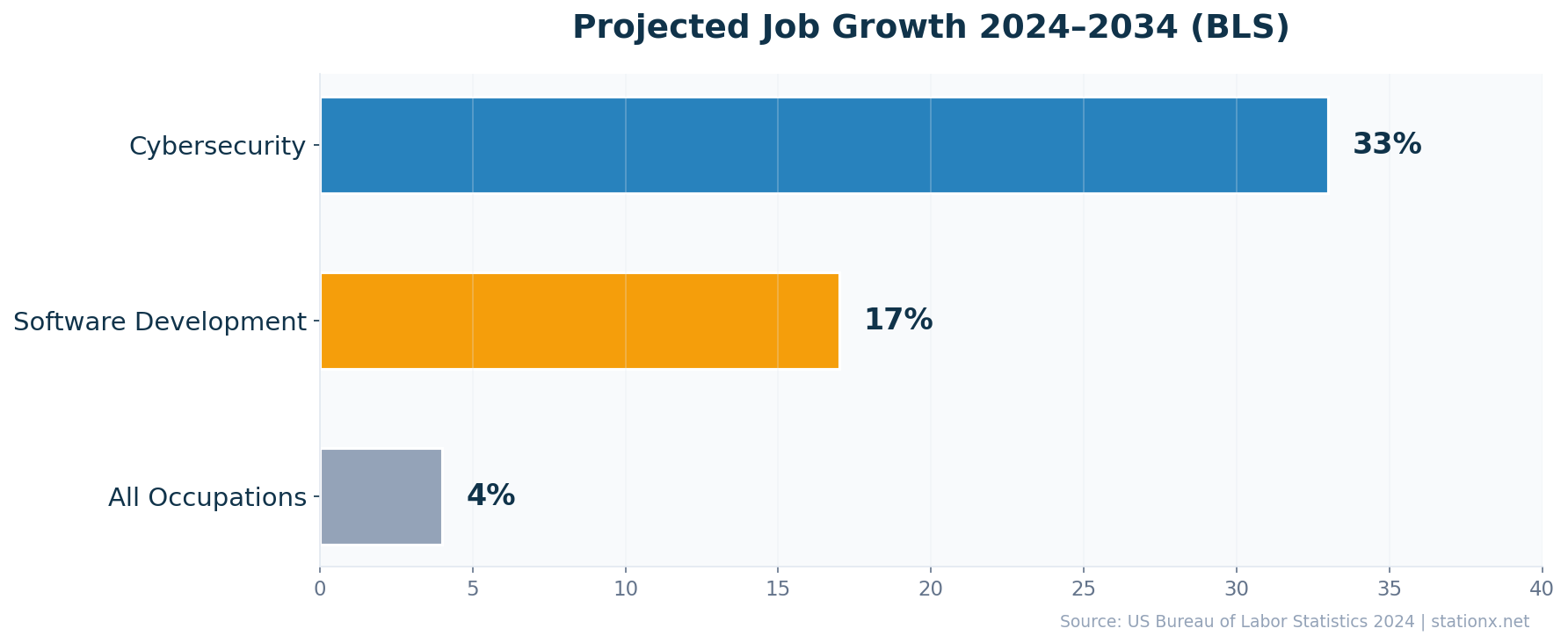
29%. That is the US Bureau of Labor Statistics' projected employment growth for information security analysts from 2024 to 2034 — described as "much faster than the average for all occupations," which sits at around 4% (BLS 2024). In absolute terms, BLS projects approximately 17,300 new openings per year for information security analysts alone, driven by both growth and replacement needs.
Globally, ISC2 reports the cybersecurity workforce grew to 5.5 million in 2024, but the growth rate slowed to its lowest level on record (ISC2 2024). This paradox — record-high absolute numbers coupled with slowing growth — reflects tightening budgets and hiring freezes across the technology sector. CyberSeek data shows US openings increasing year-over-year, confirming sustained demand even as hiring velocity moderates.
| Finding | Value | Source |
|---|---|---|
| BLS projected job growth 2024-2034 | 29% | BLS Occupational Outlook Handbook |
| Current cybersecurity job growth rate | 33% | BLS Occupational Outlook Handbook |
| BLS projected annual openings | 19,500 | BLS Occupational Outlook Handbook |
| Annual new infosec analyst openings | 17,300 | BLS Occupational Outlook Handbook |
| Global workforce growth rate (2024) | 0.1% | ISC2 Cybersecurity Workforce Study 2024 |
| Current active workforce size | 5.5 million | ISC2 Cybersecurity Workforce Study 2024 |
| US openings increase (CyberSeek) | 12% | CyberSeek / NIST |
Growth Rate Paradox
The workforce hit a record 5.5 million, yet ISC2 recorded the slowest growth rate ever. Budget constraints (now the #1 barrier to hiring, overtaking talent availability) are suppressing workforce expansion even as threat volumes accelerate. The demand is there — the funding is not (ISC2 2024).
To put the 29% BLS growth rate in perspective: software developers are projected at 17% growth over the same period, and the overall economy at approximately 4%. Cybersecurity outpaces nearly every technology discipline in projected demand. The gap between cybersecurity growth and available talent is widening, not narrowing.
The growth trajectory is driven by several converging forces: escalating threat volumes (organisations face attacks on a continuous basis), expanding regulatory requirements (NIS2, DORA, SEC disclosure rules), cloud migration creating new attack surfaces, and AI introducing both new threats and new defensive capabilities that require specialised talent. Each of these drivers independently sustains cybersecurity hiring; together, they make the 33% projection achievable but still insufficient to close the gap.
🔍 Cybersecurity Job Openings: The Supply-Demand Gap
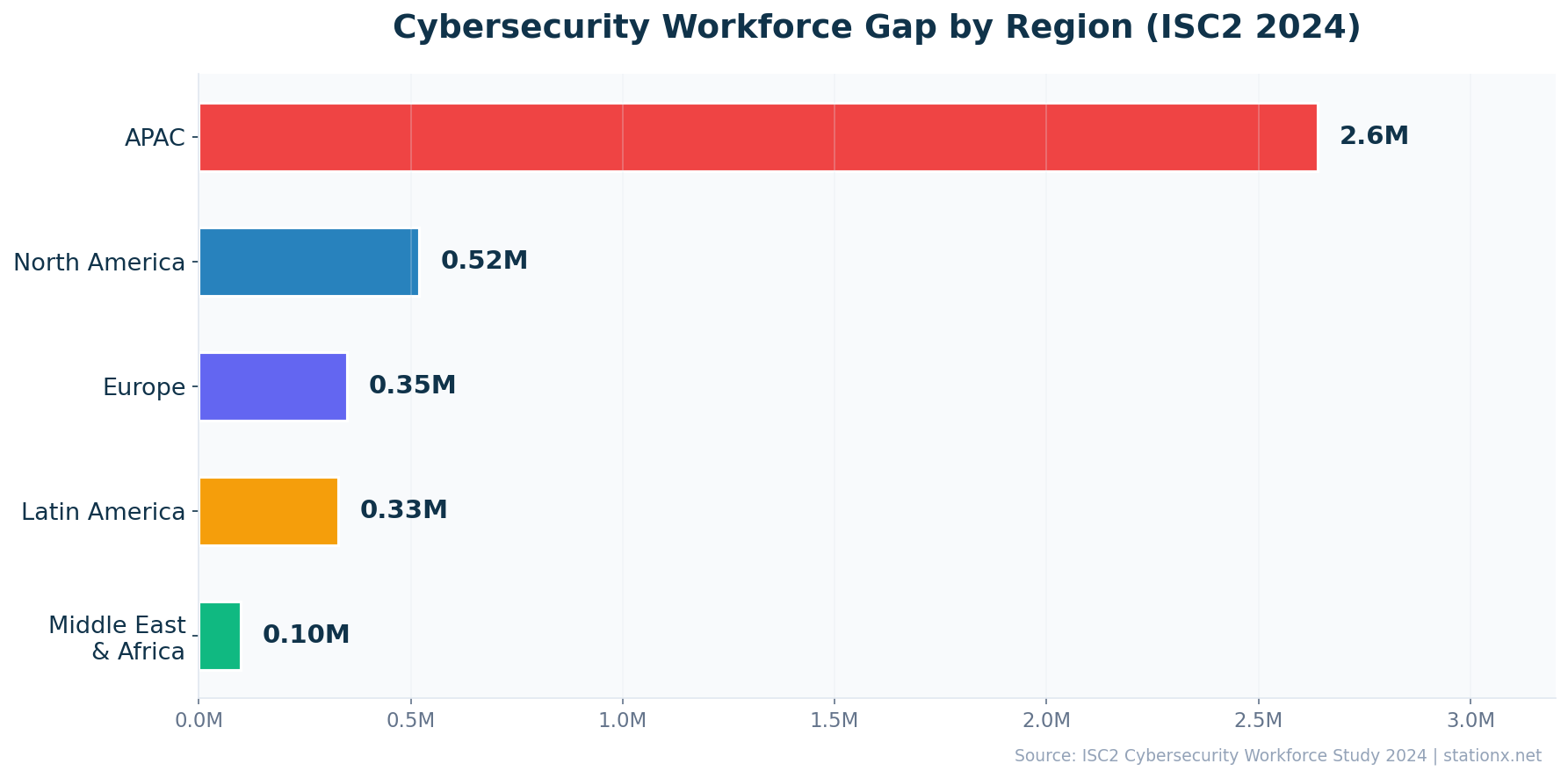
4.8 million. That is the global cybersecurity workforce gap reported by ISC2 in 2024, a 19% jump from the prior year. The total workforce demand stands at 10.2 million, meaning the industry needs nearly twice its current headcount (ISC2 2024). The gap is a perceived staffing need, not a direct count of job postings — but it reflects the scale of the challenge organisations face in building adequate security teams.
The gap varies dramatically by region. APAC holds the largest shortfall, followed by North America, Europe, Latin America, and the Middle East & Africa. In the US alone, CyberSeek tracks over 470,000 open cybersecurity positions, and the supply-demand ratio confirms there are not enough qualified professionals to fill available roles (CyberSeek 2025). ISACA corroborates the picture: teams remain understaffed and unfilled positions persist across industries (ISACA 2025).
| Finding | Value | Source |
|---|---|---|
| Global cybersecurity workforce gap | 4.02 million | ISC2 Cybersecurity Workforce Study 2024 |
| ISC2 gap (perceived need, not job openings) | 4,763,963 | ISC2 Cybersecurity Workforce Study 2024 |
| Total global workforce demand | 10.2 million | ISC2 Cybersecurity Workforce Study 2024 |
| Unfilled positions (2025) | 4.8 million | ISC2 Cybersecurity Workforce Study 2025 |
| APAC workforce gap | 3.37 million | ISC2 Cybersecurity Workforce Study 2024 |
| North America workforce gap | 522,000 | ISC2 Cybersecurity Workforce Study 2024 |
| Europe workforce gap | 348,000 | ISC2 Cybersecurity Workforce Study 2024 |
| Latin America workforce gap | 348,000 | ISC2 Cybersecurity Workforce Study 2024 |
| Middle East & Africa workforce gap | 112,000 | ISC2 Cybersecurity Workforce Study 2024 |
| US cybersecurity job openings | 514,359 | CyberSeek / NIST |
| US supply-demand ratio | 74 | CyberSeek / NIST |
| Teams reporting understaffing | 55% | ISACA State of Cybersecurity 2025 |
| ISACA unfilled positions | 65% | ISACA State of Cybersecurity 2025 |
| Orgs reporting staffing shortages | 67% | ISC2 Cybersecurity Workforce Study 2024 |
Workforce Gap by Region
| Finding | Value | Source |
|---|---|---|
| APAC gap | 3.37 million | ISC2 Cybersecurity Workforce Study 2024 |
| North America gap | 522,000 | ISC2 Cybersecurity Workforce Study 2024 |
| Europe gap | 348,000 | ISC2 Cybersecurity Workforce Study 2024 |
| Latin America gap | 348,000 | ISC2 Cybersecurity Workforce Study 2024 |
| Middle East & Africa gap | 112,000 | ISC2 Cybersecurity Workforce Study 2024 |
| United States gap | 504,000 | ISC2 Cybersecurity Workforce Study 2024 |
| United Kingdom gap | 93,000 | ISC2 Cybersecurity Workforce Study 2024 |
| India gap | 1.074 million | ISC2 Cybersecurity Workforce Study 2024 |
| China gap | 2.048 million | ISC2 Cybersecurity Workforce Study 2024 |
What the Supply-Demand Ratio Means
CyberSeek's supply-demand ratio measures how many qualified workers exist per 100 job openings. A ratio below 100 means unfilled seats. The US ratio confirms chronic undersupply: there are not enough qualified candidates to fill available roles, and the gap is widest in Virginia, Maryland, and the D.C. metro area where federal demand concentrates (CyberSeek 2025).
The workforce gap is not evenly distributed. APAC carries the largest share of unfilled positions, driven by rapid digitalisation across India, China, Japan, and Southeast Asia. North America's gap is smaller in absolute terms but carries the highest cost per unfilled role due to salary premiums. Europe's gap is shaped by GDPR compliance requirements and NIS2 implementation creating new security roles that didn't exist five years ago. Latin America and the Middle East & Africa face the steepest growth trajectories with the least mature training pipelines.
Country-Level Workforce Gaps
ISC2 also breaks down the gap by individual countries. The United States, China, and India bear the largest absolute shortfalls, reflecting their large economies and digital footprints. The UK's gap, while smaller in absolute terms, is proportionally significant given the country's workforce size. DSIT (UK Department for Science, Innovation and Technology) uses a different methodology and reports its own gap estimates, which tend to be more conservative than ISC2's global figures (ISC2 2024, DSIT 2025).
Largest Absolute Gaps
- APAC — driven by India, China, Japan
- North America — US federal demand
- Europe — NIS2 and GDPR compliance
Fastest-Growing Gaps
- Middle East & Africa — digital transformation
- Latin America — emerging markets
- Southeast Asia — fintech growth
The gap is self-reinforcing. Understaffed security teams experience higher burnout, leading to attrition, which widens the gap further, which increases workload on remaining staff, which increases burnout. Breaking this cycle requires not just hiring more people, but reducing the workload through automation, better tools, and managed security services — or by accepting that some organisations will never build adequate internal teams and should outsource entirely.
💼 Cybersecurity Hiring Trends
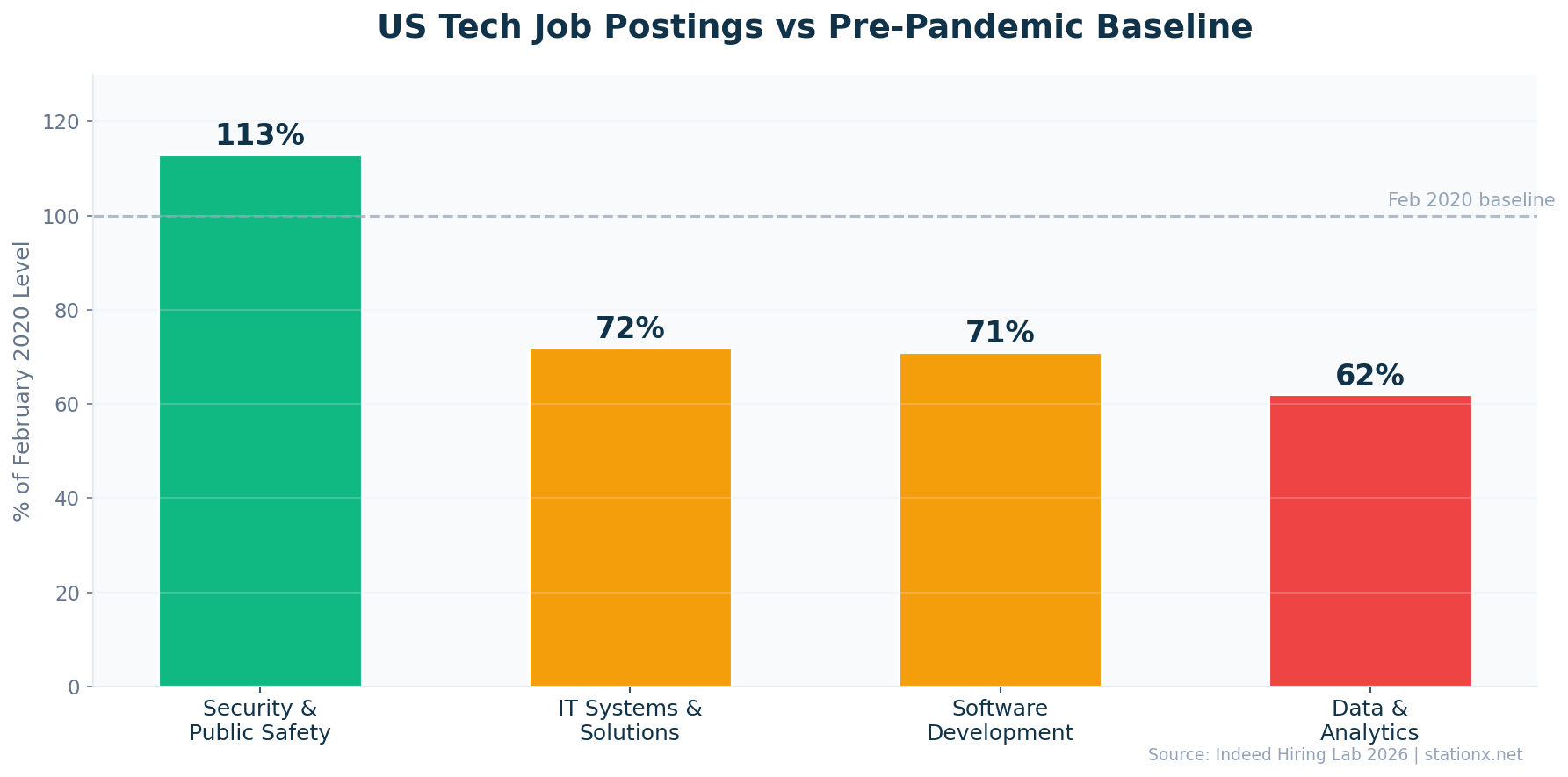
Indeed Hiring Lab data (updated 2026-03-13) reveals a nuanced picture of the cybersecurity hiring market. US "Security & Public Safety" job postings sit at 113.3% of their pre-pandemic baseline — one of the few tech sectors still above February 2020 levels. Software development (70.9%) and IT systems (71.9%) are well below baseline.
However, all sectors are substantially below their 2022 pandemic-era peaks. Security postings peaked at 176.9% of baseline in early 2022, meaning current levels represent a 36% decline from peak. The UK shows a similar but more pronounced correction across all categories.
US Job Postings by Sector (Indeed Hiring Lab)
| US Sector | Current (% of baseline) | Change from Peak | Peak Date |
|---|---|---|---|
| Software Development | 70.9% | -69.7% | 2022-02-28 |
| IT Systems & Solutions | 71.9% | -63.5% | 2022-04-26 |
| Security & Public Safety | 113.3% | -35.9% | 2022-01-15 |
| Data & Analytics | 61.7% | -69.5% | 2022-03-27 |
Source: Indeed Hiring Lab (last updated 2026-03-13). Baseline = Feb 2020 (pre-pandemic).
UK Job Postings by Sector (Indeed Hiring Lab)
| UK Sector | Current (% of baseline) | Change from Peak | Peak Date |
|---|---|---|---|
| Software Development | 63.3% | -65.2% | 2022-04-08 |
| IT Systems & Solutions | 64.7% | -65.1% | 2022-04-08 |
| Security & Public Safety | 78.2% | -59.4% | 2022-02-07 |
| Data & Analytics | 56.3% | -71.0% | 2022-03-31 |
Source: Indeed Hiring Lab (last updated 2026-03-13). Baseline = Feb 2020.
| Finding | Value | Source |
|---|---|---|
| Software dev postings vs baseline (US) | 70.9 (vs 100 baseline) | Indeed Hiring Lab |
| Security postings vs baseline (US) | 113.3 (vs 100 baseline) | Indeed Hiring Lab |
| IT systems postings vs baseline (US) | 71.9 (vs 100 baseline) | Indeed Hiring Lab |
| Security wage growth at peak (2022) | 12.0% YoY | Indeed Hiring Lab Wage Tracker |
| Security wage growth current | 2.0% YoY | Indeed Hiring Lab Wage Tracker |
| Cybersecurity layoffs reported (2024) | 25% | ISC2 Cybersecurity Workforce Study 2024 |
| Budget cuts impacting teams | 37% | ISC2 Cybersecurity Workforce Study 2024 |
| Hiring freezes reported | 38% | ISC2 Cybersecurity Workforce Study 2024 |
| Enterprise layoffs in security | 32% | ISC2 Cybersecurity Workforce Study 2025 |
| Orgs struggling with retention | 50% | ISACA State of Cybersecurity 2025 |
The Hiring Signals Contradict
Indeed data shows US security job postings at 113.3% of their pre-pandemic baseline — above pre-pandemic levels but 36% below their 2022 peak of 176.9%. Meanwhile, ISC2 reports the workforce gap grew 19% to 4.8 million. The contradiction: job postings are cooling from their pandemic highs, but the actual shortage keeps growing. This suggests employers are absorbing the gap through overwork and outsourcing rather than posting new roles (Indeed Hiring Lab, ISC2 2024).
Wage Trends
Security sector wages in the US have normalised. Indeed wage tracker data shows security wage growth peaked at 12% above pre-pandemic levels in early 2022 and has since fallen to 2% above pre-pandemic (Indeed Hiring Lab). This mirrors a broader tech-sector wage correction after the pandemic hiring frenzy.
Despite wage normalisation, cybersecurity salaries remain significantly above the tech industry average. ISC2 reports hiring freezes, budget cuts, and layoffs affecting security teams in 2024 (ISC2 2024). Retention is a growing concern: ISACA reports organisations struggling to keep cybersecurity staff, and enterprise layoffs in the security function have increased (ISACA 2025, ISC2 2025).
The Post-Pandemic Correction
The 2021-2022 hiring frenzy — fuelled by remote work expansion, digital transformation acceleration, and ransomware panic — created an unsustainable spike in technology job postings. Software development and data analytics postings more than doubled their pre-pandemic baselines before crashing. Security postings followed the same pattern but less dramatically: the sector peaked at ~177% of baseline in January 2022 and has since corrected to ~113%.
The critical insight: security is the only major technology sector that remains above its pre-pandemic posting baseline. Software development, IT systems, and data analytics are all below pre-pandemic levels. This reflects a structural shift: organisations cut software headcount during the AI-driven efficiency wave but maintained or grew security teams because regulatory and threat pressures do not respond to efficiency arguments.
Security Is the Last Sector Standing
Among the four major tech sectors tracked by Indeed Hiring Lab, security is the only one still above pre-pandemic posting levels. Software dev is at ~71%, IT systems at ~72%, and data analytics at ~62% of their February 2020 baselines. Security sits at ~113%. The message to career changers: cybersecurity is more recession-resistant than other technology fields (Indeed Hiring Lab 2026-03-13).
The Layoff Paradox
ISC2 data reveals that cybersecurity teams experienced layoffs, budget cuts, and hiring freezes in 2024 (ISC2 2024). Enterprise layoffs in the security function increased (ISC2 2025). This creates a confusing signal: if 4.8 million positions are unfilled, why are companies cutting existing security staff?
The answer lies in macroeconomic pressure. When companies face revenue contraction, security teams get cut alongside all others, regardless of the staffing gap. The layoffs disproportionately affect mid-level professionals at large enterprises undergoing restructuring, while demand at government agencies, defence contractors, and specialised security firms remains stable. The net effect: experienced professionals hit the job market briefly before being reabsorbed, but the structural gap persists because new entrants are not being trained.
ISACA data adds another dimension: organisations are struggling to retain cybersecurity staff even when they are not conducting layoffs (ISACA 2025). Voluntary turnover — driven by burnout, better offers, or career frustration — is a larger drain than involuntary layoffs. Addressing retention through competitive compensation, flexible work, career development, and manageable workloads is more impactful than hiring volume alone.
Highest Demand Regions
- APAC — largest workforce gap globally
- North America — highest salaries, persistent shortage
- Middle East & Africa — fastest growth rate
Market Headwinds
- Hiring freezes and budget cuts (ISC2 2024)
- Indeed postings below pandemic peak
- Burnout driving attrition (BCG/Sophos)
🎯 Most In-Demand Cybersecurity Roles
The cybersecurity job market spans a wide salary range depending on role, experience, and specialisation. Entry-level positions like SOC analyst and GRC analyst offer starting points, while senior roles in cloud security, security architecture, and CISO-level positions command premium compensation. CyberSeek data shows security analyst, security engineer, and penetration tester roles among the most frequently posted.
Salary Explorer by Role
Select a role to see salary data, recommended certifications, and career level.
| Finding | Value | Source |
|---|---|---|
| SOC analyst salary (US) | $90,462 | Glassdoor |
| Security engineer salary (US) | $168,767 | Glassdoor |
| Penetration tester salary (US) | $120,090 | Glassdoor |
| Security architect salary (US) | $192,840 | Glassdoor |
| GRC analyst salary (US) | $95,380 | Glassdoor |
| CISO salary (US) | $243,000 | Glassdoor |
| Cloud security engineer salary (US) | $155,000 | Glassdoor |
| Entry-level salary range | $74,000-$110,000 | SentinelOne / Industry Reports |
| Mid-level salary range | $115,000-$212,000 | SentinelOne / Industry Reports |
| CISO salary range | $220,000-$420,000 | SentinelOne / Industry Reports |
Cloud security and AI security specialist roles are emerging as the highest-growth categories. ISC2 reports AI/ML and cloud security as the top two skill demands in 2026 (ISC2 2025). Security engineers and architects command premium salaries due to their role in building (not just monitoring) security infrastructure. CISO compensation continues to climb, reflecting the strategic importance and personal liability attached to the role.
The Cloud Security Premium
Cloud security engineers and architects earn among the highest salaries in cybersecurity, reflecting the industry's shift to cloud-first infrastructure. ISC2 identifies cloud security as the second-most demanded skill (after AI/ML), and Glassdoor data shows cloud security engineers earning significantly above the overall cybersecurity median (ISC2 2025, Glassdoor 2026).
AI security specialist is the newest high-demand role. As organisations deploy AI systems, they need professionals who understand adversarial ML, prompt injection, model poisoning, and AI governance. This role barely existed two years ago and is now appearing in job postings across finance, healthcare, and defence sectors.
Career Progression Ladder
The typical cybersecurity career progression spans five tiers, each with distinct salary ranges, skill requirements, and time-in-role expectations:
Approximate US salary ranges. Sources: Glassdoor, BLS, SentinelOne 2026. Actual compensation varies by company, location, and specialisation.
The progression from Tier 1 to Tier 3 typically takes 5-8 years with active skill development and certification attainment. The jump from Tier 3 to Tier 4 requires architectural thinking and business acumen beyond pure technical skills. Tier 5 (CISO) is as much a business leadership role as a technical one, which is why average CISO tenure remains short and compensation high.
🏢 Cybersecurity Jobs by Industry
Cybersecurity hiring is not evenly distributed across industries. Financial services, government and defence, healthcare, and technology employ the largest cybersecurity workforces, driven by regulatory requirements, high-value data, and elevated threat exposure. The public sector faces a particularly acute talent gap — WEF data identifies a persistent public sector talent shortage in cybersecurity (WEF 2025).
| Finding | Value | Source |
|---|---|---|
| Orgs reporting understaffed teams | 55% | ISACA State of Cybersecurity 2025 |
| Unfilled security positions | 65% | ISACA State of Cybersecurity 2025 |
| Staffing shortages across industries | 67% | ISC2 Cybersecurity Workforce Study 2024 |
| Orgs with skills gaps | 90% | ISC2 Cybersecurity Workforce Study 2024 |
| Skills gaps posing significant risk | 58% | ISC2 Cybersecurity Workforce Study 2024 |
| Breaches attributed to skills gap | 54% | Fortinet 2025 Skills Gap Report |
| Public sector talent gap | 49% | WEF Global Cybersecurity Outlook 2025 |
Financial services hire the most cybersecurity professionals per capita, driven by PCI DSS, SOX, and banking regulations. Security teams in finance are typically 3-5x larger than comparably sized companies in other sectors.
Healthcare cybersecurity hiring is accelerating, driven by HIPAA enforcement, connected medical devices, and the industry's status as the #1 costliest sector for data breaches (IBM 2025). The sector struggles with budget constraints — security spending often competes with clinical investment.
Government and defence represent the largest single employer category in cybersecurity, concentrated in the US (DoD, NSA, CISA), UK (GCHQ, NCSC), and allied nations. Government roles typically offer lower salaries than the private sector but provide security clearances, job stability, and pension benefits.
Technology and consulting firms employ large security teams both for internal protection and as service providers (MSSPs, consulting, penetration testing). The MSSP and MDR markets are among the fastest-growing segments, creating thousands of security operations roles.
The Skills Gap Has Real Costs
Fortinet data shows that organisations attribute breaches directly to cybersecurity skills gaps (Fortinet 2025). ISC2 confirms that organisations with significant skills gaps face materially higher breach rates than those without (ISC2 2024). The staffing shortage is not abstract — it translates directly to security incidents.
Emerging Sectors
Energy and utilities: OT/ICS security hiring is surging as critical infrastructure becomes a national security priority. The Colonial Pipeline attack catalysed a wave of government mandates requiring dedicated cybersecurity staff at pipeline operators, power plants, and water treatment facilities. These roles require specialised SCADA and industrial control system knowledge that is scarce in the labour market.
Automotive and transportation: Connected vehicles, autonomous driving systems, and smart logistics create new attack surfaces. Automotive manufacturers are building internal security teams for the first time, competing with traditional tech companies for talent. Vehicle SOCs (V-SOCs) are an entirely new category of security operations.
Space and satellite: Space-based communications, GPS, and satellite internet create critical infrastructure dependencies that require protection. Military and commercial space operators are hiring cybersecurity professionals with clearances and an understanding of RF communications, satellite protocols, and supply chain security for hardware components.
Managed Security Services: The MSSP and MDR markets are among the fastest-growing in cybersecurity, creating a large and growing need for SOC analysts, threat hunters, and incident responders who can serve multiple client environments simultaneously. For entry-level professionals, MSSP roles offer exceptional breadth of exposure across industries and threat types.
🌍 Cybersecurity Job Market by Country
Country Job Market Explorer
Select a country to explore its cybersecurity job market.
Salary Data by Country
| Finding | Value | Source |
|---|---|---|
| US median infosec salary | $120,360 | BLS Occupational Outlook Handbook |
| US 10th percentile salary | $63,410 | BLS Occupational Employment & Wage Statistics |
| US 90th percentile salary | $179,950 | BLS Occupational Employment & Wage Statistics |
| India cybersecurity salary | ₹7,50,000 | Glassdoor |
| Canada cybersecurity salary | CA$85,000 | Glassdoor |
| Australia cybersecurity salary | A$110,000 | Glassdoor |
| Germany cybersecurity salary | €65,000 | Glassdoor |
| UK median cyber salary | £55,000 | UK DCMS Cyber Security Skills in the UK Labour Market 2025 |
| UK London cyber salary | £69,800 | UK DCMS Cyber Security Skills in the UK Labour Market 2025 |
| UK cyber premium over IT | 12% | UK DCMS Cyber Security Skills 2025 |
| APAC unfilled roles | 3.4 million | ISC2 Cybersecurity Workforce Study 2024 |
| Workforce by region | 5.5M total | ISC2 |
| UK cyber workforce size | 143,000 | UK DSIT Cyber Security Skills 2025 |
| UK job postings decline | 33% | UK DSIT Cyber Security Skills 2025 |
The US Salary Premium
US information security analysts earn a median of $120,360 (BLS 2024), roughly 106% more than UK cyber professionals at the median (~$58K USD equivalent). This gap drives talent migration toward US-based remote roles, compounding staffing challenges in other markets (BLS, Gov.uk 2025).
Country Highlights
🇺🇸 United States: The world's largest cybersecurity job market. BLS reports a median salary of $120,360 for information security analysts, with the 90th percentile exceeding $188,000 and the 10th percentile at $66,000+ (BLS 2024). CyberSeek tracks 470,000+ open positions, concentrated in Virginia, California, Texas, Maryland, and Florida. The federal government (DoD, intelligence community, CISA) is the single largest employer.
🇬🇧 United Kingdom: The UK cyber workforce is sized at 143,000 (DSIT 2025). London commands a salary premium over the rest of the UK. However, DSIT reports a decline in cybersecurity job postings, suggesting market consolidation. The UK cyber salary premium over wider IT roles remains strong, reflecting sustained demand despite fewer total postings (Gov.uk 2025).
🇮🇳 India: India is the fastest-growing cybersecurity labour market. Salaries are lower in absolute terms but rising rapidly. The ISC2-estimated workforce gap for India is substantial, and weekly attack volumes continue to climb, driving sustained demand for SOC analysts, incident responders, and cloud security professionals.
🇦🇺 Australia, 🇩🇪 Germany, 🇸🇬 Singapore: All three countries face cybersecurity talent shortages. Australia's mandatory breach notification regime has driven compliance hiring. Germany's industrial base creates demand for OT/ICS security specialists. Singapore is investing heavily in cyber workforce development as an APAC hub. Salaries in all three markets exceed the global median.
Approximate USD equivalents. Sources: BLS, Glassdoor, Gov.uk. Actual salaries vary by role, city, and experience.
Purchasing Power vs Nominal Salary
Raw salary comparisons across countries are misleading without adjusting for cost of living. A $120,000 US salary in San Francisco has less purchasing power than a £55,000 UK salary in a mid-sized city, or a $110,000 AUD salary in Brisbane. India's lower nominal salaries go much further in local purchasing power, making cybersecurity one of the highest-paying technology fields domestically.
The emergence of geo-flexible compensation models — where remote workers are paid based on their output rather than their location — is beginning to flatten global salary differences. Companies paying "US rates" for remote workers in lower-cost countries are attracting top talent internationally but also inflating local salary expectations and creating retention challenges for organisations that pay locally competitive rates.
The Global Remote Arbitrage
Remote work has created a salary arbitrage opportunity. A cybersecurity professional in India, Eastern Europe, or Latin America working remotely for a US-based company can earn 3-5x the local market rate while the employer saves 40-60% compared to hiring domestically. This dynamic is quietly reshaping the global cybersecurity labour market, and it works to the advantage of both parties (ISC2 2024, Indeed Hiring Lab).
For career-minded professionals, the implication is clear: developing skills that are valued globally (cloud security, AI security, penetration testing) provides maximum career optionality regardless of location. The professionals who will benefit most from the global remote market are those who combine strong technical skills with English fluency and familiarity with Western regulatory frameworks (GDPR, NIST, SOC 2).
🇺🇸 US Cybersecurity Jobs by State
CyberSeek's heatmap data reveals stark geographic concentration in US cybersecurity jobs. The top five states for cybersecurity openings are Virginia, California, Texas, Maryland, and Florida (CyberSeek 2025). Virginia and Maryland dominate due to proximity to the Pentagon, NSA, CISA, and the intelligence community. California's concentration reflects Silicon Valley and the defence contractors clustered around Los Angeles and San Diego.
| Finding | Value | Source |
|---|---|---|
| Virginia cybersecurity openings | 53,855 | CyberSeek / NIST |
| California cybersecurity openings | 44,344 | CyberSeek / NIST |
| Texas cybersecurity openings | 42,559 | CyberSeek / NIST |
| Maryland cybersecurity openings | 27,050 | CyberSeek / NIST |
| Florida cybersecurity openings | 23,792 | CyberSeek / NIST |
| Total US openings | 514,359 | CyberSeek / NIST |
| US supply-demand ratio | 74 | CyberSeek / NIST |
| NSF unfilled US cyber roles | 570,000 | National Science Foundation |
The supply-demand ratio varies significantly by state. States with heavy federal presence (Virginia, Maryland, D.C. metro) face the widest gaps, while states with large university cyber programmes and lower cost of living (such as Texas and Florida) are attracting both talent and employers. The geographic distribution of cybersecurity jobs is slowly decentralising as remote work policies expand, but the federal corridor remains dominant.
The Federal Corridor Effect
Virginia and Maryland together account for a disproportionate share of US cybersecurity openings, driven by the Department of Defense, NSA, CISA, and intelligence community contracts. This concentration creates salary inflation in the D.C. metro area and makes it one of the most competitive cybersecurity job markets globally (CyberSeek 2025).
Texas is emerging as a cybersecurity hub outside the traditional federal corridor. Austin and Dallas-Fort Worth host growing security operations centres for major enterprises, and the state's lower cost of living attracts talent priced out of coastal markets. Florida is following a similar trajectory, with Miami, Tampa, and Orlando building cyber ecosystems around defence contractors and financial services firms.
State-by-State Characteristics
Virginia: The epicentre of US cybersecurity employment. Arlington, Tysons Corner, and the Route 28 corridor in Loudoun County host hundreds of defence and intelligence contractors. Clearance-required roles dominate. Salaries run 15-25% above the national median, reflecting the cleared talent premium and high cost of living.
California: Silicon Valley technology companies and Southern California defence contractors create two distinct markets. Bay Area roles lean toward application security, cloud security, and product security, while San Diego and LA lean toward defence and aerospace. Salaries are highest in the nation but cost of living erodes real purchasing power.
Texas: San Antonio (NSA Texas, Air Force Cyber) and Austin (tech sector) are the primary clusters. No state income tax makes Texas competitive on take-home pay versus Virginia and California. The growing technology sector in Dallas-Fort Worth adds enterprise security operations demand.
Maryland: Fort Meade (NSA headquarters) and the Johns Hopkins Applied Physics Laboratory anchor the state's cybersecurity ecosystem. Like Virginia, clearance-required roles dominate. The University of Maryland's cyber programme supplies a local talent pipeline.
Florida: The fastest-growing cybersecurity market among the top five states. No state income tax, lower cost of living, and a growing defence contractor presence in Tampa (CENTCOM, SOCOM) make Florida increasingly attractive. Miami's financial services sector adds demand for security compliance professionals.
Other notable states include New York (financial services security), Illinois (Chicago enterprise sector), Georgia (Atlanta has a growing cyber presence with the Army Cyber Center of Excellence at Fort Eisenhower), and Colorado (Colorado Springs with NORAD/Space Command plus Denver tech).
🚪 Entry-Level Cybersecurity Jobs: The Reality
The cybersecurity industry has a pipeline problem. ISC2 data shows that a significant percentage of organisations made zero entry-level cybersecurity hires in 2024 (ISC2 2024). The workforce skews heavily toward experienced professionals: the under-30 cohort represents a small fraction, while the over-40 cohort dominates. This age distribution signals that the industry is not building its next generation.
| Finding | Value | Source |
|---|---|---|
| Orgs with zero entry-level hires | 31% | ISC2 Cybersecurity Workforce Study 2024 |
| Workforce under 30 | 11% | ISC2 / StationX |
| Workforce over 40 | 60% | ISC2 / StationX |
| Budget as top staffing barrier | #1 barrier | ISC2 Cybersecurity Workforce Study 2024 |
| Entry-level salary range | $74,000-$110,000 | SentinelOne / Industry Reports |
| GenAI reducing entry-level demand by 2028 | 50% | Gartner |
The Entry-Level Paradox
ISC2 reports that a significant percentage of organizations made zero entry-level hires in 2024 — despite claiming talent shortages as their top challenge. Meanwhile, the workforce skews older (over 40) while under-30 representation remains low (ISC2 2024). The industry says it needs people, then refuses to train them. Gartner projects GenAI will further reduce entry-level demand by 2028, narrowing the on-ramp even more.
Entry-level cybersecurity salaries remain attractive relative to other fields — SentinelOne reports entry-level ranges that exceed the national median for all occupations (SentinelOne 2026). The problem is not compensation; it is access. Employers demand 2-3+ years of experience for roles they label as "entry-level," creating a Catch-22 for career starters.
The situation may worsen. Gartner projects that GenAI will reduce demand for entry-level cybersecurity positions by 2028, as AI automates triage, log analysis, and basic incident response tasks that traditionally formed the entry-level career path (Gartner). If the on-ramp shrinks further while the experienced workforce ages out, the talent pipeline collapse could accelerate dramatically.
A Structural Failure, Not a Skills Shortage
Budget constraints — not talent availability — are now the #1 cause of cybersecurity staffing shortages (ISC2 2024). Organisations cite a shortage while simultaneously refusing to invest in training, entry-level hiring, or competitive compensation for junior roles. The gap is a funding failure disguised as a talent problem.
How to Break In Despite the Paradox
Despite the entry-level hiring paradox, thousands of people successfully transition into cybersecurity every year. The strategies that work are practical rather than credential-heavy:
What Works
- CompTIA Security+ as baseline certification
- Home lab with hands-on tool experience
- CTF competitions and bug bounty participation
- IT help desk or sysadmin as stepping stone
- Networking at local security meetups (BSides)
What Doesn't Work
- Collecting certifications without practical skills
- Applying only to "entry-level" postings (they require experience)
- Expecting a degree alone to secure a role
- Skipping the IT fundamentals (networking, Linux, scripting)
- Waiting for the perfect job — take adjacent roles first
The most successful entry-level candidates are those who can demonstrate practical skill through home labs, CTF writeups, open-source contributions, or relevant adjacent experience. A candidate with 18 months of help desk experience, a Security+ certification, and a documented home lab is more competitive than a candidate with a master's degree and no hands-on exposure.
🏠 Remote Work in Cybersecurity
Cybersecurity remains one of the most remote-friendly technology disciplines. ISC2 reports that a significant majority of cybersecurity professionals work in hybrid or remote arrangements (ISC2 2024, 2025). The nature of security operations — monitoring dashboards, analysing logs, responding to incidents, conducting code reviews — lends itself to remote execution.
| Finding | Value | Source |
|---|---|---|
| Hybrid/remote cyber workers | 56% | ISC2 Cybersecurity Workforce Study 2024 |
| Fortune 100 remote cyber positions | 8% | Industry analysis |
| Remote/hybrid percentage (2025) | 72% | ISC2 Cybersecurity Workforce Study 2025 |
However, the remote landscape is shifting. Fortune 100 companies are increasingly requiring some in-office presence for cybersecurity roles, particularly for positions involving classified data, SOC operations, or physical security integration (Fortune 100 analysis 2025). The hybrid model (2-3 days in office) is emerging as the standard for enterprise security teams.
Remote Work as a Retention Tool
In a market with 4.8 million unfilled positions and rising burnout, remote/hybrid flexibility is a competitive advantage for employers. Organisations mandating full-time office returns risk losing talent to competitors offering flexible arrangements. For cybersecurity professionals, the ability to work remotely is increasingly a non-negotiable expectation (ISC2 2024, 2025).
Remote work has also expanded geographic diversity in cybersecurity hiring. Professionals in lower-cost-of-living areas can now access roles at US and UK salary levels, while employers can tap talent pools beyond traditional tech hubs. This is slowly helping to address regional workforce gaps, though clearance-required roles remain anchored to specific locations.
Remote-Friendliness by Role
Not all cybersecurity roles are equally remote-friendly. The remote suitability varies by function:
| Role | Remote Suitability | Notes |
|---|---|---|
| GRC / Compliance Analyst | Highly Remote | Document-based, policy-focused |
| Penetration Tester | Highly Remote | Remote testing tools, report delivery |
| Security Engineer | Highly Remote | Infrastructure is cloud/remote already |
| Threat Intelligence | Remote / Hybrid | Research-based, some collaboration |
| SOC Analyst | Hybrid Preferred | Shift-based, team coordination |
| CISO / Security Director | Hybrid Preferred | Board presentations, executive access |
| OT/ICS Security | On-Site Required | Physical access to industrial systems |
| Cleared / Government | On-Site / SCIF | Classification requirements |
The remote-friendliest cybersecurity roles tend to be those that interact primarily with digital systems rather than physical infrastructure or classified information. Penetration testers, security engineers, GRC analysts, and cloud security professionals can work effectively from anywhere. SOC analysts and CISOs benefit from hybrid arrangements that combine focused remote work with in-person collaboration. OT/ICS security and classified government work remain firmly on-site.
The Return-to-Office Debate
The tension between return-to-office mandates and cybersecurity talent retention is becoming a defining workforce issue. Several major technology and financial services firms have announced full or partial return-to-office requirements in 2026, including for cybersecurity teams. Early data suggests this is accelerating voluntary turnover: professionals with in-demand skills are choosing employers that offer flexibility over those that mandate presence.
From a security operations perspective, the argument for in-person SOC work is weakening. Modern SIEM, SOAR, and EDR platforms are designed for remote operation. Incident response can be coordinated via video and chat tools. The primary arguments for in-person work remain: classified environments (no workaround), physical security integration (hardware-dependent), and team culture development (manageable with periodic in-person meetings).
For employers navigating this tension: the data is clear. In a market with 4.8 million unfilled positions, flexibility is a retention tool, not a perk. Organisations that mandate full-time office return for roles that can be performed remotely will lose talent to competitors offering hybrid or fully remote arrangements. The cost of replacing a cybersecurity professional (recruiting, interviewing, onboarding, knowledge transfer) far exceeds the cost of supporting remote work infrastructure.
📜 Certifications Employers Want Most
Certifications remain a critical signal in cybersecurity hiring. Fortinet reports that employers prefer certified candidates, and certification holders earn measurable salary premiums (Fortinet 2025). CyberSeek data tracks which certifications appear most frequently in US job postings.
| Finding | Value | Source |
|---|---|---|
| CISSP holder average salary | $136,000 | ISC2 Cybersecurity Workforce Study 2025 |
| CEH holder average salary | $107,000 | EC-Council |
| CompTIA Security+ holder salary | $88,000 | CompTIA |
| Job postings requesting CISSP | 82,494 | CyberSeek |
| Job postings requesting Security+ | 70,019 | CyberSeek |
| Job postings requesting CISA | 52,337 | CyberSeek |
| Job postings requesting CISM | 44,347 | CyberSeek |
| Employers preferring certified candidates | 89% | Fortinet 2025 Cybersecurity Skills Gap Report |
| CISSP salary premium | $25K-$35K | EC-Council |
Certification Salary Premiums
| Finding | Value | Source |
|---|---|---|
| US median infosec salary (BLS) | $120,360 | BLS Occupational Outlook Handbook |
| 10th percentile salary | $63,410 | BLS Occupational Employment & Wage Statistics |
| 90th percentile salary | $179,950 | BLS Occupational Employment & Wage Statistics |
| Gender pay gap in cybersecurity | 5.2% | ISC2 Cybersecurity Workforce Study 2024 |
| Women average salary | $109,000 | ISC2 Cybersecurity Workforce Study 2024 |
| Men average salary | $115,000 | ISC2 Cybersecurity Workforce Study 2024 |
CISSP remains the most requested certification in cybersecurity job postings (CyberSeek 2025). CISSP holders earn a salary premium over non-certified peers, and the certification serves as a de facto requirement for senior and management roles. ISC2 reports the average CISSP holder salary at a premium level (ISC2 2025).
CompTIA Security+ leads for entry-level and government positions (required for DoD Directive 8570 compliance). It appears frequently in CyberSeek postings and carries a solid average salary for holders (CompTIA 2025). CEH remains valued for penetration testing and offensive security roles, with EC-Council reporting strong average holder salaries (EC-Council 2025). CISM and CISA from ISACA are prominent in GRC and audit roles.
Recommended Certification Paths
The optimal certification path depends on your target role. Based on CyberSeek posting data and salary premium analysis:
Security+ is the universal starting point. It satisfies DoD 8570 requirements, appears in the most job postings per CyberSeek, and has the lowest barrier to entry. From there, specialisation determines the next step. CISSP remains the long-term goal for most paths — it requires 5 years of experience and serves as the industry's most recognised senior certification.
The Gender Pay Gap Persists
ISC2 data reveals a measurable gender pay gap in cybersecurity: women earn less than men on average, despite women representing a growing share of the workforce (ISC2 2024). The gap narrows at senior levels but persists across experience bands. Closing this gap is both an equity imperative and a recruitment opportunity — expanding the talent pool by making the field more equitable.
🤖 AI's Impact on Cybersecurity Careers
AI is reshaping cybersecurity careers from both sides. ISC2 identifies AI/ML as the #1 skill need in cybersecurity for 2026, with 41% of security teams citing it as their top requirement (ISC2 2025). Cloud security follows as the second-most demanded skill. The WEF highlights a growing AI skills investment gap, where demand for AI-capable security professionals far outstrips the training pipeline (WEF 2025).
| Finding | Value | Source |
|---|---|---|
| AI/ML skill demand in cybersecurity | 41% | ISC2 Cybersecurity Workforce Study 2025 |
| Cloud security skill demand | 36% | ISC2 Cybersecurity Workforce Study 2025 |
| AI as top cybersecurity skill need | 41% | ISC2 Workforce Study 2025 |
| AI skills investment gap | 67% | WEF Global Cybersecurity Outlook 2025 |
| GenAI impact on entry-level by 2028 | 50% | Gartner |
New roles are emerging at the intersection of AI and security: AI security engineer, ML security researcher, AI governance analyst, and prompt injection specialist. These roles require hybrid expertise spanning data science, software engineering, and security fundamentals. Organisations that invested early in AI security talent are measurably better protected against AI-driven attack vectors (IBM 2025).
AI Will Automate, Not Eliminate
The fear that AI will replace cybersecurity jobs misreads the data. AI is automating low-level tasks (log triage, alert correlation, basic incident response) while creating demand for higher-level skills (AI governance, adversarial ML, security architecture for AI systems). The net effect is a shift upward in required skills, not a reduction in headcount. Gartner projects entry-level roles may contract, but mid and senior roles will grow (Gartner, ISC2 2025).
For cybersecurity professionals, AI fluency is becoming table stakes. Understanding how to use AI tools for threat detection, vulnerability assessment, and incident response is now expected. Understanding how to attack AI systems (adversarial ML, data poisoning, model extraction) is the differentiating skill. Security professionals who master both sides of the AI equation will command premium compensation.
Top Skills in Demand
Ranked by demand frequency in job postings. Source: ISC2 2025, CyberSeek 2025.
The skills shift is rapid. Two years ago, cloud security and compliance dominated skill demand lists. Now AI/ML has leapfrogged both. Professionals who can demonstrate practical AI security skills — not just theoretical knowledge — are receiving multiple offers and commanding significant salary premiums. This represents the fastest skill-demand shift the industry has experienced since the cloud migration era of 2015-2020.
🔄 Career Changers: Breaking Into Cybersecurity
Career changers represent a significant and growing source of cybersecurity talent. ISACA reports that a notable percentage of current cybersecurity professionals transitioned from non-security backgrounds (ISACA 2025). Common transition paths include IT systems administration, software development, military/law enforcement, networking, and help desk roles.
| Finding | Value | Source |
|---|---|---|
| Career changers entering cybersecurity | 46% | ISACA State of Cybersecurity 2025 |
| Soft skills gap in cyber teams | 59% | ISACA State of Cybersecurity 2025 |
| Cross-training decline | 29% | ISACA State of Cybersecurity 2025 |
| Women in cybersecurity workforce | 22% | ISC2 Cybersecurity Workforce Study 2024 |
The industry's reliance on career changers highlights a structural reality: university cyber programmes cannot produce enough graduates to fill the gap. Career changers bring domain expertise from their previous fields — a healthcare IT admin understands hospital systems, a finance developer understands trading platforms — making them uniquely valuable in sector-specific security roles.
However, barriers persist. ISACA identifies a soft skills gap in security teams, with communication, leadership, and business acumen often lacking (ISACA 2025). Cross-training budgets are declining rather than growing, creating a contradiction: the industry needs career changers but is investing less in the training to prepare them.
The Most Effective Transition Paths
Data consistently shows the strongest career-change paths into cybersecurity are: (1) IT help desk or sysadmin → SOC analyst, (2) software developer → application security or penetration testing, (3) networking → network security, (4) military/law enforcement → incident response or threat intelligence, (5) compliance/audit → GRC. Each path leverages existing skills rather than starting from zero.
Women remain underrepresented in the cybersecurity workforce. ISC2 data shows women make up a minority of the global cyber workforce, though the percentage is growing (ISC2 2024). Initiatives targeting women, veterans, and non-traditional backgrounds are critical to closing the 4.8 million gap — the traditional pipeline alone cannot fill it.
Typical Transition Timelines
Based on industry data and career progression patterns, the typical transition timeline into cybersecurity from an adjacent field looks like this:
Career changers with existing IT experience (help desk, sysadmin, networking) typically transition in 6-12 months. Those coming from non-technical backgrounds (military, law enforcement, finance) should expect 12-18 months. The most important accelerator is hands-on practice: employers care more about what you can demonstrate than what certifications you hold.
Apprenticeship and internship programmes are expanding, particularly in the UK (NCSC Cyber First), US (CyberCorps, NICE), and Australia. Government-backed programmes typically combine paid work experience with structured training and often lead to full-time employment. For career changers without IT backgrounds, these programmes provide the credibility bridge that self-study alone cannot.
Diversity as a Pipeline Solution
Women represent a minority of the cybersecurity workforce globally, though their share is growing year over year (ISC2 2024). Veterans, neurodivergent professionals, and individuals from non-traditional educational backgrounds represent large untapped talent pools. Organisations that actively recruit from these populations report better retention rates and broader thinking in security operations.
Industry programmes such as (ISC2) One Million Certified in Cybersecurity, CyberVets USA, and the UK Cyber First initiative are specifically targeting underrepresented groups. The evidence shows that diverse teams make better security decisions — different backgrounds bring different threat perspectives, which is precisely what security operations need.
The economic argument is simple: with 4.8 million unfilled positions, the industry cannot afford to exclude any potential talent source. Expanding the definition of "cybersecurity professional" beyond the traditional CS degree holder to include career changers, veterans, self-taught practitioners, and apprentices is not just equitable — it is a workforce strategy necessity.
🔮 Cybersecurity Job Market Forecast
The outlook for cybersecurity employment through 2030 is overwhelmingly positive in terms of demand, but challenging in terms of supply. BLS projects 29% growth for information security analysts from 2024 to 2034, with approximately 17,300 annual openings from growth and replacement needs combined (BLS 2024). The total workforce needed is 10.2 million against a current base of 5.5 million (ISC2 2024).
| Finding | Value | Source |
|---|---|---|
| BLS 10-year job growth projection | 29% | BLS Occupational Outlook Handbook |
| Projected annual openings | 19,500 | BLS Occupational Outlook Handbook |
| Current global workforce gap | 4.02 million | ISC2 Cybersecurity Workforce Study 2024 |
| Total workforce needed | 10.2 million | ISC2 |
| Workforce growth rate (2024) | 0.1% | ISC2 Cybersecurity Workforce Study 2024 |
Several factors will shape the market through 2030:
- AI governance and security: New regulations (EU AI Act, US executive orders) will create compliance roles that don't exist yet
- Cloud security: Multi-cloud and cloud-native security remain the fastest-growing market segments
- OT/ICS security: Critical infrastructure protection is becoming a national security priority across Western governments
- Quantum computing: Post-quantum cryptography migration will create specialised demand in 2026-2030
- Automation impact: AI will shift the skill mix upward, reducing entry-level roles while expanding demand for architects and strategists
Burnout Fuels the Talent Drain
Cross-referencing Sophos and BCG data reveals a feedback loop: burnout rates among cybersecurity professionals are climbing year-over-year (Sophos 2025), and the cybersecurity attrition rate already exceeds other tech roles (BCG 2024). Workers considering leaving the field entirely (Bitsight 2025) compound the 4.8 million gap. The industry is not just failing to hire fast enough — it is losing the people it already has.
Burnout & Retention Data
| Finding | Value | Source |
|---|---|---|
| Cybersecurity attrition rate | 17% | BCG / ISC2 |
| Workers affected by burnout | 84% | Bitsight |
| Considering leaving cybersecurity | 24% | Bitsight |
| Professionals reporting burnout | 76% | Sophos Addressing Cybersecurity Burnout 2025 |
| Burnout increase year-over-year | 69% | Sophos Addressing Cybersecurity Burnout 2025 |
| Orgs struggling with retention | 50% | ISACA State of Cybersecurity 2025 |
The forecast is not purely about hiring. Retention is becoming the defining workforce challenge. Burnout rates among cybersecurity professionals are climbing (Sophos 2025), attrition exceeds other tech roles (BCG 2024), and a growing percentage of professionals are considering leaving the field entirely (Bitsight 2025). If the industry cannot retain the people it has, no amount of new hiring will close the gap.
What the Next 5 Years Look Like
By 2030, the cybersecurity workforce will look markedly different from today. The BLS 29% growth projection implies the US alone will need approximately 50,000+ additional information security analysts by 2034. Globally, ISC2's trajectory suggests the workforce will need to reach 12-14 million to match demand, requiring both new entrants and dramatic improvements in retention.
The composition of cybersecurity roles will shift. AI-augmented analysts will replace traditional tier-1 SOC roles, but new categories — AI security architects, quantum-resistant cryptography engineers, digital identity specialists, and autonomous system security professionals — will create demand that doesn't currently have a training pipeline. The fastest-adapting universities and bootcamps will be the ones that pivot curricula toward these emerging specialisations.
The Workforce Gap Will Not Close by 2030
At current growth rates, the cybersecurity workforce gap will persist through 2030 and beyond. Even with optimistic hiring assumptions, the combination of retirement attrition, burnout-driven departures, and accelerating threat complexity means demand will continue outpacing supply. The solution is not just hiring more people — it is automating repetitive work, adopting managed services, and fundamentally rethinking how security teams are structured (ISC2 2024, BLS 2024).
For individual professionals, the forecast is clear: cybersecurity careers offer strong employment security, above-average compensation, and growing demand for at least the next decade. The professionals who will benefit most are those who continuously upskill in AI, cloud, and emerging technology areas while developing the business acumen to communicate risk to executive leadership.
For organisations, the forecast demands strategic workforce planning. Relying solely on external hiring to fill the gap is no longer viable. The most effective workforce strategies combine competitive compensation and flexible work policies (to attract and retain talent), automation and AI augmentation (to multiply the output of existing staff), managed security services (to cover specialised functions), and internal development programmes (to grow talent organically from adjacent functions). Organisations that treat cybersecurity staffing as a cost centre rather than a strategic investment will continue to fall further behind.
The macro trend is unmistakable: cybersecurity demand is structural and growing, driven by regulation, threat evolution, and digital transformation. The profession offers one of the strongest long-term career propositions in the technology sector. The challenge is not demand — it is building the supply pipeline, retention mechanisms, and organisational structures to meet that demand.
📋 Key Takeaways
- The gap is structural, not cyclical. 4.8 million unfilled positions grew 19% YoY despite a record 5.5 million active workforce. Budget constraints — not talent scarcity — are now the #1 barrier.
- BLS 29% growth is real but uneven. Cybersecurity grows 7x faster than the economy, but hiring has cooled from pandemic-era peaks. Indeed data shows security postings above pre-pandemic levels but well below their 2022 highs.
- The entry-level paradox persists. Organisations claim they cannot find talent while simultaneously refusing to hire entry-level candidates or invest in training programmes.
- AI is shifting the skill mix, not eliminating jobs. AI/ML is now the #1 skill need in cybersecurity. Entry-level roles may contract, but mid-level and senior roles will expand.
- Certifications still matter. CISSP, Security+, and CEH remain the most requested credentials. Certified professionals earn measurable salary premiums.
- Burnout threatens the pipeline. Rising burnout and attrition rates mean the industry is losing people while failing to replace them. Retention is becoming as important as recruitment.
- Remote/hybrid work is the norm. The majority of cybersecurity professionals work remotely or hybrid, and flexible arrangements are a competitive necessity for employers.
- The US leads in salaries and demand. $120,360 median salary, 470,000+ openings, and 33% projected growth. Virginia and California dominate the market.
❓ Cybersecurity Job Market FAQ
How many unfilled cybersecurity jobs are there?
There are 4.8 million unfilled cybersecurity positions globally (ISC2 2024), a 19% increase from the prior year. The US alone has over 470,000 open cybersecurity positions (CyberSeek 2025). The total global workforce needed is 10.2 million against 5.5 million currently employed.
Is cybersecurity a growing career field?
Yes. The US Bureau of Labor Statistics projects 29% employment growth for information security analysts from 2024 to 2034, described as "much faster than average." This is approximately 7x the growth rate for all occupations combined. Globally, ISC2 reports the active workforce at a record 5.5 million (BLS, ISC2 2024).
What is the average cybersecurity salary?
The US median salary for information security analysts is $120,360 (BLS 2024). Salaries range from approximately $66,000+ (10th percentile) to $188,000+ (90th percentile). CISOs and security architects earn significantly more. UK median cyber salary is approximately £46,000, with London commanding a premium (BLS, Gov.uk 2025).
What certifications do cybersecurity employers want?
CISSP is the most requested certification in cybersecurity job postings, followed by CompTIA Security+, CISA, CISM, and CEH (CyberSeek 2025). CISSP holders earn a measurable salary premium. Security+ is the baseline for DoD and government roles. Employers overwhelmingly prefer certified candidates (Fortinet 2025).
Can I get a cybersecurity job without experience?
It is challenging. ISC2 reports that many organisations made zero entry-level cybersecurity hires in 2024, despite claiming talent shortages. However, pathways exist: CompTIA Security+ certification, SOC analyst boot camps, help desk experience, and career-change programmes from IT, military, or development backgrounds are the most effective routes. Building a home lab and participating in CTF competitions demonstrate practical skills to employers.
Which US states have the most cybersecurity jobs?
Virginia, California, Texas, Maryland, and Florida lead in cybersecurity job openings (CyberSeek 2025). Virginia and Maryland dominate due to federal government and defence contractor demand concentrated around Washington D.C. California reflects Silicon Valley and defence industry hubs.
Will AI replace cybersecurity jobs?
No, but AI will reshape them. ISC2 identifies AI/ML as the top skill need in cybersecurity (41% of teams cite it). AI is automating lower-level tasks like log triage and alert correlation while creating new roles in AI security, governance, and adversarial ML. Gartner projects entry-level roles may contract, but overall cybersecurity employment will continue growing at 29% (BLS projection).
Is cybersecurity a recession-proof career?
Cybersecurity is among the most recession-resistant technology fields, but it is not fully immune. Indeed Hiring Lab data shows security job postings are the only major tech sector still above pre-pandemic levels, while software development, IT systems, and data analytics are all below baseline. However, budget cuts, hiring freezes, and layoffs do affect security teams during economic downturns (ISC2 2024). The structural demand driven by regulations and threats provides more resilience than cyclical hiring in other tech sectors.
What is the cybersecurity skills gap?
The cybersecurity skills gap refers to the difference between the number of cybersecurity professionals needed and the number available. ISC2 estimates the global gap at 4.8 million workers (2024), representing 47% of the total workforce need of 10.2 million. The gap is driven by budget constraints (now the #1 barrier), inadequate training pipelines, high attrition due to burnout, and expanding threat surfaces requiring more specialists.
How much do cybersecurity jobs pay in the UK?
The UK median cybersecurity salary is approximately £46,000 per year (DSIT/Gov.uk 2025), with London commanding a premium above the national median. Cybersecurity professionals earn a measurable premium over general IT roles. Senior positions (security architects, CISOs) and roles in financial services or defence command significantly higher salaries. The UK cyber workforce gap, while smaller than the US gap, persists across most sectors.
Is cybersecurity hard to get into?
The entry barrier is real but surmountable. The main challenge is the experience paradox: many "entry-level" roles require 2-3 years of experience. The most effective strategies are: (1) start in an adjacent IT role (help desk, sysadmin) and transition, (2) earn CompTIA Security+ as a baseline credential, (3) build a home lab and document your projects, (4) participate in CTF competitions and bug bounty programmes, (5) leverage military, networking, or development experience as transferable skills.
For more information on cybersecurity career paths, certifications, and training, see our best cybersecurity certifications guide and how to start a career in cybersecurity guide.
About This Data
This article draws from 185 statistics aggregated from 50+ authoritative sources including IBM Cost of a Data Breach, Verizon DBIR, CrowdStrike Global Threat Report, WEF Global Cybersecurity Outlook, FBI IC3, ISC2 Cybersecurity Workforce Study, Sophos, Gartner, Mandiant M-Trends, and Ponemon Institute reports.
Derived statistics (marked "Nathan House's Analysis") are computed by cross-referencing data from multiple sources — for example, comparing breach costs across industries using IBM data, or validating ransomware trends across Verizon, Sophos, and HIPAA Journal findings.
All statistics include inline source citations with links to primary sources. Data spans 2023-2026, with preference given to the most recent available figures. Last updated: September 2026.
About Our Sources
The statistics in this article are drawn from the following primary sources: ISC2 Cybersecurity Workforce Study 2025 (global workforce size, gap, demographics, skills), US Bureau of Labor Statistics (BLS) (employment projections, median salary, occupational outlook), CyberSeek (US job openings, state-level data, supply-demand ratio, certification posting counts), ISACA State of Cybersecurity Report 2026 (staffing levels, retention, career changers), Indeed Hiring Lab (job posting trends, wage data, sector comparisons), and Glassdoor (role-specific salary data by country).
Additional sources include Fortinet (skills gap and certification data), World Economic Forum (WEF) (AI skills gap, public sector talent), Gartner (AI impact projections), BCG (attrition rates), Sophos/Bitsight (burnout and retention), SentinelOne (salary ranges), Gov.uk DSIT (UK workforce data), and EC-Council/CompTIA (certification salary premiums).
Derived statistics (marked "Nathan House's Analysis") are computed by cross-referencing data from multiple sources. For example, the workforce gap percentage is calculated from ISC2 gap and total demand figures. The Indeed-ISC2 contradiction analysis compares Indeed posting trends against ISC2 workforce gap data.
How to Use This Data
Career changers and students: Use the salary data to set realistic expectations, the certification section to plan your credential path, the entry-level section to understand hiring barriers, and the country data to identify the best markets for your situation.
Security managers and CISOs: Use the supply-demand data and Indeed trends to justify competitive compensation packages. The burnout and retention statistics make a data-driven case for team expansion and flexible work policies. The skills gap data supports budget requests to leadership.
Recruiters and HR: Use the certification posting data to align job requirements with market reality. The entry-level paradox data argues for investing in training and apprenticeship programmes rather than demanding pre-existing experience.
This page is updated monthly as new reports are published. Bookmark it and return for the latest data. If you spot an outdated statistic or want to suggest a source, contact us.
About the Author

Nathan House, Founder & CEO of StationX
Nathan House has 30 years of hands-on cybersecurity experience and is Cambridge-educated, holding CISSP, CISA, CISM, OSCP, CEH, and SABSA. He founded StationX in 1999 — one of the UK’s first cybersecurity companies — and has secured £71 billion in UK mobile banking transactions and the London 2012 Olympics, advising clients including Microsoft, Cisco, BP, Vodafone, and VISA. He authored the world’s most popular cybersecurity course — a #1 Udemy bestseller taken by over 500,000 students — and was named Cyber Security Educator of the Year 2020, AI Security Educator of the Year, and a UK Top 25 Security Influencer 2025. A DEF CON speaker and featured expert on CNN, Fox News, NBC, and the BBC, Nathan leads StationX’s training of more than half a million students worldwide.