StationX Certified AI-Driven Security Engineer (SX-AIE)
Proof that you can direct AI to build real, working, secure security solutions — on AI infrastructure you built yourself. There's no exam. You show us what you've built, and we assess it the way a customer would.
The 30-second version
An advanced certification proving you can build commercial-grade, secure security solutions by directing AI — the capability behind the new wave of AI-driven security roles.
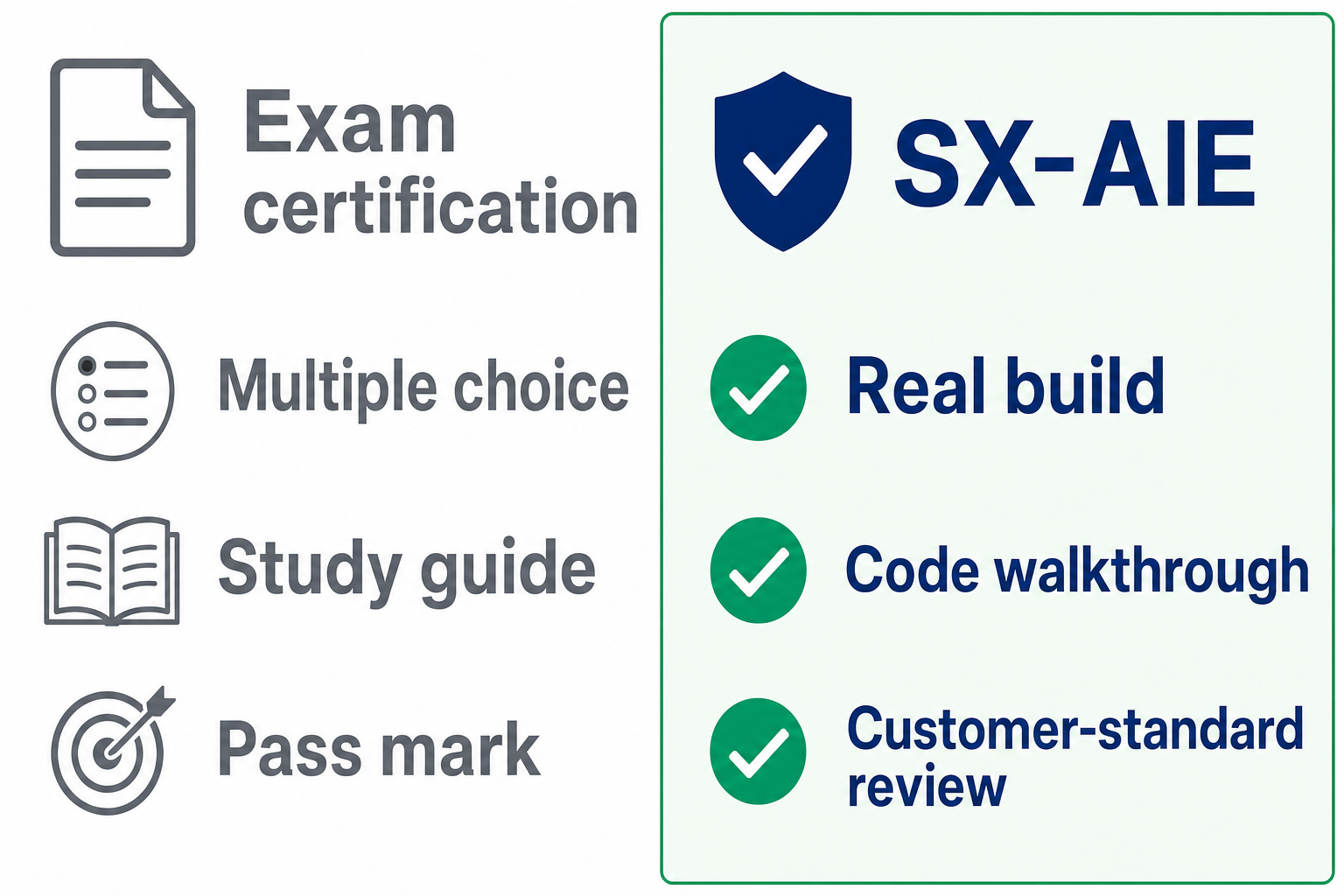
No exam. You submit your artifacts, then demonstrate them live — working solution, code walkthrough, questions on how you built it. We evaluate it as if we were your customer.
No prerequisites. Anyone can apply. If you can do it, you can do it. The AI Master's Program teaches the capability and includes the assessment.
$1,950 standalone, or $2,450 with retake insurance. Included at no extra cost with the AI Master's Program.
Why it matters: employers are advertising real AI-driven security roles paying up to $22000K for exactly this capability — see a sample of the listings.
What the SX-AIE certifies
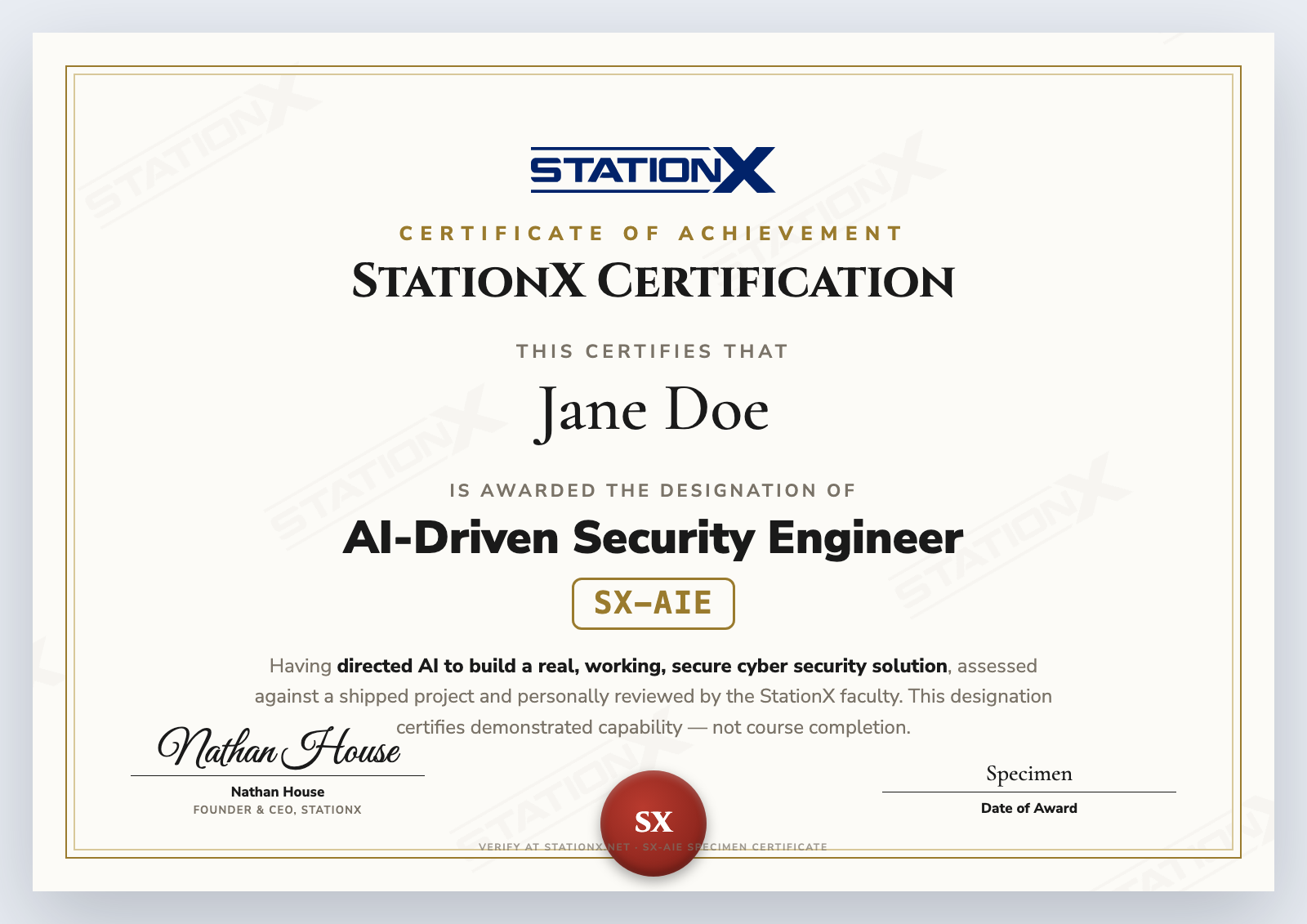
Most certifications certify that you passed an exam. This one certifies that you built something. To earn the SX-AIE you have to demonstrate two things, and both have to survive scrutiny:
Your own AI infrastructure
A persistent system you built and operate yourself, covering the seven parts we teach: structure (the files it lives in), identity (who it is), memory (what it keeps between sessions), skills (what it knows how to do), work (agents and automation doing real jobs), interface (how you reach it), and governance — guards on what it may do and validation that its output is right. The reference example is HAL, the AI infrastructure that runs most of StationX. Using ChatGPT well is not infrastructure; a system that makes every project faster than the last one is.
Real, secure solutions built through agentic engineering
A solid, working security solution of genuine significance — or several smaller ones — built by directing AI, solving real problems for real users. Commercial-grade, security-reviewed, and rigorous. Fictional projects and portfolio theatre don't qualify, no matter how polished.
That combination is deliberate. The infrastructure proves you can keep building; the solutions prove what you build holds up.
One without the other doesn't pass.
⚠️ This is an advanced certification. There are no prerequisites — the assessment is purely capability-based — but the bar is a commercial standard. If you're starting from zero, the honest route is to build the capability first.
Why this certification exists
Security hiring has quietly repriced. We've been capturing real job listings from named employers where AI, LLM, or agentic tools are part of how the security work gets done. It's a sample with evidence rather than a job board: every listing archived with the full posting and a screenshot. The ceilings run to $22000K: Bridgewater Associates advertised a Staff AI Agentic Security Engineer at $450K–$600K, and postings from Anthropic, Amazon, Capital One, Notion, and Stripe name tools like Claude Code and MCP directly in their requirements.
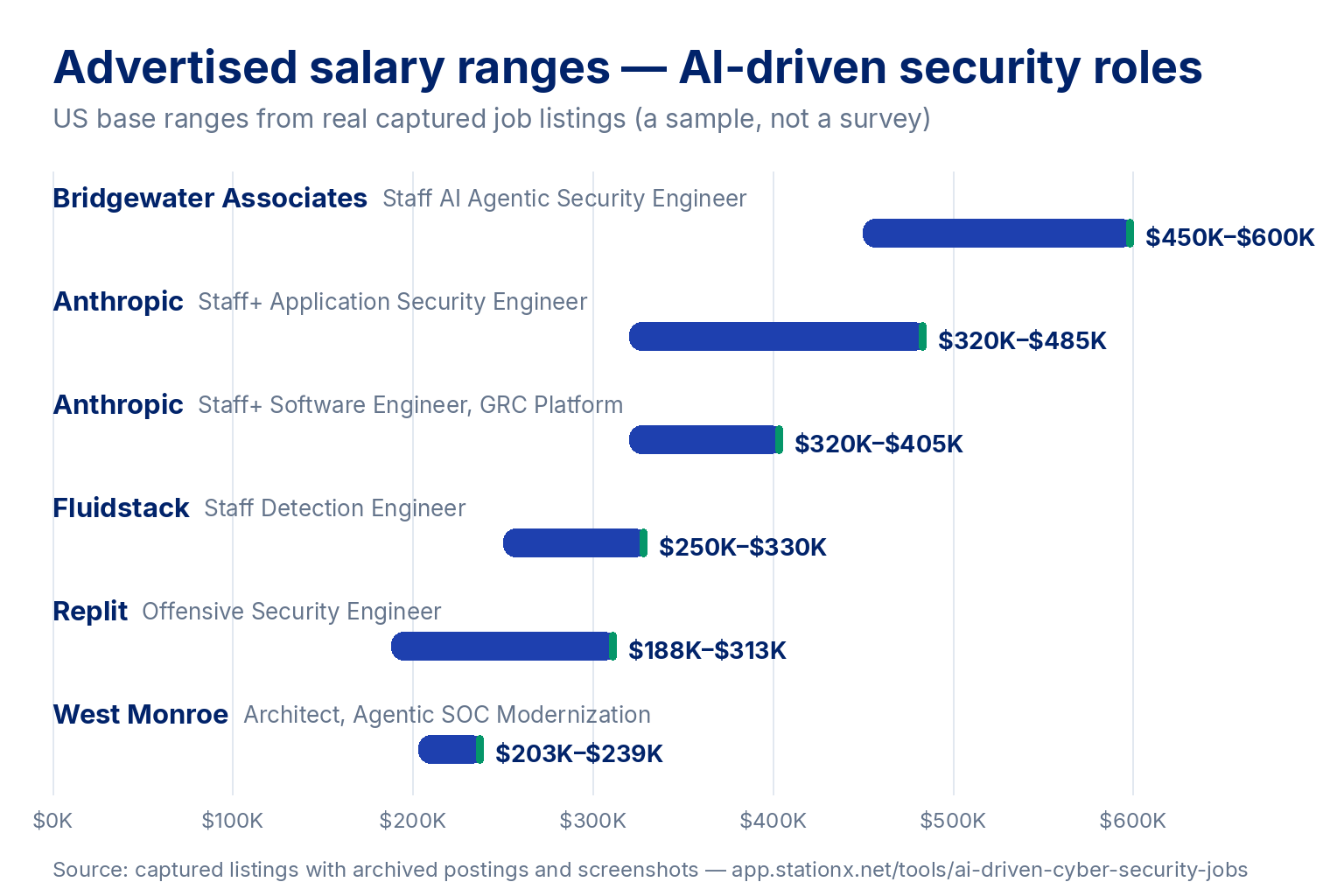
In 30 years in this industry I haven't seen a skill set reprice this fast. And the striking part is that the job titles haven't caught up: most of these roles are still called Security Engineer or Detection Engineer. The capability the market is paying for doesn't have a widely recognised name or a credential behind it yet.
The SX-AIE is that credential. It says, with evidence behind it: this person can direct AI to design, build, secure, and ship the kind of solutions those employers are hiring for.
How the assessment works
The assessment model is simple to state and hard to game: we evaluate your work the way a customer of your solution would. Not "did you follow the syllabus" — would someone pay for this, trust it, and run it?
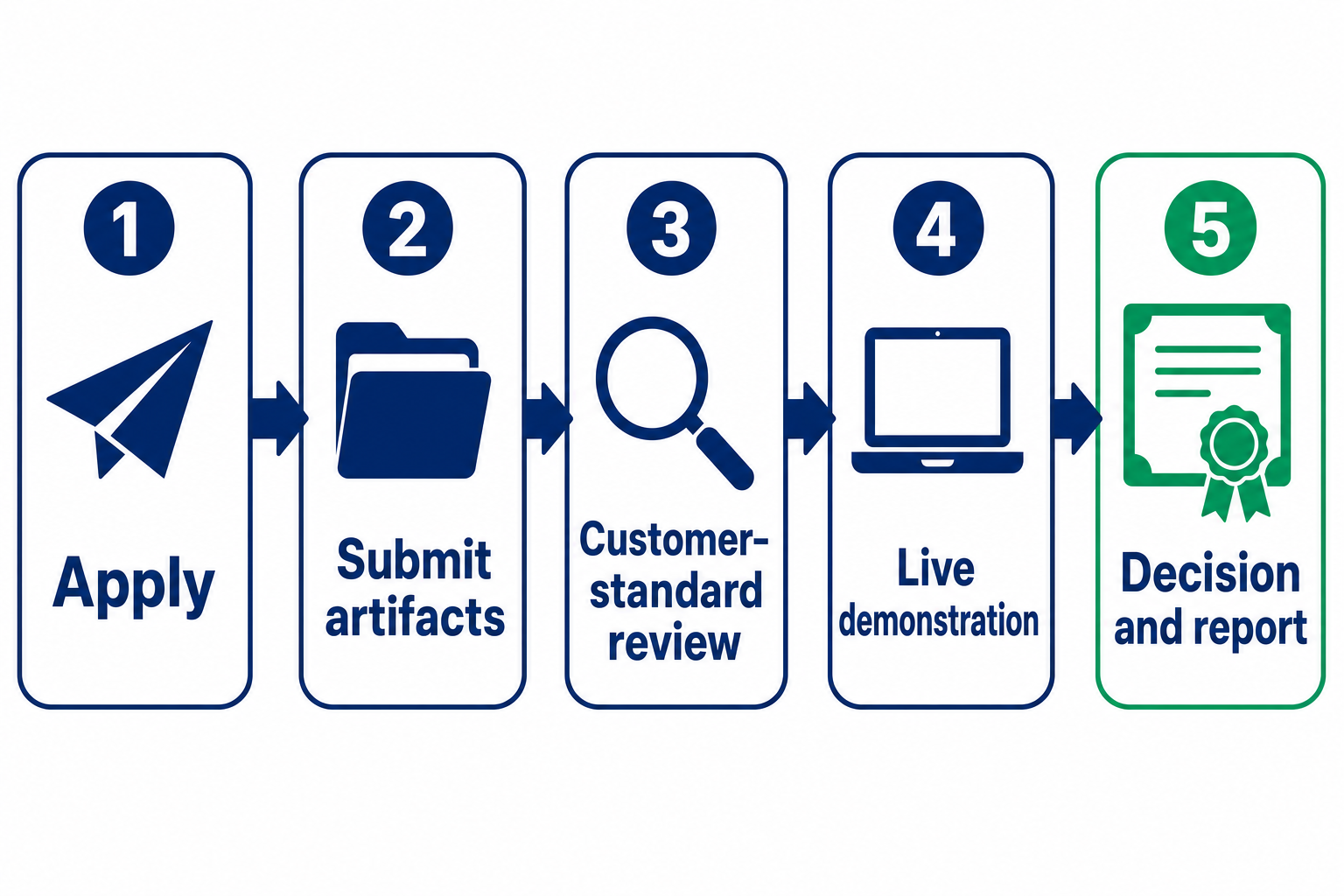
Apply
Tell us who you are and what you've built. We'll confirm your build is in scope before you commit to anything.
Submit your artifacts
The solution(s) with source code, your AI infrastructure, and the documentation that shows your engineering rigor — how it's secured, tested, and deployed.
Review
We go through your submission as a customer would: does it solve a real problem, is it genuinely secure, does the engineering hold up under inspection?
Demonstrate
A live call — sometimes more than one. You show the solution and the infrastructure behind it working, walk through the code, and answer questions about how and why you built it the way you did.
Decision
Pass: certificate, assessment report, and your entry on the StationX registry. Not yet: written feedback on exactly why, so a retake is a targeted fix rather than a guess.
💡 What fails a submission. Three things, in practice: solutions that don't solve a real problem, solutions with security weaknesses, and solutions that skipped proper engineering rigor. Every failed assessment comes with feedback naming which one — and where.
Using AI to build your submission is the point of the certification. We judge the shipped outcome and how well you command it. You must be able to explain and defend every part of what you submit, and if AI built something you don't understand, the call will find out.
What kind of build qualifies
The builds that qualify are the builds the AI-driven security roles are hiring people to produce. A single solution of significant scope, or several smaller ones — what matters is that each solves a real problem, for real users, to a standard you'd defend commercially. These are examples, not an exhaustive list:
Agentic SOC & detection. LLM triage agents, detection pipelines that generate and maintain their own rules, automated response playbooks — the modern SOC's engine room.
Offensive security tooling. AI-assisted testing harnesses, vulnerability-hunting agents, red-team automation that finds and proves exploitable weaknesses.
AppSec & vulnerability management. Continuous review pipelines across code, infrastructure, and cloud. My own example: Titus — AI-powered vulnerability management for fintech, reviewing every commit, every day.
GRC & compliance automation. Evidence generation, control monitoring, risk workflows — the compliance work AI agents now do continuously instead of quarterly.
Network security solutions. LLM-driven firewall management, traffic analysis, network monitoring and response tooling.
And what you build is yours. You keep full commercial rights to everything you submit — some candidates will finish with both the credential and a product they can sell. Your submission is covered by a non-disclosure agreement, so showing us your work doesn't compromise it.
Those five examples map directly onto the role categories in the job listings. If your build sits outside them and solves a real security problem to the same standard, apply anyway; the categories describe the market, they don't limit the assessment.
Are you ready to apply?
An honest self-check before you spend $1,950. We also confirm your build is in scope at application, before you commit to anything — but you can get most of the way there yourself:
Likely ready
You run your own AI infrastructure daily — persistent memory, reusable skills, agents doing real work — and it covers most of the seven parts above.
You've shipped at least one working, secure security solution with it that real people use, or that you could credibly sell.
You could walk a stranger through the code and defend every design and security decision without notes.
Your builds have been through real engineering rigor: tested, security-reviewed, deployed.
Not yet
Your AI use is prompting in a chat window — however skilled.
Your projects are tutorials, lab exercises, or portfolio demos without a real problem behind them.
AI wrote code you couldn't explain line by line under questioning.
Nothing you've built has been tested, security-reviewed, or deployed anywhere real.
In the "not yet" column? That's not a rejection; it's a curriculum. The AI Master's Program exists to build exactly this list.
Two routes to the SX-AIE
Apply directly
You've already built your infrastructure and your solutions. No program required, no prerequisites — if you can demonstrate the capability, you can earn the credential. Apply, submit, demonstrate.
Build the capability first
The AI Master's Program is where I teach this: you build your own AI infrastructure and ship real solutions with mentorship and supervised project work — and the program stays open until you've earned the SX-AIE. The assessment is included.
What you get — and how it stays credible
Certificate and assessment report. The certificate plus a short report of what you built and demonstrated — something concrete to put in front of an employer or client, beyond a logo on a profile.
The StationX registry. Certified engineers are listed on the StationX registry, so the credential can be verified — and StationX will act as a reference for holders.
Yearly resubmission. The credential stays current through a yearly resubmission of what you're working on — a light-touch check that you're still building, in the spirit of CPEs. $150 per year.
The credibility model matters more than the paper. The SX-AIE is new, and I won't pretend otherwise: nobody hiring today grew up respecting it. What earns a new certification respect is a real deliverable, reviewed by a human who has done the work themselves, with a bar people genuinely fail. I assess these personally against the same standard I hold my own products to, and I've shipped a fair few of them. That's also why every holder gets the report, the registry entry, and StationX as a reference: the evidence carries the credential while the name earns its history.
Pricing
Assessment
$1,950
Full assessment: submission review, live demonstration call(s), decision with feedback. A retake, if you need one, is charged at the full fee again.
Assessment + Retake Insurance
$2,450
The same assessment, plus one full retake already covered if your first submission doesn't pass. Without it, a retake is a fresh $1,950 assessment fee.
AI Master's Program
Included
The assessment comes at no extra cost with the AI Master's Program — the paid mentorship program that teaches this capability. The mentorship, the builds, and the assessment are one path. Program details & pricing →
Frequently asked questions
Is there an exam for the SX-AIE certification?
No. There is no multiple-choice exam and no lab flags. You submit the artifacts of what you have actually built — your AI infrastructure and your security solution or solutions — and then demonstrate them on a live call: showing them working, walking through the code, and answering questions about how and why you built things the way you did.
Do I need to join the AI Master's Program to earn the SX-AIE?
No. The SX-AIE is a standalone credential. If you can demonstrate the capability, you can earn it — apply directly. The AI Master's Program is the route for people who want to be taught the capability, with mentorship and supervised project work; the assessment is included for program members.
What are the prerequisites for the SX-AIE?
There are none. The assessment is purely capability-based. No degree, no prior certifications, no minimum years of experience. What you have built and how you built it are the only things assessed. It is an advanced certification, though, and the bar is a commercial standard.
What do I actually submit for assessment?
The artifacts of your work: your security solution or solutions with source code, your own AI infrastructure, and enough documentation to show the engineering rigor behind them — how the solution is secured, tested, and deployed. After the submission review, you demonstrate everything live on a call or calls.
What counts as a qualifying solution?
A working, secure security solution that solves a real problem — the kind of build the AI-driven security roles now advertise for. One solution of significant scope qualifies, and so does a portfolio of smaller ones, as long as each solves a genuine problem for genuine users. Fictional or toy projects do not qualify, however polished.
Can I use AI to build my submission?
Directing AI to build it is the entire point. The SX-AIE certifies that you can drive AI agents to produce commercial-grade, secure work — so we assess the outcome and your command of it; nobody is checking who typed which line. What you must be able to do is explain and demonstrate everything you submit.
Can I submit work I built for my employer?
Generally, no — submit work you own. The assessment is of you as an individual, so employer-owned and team-built work is best avoided: it is usually not yours to share, and it makes your personal capability hard to isolate. Most candidates build their own solutions, and that is an advantage — everything you build for the SX-AIE is fully yours, with complete commercial rights, and you can sell it afterwards if you wish. Your submission is covered by a non-disclosure agreement, so what you show us stays between us.
How long does the SX-AIE assessment take?
There is no fixed timeline, because it genuinely depends on the scope of what you submit and how the review and demonstration calls go. What we do fix: your build is confirmed as in scope at application, before you commit to anything.
What happens if I fail the SX-AIE assessment?
You get written feedback on exactly why: typically a solution that does not solve a real problem, security weaknesses, or missing engineering rigor. You can retake the assessment at the standard fee, or — if you chose the retake-insurance option when you applied — your retake is already covered.
How do employers verify an SX-AIE holder?
Certified engineers are listed on the StationX registry, and StationX will act as a reference for the credential. Every holder also receives a certificate and an assessment report summarising what they built and demonstrated.
Does the SX-AIE certification expire?
The credential stays current through a yearly resubmission of what you are working on — a light-touch check, in the spirit of CPE requirements, that you are still building. The resubmission fee is $150.
Apply for the SX-AIE assessment
Tell us what you've built. We'll confirm your build is in scope, then take you through submission and scheduling. If you're not there yet, the AI Master's Program is the route that gets you there.
We reply personally to every application. No mailing-list games.
StationX Certified AI-Driven Security Engineer (SX-AIE) — issued by StationX, assessed by Nathan House. Page current as of 2026.
About the Author

Nathan House, Founder & CEO of StationX
Nathan House has 30 years of hands-on cybersecurity experience and is Cambridge-educated, holding CISSP, CISA, CISM, OSCP, CEH, and SABSA. He founded StationX in 1999 — one of the UK’s first cybersecurity companies — and has secured £71 billion in UK mobile banking transactions and the London 2012 Olympics, advising clients including Microsoft, Cisco, BP, Vodafone, and VISA. He authored the world’s most popular cybersecurity course — a #1 Udemy bestseller taken by over 500,000 students — and was named Cyber Security Educator of the Year 2020, AI Security Educator of the Year, and a UK Top 25 Security Influencer 2025. A DEF CON speaker and featured expert on CNN, Fox News, NBC, and the BBC, Nathan leads StationX’s training of more than half a million students worldwide.