Will AI Kill Your Cyber Security SaaS? Score Your Moat in 10 Questions
Picture a rival with two engineers and a stack of AI coding tools. They study your product page, sign up for your trial, and rebuild the features your customers actually use in a few months. If you run a cyber security SaaS, that rival is no longer hypothetical. So the question a lot of security founders are quietly asking is this: when code gets cheap, why would a customer stay with you?
This guide gives you a way to answer that honestly. We'll look at the ten ways AI can hit a security SaaS, the old defences it is draining, and then the 10 moats that still hold, each with a real security example and a 0 to 3 score. Add them up and you'll know where you stand by the end, plus what to build next.
TL;DR if you've only got 30 seconds
AI makes copying software cheap. Features alone no longer protect a cyber security SaaS.
What still protects you lives outside the code: who recommends you, what you're trusted to do, the data only you see, and the approvals a newcomer has to wait for.
Score yourself 0 to 3 on each of the 10 moats below. Under 10 out of 30 means you have few moats yet, and 18 or more means you're defensible. A single 3 is a real moat, whatever your total.
Pick the two moats you can realistically build in the next 12 months and put them on your roadmap.
The framing owes a lot to Rob Walling, whose MicroConf Europe 2026 talk, The Only SaaS Moats Left in 2026 (co-written with Einar Vollset), asked the same question for SaaS in general. What follows is our version for security founders, scored with the defensibility test we use at StationX for any business idea.
I've seen the threat from the founder's side. At StationX we built an AI system called HAL, and one of the things it now runs is a vulnerability-hunting pipeline that sweeps tens of thousands of WordPress plugins and themes for real security flaws. It has found bugs we've been paid bounties for. If a small team can build that for itself, so can your customers and your competitors.
The 10 Ways AI Comes for a Security SaaS
Start with the threat, because you can't judge a wall until you know what's coming at it. AI hits you from two directions. On the supply side, there are suddenly far more products like yours. On the demand side, there are fewer buyers, or fewer people inside each buyer who need your product.
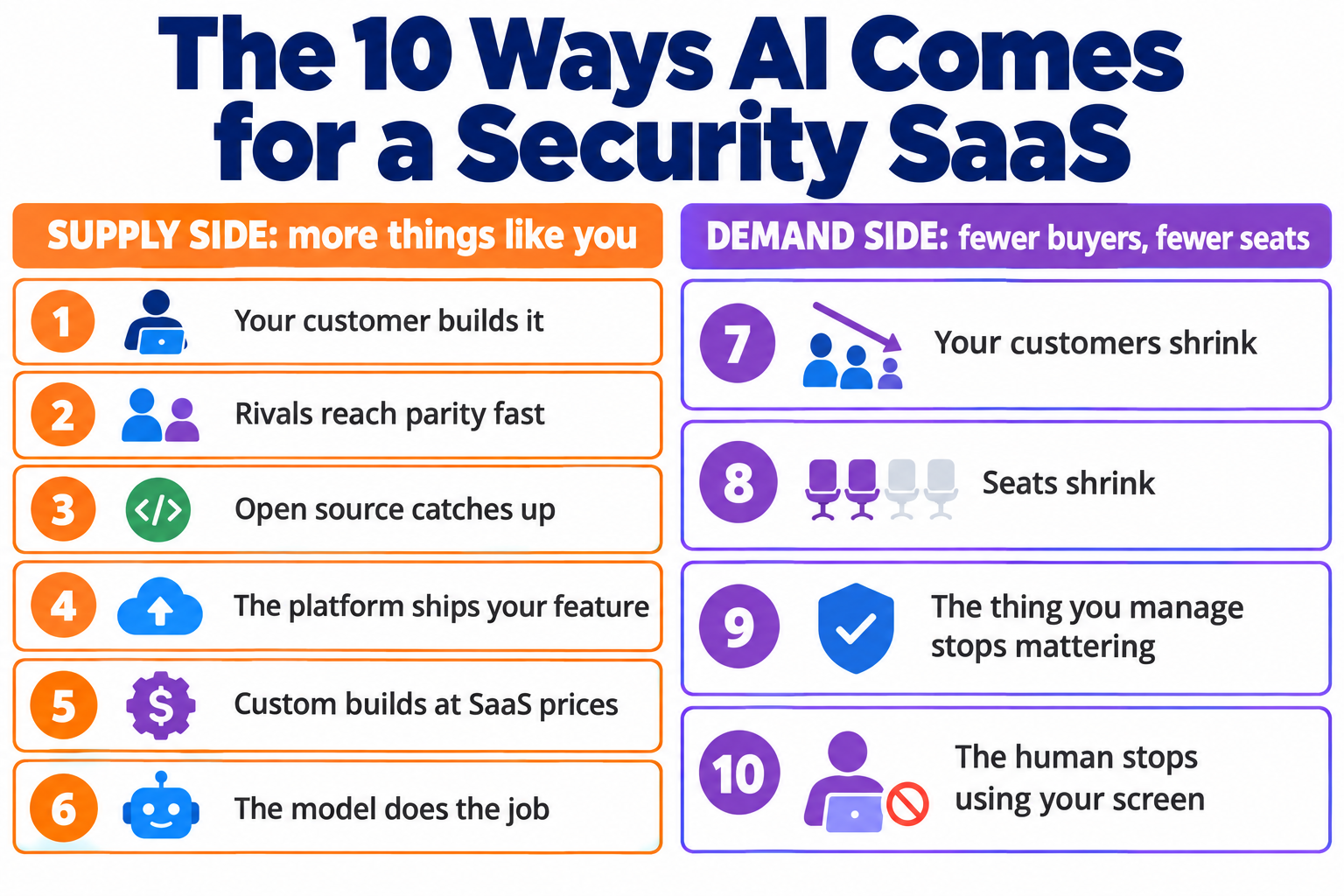
Supply side: more things like you
Your customer builds it. A security engineer with an AI assistant can now script the slice of your product their team uses. As Rob put it, customers "don't need your 50 features, they only need the three that they use."
Rivals reach parity fast. Whatever you shipped last quarter, a competitor can match next quarter.
Open source catches up. On 22 October 2026, Nuclei had 32,208 stars on GitHub, Wazuh 17,360 and Semgrep 17,175. That's a free vulnerability scanner, a free SIEM (the system that collects and searches a company's security logs) and a free code scanner, and AI makes them far easier for a small team to deploy.
The platform ships your feature. In May 2024 CrowdStrike gave every Falcon Insight customer 10 GB a day of third-party data in its SIEM for free. Microsoft's E5 plan bundles Defender, Purview and Entra ID P2, and since November 2025 it has been rolling in Security Copilot with a monthly usage allowance. If you sell something a platform can bolt on, you're one release away from being a free checkbox.
Custom builds at SaaS prices. Say a mid-sized retailer wants help sorting the phishing emails its staff report. An agency can now build it a tailored tool in weeks and run it for a monthly fee, so the retailer never needs your off-the-shelf product.
The model does the job. OpenAI launched Aardvark, an AI security researcher, in October 2025, and it became Codex Security in March 2026. Google's Big Sleep agent found its first real vulnerability in SQLite in 2024. Anthropic added an automated security review to Claude Code in August 2025. And in June 2025 an autonomous tool called XBOW reached number one on HackerOne's US leaderboard. We've watched the same shift up close in AI-driven penetration testing. If your product is "find the bugs and write them up", the model is coming for your lunch.
Demand side: fewer buyers, fewer seats
Your customers' own businesses shrink. Say you sell reporting software to small penetration testing firms. If AI lets their clients run more of that testing themselves, there are fewer firms left to buy from you.
Seats shrink. Microsoft, CrowdStrike and Google all now sell AI SOC agents (SOC meaning security operations centre) that triage alerts, the first-pass sorting a junior analyst used to do. In ISC2's May 2026 survey, 56% of security professionals using AI said it had reduced the need for entry-level roles. That points to fewer entry-level seats, not mass layoffs, but if you charge per analyst, fewer analysts means less revenue. Our AI-driven cyber security jobs tracker shows where the hiring is moving instead.
The thing you manage stops mattering. Rob's example was software for take-home coding tests. Once candidates could hand the test to AI, he said he'd rather pair-program with them live, which leaves that software with much less to manage.
The human stops using your screen. Say you sell a console where analysts click through alerts all day. If an AI agent works that queue instead, nobody logs in to admire your dashboard.
No single attack here sinks a company. Several at once can, and the old defences most of us relied on are the first thing to go.

The Moats AI Is Draining
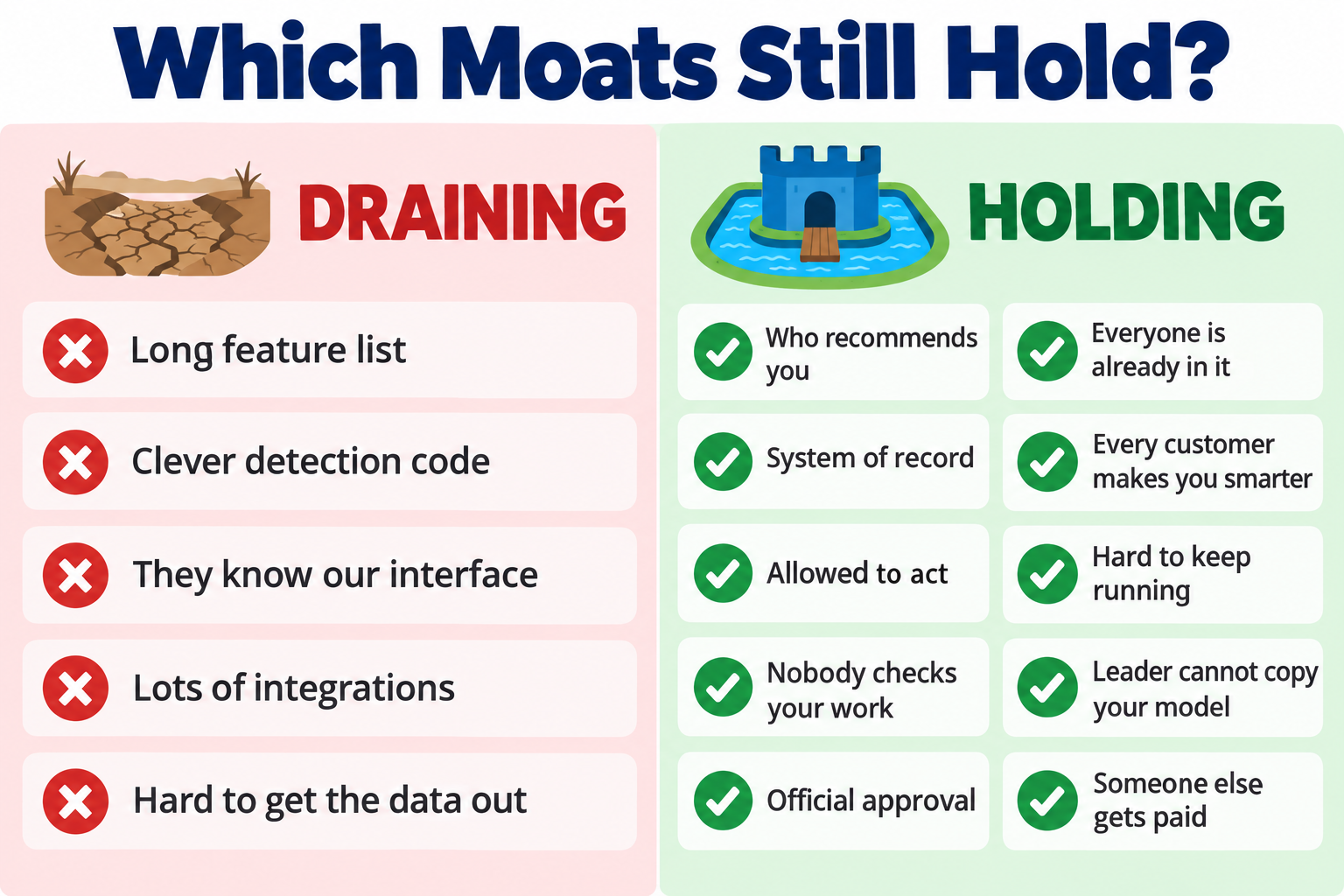
Think about why customers used to stay. Some of those reasons are now leaking:
A long feature list. Feature parity is months away for anyone with AI.
Clever detection code. Logic you spent five years tuning is easier to approximate than ever. Unless it rests on data nobody else has, it's not a moat. We covered the other half of this, AI reading finished software, in AI can copy any app now.
“They know our interface.” True while humans click buttons. Agents don't care about your UI.
Lots of integrations. An API document is now close to a spec an AI can build from.
“Hard to get the data out.” You can now point an AI at an app and have it pull the data out, even with no export button.
I made a video on the other side of this: the five kinds of software business that AI can now copy by reading the finished program, and the one-sentence test for whether yours is one of them. If your detection logic is the thing you think protects you, it's worth twelve minutes.
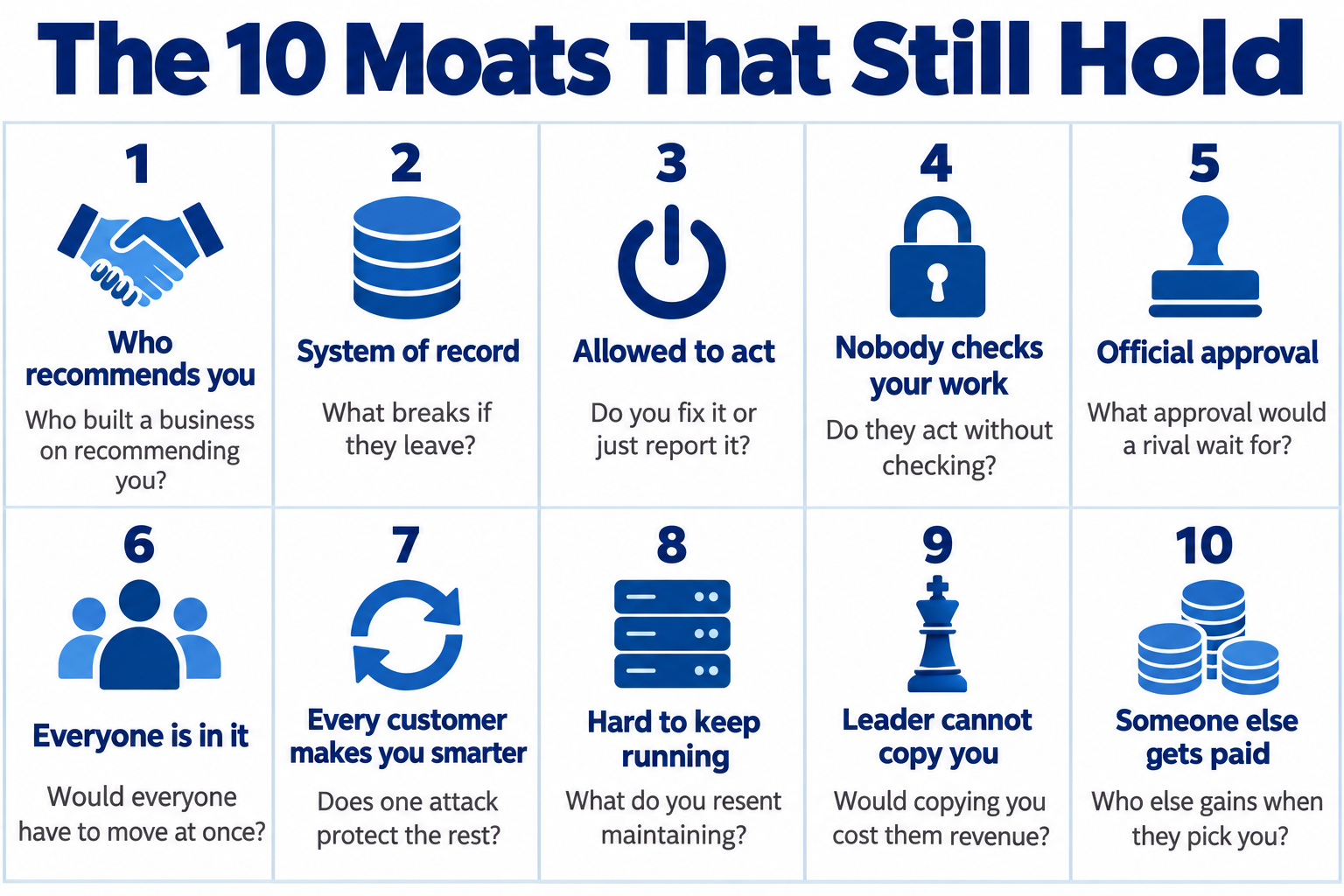
So if those old defences are going, what's left? Ten things. We'll take each one, show you a real security company that has it, and give you a way to score yourself.
How to Score Each Moat
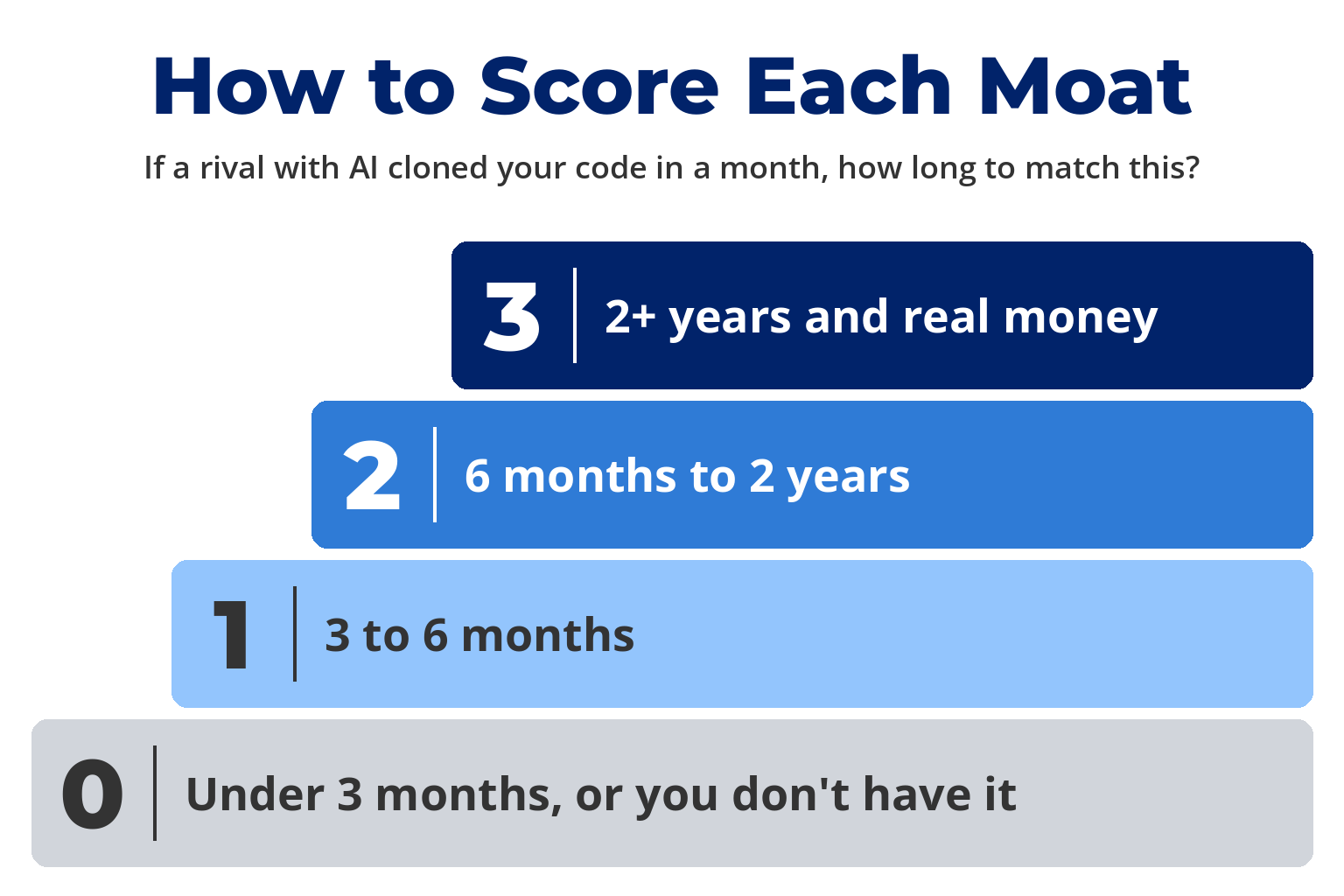
For every moat below, give yourself a score from 0 to 3. The question behind each score is our defensibility test, with an AI twist: if a well-funded rival with AI could clone your code in a month, how long would it take them to match this?
| Score | Meaning |
|---|---|
| 3 | A rival would need 2+ years and real money |
| 2 | 6 months to 2 years |
| 1 | 3 to 6 months |
| 0 | Under 3 months, or you don't have it |
Score what you have proven today, not what you could probably do. "We've done it" scores higher than "we plan to".
1. Who Recommends You?
Think about how most small businesses pick accounting software: they use whatever their accountant uses. The product matters less than the person recommending it.
In security, the people recommending you are managed service providers (MSPs), managed security providers (MSSPs), resellers and consultants. Huntress grew up selling through exactly that route. Its own site calls it “a managed security partner for MSPs”, and it still runs a reseller programme alongside selling direct. A rival can copy the agent. They can't copy thousands of MSPs who have built their service around it.
AI stress test: survives. A cloned product still has to win every one of those partners one at a time.
Score it:
0 = nobody recommends you but you
1 = a few friendly partners
2 = a partner channel that brings in a real share of revenue
3 = partners have built their business or career on recommending you
Build it: pick one channel (MSPs, a consultancy network, a compliance auditor community), give them margin and training, and make them look good to their clients.
2. Are You the System of Record?
Your bank holds your balance. You could check it in a spreadsheet, but the bank's number is the one that counts. A system of record is the place a company treats as the truth.
For a security team, that's often the SIEM, where years of logs, detections and investigations live. Cisco paid about $28 billion for Splunk, completing the deal on 18 March 2024, and Splunk describes its product as a market-leading SIEM. Identity is the other big one: Okta describes itself as the platform that “puts identity at the heart of your stack”. Leaving either means migrating history, audit trails and every system wired into it.
AI stress test: survives. AI can export tickets in an afternoon. It can't make twelve teams agree to move on the same weekend.
Score it:
0 = customers could swap you out in a day
1 = some history lives with you
2 = daily work runs through you
3 = other systems read from you, and leaving breaks things downstream
Build it: ask “what do customers have to rebuild if they leave?” and grow that list: history, approvals, audit trails, the integrations that read from you.
3. Are You Allowed to Act?
There's a difference between a smoke alarm and a sprinkler. One tells you about the fire. The other puts it out.
A vulnerability scanner that emails a PDF is a smoke alarm. An EDR (the security agent on each laptop that watches for attacks) that can cut an infected laptop off the network is a sprinkler. CrowdStrike's API has a contain action that “stops any network communications to locations other than the CrowdStrike cloud” and the addresses an admin allows. Abnormal automatically removes malicious emails from inboxes, often before anyone opens them. And when a record flood of junk traffic hit Cloudflare's network, a DDoS attack of 31.4 terabits per second, it was “detected and mitigated automatically”.
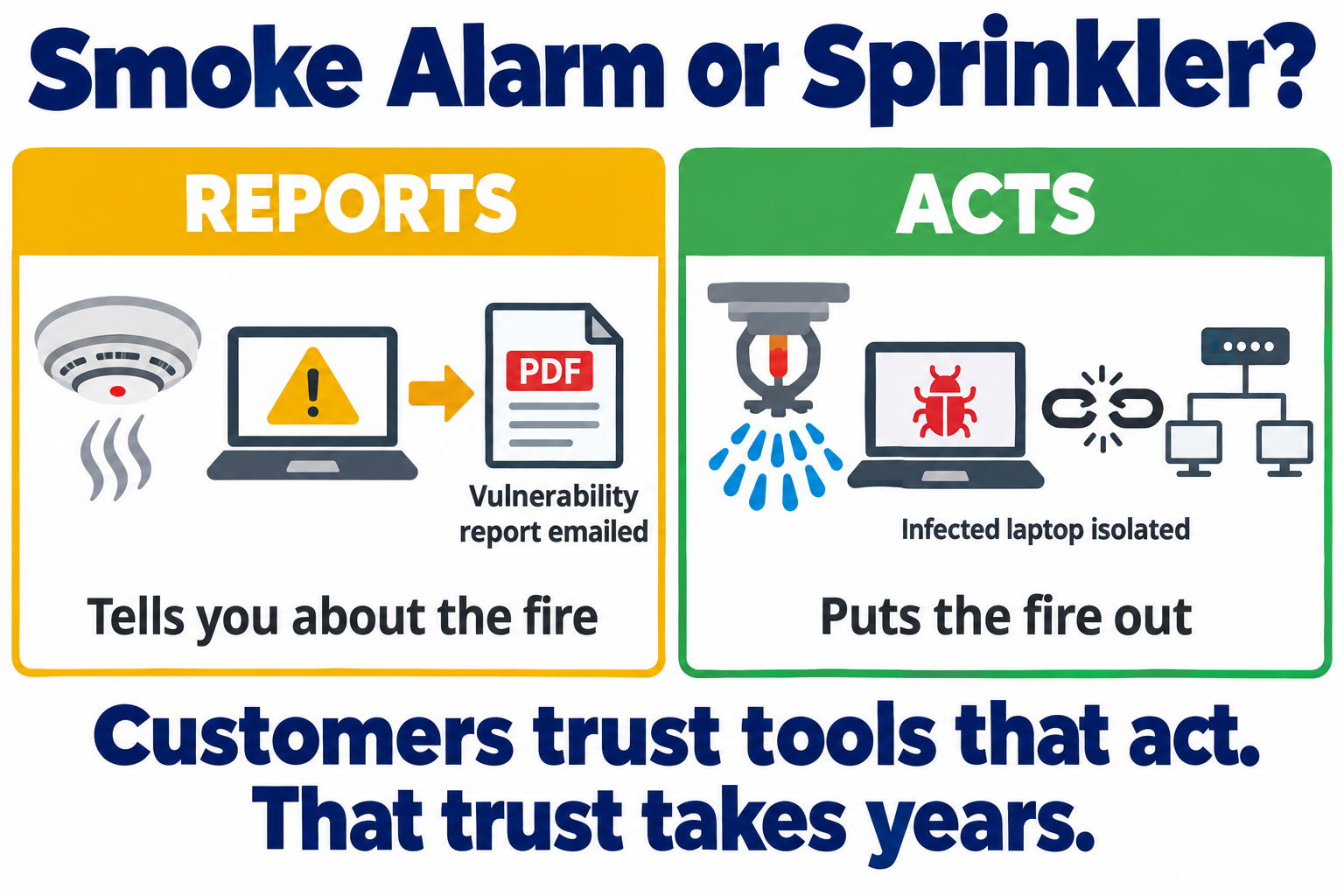
AI stress test: survives. Customers only hand the off switch to a tool they've trusted for a while, and that trust takes years to earn.
Score it:
0 = you only report
1 = you suggest fixes
2 = you act with a human approving
3 = customers let you act on your own, in production
Build it: find the one action your customers do by hand after reading your report, and offer to do it for them, behind an approval step at first.
4. Does Anyone Check Your Work?
Most of us never check our payroll provider's tax maths. We just trust it, because it has been right for years.
In security, the clearest example is a certificate authority: the organisation that vouches a website is who it claims to be, which is why your browser shows the padlock. Let's Encrypt's root certificate has been in browser trust stores since late 2016, and its trust is “nearly ubiquitous”. Every day, browsers accept its certificates automatically. A new authority with identical code would start with zero trust. That trust can be withdrawn, though. Let's Encrypt's own docs note that root programmes can terminate it, so this is a moat you keep earning.
AI stress test: survives. AI can copy the output, but not a decade of being right.
Score it:
0 = customers double-check everything you produce
1 = they spot-check
2 = they act on your output most of the time
3 = they act on it without checking, and so do third parties
Build it: publish your accuracy, keep a record of being right, and get your output accepted by someone downstream, such as an auditor, an insurer or a regulator.
5. Has Someone Official Already Said Yes?
A newcomer can build a better taxi app overnight. They can't conjure up a taxi licence.
Security has plenty of these approvals:
FedRAMP for selling cloud services to the US government. Its new FedRAMP 20x route issues “Certifications” and no longer needs a government agency to sponsor you. The older Rev5 route stops taking new certifications on 11 June 2027.
PCI ASVs. Companies that run the external scans card merchants need must be approved by the PCI Security Standards Council and re-approved every year.
CREST accreditation for penetration testing companies.
CMMC for US defence suppliers. The Pentagon's contract rule took effect on 10 November 2025, and under its three-year phased rollout, the second phase begins on 10 November 2026.
Cyber Essentials, the UK government-backed security certification, delivered through IASME, the NCSC's official delivery partner.
⚠️ One honest caveat: SOC 2 (an auditor's report that your security controls work) slows a rival down without stopping them. Plenty of companies have it. It matters most when the approval is hard to get, limited in number, or required by law.
AI stress test: survives. Code can be cloned in a month. An approval process can't be.
Score it:
0 = no approvals needed in your market
1 = common ones, like SOC 2 or ISO 27001 (the international security management standard)
2 = an approval that takes 6 months to 2 years to win
3 = an approval that is hard to win, renewed regularly, and required by your buyers
Build it: find the approval your best buyers are required to look for and start the process early. It's slow, and slow is the point.
6. Is Everyone Already in It?
You can't leave a WhatsApp group chat without leaving the people in it, and the people are why you joined.
Bug bounty platforms work like this on two sides at once. HackerOne says it has “over 2 million” researchers and more than 1,200 customers. The researchers go where the programmes are, and the programmes go where the researchers are. A rival with better software would still have to move both crowds at once.
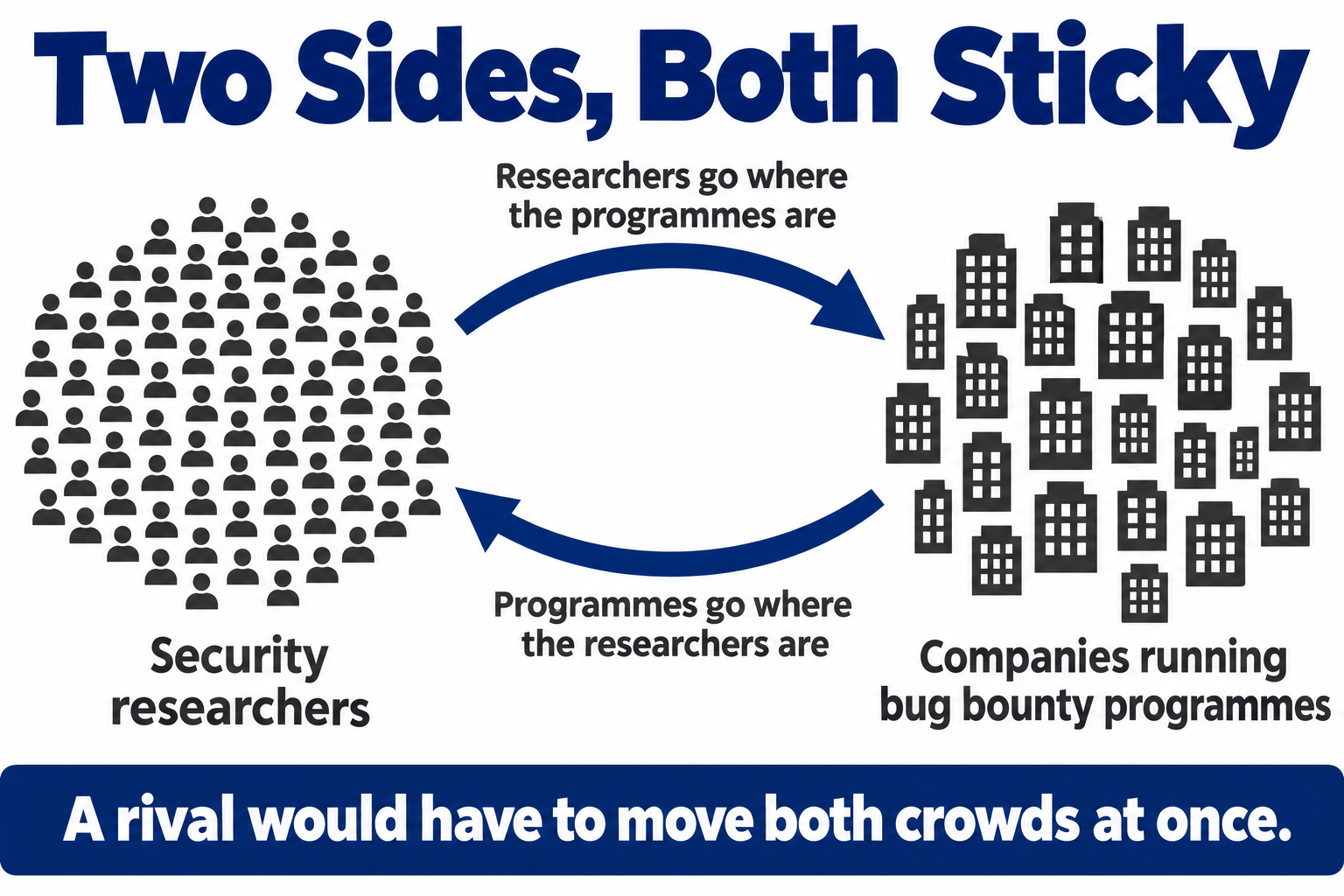
AI stress test: survives. Software is cheap to copy. A crowd isn't.
Score it:
0 = one person uses you
1 = one team
2 = a whole company, or two sides that need each other
3 = a whole community or market would have to move together
Build it: add the second person. Shared dashboards, partner and client views, or a community around your data all turn a single-user tool into something a group depends on.
7. Does Every Customer Make You Smarter?
Waze gets better at finding traffic jams because every driver feeds it. One driver alone could never build that map.
In security, this is threat intelligence that learns across every customer. CrowdStrike's Threat Graph processes “more than a trillion events per day” and says it uses the network effect to protect everyone against a new threat. Cloudflare proxies “approximately 20% of the web”, and every request it sees strengthens its machine learning.
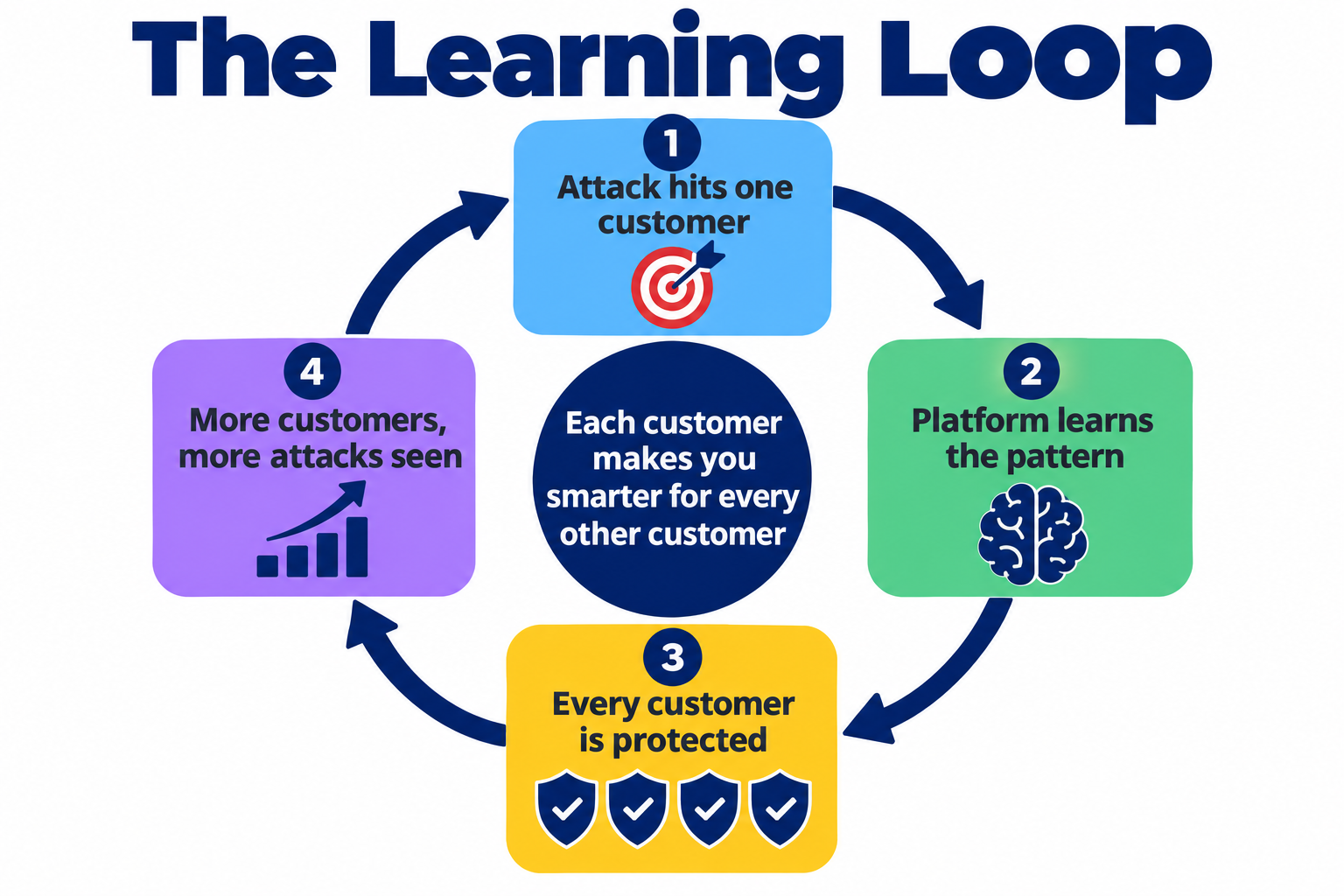
Rob's talk adds three gates this moat has to pass, and they're worth keeping:
Everyone benefits. Each customer makes the product better for every other customer, not just for themselves.
The learning stays. Customers can take their data with them, but not what you learned from it.
It keeps going. A model that stopped improving last year is just a feature.
AI stress test: survives. A rival's AI is only as good as its data, and a newcomer starts with none.
Score it:
0 = each customer's data stays separate
1 = you learn a little across customers
2 = an attack spotted at one customer protects the rest
3 = your detection is measurably better because of your customer base, and keeps improving
Build it: look at what you already collect, and ask how one customer's incident could protect the next customer automatically.
8. Is It Hard to Keep Running?
Anyone can build a website. Keeping one online during a huge attack is a different job entirely.
Some security products are easy to write and hard to operate. A 24/7 security operations centre needs people on shift every night of the year; Huntress runs a “24/7 human-led, AI-Centric SOC”. Absorbing DDoS attacks needs a network the size of Cloudflare's: that 31.4-terabit attack in 2025 lasted just 35 seconds. Rob's best question for this moat: what do you maintain that you resent maintaining? That headache might be your moat.
AI stress test: mostly survives. AI can take on some of the work, which is why Huntress now calls its SOC AI-centric, but someone still has to carry the pager.
Score it:
0 = anyone could host it
1 = it takes real operational care
2 = it needs round-the-clock people or infrastructure
3 = it needs scale a newcomer can't afford
Build it: take on the unglamorous operating work your customers hate doing themselves, and get very good at it.
9. Can the Leader Copy Your Model Without Hurting Itself?
When a big firm earns money one way, copying a cheaper rival can mean cutting its own revenue. So it often doesn't copy at all.
Penetration testing shows this well. Traditional consultancies earn day rates. Horizon3.ai sells continuous NodeZero tiers with “unlimited pentests”, and says a year of it costs about the same as one traditional engagement. SenseOn charges when an AI agent “completes an outcome, not when it attempts one”, aiming at SIEMs that charge by data volume. Dropzone sells AI analyst investigations with “No seat limit.” Outside security, Zendesk now charges only for issues its AI resolves on its own. In our view, that kind of pricing makes sense once seats start shrinking.
AI stress test: survives until the incumbent decides to eat the loss. Speed matters here.
Score it:
0 = you price and deliver like everyone else
1 = slightly different
2 = the leader would lose revenue copying you
3 = the leader would have to rebuild its whole business model
Build it: look at how the market leader earns its money and ask what pricing or delivery it can't match without hurting itself.
10. Does Someone Else Get Paid When They Pick You?
If your insurer gives you a discount for using a particular alarm company, that alarm company has a sales team you never see.
Security has a few of these routes now. Coalition offers a UK premium discount for three hand-selected MDR services, where an outside team watches your systems around the clock. Cowbell's Rx programme offers pre-negotiated discounts of up to 60% on tools such as CrowdStrike. Microsoft's security partner association, MISA, is “by nomination only”. And AWS account managers receive incentives when partner software sells through AWS Marketplace.
AI stress test: partly survives. Partnerships end and new vendors get added, so treat this as a strong accelerator rather than a wall.
Score it:
0 = nobody else benefits when a customer picks you
1 = a listing in a marketplace
2 = a partner actively steers customers to you
3 = an exclusive or hard-to-get position (an insurer's shortlist, a nomination-only programme)
Build it: list who else gains when your customer is safer (insurers, cloud platforms, auditors) and make it easy for them to recommend you.
Score Yourself
Add up your ten scores to get your SaaS moat score out of 30. Be harsh. If you're between two numbers, take the lower one.
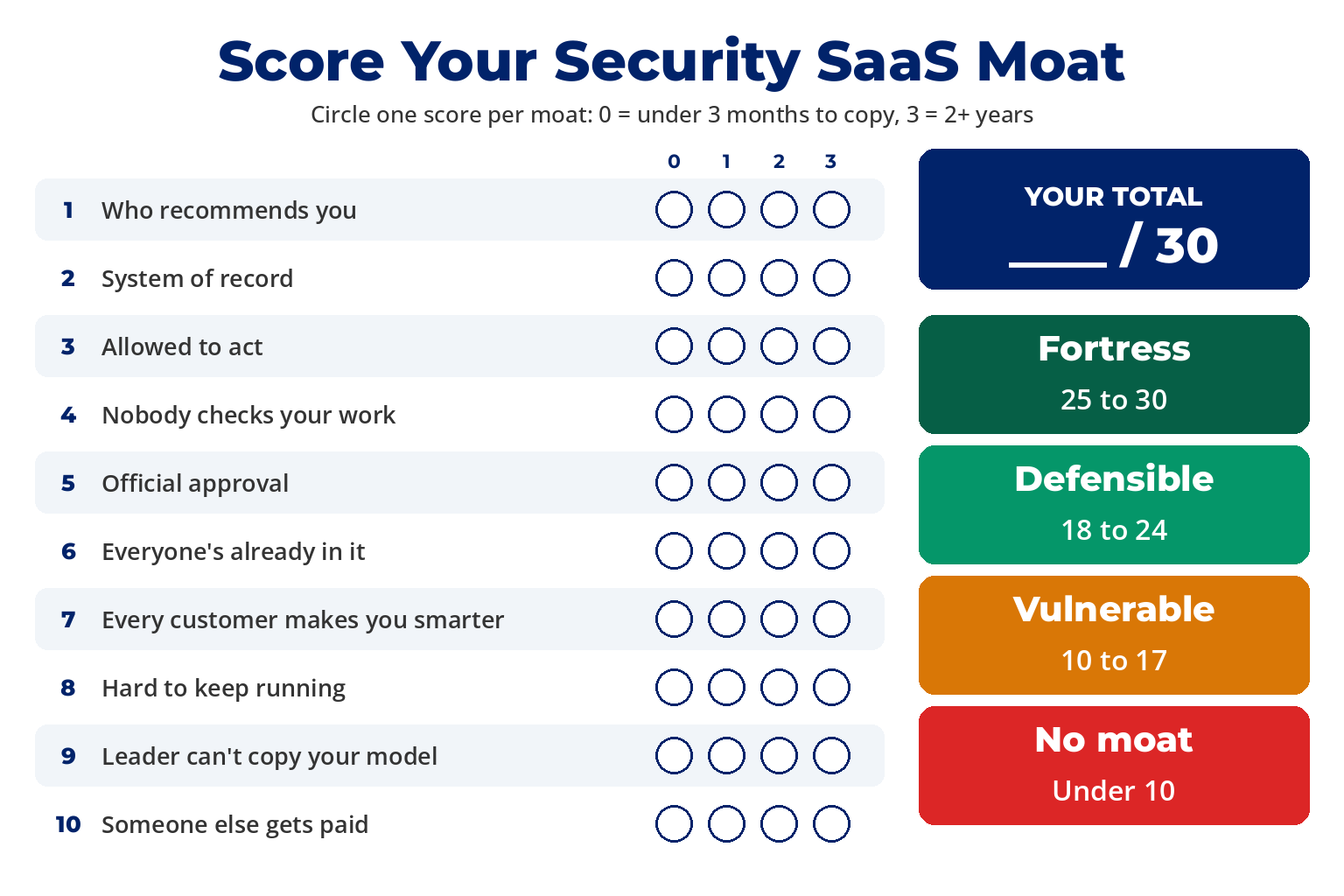
| Total | What it means |
|---|---|
| 25 to 30 | Fortress. Several strong moats. Keep investing in them. |
| 18 to 24 | Defensible. Two or three real moats. Most good businesses live here. |
| 10 to 17 | Vulnerable. Your moats are few or thin. Build moats now. |
| Under 10 | No moat. You're competing on features, and features are getting cheap. |
Read your top scores as well as the total. A single 3 is a real moat even if the total is low, because it's the one thing a rival with AI can't copy quickly. A low first score just tells you what to build next.
Your 5-Step Moat Plan
Score honestly. Use evidence (“we've proven”) rather than hopes (“we could”). Ask a customer or an investor to score you too.
Pick two. Choose the two moats you can realistically move by a full point in the next 12 months. Nobody has all ten.
Use the move map. Most security products can step from where they are to the next moat along, as the move map after these five steps shows.
Set one milestone per moat. Make each one measurable: “30% of revenue through MSP partners”, “auto-containment turned on by 50 customers”, “ASV approval by June”.
Re-score every quarter. Moats wear away. A score you don't re-check is just a hope.
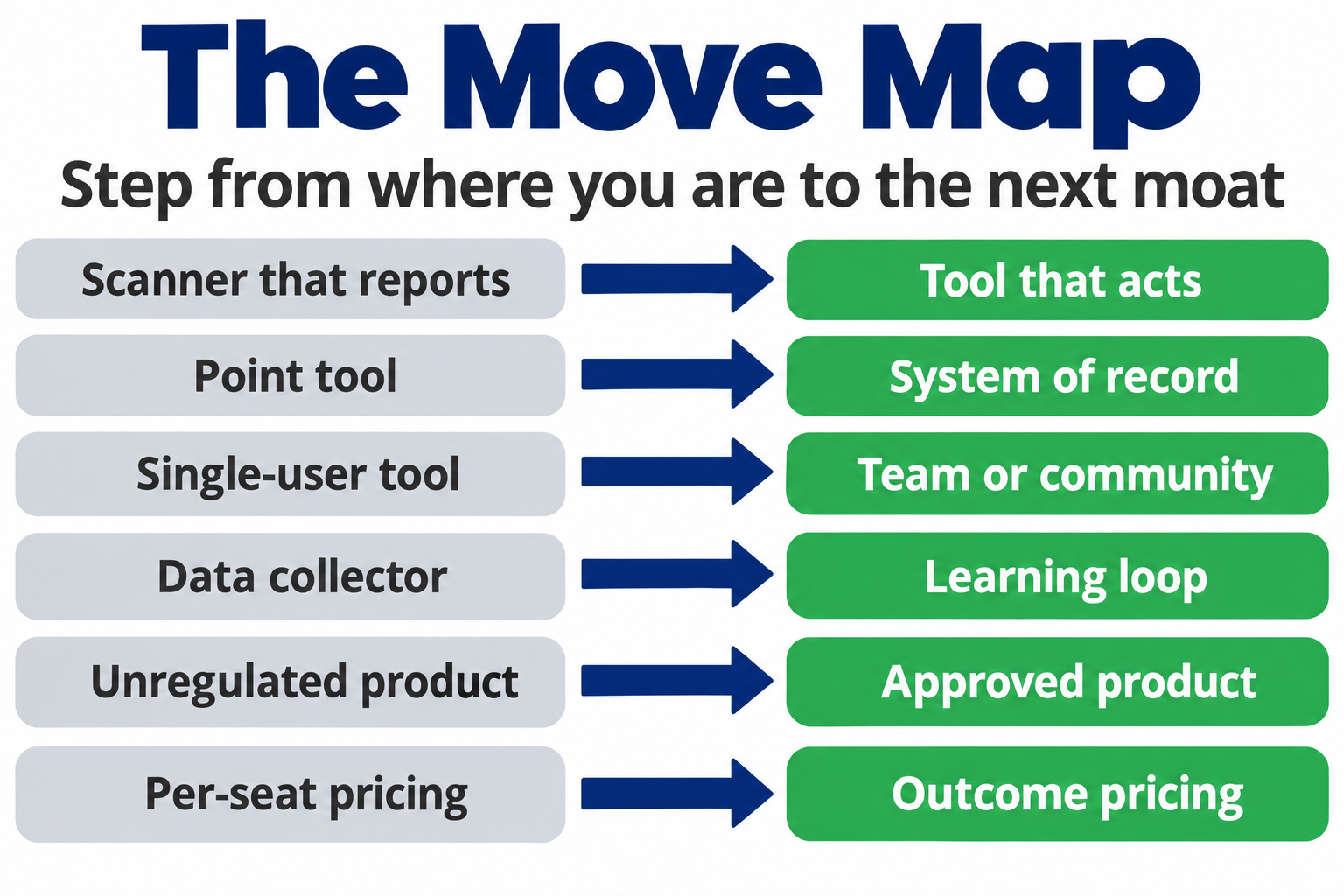
A scanner that reports becomes a tool that acts.
A point tool becomes the system of record for that job.
A single-user tool becomes something a whole team or community shares.
A data collector becomes a learning loop across customers.
An unregulated product becomes an approved one.
Per-seat pricing becomes outcome pricing the leader can't match.
If you want to see what a small team can now build with AI, and so what your rivals can too, our AI-driven engineering page shows how we work. The founders who come through the next few years in good shape won't be the ones with the most features. They'll be the ones customers can't easily leave, even when a perfect copy is a free trial away.
Frequently Asked Questions
Is SaaS dead because of AI?
No. Rob Walling's own estimate is that somewhere between 10% and 20% of SaaS companies will decline or go to zero. That's painful, but it's a long way from all of them. The ones at risk are the ones whose only defence was their feature list.
Is SOC 2 a moat?
On its own, not much of one. Most serious competitors can get it within a year, so it slows a rival down without stopping them. Approvals that are slow, limited or legally required (FedRAMP, PCI ASV, CMMC) are far stronger.
Can a small cybersecurity startup have any of these moats?
Yes. Being allowed to act, being hard to keep running and having a partner channel are all within reach of a small team. Network effects and learning loops usually take longer.
Does open source kill my product?
Only if your product is mostly code. Open source gives away the software. It doesn't give away the 24/7 operation, the approvals, the trust or the cross-customer data.
What's the strongest moat for a security company?
In our view, being allowed to act combined with every customer making you smarter. A tool customers trust to stop attacks on its own, and which gets better with every customer, is very hard to copy with code alone.
How often should I re-score?
Every quarter, and whenever a platform you depend on announces something new.
About the Author

Nathan House, Founder & CEO of StationX
Nathan House has 30 years of hands-on cybersecurity experience and is Cambridge-educated, holding CISSP, CISA, CISM, OSCP, CEH, and SABSA. He founded StationX in 1999 — one of the UK’s first cybersecurity companies — and has secured £71 billion in UK mobile banking transactions and the London 2012 Olympics, advising clients including Microsoft, Cisco, BP, Vodafone, and VISA. He authored the world’s most popular cybersecurity course — a #1 Udemy bestseller taken by over 500,000 students — and was named Cyber Security Educator of the Year 2020, AI Security Educator of the Year, and a UK Top 25 Security Influencer 2025. A DEF CON speaker and featured expert on CNN, Fox News, NBC, and the BBC, Nathan leads StationX’s training of more than half a million students worldwide.