Every CompTIA SecAI+ Objective Explained
In December 2023, a Chevrolet dealership's website chatbot agreed to sell a 2024 Chevy Tahoe for one dollar. Nobody broke into a server. A user simply typed instructions into the chat box, and the bot followed them. That attack has a name, prompt injection, and it is one of 23 attack types on CompTIA's new SecAI+ exam objectives.
I went through every objective on the SecAI+ exam (CY0-001). Below you'll find all four domains, what each objective actually means, the real incidents behind them, free tools to practise with, and homework you can start tonight.
Updated since the video
In the video I quote $359 for the exam. When we checked in October 2026, CompTIA's US list price was $298 (prices change and vary by country). I also mention a $76,000 price for the Tahoe; the reliable reports only say a 2024 Chevy Tahoe, so this page leaves the figure out. Where the video and this page differ, this page is current.
TL;DR: if you've only got 30 seconds
4 domains, 11 objectives. Up to 60 questions in 60 minutes, pass mark 600 out of 900.
Domain 2 is 40% of the exam. Securing AI systems, including 23 attack types. Study it first.
You can practise for free. Gandalf, AI Goat, garak and PyRIT cover the attack side.
Follow along with the official list: download the SecAI+ exam objectives (PDF).
The SecAI+ Exam at a Glance
CompTIA SecAI+ (exam code CY0-001) launched on 17 February 2026. It is CompTIA's first "expansion" certification: it doesn't replace Security+, it sits alongside it and adds a specialism. Wondering which one to take? I compared them in SecAI+ vs Security+: Which One Do You Need?
Up to 60 questions, multiple choice and performance-based.
60 minutes. About a minute a question, so don't linger.
Pass mark 600 on a scale of 100 to 900.
No formal prerequisite. CompTIA recommends 3 to 4 years in IT, 2+ hands-on in security, and Security+, CySA+, PenTest+ or equivalent.
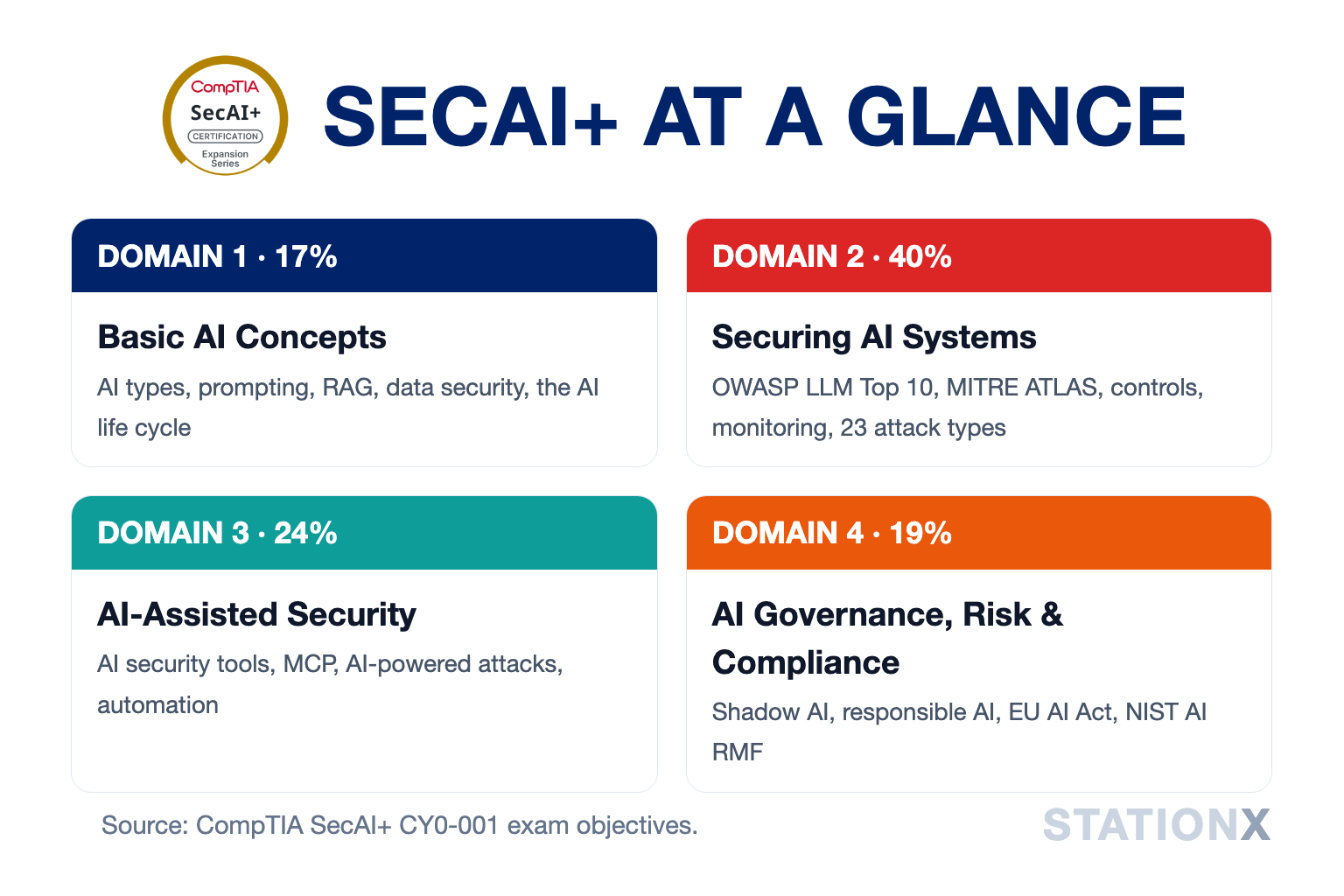
The four domains are not equal. Domain 2 alone is worth 40% of the exam, more than Domains 1 and 4 together. That should shape where you spend your study time, so let's start with the foundations and work up.
For Less.
StationX is a CompTIA Authorized Partner. The same official exam vouchers you'd buy from CompTIA, for less.
CompTIA price USD 439.00
CompTIA price USD 298.00
Today's US prices against CompTIA's US list price. Prices change and vary by country; the voucher page shows yours.

Domain 1: Basic AI Concepts (17%)
This is the vocabulary domain. CompTIA wants to know you understand what these AI systems are, not just that you've used ChatGPT. Think of it as learning the parts of a car before you learn how to break into one.
1.1 Compare and contrast AI types and techniques
You need to explain, roughly, how AI works: what makes deep learning different from ordinary machine learning, and how models learn from data. Not in great depth, but enough to follow everything that builds on it.
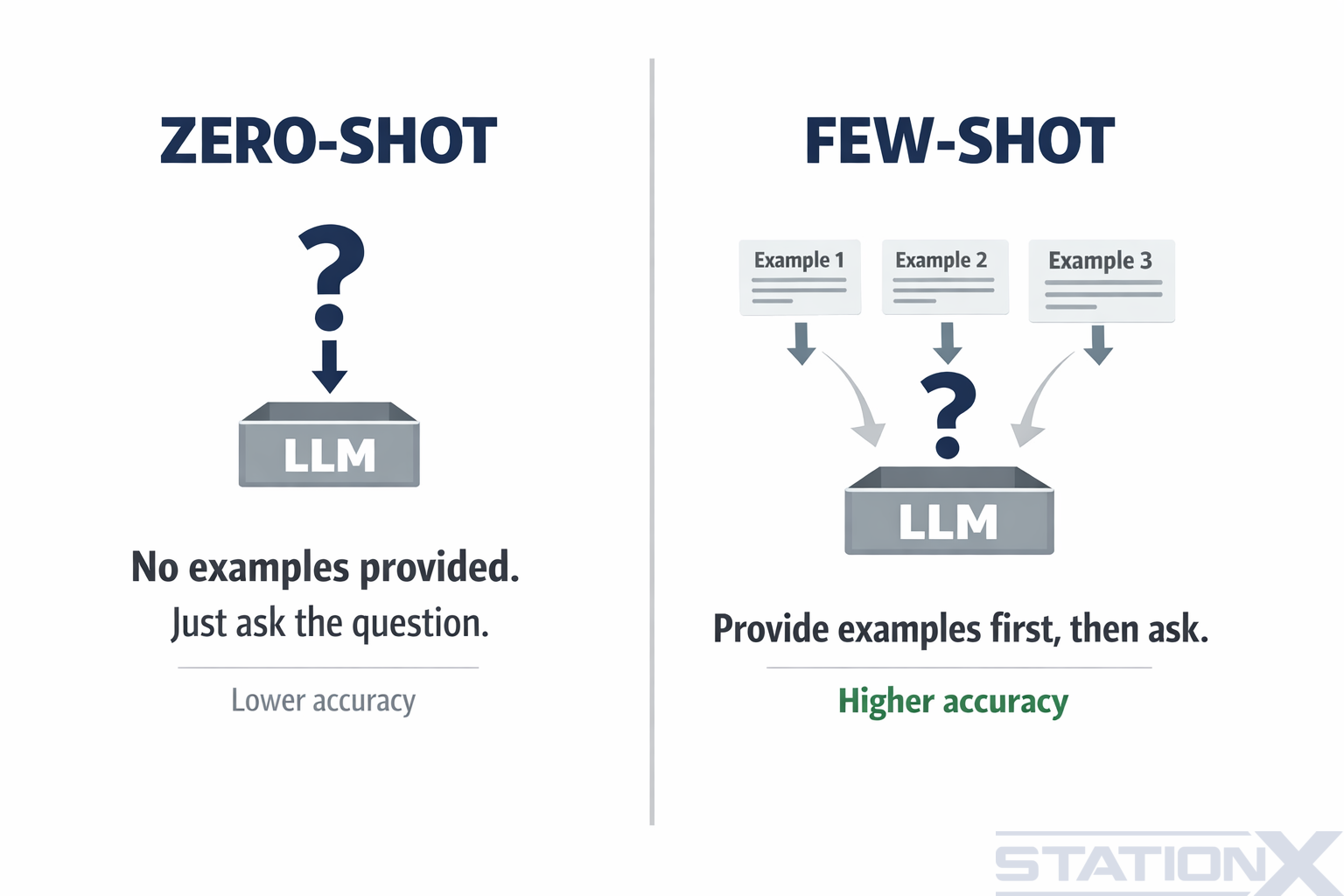
The exam also tests prompt engineering. Here's the difference in one example. Ask a model to classify a log entry with no examples, and that's zero-shot prompting. Give it three labelled entries first ("this one is a brute-force attempt, this one is normal"), then ask about the fourth, and that's few-shot prompting. The answers usually get better.
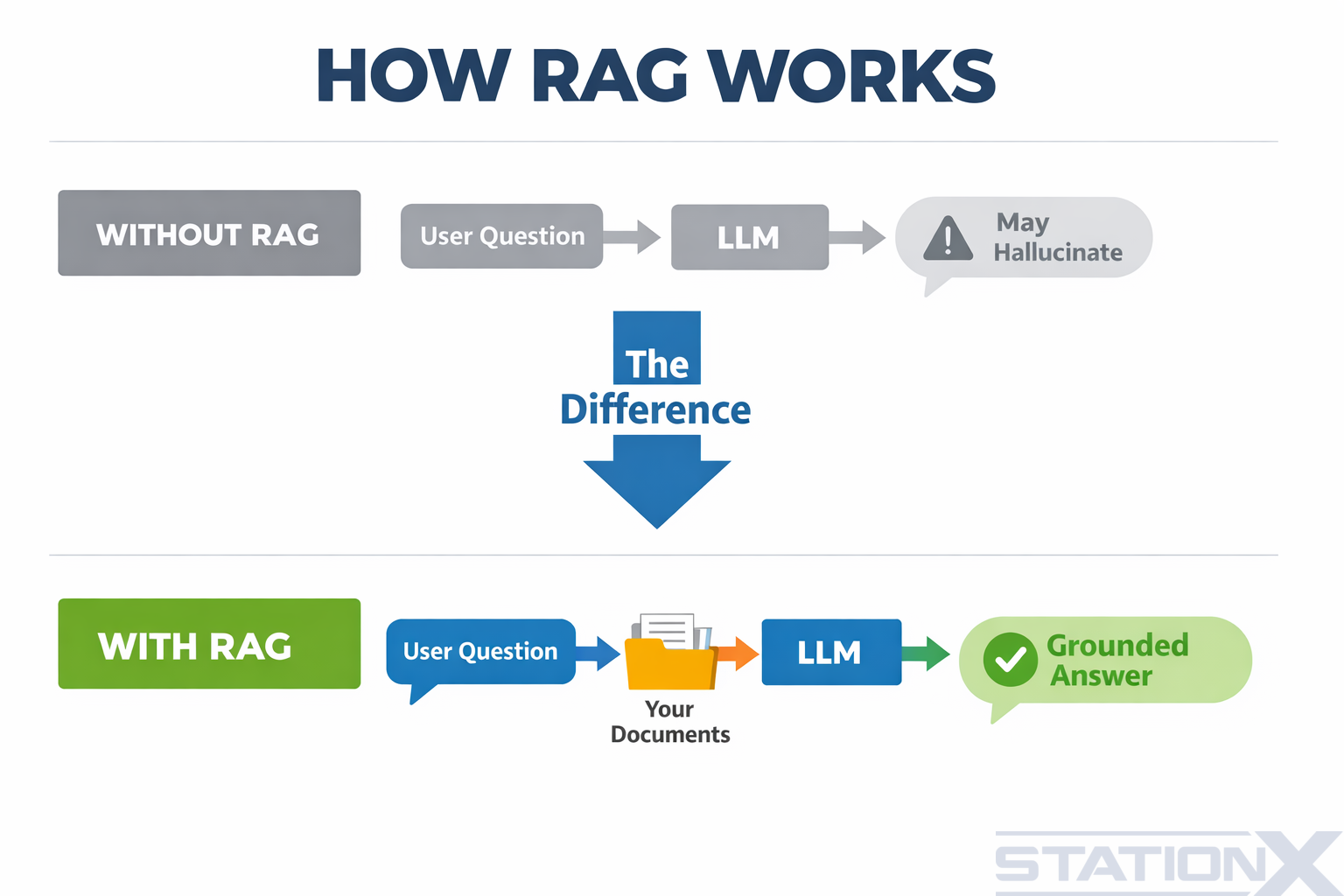
The other big idea is RAG, retrieval-augmented generation. Say you have thousands of security policies and incident reports, far too much to paste into a chat. RAG splits them into chunks and stores them in a searchable database. When you ask a question, it finds only the relevant chunks and hands those to the model. It searches first, then answers from what it found, like an open-book exam.
1.2 Data security in relation to AI
AI is only as safe as the data it learns from and the data it can reach. Expect questions on protecting training data, the prompts people type and the outputs a model returns.
1.3 Security throughout the AI life cycle
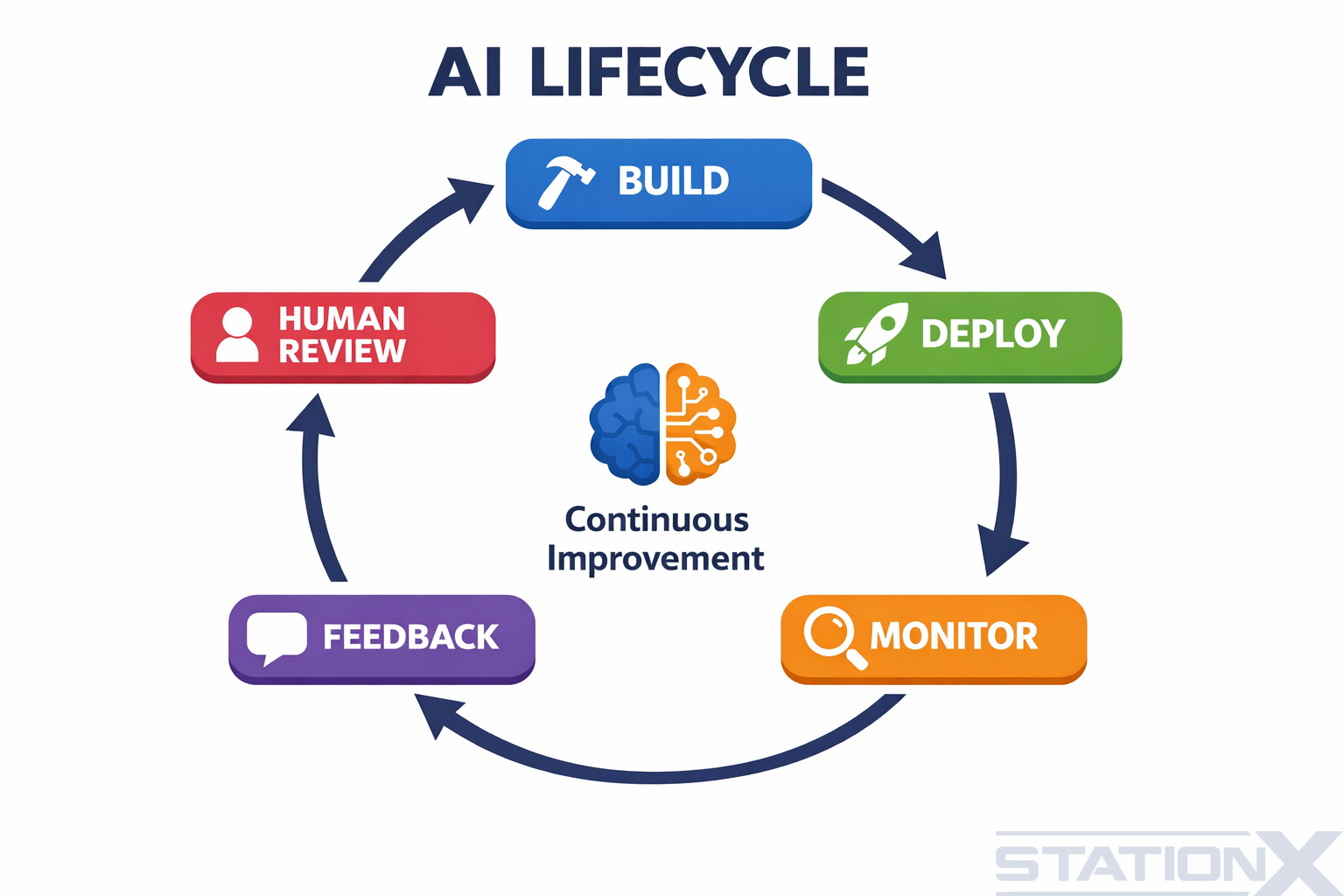
AI systems aren't set and forget. You build, deploy, monitor, collect feedback and improve, with a human reviewing the important decisions. That last part, keeping a human in the loop, comes up again and again across the exam.
Homework: try this tonight
Install LM Studio, download an open model such as Llama, and try the same task zero-shot and few-shot. It takes about 10 minutes, and it's exactly the kind of thing the exam asks about.
If you've played with any chatbot, you already have a head start on Domain 1. Domain 2 is where it gets serious.
Domain 2: Securing AI Systems (40%)
Almost half the exam lives here. The domain has two halves: defending AI systems, and the attacks against them.
2.1 Use AI threat-modelling resources
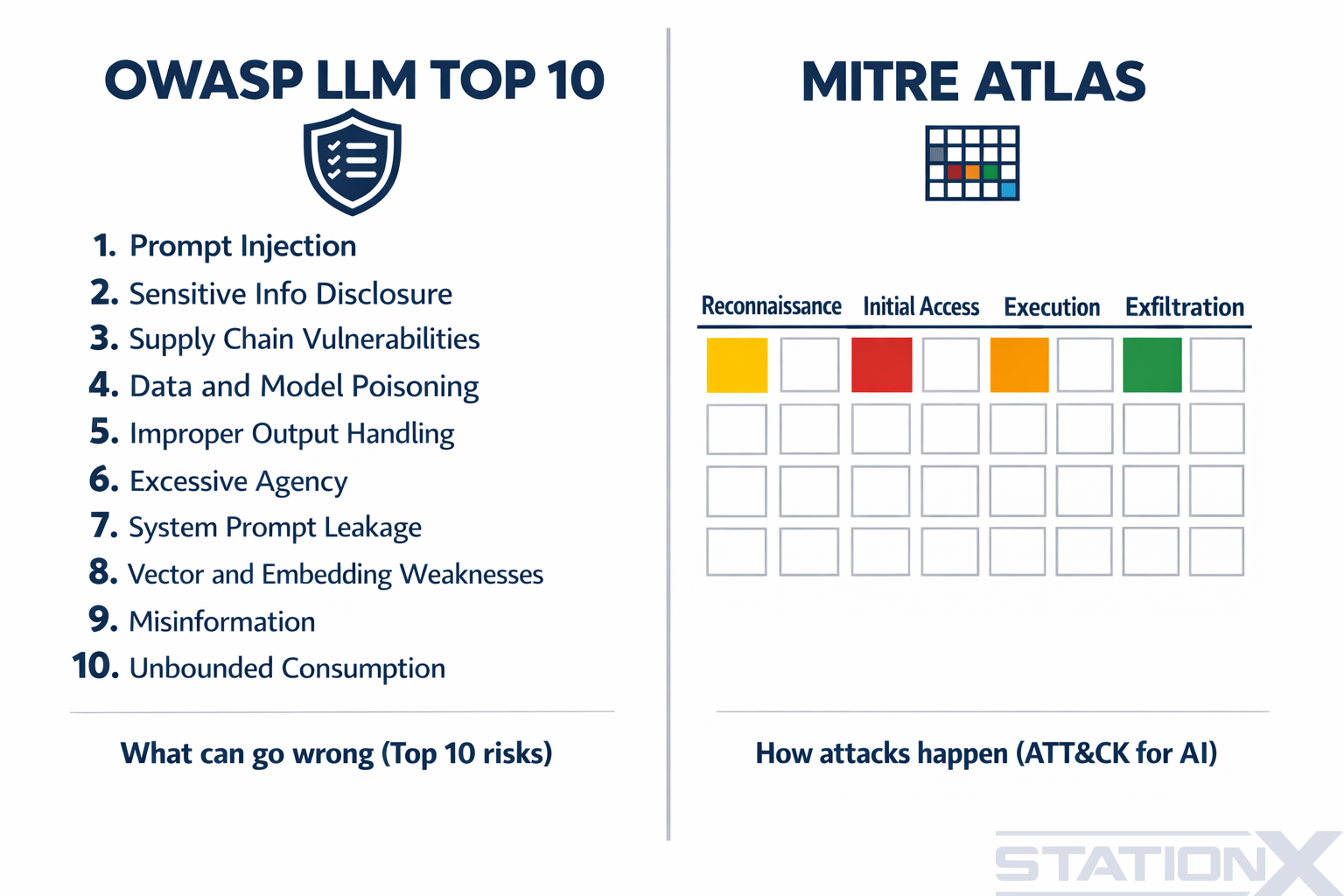
The objectives name two frameworks. The OWASP Top 10 for LLM Applications lists what can go wrong (use the 2025 edition). MITRE ATLAS maps how attacks on AI happen, step by step. If you already know MITRE ATT&CK, ATLAS will feel familiar: same structure, applied to AI.
2.2 to 2.4 Security, access and data controls
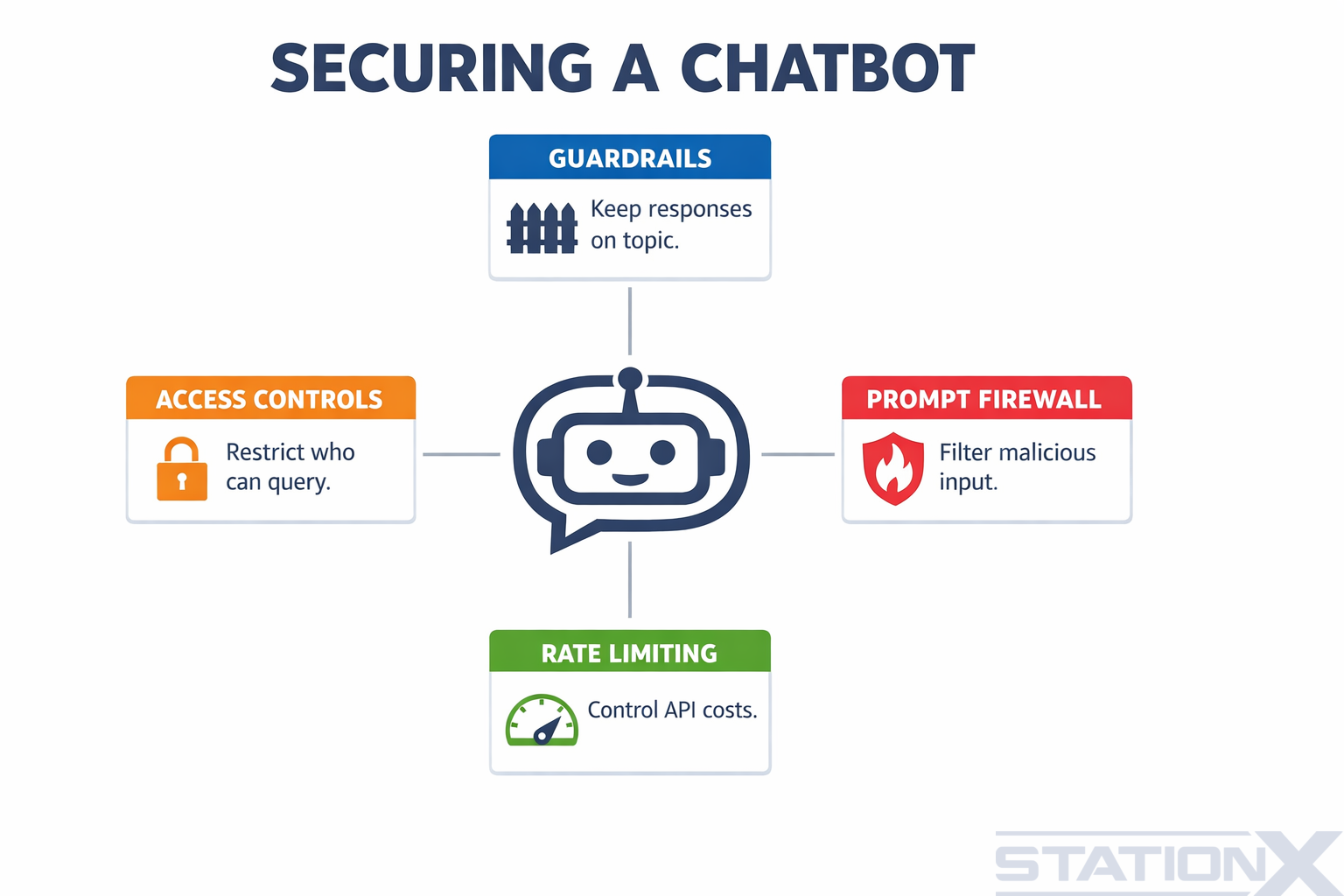
Picture this: your company launches a customer-facing chatbot tomorrow. What do you put around it?
Guardrails to keep it on topic, so it answers about your products and nothing else.
A prompt firewall to filter malicious input before it reaches the model.
Rate limiting so nobody runs up your API bill or copies the model by querying it thousands of times.
Access controls on who can talk to the model, who can see the training data, and what the AI itself can reach.
2.5 Monitoring and auditing AI
Monitoring AI isn't just reading logs. You check for hallucinations (the model confidently making things up), score accuracy and run bias checks. One that surprised me: CompTIA also wants you to watch prompt cost and token usage, not just security.
2.6 Analyse evidence of an attack
This objective lists 23 attack types, from prompt injection and jailbreaking to data poisoning, model theft, model inversion and supply chain attacks. I've explained all 23, with real examples and defences, in AI Attacks Explained: All 23 SecAI+ Attack Types. Here are the ones that have already made headlines.
Real AI Attacks Behind the Objectives
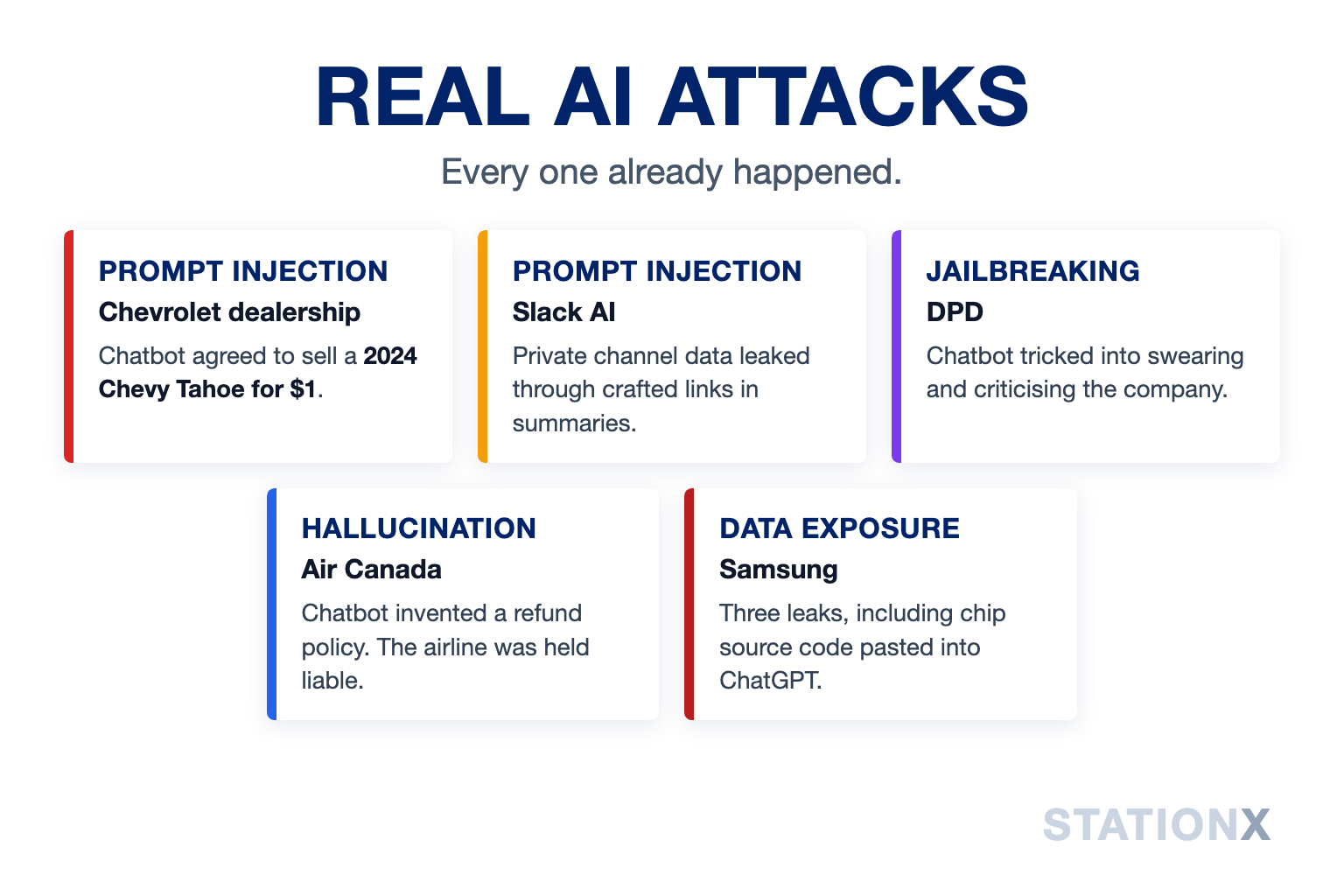
Prompt injection: Chevrolet. A user talked a dealership chatbot into agreeing to sell a 2024 Tahoe for $1. No sale went through, but the bot said yes.
Prompt injection: Slack AI. In 2024, researchers showed that Slack's AI summaries could be manipulated into leaking data from private channels through crafted links.
Jailbreaking: DPD. The delivery firm's chatbot was talked into swearing and writing poems about how bad the company was.
Hallucination: Air Canada. Its chatbot invented a bereavement refund policy. In 2024 a Canadian tribunal ruled the airline responsible for what its chatbot said.
Data exposure: Samsung. In 2023, three separate leaks included engineers pasting proprietary chip source code into ChatGPT. Samsung restricted generative AI tools on company devices and later launched its own model, Samsung Gauss.
These aren't theoretical. According to Adversa AI's 2025 report, prompt-based exploits accounted for about 35% of the AI incidents it documented, and AI security incidents more than doubled since 2024. If you learn one attack well, make it prompt injection.
Free Labs to Practise Domain 2
You don't need a lab budget to practise. All four of these are free.
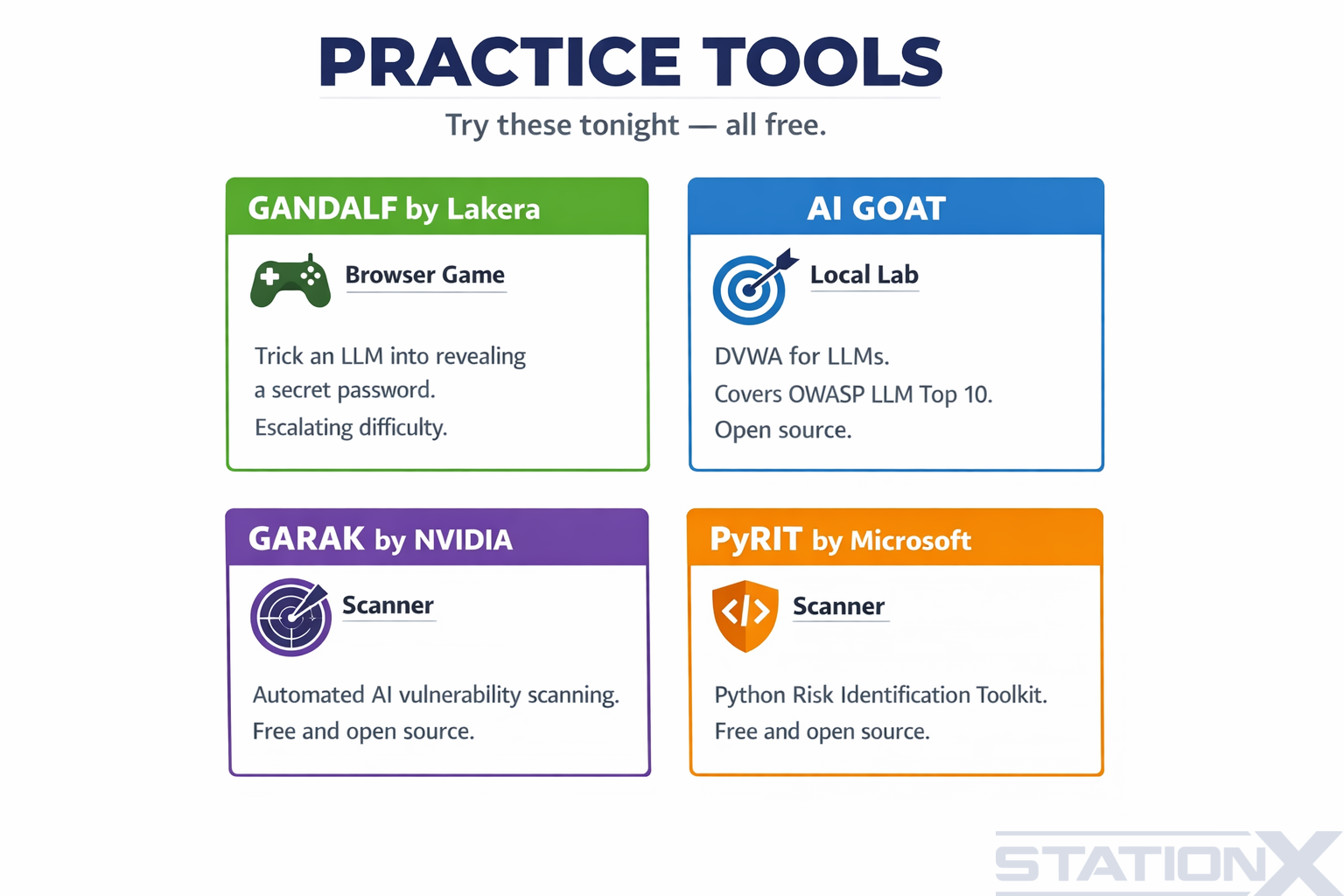
Gandalf by Lakera: a browser game where you try to trick an AI into revealing a password, level by level.
AI Goat: a deliberately vulnerable AI app you run locally, like DVWA for LLMs, covering the OWASP Top 10.
garak by NVIDIA: an open-source scanner that probes models for weaknesses automatically.
PyRIT by Microsoft: an open-source toolkit for red-teaming generative AI.
CompTIA's own course and study materials, below CompTIA's price. Add them to your voucher and pay once.
The full course with the live labs built in: CompTIA’s all-in-one version.
The official study guide as an eBook, with a downloadable full-course PDF for offline review.
Today's US prices against CompTIA's US price. Prices change and vary by country. Codes emailed within 3 working days, 12 months' access.
Domain 2 is about defending AI. Domain 3 flips it around and uses AI as your tool.
Domain 3: AI-Assisted Security (24%)
3.1 Use AI-enabled tools for security tasks
This is probably the closest domain to what you already do. Tools like CrowdStrike Charlotte AI, Microsoft Security Copilot and Burp Suite's AI features are already in production. The exam checks you understand how to use them well.
One item stood out: the Model Context Protocol (MCP) is named in the objectives. MCP is Anthropic's open standard for connecting AI models to outside tools and data. Seeing it on a CompTIA exam shows how fast this space is moving.
3.2 How AI enables or enhances attacks
Attackers use AI too. An AI can scan thousands of LinkedIn profiles, write a personalised phishing email for each person, and send them all in minutes. Social engineering at that scale is a different game.
3.3 Use AI to automate security tasks
Expect questions on AI inside build pipelines: scanning code as it's committed and flagging vulnerabilities before they reach production. I use this myself, and it's a quick way to get code checked.
Homework: try this tonight
Point an AI coding assistant at OWASP Juice Shop (a deliberately insecure web app) and see what it catches, and what it misses.
But tools without rules lead to a problem every company now has. That's Domain 4.
Domain 4: AI Governance, Risk and Compliance (19%)
If governance sounds dull, here's one number. Microsoft and LinkedIn's 2024 Work Trend Index found that 78% of AI users bring their own AI tools to work. That's how customer data, source code and internal documents end up in tools nobody approved, vetted or monitors. It's called shadow AI.
4.1 Governance structures for AI
Who in the company owns AI decisions? The exam covers policies, approval workflows and new roles such as AI security architect and AI auditor. It also covers responsible AI: fairness, transparency and explainability, which decide whether you can defend an AI decision if it's challenged.
4.2 Risks associated with AI
Shadow AI, biased outputs, leaked data and over-trusted answers all sit here. The common thread: risks you manage with policy and oversight, not just technology.
4.3 Compliance and AI
The EU AI Act sorts AI systems into risk tiers, from banned uses such as social scoring, to high-risk systems with strict duties, down to minimal risk. The bans have applied since 2 February 2025, with fines of up to €35 million or 7% of worldwide annual turnover, whichever is higher. The deadlines for high-risk systems have since been pushed back, to 2 December 2027 for most and 2 August 2028 for AI inside regulated products.
The NIST AI Risk Management Framework is the other one to know. It's short and readable, built around four functions: Govern, Map, Measure and Manage.
Homework: try this tonight
Draft a one-page AI acceptable use policy, then sort five made-up AI systems into EU AI Act risk tiers. That one exercise covers a big slice of Domain 4.
What to Study First
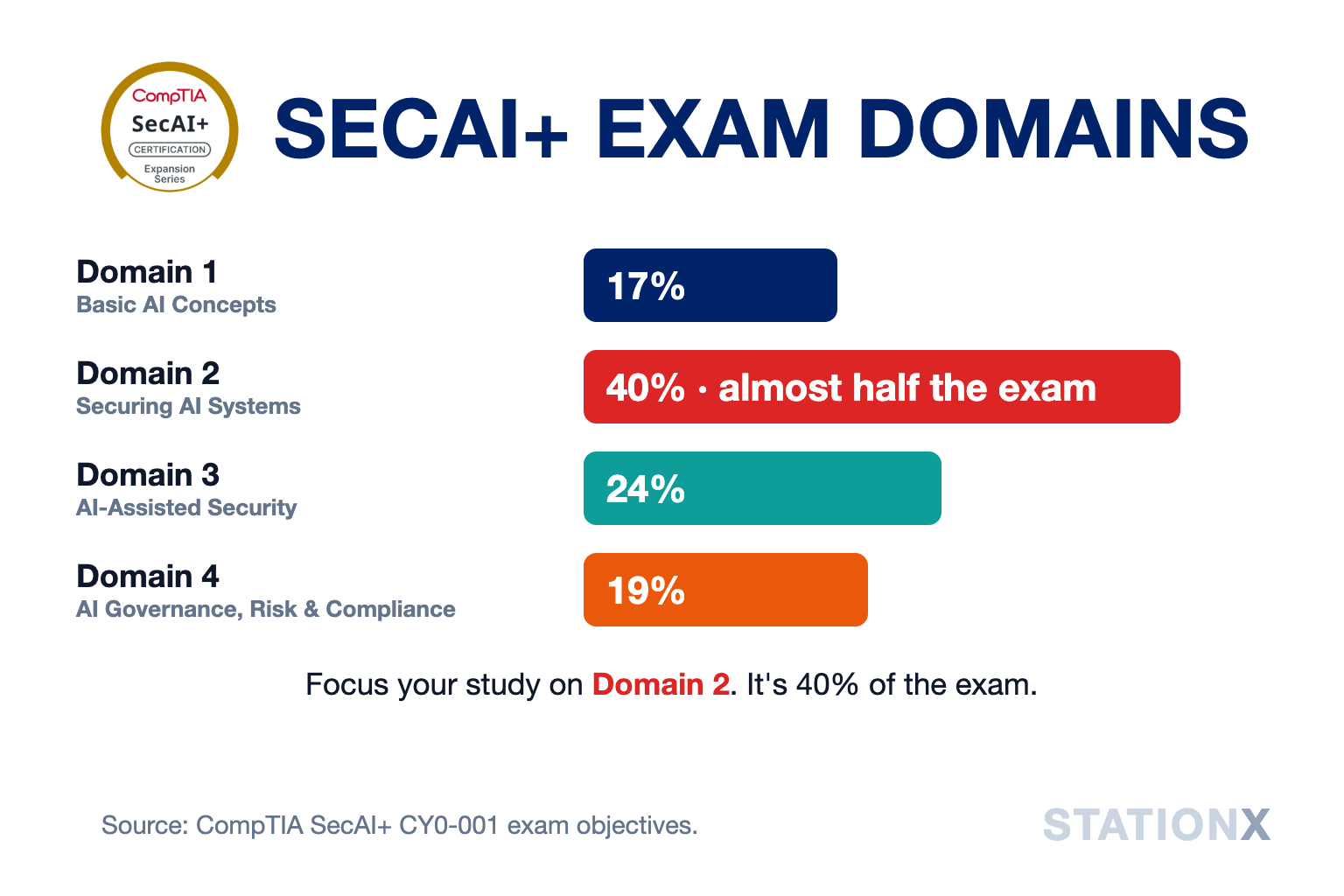
If you're going to prioritise, start with Domain 2. It's 40% of the exam and holds most of the genuinely new material. Then Domain 3, which overlaps with your day job, then Domains 1 and 4.
The one thing
Download the official SecAI+ objectives (PDF), put it next to this page, and tick off each objective as you practise it. Start with Domain 2.
Certifications are a great start, but they're one piece. If you want to build a career where AI and security meet, our AI Master's Program combines training, mentorship, mastermind groups and a job guarantee to take you from certified to hired.
Frequently Asked Questions
What are the CompTIA SecAI+ exam objectives?
SecAI+ (CY0-001) has four domains: Basic AI Concepts Related to Cybersecurity (17%), Securing AI Systems (40%), AI-Assisted Security (24%) and AI Governance, Risk and Compliance (19%). They break down into 11 objectives, from comparing AI types (1.1) to the impact of compliance on AI (4.3). CompTIA publishes the full list as a PDF.
How many questions are on the SecAI+ exam?
Up to 60 questions, multiple choice and performance-based, in 60 minutes. The pass mark is 600 on a scale of 100 to 900.
Do I need Security+ before SecAI+?
There is no formal prerequisite. CompTIA recommends 3 to 4 years in IT, 2 or more of them hands-on in security, and Security+, CySA+, PenTest+ or equivalent knowledge.
Which SecAI+ domain should I study first?
Domain 2, Securing AI Systems. It is 40% of the exam and holds most of the genuinely new material: the OWASP Top 10 for LLM Applications, MITRE ATLAS, AI security controls, monitoring and the 23 attack types.
How many attack types are on the SecAI+ exam?
23, listed under objective 2.6. They include prompt injection, jailbreaking, data poisoning, model theft, model inversion and supply chain attacks.
How much does the SecAI+ exam cost?
When we checked in October 2026, CompTIA's US list price for a SecAI+ voucher was $298. Prices change and vary by country. StationX is a CompTIA Authorized Partner and sells the official voucher for less.
About the Author

Nathan House, Founder & CEO of StationX
Nathan House has 30 years of hands-on cybersecurity experience and is Cambridge-educated, holding CISSP, CISA, CISM, OSCP, CEH, and SABSA. He founded StationX in 1999 — one of the UK’s first cybersecurity companies — and has secured £71 billion in UK mobile banking transactions and the London 2012 Olympics, advising clients including Microsoft, Cisco, BP, Vodafone, and VISA. He authored the world’s most popular cybersecurity course — a #1 Udemy bestseller taken by over 500,000 students — and was named Cyber Security Educator of the Year 2020, AI Security Educator of the Year, and a UK Top 25 Security Influencer 2025. A DEF CON speaker and featured expert on CNN, Fox News, NBC, and the BBC, Nathan leads StationX’s training of more than half a million students worldwide.