Hardware Hacking Explained: Tools, Jobs & Salaries [2026]
Most people picture hacking as someone typing furiously at a keyboard, breaking into a website from across the world. Hardware hacking is the opposite. It's someone sitting at a bench with a screwdriver, a cheap logic analyser, and a circuit board they've physically pulled apart to find out what makes it tick. And right now it's one of the most under-supplied, well-paid corners of the whole security industry.
We get asked about this a lot at StationX, usually by people who are strong on web or network testing and wondering whether the physical stuff is worth learning. So this is the honest guide I wish those people could just read in one go: what hardware hacking actually is, what the job involves day to day, the tools you'd use, where AI is quietly changing the work, and what the careers and salaries really look like. I'll be straight about the parts that are hard, because there are a few. Let's get into it.
What Is Hardware Hacking?
Hardware hacking is finding and exploiting security weaknesses in the physical guts of a device rather than the software running on top of it. The chips, the circuit board, the firmware baked into memory, the radios it talks over. If a device has a processor and it does something you weren't meant to be able to make it do, someone probably got there through the hardware.
The clean way to think about it: web and network hacking attack the thing you can reach over a wire. Hardware hacking attacks the thing you can hold in your hand. That difference matters more than it sounds, because the moment you have physical access, a whole set of assumptions the device's designers made just stop being true. They assumed nobody would solder onto that debug port. They assumed nobody would read the flash chip directly. You're the person who does exactly that.
And it's everywhere now, which is the real reason it's worth caring about. Your router, your kid's smart toy, the insulin pump, the car, the badge reader on the office door, the drone overhead. All of it is hardware with security someone has to test, and there are nowhere near enough people who can do it.

What Does a Hardware Hacker Actually Do?
This is where hardware penetration testing stops being abstract. A typical hardware pentesting engagement runs through a fairly consistent set of moves, and it looks nothing like a web test.
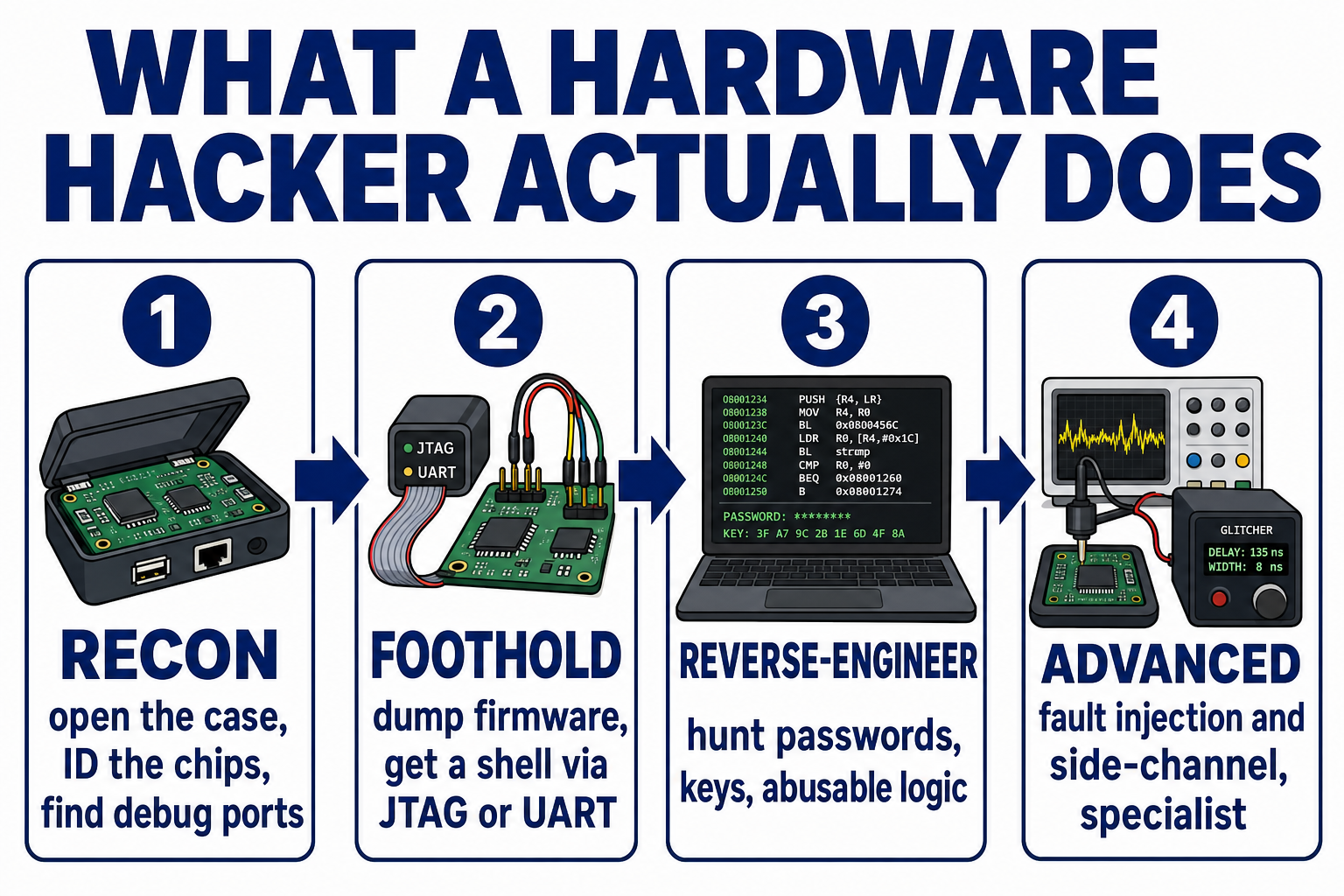
You start with reconnaissance, but physical: open the case, identify the chips, find the datasheets, and hunt for the ports the manufacturer left on the board for their own debugging. Then you try to get a foothold — dumping the firmware off the flash chip, or getting a shell through a debug interface like JTAG or UART if the manufacturer left one open (increasingly they lock or fuse them off, and getting past that is half the challenge). Once you've got the firmware, you reverse-engineer it looking for hardcoded passwords, crypto keys, and logic you can abuse. And where the easy routes are shut, the specialists reach for the heavy techniques: fault injection, glitching the power to make the chip skip a security check, or side-channel work reading secrets out of the tiny power fluctuations the chip gives off while it runs. Those last ones are advanced and equipment-hungry — most engagements never need them, but knowing they exist is part of thinking like a hardware hacker.
Here's the bit that surprises people, and it's the whole reason this is a separate discipline. Hand an IoT device to a brilliant pure web tester and, more often than not, you get a web report back — they test the app and the cloud API and hand it in, because the RF, the firmware, and the physical attack surface are effectively invisible to them. That's not a knock on web testers. It's just a genuinely different skill set, and it's exactly why the people who have it are scarce.

At the StationX bench — some of this work really is just you, a board, and a soldering iron.
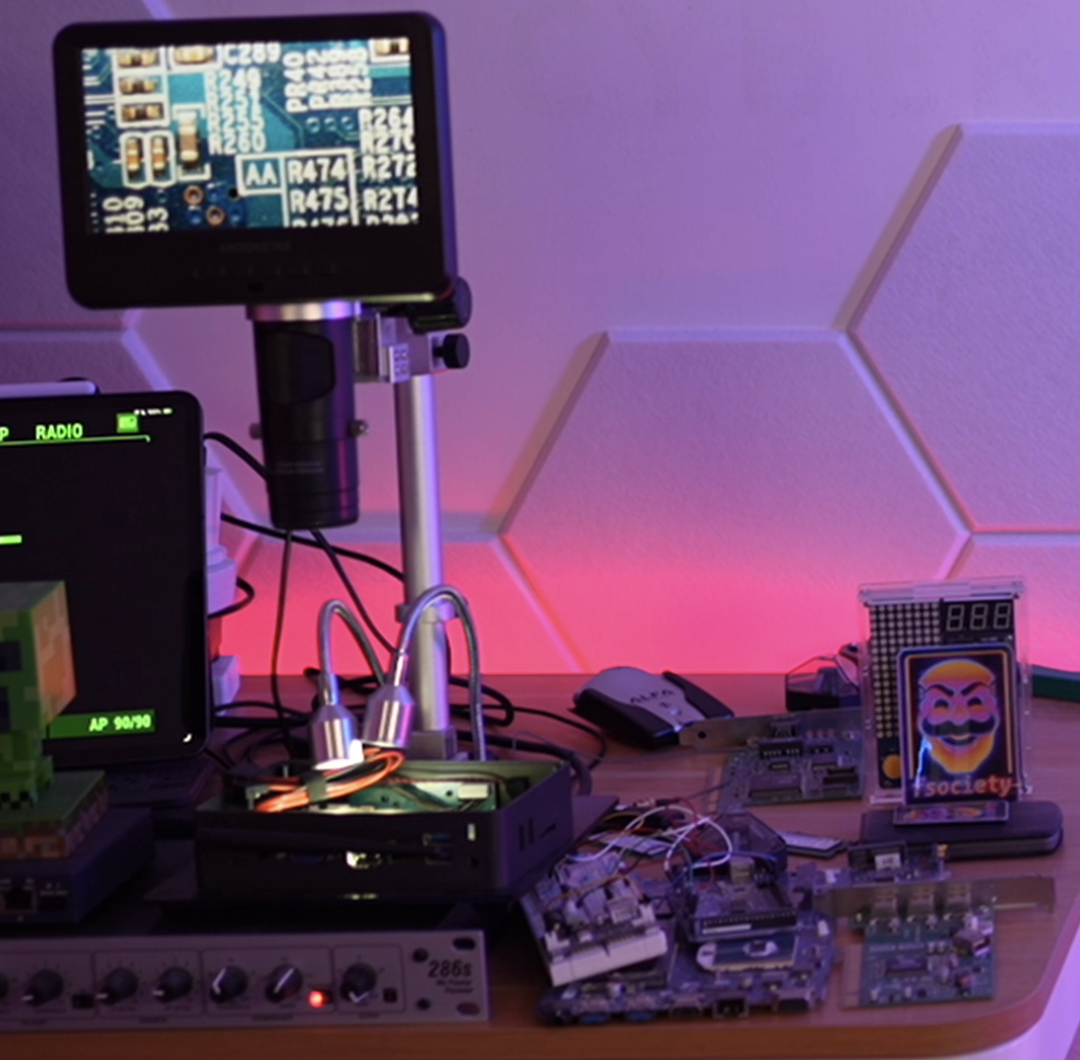
A digital microscope earning its keep — reading component references off a board too small for the naked eye.
A recent, low-drama example from our own bench: the Starlink dish on our network exposes a local API that most owners never even know is there, and simply enumerating what it will tell you (status, obstruction maps, diagnostics) is textbook hardware recon. No soldering required for that first pass. I'll come back to exactly how we did it, and where the AI helping us got it wrong, in the AI-driven section below.
The Hardware Hacking Toolkit
You don't need a lab worth tens of thousands to start. A surprising amount of hardware hacking is done with kit that fits in a shoebox. These are the hardware hacking tools that actually earn their place on the bench:
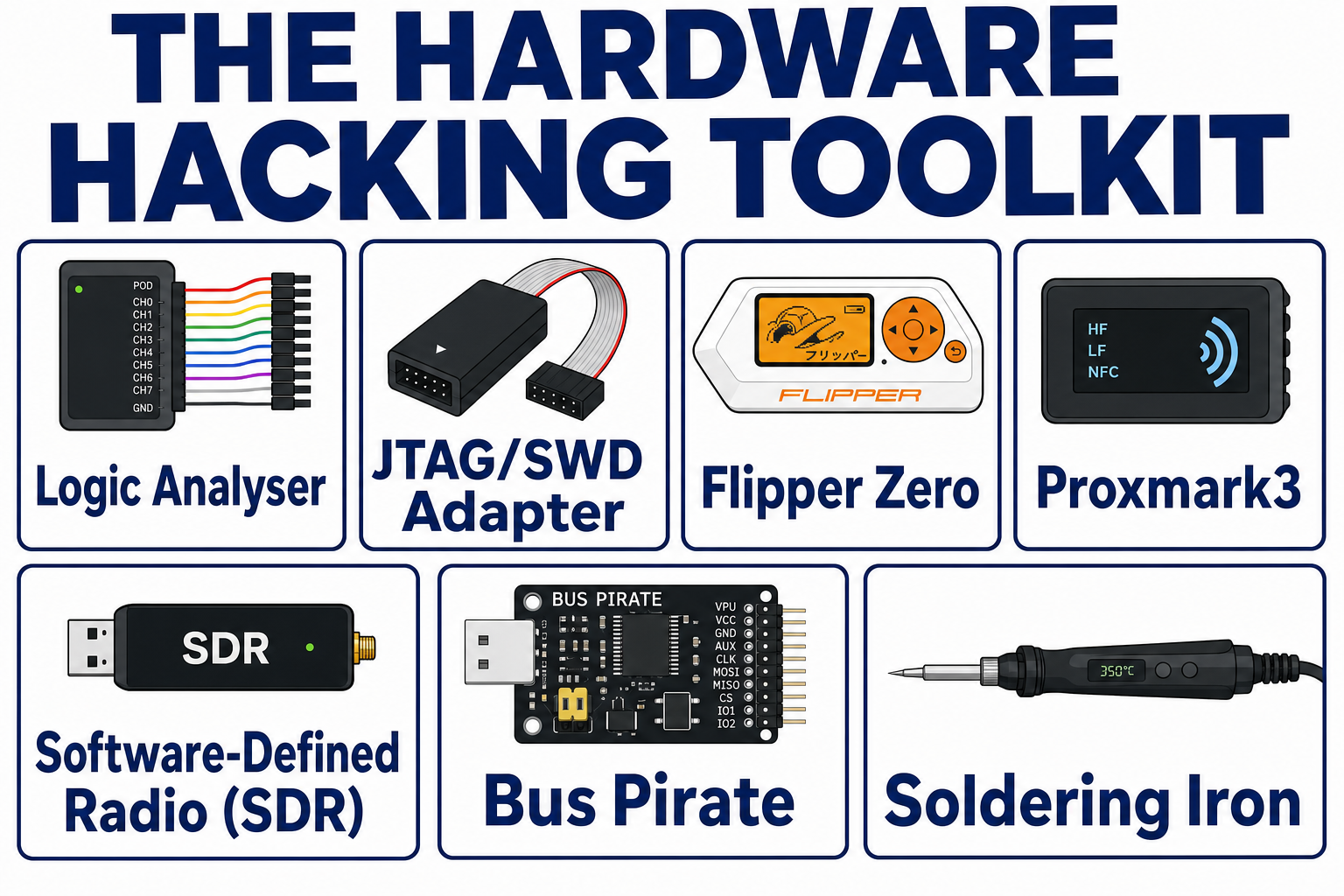
Logic analyser. Your eyes on the wires. It watches the digital chatter between chips so you can decode what they're saying to each other, and you can get a usable one for the price of a nice meal out.
Multimeter and a cheap oscilloscope. The basics. One tells you what's connected to what; the other shows you signals moving in real time.
JTAG/SWD adapter. The debug doorway. If a board left its debug port alive, this is how you connect to and control the processor — and finding out whether it's open or fused shut is one of your first moves.
Bus Pirate or flash reader. For talking to and dumping memory chips directly, so you can pull the firmware off without asking the device nicely.
Flipper Zero and Proxmark3. The RFID and sub-GHz Swiss army knives, for reading and probing access cards and poking at wireless protocols. Plenty of low-security cards can be read and cloned outright; the better ones use rolling codes that don't fall to a simple replay, which is exactly the kind of thing you learn by trying. The Flipper is what put a lot of newcomers on this path.
Software-defined radio (an SDR). This is the one that unlocks the radio world. A cheap SDR lets you listen to, decode, and replay the wireless signals a device uses, and it's the single most important tool for anything drone-related.
A soldering iron. Unglamorous and non-negotiable. At some point you will be attaching a wire to something the size of a grain of rice, and no software will save you.
My honest advice: don't buy the shopping list on day one. Get a logic analyser, a cheap SDR, and a soldering iron, pick one device you own, and try to break into it. You'll learn what you're missing far faster than any kit guide will tell you.
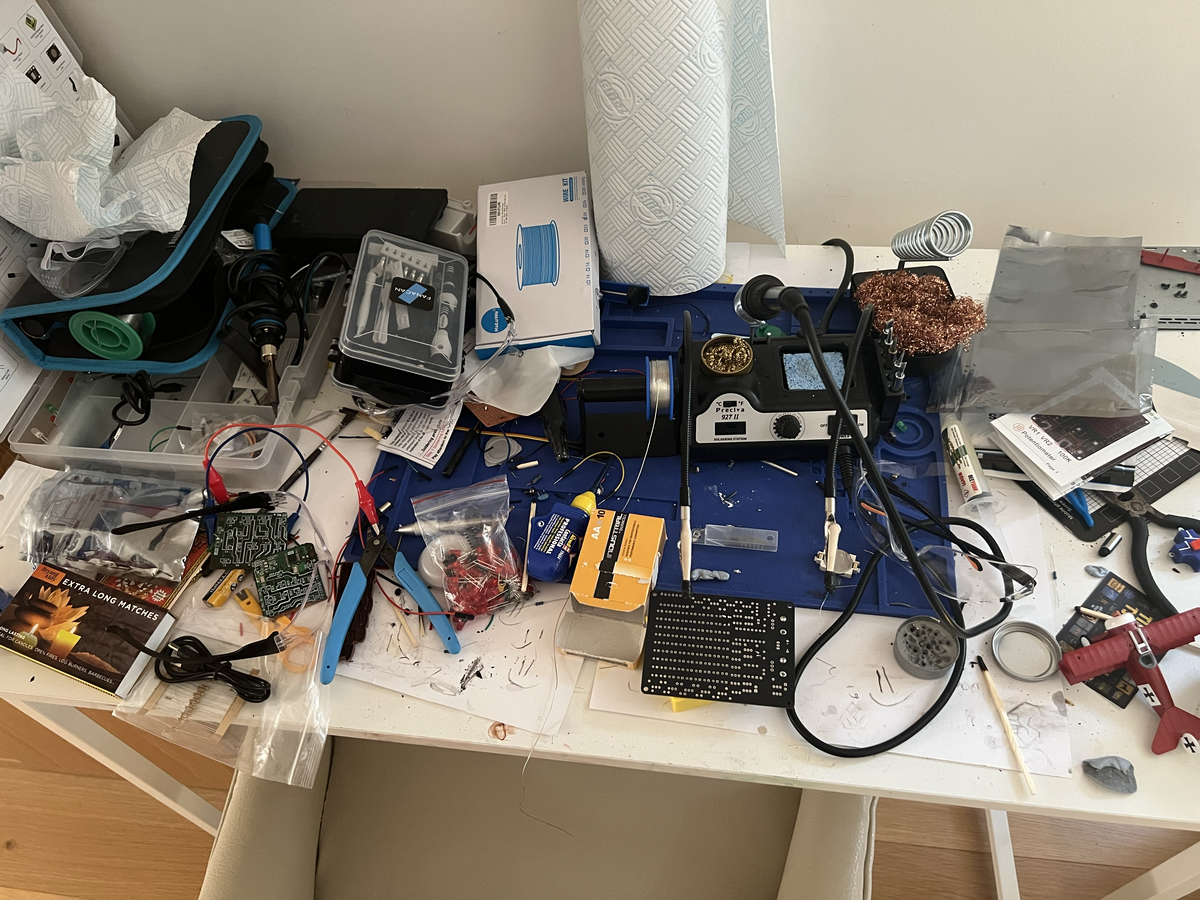
And here's the honest reality: my actual bench mid-project. It gets messy. Nobody's is tidy.
From Gadgets to Drones: Where Hardware Hacking Bites
The reason demand keeps climbing is that the number of things containing a vulnerable chip keeps exploding. IoT penetration testing covers the obvious consumer stuff — cameras, locks, smart speakers — but the serious money and the serious stakes are in medical devices, cars, and industrial control systems, where a hardware flaw isn't an inconvenience, it's a safety problem.
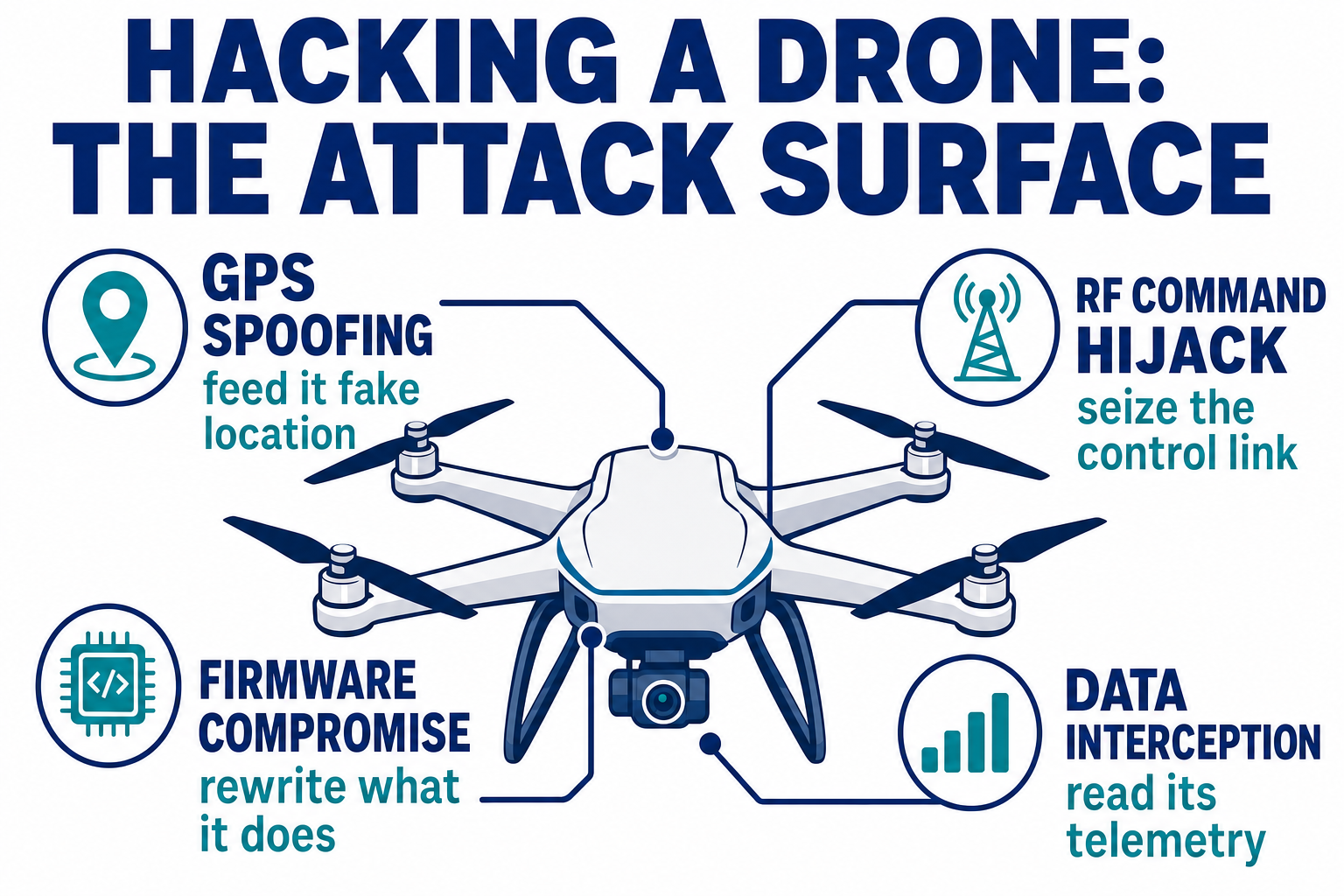
And then there are drones, which deserve their own paragraph because they're about to be everywhere. A drone is basically a flying embedded computer with radios, GPS, and firmware — which makes it one of the richest hardware hacking targets going. Drone hacking is a real and growing field: GPS spoofing to send a drone somewhere it shouldn't go using a cheap SDR, hijacking the radio command link, or pulling apart the firmware to see what the thing will do if you ask it the wrong question.
The market backs this up. On pretty much every forecast I've seen, drone-related cybersecurity is on a steep climb over the next decade, and counter-drone security is growing faster still, driven heavily by what everyone's watched happen in Ukraine. I'd take the exact figures with a pinch of salt — market-research numbers always vary — but the direction is not in any doubt. If you want a specialism with a long runway, this is one of the clearest bets in security right now.
AI-Driven Hardware Hacking: Working at Agent Speed
Here's the part almost nobody else writing about hardware hacking will tell you, and it's where the field is quietly changing under everyone's feet.
A lot of hardware work is slow, grinding, and repetitive. Reading thousand-page datasheets. Picking apart an unfamiliar protocol. Enumerating a device's undocumented local interfaces to work out what it will even talk to you about. Much of embedded security and firmware security research is exactly this kind of grind, and it's exactly the work AI is genuinely good at accelerating. An AI-driven hardware hacker (someone who coordinates AI agents to do the heavy lifting while staying fully responsible for the result) can move through it far faster than someone doing it all by hand.

Let me show you what that looks like on a real device rather than in the abstract, because we did exactly this recently. A quick honest caveat first: this is the reconnaissance end of the spectrum, not chip glitching or a flash dump. Talking to a device's own local API is where hardware work often starts, before you ever pick up a soldering iron, and it's the perfect place to see the AI-driven approach at work without pretending it's the deep end.
We pointed an AI-driven workflow at the Starlink dish sitting on our own network. The dish exposes a local API most owners never touch, and the first job of any hardware recon is simply to map what's there. The AI drove the enumeration — I described the target, and it worked through reaching the local gRPC endpoint and listing what the device would expose:
# List the services the dish's local gRPC endpoint exposes
$ grpcurl -plaintext 192.168.100.1:9200 list

# Describe the device service to see every request it accepts
$ grpcurl -plaintext -protoset-out dish.protoset 192.168.100.1:9200 describe SpaceX.API.Device.Device

# Ask the dish for its status via the single Handle RPC (a oneof request)
$ grpcurl -plaintext -d '{"get_status":{}}' 192.168.100.1:9200 SpaceX.API.Device.Device/Handle
That first list and describe pass is the reconnaissance step, and the AI is genuinely fast at it: it knew to use grpcurl, understood that the dish exposes a single Handle RPC with a oneof request rather than tidy separate methods, and pulled back status, obstruction, and diagnostic data in minutes. Where it saved the most time was the boring, essential mapping, the kind of thing that used to mean an evening of forum-crawling.
But — and this is the whole game — you cannot trust it blindly. On the same job it confidently told me to add a route on the Mac to reach the dish's management IP in bypass mode. Plausible, cleanly explained, and wrong: on our topology the route belongs on the edge router, and the Mac needs nothing. If I'd pasted it in and it hadn't worked, I'd have wasted an hour chasing a fix for a problem the AI invented. I only knew because I checked it against how the network is actually wired, not because the AI flagged any doubt.
That failure mode is not unique to networking. I saw the same pattern when we got AI to design a physical circuit board (I wrote that up in our AI PCB design article): AI is like a fast, enthusiastic junior engineer who occasionally hallucinates physics. In one 2026 head-to-head, Altium Academy put the same schematic through a human designer and an AI layout tool, and the AI's board came back with 168 design-rule violations against the human's essentially clean one. Brilliant at reading the datasheet, dangerous the moment physical or spatial reality is involved.
So how do you get the speed without pasting in the mistakes? The same discipline that makes AI-driven software engineering work, which Andrej Karpathy (a founding member of OpenAI) calls agentic engineering. His word for AI agents is "spiky": in his description they are "fallible and stochastic, but extremely powerful" — brilliant one minute, unreliable the next, and you can't tell which you're getting. Two rules carry most of the weight. First, when the AI learns something true, a verified pinout, the dish's actual routing quirk, a specific chip's behaviour, you save it to a file it reads every session, so it never re-learns the same lesson. Second, anything that must be right every time becomes a script the AI has to run and pass, not a step it's trusted to remember. Let the AI be creative in the recon; give it zero discretion in verification.
That's what I mean by AI-driven, and it applies to hardware hacking exactly as it does to the rest of security. If you want the full picture of how this way of working reshapes an entire security role, our guide to agentic engineering covers it properly. For hardware specifically, the takeaway is simple: the AI makes the grind faster, but you are still the one signing off that the finding is real.
Is Hardware Hacking a Good Career?
Short version: I think it's one of the better long-term bets in security, and the reason is almost boringly simple. Demand outruns supply.
There aren't a huge number of hardware jobs compared to web app or network testing. That's just true, and you should know it going in. But there are far fewer people who can do them, and that imbalance is what drives the pay.

Take these as ballpark rather than gospel, because good hardware-specific salary data is genuinely thin, but as indicative ranges:
| Role | US (experienced) | UK (experienced) |
|---|---|---|
| Web app pentester | ~$90–150k | ~£50–80k |
| Red teamer | a notch above web | a notch above web |
| Hardware / embedded specialist | ~$120–200k+ | ~£70–110k+ |
Hardware and embedded specialists tend to sit at or slightly over red-team money, with contractor day rates higher again. The premium isn't magic. It's scarcity, plain and simple. There's also a growing pull from iot security jobs specifically, as more of the economy ends up running on connected devices someone has to test.
There's a tailwind here too that's easy to miss: regulation. A wave of new rules is landing over the next few years — the EU's Cyber Resilience Act, the UK's product security law, radio equipment requirements, medical-device cybersecurity rules in the US — and the common thread is that manufacturers can no longer ship connected hardware without testing it properly. Regulation doesn't care about the economy, which makes it about as durable a source of demand as you can find.
And here's the part that matters most if you're worried about the thing everyone's worried about: this is one of the more AI-resistant jobs in security. We built a tool called JobZone Risk that scores how exposed different roles are to AI, and hardware security engineer comes out GREEN — 65.4 out of 100, "protected", safe for at least five years. The reasoning is exactly the stuff we've been talking about: the work needs a physical lab, deep analogue and hardware expertise, and there simply aren't viable AI tools for side-channel analysis or fault-injection testing. You can't glitch a chip from a chatbot.
The AI-safe angle
On our JobZone Risk assessment, hardware security engineer scores 65.4/100 (GREEN — protected): high task-resistance to automation, real physical-lab barriers, and AI adoption that adds demand rather than removing it. The role's shape changes as AI assists trace analysis and paperwork, but the core job — physically measuring and attacking silicon — stays human. The people it rewards even more are the ones who learn to build AI tooling for the work, not the ones who avoid it.
How to Get Into Hardware Hacking
If you're coming from web or network testing, the good news is you're not starting from zero. Modern devices are a hybrid of hardware plus a mobile app plus a cloud API, so your existing skills stay useful — you're adding a layer, not replacing one.
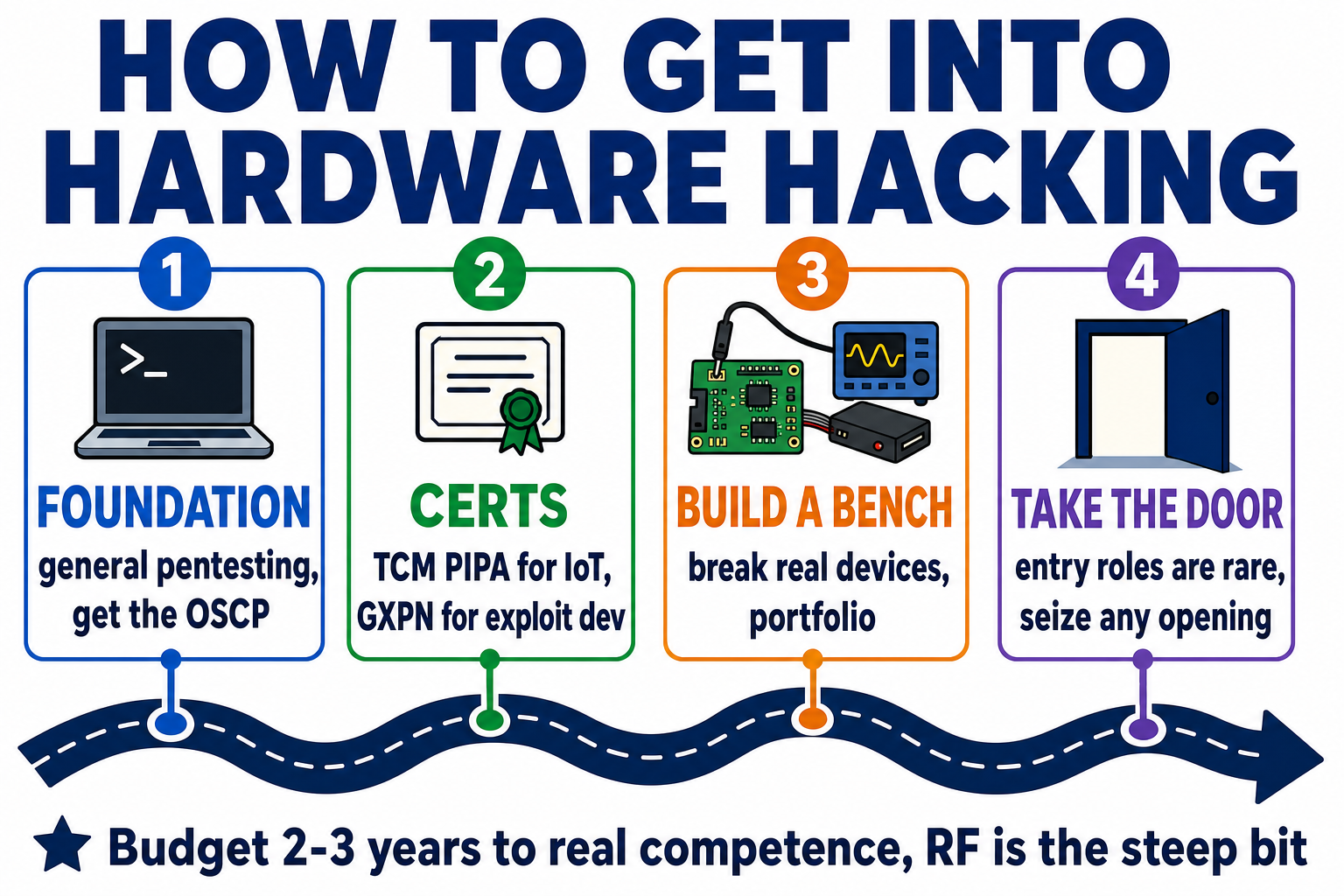
If you're wondering how to become a penetration tester who does hardware, here's the honest path. Get your general pentesting foundation first; the OSCP is the near-universal currency and proves you can grind through something hard. From there, the most directly relevant credential is TCM Security's PIPA (Practical IoT Pentest Associate), which is hands-on and IoT-focused, and GXPN (GIAC's Exploit Researcher and Advanced Penetration Tester) is worth knowing if you're heading toward the exploit-development side. Just don't over-index on certificates: they get you the interview, not the competence. This field rewards people who've actually torn devices apart, so build a bench and a portfolio of things you've broken.
Two honest warnings. First, budget something like two to three years of hands-on work before you feel genuinely competent across the whole stack, and know that RF is the steep bit. It's the part everyone underestimates and where you'll feel slowest for the longest. Second, and this is the big one: entry-level hardware roles barely exist. It's mostly a seniors-only club, which is exactly why people struggle to break in by applying cold. So if a door ever opens, whether it's a role, an internal move, or a mentor willing to take you on, my strong advice is take it, because the hardest part of this entire path is getting the first foot in.
Frequently Asked Questions
Is hardware hacking legal?
Hacking hardware you own, or hardware you've been explicitly authorised to test, is legal and is how the entire profession learns. Doing it to devices you don't own or have permission to test is not. As with every kind of pentesting, the line is authorisation — get it in writing before you touch anything that isn't yours.
Do I need to know how to code for hardware hacking?
Yes, but probably less than you fear and in different languages than you expect. C and Python do most of the heavy lifting, and comfort reading assembly helps a lot when you're deep in firmware. If you're coming from web testing you already have the mindset; you're mostly retargeting it.
What's the difference between hardware hacking and software hacking?
Software hacking attacks code you reach over a network or through an application. Hardware hacking attacks the physical device — its chips, circuit board, firmware, and radios — usually with physical access. Hardware hacking almost always involves some firmware work, but it starts from the bench, not the browser.
Can AI do hardware hacking?
AI can accelerate big parts of it — reading datasheets, mapping a device's local interfaces, decoding protocols, triaging firmware — but it can't be trusted with anything involving physical or electrical reality, where it confidently makes mistakes. The productive model is AI-driven: the AI does the grind at speed, you verify everything and stay responsible for what ships.
What does a hardware pentester earn?
Treat any figure as directional, since the data's thin, but hardware and embedded specialists generally earn at or slightly above red-team rates — roughly $120–200k+ in the US or £70–110k+ in the UK for experienced people, with contractor day rates higher again. The premium comes from scarcity, not seniority alone.
About the Author

Nathan House, Founder & CEO of StationX
Nathan House has 30 years of hands-on cybersecurity experience and is Cambridge-educated, holding CISSP, CISA, CISM, OSCP, CEH, and SABSA. He founded StationX in 1999 — one of the UK’s first cybersecurity companies — and has secured £71 billion in UK mobile banking transactions and the London 2012 Olympics, advising clients including Microsoft, Cisco, BP, Vodafone, and VISA. He authored the world’s most popular cybersecurity course — a #1 Udemy bestseller taken by over 500,000 students — and was named Cyber Security Educator of the Year 2020, AI Security Educator of the Year, and a UK Top 25 Security Influencer 2025. A DEF CON speaker and featured expert on CNN, Fox News, NBC, and the BBC, Nathan leads StationX’s training of more than half a million students worldwide.