AI Won't Just Replace Your Job. It's Worse.
Most of the talk about which jobs AI will replace stops at the job. Will mine go? Will yours? That's a fair question, and I'll show you how to answer it for your own role. But losing a job isn't the worst part of what's coming. The worst part is what happens to everyone's bargaining power when the people at the top stop needing us.
I started digging into this when I realised AI was coming for the exact entry-level roles my students were training for. I've spent 30 years in cybersecurity, and I built a tool, JobZone Risk, that now scores 3,649 jobs on how exposed they are to AI. What I found is a pattern economists have watched play out for decades with oil. Researchers have a name for its AI version: the intelligence curse.
In this article, we'll go through the pattern, the evidence that it has started, the parts of the story that are opinion rather than measured fact, and what you can do about it while there's still time to move.
TL;DR if you've only got 30 seconds
When a country's wealth comes from oil instead of people, its rulers often stop investing in people. That's the resource curse.
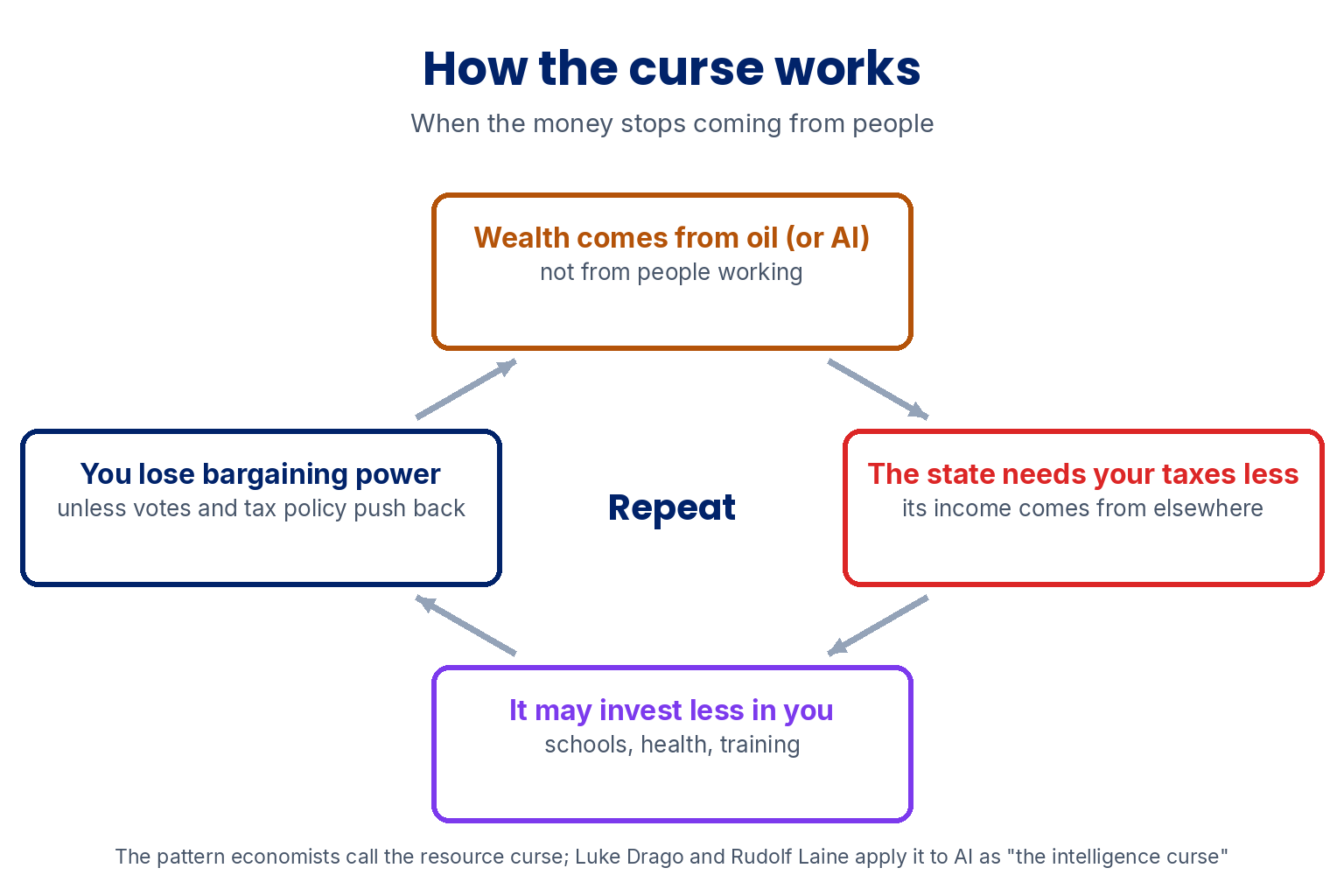
Swap the oil well for a data centre and you get the intelligence curse: if AI produces the wealth, our labour and our taxes may matter less to the people in charge, unless votes and tax policy push back.
It has started at the edges: employment of young workers in the most AI-exposed jobs is about 19% below where it would be if it had kept pace with their peers, though there's no economy-wide wave of job losses yet.
Score your job task by task, then move your time towards the tasks AI finds hardest: judgement, accountability, seniority, physical work, and directing AI yourself.
The Resource Curse: Why Oil-Rich Countries Stay Poor
There's a pattern in economics called the resource curse. You'd expect a country sitting on huge natural wealth to be rich. Often, it's the opposite.
Take Venezuela. It has the largest proven oil reserves on Earth, about 304 billion barrels, more than Saudi Arabia. In the 1970s it had the highest income per person in South America. Today, according to the country's largest household survey, about three in four Venezuelans live in income poverty. What happened? One explanation economists propose is that the oil money poured in and the government stopped needing its people. Why invest in education when the wealth comes out of the ground?
Nigeria is the same story. It's Africa's largest oil producer, though Libya is now close behind. And the World Bank estimates more than 60% of Nigerians lived below the national poverty line in 2025. I lived there. I was in the Niger Delta and saw it myself: shanty towns next to oil fields.
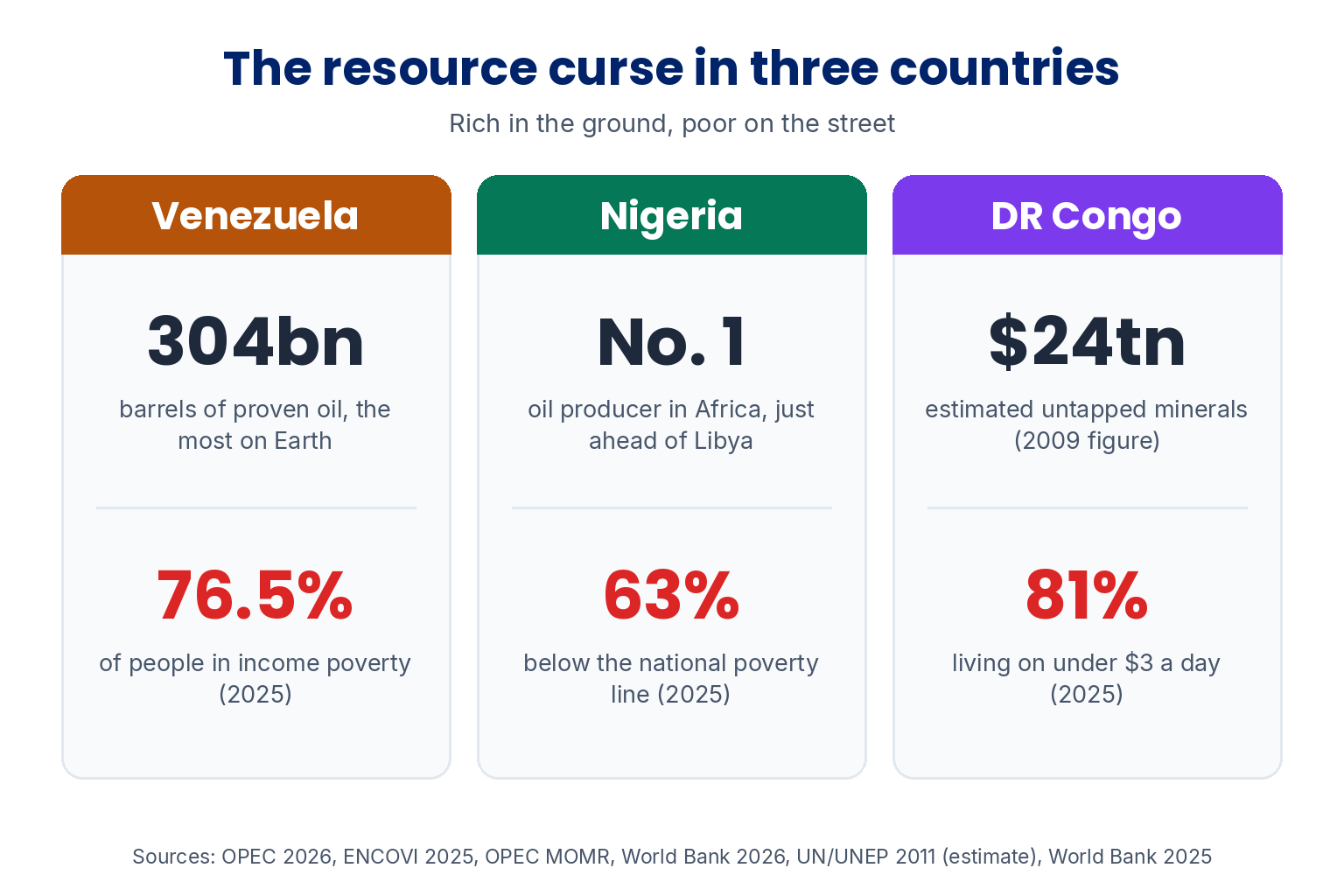
The Democratic Republic of Congo's untapped minerals have been estimated at up to $24 trillion. That's a rough figure from 2009 that the UN has repeated, so treat it as an order of magnitude. Yet about 8 in 10 Congolese live on under $3 a day. Even Saudi Arabia, pouring hundreds of billions through its sovereign wealth fund into building an economy that doesn't depend on oil, has had to scale back its flagship megaprojects. That shows how hard the trap is to escape once it sets in.
Corruption, conflict and bad policy all play a part, and no two countries are the same. But the incentive is the part that worries me: when wealth comes from the ground instead of from people, people can become less important to the ones in charge.
The Intelligence Curse: When AI Pays the Bills
Now here's where it gets personal. Replace the oil well with a data centre. Replace mineral extraction with AI doing the work. My view is that the economics are the same, and so is the likely outcome.
Picture a country where half, or 70%, of the economy's output comes from AI. In my view, that's where the AI companies are trying to take us, because their financial models need it. If that happens, we lose bargaining power at work, because AI needs less of our labour. And if AI reduces a government's dependence on workers and their taxes, it may have less economic reason to invest in people. Our votes, and decisions about how AI wealth is taxed and shared, are the counterweight. Whether they hold is the open question.
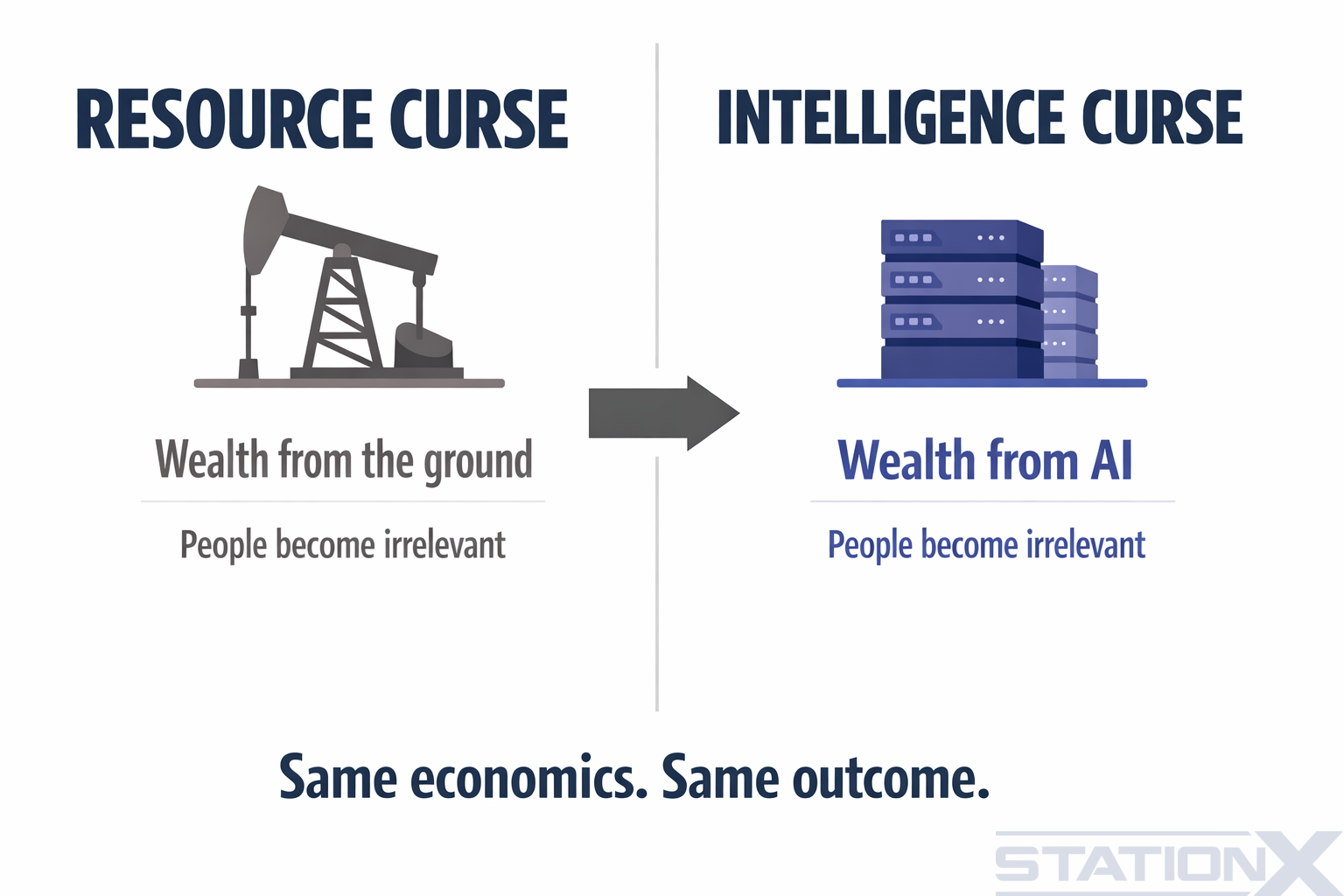
I didn't invent this idea. The term "intelligence curse" was coined by Luke Drago in an essay in January 2025 and developed with Rudolf Laine in their series The Intelligence Curse. Their core warning is that powerful actors who can create general intelligence "will lose their incentives to invest in people." Tristan Harris took it further on Sam Harris's Making Sense podcast (#469) in April 2026. It's a prediction, not a certainty. But it's built on how people with power have behaved before.
What Sam Altman Said About "Training a Human"
In February 2026, during India's AI Impact Summit week, Sam Altman, the CEO of OpenAI, was asked by The Indian Express about the energy AI uses. His answer:
"It also takes a lot of energy to train a human. It takes like 20 years of life and all of the food you eat during that time before you get smart."
He was making a point about efficiency. But listen to how it lands. The head of the world's best-known AI company compared raising a person to training a model, as two costs on the same balance sheet. My read is that this is the intelligence curse in one sentence: we're being reclassified from citizens to overhead.
Why the AI Business Model Needs Your Job
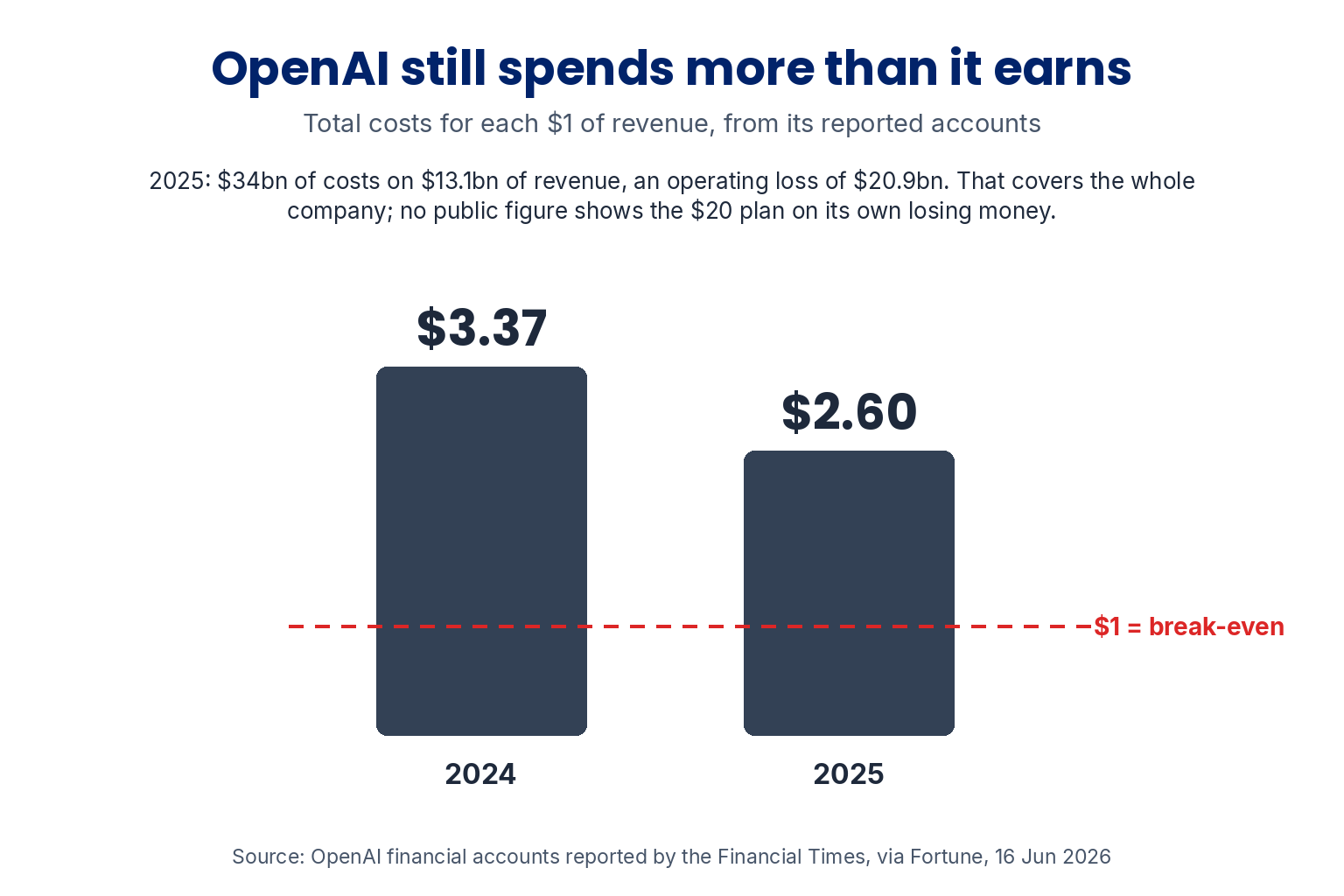
Follow the money. OpenAI charges around $20 a month for ChatGPT Plus. The company as a whole still spends far more than it earns: according to its accounts as reported by the Financial Times, it had $34 billion of costs on $13.1 billion of revenue in 2025. That's about $2.60 spent for every $1 earned, and an operating loss of nearly $21 billion. To be fair, no public figure shows the $20 plan on its own losing money. The losses are across the whole company.
So where does a company that size make its money back? My forecast is that subscriptions and advertising won't bring in enough to justify the spending. The prize big enough to justify the spending is the human labour economy itself, worth tens of trillions of dollars a year. That's my read of the business model: not to help you do your job, but to do it instead. We're not being augmented. We're being replaced, or at least that's the plan on the spreadsheet.
If you want the other half of this story, why no single CEO can stop the race even if they wanted to, read The AI Layoff Trap.
Jobs AI Will Replace: What's Happening Now
Is this just a theory? Partly it's still ahead of us, and I want to be honest about which part. But some of it is already measurable.
Stanford's Digital Economy Lab has been tracking young workers using payroll data. Its August 2026 update finds that employment among 22 to 25-year-olds in the most AI-exposed occupations is now about 19% below where it would be if it had kept pace with their peers in less-exposed jobs. In the video I quoted 13%, from the first version of the study. It has grown with each update, though each one also uses newer data and a refined measure.
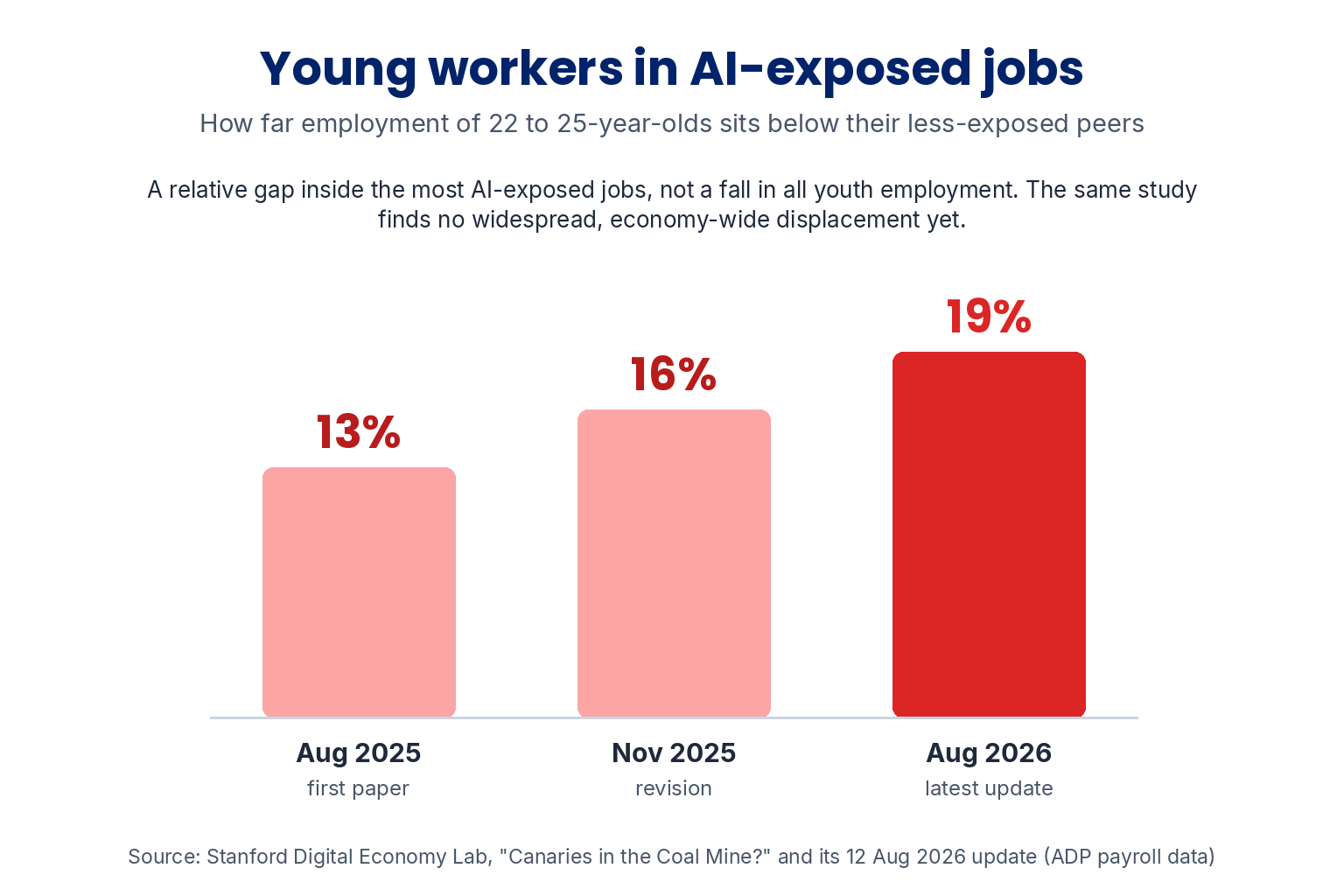
Two things to be clear about. This is a gap inside the jobs most exposed to AI, like software development and customer service, not a fall in all youth employment. And the same researchers say they see "no widespread, economy-wide job displacement" yet; the gap comes mostly from companies hiring fewer young people, rather than from layoffs. That's exactly how the entry level disappears: the job you would have got just never gets posted.
Then there are the "arm farms", a nickname for a new kind of gig work. In Los Angeles, hundreds of people are strapping cameras to their heads and filming themselves folding laundry and washing dishes, for about $80 for two hours, so the footage can train humanoid robots. The same work is happening in China and in India. One of the newest job categories is, quite literally, training our replacements. Right now AI still needs us for that data. That work may turn out to be a bridge, not a career.
The Safety Gap Nobody Is Closing
A related concern is whether the money spent making AI more capable is matched by money spent protecting people from its risks. On the podcast that sparked this video, Tristan Harris put the ratio at about 2,000 to 1: around $2,000 on making AI more powerful for every $1 on making it safe. I want to be straight with you about that number. Harris credits it to the AI researcher Stuart Russell, and I couldn't find a published calculation behind it. Russell's own figure, from a 2024 interview, is even starker, about 10,000 to 1, but it only counts public-sector safety research.
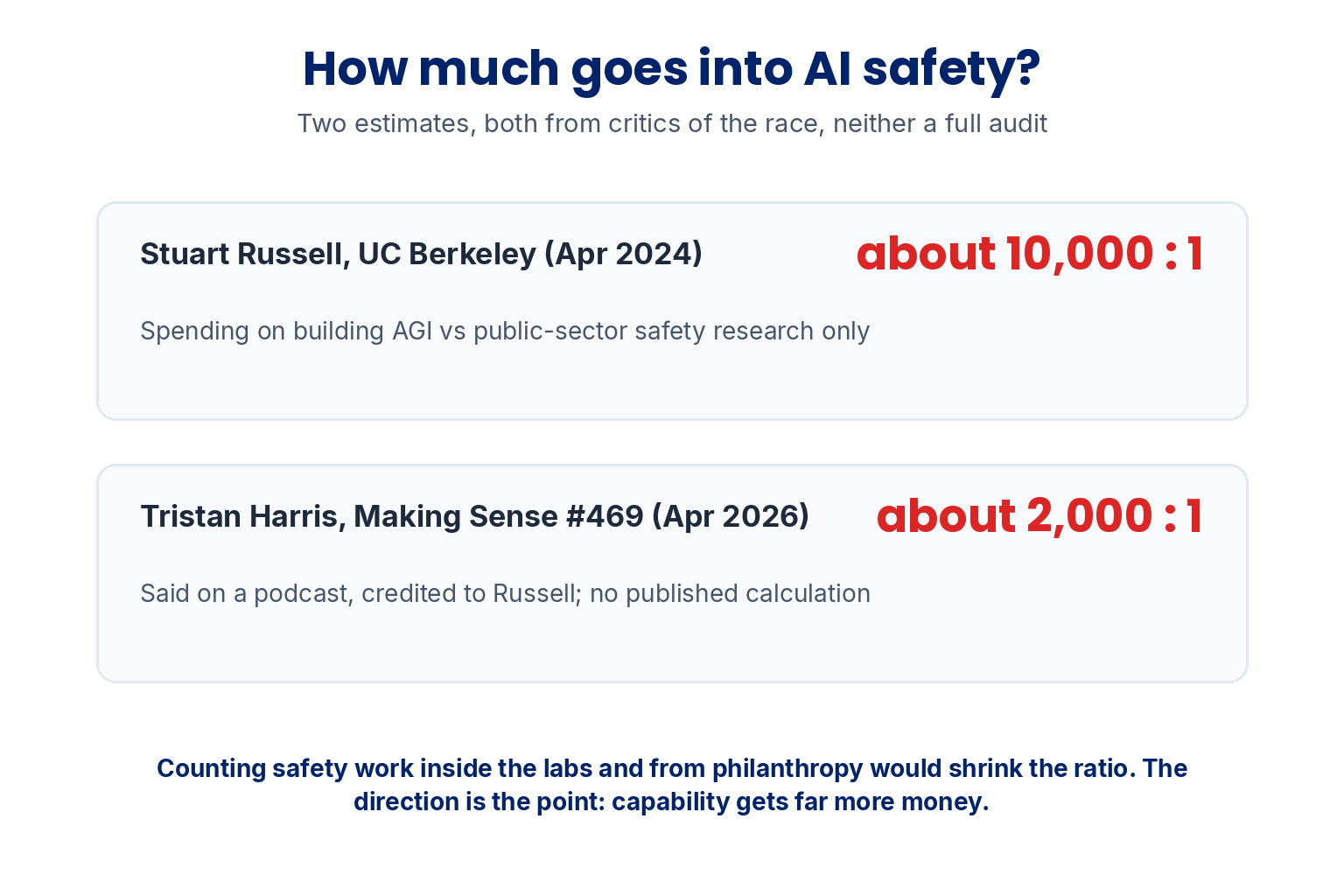
Count the safety work done inside the labs and funded by philanthropy and the ratio would shrink. But the direction is the point: far more money goes into making AI more capable than into making it safe. Harris also claimed that around one in five staff at Anthropic would back a pause if asked. No poll has been published, so take that as his claim. If it's even close, the people building this aren't sure it's safe, and the race is speeding up anyway.
Will AI Take My Job? Score It in 5 Minutes
The intelligence curse hasn't locked in yet. My view, from the data we track, is that you have roughly 12 to 24 months to reposition before the shift starts to reinforce itself. That's a judgement call, not a measured deadline. But either way, right now is the best position you'll be in to move.
Start by scoring your job. JobZone Risk is free. Type in the job you do and you'll get a score from 0 (very exposed to AI) to 100 (safe). But the number isn't the useful part. It breaks your role down task by task: which parts of your job are safe, and which parts AI is coming for first.
That task breakdown is what matters. If you have some control over your duties, shifting your time towards the tasks that protect you may help without a career change. For example, in my own field, a tier 1 security operations centre (SOC) analyst, who checks security alerts against a written procedure, scores 5.4 out of 100. A chief information security officer (CISO), who has to make the call and answer for it, scores 83.0. Same field, very different exposure, and the difference is the tasks.
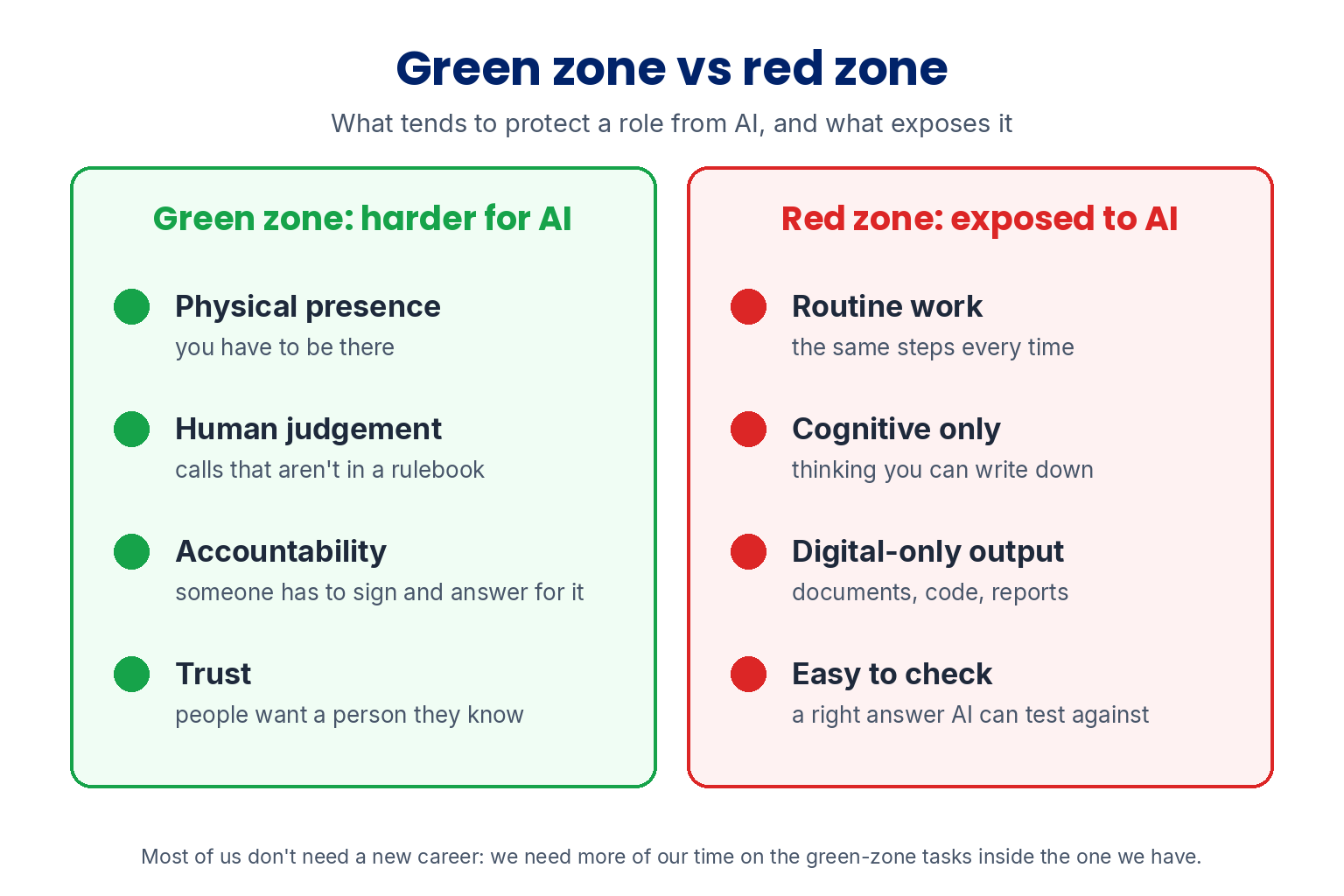
Roles in the green zone resist AI through things like physical presence, human judgement, accountability and trust. Roles in the red zone are exposed through routine work, thinking that can be written down as steps, and output that's purely digital.
5 Pillars to Protect Your Career From AI
Across the roles we've scored, five things keep separating the protected ones from the exposed ones. Think of them as directions to move your time in, not boxes to tick.
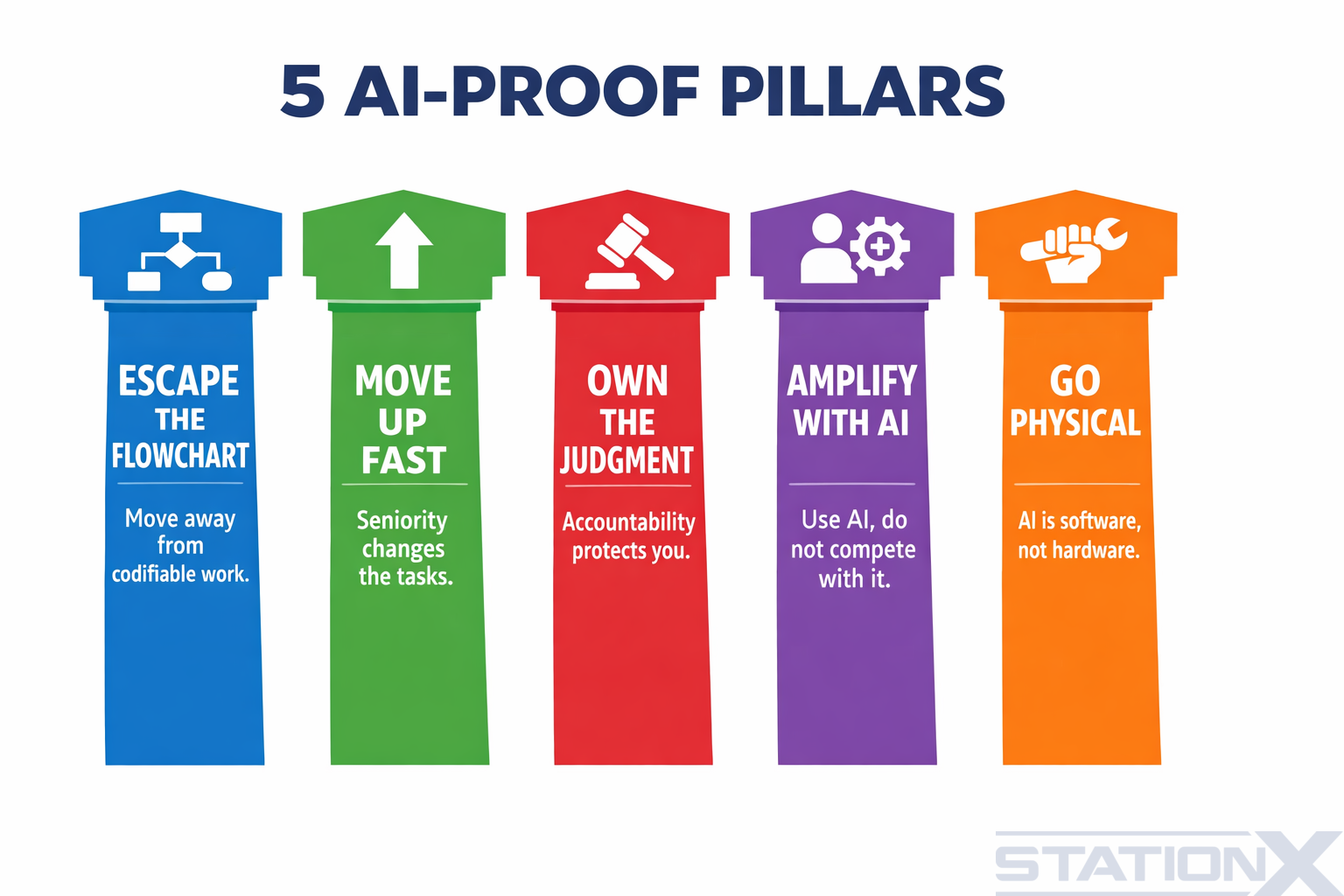
"AI-proof" here means ways to reduce your exposure, not guarantees.
Escape the flowchart. Move away from work that can be written as a step-by-step workflow. If you could hand someone a checklist and they'd get it right, so can AI.
Move up, fast. Seniority changes the tasks, and the tasks are what protect you. A senior person spends more time deciding and less time doing.
Own the judgement. Take on the calls that need someone to stand behind them. Accountability is hard to hand to a machine.
Amplify with AI. Use AI to multiply your own output instead of competing with it. This is where I see the future, and I call it AI-driven engineering. Employers are already writing it into jobs: every one of the 661 listings in our AI-Driven Cyber Security Jobs archive includes a line about working with AI.
Go physical. Where you can, lean into the physical parts of your role. Physical work is harder and slower to automate: AI is software, and it still needs someone on site, at the machine, in the room. Robots are being trained to close that gap, as the arm farms show, so this buys time rather than guaranteeing it.
If you work in or want to move into cybersecurity, I've applied the same thinking to specific skills in I Scored 3,500 Jobs. These 6 Cyber Skills Win. And if you want to start on the amplify pillar, our guide to agentic engineering explains how it works in practice.
The intelligence curse isn't about whether AI can do our jobs. It's about whether anyone will care when it does. Knowing your score is the first step. Building towards the tasks that protect you is everything else. The window is still open.

Frequently Asked Questions
Which jobs will AI replace?
AI replaces tasks before it replaces whole jobs, and the most exposed tasks are routine, rule-based and digital: work you could write down as a step-by-step workflow. Stanford researchers find employment of 22 to 25-year-olds in the most AI-exposed occupations is now about 19% below where it would be if it had kept pace with their less-exposed peers. Check your own role, task by task, on JobZone Risk.
What is the intelligence curse?
The intelligence curse is the idea that when AI, rather than people, produces most of a country's wealth, governments and companies may lose their economic reasons to invest in people, just as oil-rich states often neglect their citizens. The term was coined by Luke Drago in January 2025 and developed with Rudolf Laine in their essay series The Intelligence Curse.
Will AI take my job?
It depends on the tasks you do, not your job title. Roles that need physical presence, human judgement, accountability and trust are harder for AI to take. Roles made of routine, digital-only work are more exposed. JobZone Risk scores 3,649 roles from 0 to 100 and breaks each one down task by task.
Is AI already causing job losses?
The evidence so far is narrow but growing. Stanford's Digital Economy Lab finds no widespread, economy-wide job displacement yet, but a 19% gap for young workers in the most AI-exposed jobs, mostly from reduced hiring rather than layoffs.
How do I protect my career from AI?
Spend more of your time on the tasks AI finds hardest. Move away from work that can be written as a workflow, move up towards senior work, take on judgement and accountability, use AI to multiply your own output, and lean into the physical parts of your role where you can.
About the Author

Nathan House, Founder & CEO of StationX
Nathan House has 30 years of hands-on cybersecurity experience and is Cambridge-educated, holding CISSP, CISA, CISM, OSCP, CEH, and SABSA. He founded StationX in 1999 — one of the UK’s first cybersecurity companies — and has secured £71 billion in UK mobile banking transactions and the London 2012 Olympics, advising clients including Microsoft, Cisco, BP, Vodafone, and VISA. He authored the world’s most popular cybersecurity course — a #1 Udemy bestseller taken by over 500,000 students — and was named Cyber Security Educator of the Year 2020, AI Security Educator of the Year, and a UK Top 25 Security Influencer 2025. A DEF CON speaker and featured expert on CNN, Fox News, NBC, and the BBC, Nathan leads StationX’s training of more than half a million students worldwide.