NordVPN Review (Sept 2026) by a Leading Security Expert
NordVPN is the biggest name in VPNs, and if you've been shopping around, it's impossible to ignore. But most NordVPN reviews are written by affiliates who never got further than the pricing page.
We did something different. We spent two days inside NordVPN's offices, questioned their tech team, reviewed their security measures, and performed our own audit of their no-logs claims. We've also been using the service ourselves, across different devices and servers, for years. We last verified the prices and product facts on 3 August 2026.
In this NordVPN review, we'll cover whether NordVPN is safe, what it really costs in 2026, how fast it is, and where it falls short. Let's get into what we found.
Disclosure: if you buy through our link, StationX earns a commission at no extra cost to you. That doesn't change what we found, and we'll show you the downsides Nord doesn't advertise, including what renewal actually costs.
TL;DR — if you've only got 30 seconds
Verdict: recommended — our rating 4.6/5. One of the strongest no-logs audit records of any VPN (6 audits, latest by Deloitte in December 2025), plus our own on-site check of their zero-logging setup.
Fast: CNET's fastest VPN in its latest lab tests, with roughly 3% average speed loss. In our own testing a nearby server held a median 338 Mbps and added about 2 ms of latency. Around 9,000 servers across 224+ locations, and post-quantum encryption already shipped.
Price: $11.59 $3.49/month — 75% off the 2-year plan + 3 extra months free through our link. But it renews at $139.08/year, so diarise the renewal date.
Skip it if: you need unlimited device connections (Nord caps at 10) or want full malware blocking on the cheapest plan — Threat Protection Pro starts at the Complete tier.
NORDVPN
4.6 out of 5
Highly Recommended
How We Tested NordVPN
For online VPN reviews, it's a case of buyer beware. Many reviews are driven purely by affiliate commissions, so you can never be certain you're getting a frank assessment.
So rather than repeat NordVPN's marketing claims, we checked them:
We visited NordVPN's offices for 2 days. We sat with their engineers, reviewed their security measures first-hand, and shared meals with the team — the kind of access a press kit doesn't give you.
We performed our own audit of their zero-logging setup, rather than taking the published audit reports on faith.
We used the product long-term. Different servers, different platforms (Windows, macOS, Linux, Android, iOS), everyday use and deliberate stress tests.
We cross-checked the independent evidence. The Deloitte and PwC audit reports, CNET's lab speed tests, and AV-Comparatives' anti-phishing test results.
With 30 years in cyber security, including penetration testing and securing systems for banks and governments, we knew exactly what to look for. That's the basis for everything below.
Why did they give a reviewer that much access? At the time, NordVPN was looking for an outside security advisor, and they opened their doors to me on ask-anything terms. That's what made the visit — in early 2024 — more than a guided tour: it was, in effect, a security audit — direct questions to their engineers, their security measures on the table, and their no-logs setup checked by someone whose job for 30 years has been finding the gaps. This was not a formal assurance engagement like Deloitte's; it was two days of unrestricted access and blunt questions. Deloitte provides the paperwork — the visit is why I personally believe it. This review is written from what that visit found, re-verified against the current product on 3 August 2026.


Our Own Speed Tests
Most VPN reviews test one server, once, and print the number. We wanted to know something more useful: how much does it matter which server you pick?
So on 7 August 2026 we tested 26 NordVPN servers from two machines — one in New York, one in London — both on datacentre lines fast enough that the VPN, not our own connection, was the limiting factor. That matters: on a typical home line the connection gives out before the VPN does, so you end up measuring your broadband instead of the product. We sampled servers across the load range rather than cherry-picking the empty ones, and report medians rather than averages, because speed results are not normally distributed — a point NordVPN's own engineers make in their published research.
Connect nearby and it's quick. Connect far away and it isn't.
| Route | Median download | Bare line | Retained |
|---|---|---|---|
| London machine → UK servers | 338 Mbps | 1,526 Mbps | 22% |
| New York → US servers | 144 Mbps | 1,324 Mbps | 11% |
| London → US servers | 124 Mbps | 1,526 Mbps | 8% |
| New York → UK servers | 116 Mbps | 1,324 Mbps | 9% |
Those retention figures look harsh next to CNET's lab result of roughly 3% speed loss, and the difference is worth explaining rather than glossing over. CNET measures on a domestic line where the connection itself is the ceiling; we deliberately used datacentre links fast enough that NordVPN's own capacity became the limit. Both numbers are honest — they answer different questions. Ours tells you what the service can carry when nothing else is in the way, which is why the percentages should not be read across to a home connection.
Latency tells the story more sharply, and it's the number you actually feel.
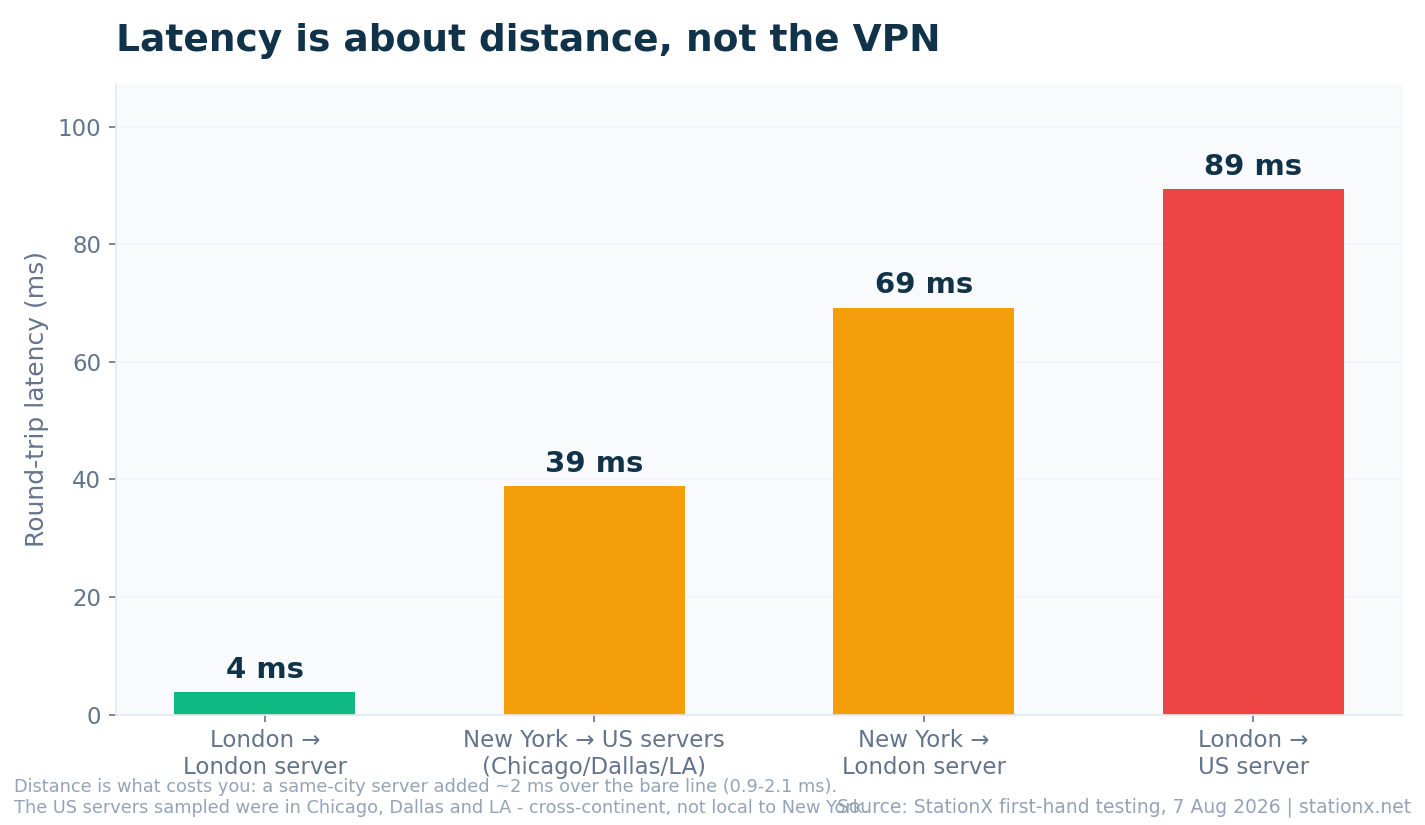
A London machine talking to a London server made the round trip in 3.8 ms — against 0.9 ms with the VPN switched off. You would never notice that. Cross the Atlantic and it climbs to 69 ms, and London to the United States reached 89 ms. If speed matters to you, the country you connect to matters far more than the VPN you bought.
The part nobody tests: which server you land on
Here is the finding we did not expect. From our New York machine we tested twelve different London servers, within the same hour, using the same method. The slowest managed 88 Mbps. The fastest managed 1,208 Mbps.
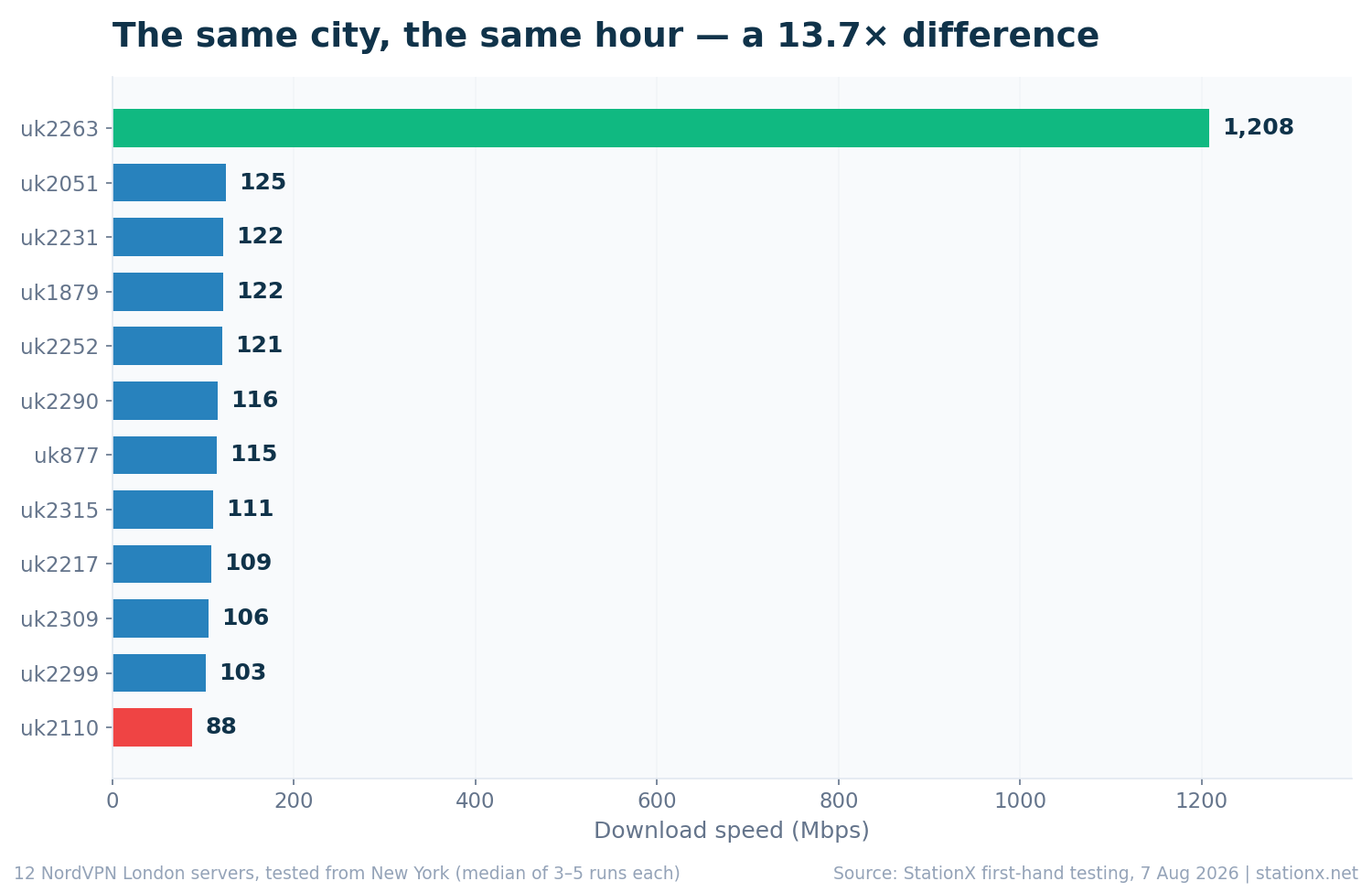
That is a 13.7-fold difference inside one city, on one provider, at one moment. The median London server gave us 116 Mbps — but the spread around it is enormous.
We also checked whether NordVPN's reported server load predicts any of this. In our sample it did not: three servers all reporting 11% load delivered 106, 122 and 1,208 Mbps. Across the servers that worked, reported load ran from 8% to 27% with no pattern we could see in the speeds. On this evidence the load percentage tells you how busy a server says it is, not how fast it will be for you.
What we found broken
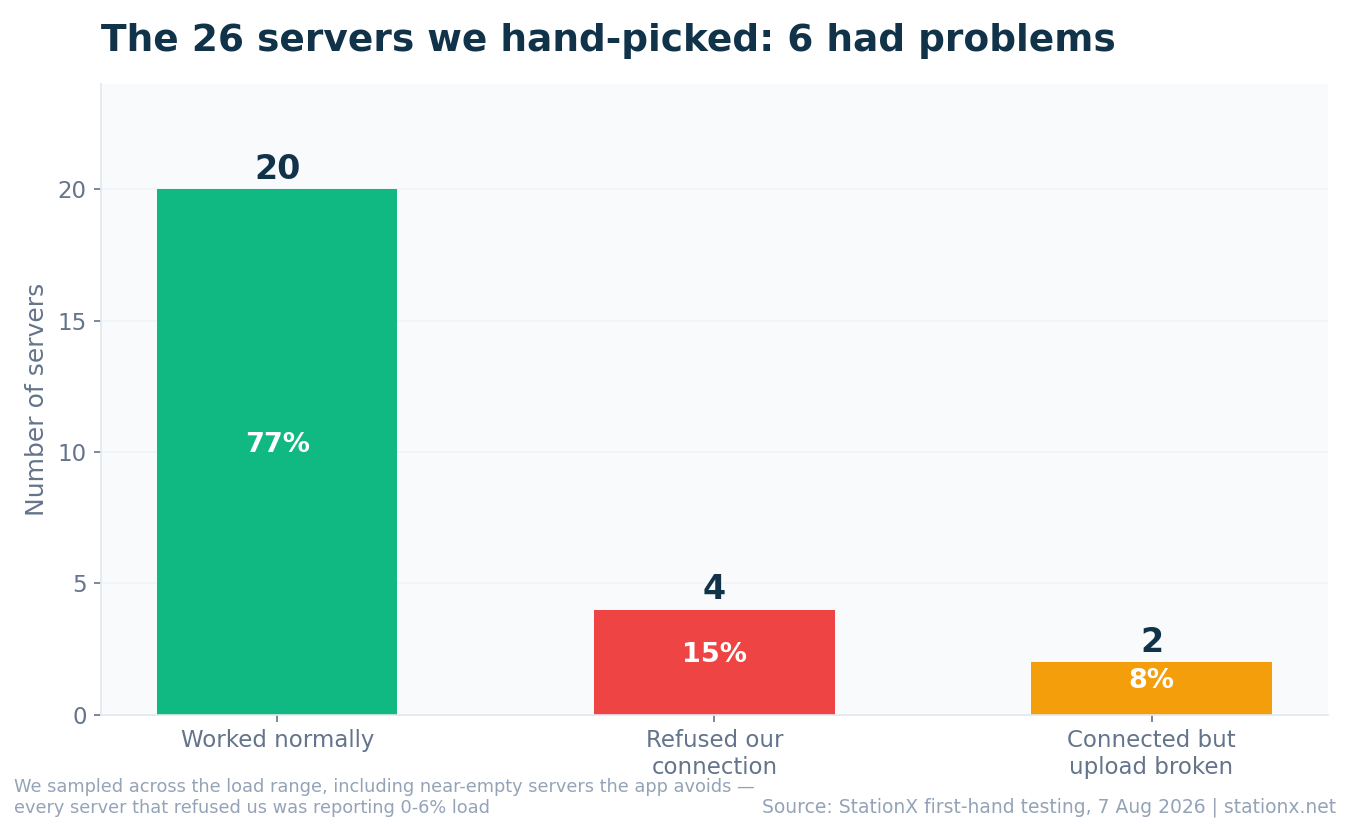
Four of the 26 servers we sampled — 15% — rejected our credentials, returning an authentication failure while the same credentials worked on other servers seconds later. Two of the four refused us from both test machines. We could not establish the cause from outside, so we are reporting what we observed rather than diagnosing it.
Two more connected happily, downloaded at normal speed, and had an effectively dead upload path: 5 Mbps up against 88 down. On those servers web browsing feels fine while video calls, cloud backup and file sharing struggle, and nothing in the software flags a problem.
That last detail is worth sitting with, because it inverts the obvious advice: an empty server may be empty precisely because it isn't working. Picking the least-loaded server from the list — the intuitive move, and the one the load figures invite — landed us on an unusable server every time.
We should be straight about where that 15% comes from, because it is not the failure rate you would experience. We deliberately sampled across the whole load range, including the near-empty servers, and those are exactly the ones that turned out to be unusable. Someone clicking Quick Connect would probably have hit none of them. We found these because we went looking in the part of the server list the app steers around. The finding is real, and it matters if you pick servers by hand; it is not a claim that a seventh of NordVPN's network is down.
So does the app save you from this?
Largely, yes, and this is the practical takeaway. We checked the recommendation service that NordVPN's Quick Connect uses: none of the servers that failed for us appeared anywhere in its top 20 suggestions for their country. It also doesn't simply pick the emptiest machine: on repeated checks its suggestions clustered in the low-to-mid range of reported load rather than at the zero-load end, which is where every server that failed us was sitting.
Use Quick Connect. The manual server list will hand you a dud without comment; the recommendation engine steers around them. It's a small thing that makes a large difference, and it's the opposite of what an experienced user's instinct — pick the empty one — would tell them to do.
What we didn't test, and why
These numbers are OpenVPN, not NordLynx. NordLynx is Nord's WireGuard-based protocol, it's what the app uses by default, and by Nord's own published testing it beats OpenVPN in the large majority of cases. Getting NordLynx keys requires account-level access our manual setup didn't have, so treat the speed figures above as the conservative case — though we should be clear that we have not measured whether the reliability problems above look any different on NordLynx.
We also tested for leaks. The IP address changed correctly every time, and no IPv6 address leaked. DNS is more nuanced: NordVPN's servers correctly push their own resolvers, which we confirmed in the connection log — but a hand-rolled OpenVPN setup on Linux ignores them unless you wire up the resolver hook yourself, and ours did until we looked. That's a warning about manual configurations, not about NordVPN. The same goes for the kill switch: kill a bare OpenVPN tunnel and traffic reverts to your real connection immediately, because plain OpenVPN has no kill switch at all. Nord's app ships one; we haven't yet tested it.
Tested 7 August 2026 across 26 servers (28 server-and-location combinations) from New York and London datacentres, OpenVPN UDP, medians of 4–10 download measurements per server. Download figures use a compressible test payload and should be read as indicative; upload figures use random data. These are datacentre results on lines fast enough not to be the bottleneck — do not assume either the raw speeds or the retention percentages transfer to a home connection.
Is NordVPN Good? Feature by Feature
The key to choosing a VPN lies in identifying what you're trying to protect yourself against. Are you worried about censorship, passive surveillance, or targeted attacks? Do you do a lot of P2P file sharing? Are you most interested in accessing geo-blocked content?
NordVPN promises to solve all of those problems. Here's how it holds up, feature by feature.
Does NordVPN Keep Logs? Audited 6 Times
Plenty of VPN providers promise they don't keep activity records. It's an easy claim to make — but who's actually checking?
NordVPN has now had its zero-logging policy independently verified 6 times, more than any competitor we're aware of. PricewaterhouseCoopers audited them in 2018 and 2020, and Deloitte has audited them annually since 2022. The most recent engagement ran from November to December 2025, and Deloitte's report — announced in February 2026 — found NordVPN's systems configured in line with its no-logs policy at the time of review. Deloitte's practitioners inspected the standard servers plus the specialty ones (Double VPN, Onion Over VPN, and obfuscated servers) and interviewed staff to verify internal practice matches the policy.
NordVPN is also legally based in Panama, one of the most privacy-friendly jurisdictions in the world: no mandatory data retention laws, and outside the Five Eyes intelligence-sharing alliance.
The audits are great news, but we wanted to check for ourselves. During our visit to the NordVPN offices, we checked their zero-logging setup first-hand — and everything we inspected backed the policy.
Security Features: Threat Protection Pro (Formerly CyberSec)
If you used NordVPN years ago, you'll remember a feature called CyberSec. It's been rebuilt and renamed Threat Protection Pro, and it now works more like a lightweight antivirus than a simple ad blocker. In AV-Comparatives' May 2026 anti-phishing test (275 live phishing URLs), it blocked 96% of phishing attempts with zero false positives.
Malicious URL blocker. Automatically scans URLs and blocks access to malware-hosting or otherwise malicious websites, including known phishing pages.
Web tracker and ad blocker. Stops third parties from gathering data on your preferences and cuts the ads out of your browsing.
Download scanner. Automatically checks newly downloaded files for known malicious signatures.
App vulnerability scanner. Alerts you when installed software has known vulnerabilities.
The full Threat Protection Pro is not included in the cheapest Basic plan — you'll need Complete or Prime for it — and it only runs on Windows and macOS. On Android, iOS, Linux, and the browser extensions you get the lighter Threat Protection, which blocks ads and known malicious domains while the VPN is connected (Basic subscribers get that lighter version everywhere). If you're mobile-first, don't buy up a tier for a feature your device won't run.
Choice of Servers
NordVPN now operates around 9,000 servers across 224+ locations (as of 3 August 2026), up from roughly 6,000 servers when we first reviewed them. You choose your location from a list with a couple of clicks, or hit "Quick Connect" and let the software pick the best server for you.
The servers are also RAM-only: nothing is written to disk, so a physically seized server cannot hand over stored user data — there is nothing on it to recover once the power is cut. (RAM-only prevents post-seizure forensic recovery; like any architecture, it doesn't stop an attacker who gains live root access while a server is running.)
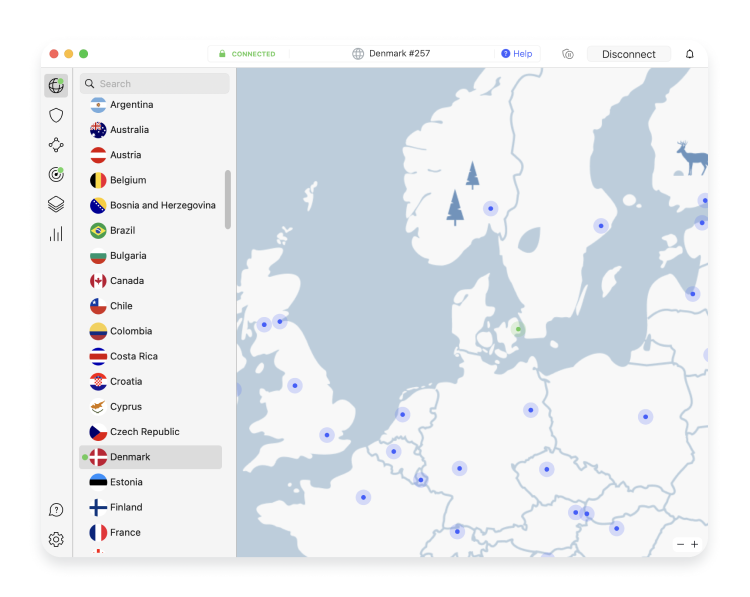
Multiple server types suit different use cases:
Double VPN. Routes your traffic through two servers, changing your IP address twice and protecting your connection with double encryption. Useful if you're accessing or transferring especially sensitive information.
Onion over VPN. Combines the VPN with the Tor network, making it even more difficult to trace the origin and destination of traffic.
Obfuscated servers. Disguise your VPN traffic to get around firewalls and VPN blocks, useful in countries with restricted internet access. In 2025, Nord introduced its NordWhisper protocol for exactly this, making VPN traffic look like ordinary web traffic.
Dedicated IP. Your own fixed IP address, available in a growing list of countries. Good for online banking and remote access to corporate networks.
P2P support. Current apps support P2P traffic across the standard server network (the old dedicated P2P category has been retired). NordVPN also offers Meshnet connectivity, which links your devices directly like a secure LAN. Handy for file sharing and gaming.
Speed and Performance
Any VPN will slow down your internet — the question is whether you'll notice.
In CNET's latest lab tests, NordVPN measured an average speed loss of around 3%: the best result of any VPN they tested, and a big improvement even on the 11% that won it "fastest VPN" in earlier rounds. The speed comes largely from NordLynx, Nord's WireGuard-based protocol.
Numbers from other sources are nice, but we ran our own. Across 26 servers tested from two datacentres, a London machine connecting to UK servers held a median 338 Mbps, and the latency penalty on a same-city server was about 2 ms — imperceptible in use. The catch is that which server you pick moved the result far more than we expected: see our own speed tests for the full numbers and the servers that let us down.
The platform is compatible across all operating systems and devices: Windows, macOS, Linux, Android, iOS, even Apple TV and Android TV. Split tunneling lets you route some apps through the VPN and not others, though note it isn't available on iOS.
Encryption and Protocols: Post-Quantum Ready
Under the hood, NordVPN runs AES-256 and ChaCha20 encryption over three protocols — NordLynx (the fast default), OpenVPN, and IKEv2/IPsec — plus the newer NordWhisper for obfuscation.
The change security professionals should care about: NordVPN completed rolling out post-quantum encryption (to the NIST post-quantum standards, via NordLynx) across its major apps in 2025, after piloting it on Linux in late 2024. That defends against "harvest now, decrypt later" attacks, where an adversary records your encrypted traffic today and waits for quantum computers to break it. Very few consumer VPNs have shipped this in production. For a tool whose whole job is long-term confidentiality, we think it matters, and Nord got there early.
Is NordVPN Safe, and Can It Be Trusted?
This is the question that matters most with any VPN. You're routing all your traffic through them, so trust is the product. Our answer is yes, with eyes open. Here's the full picture, including the parts Nord's marketing won't tell you.
The case for trust. 6 independent no-logs audits since 2018, the latest completed by Deloitte in December 2025. RAM-only servers. Panama jurisdiction, outside the Five Eyes. A public bug bounty program. And our own on-site audit, where their engineers opened the systems to us and the zero-logging claims checked out.
The 2018 server incident. A single NordVPN server in Finland was accessed through an insecure remote-management system left by the data center, and an expired TLS key was stolen — which in theory could have enabled a targeted man-in-the-middle attack against users of that one server while the key was valid. No user activity logs were exposed (there were none to expose), but Nord took around 18 months to disclose it, which drew fair criticism. Since then they've moved to RAM-only servers, co-located hardware, and the annual audit cycle. In our view the response was stronger than the failure.
The January 2026 "breach" claim. A threat actor on a hacking forum claimed to have stolen databases from a NordVPN development server, including Salesforce API keys and Jira tokens. NordVPN's response: the leaked material was dummy data from an isolated third-party test environment, with no customer data involved. Independent reporting by BleepingComputer and SecurityWeek found no evidence of customer impact. We looked at what was published, and it's consistent with Nord's explanation, but we'll update this review if that changes.
The billing lawsuits. Nord Security has faced several US class-action lawsuits (filed 2024 through 2026) alleging its auto-renewal practices make cancelling harder than it should be. These concern billing, not privacy: no lawsuit alleges logging or data misuse. But it's a real pattern worth knowing about, and it's why we spell out the renewal prices below rather than just the intro deals. Set a calendar reminder before your renewal date, and you sidestep the whole issue.
Nothing in that list changes our recommendation. The privacy engineering, the part we audited ourselves, is genuinely excellent. Just go in knowing what the renewal will cost.
How Much Does NordVPN Cost?
NordVPN sells three plans in the US (Basic, Complete, and Prime) across monthly, 1-year, and 2-year terms. Prices below are the US rates verified on 3 August 2026; the 2-year deals currently include 3 extra months.
| Basic | Complete | Prime | |
|---|---|---|---|
| 2-year plan | $3.49/mo ($94.23 upfront) | $4.49/mo ($121.23) | $7.49/mo ($202.23) |
| 1-year plan | $5.49/mo ($65.88) | $6.49/mo ($77.88) | $9.49/mo ($113.88) |
| Monthly | $14.99 | $19.99 | $29.99 |
| Renews at | $139.08/yr | $219.48/yr | $296.28/yr |
| VPN + basic Threat Protection | ✅ | ✅ | ✅ |
| Threat Protection Pro | — | ✅ | ✅ |
| NordPass password manager | — | ✅ | ✅ |
| 1 TB NordLocker encrypted storage | — | ✅ | ✅ |
| Identity theft protection | — | — | ✅ |
Which plan? Basic if you only want the VPN, or if you're mobile-first (the full Threat Protection Pro only runs on Windows and macOS anyway). Complete if you're on desktop and want Threat Protection Pro plus the password manager and encrypted storage — the pick for most of our readers. Prime only if you also want identity theft cover.
⚠️ Watch the renewal price. That $3.49/month headline rate is the intro deal. After the first term, Basic renews at $139.08 a year — roughly $11.59/month. That's the single biggest complaint about NordVPN, and we'd rather you hear it from us than from your card statement. The intro deal is still genuinely good value; just diarise the renewal date and renegotiate or switch when it arrives.
There's a 30-day money-back guarantee on all plans (claimed through Nord's live-chat support), and auto-renewal is on by default — you can switch it off any time in your Nord Account dashboard, which is the clean way to bank the intro price without ever meeting the renewal rate. If you prefer to maintain anonymity, NordVPN accepts payment in several cryptocurrencies, including Bitcoin and Ethereum. Prices are promotion-driven and vary by region, so check the checkout page for your final figure.
NordVPN gives StationX readers 75% off the 2-year plan plus 3 extra months — click the banner to claim it:
What We Don't Love About NordVPN
Four things we'd change:
Renewal pricing. The jump from intro to renewal rates is steep, and the auto-renewal has attracted lawsuits. You can defuse it by switching auto-renewal off on day one — but I keep going back and forth on how much to hold this against a product whose engineering I rate this highly. It's the one thing about Nord I haven't made peace with.
Threat Protection Pro is gated. The best security feature isn't in the cheapest plan. Surfshark bundles its equivalent lower down the price ladder.
10-device cap. Fine for most households, but Surfshark and Private Internet Access offer unlimited simultaneous connections.
No split tunneling on iOS. A platform limitation that still stings if you're iPhone-first.
A free tool we built while testing this
Switching countries to check one thing gets old fast, and connecting the whole laptop to Tokyo just to load a single page is a blunt instrument. So we wrote runfrom. It sends one command through another country while everything else on your machine stays put:
runfrom us -- curl https://example.com
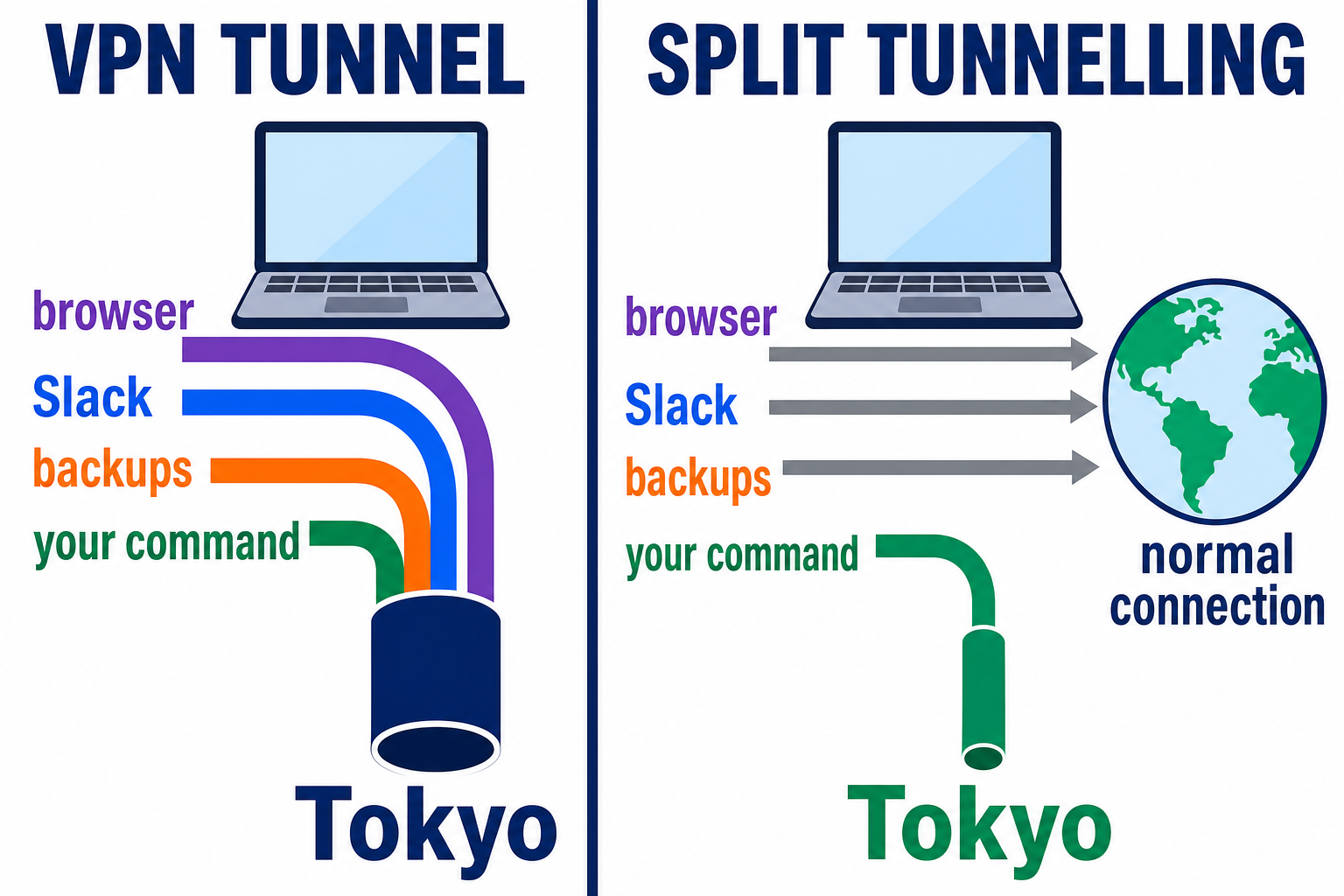
It's free, MIT-licensed, and needs no admin rights. It works with any provider's SOCKS5 servers, or any machine you can SSH to, not just Nord. macOS only for now.
What Is a VPN and Why Use One?
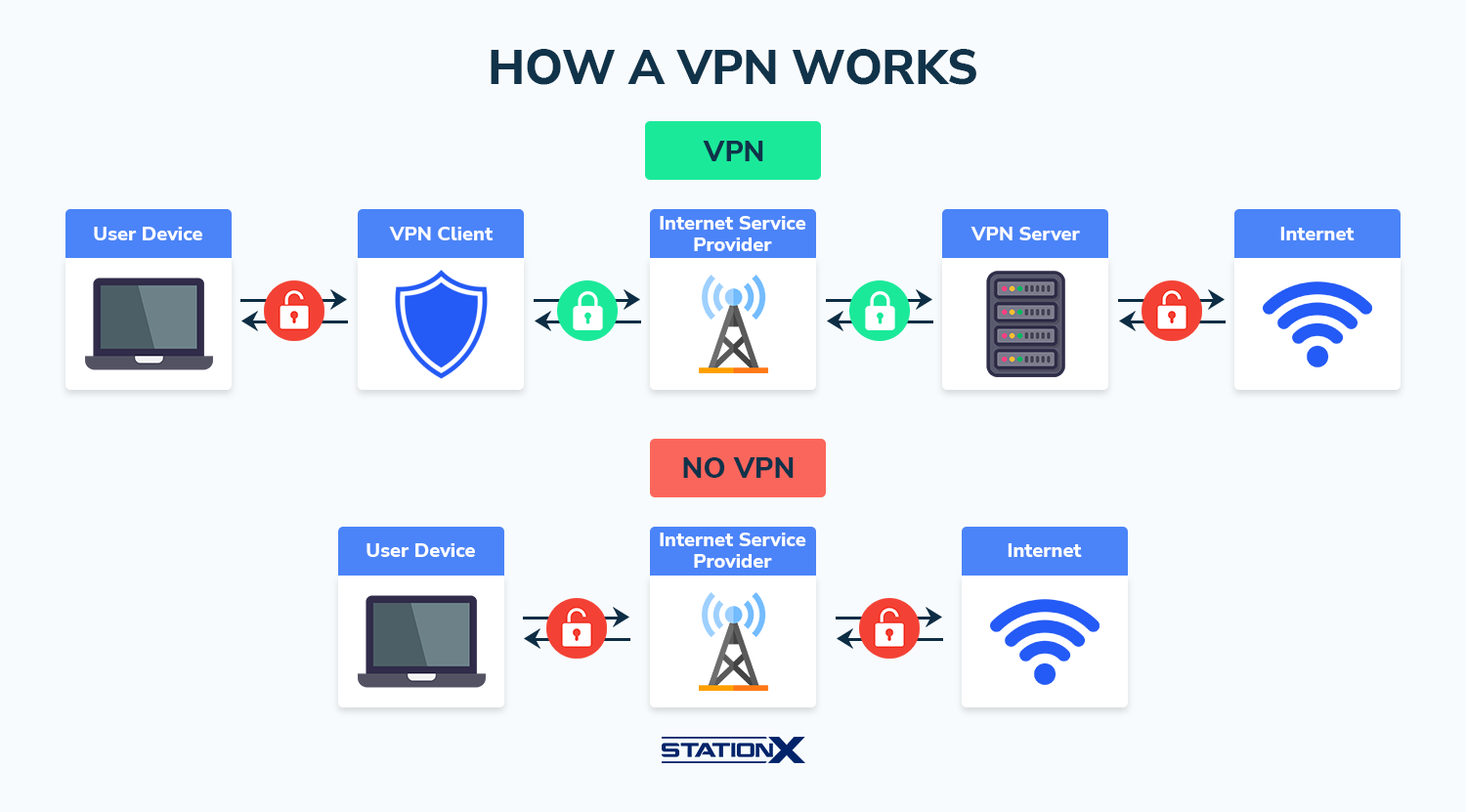
If you're newer to this, a quick grounding. A VPN (Virtual Private Network) creates a secure, encrypted tunnel between your device and the internet. Instead of connecting straight through your internet service provider (ISP), your traffic is encrypted on your device, sent to a remote VPN server, and decrypted there before travelling on.
That has two important consequences. First, your ISP cannot see which websites you visit, because your data is encrypted before it reaches them. Second, your identity is masked: the websites you visit see the VPN server's IP address, not yours.
VPN use has gone thoroughly mainstream over the past decade, and the reasons are mostly practical. Privacy is the big one: it should be nobody's business what sites you visit — not your ISP's, and not the data brokers' — and in some regions ISPs filter perfectly legal websites by default, which a VPN gets around. Security on public WiFi is the next: at the coffee shop or airport, a VPN encrypts your data at the device level, so an attacker on the same network can't see your passwords or credentials. Then there's streaming — you've paid for it, so why should travelling lock you out? Connecting to a server in your home country bypasses the geo-blocks. And a niche one people forget: businesses often price differently by country, so trying a few VPN locations can find you a better deal.
Whether you choose NordVPN or a rival, insist on these: an audited no-log policy (anyone can claim "no logs" — only audits turn the claim into evidence), AES-256 encryption with post-quantum key exchange as the new bar, a kill switch that blocks your internet if the VPN drops (and use the provider's app to get one — we measured a hand-rolled OpenVPN config falling straight back to the real connection the moment the tunnel died, because bare OpenVPN has no kill switch of its own), a privacy-friendly jurisdiction outside surveillance alliances such as the Five Eyes countries, and independently tested speeds. One thing a VPN alone won't do: stop advert tracking. Advertisers follow you with cookies and browser fingerprinting, which don't rely on your IP address, which is why bundled tracker-blocking (like Threat Protection Pro) or a dedicated ad blocker is worth having alongside.
Is NordVPN Worth It? My Verdict
Having put it to the test, in their offices and on our own devices, we've concluded that NordVPN lives up to the hype.
It has one of the strongest no-logs audit records of any VPN: 6 audits, the latest by Deloitte in December 2025, on top of our own on-site check. It's the fastest VPN in CNET's lab tests. It shipped post-quantum encryption before almost anyone else. And it's legally based in Panama — not a Five Eyes member — running RAM-only servers on which nothing persists once the power is cut.
The trade-offs are real but manageable: a steep renewal price you should diarise, and the best security features sitting in the mid-tier plans rather than Basic.
✅ The bottom line. If you want a VPN whose privacy claims have actually been checked — by PwC, by Deloitte 4 times, and by us in person — NordVPN is the one we recommend. Take the 2-year Basic plan for the best rate, add Complete if you want the full Threat Protection Pro, and set that renewal reminder.
75% off + 3 extra months free · 30-day money-back guarantee
If you want to learn more about protecting yourself online, or cyber security as a whole, consider the StationX Master's Program. You'll get access to over 30,000 courses and labs on IT, networking, and both offensive and defensive cyber security.
❓ NordVPN Review FAQ
Is NordVPN safe?
Yes. NordVPN's zero-logging policy has been independently audited 6 times: by PricewaterhouseCoopers in 2018 and 2020, and by Deloitte annually since 2022, most recently in December 2025. It uses AES-256 encryption, RAM-only servers, a kill switch, and has completed rolling out post-quantum encryption across its major apps. We also carried out our own on-site technical review at NordVPN's offices, and everything we inspected backed their no-logs claims.
Can NordVPN be trusted?
We believe so. It has one of the strongest no-logs audit records in the industry, is based in privacy-friendly Panama, and runs RAM-only servers that keep nothing on disk. Its record isn't spotless — a single server was accessed in 2018 (no user data exposed), and US lawsuits have criticised its auto-renewal billing — but no incident or lawsuit has ever involved logging or misuse of user data.
Does NordVPN keep logs?
No. NordVPN's sixth independent no-logs audit (Deloitte's fourth), completed in December 2025, confirmed NordVPN stores no data about customers' online activity: no browsing history, no connection logs, no IP addresses. Its servers run entirely in RAM, so data physically cannot persist between reboots.
What happened to NordVPN CyberSec?
CyberSec was rebuilt and renamed Threat Protection Pro. It blocks malicious websites, ads, and trackers, scans downloads for malware, and flags vulnerable apps. In AV-Comparatives' May 2026 anti-phishing test it blocked 96% of phishing attempts with zero false positives. The full version is included in the Complete and Prime plans; the Basic plan gets a lighter version that works while connected to the VPN.
Can I be tracked if I use NordVPN?
NordVPN hides your IP address and encrypts your traffic, and its Threat Protection Pro feature blocks most ad trackers. But no VPN makes you untraceable: you can still be tracked through malware on your device, accounts you log into, and browser fingerprinting. A VPN is one strong layer in your privacy setup, not the whole answer.
Can NordVPN bypass Netflix geo-restrictions?
Usually, yes. Select a server in the country whose library you want and it should work — NordVPN has one of the strongest records among VPNs for unblocking Netflix, Disney+, and BBC iPlayer. Streaming platforms actively fight VPN access, so no provider can guarantee it 100% of the time; if a server is blocked, switching locations or server categories normally fixes it.
How much does NordVPN cost?
As of 3 August 2026, US prices start at $3.49 per month on the 2-year Basic plan ($94.23 upfront, including 3 free months), $5.49 per month on the 1-year plan, or $14.99 month-to-month. Complete adds the full Threat Protection Pro, the NordPass password manager, and 1 TB of encrypted storage; Prime additionally adds identity theft protection. Watch the renewal price: Basic renews at $139.08 per year after the intro term.
Methodology: the load-bearing claims in this review — pricing, plans, server counts, audit history, and incident reporting — were verified against nordvpn.com, its pricing checkout, the Deloitte audit announcement, and independent reporting on 3 August 2026. The office visit and our own audit of NordVPN's zero-logging setup come from our hands-on assessment for the original March 2024 version of this review. StationX is a NordVPN affiliate partner; our discount and commission come from the same programme.
About the Author

Nathan House, Founder & CEO of StationX
Nathan House has 30 years of hands-on cybersecurity experience and is Cambridge-educated, holding CISSP, CISA, CISM, OSCP, CEH, and SABSA. He founded StationX in 1999 — one of the UK’s first cybersecurity companies — and has secured £71 billion in UK mobile banking transactions and the London 2012 Olympics, advising clients including Microsoft, Cisco, BP, Vodafone, and VISA. He authored the world’s most popular cybersecurity course — a #1 Udemy bestseller taken by over 500,000 students — and was named Cyber Security Educator of the Year 2020, AI Security Educator of the Year, and a UK Top 25 Security Influencer 2025. A DEF CON speaker and featured expert on CNN, Fox News, NBC, and the BBC, Nathan leads StationX’s training of more than half a million students worldwide.