Graph Engineering Explained: Multi-Agent Orchestration 2026
TL;DR — if you've only got 30 seconds
Graph engineering means pinning your multi-agent workflow to a fixed topology in a versioned file, instead of letting a model improvise the coordination on every run.
Done properly it buys three things: nothing gets silently dropped, every run is auditable, and a crashed run resumes from where it died. Those come from specific mechanisms, a total join against the input list, a journal, a version stamp, checkpoints, not from the shape itself.
It does not buy better judgement. We have a run where the same machinery gave two different answers to the same 81 files.
Most tasks never need one. The default should be a single good agent, and model-family diversity is not a reason to build.
The term is contested, and the frameworks that already do this predate the buzzword: LangGraph by years, AutoGen and Google ADK by less.
What Graph Engineering Is (And What It Isn't)
Let's clear up the name first, because it collides with two other things and half the confusion comes from that.
So what is multi agent orchestration when people call it graph engineering? It means designing a multi-agent AI system as an explicit topology: which agents run, in what order, in parallel or in sequence, what each one must return, and how their outputs get joined back together. That description lives in a stored, versioned file. The runtime reads the file and executes it the same way every time.
It has nothing to do with knowledge graphs, GraphRAG, or graph databases, which is the other thing people mean when they say "graph." And if you search the term cold you will also get a lot of graph paper. Worth knowing before you go looking for material.
The thing a graph replaces is what I'd call authored-fresh orchestration: the model writes the coordination logic at run time, or just improvises it inside its own reasoning. That works, and for most tasks it is the right choice. But the two approaches fail differently, and the difference is the whole subject.
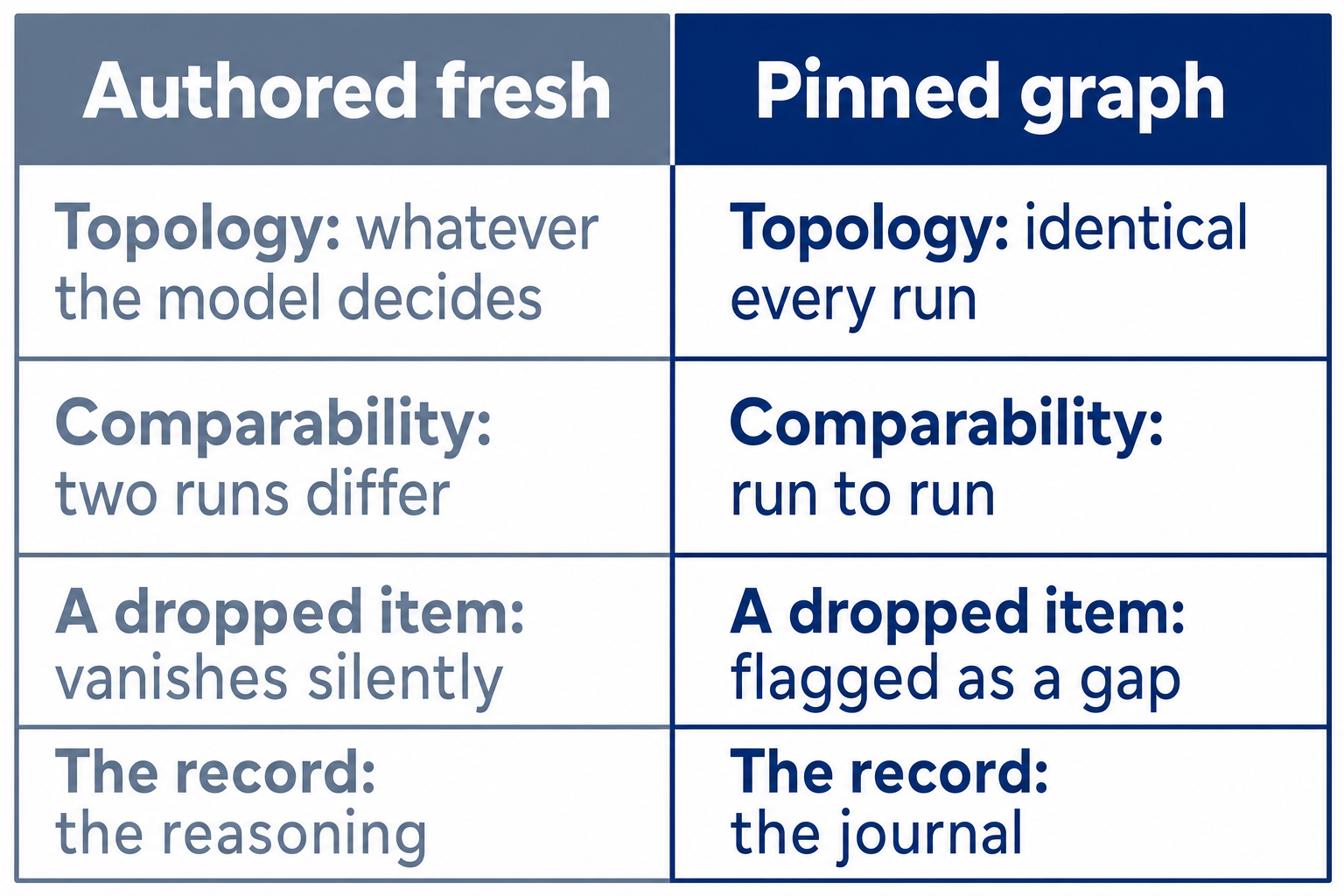
The one-line version, and I'll defend this all the way down: a graph cannot forget. That is a claim about retention across a correctly enumerated set of inputs. It is not a claim that the graph points at the right inputs, and it is definitely not a claim that its judges reach the same verdict twice. Both of those failed on us, and I'll show you where.

Where the Term Came From
Peter Steinberger, who built OpenClaw, posted twelve words on 18 July 2026: "Are we still talking loops or did we shift to graphs yet?" It reportedly picked up around three million views. Within two days the term had three competing definitions and a wave of guides. A quieter blog post by Josh Simmons on 4 July looks like the earliest documented use.
The useful response came from Harrison Chase, who built LangChain and LangGraph: "So i didn't really know what graph engineering is, and i still don't really... but it's basically just langgraph?" LangChain then leaned into it and published a piece called 3 Years of Graph Engineering with LangGraph. Which is the point. Microsoft's AutoGen had GraphFlow before it went into maintenance mode, and its successor, Agent Framework, keeps the graph shape. Google's ADK moved to a graph-based workflow engine in 2.0, first in Python and then in the Go release. OpenAI's guide to building agents describes multi-agent systems as graphs too, then argues against pre-defining the whole graph up front and takes a code-first approach in its Agents SDK instead. So even the vendor that models the shape declines to pin it. Nobody claims to have invented this.
So why does the naming matter to you? Because it tells you whether you need to build something or just use what you already have. If you are already running LangGraph multi agent orchestration, you are doing graph engineering and the term is a label for your Tuesday. The question worth your time is not "should I adopt graph engineering" but "does this particular job need an explicit topology at all", which is what the rest of this article is about.
Two claims worth not repeating
The hype pulled in some fiction. A widely shared claim about a $3.1M Stanford and Anthropic study went round the timeline in the first 48 hours. Eugeniu Ghelbur went looking for it and reported plainly that it does not exist. A second story, about an Anthropic engineer receiving a large bonus for an eight-step graph pipeline delivering a 42% productivity gain, circulated just as widely. I could find no corroboration for it from any source, and I would not repeat it as fact either way.
What a Graph Actually Buys You
This is the section I'd read if I only read one.
What it buys. Three things, and they are all about accountability rather than intelligence. One caveat first, because it is the thing most people get wrong: the topology does not deliver any of these on its own. Pinning a shape buys you the place to put the mechanisms. The mechanisms do the work, and if you skip them you get a fixed diagram and none of the benefits.
Completeness from building the final result set out of the input list rather than out of whatever the last agent handed back, and from enumerating that input list correctly in the first place.
Auditability from the run writing a journal, and from the graph stamping its own version as its first act, so weeks later you can prove which revision produced which answer.
Recoverability from checkpointing each finished step, so a run that dies halfway resumes from cache instead of starting over.
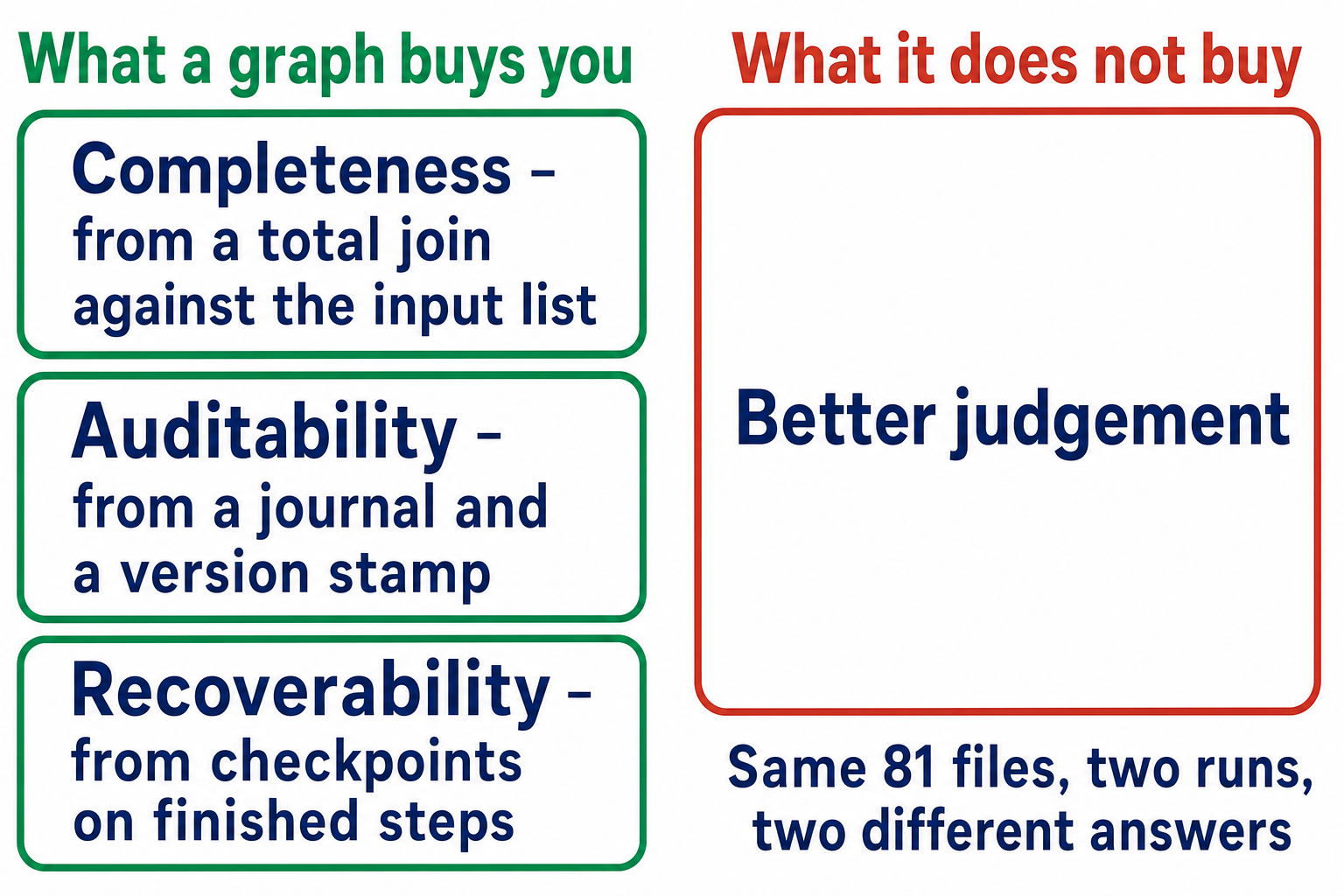
What it does not buy: better judgement. No measurement I have supports the idea that a pinned topology makes the output smarter, and I have evidence pointing the other way. I'll get to it in a moment.
There is a piece of theory here that I think is the most important thing in this whole discussion, and almost nobody writing about graph engineering has picked it up. In March 2026, Ruicheng Ao, Siyang Gao and David Simchi-Levi published On the Reliability Limits of LLM-Based Multi-Agent Planning. Proposition 6 says that without new exogenous signals, a delegated network is decision-theoretically dominated by a single centralised decision maker looking at the same information. In plain terms: no arrangement of agents can beat an ideal, centralised decision maker looking at the same evidence. That is a ceiling, not a claim that one real model reaches it. A single language model is nowhere near that ideal, which is why a panel can still help in practice, by cutting the variance of one fallible judge, while never lifting the ceiling itself. It just rearranges and compresses what you already had.
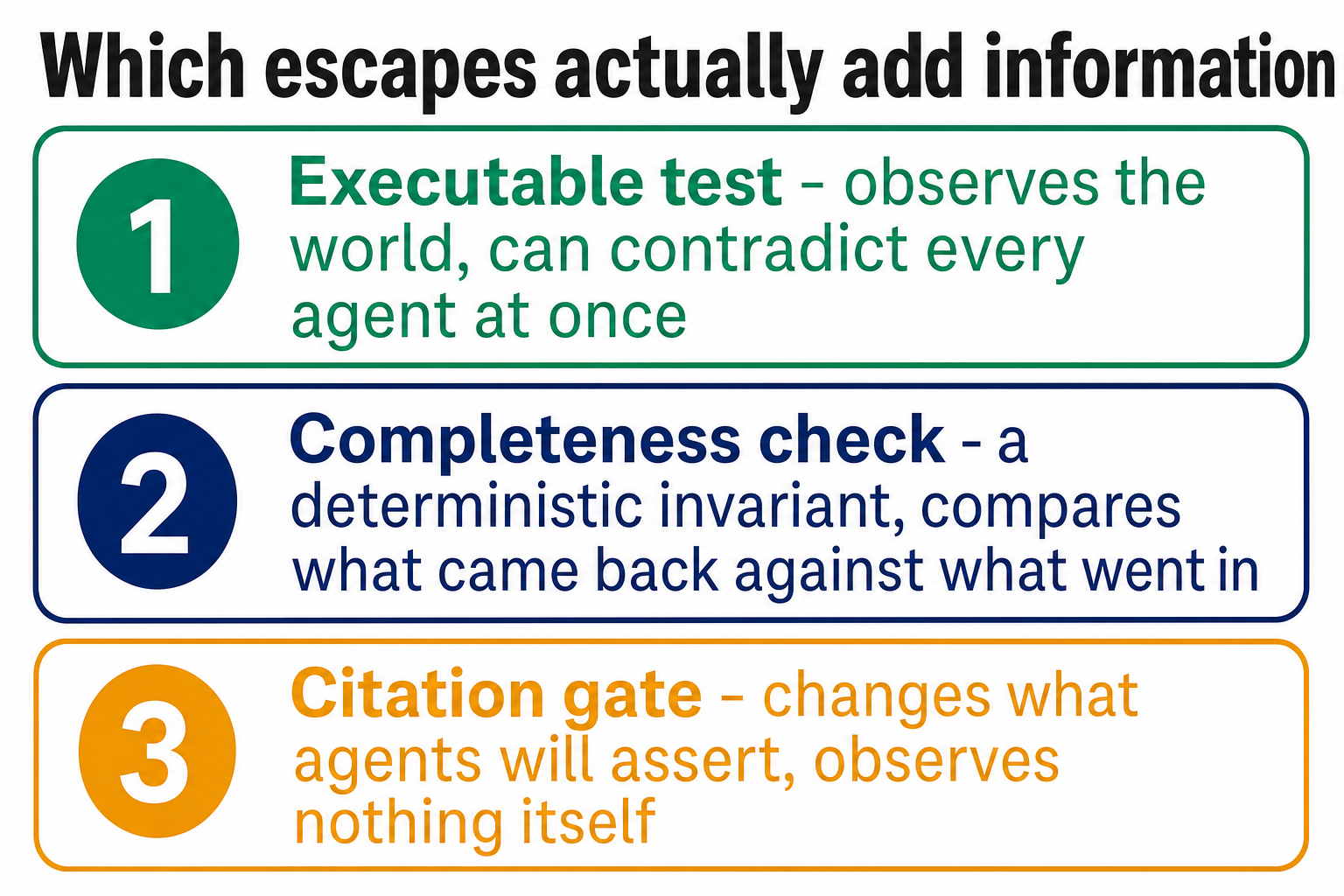
That is a serious problem for anyone selling multi-agent systems, and it should temper your enthusiasm before you build one. But the same paper names the escape. Executable tests and external validators move the boundary, because they bring in information the system did not have. Self-critique that only re-reads the same material does not.
So the honest reading is this. What earns its keep is not the act of adding another reviewer, and the escapes are not all equal. An executable test brings in genuinely new information: it observes the world and can contradict every agent at once. A completeness check against the input list is a deterministic invariant rather than new evidence, but it catches something no amount of re-reading will, because it compares what came back against what went in. An evidence gate that demands a citation is weaker still, it changes what agents are willing to assert, but it does not by itself observe anything. Reach for the executable check first.
And I want to be straight about something I got wrong for a while. I assumed that running agents from different model families counted as new information. It doesn't. Swapping GPT for Gemini re-reads the same evidence with a different reader.
The case for model diversity is a separate and much weaker one: that errors from different families are less correlated. I have not measured it properly, I would treat it with real suspicion, and the one data point I have from September points the wrong way: two families accepted the same unreproduced argument. In 1986 John Knight and Nancy Leveson tested exactly this assumption for software, in a paper titled An Experimental Evaluation of the Assumption of Independence in Multiversion Programming. They had 27 programs written independently to the same specification, and found the failures were significantly correlated anyway. Independent authorship did not deliver independent errors. If that holds for model families, and nobody has shown either way, then diversity buys less than the people selling multi-model panels imply.
The proof, on completeness
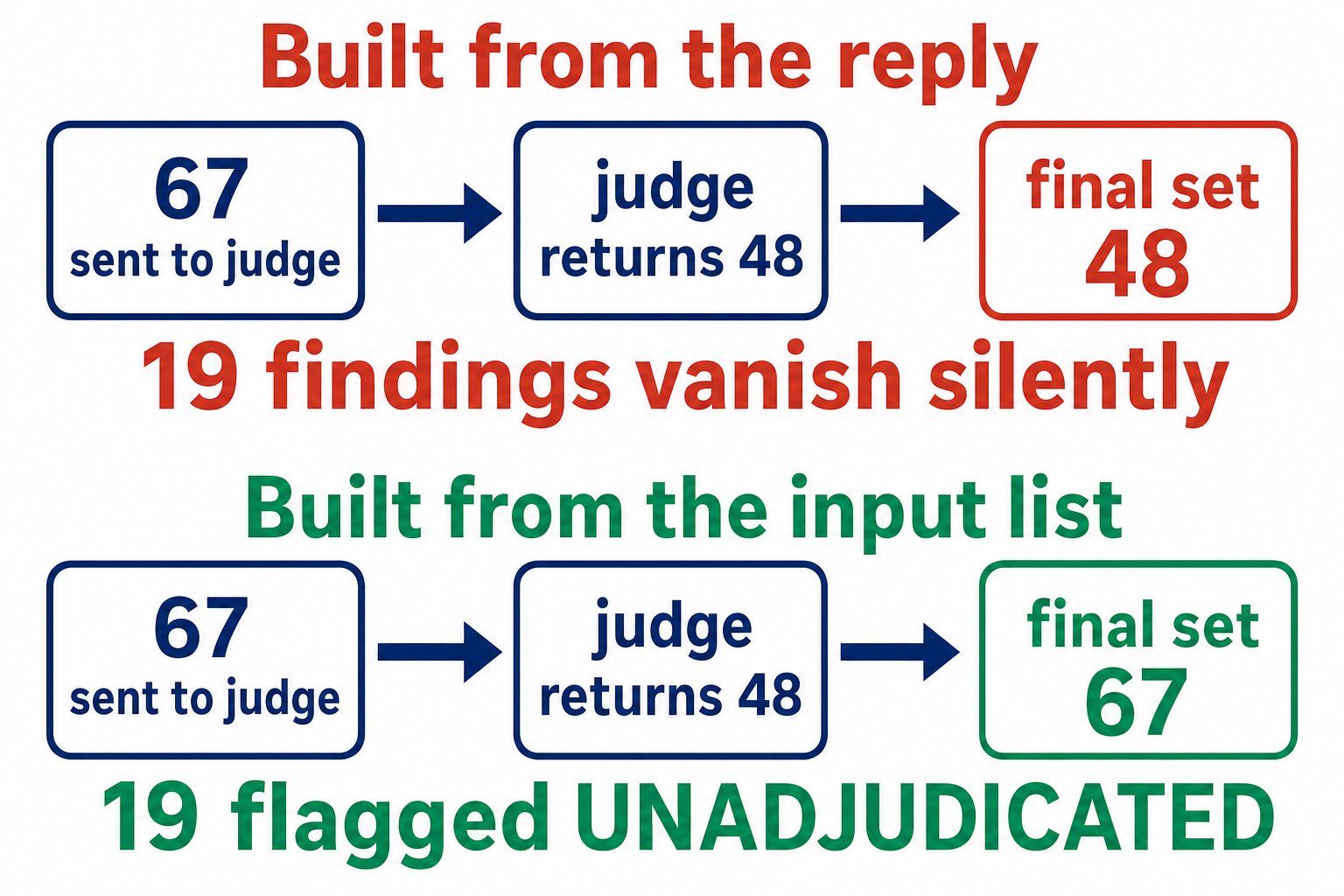
The panel that reviewed the plan for this article ran on 1 September 2026. Six reviewers raised 72 findings between them. After removing duplicates, 67 distinct findings went to the adjudicating agent. It returned a verdict on all 67. Nothing was dropped: 47 upheld, 19 killed, 1 ruled out of scope. Two findings were demoted because their citations didn't check out, and one was killed outright as false. I reconstructed all of that from the run journal afterwards, working from figures nobody had written down at the time, which is the auditability claim demonstrating itself rather than being asserted.
About that diagram
The numbers above illustrate the mechanism rather than reporting a real run. Our 1 September panel had zero omissions, which is the happy path. The point of the picture is what happens when a judge does drop items: build the set from the reply and they disappear without a trace, build it from the input list and every one of them announces itself.
On three earlier runs in August, the same completeness check caught adjudicating agents silently omitting 24, 41 and 62 findings. Those are counts I recorded at the time; the input totals are no longer recoverable, so treat them as counts and not as rates. The reproducible part is the mechanism: build the final set from the input list, and an omission announces itself instead of vanishing.
The counter-proof, on judgement
In August we ran a review gate twice over the same 81 files. The first run classified the 81 files as 69 clean, 8 unverified and 4 dirty, with none flagged as blocking. The second classified the same 81 as 48 clean, 24 unverified and 9 dirty, and flagged 8 of those as blocking. Per-check coverage moved too: one check read 81 of 81 files on the first run and only 73 on the second. Same bytes, same topology, same instructions.
A gate that gives different answers to the same input cannot authorise anything, and re-running it until it agrees is just verification by repetition. We never diagnosed why the model flip-flopped. What we did was make it stop mattering: findings we have already adjudicated get passed into the run as fixed data so the judge cannot relitigate them, and any run that misses a deliberately planted test case is discarded rather than trusted. Be clear about what that does and does not fix. Pinning settled findings stops the judge re-opening them. It does nothing for the first verdict on a new finding, which is exactly where the two runs diverged. The same paper offers the honest answer in its Theorem 10: a threshold rule that automates only where the machine's expected error is below a human's, and escalates the rest to a person. We now do that by hand; nobody has automated it here yet.
What did move judgement, on 2 September. I ran the pinned code-review graph over a billing service whose defects we already knew, because an ad-hoc panel had found and fixed them in August. The graph found the exploit that burned money. Then it talked itself out of it. The validator argued that the attack needed an identifier the attacker could not see. The cross-check from a second model family accepted the same argument. The adjudicator downgraded it to low. The August panel had not argued; it had run the attack, using an artefact that already existed, and watched the quota drain. The hunters on this run were effectively one family: one of the other families timed out and the other returned a single finding. The check and the adjudication crossed families, and both accepted the argument. Two families, one unreproduced argument, the same wrong call. Knight and Leveson, live.
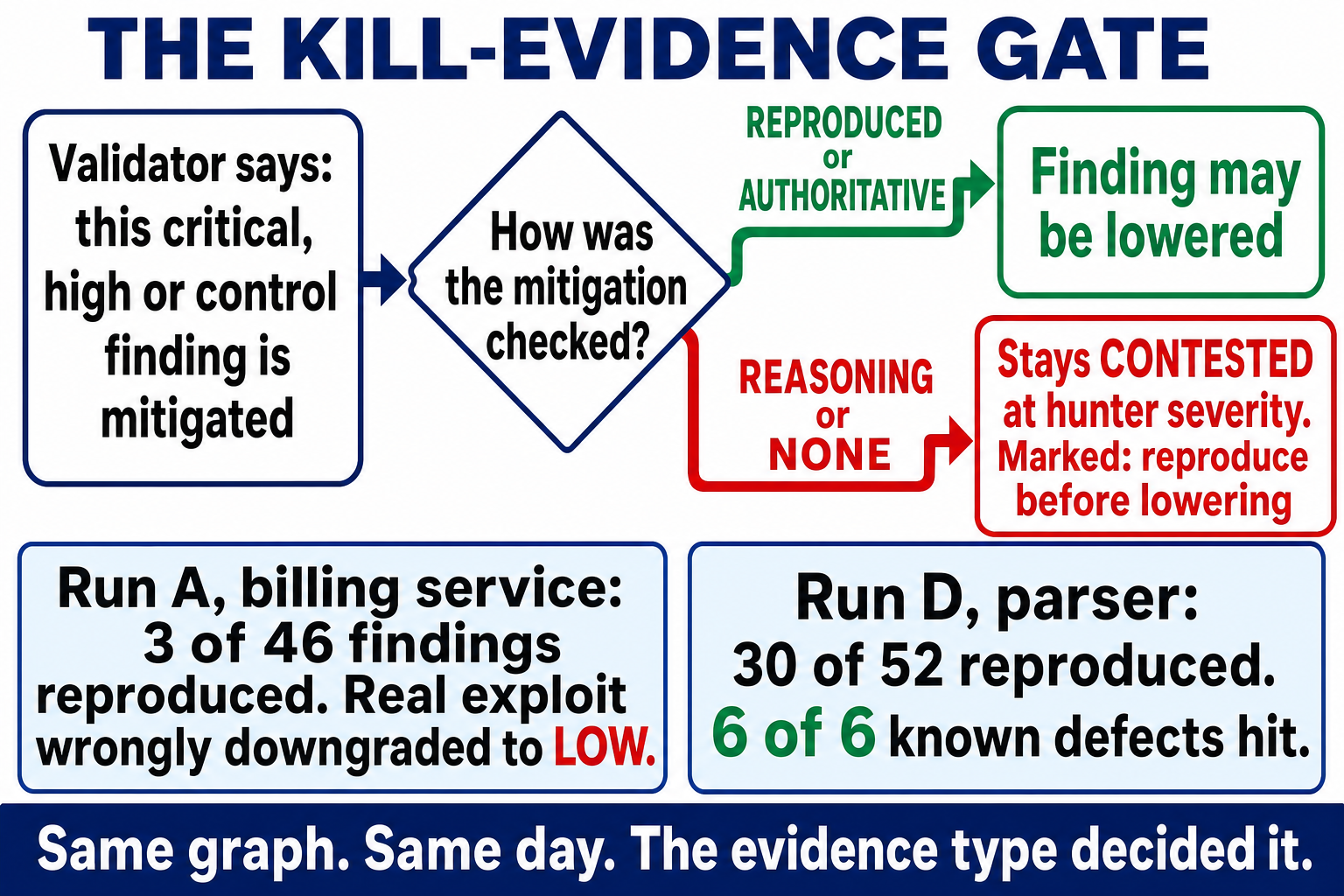
The fix was not more agents and not a different shape. It was a field in the schema. When a validator claims a mitigation, it now has to say how it checked: reproduced, taken from an authoritative source, or reasoned. The join refuses to lower a critical or high finding, or a medium one about a missing or broken control, on reasoning alone; the finding stays contested, at the severity the hunter gave it, and is marked: reproduce before lowering. There is no separate reproduction stage in the graph yet; the mark is a demand on the next human or agent that touches the finding. I re-ran the validator and adjudicator over the same cached hunter output with that gate in place. It held five high-severity findings as contested that the first pass had waved away. It did not rescue the exploit I just described. The first version of the gate covered only critical and high findings, the hunter had rated that one medium, so it slipped under and was downgraded again. I widened the gate to medium control findings and showed, by replaying the same verdicts offline, that the widened rule holds it. That is a replay, not a live run, and I am telling you so. One hole stays open: a validator can reproduce an adjacent fact, that creating a new artefact is blocked, and call an attack mitigated when the attack used an artefact that already existed. The gate stops pure argument. It does not check that the reproduction matches the attack path; a prompt rule asks the adjudicator to, which is weaker.
On a second snapshot the same day, where most of the defects were import and parsing bugs and cheap to fault-inject, the graph reproduced 30 of its 52 findings and hit six of six known defects, five of them by reproduction. On the billing snapshot it reproduced three of 46 and downgraded the one that mattered. Same graph, same day, the hunters reduced to one family both times. Across those two runs the variable that tracked correctness was the share of reproduced evidence, not topology and not diversity. Two runs on two codebases is not a law, and the defect class decided how much could be reproduced: a parser is cheap to fault-inject, a live impersonation exploit is not. That is why the gate marks a finding for reproduction rather than assuming a reproduction exists. What the graph contributed was that the schema made the evidence type checkable, so the join could enforce it.
The boundary
Pinning the topology does not pin the judgement. A graph guarantees that the same agents run in the same shape with the same joins. It cannot make a language model reach the same verdict twice.
The Shape Worth Copying
Look across enough multi agent orchestration work and the same skeleton keeps appearing. Across six implementations covering five workflow designs, two of them are variants of the same design, the topology never really changed. Different domains entirely: source code review, prose evaluation, checking files before they ship, testing a running web app, verifying a distributed package. Same three beats every time.
Fan out. Several agents work the same input in parallel, each with a different brief.
Challenge. Every finding gets independently checked by something that did not produce it, and marked valid, overstated or false.
Adjudicate. A fresh agent from a different model family, one that authored none of it, reads the findings and the challenges, and returns a verdict on every single item. It does not see which agent raised what, so it weighs the finding rather than the source.
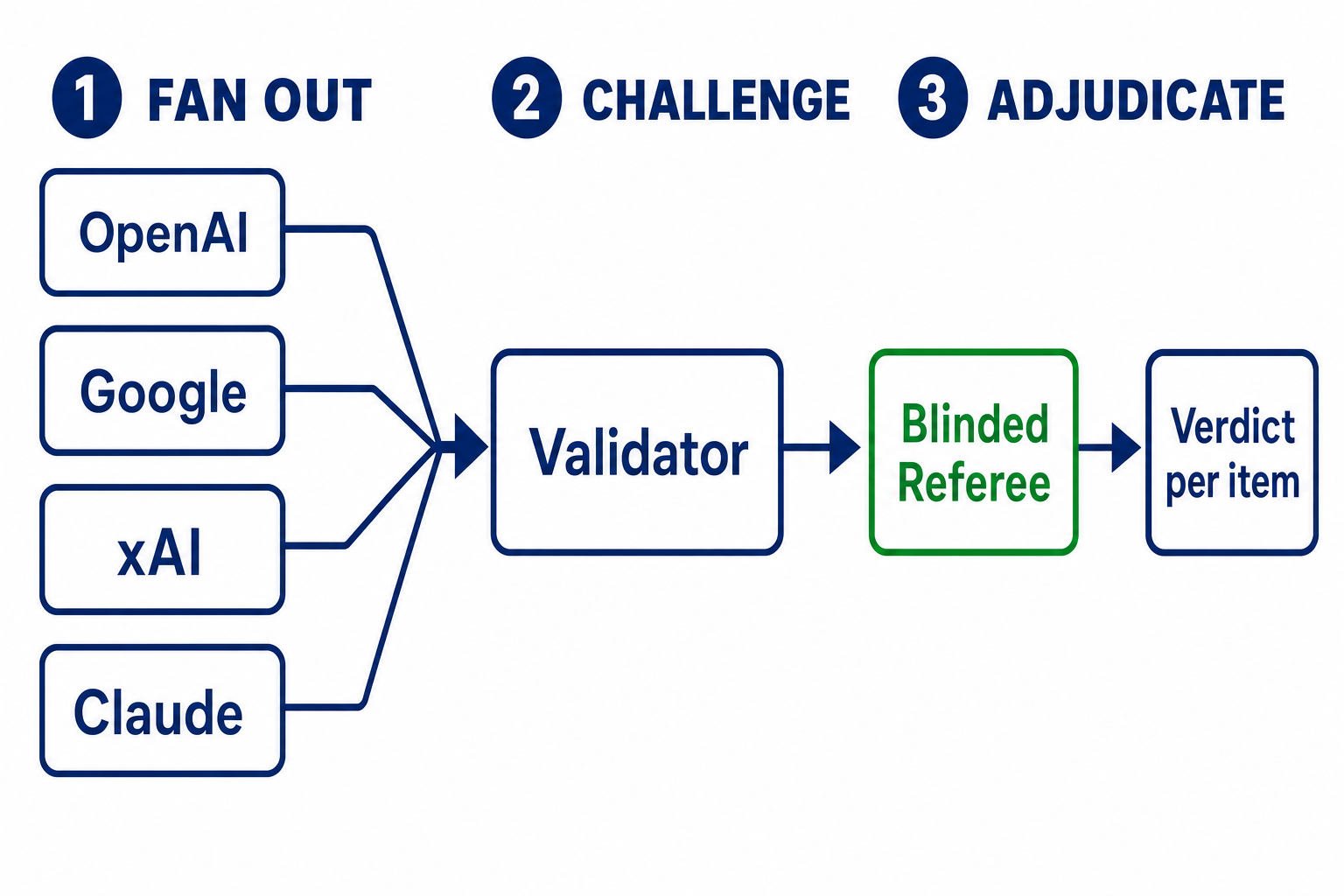
If you build one thing from this article, build that. It ports to any multi agent orchestration framework you like, LangGraph, Microsoft's Agent Framework, ADK or something bespoke, without much thought.
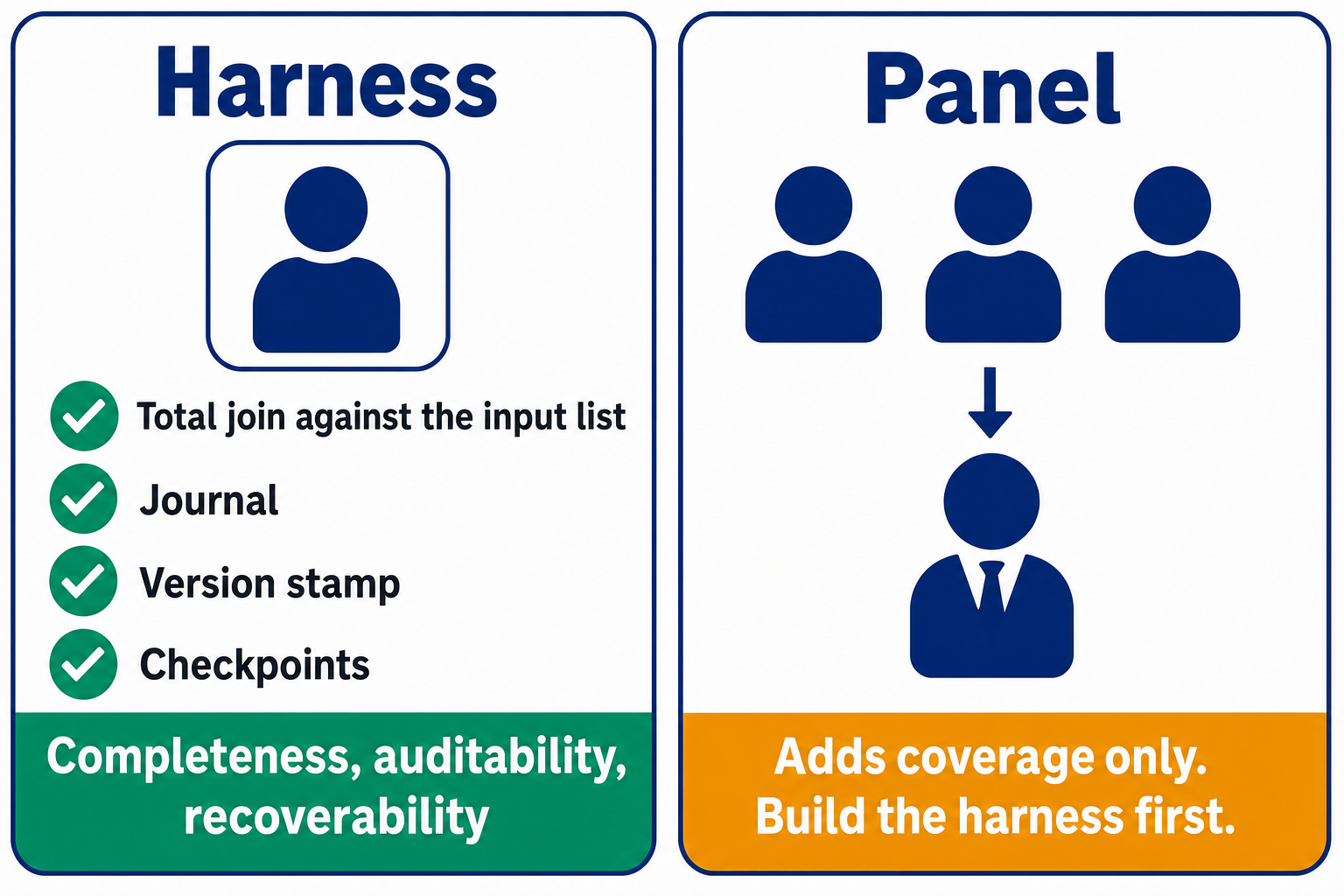
One distinction I should have drawn earlier. The three benefits above come from the harness: the total join, the journal, the version stamp, the checkpoints. A single agent inside that harness gets all three. The panel, the fan out and the challenge and the adjudication, is a separate bet, and it pays only when coverage genuinely matters or you are worried about one model's blind spots. Build the harness first. Add the panel when a job earns it.
Two details matter more than they look. The adjudicator must return a verdict per item, with skipping treated as a flag rather than as neutral, otherwise silence looks like agreement. And ranking is a different job from adjudicating; ask for both separately or you will get a tidy top five and no idea what happened to the rest.
Two more from the day I finished this piece. The coverage check must fail closed. When one lens's read of eight files failed, the run recorded those eight as unverified rather than clean, and refused to produce a record at all. And a deterministic gate downstream must not trust the upstream's scope, only its bytes. I had pointed the panel at the package folder and missed a changed file at the repository root: my scoping error, not the models'. The push gate, which binds the panel's record to a tree hash and demands byte-identity proof for anything the panel did not read, refused the push. Two mechanical checks caught what had not been read: one lens's batch in the first case, the whole file in the second.
On the fresh-family adjudicator: as I said above, the justification is error decorrelation, not information gain, and Knight and Leveson give real reason to doubt even that. The genuine value in that step comes from the completeness check and the evidence gate wrapped around it, both of which are exogenous to whatever the judge happens to think.
The Six Things That Will Bite You
These are the multi agent orchestration patterns that fail in practice, and every one of them cost us something. If you are designing an AI agent architecture from scratch, assume you will meet all six.
1. Untrusted input is an instruction channel
Anything your agents read, code under review, a document, a previous run's output, can contain text aimed at them. Fence it explicitly: mark it as data under review, and tell the agent never to follow directives inside it. When we adversarially reviewed our own review system, the third round found the one boundary we had left unfenced.
The topology matters here more than I expected. In From Spark to Fire, published in March 2026, the authors injected a single error into star-shaped multi-agent systems and measured how far it spread. Injecting at the central hub in LangGraph caused 100% system-wide failure. Injecting at a leaf node reached 9.7%. In CrewAI the hub was 6.29 times more damaging than the periphery.
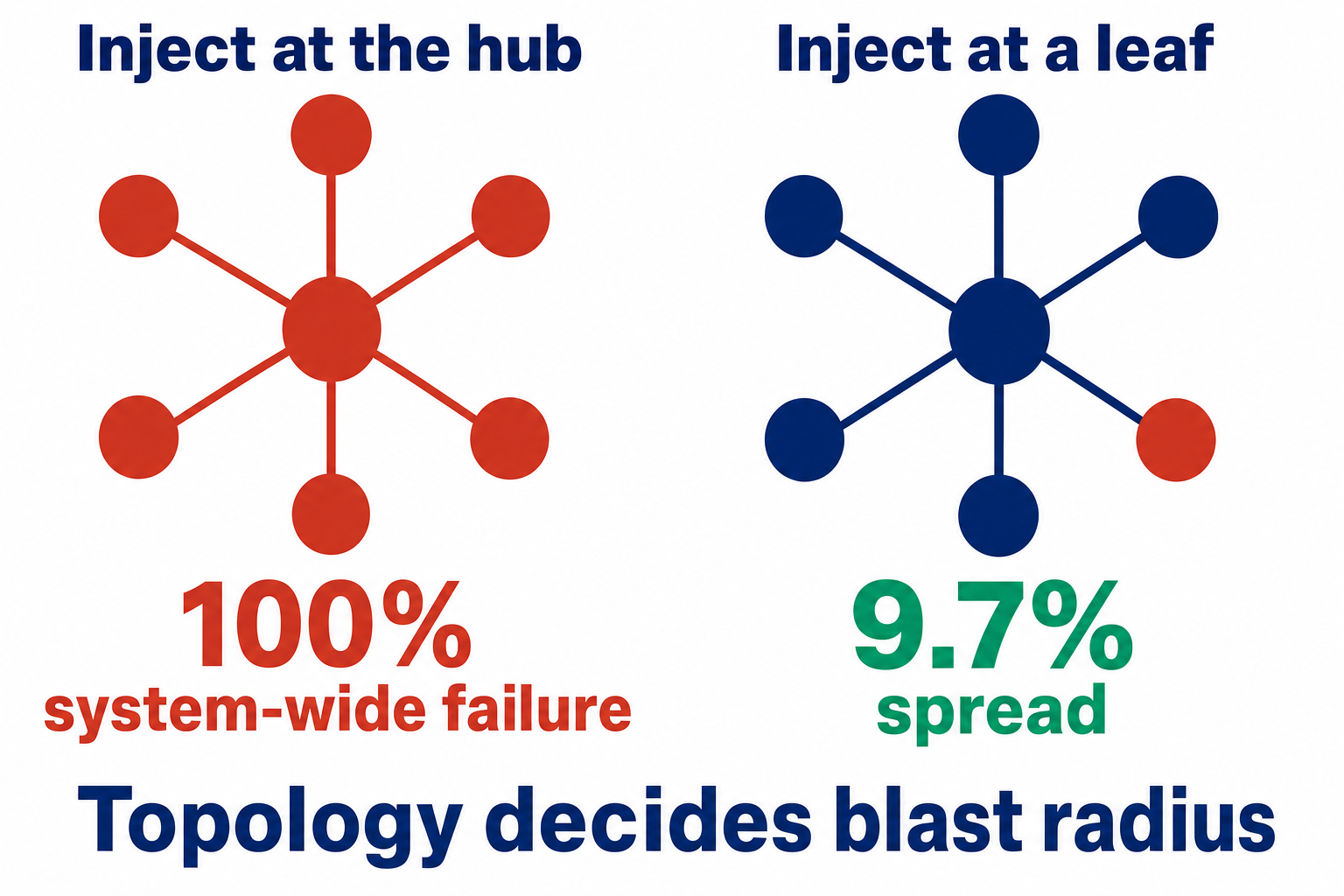
Topology determines blast radius, and that is a measured result rather than an opinion. I should be clear that the paper does not test our fencing approach, and our belief that our adjudicator is not a hub in that sense is an internal hypothesis we have not measured.
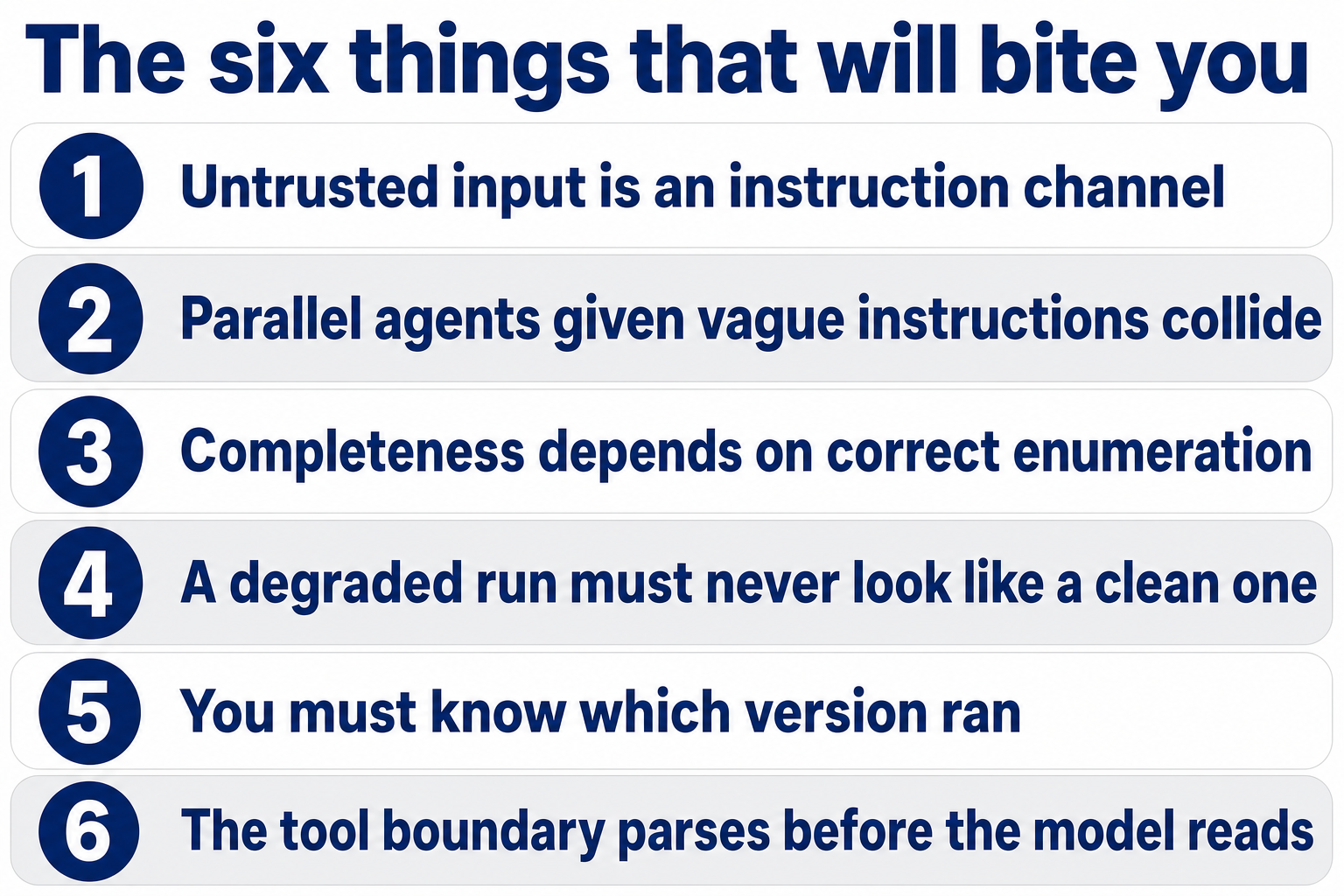
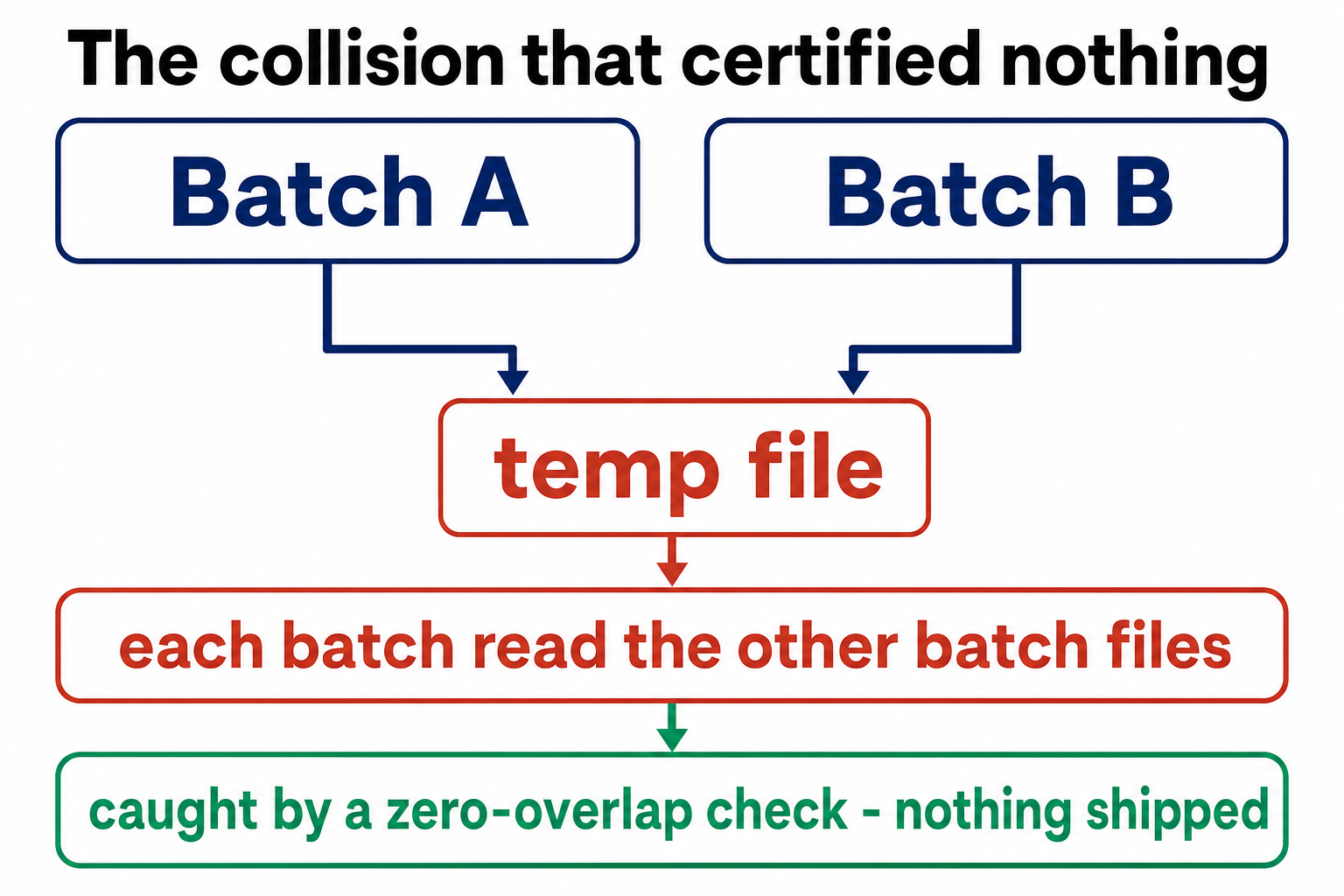
2. Parallel agents given vague instructions collide
We told several agents to write to "a temp file." They all picked the same obvious name and overwrote each other, and two batches ended up certifying each other's work as their own. It was caught by a structural check that compared which files each batch had actually read, and found zero overlap where there should have been none. Nothing shipped. Give every parallel agent a unique path, and never one inside the tree it is examining.
3. Completeness depends on correct enumeration
This one is my favourite because it is so quiet. While verifying a file set by hand, a routine git command silently skipped two files in a credentials directory because an ignore rule excluded them, and produced a confident mismatch. The shortfall lands in the highest-risk directory, every time. Your completeness guarantee is only as good as the list you built it from.
4. A degraded run must never look like a clean one
If an agent crashes, the run should record that as a gap and carry on, not swallow it. The moment a partial run is indistinguishable from a complete one, none of your runs mean anything.
5. You must know which version ran
We had a run execute a stale copy of a script, and the only way to detect it afterwards was hashing the file that had actually run. Now every graph logs its version as its first act.
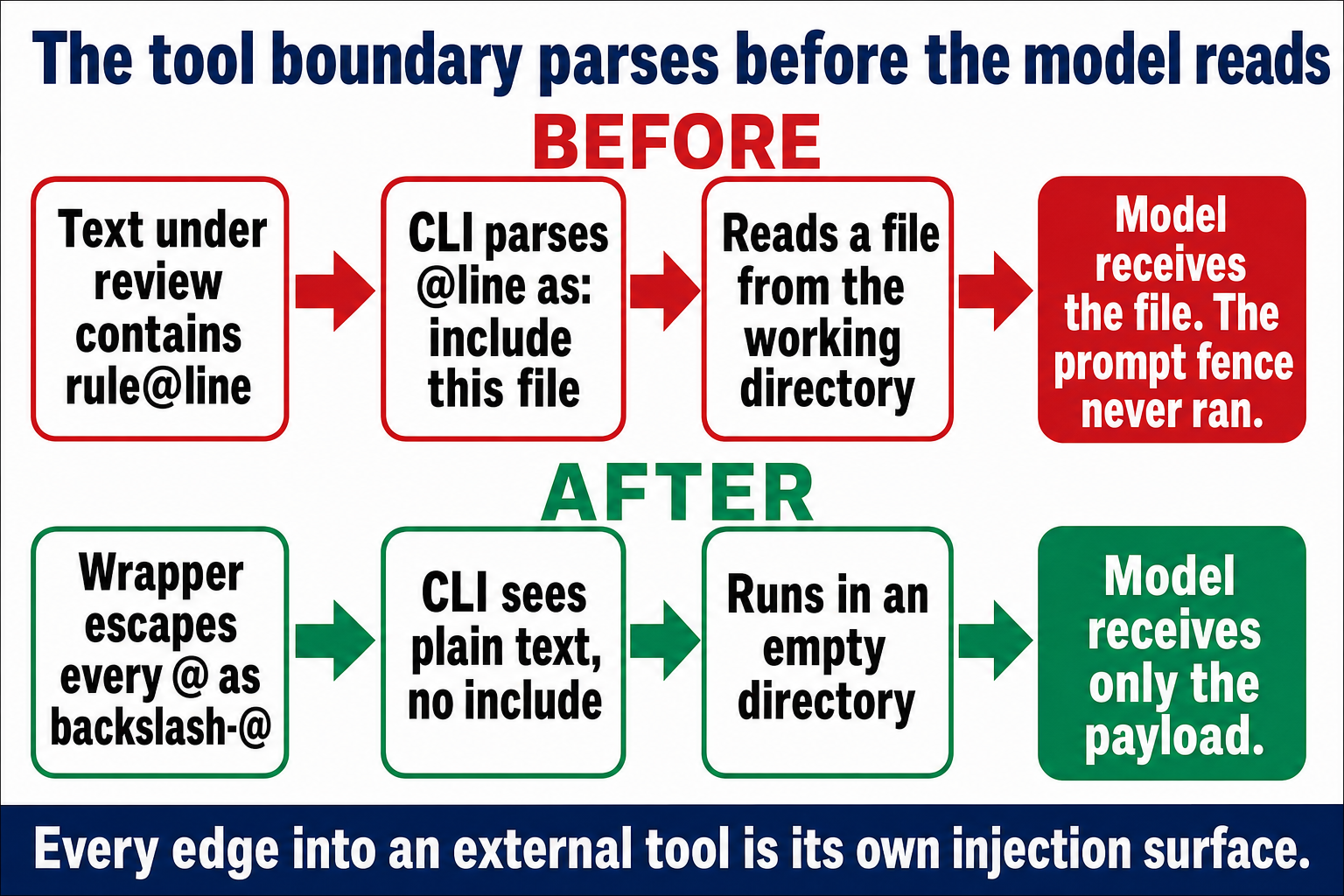
6. The tool boundary parses before the model reads
On 2 September a scan of our own package returned a blocking finding about a file that was not in the payload. The Gemini command-line tool treats any @word in a prompt as an instruction to include that file, and a token in the text under review, rule@line, made it read a file from the working directory and hand it to the model. The fence from item 1 did nothing, because the tool rewrote the input before any model saw it. I proved it with a marker file: the old wrapper returned the file's contents; the fixed one returned the literal token. The fixed wrappers escape every @. The one that only relays text also runs the tool in an empty directory; the one that reviews a repository cannot, because it reads the repository by tool, so it relies on the escaping alone. Every edge into an external tool is its own injection surface with its own escaping rules, and it sits upstream of anything you tell the model.
What It Costs
A four-persona panel on a mid-sized application takes roughly 30 to 40 minutes and about 1.5 million tokens. Ours runs as Claude Code multi agent orchestration, so those figures are real bills rather than estimates. The panel that reviewed this article's plan used 16 agents and 1.16 million tokens across 38 minutes.
That is not free, and quotas are real. Our first exploratory run exhausted a model quota partway through and lost 37 of its 38 validation agents plus the adjudicator. Recovery was cheap, because the journal let us replay the finished work from cache and re-run only what failed. That is the clearest practical argument for the harness: the journal, the cache and the checkpoints. A pinned graph is one place to host them; the improvised scripts we ran before had none of them.
On 2 September the same limit hit three times: once it killed a run at 13 of 14 agents, once it took the last three steps of another, once it took five agents of eleven. The last of those resumed from cache with only the five re-run; the run that lost its last three steps shipped its findings without them. The caveat I learned the same afternoon is that the cache is faithful to bad results too. One resumed run replayed a failed scan batch exactly as it had failed, and the only way to re-run that one batch was to evict its single cached entry by hand. A cache needs an eviction handle, or a transient failure becomes a permanent one.
There is a structural cost too. Our runtime cannot import shared modules, so each graph carries its own copy of the common blocks with a marker pointing home. The rule is to edit the source and propagate. When I checked this while writing the article, only one of the graphs still carried its markers, the code had propagated, the provenance had not. Disciplines decay quietly, and a graph is a discipline.
The sharpest criticism, stated plainly
If your individual agents are unreliable, a graph organises their failures more elaborately. Well-organised nonsense is still nonsense, and a graph is only as strong as its weakest node. LangChain themselves moved a research agent off a predefined graph and back to an agentic loop, because planning and delegation turned out to be hard to pin down ahead of time.
When NOT to Build a Graph
Everything above exists to make this section trustworthy, so here it is.
The honest default for agentic ai orchestration is one good agent doing one pass. Most tasks never need anything else, and Pawel Huryn was not wrong when he posted "I call BS on graph engineering. Loop engineering was already confusing." His constructive point is the one worth taking: what matters is clear objectives, explicit stopping rules and independent verification, not which shape you draw them in. That is a better test than the label. OpenAI's own guidance lands on the same side: model the system as a graph if it helps you think, but do not force every branch and loop to be declared in advance.
Build the harness when the second or third of these bites. Add the panel, the multi-agent part, only when the first does. The costs above have to be worth paying either way.
Coverage matters. If missing one item out of forty is merely annoying, you do not need a structural join. If it is a security finding or a compliance item, you do.
You need to prove what happened. Regulated work, anything auditable, anything where someone will later ask which version produced which answer.
Runs are long enough that losing one hurts. If a failure halfway through costs you 40 minutes and a chunk of quota, checkpointing pays for itself.
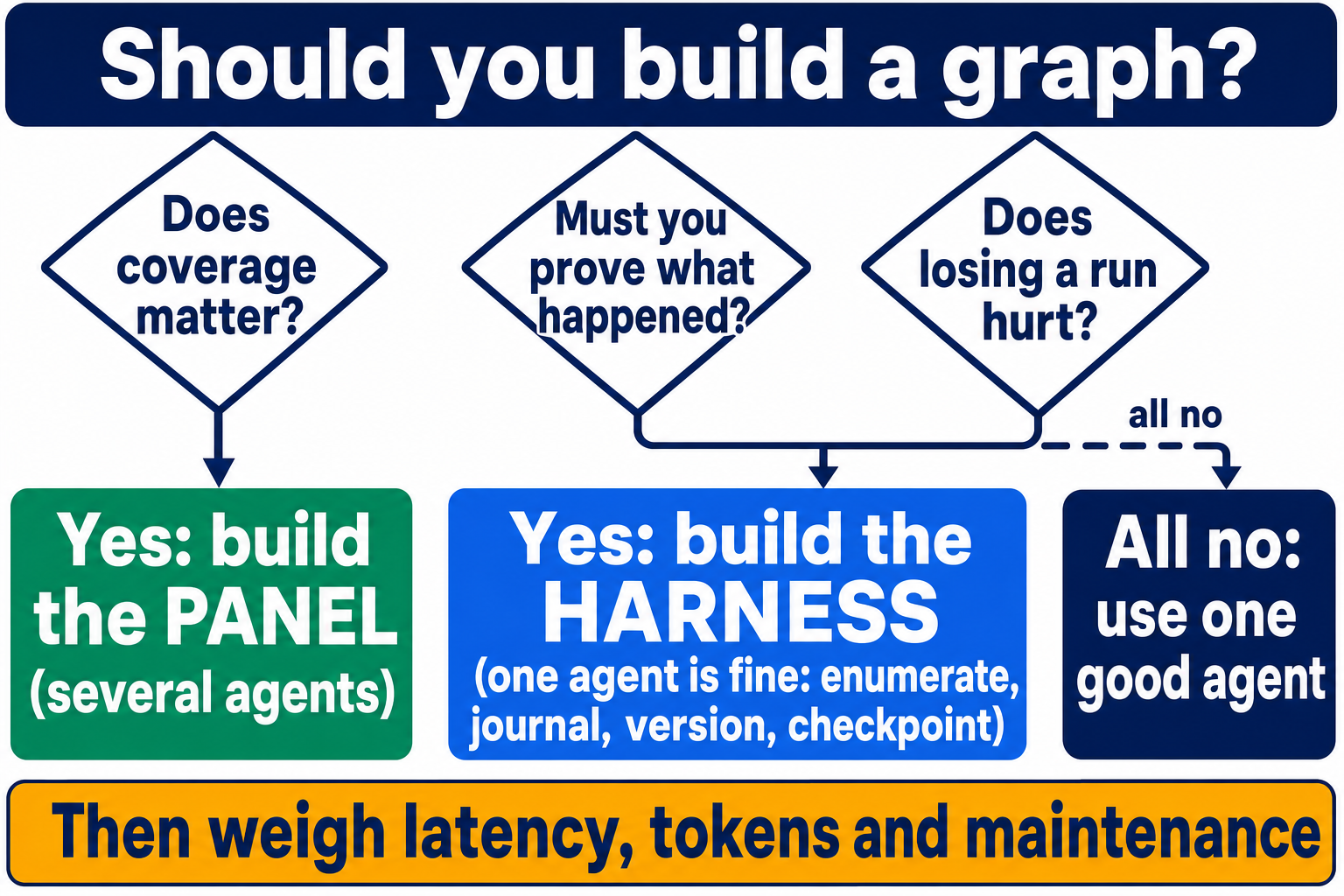
The first justifies a panel on its own. The second and third justify the harness, which a single agent can sit inside; they do not by themselves justify more agents. Note what is not on the list: model-family diversity. That is the decorrelation hypothesis, it is unmeasured, and Knight and Leveson's result gives real reason to doubt it. Treat it as a bonus you might get, never as the reason to build.
Then weigh it against the costs: latency, tokens, and the maintenance of a topology that has to be kept honest. If the value of the thing is being fast, a panel destroys it.
We keep one reviewer deliberately single-voice for exactly that reason. Its whole value is being a quick conversational gut-check, and wrapping it in a panel would make it slow and ceremonial. Knowing when not to apply the machinery is part of the engineering.
The cost of a premature graph is concrete. Every node is another thing to design, another place to fail, another output to verify. Every edge is coordination latency that a single agent would have spent inside one context window. Resist adversarial everything.
Methods and What We Did Not Measure
Everything above comes from one estate: six graph implementations across five workflow designs, running between June and September 2026, on a mix of Claude, GPT, Gemini and Grok models with pinned versions. Findings are drawn from run journals and dated incident notes written at the time.
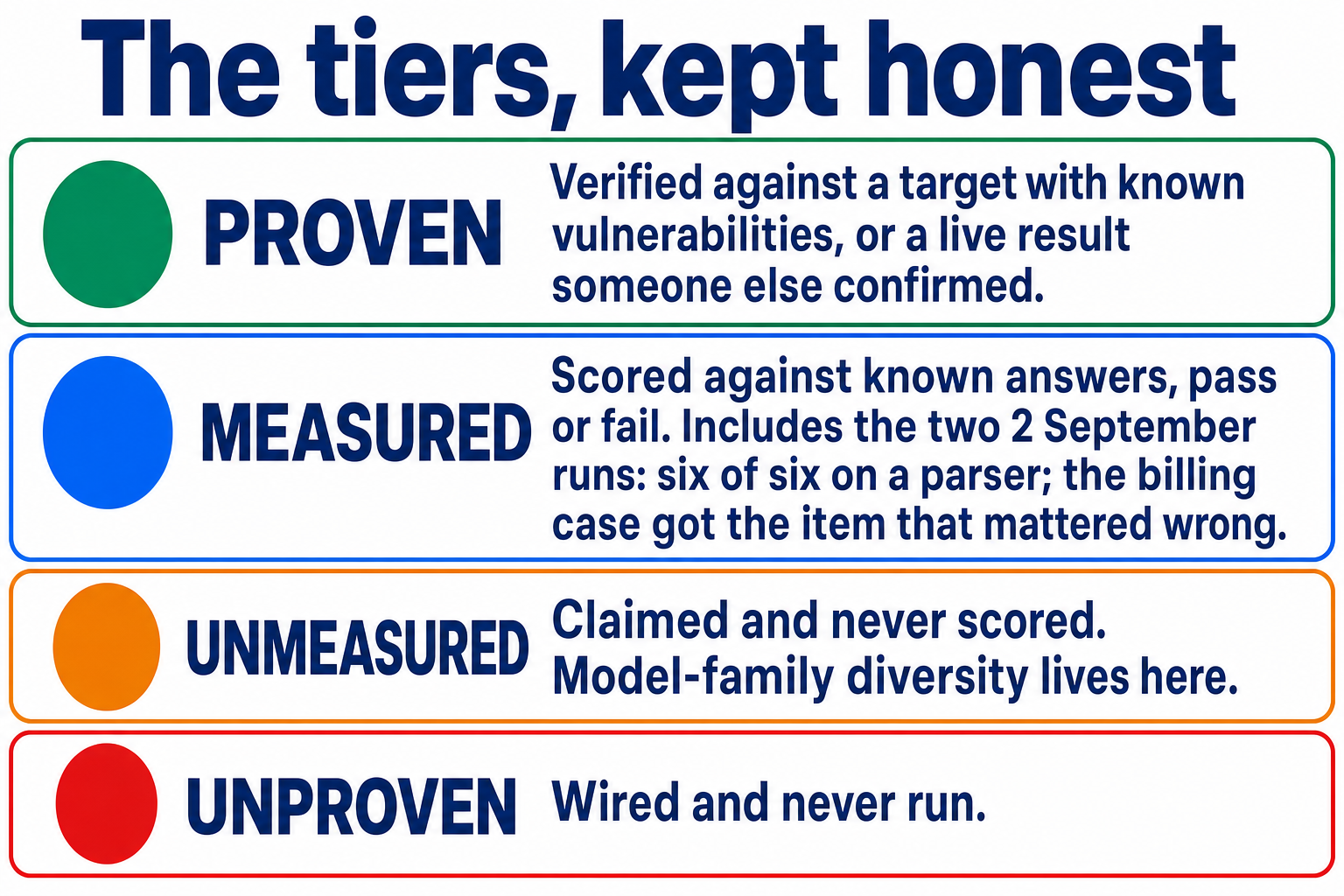
The tiers, kept honest. Proven means verified against a target with known vulnerabilities, or a live result someone else confirmed. Measured means scored against known answers, pass or fail. Unmeasured means claimed and never scored. Unproven means wired and never run.
Proven. Code review on web and LLM domains, verified against a deliberately vulnerable application and a live run that surfaced seven real findings a single-lens review missed.
Measured. Seven evaluation lenses through a scored suite in June 2026: verdict-accurate, full detection of planted flaws, zero false positives on the planted-flaw suite after two defects were found and fixed. Two live runs against known answers on 2 September: six of six on a parser, and the billing case above, which got the item that mattered wrong. In the field the same machinery over-flags good work, as the calibration paragraph below says.
Unmeasured. The model-diversity decorrelation claim. One September data point of correlated error is an anecdote, not a measurement. The 1 September completeness figure is a single run.
Unproven. The cloud-infrastructure domain, and one pipeline whose wiring is tested but which has never run on a real case.
What I cannot give you, and what nobody else has published either: a controlled comparison between a pinned graph and an improvised one. Nothing has measured topology against topology. There is no cost or latency A/B. Everything above is field evidence from one estate with an n of one, not a study.
The recurring weakness worth knowing about: this kind of adversarial machinery is strong at detection and prone to over-flagging good work. Finding problems is easy. Calibration is hard.
Of five panel passes on the day I finished this, over successively fixed versions of one package, the third raised findings in files the first two had read and passed unchanged. A panel samples; it does not scan. The August rerun above is the cleaner proof, because there the input did not change at all. What the graph gives you is that every pass is repeatable and its diff is legible, and adjudicated findings pass forward as fixed data so it stops re-litigating them.
One last admission, because it is a finding in its own right. There was never a design document for any of this. No memo arguing the case for graphs, no architecture review. Every block in the system exists because something went wrong first. The practice grew from incidents; it was not designed up front. Given the theory above says most multi-agent enthusiasm is unwarranted, growing it from real failures may have been the safer path, but I would not present it as a plan.
FAQ
What is graph engineering?
Designing a multi-agent AI system as an explicit, versioned topology: which agents run, in what order, what each returns, and how their outputs are joined, rather than letting a model improvise the coordination at run time. The topology is the place the guarantees live; the enumeration, join, journal and checkpoints are what actually provide them.
Is graph engineering just LangGraph?
Largely, yes, as a practice. LangGraph, Microsoft's AutoGen and Google ADK were all doing graph-shaped orchestration before the term trended in July 2026. Harrison Chase, who built LangGraph, publicly said as much. The term is a new label for existing architecture, which is why the useful question is whether a given job needs an explicit topology, not whether to adopt a methodology.
What is the difference between graph engineering and loop engineering?
A loop is one agent's cycle: plan, act, observe, retry. A graph is the structure connecting several such loops, with branching, parallel work, handoffs and joins. A loop can be drawn with graph primitives, but a single agent looping is not what graph engineering means in practice. Master the loop first, and reach for a graph when one loop genuinely cannot hold the job.
Does a graph make AI agents more reliable?
It makes them more accountable, which is not the same thing, and only if you build the mechanisms. Completeness comes from a total join against the input list, auditability from a journal and a version stamp, recoverability from checkpoints. Pin a topology without those and you have a diagram. What no graph gives you is better judgement: we have a documented case of identical input producing two contradictory verdicts under a fixed topology.
When should I not use a graph?
When none of the three triggers bite: coverage does not really matter, nobody will need to prove what happened, and a lost run is cheap to redo. If only the second or third bites, build the harness around one agent and stop there. Also when latency is the point, because a panel destroys it. Every node is another failure point and every edge is coordination latency. The default should be one good agent.
Is graph engineering the same as a knowledge graph?
No. A knowledge graph structures information as entities and relationships for an agent to query. Graph engineering structures execution. The word collides; the concepts do not overlap.
About the Author

Nathan House, Founder & CEO of StationX
Nathan House has 30 years of hands-on cybersecurity experience and is Cambridge-educated, holding CISSP, CISA, CISM, OSCP, CEH, and SABSA. He founded StationX in 1999 — one of the UK’s first cybersecurity companies — and has secured £71 billion in UK mobile banking transactions and the London 2012 Olympics, advising clients including Microsoft, Cisco, BP, Vodafone, and VISA. He authored the world’s most popular cybersecurity course — a #1 Udemy bestseller taken by over 500,000 students — and was named Cyber Security Educator of the Year 2020, AI Security Educator of the Year, and a UK Top 25 Security Influencer 2025. A DEF CON speaker and featured expert on CNN, Fox News, NBC, and the BBC, Nathan leads StationX’s training of more than half a million students worldwide.