Bank Cyber Security Jobs: Do You Still Qualify in 2026?
TL;DR — if you've only got 30 seconds
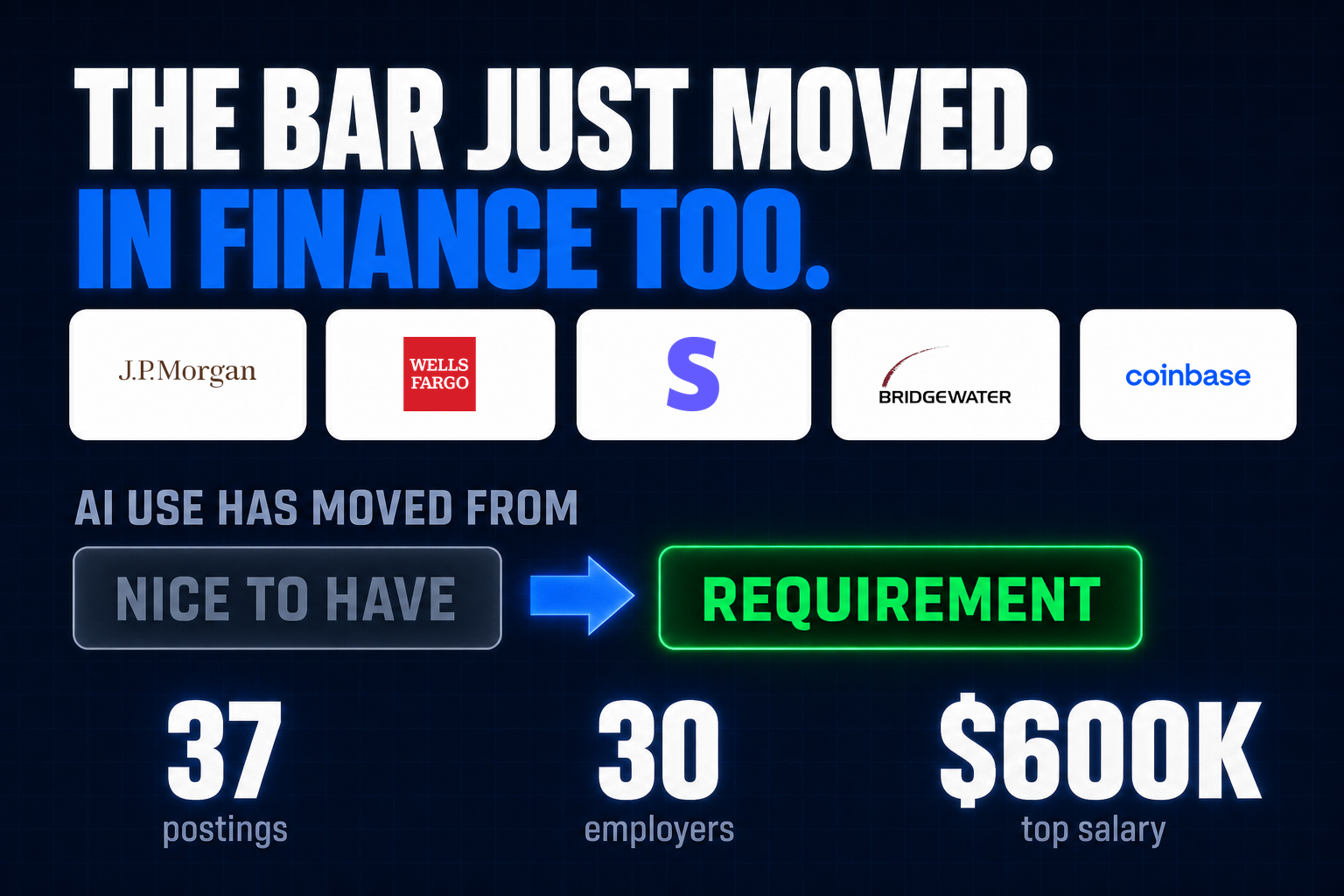
76 security postings from 32 banks, funds, fintechs and crypto firms now put AI use in the requirements, not the wishlist. JPMorgan, Wells Fargo, Amex, Morgan Stanley, Visa, Blackstone, Bridgewater among them.
Same requirement, two vocabularies. Fintechs name a frontier tool in 10 of 25 postings; banks in 5 of 51. Banks say "approved" and "validation"; fintechs say "Claude Code" and "production". Prepare for the one you're walking into.
Detection & SOC is the widest door (15 of 76), but finance is a senior market: 57 of the 76 want senior experience or more, and only 3 are entry-level. Come in mid-career, or come in through the fintechs.
Ceiling is Bridgewater Associates at $450,000, the top of the finance range, though Netflix pays more still across the 712 postings we track. Blackstone's CV standard: "several projects where you used AI", and you can walk through them.
The short answer
A lot of us in security assumed finance would be the last sector to move on AI. The banks are regulated, they're careful, and they don't tend to write "Claude Code" into a job advert. So when we published our FAANG piece, the question we got back was: fine for Apple and Google, but does any of this apply to a bank?
It does. We went back through our collection of AI-driven security job postings and pulled every one from a bank, a broker, a fund, a fintech or a crypto firm. That's 76 postings from 32 employers: JPMorgan, Morgan Stanley, Wells Fargo, American Express, Capital One, Visa, Blackstone, Bridgewater, Block, Coinbase and 22 more. In every one of them, using AI sits in the requirements, not the "nice to have" list at the bottom.
So yes, the bar moved in finance too. Here's what we'll cover: what actually changed, the one genuine difference between banks and fintechs (it will change how you answer in an interview), which specialism is the widest door, and what it pays, up to the highest number in our whole collection.
One caveat before we start, because it shapes everything: a job advert tells you what a hiring manager wrote, not what the team does. Banks in particular use legally-reviewed templates. What we can measure is what they now ask for in public, and that is what you're judged against when you apply.
So let's start with what actually changed, because it's more specific than "they want AI now".

What changed: AI moved out of the "nice to have" box
If you've been reading job adverts for a couple of years, you'll have noticed AI language creeping into the bottom section, the "preferred" and "desirable" bit that nobody has to satisfy. That's where it lived, and you could ignore it.
The evidence says that's over. When we grade a posting for our jobs page, we only count it if the AI requirement sits under Responsibilities, Requirements or Qualifications, the things an employer won't hire without. Anything under "preferred" gets thrown out, however strong the wording.
76 finance postings survived that bar. And I think the interesting part is how blunt some of them are. Visa's is probably my favourite line in the entire collection:
"AI is at the core of our work at Visa. We need you to be very proficient with AI for this role and not just use AI tools but understand how they work."
Not "familiarity with". Not "exposure to". Very proficient, and understand how they work. That's a requirement written by someone who has been let down by a candidate who said they used AI and turned out to mean they'd tried ChatGPT once.
Bridgewater's is the one that sets the ceiling, and I'll come back to the number. Their Staff AI Agentic Security Engineer is asked to:
"Design, develop, and deploy autonomous agents for threat detection, alert triage, vulnerability management, and incident response… Replace manual runbooks with intelligent agents that reason, act, and…"
Replace manual runbooks with agents. At a hedge fund. That sentence would have read as science fiction in a security job advert two years ago.
So the requirement is there. But here's what surprised us when we read all 76 side by side: banks and fintechs describe it in noticeably different language, and the difference is one you can use.
Banks vs fintechs: same requirement, two vocabularies
Read a bank's posting and a fintech's posting for what looks like the same role, and you'll spot it. Let me give you the two ends.
Wells Fargo, Senior Information Security Engineer:
"Demonstrate proficiency in using AI-assisted development and analysis tools (e.g., GitHub Copilot and approved code-centric agents)"
JPMorgan, Manager of Security Engineering:
"Experience leading teams in the safe use of enterprise-authorized AI capabilities within the work environment for security engineering workflows, including validation habits…"
Now Block (Square and Cash App), Senior Security Engineer:
"Demonstrated fluency with AI-assisted development tools (e.g., Claude Code, Cursor, GitHub Copilot, or similar agentic coding tools) in real production work"
And Gusto, Senior Staff Security Engineer:
"Operate as an AI-native engineer, using Claude Code, MCP-driven tooling, and agentic workflows as a daily force multiplier across investigation, automation, and detection engineering."
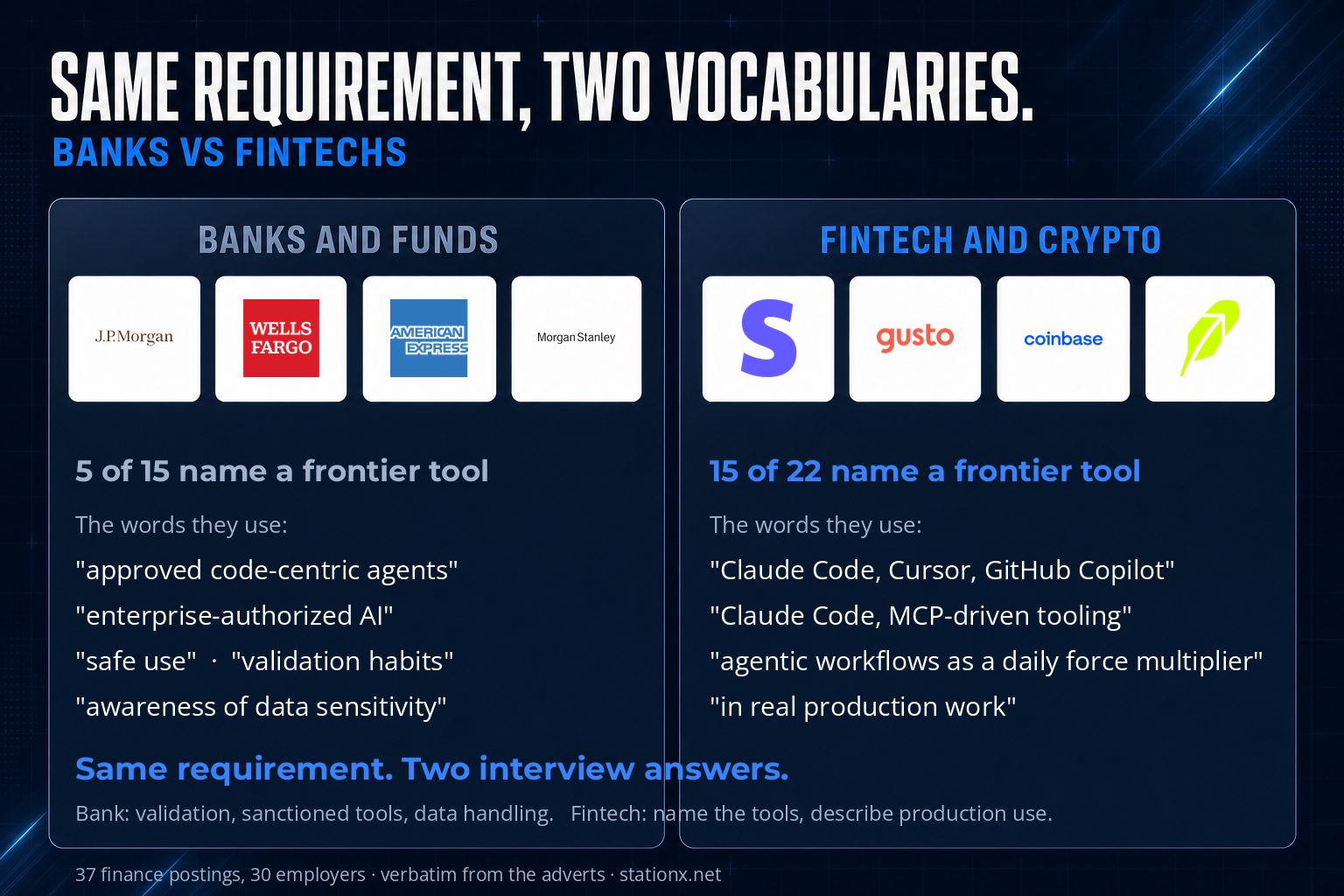
The banks say approved, authorized, safe use, validation habits, data sensitivity. The fintechs name the frontier tools and want you already fluent.
We wanted to check that wasn't just four cherry-picked quotes, so we counted. Of the 51 postings from banks, brokers and funds, 5 of 51 name a frontier tool (Claude Code, Cursor or MCP) by name. Of the 25 from fintechs and crypto firms, 10 of 25 do. A fintech posting is many times likelier to tell you which tool it expects you to know.
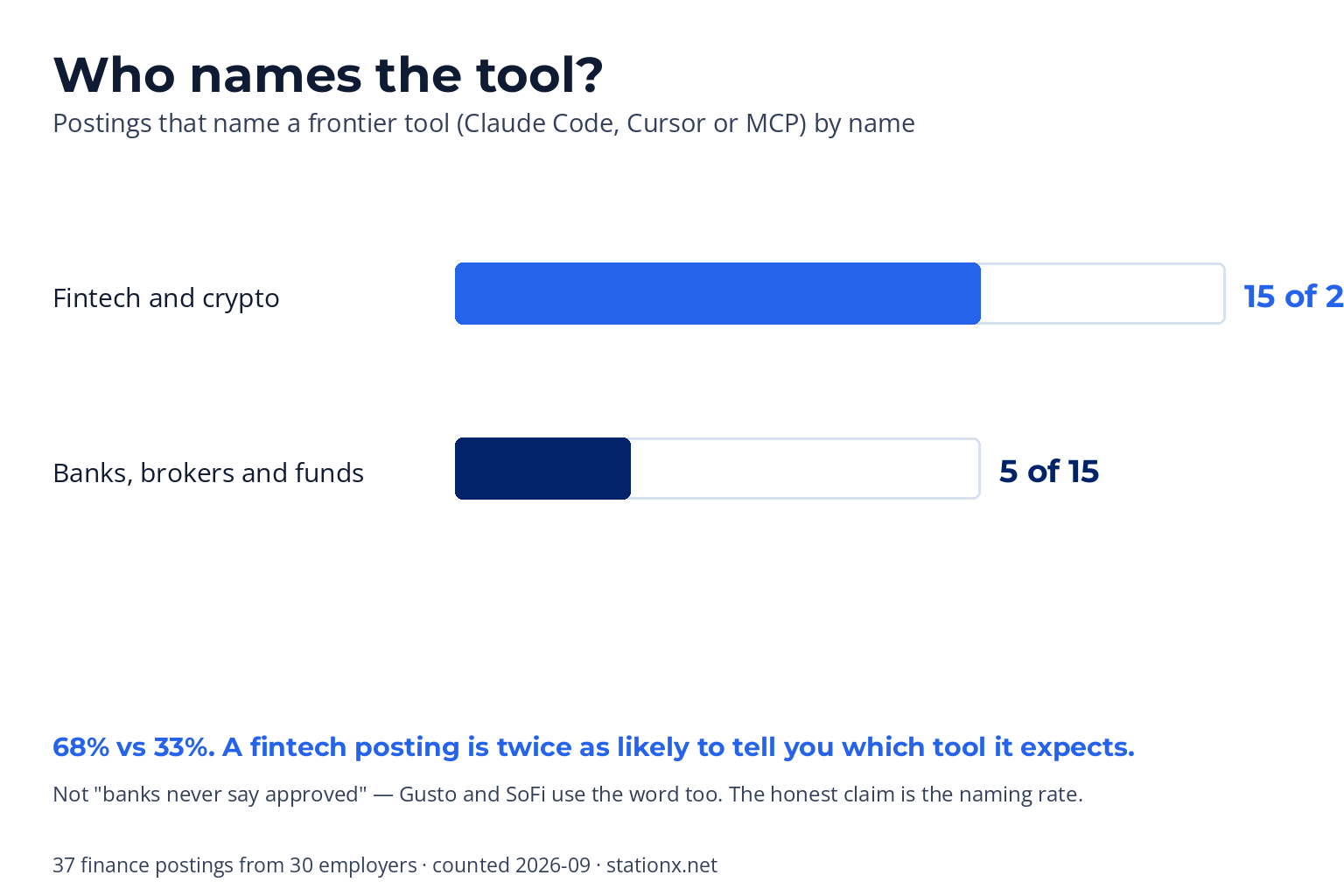
I want to be careful here, because the obvious next claim is "banks say approved, fintechs don't", and that one's false. Gusto and SoFi use the word "approved" too. The honest version is narrower: fintechs are far more likely to name the tool, and banks are more likely to wrap the requirement in governance language.
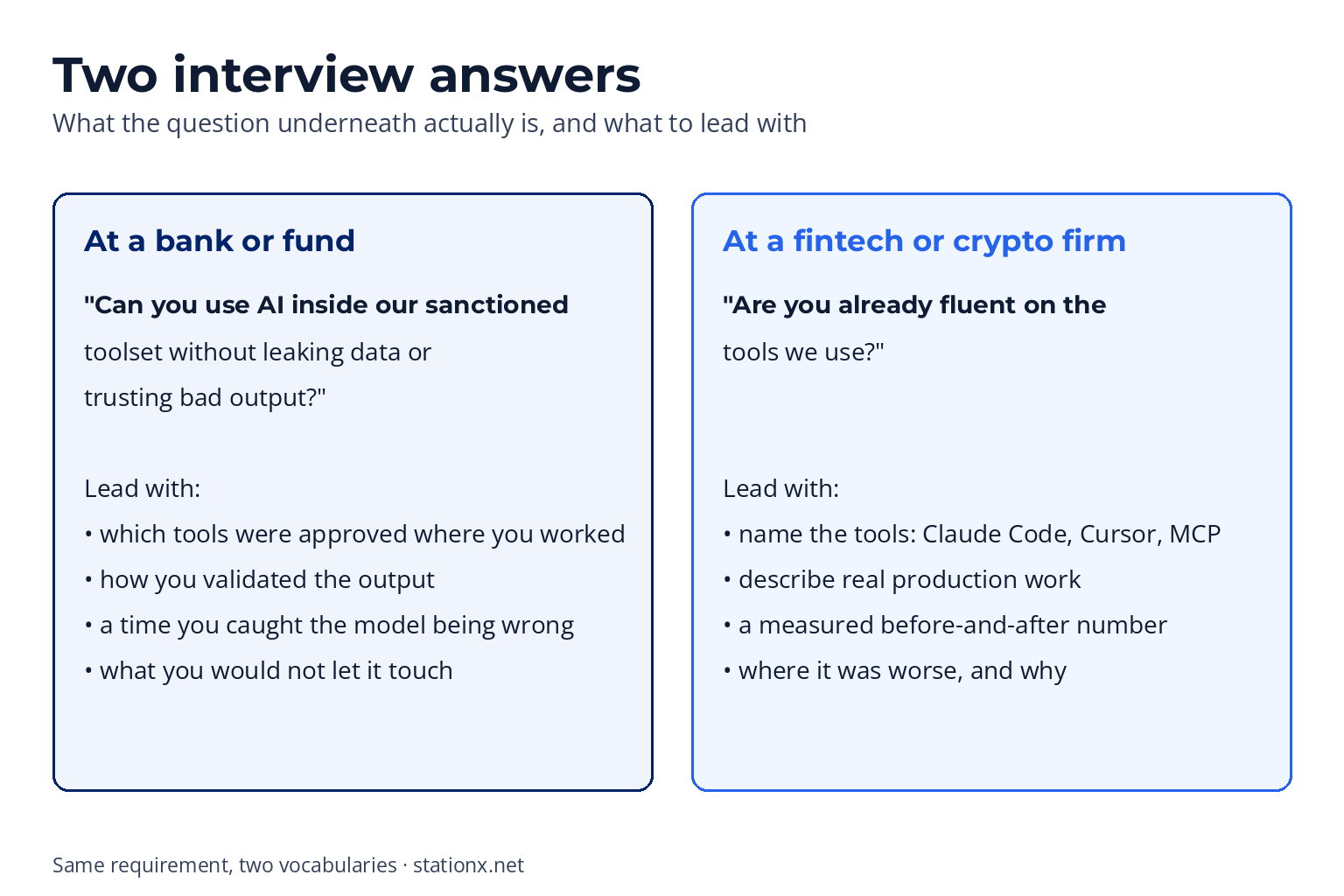
Why does that matter to you? Because it's two different interview answers. At a bank, the question underneath is can you use AI inside our sanctioned toolset without leaking data or trusting bad output? Your answer should be about validation, about which tools were approved where you worked, about a time you caught the model being wrong. At a fintech, the question is are you already fluent on the tools we use? Your answer should name them and describe production work. Read the advert first, though: most fintech postings in this set still don't name a tool, so let the wording in front of you decide how specific to be.
Same requirement. Two vocabularies. Prepare for the one you're walking into.
Which raises the practical question: which door do you actually go through?
Which door: Detection & SOC is the way in
Of the 76 finance postings that cleared our bar, here's the split by specialism:
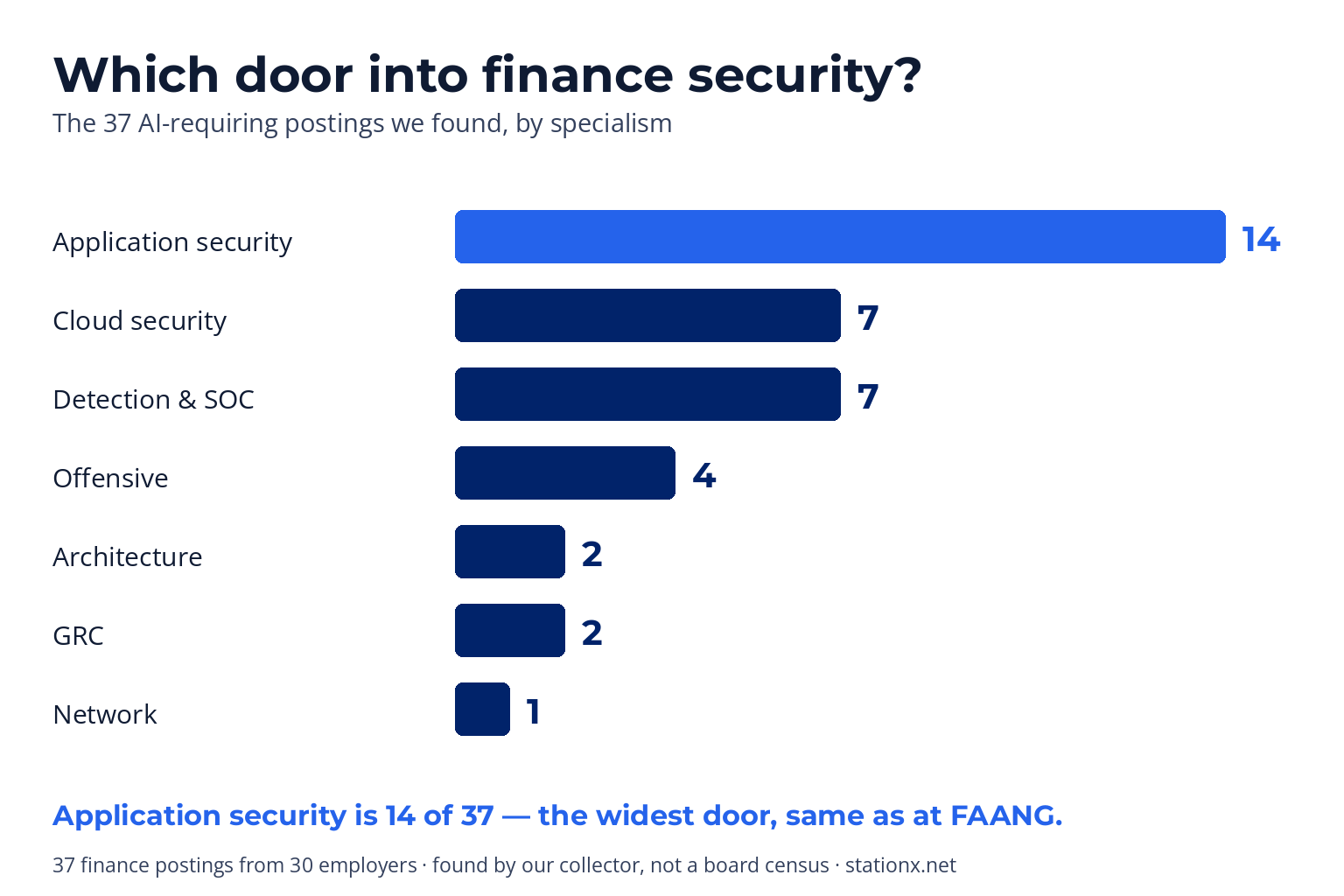
Detection & SOC is the widest door here, ahead of application security, and that is a change from FAANG, where AppSec leads. It fits what banks are: enormous estates under constant attack and constant audit, so the first place an agent earns its keep is triage and detection rather than code review. Application security is close behind, and for the FAANG reason: chasing vulnerability classes across a big codebase is exactly the work an agent accelerates.
The other number worth knowing, and it is the least encouraging thing in this piece: finance is a senior market. 40 of the 76 postings want senior experience, 8 staff, 9 leadership, 16 mid, and just 3 are entry-level. We read that from the years each posting states rather than the word in its title, because a "Senior" badge on a role asking for two years tells you nothing, and it cuts both ways: some titles overstate, and these ones do not. If you are early in your career, the fintechs and the wider collection are a better first target than a bank. Some postings carry a director, VP or principal. The door isn't only open to people already inside.

Where they are is far more spread than FAANG, and this is the single most useful thing in the piece if you are not American: 37 of the 76 are outside the US, against 39 inside it. Singapore (10), Canada (9), India (7), United Kingdom (7) lead, with the rest scattered across Ireland, France and Australia. Finance is not a US market with a few overseas offices; it is a global one. If you are outside the US, this is a genuinely better bet than big tech was.
So you know the discipline and you know the split. The hard part, as ever, is proving it.
How to prove it on a CV
This is where I think most of us will find it hardest, and the finance postings are unusually specific about what they want to see.
Blackstone put it more plainly than any employer in our collection. Their Threat Intelligence Analyst role asks for candidates who have:
"Demonstrated, hands-on experience applying AI tooling (such as LLMs and coding assistants) to real work, and can clearly speak to several projects where you used AI to automate or accelerate a task"
Several projects. Clearly speak to. That's a CV standard, and it's a good one. Not "familiar with AI". Not a certificate. Several things you built or automated, that you can walk through.
Lumin Digital has the harshest single bar we've seen anywhere, in two separate postings:
"At least 1 year of production experience with at least 2 agentic coding tools, such as Claude Code, Gemini, Cursor, Codex, AMP, or OpenCode."
A year. Two tools. In production. That's a clock, and it started for some people in 2024.
And Ridgeline names the thing that, to be honest, I think matters most:
"Hands-on, daily use of AI/LLM tooling, and the judgment to validate its output for correctness and risk. This is essential to the role."
The judgment to validate its output. Every serious posting in this set asks for that in some form, and it's the thing you can only get from having been let down by a model.
So, practically, three things:
Have several projects, and be able to walk through them. Blackstone's standard. "Built an agent that triages our SAST findings against exploitability criteria, cut the weekly review from a day to an hour" is a project. "Used Copilot" is not.
Match the vocabulary to the employer. At a bank, lead with validation and governance: which tools were sanctioned, how you checked the output, what you wouldn't let it touch. At a fintech, name the tools and describe production use.
Name where it failed. Ridgeline's "judgment to validate" is the same thing Netflix asked for in our FAANG piece. An engineer who can say "we tried agents for X and it was worse, here's why" is demonstrably more useful than one who claims it works everywhere.
I'll give you ours, because the "judgment to validate" part isn't theoretical for us, and it's the story a bank interviewer actually wants to hear.
What that looks like in practice: our own receipts
StationX runs on an AI infrastructure platform we built called HAL: 1,400+ skills and commands, 1,281 utility scripts, 20 servers across six cloud providers, 27 categories of persistent memory. It's seven months of compounding work and it's the execution layer for most of the business.
On the security side we run a WordPress bug-bounty pipeline through the same setup, and that's where the honest half of the story lives, because it's the "judgment to validate" part that finance is asking for:
We deep-read a finding, logged it, put it on a dashboard, then discovered it was CVE-2025-12752, already patched in the version we'd read. A two-second duplicate check first would have killed it. The rule now is dupe-check before anyone reads code.
We proved a genuine unauthenticated SQL injection in a plugin with 300 installs. Real bug, real proof of concept, worth £0, below the install threshold that pays. The bug was never the constraint; the target selection was.
Agents are structurally blind to some bug classes. Missing-authorization flaws are 56% of the recent CVEs in our own mirror, and taint scanners cannot see them at all; they hunt dangerous sinks reached by dirty data, not checks that should exist and don't. We only found those by asking a different question, by hand.
That last one is exactly what Ridgeline means. The agent didn't replace the judgment about where to point it, and knowing where your tooling is blind is what separates someone who uses AI from someone who just runs it. If you're interviewing at a bank, that's the story they want.
And it's being paid for, in finance more than almost anywhere.
What it pays
Of the 76 finance postings, 35 publish a US-dollar salary band, and the median top-of-band is $220,000. Most of the rest are UK, Canadian, Indian or Singaporean roles quoting their own currency, which we never convert.

The finance ceiling is Bridgewater Associates at $450,000 to $600,000 for that Staff AI Agentic Security Engineer, the one replacing manual runbooks with agents. A hedge fund pays more for this than Anthropic does. Only one posting in our whole collection of 712 across 445 employers goes higher, and it is Netflix at $900,000.
Below that, Block's platform security role tops out at $327,000, Gusto at $270,000 and JPMorgan's senior lead at $260,000. The finance median of $220,000 sits a little under FAANG's $227,000, and the spread is wider: a hedge fund at $600,000 at one end, and plenty of $150,000 to $200,000 bands at the other.
All of which rests on us having read these properly, so here's what we did and where it's weakest.
How we know
Everything above comes from the actual adverts, so here's the method, and one limit I want to be straight about.
Every posting is on our jobs page with the original text, the salary, a screenshot where we captured one, and an archive.org snapshot where one exists. 76 of the 76 have a screenshot. We graded each by hand against where the AI language sits: Responsibilities, Requirements or Qualifications counts; "preferred", "desirable" or "nice to have" doesn't, even when the wording is strong.
The limit: these were found, not measured. For our FAANG piece we swept all five careers boards and could tell you we'd read 403 of 743 listed postings. We didn't do that for finance. These 76 came from our general collector, which watches boards and aggregators for AI-driven security roles across every sector. So I can tell you every one of these is real, verbatim and current at capture. I can't tell you what fraction of all finance security postings they represent, and I won't pretend to.
What the 76 do establish is that at 32 named financial employers, for some teams, AI use has crossed from wish to requirement. That's a floor. 11 of the 32 employers appear once, which tells you the pattern is broad rather than deep at any single firm, and I'd rather you knew that than inferred a company-wide policy from one advert.
What to do this week
If you want one of these roles:
- Work out which vocabulary you're walking into. Bank or fund: validation, sanctioned tools, data handling. Fintech or crypto: name the frontier tools, describe production use.
- Aim at Detection & SOC if you're choosing a direction: 15 of 76, the widest door.
- Get to "several projects". Blackstone's bar. Build one thing that does real security work, measure it, and be able to walk through it.
- Write down where it failed. Ridgeline's "judgment to validate its output". Almost nobody includes it, and every serious posting asks for it.
Every finance listing quoted here, plus the other 636 from 413 more employers, is on our AI-Driven Cyber Security Jobs page, with the original advert text and archived snapshots, so you can read the requirements yourself rather than taking our word for the quotes.
Frequently asked questions
Do banks really require AI skills for cyber security jobs now?
Some teams do, in writing. Of 76 finance-sector security postings we hold from 32 employers, every one places AI use under Requirements, Responsibilities or Qualifications rather than "nice to have". That includes JPMorgan, Wells Fargo, American Express, Morgan Stanley, Visa, Blackstone and Bridgewater. It is not every security job at every bank, and 11 of the 32 employers appear once, so read it as a floor, not a company-wide policy.
Will AI replace cyber security jobs in banking?
Nothing in these adverts suggests replacement. Every posting still wants the fundamentals, cloud, application security, threat detection, incident response, and adds AI use on top. The requirement is being extended, not swapped. Bridgewater is advertising up to $600,000 for an engineer to build agents that replace manual runbooks; that is a job being created, not removed.
Is a fintech different from a bank for these roles?
Same requirement, different vocabulary. Fintech and crypto postings name a frontier tool (Claude Code, Cursor, MCP) in 10 of 25 cases; bank, broker and fund postings do so in 5 of 51. Banks are more likely to wrap it in governance language: "approved", "enterprise-authorized", "validation habits". Prepare for the interview you are walking into: validation and sanctioned tools at a bank, named tools and production use at a fintech.
Which cyber security specialism has the most AI-driven roles in finance?
Detection & SOC, with 15 of the 76, then AppSec & Product Security 10, GRC & Risk 9, Security Leadership 8. Reviewing code, writing detections and triaging findings across a large estate is where agentic tooling helps first.
Do I need to be senior to get one of these finance roles?
Mostly, yes — and that is worth knowing before you spend months aiming at it. Read by the years each posting states rather than its title, 40 of the 76 want senior experience, 8 staff and 9 leadership, against 16 mid and only 3 entry-level. Finance is buying people who have already done the security job and can now do it with agents. If you are earlier than that, the fintechs in this set and the wider collection of 712 roles are a better first target.
What do AI-driven cyber security jobs in finance pay?
Of the 76 postings, 35 publish a US-dollar band, with a median top-of-band of $220,000. The finance ceiling is Bridgewater Associates at $450,000 to $600,000 for a Staff AI Agentic Security Engineer. Across all 712 postings we track from 445 employers the top band is higher still, Netflix at $900,000.
About the Author

Nathan House, Founder & CEO of StationX
Nathan House has 30 years of hands-on cybersecurity experience and is Cambridge-educated, holding CISSP, CISA, CISM, OSCP, CEH, and SABSA. He founded StationX in 1999 — one of the UK’s first cybersecurity companies — and has secured £71 billion in UK mobile banking transactions and the London 2012 Olympics, advising clients including Microsoft, Cisco, BP, Vodafone, and VISA. He authored the world’s most popular cybersecurity course — a #1 Udemy bestseller taken by over 500,000 students — and was named Cyber Security Educator of the Year 2020, AI Security Educator of the Year, and a UK Top 25 Security Influencer 2025. A DEF CON speaker and featured expert on CNN, Fox News, NBC, and the BBC, Nathan leads StationX’s training of more than half a million students worldwide.