AI Writing Patterns: We Built a Detector to Test the Claim
Everyone can now smell AI writing, and almost everyone is looking for it in the wrong place. They hunt for the em-dash, the word "delve," the tidy three-item list. Strip those out and most people assume the text is safe. It isn't. The real AI writing patterns live somewhere the find-and-replace can't reach: in the shape of the thing. The structure. Whether it names anything real. Whether it dares to leave a thought unfinished.
I know this because I spent a day building a tool to detect it, and another testing whether the tool actually worked. This article is what I found: what the actual research says AI writing patterns are, the honest experiment we ran to test it, and the specific moves that make writing read as human. Some of it will change how you read everything.
TL;DR — if you've only got 30 seconds
AI writing has a shape, not just a vocabulary. Research detected it from structure alone with 93.2% accuracy — no word analysis.
The tells that matter: AI states the lesson, names nothing real, ties every bow, and leaves no lived detail.
We built a detector around it and tested it blind — it sorted human from AI 7 out of 7, and flipped 3 of 4 AI drafts back to human.
The honest limit: there's no reliable AI percentage, and human-plus-AI blends beat every method — ours included.
What "AI Writing Patterns" Actually Means
Start with the thing most guides get wrong. When people list AI writing patterns, they give you a vocabulary list: delve, tapestry, leverage, "in today's fast-paced world." Useful, but shallow — because the words are the easiest thing to change. GPT-5.4 already uses the em-dash far less than its predecessors did. Train a model to avoid a banned-word list and it will.
The patterns that actually give AI away are structural. They're decisions, not words: does the piece state its own moral out loud, or trust you to get it? Does it name a real person, a real price, a real Tuesday-afternoon failure — or does it keep everything comfortably vague? Does every thread resolve into a neat bow, or is something left hanging the way real thought leaves things hanging?
That's a harder thing to fake, and a much more reliable tell. The rest of this article is about that layer.

The Claim That Started This
This started with a 60-second video. Someone claimed you could spot AI writing from its structure alone — no word analysis at all — about 93% of the time. My instinct with a number that clean is to distrust it, so instead of taking the video's word for it, I went and found the paper it was quoting.
It's real. It's called StoryScope, published in 2026 by a team from the University of Maryland and Google DeepMind. And what it actually did is more interesting than the video let on.
What the Research Found: AI Writing Has a Shape
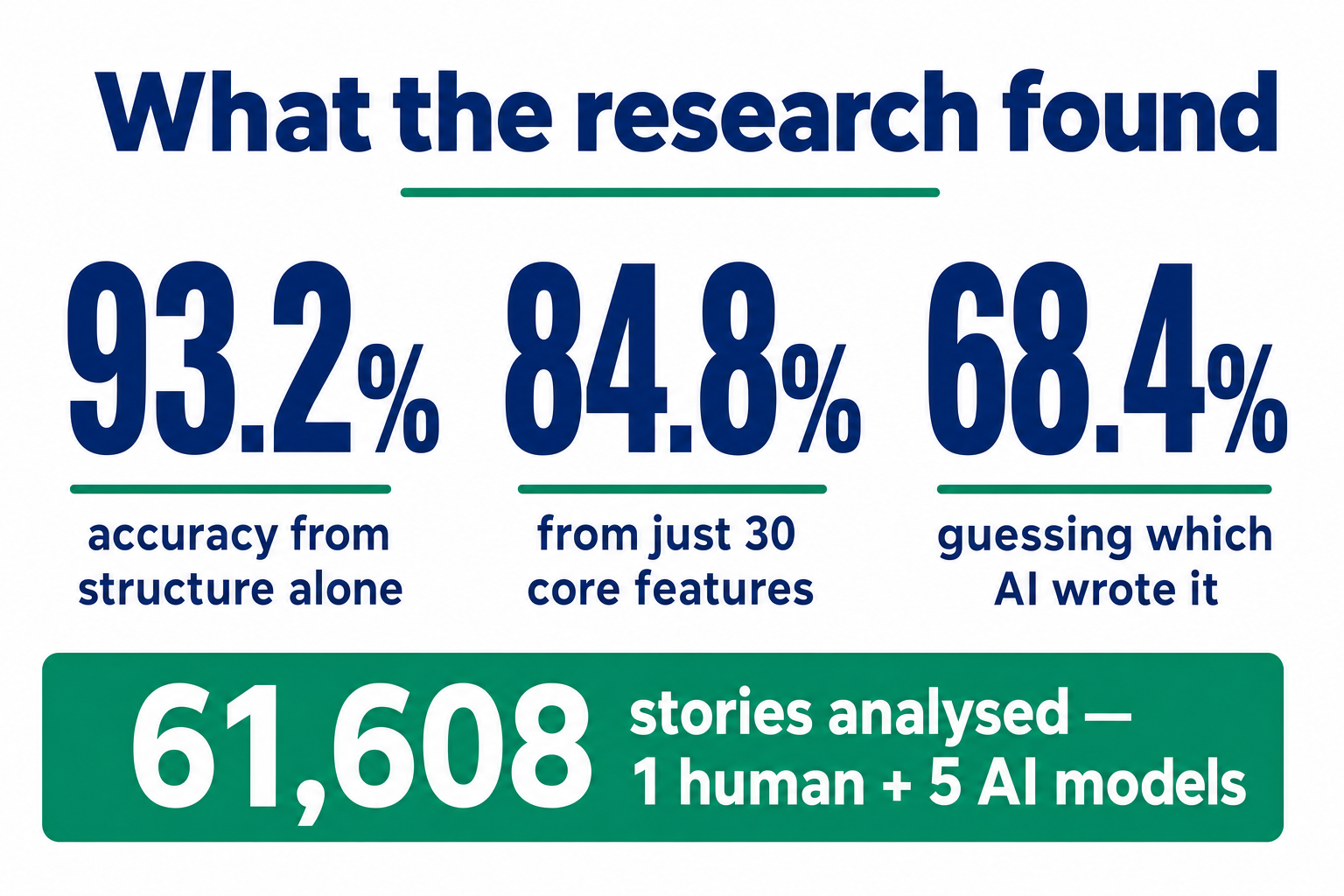
The researchers took 10,272 writing prompts and had each one written six ways — once by a human author, and once each by five different AI models (Claude, GPT, Gemini, DeepSeek, and Kimi). That's 61,608 stories. Then, instead of looking at word choice, they scored each story on 30-odd structural features: how explicitly it stated its theme, whether it had subplots, whether the ending resolved tidily, whether it named real things.
Two findings matter for you.
First, structure alone identified human versus AI writing with 93.2% accuracy — and even a stripped-down set of 30 core features hit 84.8% on its own. No vocabulary analysis. Just shape.
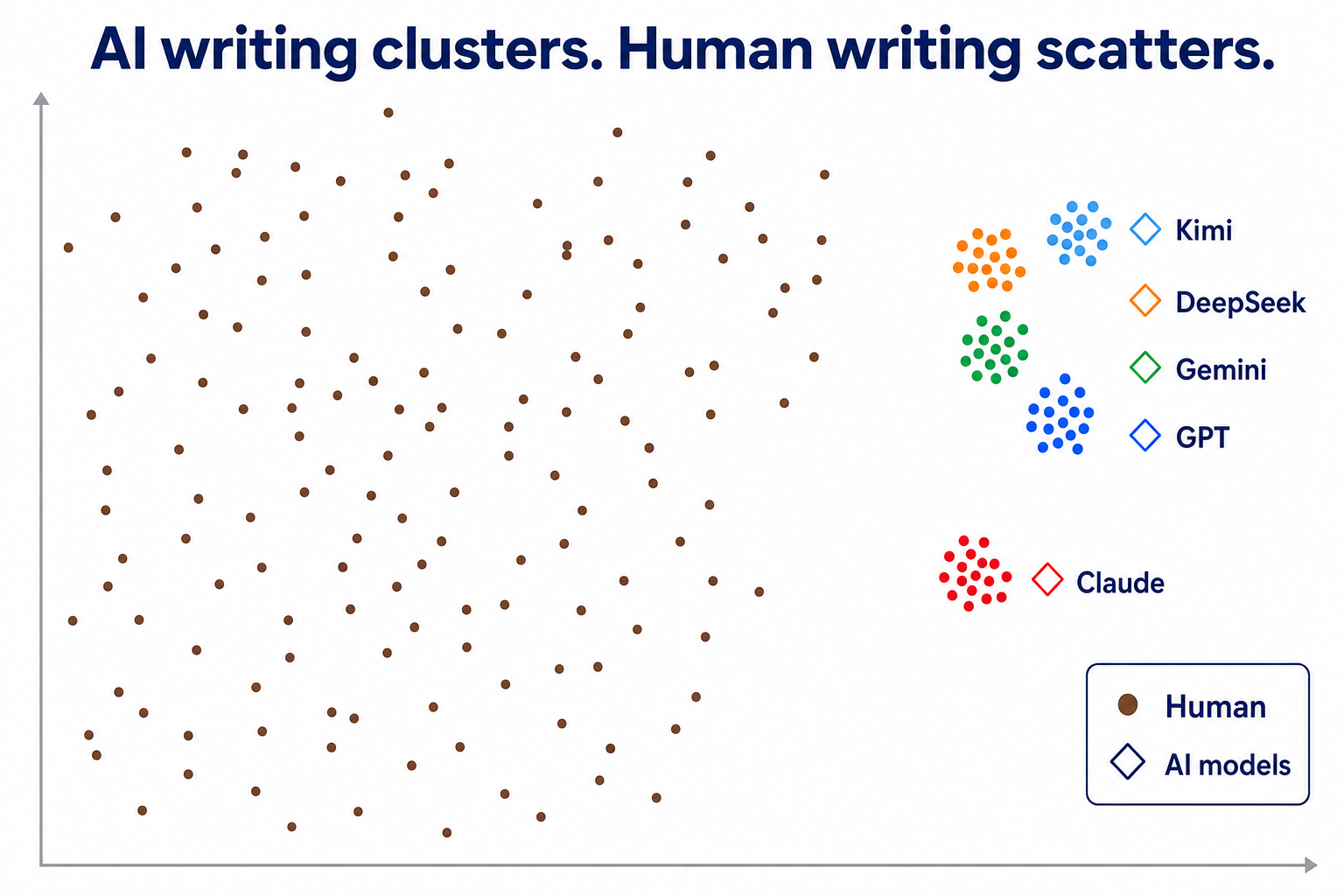
Second, and this is the part that stays with me: when they mapped all the stories, the five AI models clustered together in a tight little clump. The human stories were scattered everywhere. AI converges on a narrow, safe, tidy region of "how a piece of writing goes." Humans are all over the place — messier, rarer, less predictable. The human signature isn't a feature you can add. It's the dispersion itself.
The Most Common AI Writing Patterns (With Examples)
Here are the tells that actually transfer to normal writing — the ones I'd watch for in an article, an email, a report. Each is a structural habit, not a word.
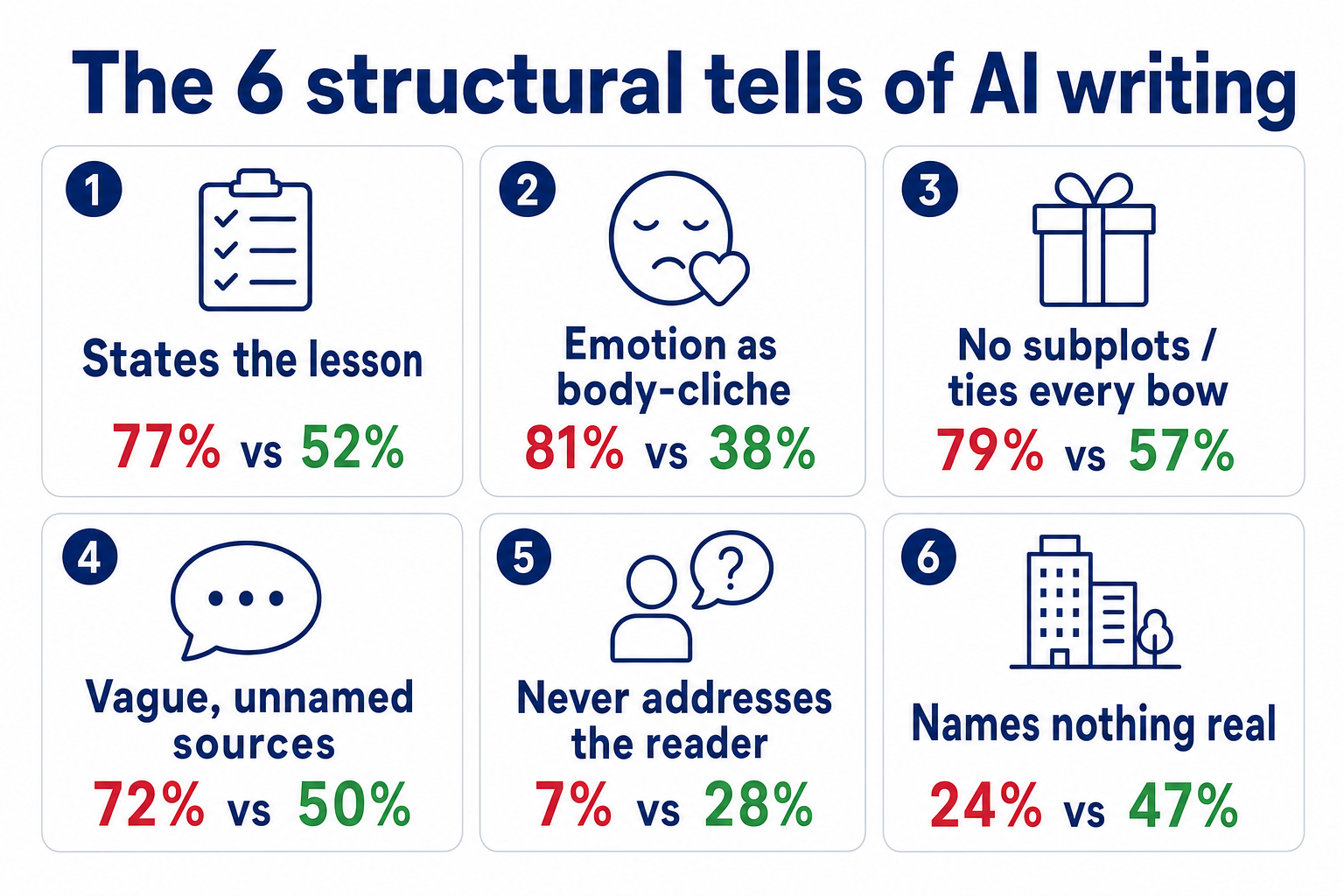
It states the lesson. AI narrators spell out the moral 77% of the time; humans, 52%. The AI version of a story about burnout ends with "and that's why growth is the antidote to burnout." The human version just shows you the burnout and trusts you.
It names nothing real. "Experts say." "Studies show." "A major company." Humans name the study, the company, the price, the person. Vague allusion is one of the strongest AI tells there is.
It ties every bow. AI resolves cleanly — every thread closed, every arc landed on internal acceptance. Human writing leaves things unresolved, goes off on a tangent, drops a subplot and never picks it back up.
It performs emotion instead of stating it. AI reaches for the body-language cliché — the tightening throat, the racing heart — where a human will just say "I was furious," or give you an odd, specific detail you couldn't invent.
It has no lived experience in it. Nothing only that one author could know. No real failure, no real name, no actual Tuesday. This is the hardest thing for a model to fake and the easiest for a person to supply.
Notice none of these is a word. You could write a paragraph with zero banned vocabulary that hits every one of them — and it would still read as AI.
So We Built a Detector — and Tested It Blind
Reading a paper is one thing. I wanted to know whether these patterns were real enough to act on, so I built a detector and ran an honest test.
The build itself is not exotic, which is the point — you could do it too. I turned those 30 structural features into a scoring rubric, handed it to a large language model as its instructions, and had it read a piece of text and mark each feature as leaning human or leaning AI, quoting the sentence that gave it away. No training, no maths, no custom model. A rubric and a prompt.
Then, keeping yourself honest is the hard part. You can't use famous authors as your human samples — if the tool recognises a passage of Hemingway, it'll call it "human" from memory, not from structure, and you've proved nothing. So I used obscure, forgotten writers from before AI existed, stripped the titles and names off, and mixed them with fresh AI-written stories from two different models. Then a separate AI, told nothing about which was which, scored each one on structure alone.
Seven out of seven correct. It sorted the obscure human fiction, the human non-fiction, and the AI stories cleanly — and told me why each time, pointing at the exact tells above.
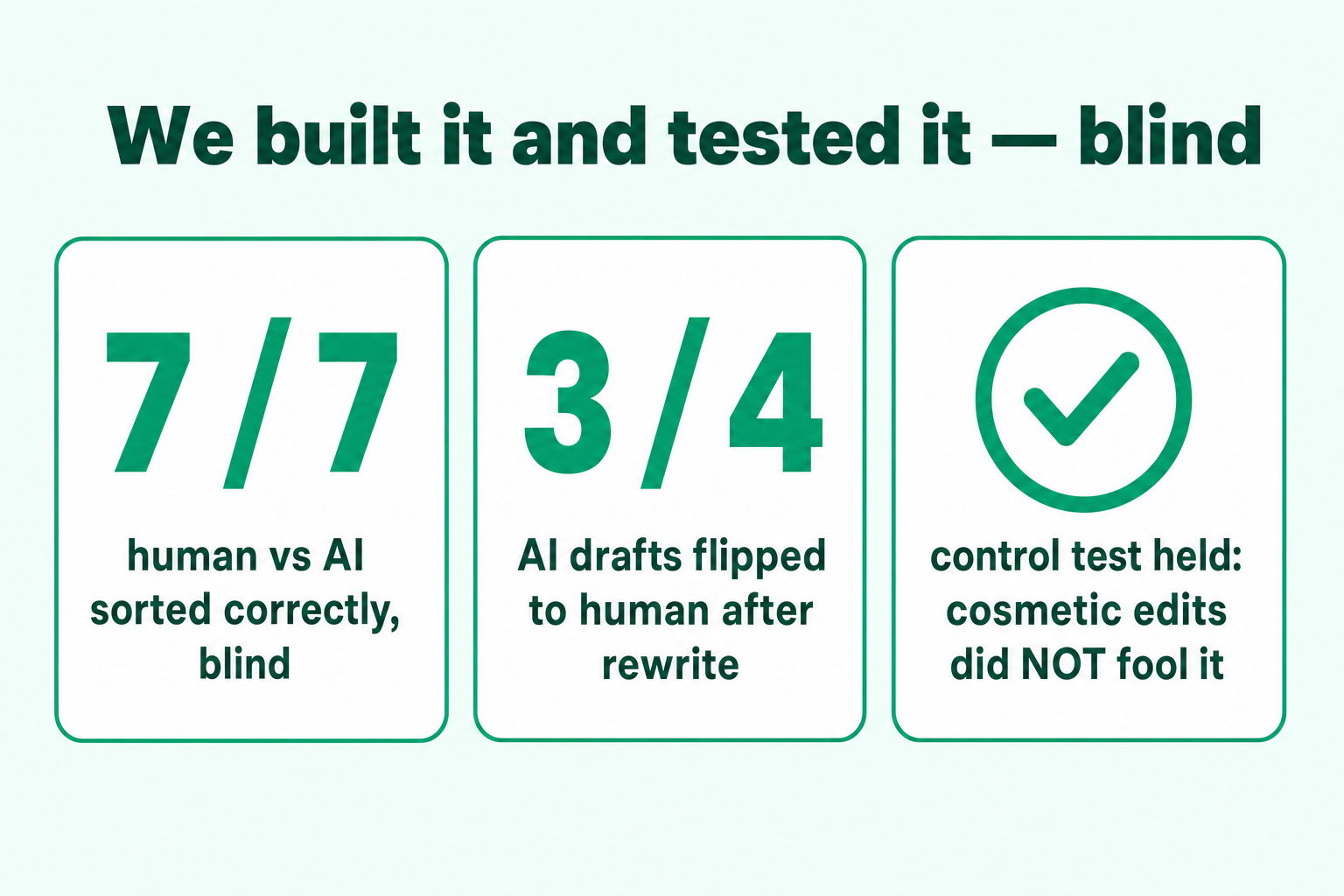
Fiction is where the research lives, but it's not what you write. So I pointed the same tool at the kind of thing this audience actually produces: a short incident write-up. The AI-drafted version came back leaning AI, and the reason it gave was exactly right — "escalation compresses to a clean 'contained and resolved' beat, no named system, no real timestamp." The rewrite that named the actual host, the actual 3 a.m. page, and left one loose end unresolved flipped to human. Same tells, different genre. A report, it turns out, is just a story wearing a tie.
I'll be honest about the size of all this: a handful of samples is a demonstration, not a clinical trial. But it separated cleanly, blind, judged by a different AI than wrote the samples. That was enough to trust the shape of the thing.
How to Make AI Writing Sound More Human
Then I built the opposite tool — one that takes AI-shaped writing and rewrites the structure to be human. Same rubric, run backwards.
The moves are exactly the inversions of the tells:
Name real things. Swap "studies show" for the actual study.
Cut the stated lesson. Delete the sentence that explains what the point meant.
Commit to an opinion you'd have to defend, instead of hedging both ways.
Leave one thread open. Let a tangent go somewhere and not fully resolve.
Put in the one detail only you would know.
Does it work? I took four AI stories the detector had flagged and ran them through. Three flipped to reading as human — verified blind, by a different model. The fourth is the useful one: it didn't flip, because my "refuse the neat ending" edit was so obvious that the detector caught the avoidance as its own new tell. Which taught me something worth keeping: you can't just invert the rules mechanically. The human move has to be genuine, not performed. An anti-lesson announced as an anti-lesson is just another pattern.
What AI Detection Cannot Do (the Honest Part)
Now the part most "AI detector" articles skip, because it's not sellable.
None of this gives you a percentage. There is no honest number that says "84% AI." Our tool reports evidence — these specific tells, in these specific sentences — not a verdict you can put in a disciplinary hearing. Anyone selling you a confident percentage is selling you a coin-flip with a progress bar.
The hardest case beats everyone
Text a human wrote with AI — where your real experience went into a file and a model wrote the prose around it — is a genuine blend, and nobody has cleanly cracked it. No tool, no paper, not us. Anyone claiming otherwise is overselling.
It measures structure, and structure only. The commercial detectors you've heard of (the ones schools use) measure something different — statistical fingerprints in the raw text. A piece can pass one and fail the other. They're different instruments pointed at different things.
I'd rather tell you that than pretend. Knowing what a tool can't do is the difference between using it and being fooled by it.
The Tools We Built
Everything here — the detector, the humanizer, the full 30-feature rubric, the writing-voice files that build these human patterns in before a word is written — we packaged up ready to run.
For Inner Circle members
Grab the pre-made packages from the HAL Vault and drop them straight into your own setup — the detector, the humanizer, and the rubric, ready to run. The article stands on its own; the Vault is for when you want to run it yourself.
Where This Leaves Me
Here's the awkward bit, and I'm going to leave it awkward. Our own detector read a draft of this article and flagged it — mildly — as leaning AI. Not for the facts or the words. For exactly the thing I've been warning you about: I kept tying sections up in neat little bows and ending on tidy maxims, because that's what a model trained me to reach for too. I've roughed some of that out. I haven't caught all of it, and I'm not going to pretend I have.
That's the real lesson, if there is one. A model left alone always reaches for the safest, tidiest, most average version of the sentence — it regresses to the mean, because the mean is what it was trained on. And so do the rest of us, once we've spent enough time reading its output. The pull toward the cluster is strong. Naming a real thing, committing to an opinion you'd have to defend, leaving a thread hanging on purpose — none of that is natural anymore. You have to choose it. This paragraph included, which is why I'm going to stop here instead of landing it cleanly.
AI Writing Patterns FAQ
Can you detect AI writing?
Partly. Structural analysis distinguishes clearly AI-written text from clearly human text with good accuracy, but it produces evidence, not proof — and blended human-plus-AI writing remains hard for every method. Treat any tool that gives you a confident percentage with suspicion.
Does AI writing have a pattern?
Yes — but the reliable pattern is structural, not vocabulary. AI writing tends to state its themes outright, resolve everything tidily, avoid naming real specifics, and cluster around a narrow, safe shape. Those discourse habits are far harder to hide than the word 'delve'.
How do I make AI writing sound more human?
Name real specifics instead of vague allusions, cut the stated lesson, commit to an opinion you'd defend, leave a thread unresolved, and include something only you would know. Roughen the structure, not just the words — swapping vocabulary alone does not move the underlying shape.
Are AI detectors accurate?
Treat any single percentage with suspicion. Detectors measure different things — narrative structure versus token-level statistics — none is reliable on human-AI hybrids, and none should be used as sole proof of authorship. They are evidence, not a verdict.
What are the most common AI writing patterns?
The structural ones that transfer to any writing: stating the lesson outright (AI 77% vs human 52%), naming nothing real, tying every thread into a neat bow, performing emotion through body clichés (AI 81% vs 38%), and never addressing the reader (AI 7% vs human 28%). Word-level tells like 'delve' are the easiest to change and the least reliable.
About the Author

Nathan House, Founder & CEO of StationX
Nathan House has 30 years of hands-on cybersecurity experience and is Cambridge-educated, holding CISSP, CISA, CISM, OSCP, CEH, and SABSA. He founded StationX in 1999 — one of the UK’s first cybersecurity companies — and has secured £71 billion in UK mobile banking transactions and the London 2012 Olympics, advising clients including Microsoft, Cisco, BP, Vodafone, and VISA. He authored the world’s most popular cybersecurity course — a #1 Udemy bestseller taken by over 500,000 students — and was named Cyber Security Educator of the Year 2020, AI Security Educator of the Year, and a UK Top 25 Security Influencer 2025. A DEF CON speaker and featured expert on CNN, Fox News, NBC, and the BBC, Nathan leads StationX’s training of more than half a million students worldwide.