AI Regulations Around the World: Full 2026 Breakdown
If you learned the global AI-regulation map last year, it's already out of date. The EU pushed back its key high-risk deadlines. Canada's flagship AI law died in Parliament. A US executive order now tells federal lawyers to challenge states over their AI rules. For anyone responsible for security, privacy, or compliance, this isn't trivia — build to the wrong spec today, and your product could be locked out of a major market tomorrow.
So we built you the map. In this guide we'll walk through the major regimes one by one — the EU AI Act, the US state patchwork, the UK, China, Canada, and the rising laws across Asia and beyond — and, crucially, what each one actually requires you to do. Every date and penalty here was checked against the primary source, because on this topic most of what's published is out of date. Let's get into it.
Why AI regulation matters (and why it's a moving target)
Here's the thing that trips people up: there is no such thing as "AI regulation" in the singular. There are dozens of regimes, and they don't agree with each other — not on definitions, not on scope, not even on whether AI needs its own law at all.
Broadly, the world has split into two camps. On one side is the comprehensive, risk-based model — one big horizontal law that classifies AI by how dangerous it is and layers obligations on top. The EU wrote the template; South Korea followed. On the other side is the light-touch, principles-based model — no dedicated AI statute, just existing regulators applying broad principles within their own patch. The UK is the clearest example. The US sits somewhere stranger: no federal law, fifty states doing their own thing, and a federal government now actively trying to stop them.
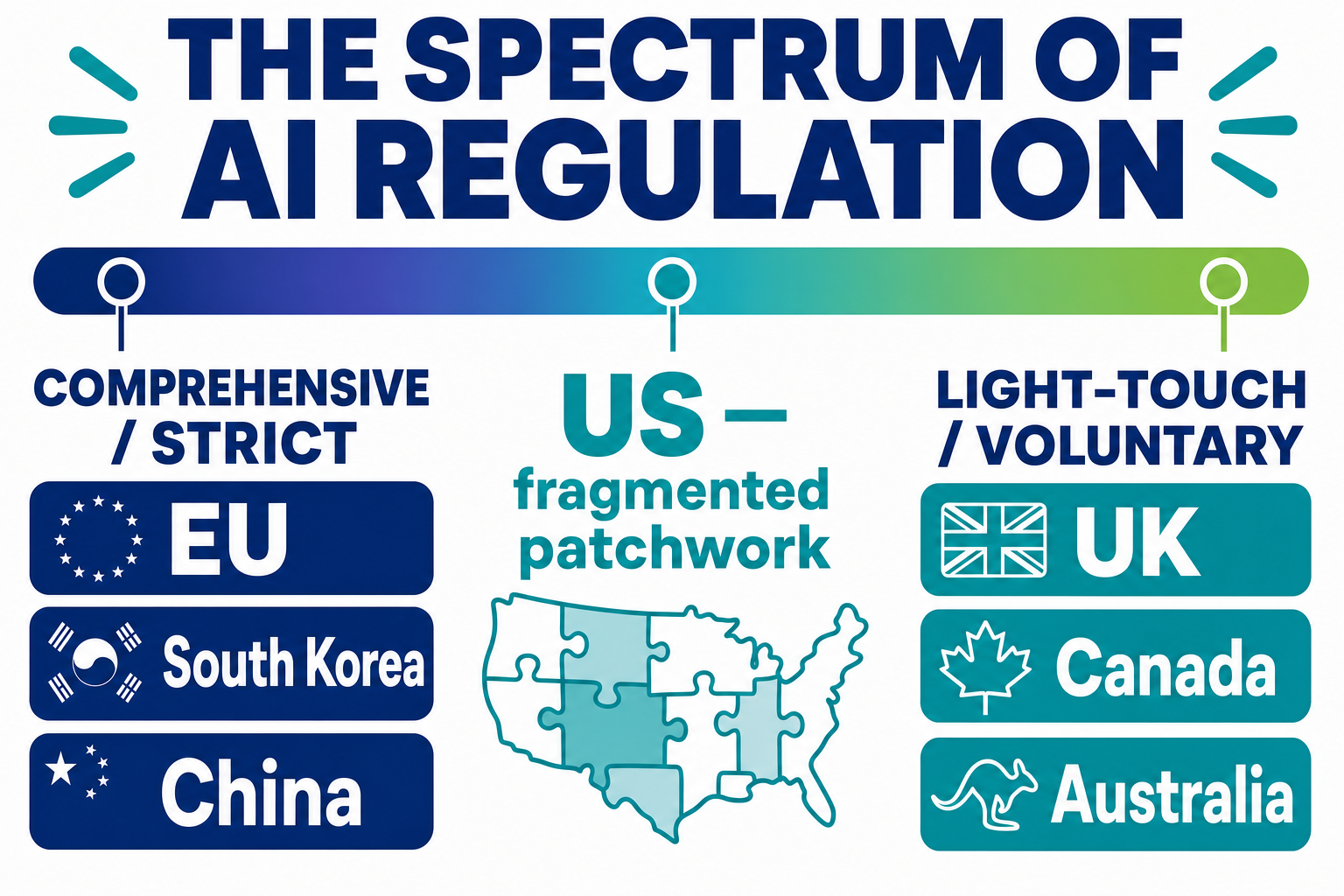
Here's the whole world at a glance before we go deep:
| Jurisdiction | Main instrument | Approach | Status / key date | Penalty / exposure |
|---|---|---|---|---|
| EU | EU AI Act | Comprehensive, risk-based | In force; high-risk from Dec 2027 | Up to €35M or 7% global turnover |
| US | State patchwork | Fragmented, no federal law | Live and changing | Varies ($20k+/violation) |
| UK | Five principles | Light-touch, regulator-led | No horizontal AI Act | Existing regulators |
| China | CAC measures | Content-first, security-heavy | In force | Assessment, filing, labelling |
| Canada | None (AIDA failed) | Privacy + voluntary code | No comprehensive AI law | Existing privacy law |
| South Korea | AI Basic Act | Comprehensive, risk-based | In force (Jan 2026) | Fines + foreign-provider reach |
💡 In plain English. "Risk-based" means the law cares more about a CV-screening AI than a spam filter. The higher the potential harm to people, the heavier the rules.
🎯 Does this apply to you?
Start with user geography, not headquarters. The EU, China, South Korea, and several US states can catch foreign providers if the AI is placed on their market, used by their residents, or affects people there. Before you classify risk, map where your users, customers, employees, and affected individuals actually are.
Nathan's take: if your organisation operates across borders, you don't get to pick a camp. You have to comply with the strictest regime you touch — and right now that's the EU. Build for that, and most of the rest falls into place.

The EU AI Act: the world's first comprehensive AI law
If you only learn one regime, learn this one — because it's the most complete, the most copied, and the one with the teeth. The EU AI Act (Regulation (EU) 2024/1689) entered into force on 1 August 2024 and is the world's first comprehensive, horizontal law for artificial intelligence. (Official EU AI Act page.)
It works on a four-tier risk pyramid:
Unacceptable risk. Banned outright.
High risk. Allowed, but with strict obligations — this is where most of the compliance work lives.
Limited / transparency risk. You just have to tell people — chatbots, deepfakes, and generative content must be labelled.
Minimal risk. Spam filters, AI in video games. No obligations.
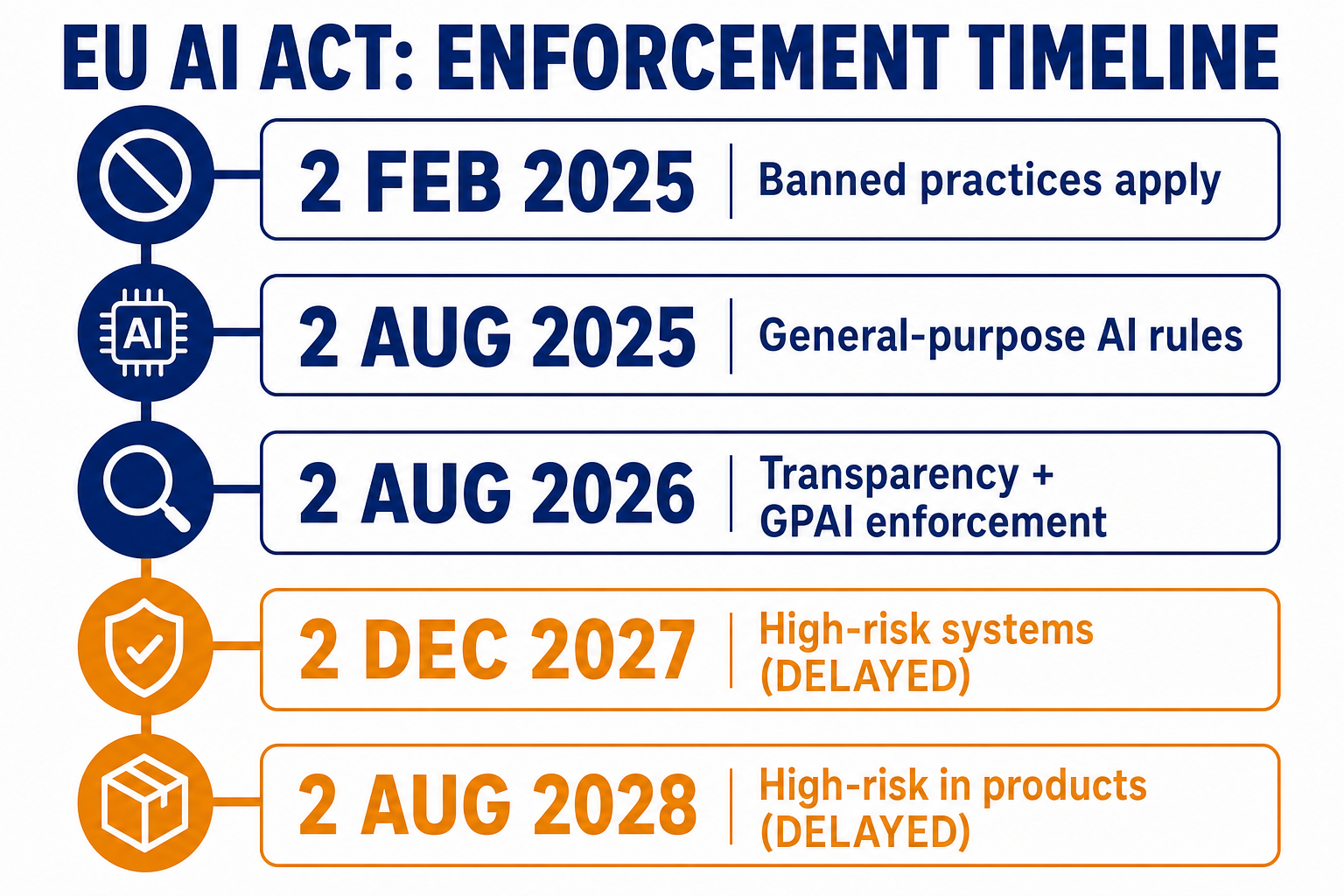
The eight banned practices (Article 5) include social scoring, untargeted scraping of faces from the internet or CCTV to build recognition databases, emotion recognition in workplaces and schools, and real-time remote biometric identification in public spaces by law enforcement. These prohibitions have applied since 2 February 2025.
While legal teams tend to focus on Article 5's banned practices, security teams should pay closest attention to Article 15, which governs high-risk systems. It demands an appropriate level of accuracy, robustness (fail-safe and backup behaviour), and cybersecurity — explicitly including protection against data and model poisoning and adversarial attacks. That's not a privacy footnote; it's a security-engineering requirement written into law.
But Article 15 doesn't stand alone. High-risk systems also bring lifecycle risk management, technical documentation, logging, human oversight, post-market monitoring, and serious-incident reporting. Translated into security terms, that's SDLC governance, audit evidence, telemetry, and incident response — applied to AI. If you already run those disciplines for software, you're extending them, not inventing them.
The timeline everyone gets wrong. Most articles still show high-risk obligations landing in August 2026. They don't anymore. A simplification package (the "Digital Omnibus"), adopted 19 November 2025 with political agreement reached in May 2026, pushed the high-risk deadlines back:
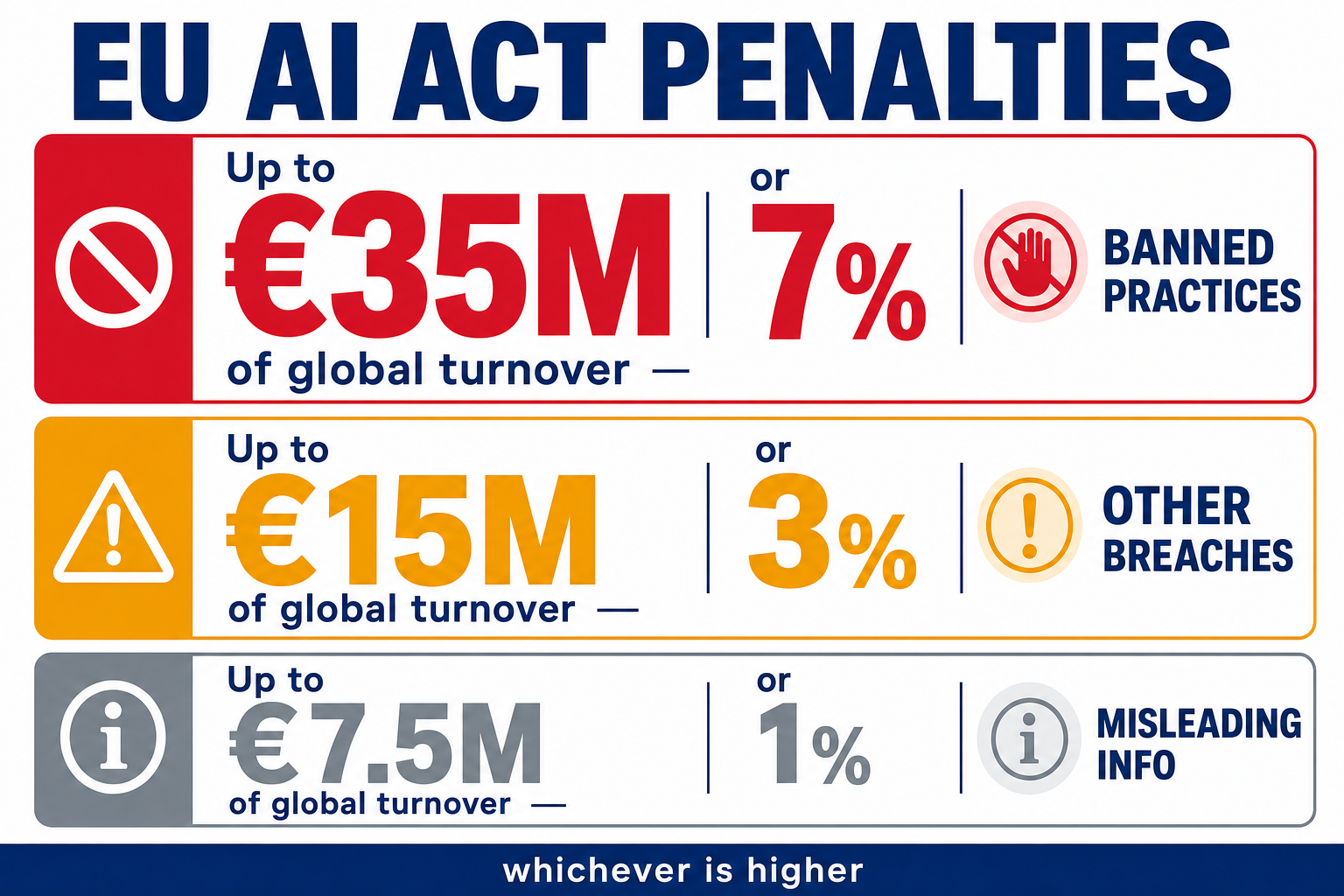
The penalties are what make people pay attention. Breach a banned practice and you face up to €35 million or 7% of global annual turnover, whichever is higher. Other breaches run to €15M or 3%, and giving regulators misleading information costs €7.5M or 1%. (Small businesses pay the lower of the two figures.)
One more thing worth knowing: the AI Act doesn't replace GDPR — it runs alongside it. If your AI touches personal data, you still owe a lawful basis, data protection impact assessments, and the automated-decision rights under Article 22.
✅ Nathan's take. The EU is the benchmark. If you build your AI governance to satisfy the AI Act's high-risk obligations, you've done most of the work for every other regime in this guide. Which brings us to the one that couldn't be more different.
AI regulations in the US: a volatile state-by-state patchwork
If the EU is a cathedral, the US is a building site in an earthquake. There is no comprehensive federal AI law — and the federal picture has whipsawed with each administration.
At the federal level, the story is whiplash. The Biden administration's sweeping AI-safety order (EO 14110) was rescinded on day one of the new administration and replaced by a January 2025 order (EO 14179) focused on removing barriers and driving growth, which produced a national AI Action Plan in July 2025. The EO numbers matter for your citations; the practical point is that federal policy reversed direction while state laws kept moving.
Then came the big one for compliance teams. In December 2025, EO 14365 directed the Attorney General to set up an "AI Litigation Task Force" to challenge state AI laws as unconstitutional, and tied federal broadband funding to how "onerous" a state's AI rules are. But — and this matters — an executive order is not a law. It doesn't actually preempt anything. The much-feared "10-year moratorium" that would have banned states from regulating AI was stripped out of the budget bill and never became law.
⚠️ Don't misread this
Until courts rule, every state AI law below remains fully in force and enforceable. Treating state compliance as optional right now is a mistake.
So the real action is at the state level, where the picture is genuinely messy. And most of these rules follow the affected resident, not your office address — so one national product can trigger several state obligations at once:
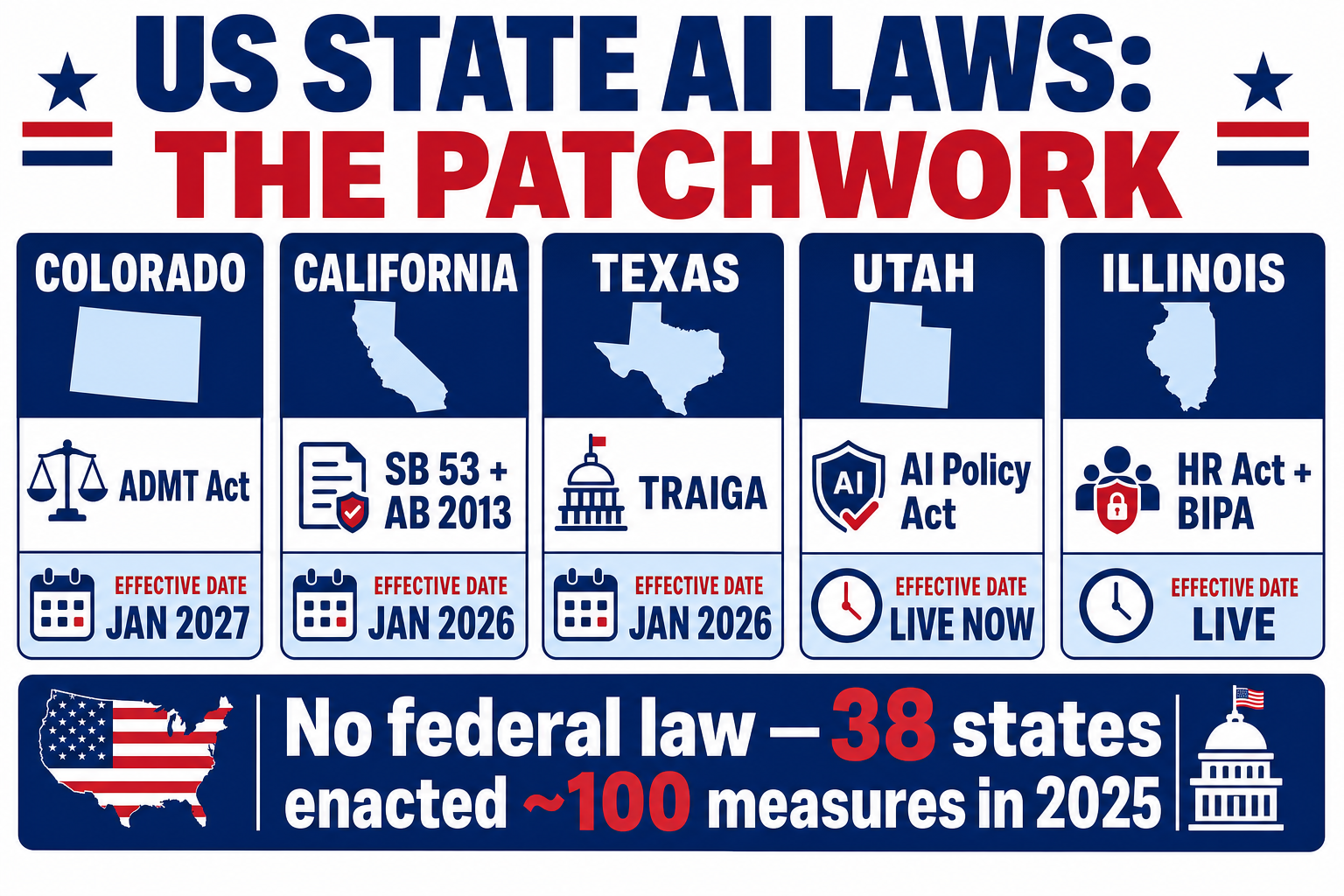
Colorado. The pioneering AI Act (SB 24-205) was delayed, then repealed and replaced by the narrower ADMT Act, now effective 1 January 2027. It requires pre-use notices, explanations of adverse decisions, and human review, with penalties up to $20,000 per violation (Attorney General enforcement only).
California. SB 53 (frontier-AI safety) and AB 2013 (training-data transparency) took effect 1 January 2026; the AI Transparency Act (SB 942) follows later in 2026.
Texas. The Responsible AI Governance Act (TRAIGA) took effect 1 January 2026, banning AI intentionally built to discriminate or harm, with a regulatory sandbox and AG enforcement.
Utah. The AI Policy Act is already live, requiring disclosure when you're interacting with generative AI.
Illinois. Amended its Human Rights Act to cover AI in hiring, on top of the long-standing biometric law (BIPA).
To put the scale in perspective: in the 2025 session, all 50 states introduced AI legislation and 38 enacted around 100 measures (per the National Conference of State Legislatures).
Nathan's take: the US is the hardest regime to comply with precisely because it's fragmented. You can't build to one standard — you have to track a moving patchwork, and the federal-vs-state fight means the ground will keep shifting through 2026 and 2027. Don't set-and-forget this one.
The UK's principles-based approach
Cross the Channel and the philosophy flips completely. The UK has deliberately chosen not to pass a horizontal AI Act. Instead, its 2023 white paper set out five cross-sectoral principles — safety and robustness; transparency and explainability; fairness; accountability and governance; and contestability and redress — and asked existing regulators (the ICO, FCA, Ofcom, CMA) to apply them within their own domains.
Two things are worth flagging. First, in February 2025 the government renamed the AI Safety Institute the AI Security Institute — a deliberate signal that its focus is national-security and misuse risks (cyber-attacks, fraud, chem-bio, CSAM), not content moderation. Second, there is a private member's Artificial Intelligence (Regulation) Bill floating around Parliament — but it isn't government-backed and isn't law. The government has hinted at binding rules for the most powerful frontier models but committed to no firm date.
Nathan's take: the UK is betting that agility beats comprehensiveness. It's a reasonable bet for innovation, but it leaves businesses with less certainty — you're reading five principles across a dozen regulators instead of one rulebook. For a security team, "flexible" often just means "ambiguous."
China's content-first AI rules
China regulates AI heavily — but with a different motive. Where the EU is protecting fundamental rights, China's rules are built primarily around content control and information security, enforced by the Cyberspace Administration of China (CAC).
Rather than one law, it's a stack of binding measures:
Generative AI. The Interim Measures for Generative AI Services (effective 15 August 2023) require public-facing services to pass security assessments, keep training data lawful, moderate output, and file their algorithms with regulators.
Deepfakes. The Deep Synthesis and algorithmic recommendation provisions have mandated labelling of synthetic media since 2022–2023.
Content labelling. The Measures for Labelling AI-Generated Synthetic Content (effective 1 September 2025) go further than almost anywhere else on earth, requiring both explicit labels (visible marks) and implicit labels (metadata and watermarks) across text, images, audio, and video.
Nathan's take: China is the heaviest operational lift of any regime here — pre-deployment assessments, filings, content controls, and dual labelling. And the reach is extraterritorial in effect: if your service is available to the Chinese public, these rules can catch you. Which is exactly what makes the next country such a contrast.
Canada, and why AIDA never happened
If your compliance team is still planning around Canada's AIDA, you can tell them to stop: Canada has no comprehensive AI law.
The Artificial Intelligence and Data Act (AIDA) died with Bill C-27 when Parliament was prorogued in January 2025 — it never received Royal Assent. If a guide lists it as enacted, that guide is out of date. For now, Canada means existing privacy law (especially PIPEDA) plus a voluntary code of conduct for advanced generative AI. A successor bill may come, but nothing is confirmed as law today.
Nathan's take: Canada is a useful reminder that a proposed law and an enacted one are worlds apart. Always check the legislative status before you build a compliance programme around a headline.
The rest of the world at a glance
The two-camp split plays out everywhere. A quick tour of the jurisdictions worth watching:
| Jurisdiction | Instrument | Status | Approach |
|---|---|---|---|
| South Korea | AI Basic Act | Effective 22 Jan 2026 | Comprehensive, risk-based — Asia's first |
| Japan | AI Promotion Act | In force (2025) | Soft law — principles, no penalties |
| Brazil | PL 2338/2023 | Bill (Senate-approved) | Risk-based, EU-style — not yet law |
| Australia | Voluntary AI Safety Standard | Voluntary; guardrails proposed | Light-touch, moving toward binding |
| Singapore | Model AI Governance + AI Verify | Voluntary | Pro-innovation, testing-led |
| India | DPDP Act 2023 (+ advisories) | No dedicated AI law | Advisory, privacy-anchored |
The standout is South Korea, whose AI Basic Act took effect on 22 January 2026, making it Asia's first comprehensive AI law — and, like the EU, it reaches foreign providers and requires transparency, labelling, and human oversight for "high-impact" AI. Above all of these sit the OECD AI Principles and the G7 Hiroshima Process: non-binding, but the shared vocabulary most of these national laws borrow from.
Nathan's take: watch the direction of travel, not just today's status. Brazil and Australia are both drifting toward binding, EU-flavoured rules. The comprehensive camp is winning.
What this means for security teams: from law to practice
Here's the question that actually matters: laws tell you what, but not how. So how do you turn this mess into a compliance programme you can actually run? The good news is you don't start from scratch — three frameworks do the heavy lifting, and they stack neatly.
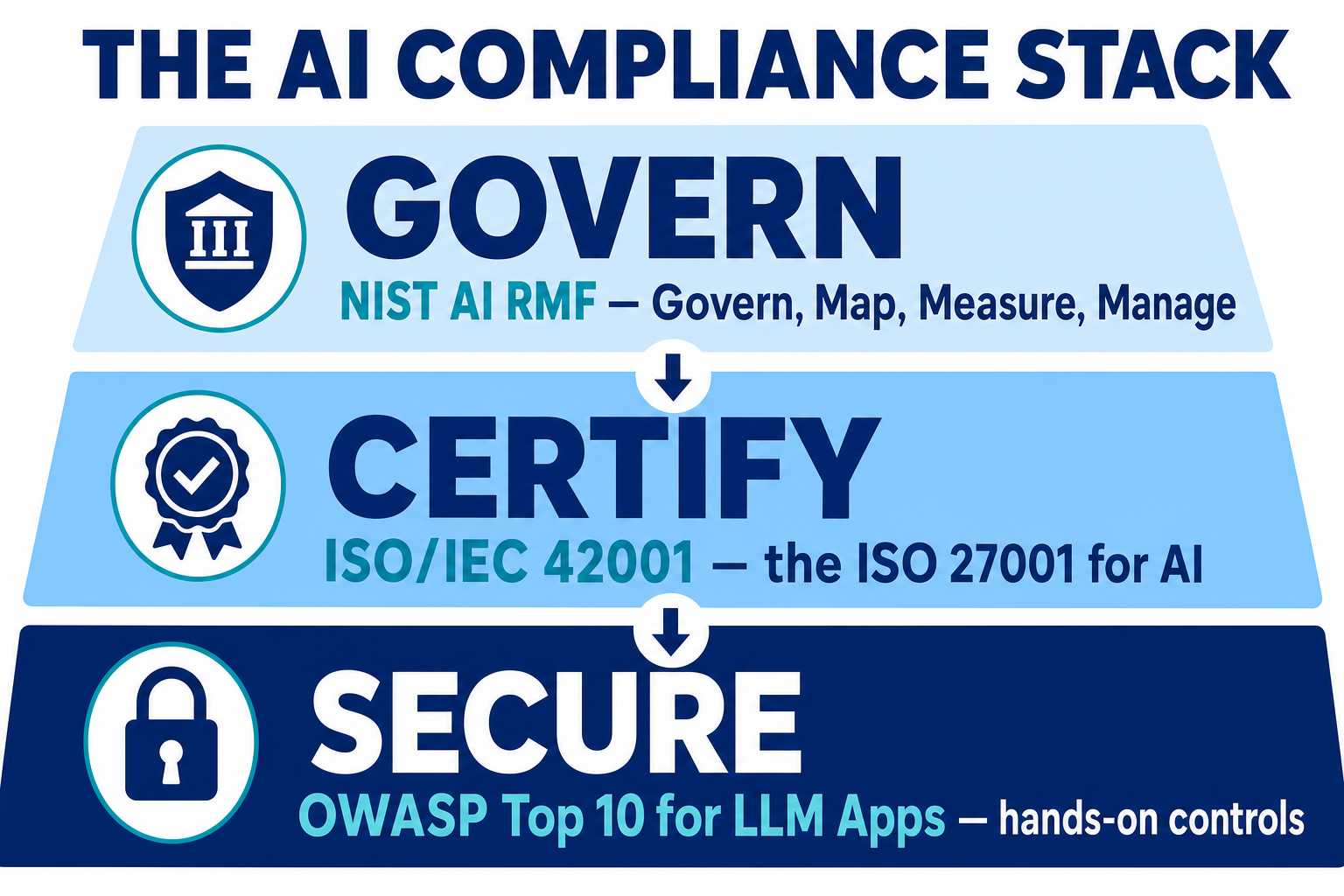
NIST AI Risk Management Framework (AI RMF). Voluntary, free, and the closest thing to a universal common language. Its four functions — Govern, Map, Measure, Manage — give you a structure regulators everywhere already recognise. Start here.
ISO/IEC 42001. The world's first certifiable AI management system standard. Think of it as ISO 27001 for AI: it proves your governance system exists and maps onto multiple regimes at once (including EU AI Act conformity). This is what auditors and enterprise customers will ask for.
OWASP Top 10 for LLM Applications. The hands-on security layer, where legal duties become engineering work. Prompt injection means input/output filtering and least-privilege agent actions. Insecure output handling means treating model output as untrusted and sandboxing tool calls. Data and model poisoning means validating training-data provenance and red-teaming model behaviour. If you already run ISO 27001 or SOC 2, much of the spine is familiar — access control, logging, incident response, vendor risk, and change management, now pointed at your AI.
✅ The one thing
If you do nothing else, adopt the NIST AI RMF as your baseline and treat ISO/IEC 42001 as the certification target. Together they satisfy the spirit of almost every regime in this guide — and they're the same controls whether you're complying with Brussels, Seoul, or Sacramento.
Your starting point — five steps:
Inventory every AI system you build or buy.
Map geography — where its users and affected people actually are.
Classify each system against the EU AI Act risk tiers (it's the strictest yardstick).
Govern + secure — use NIST AI RMF for governance and the OWASP LLM Top 10 for application controls.
Certify — set ISO/IEC 42001 as your audit-ready management-system target.
Nathan's take: don't chase individual laws country by country — you'll never keep up, as this article itself proves. Build one strong governance system to the strictest standard you touch, certify it, and layer real security controls underneath. That scales; whack-a-mole compliance doesn't.
Frequently Asked Questions
Which countries have AI laws in 2026?
The jurisdictions with comprehensive, in-force AI laws are the EU (AI Act) and South Korea (AI Basic Act, effective January 2026). China enforces a stack of binding AI measures. The US has no federal law but around 38 states have enacted AI measures. The UK, Canada, Japan, Australia, Singapore, and India rely on principles, voluntary codes, or existing law rather than a dedicated AI statute. Brazil's comprehensive bill is still in progress.
Which country has the strictest AI regulation?
The European Union, via the EU AI Act — it's comprehensive, risk-based, and carries fines up to €35 million or 7% of global turnover. China is arguably the heaviest operationally (pre-deployment security assessments and dual content labelling), but the EU sets the strictest legal benchmark most global businesses build toward.
Is there a federal AI law in the United States?
No. As of 2026 there is no comprehensive federal AI statute. AI is governed by a patchwork of state laws (Colorado, California, Texas, Utah, Illinois and more) plus executive orders. A proposed federal ban on state AI laws was removed before it became law, so state rules remain in force.
When do the EU AI Act's high-risk rules take effect?
They were delayed by a 2025–2026 simplification package. Standalone high-risk systems now apply from 2 December 2027, and high-risk AI embedded in regulated products from 2 August 2028. Banned practices (Feb 2025) and general-purpose AI rules (Aug 2025) are already in force.
Did Canada's AIDA become law?
No. The Artificial Intelligence and Data Act was part of Bill C-27, which died when Parliament was prorogued in January 2025. Canada currently relies on existing privacy law (PIPEDA) and a voluntary code of conduct.
How should a security team actually comply with all this?
Don't chase each law individually. Inventory your AI systems, map where your users are, classify against the EU AI Act tiers, adopt the NIST AI Risk Management Framework as your baseline, use the OWASP Top 10 for LLM Applications for hands-on security, and work toward ISO/IEC 42001 certification (the "ISO 27001 for AI"). Building to the strictest regime you operate in covers most of the rest.
About the Author

Nathan House, Founder & CEO of StationX
Nathan House has 30 years of hands-on cybersecurity experience and is Cambridge-educated, holding CISSP, CISA, CISM, OSCP, CEH, and SABSA. He founded StationX in 1999 — one of the UK’s first cybersecurity companies — and has secured £71 billion in UK mobile banking transactions and the London 2012 Olympics, advising clients including Microsoft, Cisco, BP, Vodafone, and VISA. He authored the world’s most popular cybersecurity course — a #1 Udemy bestseller taken by over 500,000 students — and was named Cyber Security Educator of the Year 2020, AI Security Educator of the Year, and a UK Top 25 Security Influencer 2025. A DEF CON speaker and featured expert on CNN, Fox News, NBC, and the BBC, Nathan leads StationX’s training of more than half a million students worldwide.