AI Just Handed You the Biggest Career Opportunity of Your Life [2026]
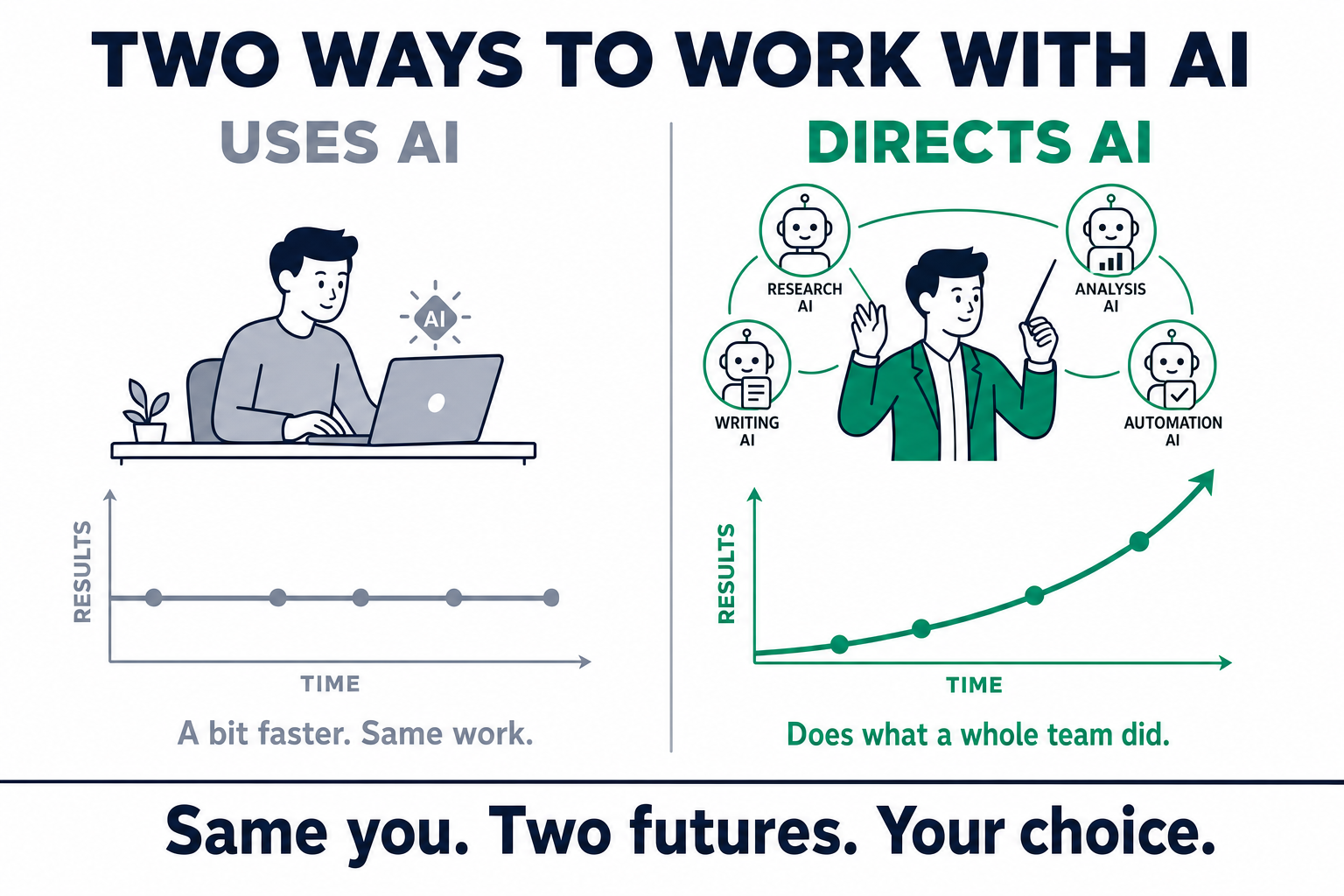
Something has just happened that almost nobody has fully noticed yet, and it's the best news for your career in a decade. The work that used to take a whole team (and quietly locked you into one small slice of it) can now be done by one person who knows how to direct AI. That person can be you, in whatever field you're in. Let me show you how.
I've spent thirty years in cyber security, I run a company, and I build with AI every single day. That combination lets me see something most people can't, because they only see their own corner of it: there's a real divide opening up, and it isn't between people who use AI and people who don't, because almost everyone uses it now. It's between the people who use AI to do their work a bit faster, and the people who direct AI to do the work for them. The second group is about to be able to do things that used to take entire teams. And that is the opportunity.
This isn't a far-off prediction. I'm watching it happen across one kind of computer-based work after another, right now, and I'll show you the evidence, not just assert it: what I've built this way, and what employers are already paying people to do it. Here's what's actually changing, why it's such an opening for you specifically, and exactly how to get on the right side of it.
The opening hiding inside "I use AI now"
There's a popular line going around: AI won't replace you. Someone using AI will. It sounds wise, but it stops one step short of the good part, because it still treats using AI as the finish line. Using AI isn't the finish line. It's barely the starting line, and the real prize is just past it.
Think about what your job actually is. Strip it down and almost every knowledge job is two different things bolted together: the doing, and the deciding. The doing is the execution: writing the report, building the slide deck, drafting the code, pulling the numbers, processing the tickets. The deciding is the judgement: what's worth doing at all, whether the output is any good, what to do next, what to ship.
For your whole career those two were fused, because the only way to get the doing done was to do it yourself, and the doing ate most of your week, capping how much you could ever take on. AI is starting to unfuse them. It can take on more and more of the doing (not all of it, not perfectly, and only when you've set the goal and you check the result), but enough that, for the first time, the grind isn't automatically yours to carry. That's not a loss. That's the cap coming off.
What share of your week is the doing (execution you could describe to someone else and have them carry out) versus the deciding? Drag to estimate. The bigger your "doing" share, the more upside is sitting there for you: that's the part AI can increasingly take, freeing you for the higher-value half.
So "I use AI" usually means "I've got AI to help me do the doing a bit faster." That's fine, but it's playing small. The real prize is a different size of job altogether, and it's sitting right next to the one you have.
(And yes, it's a simplification. In practice the two blur, and verifying work well often takes the same judgement as producing it. But as a lens for where your value is heading, it holds.)

Why almost nobody is saying this plainly
Here's the part that should make you sit up: the same shift is hitting every kind of computer work at once, and most of the people writing about AI can't see it, because each of them is standing in only one part of it. The security person sees AI in security. The developer sees it in code. The business owner sees it in operations. Each is describing one wall of the same room; none is describing the room.
I happen to stand where the walls meet. I'm deep in security, I'm technical enough to know what these tools can and can't actually do rather than the hype version, and I run a business so I see how it lands on real budgets and real hiring. That's not me being clever; it's just an unusual vantage point, and from it the whole room is visible: it isn't happening to coders or analysts or security people. It's happening to all of them, together.
The proof: things that should have taken teams
I don't want you to take my word for any of this, so let me show you instead of tell you. Here's what one person (me, directing AI) has built recently. Not "could build." Built. Live. In production.
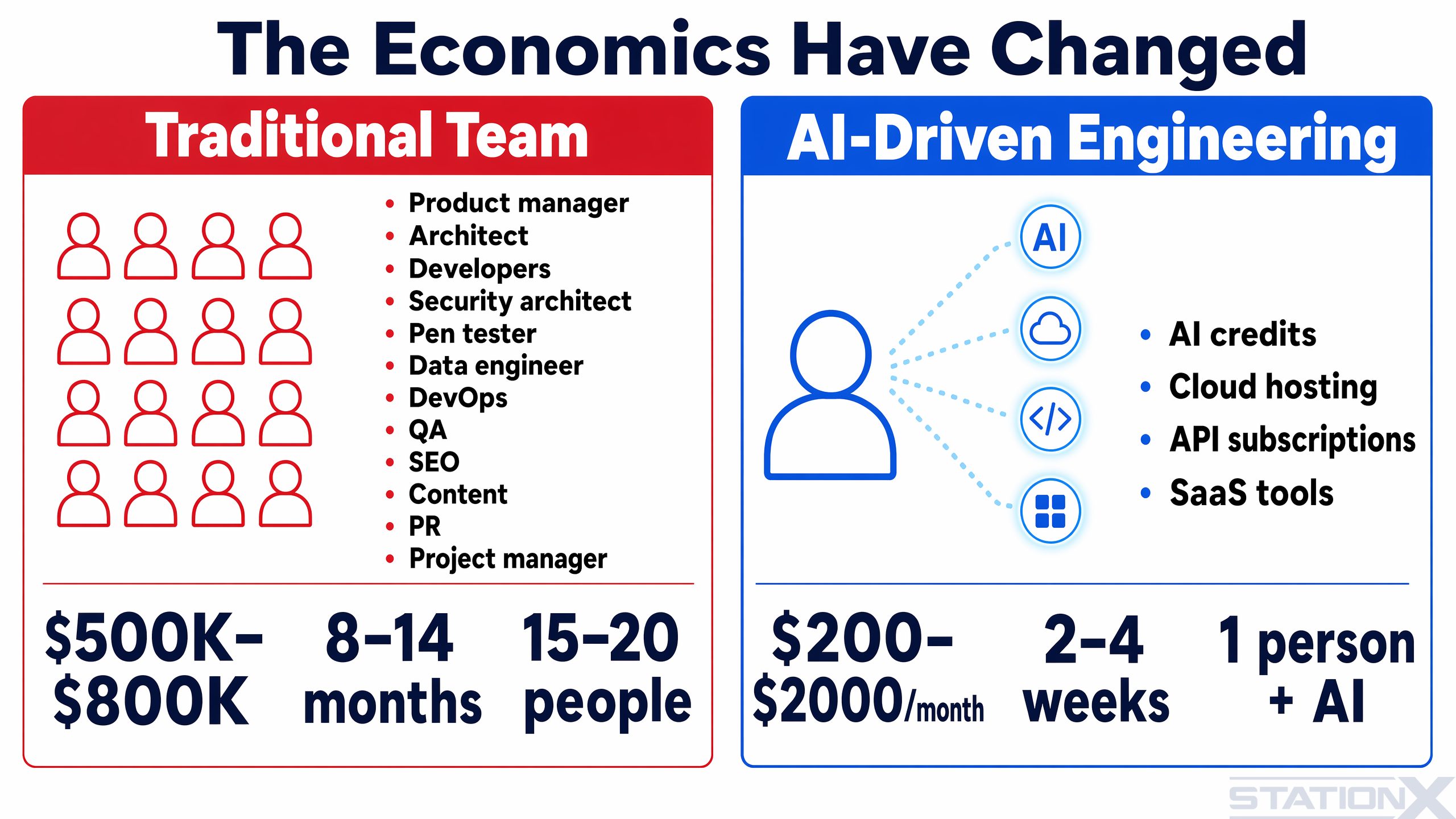
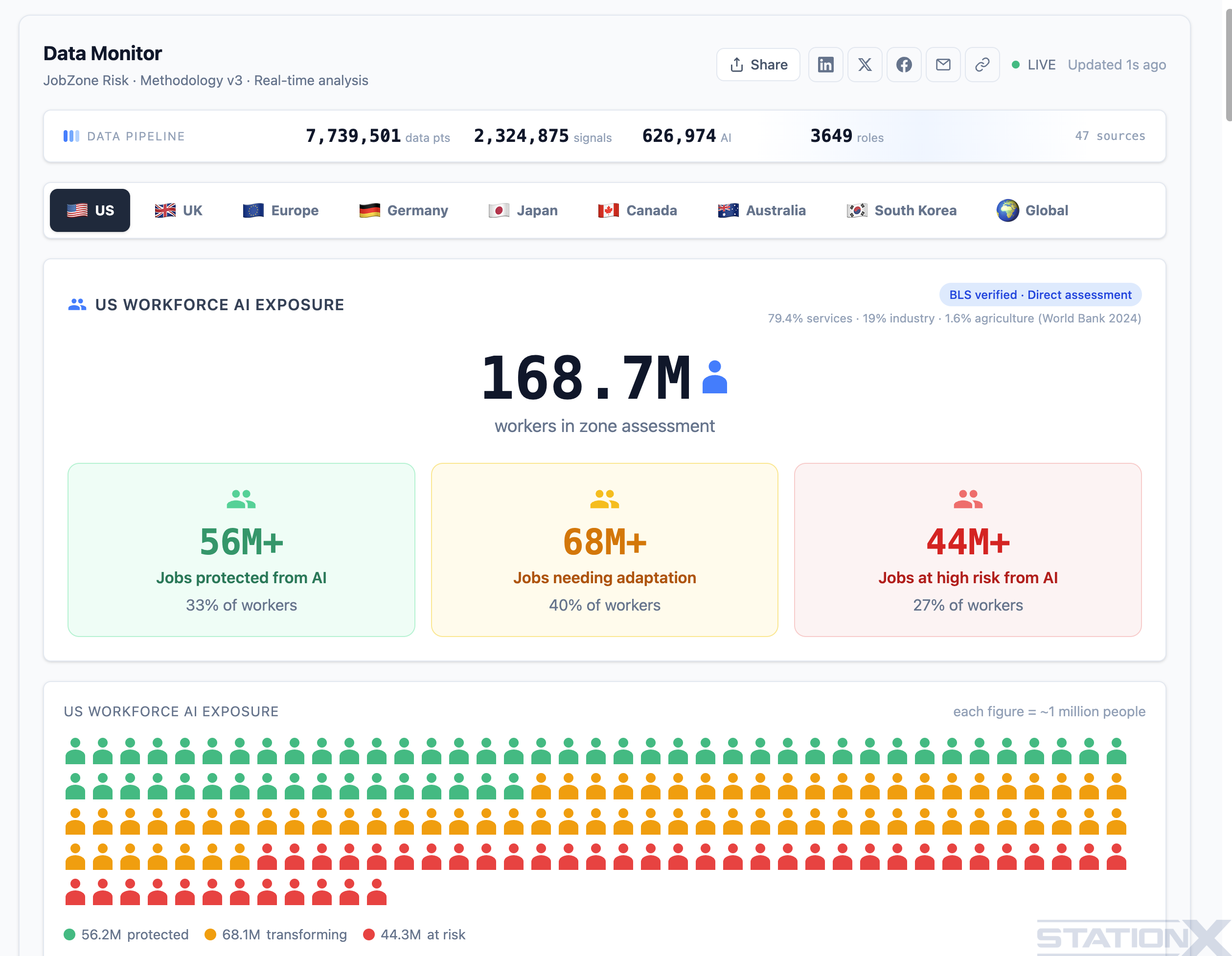
JobZone Risk: an AI job-risk platform that scored every cyber security role for how exposed it is to AI, with live labour-market data, interactive maps for nine countries, and a methodology I designed. Built solo in two weeks. To commission that from an agency at market rate (researchers, a data journalist, a methodology designer, SEO, a penetration tester, DevOps, QA), you'd be quoted fifteen to twenty specialists, the best part of a year, and somewhere around half a million to eight hundred thousand dollars. That's the going rate for the team it replaces. One person. Two weeks.
And it isn't only software, which is the part that should land for you whatever you do: the same move works on a market-research report, a financial model, a marketing campaign, a legal first-draft, any work that used to mean a person grinding through execution. Titus (continuous AI-powered vulnerability management for fintech), Athena and SATs Revision (production-grade education software, shipped at speed): different fields, same one-person-directing-AI move.
And underneath all of them, HAL: the AI infrastructure that now runs about 80% of my company, directed by one person. Almost nobody has built this publicly. It's the system that builds the systems.
Here's why that last one matters most. Four products could be luck. A system that keeps producing them isn't luck; it's a different way of working. I didn't get better at typing. I built something that gets better at everything, so the next thing ships faster than the last. That compounding is the actual story.
And before you decide this only works because it's me: it isn't. People learning this in our program are already doing it: a member built a self-hosted intrusion-deception tool; another turned a wall of red vulnerability alerts into a clean, actionable list. No team. No six-figure budget. One person directing AI, the judgement theirs, the building done for them.
I won't pretend it's automatic. Not everyone who picks this up gets there, and it's a real skill that takes real work. But the door is open in a way it simply wasn't two years ago. That's the point of showing you.
The proof: employers are already paying for it
My builds are one kind of evidence, and you'd be right to discount them: I'm the one telling the story. So here's the kind you can check yourself. We track real job postings that require directing AI, not just using it, and archive every one with a screenshot. As of September 2026 that's 565 postings from 370 named employers, and 159 of them mention a specific AI coding or agent tool by name somewhere in the posting, Claude Code, Cursor and Copilot among them. Of the 170 with a published US salary range, 126 run to $200,000 or more, topping out at $900,000 at Netflix.
The numbers size it. The wording is what should make you sit up. This is what the employers themselves are asking for (and notice that even where a posting says "use," what it describes is direction: the AI does the work, the hire owns the judgement):
"Design, develop, and deploy autonomous agents for threat detection, alert triage, vulnerability management, and incident response… Replace manual runbooks with intelligent agents that reason, act, and escalate."
"We use Claude as our primary tool across every part of the job: it drives our static analysis, drafts and fixes vulnerabilities as pull requests, performs first-line bug bounty triage, and assists threat modeling for design reviews."
"Hands-on use of AI coding assistants / agentic tools (Claude Code, Cursor, MCP) to troubleshoot, automate, and accelerate support work, plus judgment for where GenAI speeds resolution vs. where it doesn’t."
Read those again. Nobody is hiring a faster typist. Every one of them is paying for the deciding half of the sum you ran on your own week a minute ago: set the goal, direct the machine, catch it when it's wrong. The full set, with the exact wording of every posting, is in our AI-driven jobs tracker. It's cyber security because that's our field and we can verify it, but the requirement it documents is the same shift this whole article is about.
Why this is a bigger opening than any wave before it
We've done automation before, and the pattern always rhymes. Factory robots didn't end manufacturing; they turned line workers into process engineers. Spreadsheets didn't kill accountants; they turned number-crunchers into financial analysts. Cloud computing didn't end system administration; it turned rack-and-stack admins into cloud architects.
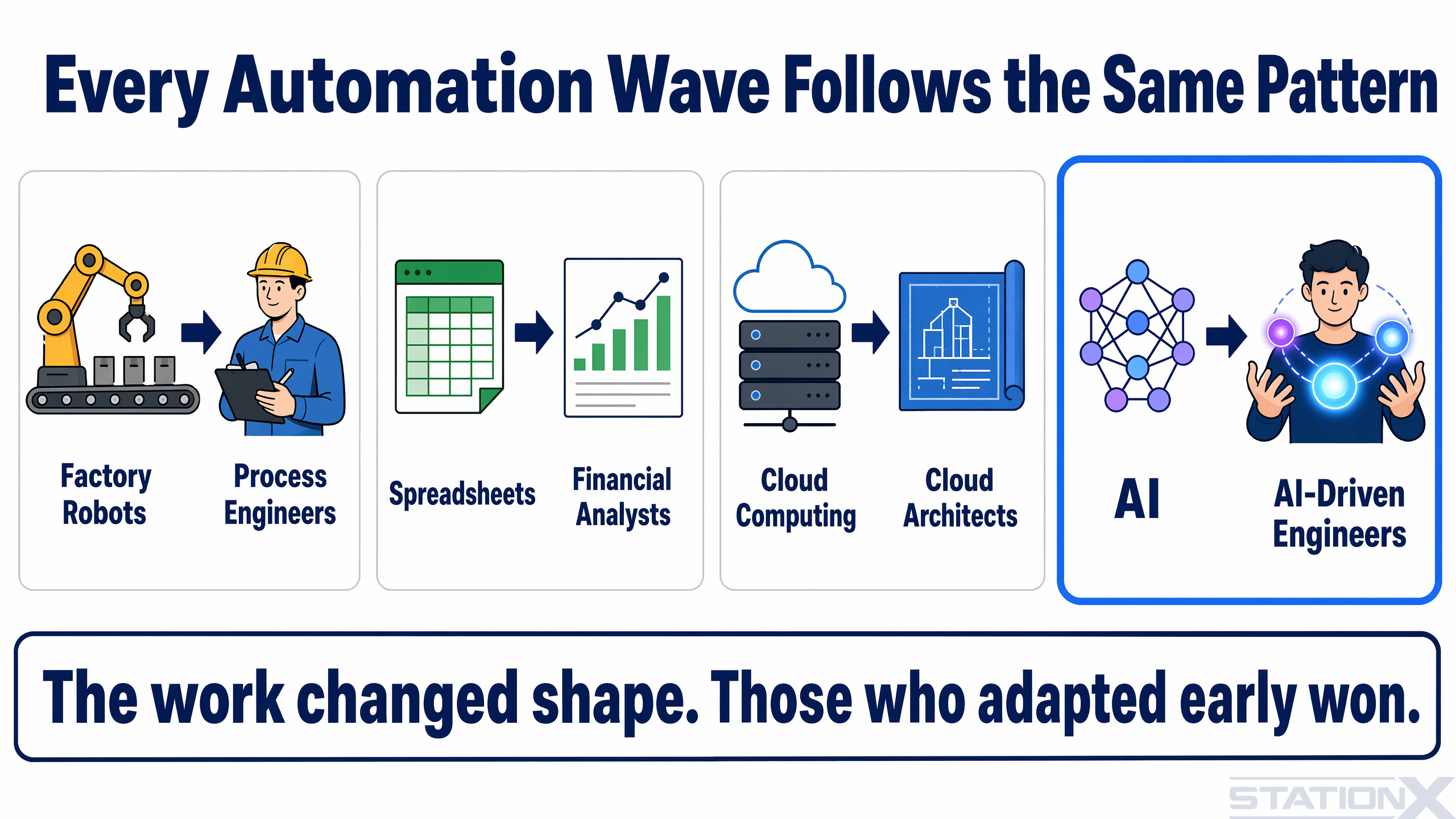
Every time, the work didn't vanish; it changed shape. And every time, the people who saw it early and changed shape with it got a head start that paid them for years, while everyone else caught up slowly.
Here's the part that makes this one bigger: speed and breadth. Earlier waves were broad too (the spreadsheet and the internet touched whole swathes of work, not one industry), but they diffused slowly, over decades, so people had time to adjust one step at a time. AI is different in pace: because it's a general capability that keeps improving, a single jump in the underlying model lifts coding, writing, analysis, design and support at the same time, across every field, in the same few years. The shift isn't new in kind; it's new in how fast and how wide it's landing.
That compression is the opportunity. Normally a head start like this opens in one field at a time, slowly enough that only the few people paying close attention there catch it early. This time the same head start is open in every field at once, and almost nobody has taken it yet, because most people are still busy using AI to type a little faster. That's the opening: wide, early, and in your field too. The trade-off is that the window is shorter than past waves gave anyone, which is exactly why starting now matters.
What the opportunity actually is
Not just using AI. Building with it: becoming the person who does the part it can't.
Here's the honest version, because I won't sell you a comfortable one: it isn't enough to "build with AI" either, if what you're building has no value. You can direct an AI all day and produce things nobody needs. What pays (what makes you genuinely hard to replace, and able to do far more than before) is the combination: doing valuable work, and directing AI to deliver it. The judgement about what's worth doing, plus the ability to actually get it shipped through AI. That's the whole game.
It's the thing I do, and it's the thing the people learning it do: you direct the AI, you architect the solution, you decide what to ship, and you verify it's right. The AI does the typing. You're the one who builds. It's also, in their own words, what those job postings are paying for. Anyone can prompt an AI to write something. Almost nobody can yet direct it to ship something good enough to actually trust, and that gap, between prompting and directing, is exactly where the opportunity lives. It's wide open precisely because so few people have crossed it.
The opportunity isn't a faster you doing the same work. It's a bigger you, directing the work.
You don't need to become a developer to cross it. You need to stop being the person who does the repeatable part by hand, and become the person who decides what's worth doing and directs the machine to do it. In every field. Including yours.
How to take it
You already ran the doing-versus-deciding sum on your own week earlier. Now act on it, and the bigger your "doing" share, the more upside is sitting there for you. Start practising the other half deliberately: stop using AI as a faster typist and start using it as something you direct. Hand it whole pieces of work, judge what comes back, send it again, own the result. That muscle, directing and verifying rather than just prompting, is the one that's about to be worth everything, and you can start building it tomorrow morning on work you already do.
If you want the structured version of exactly that, learning to direct AI until you can ship things people actually trust, that's what we built the AI Master's Program to teach. We use cyber security as the proving ground, because it's the most unforgiving place to learn it: if you can direct AI to ship something secure enough to trust in production, the same skill transfers to anything you turn it on. It's the same capability I've described here, taught deliberately. But whether you learn it with us or on your own, learn it. The reframe is the urgent part: the goal was never to use AI. It was to become the person who directs it.
And if you want to see what the finish line looks like, read three postings on the jobs tracker. You'll find the same requirement in every one, in the employer's own words.
The shift most people are nervous about is the same one a small number are quietly using to get years ahead. The door is open, it's open in your field, and it's open right now. Walk through it before the crowd does.
Frequently asked questions
Does this mean coding (or my job) is dead?
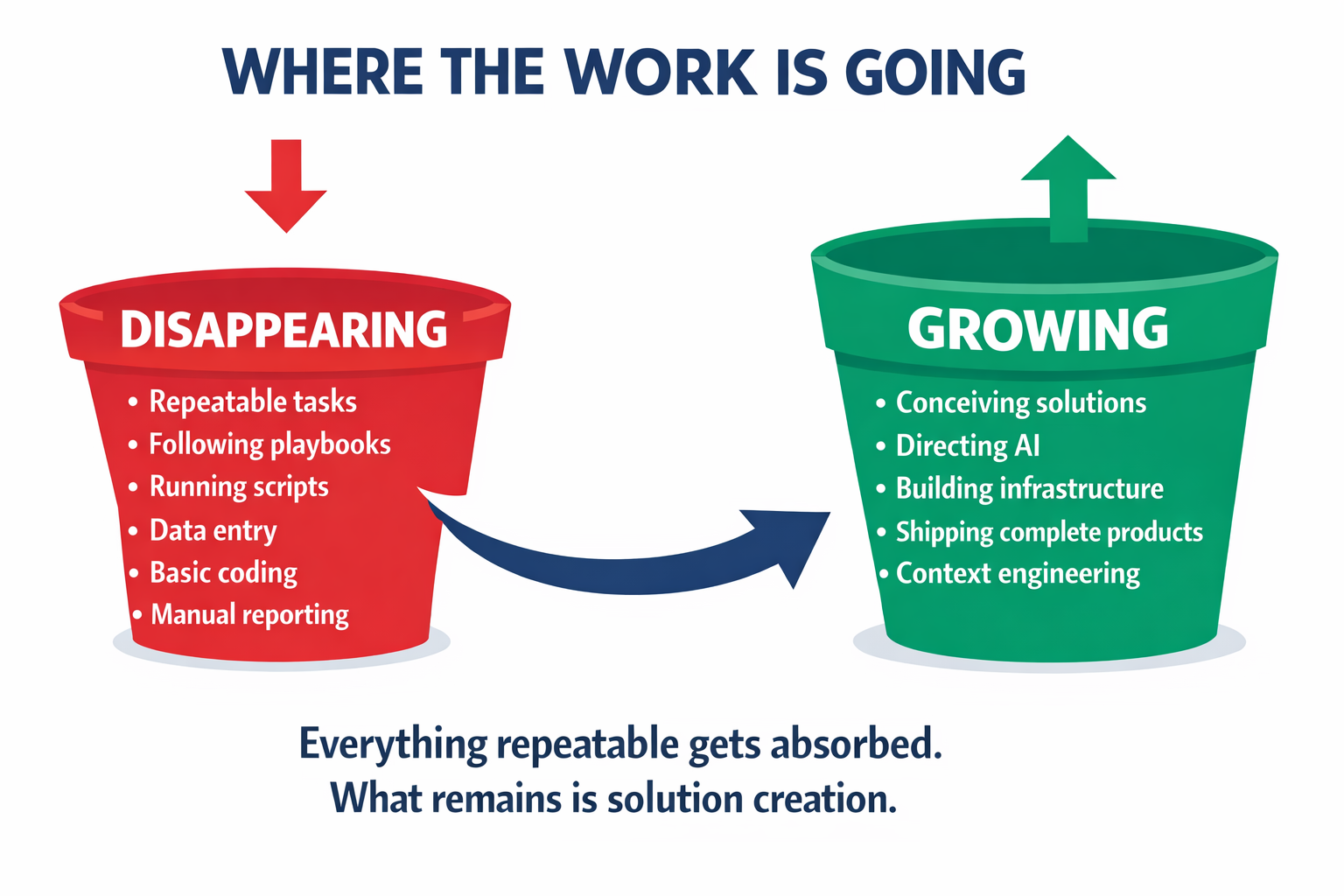
No. The manual execution part of most jobs is being absorbed by AI; the judgement, direction and verification part is growing. Your job isn't dead, but the version of it where you do the repeatable work by hand is fading, and that's where the upside is: you get to move to the higher-value half.
Isn't this just AI hype?
Fair question, and I'd be sceptical too. The difference here is that it's not a forecast; it's real things already built and live (JobZone Risk, Titus, Athena, SATs Revision, HAL), plus members of our program shipping real tools with no team and no big budget. I'm describing what AI can already do today, not promising what it might do later.
What if I'm not technical?
You don't need to be a developer. The skill is directing AI and owning the judgement: what's worth doing, and whether the output is good enough to trust. Plenty of people on the right side of this came from non-technical backgrounds. The barrier isn't coding; it's the shift from doing the work to directing it.
How long is this opportunity open?
The early-mover advantage is open right now and won't last forever. Head starts close as everyone catches on, and this one is unusually wide because it's open in every field at once. But the crossing is shorter than the marketing makes it look, and the people getting ahead today aren't geniuses; they just started directing AI instead of only using it. The best time to start was a year ago. The second-best time is this week.
Are employers actually hiring for this, or is it just a prediction?
They're hiring now. Our jobs tracker archives 565 real postings (with screenshots) from 370 named employers that require directing AI rather than just using it, with published US salary ceilings up to $900,000 at Netflix. The requirement appears across cloud, AppSec, GRC and SOC roles, and 159 postings mention a specific AI coding or agent tool by name, such as Claude Code, Cursor or Copilot.
About the Author

Nathan House, Founder & CEO of StationX
Nathan House has 30 years of hands-on cybersecurity experience and is Cambridge-educated, holding CISSP, CISA, CISM, OSCP, CEH, and SABSA. He founded StationX in 1999 — one of the UK’s first cybersecurity companies — and has secured £71 billion in UK mobile banking transactions and the London 2012 Olympics, advising clients including Microsoft, Cisco, BP, Vodafone, and VISA. He authored the world’s most popular cybersecurity course — a #1 Udemy bestseller taken by over 500,000 students — and was named Cyber Security Educator of the Year 2020, AI Security Educator of the Year, and a UK Top 25 Security Influencer 2025. A DEF CON speaker and featured expert on CNN, Fox News, NBC, and the BBC, Nathan leads StationX’s training of more than half a million students worldwide.